
Comments
-
The “Supernatural”Supernatural as a concept is intelligible. But declaring something supernatural seems, to repeat myself, presumptuous and foolish. — Art48
'Miracles are not against nature, but against what we know of nature' ~ Augustine. -
What is computation? Does computation = causationA bundle of sticks that looks like this: VIII with no one to observe it is a bundle of sticks. It can't ever be more than that without some mind observing it and attaching additional signifiers. However, when the bundle of sticks is observed by someone who knows Roman Numerals, it's a bundle of sticks AND it picks up a new attribute courtesy of the mind observing it: it's a bundle of sticks and the roman numeral for 8. — RogueAI
Know exactly what you mean. I had a marathon thread here in the past about just this kind of thing. The broader situation is, modernity divides the Universe into subjective and objective. Then it says that the objective domain is entirely devoid of meaning, because meaning resides in the subject. Then it asks, why is it meaningless? -
The American Gun Control DebateSorry about that. Figure of speech connoting deadly warrior.
-
The “Supernatural”people lving near elephants and then some non-African visitors thought that elephants could communicate over long distances - one non-African actually could feel what later was discovered to be the method of communication. — Bylaw
There's a well-known story of the death in Africa of a man called Anthony Lawrence, in 2012, who was known as the 'elephant whisperer' for his work in wildlife conservation and in particular helping elephants. When he died a herd of elephants appeared outside his home, although obviously they had obvious way of knowing what had happened. It's been documented often in the intervening years, here is an account by his widow. -
The American Gun Control Debate:lol: But the thought of going up against X million Taiwanese
ninjassoldiers ought to give anyone pause (even the PRC).
A lot of what goes under the banner of Christianity in today's America is deeply aberrant.

although I have to believe that it's not all it is. -
The American Gun Control DebateD’oh! Not Taiwan invading Australia! China invading Taiwan! :brow: That’s been a headline hypothetical in the local media the last two days, and it’s frighteningly plausible, with Australia being caught up in it as a US ally.
-
The American Gun Control DebateThat's the ticket! Appeal to fear and division. Just your kind of schtick.
The fear is not China invading Australia, but Taiwan, which then turns into a global nuclear confrontation. Gun ownership won't have any bearing on that either. It'll be fought by remote control. -
External world: skepticism, non-skeptical realism, or idealism? PollHe's not that new-found. He was mentioned here a few years back and promptly laughed off as a crank. But since then he's published quite a bit and he's become one of members of the choir.
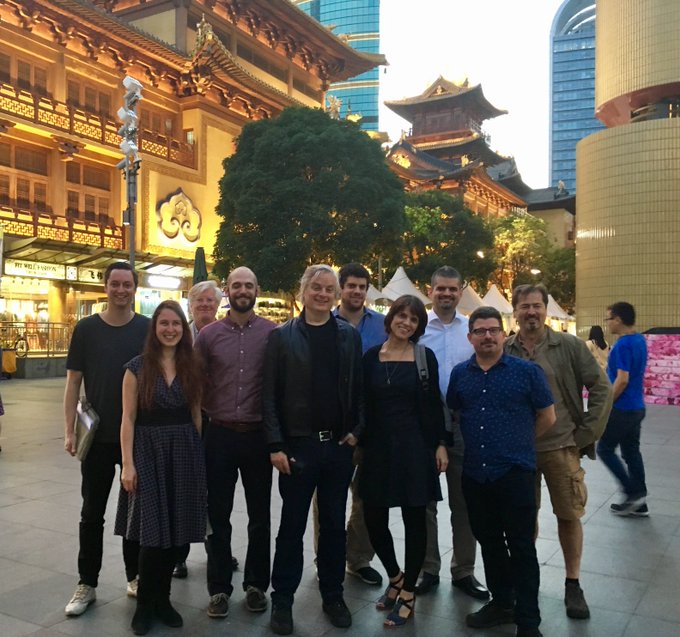
Kastrup at Conference in Shanghai, 2017, with David Chalmers, Galen Strawson, Howard Robinson, Daniel Stoljard, et al. -
The American Gun Control DebateThe identification of gun ownership with appeals to Jesus is itself a particularly revolting aspect of American conservatism. Really signals a very deep and dangerous confusion as far as I can tell. It's diabolical.
-
The Hard Problem of Consciousness & the Fundamental AbstractionThere must be a form for each and every individual. — Metaphysician Undercover
that's where we differ. I don't think that's what 'form' means. Socrates truly is the form 'man' but the form 'man' is common to all men. Likewise for forms generally. I'd like to hear @Fooloso4's view on that, though.
//ref// https://faculty.washington.edu/smcohen/320/1ovrmany.htm
In his work On Interpretation, Aristotle maintained that the concept of "universal" is apt to be predicated of many and that singular is not. For instance, man is a universal while Callias is a singular. The philosopher distinguished highest genera like animal and species like man but he maintained that both are predicated of individual men. This was considered part of an approach to the principle of things, which adheres to the criterion that what is most universal is also most real. Consider for example a particular oak tree. This is a member of a species and it has much in common with other oak trees, past, present and future. Its universal, its oakness, is a part of it. A biologist can study oak trees and learn about oakness and more generally the intelligible order within the sensible world. Accordingly, Aristotle was more confident than Plato about coming to know the sensible world; he was a prototypical empiricist and a founder of induction. Aristotle was a new, moderate sort of realist about universals. — Wiki -
The Hard Problem of Consciousness & the Fundamental AbstractionClearly, then, each primary and self-subsistent thing is one and the same as its essence. — Metaphysics Bk 7 Ch 6 1032a
Socrates is an instance of the form ‘man’ but not all men are Socrates. There are not a multitude of forms as there are multitudes of individuals. -
The American Gun Control DebateThat story is the first I'd heard of him, it appeared in my newsfeed.
In fairness that is a brief excerpt from an entire book, not yet published but highly relevant, I feel. I'm continually baffled by the American attitudes towards ownership of guns as a fundamental right. Why not poisons, explosives, torture instruments? I just don't see the rationale, other than it being a vicious circle - because so many others have guns, I need one also. I'm sure that's also why there are so many police shootings - they never know whether the guy they just pulled over in a traffic stop has a gun, so it's shoot first, ask questions later. In any case, I don't see any solution on the horizon, we all know that it's only a matter of time - and not much of it - until the next mass shooting death in America comes over the airwaves, and I don't see anything changing it. -
What is computation? Does computation = causationWhatever is recorded by instruments remains data until it's interpreted. Data comprises units of information which in themselves do not carry any specific meaning. Information is a set of data units that collectively carries a logical meaning. It also should be recalled that computers are human instruments, extensions of human sensory and intellectual capacities, designed to perform those tasks.
-
External world: skepticism, non-skeptical realism, or idealism? PollKastrup has two PhD’s, a large and growing publications list, and is very much becoming part of the global philosophical dialogue on consciousness, as the inclusion of his work in Chalmer’s paper indicates. If you read him or listen to his online debates, he’s a model of lucid analysis. So he may be a lot of things, but mad ain’t one of them.
-
External world: skepticism, non-skeptical realism, or idealism? PollOh in your book, definitely, but it’s a dull read :-)
-
External world: skepticism, non-skeptical realism, or idealism? PollGood to see Kastrup makes it into that discussion. I'll find time to read it later.
(In relation to which, he notes that Kastrup's 'dissociated identify model' 'makes our ordinary mode of existence pathological, since in this mode we are unaware of the vast majority of experiences we are having.' with the footnote to that remark 'According to some versions of this view, we can occasionally get hints of other fragments of our experience, or become more lucidly aware of our underlying cosmic experiences. For example, some Buddhist traditions suggest that certain meditative practices (e.g., Dzogchen practice in Tibetan Buddhism) can help us experience the fundamental mode of consciousness.') -
The Dialectic of Atheism and Theism: An Agnostic's PerspectiveWhat matters is the fact that there is existence — EnPassant
Again, here, the distinction of 'what exists' and 'what is' has to be discerned. 'Existence' pertains strictly to particular existents. The meaning of the term means 'is apart from' or 'is outside of'. The fact of being is more general , and so 'what is', is not necessarily synonymous with 'what exists'. In philosophical theology, this is the rationale behind for erxample Paul Tililch's insistence that God does not exist - that while God is, God is not 'an existent' which reduces God to a being, one being among others. See for elaboration God Does Not Exist, Bishop Pierre Whalon. -
The American Gun Control DebateWriter Paul Auster on the violence endemic to American culture
“American society was built by religious fanatics who promoted armed struggle, conflict, war, violence, annihilation, and what we today would call genocide,” says Auster. He notes how the Declaration of Independence that the Continental Congress approved on July 4, 1776, announced the separation of 13 North American British colonies from Great Britain. The second paragraph states that all men are created equal, and they are endowed by their Creator with certain unalienable rights. Namely: life, liberty, and the pursuit of happiness.
Auster describes this bedrock credo on which the American republic was founded “as a hypocritical lie”. He has a point. Slavery, after all, was still legal at the time the words were written. “Violence, from the very beginning, was embedded in the whole American project,” says Auster. “The United States is an invented country, based on the premise of capitalism, where there is conflict, competition, and winners and losers.”
He then spends significant time and ink deconstructing the wording of the Second Amendment of the US Constitution. Passed in 1789, along with nine other amendments known as the Bill of Rights, it reads: “A well-regulated militia, being necessary to the security of a free state, the right of the people to keep and bear arms, shall not be infringed.”
Auster says: “The Second Amendment is so confusingly worded that no one can really make sense of it. It seems to suggest that Americans have the right to set up militias. But it has nothing to do with individual ownership rights [of guns].”
Today, many Americans continue to interpret those words in different ways.
“Right now, there are tens of millions of diehard Second Amendment advocates who feel that owning guns is essential to the American way of life,” says Auster. “In fact, it serves no other purpose than to kill people. A gun is an instrument of destruction.”
https://www.smh.com.au/culture/books/america-built-by-religious-fanatics-who-promoted-armed-struggle-paul-auster-20230306-p5cpqm.html -
What is computation? Does computation = causationGiven a mindless universe, could universals/abstract objects exist? I would tend to think not, but that's pretty far afield. — Count Timothy von Icarus
Do they ever exist? Certainly not in the sense that gas clouds and galaxies exist. But wherever sentient beings evolve they will be able to discern them. So they're real as intelligibles, not as phenomena per se.
This output will include the pages of every novel ever written by a human being, plus many yet to be written. — Count Timothy von Icarus
Are you sure about that? I recall reading Simon Conway Morris about the mathematics of the 'protein hyperspace', the number of possible combinations of molecules that could form proteins - and that if these combinations were made by a purely random process, then it would take far longer than the age of the known universe to hit upon the specific combinations that actually comprise working proteins (see his book Life's Solution for details).
Likewise with your imaginary symbol-generation algorithm, whilst one can imagine the possibility of such a computation, it might require vast amounts of time to output all of the actual books, alongside the enormously greater number of 150-page collections of meaningless symbols. Maybe it will produce more 150 page collections than the total mass of the universe. It strikes me as simply a more abstract version of the 'millions monkeys' thought experiment.
Conway Morris' view is that in evolutionary time-scales, some forms are much more likely to emerge than others, because they solve problems (hence, the book's title). Wings and eyes and photosynthesis have evolved numerous times along completely different pathways to solve the same kinds of problems often by drawing on completely different elements and components. -
The Hard Problem of Consciousness & the Fundamental AbstractionDo you agree that a particular object, an individual, is a composition of matter and form, according to Aristotle? — Metaphysician Undercover
Yes. But forms, as a matter of principle, are not themselves particulars. There is not a separate form for each individual. That's the 'principle of individuation' which is subject of a long-standing discussion about Aristotle's metaphysics (SEP.)
How is it that Aristotle is mortal but his active intellect is not? Well, we still read Aristotle. His intellect is at work on us. — Fooloso4
See Mark Johnston, Surviving Death (another book I must get around to reading.) -
External world: skepticism, non-skeptical realism, or idealism? PollI don’t know if current physics does constitute materialism. There are plenty of idealist aspects within it.
-
External world: skepticism, non-skeptical realism, or idealism? PollAll true but how does it show that the elements of experience have any ultimate material constituent? What is this ‘matter’ that all is hewn out of? Sure ain’t teacups.
-
External world: skepticism, non-skeptical realism, or idealism? PollIt's a mistake to say in respect of the opposition of materialism and idealism, that they are somehow equivalent or that they are two horns of a dilemma - where materialists say that 'everything is composed of matter', idealists say that 'it's composed of mind'. It's far less simple than that.
Materialism takes many forms - as does idealism - but it must rely on there being some ultimately real object or thing, which comprises the basic constituent of all other things. (Of course, this simple picture has been considerably muddied by modern physics, but that's a whole other issue.)
Idealism, on the other hand, does not necessarily posit 'the mind' as an ultimate constituent in that sense; mind is not necessarily understood as 'a constituent' or a 'building block' in the way that, say, Lucretius' atoms were. So it's not a matter of one side saying that 'matter' is the ultimate constituent, and the other side insisting that 'mind' must be (although there are some idealists who will, but I'm leaving them aside.)
Rather idealism is saying that, whatever you say is the 'ultimate constituent of reality', that will always occur to you as an appearance, or as a consistent sensory experience - tables are consistently tables, this experiment always produces that result, and so on. It will then point out that whatever you claim is an ultimate constituent or object, can be nothing other than a consistent form of experience, something that appears invariant through time in your experience of the world. And that's not to deny the reality of such experiences - they're repeatable, governed by laws, observable by third parties, and so on. But they're all ultimately experiential in nature, rather than ultimately material in nature. So what that undercuts is the idea, not of material entities, but of their mind-independence. That's what I take idealism to be saying.
I will add that the picture of mind and body being two equal-but-opposing kinds of stuff originates fairly and squarely with Descartes, and is responsible for many of the plights of the modern condition. -
Consciousness is a Precondition of BeingAll I can refer to is in the passage I quoted:
Thus when Aristotle begins in Book 7 of the Metaphysics to ask what makes a thing a thing, he narrows the question to apply only to living things. All other being is, in one way or another, their effect. — IEP
Reading further into it, 'forms' are obviously central to it. But there is a passage further in the article germane to the differentiation of living and non-living:
A table, a chair, a rock, a painting– each is a this, but a living thing is a this in a special way. It is the author of its own this-ness. It appropriates from its surroundings, by eating and drinking and breathing, what it organizes into and holds together as itself. This work of self-separation from its environment is never finished but must go on without break if the living thing is to be at all. Let us consider as an example of a living this, some one human being. Today his skin is redder than usual, because he has been in the sun; there is a cut healing on his hand because he chopped onions two days ago; he is well educated, because, five years ago, his parents had the money and taste to send him to Harvard. All these details, and innumerably many more, belong to this human being*. But in Aristotle’s way of speaking, the details I have named are incidental to him: he is not sunburned, wounded on the hand, or Harvard-educated because he is a human being. He is each of those things because his nature bumped into that of something else and left him with some mark, more or less intended, more or less temporary, but in any case aside from what he is on his own, self-sufficiently. What he is on his own, as a result of the activity that makes him be at all, is: two-legged, sentient, breathing, and all the other things he is simply as a human being. There is a difference between all the things he happens to be and the things he necessarily is on account of what he is. Aristotle formulates the latter, the kind of being that belongs to a thing not by happenstance but inevitably, as the “what it kept on being in the course of being at all” for a human being, or a duck, or a rosebush. The phrase to en einai is Aristotle’s answer to the Socratic question, ti esti? What is a giraffe? Find some way of articulating all the things that every giraffe always is, and you will have defined the giraffe. What each of them is throughout its life, is the product at any instant for any one of them, of the activity that is causing it to be. That means that the answer to the question “What is a giraffe?”, and the answer to the question “What is this giraffe?” are the same. Stated generally, Aristotle’s claim is that a this, which is in the world on its own, self-sufficiently, has a what-it-always-was-to-be, and is just its what-it-always-was-to-be. This is not a commonplace thought, but it is a comprehensible one; compare it with the translators’ version, “a per-se individual is identical with its essence.”
* Which I think is probably the author. When I first started reading this article I thought it very idiosyncratic, but now I'm starting to warm to it. -
Ukraine CrisisOK, point taken. I've deleted those comments. I was angry, because I've just been watching the reports on the unbelievable savagery that is entailed by Putin's war. I'll keep out of this thread, I don't have anything to say, other than that.
-
Consciousness is a Precondition of BeingI think that it's because, for Aristotle, and the ancients generally, the cosmos itself was alive. I don't know if it's really pantheistic, although not far from it - more that there was the sense that man's relationship with the cosmos was 'I-Though' rather than our customary 'I-it' relationship (Martin Buber). But I think it's fair to say that for Aristotle, the Cosmos itself was ensouled, for, as a whole, it displays the attributes of all other living beings. The idea of the cosmos as inert matter governed by physical laws was yet to be arrived at.
-
Consciousness is a Precondition of BeingBut I did draw attention to the quote provided earlier by Jamal:
If we look around at beings in general—from particles to planets, ants to apes—it is human beings alone who are able to encounter the question of what it means to be. — Heidegger
So there's regardless an ontological distinction accorded to humanity (acknowledging that his use of the terminology of ontology is very complex). -
Consciousness is a Precondition of BeingI would go back and re-write the post that triggered this argument - it doesn't say what I set out to say, I sidetracked myself - but it seems pointless now.
In any case, @Fooloso4 kindly sent me the IEP link on Aristotle's Metaphysics. I noticed this passage, which seems relevant, in light of the mention of Aristotle earlier in the thread:
If the world is a cosmos, then it is one more instance of the kind of being that belongs to every animal and plant in it. And if that is so, there is nothing left to display any other kind of being. Try it: take inventory. What is there? The color red is, only if it is the color of some thing. Color itself is, only if it is some one color, and the color of a thing. The relation “taller than” is, only if it is of two or more things. What has being but is not a thing must depend on some thing for its being. But on the other hand a mere thing, mere matter as we call it, using the word differently than Aristotle ever does, is an impossibility too. Relatively inert, rock-like being is the being of a part of what comes only in wholes–cosmos, plant, or animal. And all man-made things must borrow their material from natural things and their very holding-together from the natural tendencies of the parts of the cosmos. To be is to be alive; all other being is borrowed being. Any comprehensive account of things must come to terms with the special being of animals and plants: for Lucretius, living things are not marvels but a problem which he solves by dissolving them into the vast sea of inert purposelessness. For Aristotle, as for Plato, wonder is not a state to be dissolved but a beckoning to be followed, and for Aristotle the wonderful animals and plants point the way to being itself, to that being qua being which is the source of all being, for we see it in the world in them and only in them.
Thus when Aristotle begins in Book 7 of the Metaphysics to ask what makes a thing a thing, he narrows the question to apply only to living things. All other being is, in one way or another, their effect. — IEP
Which kind of, sort of, also support's Jung's idea. -
Consciousness is a Precondition of BeingAccording to the membership of thephilosophyforum, distinguishing 'beings' from 'things' is an eccentric and idiosyncratic attitude. Somehow I'll just have to find a way to live with it.
-
The Hard Problem of Consciousness & the Fundamental AbstractionSo a material object is a combination of form and matter, and that form is proper and unique to the particular object, complete with accidents — Metaphysician Undercover
Even with my very limited knowledge of Aristotle, I’m sure this isn’t so. I think that a form by it’s nature is a universal, which is then individuated by ‘accidents’. If I’m mistaken, I’ll stand corrected. -
The Hard Problem of Consciousness & the Fundamental AbstractionI read Aristotle as a challenge to the idea of the person that many of the medieval conceptions of the rational soul are based upon. — Paine
'The soul' - not that I'm saying that I believe there is one - is not necessarily the same as (or simply limited to) 'the person'. Recall the origin of the word 'person' as the mask worn by the dramatis personae in Greek dramas. -
The Hard Problem of Consciousness & the Fundamental AbstractionThat is why, when the vehicle decays, memory and love cease; they were activities not of mind, but of the composite which has perished; mind is, no doubt, something more divine and impassable. — Paine
Thanks, the materials you provide are very informative. I wonder if in the above passage, 'mind' is the translation of 'nous'? And again, even if Aristotle is not discussing the immortality of the soul, it is easy to see how this would appear to be so for the medieval commentators, Islamic and Christian. (I'm very interested in the medieval conception of the rational soul, which seems very much aligned with these types of ideas.) -
Consciousness is a Precondition of BeingYes I've run across that previously. Does look intriguing.
-
Consciousness is a Precondition of BeingOne might also raise the problem of whether time would exist not if no soul existed; for, if no one can exist to do the numbering, no thing can be numbered. So if nothing can do the numbering except a soul or the intellect of a soul, no time can exist without the existence of soul.. — Aristotle, Physics, 223a15, translated by HG Apostle
The passage of time is not absolute; it always involves a change of one physical system relative to another, for example, how many times the hands of the clock go around relative to the rotation of the Earth. When it comes to the Universe as a whole, time loses its meaning, for there is nothing else relative to which the universe may be said to change. This 'vanishing' of time for the entire universe becomes very explicit in quantum cosmology, where the time variable simply drops out of the quantum description. It may readily be restored by considering the Universe to be separated into two subsystems: an observer with a clock, and the rest of the Universe. So the observer plays an absolutely crucial role in this respect. (Cosmologist Andrei) Linde expresses it graphically: 'thus we see that without introducing an observer, we have a dead universe, which does not evolve in time', and, 'we are together, the Universe and us. The moment you say the Universe exists without any observers, I cannot make any sense out of that. I cannot imagine a consistent theory of everything that ignores consciousness — Paul Davies, The Goldilocks Enigma -
The Hard Problem of Consciousness & the Fundamental AbstractionSerious question. The 'they' in 'they cannot share' are living things. But the 'active intellect' which is 'immortal and eternal' is a separate faculty of the intellect, is it not?
-
The Hard Problem of Consciousness & the Fundamental AbstractionDo you think this element of Aristotle's metaphysics later became absorbed in the Christian doctrine of the immortality of the soul?
-
Consciousness is a Precondition of BeingLet’s say the meaning of being, the quest for a unitive insight.
-
Consciousness is a Precondition of BeingI wonder if Platonists would say that the Forms exist. — Jamal
In my lexicon, they don't exist, but they're real - real in the same way that, say, scientific principles and constraints and logical laws are real. In casual speech to say such things as the law of the excluded middle exist is OK, but when you ask 'in what sense does it exist?' you realise it is not a sensable phenomena, but a law of thought. It does not exist qua phenomenon but is real nonetheless, as are countless other such principles, laws, and so on - they are the constituents of rational discourse (something like Popper's world three.) This is why I've become interested in universals and Platonic realism - that there really are universal structures of reason which the mind alone can access, but doesn't create from itself (per Augustine and Intelligible Objects. ) -
Consciousness is a Precondition of BeingSo it all comes back to: there is no appreciable difference between the verbs 'to be' and 'to exist'. Everyone here generally accepts that, but I dissent. I'm quite happy to leave it at that. I will not push the point in future.
Wayfarer

Start FollowingSend a Message
- Other sites we like
- Social media
- Terms of Service
- Sign In
- Created with PlushForums
- © 2026 The Philosophy Forum