
Search
-
Why is the Hard Problem of Consciousness so hard?
Besides, the problem is not only about not knowing what it is like to be another kind of being — Wayfarer
I just want to point out that I think this is not exactly the hard problem, rather it is what Ned Block has articulated to be the "harder" problem of consciousness. I could be mistaken about that. -
Why is the Hard Problem of Consciousness so hard?
I think the problem is something like this: You want to say that “Consciousness can only be identified through behaviors” and also “Therefore, anything with certain specified behaviors is conscious.” I’m not persuaded by the idea that “being alive” consists of behaviors, but let’s grant it. The argument is still shaky. The fact that (at the moment) we can only identify consciousness through behaviors doesn’t mean that all things that exhibit those behaviors must be conscious. Compare: Some Xs are Y; a is an X; therefore a is Y. This doesn’t follow.
Here’s another way to think about it. You’ve said you don’t like speculating about the future, but if consciousness is truly a scientific problem, as we both believe it is, then at some future point we’re going to know a lot more about it. Let’s imagine that someday we’ll be able to say the following: “Consciousness (C) is caused by (X + Y + Z), and only by (X + Y + Z), and is necessarily so caused.” So, in determining a particular case, we could say, “C iff (X + Y + Z); ~(X + Y + Z); therefore, ~C”. This would give us objective criteria to ascertain consciousness for any given entity. It wouldn’t rely on either behavior or subjective reports.
Now, lest you think I’m deliberately practicing sleight of hand, let me point out that this happy state of affairs is only true if it turns out that X and Y and Z are both objective and unproblematically causal. This may not be the case; we are currently clueless about what gives rise to consciousness. But if it is true, then the hard problem will have been solved. We will know what causes consciousness, and why this is necessarily so. Wouldn’t it be prudent, then, to assume that our current reliance on behavioral markers to identify consciousness is an unfortunate crutch, and that there is no important connection between the two? After all, we know that behaviors don’t cause consciousness, but something does. When we learn what that something is, we may be able to abandon functional “explanations” entirely.
A final thought: Perhaps all you’re saying is that AIs and robots and other artifacts might be conscious, for all we know. To me, that’s unobjectionable, though unlikely. It’s only when we start saying things like “Joe AI is conscious, which we know because of its behaviors,” that anti-functionalists like me get aroused. -
Logical proof that the hard problem of consciousness is impossible to “solve”
The only point I will add, is that this claim from your first post:
The idea that consciousness is caused by our physical brains is the easy problem. The hard problem is, "Will we ever know what it is like to BE a conscious individual that isn't ourselves". — Philosophim
Is factually incorrect. Chalmer’s argument is directed at the inadequacy of physical accounts to accurately capture first-person experience, yours or anyone else’s. You may not accept it, but it is what ‘the hard problem’ argument says, so your paraphrase of it is incorrect. -
Logical proof that the hard problem of consciousness is impossible to “solve”
we can't objectively know what its like for the other person. — Philosophim
Hoffman's theory is that there's no plausible theory that links the physical causes with the experiential feeling.
Why introduce unnecessary complexity when we have the simple answer in front of us that works in accordance near perfectly with the behavior aspect of consciousness as well? — Philosophim
The 'unnecessary complexity' you're referring to is philosophy, growing from the awarness that we're not simply physical things.
Regardless Wayfarer, thank you for tackling those points again. You're an intelligent and well spoken person, and I do enjoy reading your perspective even if I don't always agree on it. — Philosophim
:pray: Kind of you to say so.
//
There are a few more points I will make:
I'm simply noting the underlying support and reason for the hard problem. — Philosophim
You're not, though. You say:
The idea that consciousness is caused by our physical brains is the easy problem. — Philosophim
That is not what Chalmer's says at all. So stop saying that you're 'interpreting' or 'supporting' Chalmer's argument, when you're actually disagreeing with it. If you were honest, what you would say is 'there is no hard problem as Chalmers describes it'.
I can agree that we can have an interpretation of information as both a medium which exists, and the interplay between that medium and an interpreter. What hasn't been shown is the noun or the interpretation of information that isn't through some physical medium. Can you think of one? — Philosophim
Information itself is not a medium. If I transmit information electronically, the medium is copper or electromagnetic waves, or through speech as sound waves in the air. They are physical media. But the interpretation of information is not a physical process, and information is not physical. Again this is why Norbert Weiner says that 'information is not matter or energy'.
What is wrong with saying that this is an aspect of the physical world, when we have evidence of a radio interpreting waves? .. wasn't there a relationship between the radio waves, the radio, and then the sound played? Isn't an interpretation a physical response to stimulus or an event? — Philosophim
Humans build radios to do that and then interpret the sounds as meaningful. There is nothing in the 'physical world', if you mean the world outside human affairs, that will do that.
For decades, radio telescopes have been scanning the universe looking for signals from intelligent life. Overall, they've found none (with one possible exception.) All the signals so far have a physical or natural origin. If they found a signal originated by an alien intelligence, it would be something other than physical or natural.
As for behavior, the entirety of neuroscience, pharmacology, and psychiatry operates and functions as if consciousness as a behavior is an objective result of the mind. Without this, the entirety of modern medicine would not work. — Philosophim
As noted, psychosomatic medicine, the placebo effect, etc, undercut physicalist accounts of mind. -
The 'hard problem of consciousness'
Ok, Husserl might not seem to be a dualist, but the assumption that consciousness is immaterial in the sense that it never appears as an object in a world of objects, implies an epistemological dualism, and the hard problem reappears. For if consciousness is immaterial, then it seems we have no way of knowing what it's like to be another observer, or how immaterial experiences arise in a material world.
A similar problem arises for indirect realists because of their assumption that we never see objects directly, only by way of seeing our own sense-data (or mental images) first.
For idealists for whom everything is consciousness, the hard problem does not arise from a metaphysical or epistemological wedge. Likewise, it doesn't arise for direct realists under the assumption that we see objects directly: e.g. what it feels like is what the object appears like. -
The 'hard problem of consciousness'
I have the sense that when you say 'idealism', you believe that it posits something called 'mind' which is constitutive of reality in the same way that 'matter' is for materialism. — Wayfarer
I mention idealism and direct realism as examples of philosophies in which the hard problem does not arise from splitting the world in two between body and mind.
Bishop Berkeley understood, correctly, that such a split makes no sense, so he decided to focus on the mind. Matter is not eliminated, but it's not fundamental. Mind is.
In direct realism, the mind is directly linked to the world. My conscious awareness of the world is the actual world, not a mental replica. There's no gap between my conscious awareness and the world.
If you're using direct realism in a different way then I would hope that you would explain. — Harry Hindu
In direct realism, the mind is directly linked to the world. The world that I'm consciously aware of is the actual world, not a mental replica. So, there is no gap between my conscious awareness and the world, and without the gap, there is no inexplicable relation to explain. The hard problem of consciousness is a problem invented by dualists. -
Why is the Hard Problem of Consciousness so hard?
To be fair, there are important differences between say, Kant, Hoffman and Kastrup. Sure, they could be called "idealists", but that's a bit like saying that Strawson and Dennett are both materialists, which they are, but vastly different in what the word entails.
These are perhaps heuristics, but they need not signal agreement in terms of entailment.
I know it was aimed at me at all, but I cannot resist making but some comments, as your post is quite useful.
1) I think there are many hard questions, we just happen to live in a time in which one problem appears to be the central focus of attention, and not others, which were "hard problems" that were never solved, but accepted: the nature of motion, for instance.
2) Yes - a category error. Eliminitavism like Dennett or Churchland is cute, but fruitless.
What's the difference between a physicalist monism and a non-physical one? Is consciousness not physical? Or alternatively, if consciousness is not physical, why isn't the rest of the universe non-physical? There seems to be a lot of "empty space" - very far removed from any ordinary notions of physical stuff we have in everyday life.
Not to mention "dark matter" and "dark energy", which constitute a combined 95% of the universe - the vast majority. Is that physical or not? What consequences follow from proclaiming one term instead of another one?
The substantial issue here, I think, is that of mind independence or no mind-independence... -
Why is the Hard Problem of Consciousness so hard?
https://thephilosophyforum.com/discussion/14873/what-could-solve-the-hard-problem-of-consciousness/p1
With or without neuroscience we have the Chinese Room to thank for explaining that a proper semantics (skill in pointing words and other symbols at things in the world, as opposed to merely co-ordinating them with each other) is what makes the difference between a neural network having or not having consciousness. (I.e. between it tending or not tending to think it has a theatre in the head.)
That just leaves unsolved those other, truly hard problems of philosophy that you allude to. Time and so on. -
Why is the Hard Problem of Consciousness so hard?
I think the hard problem is not answering why consciousness is a physical manifestation, but why a physical manifestation should result in consciousness. — NotAristotle
Written this way, I can accept that as well. For example, why does oxygen and hydrogen make water? Why is there existence at all? These are hard problems that may not have an answer besides, "It just does."
The consciousness cannot be accounted for in physical terms because consciousness is not a physical thing. — NotAristotle
Your former point does not lead to the later. That would be like me saying that water is not a physical thing because I don't understand why the combination of hydrogen and oxygen make it happen. That's ridiculous. Consciousness is clearly a physical thing. Please show me an example of consciousness that can arise without any matter or energy involved. Here are some examples that could work.
1. Consciousness able to exist despite a lack of physical capability to do so.
For example, move your consciousness apart from your head where it sits into the next room that you cannot currently see. I am unable to do so.
2. Demonstrate a conscious entity that has no physical or energetic correlation.
For example, prove that a completely brain dead body is conscious. Or Inebriate someone to a high blood alcohol level and demonstrate that their consciousness is completely unaffected.
3. If consciousness is not matter and/or energy, please demonstrate evidence of its existence without using a God of the Gaps approach.
An inability to pinpoint the exact physical workings of consciousness does not negate that it is physical. We understand that a car needs an engine to run like a body needs a brain to be conscious. I don't have to understand electromagnetism to understand that a car needs an engine to run, and I don't need to understand the full mechanics of how the brain works to understand you need a brain to be conscious (in humans at least).
Our inability to understand how an engine works or how a brain works does not give us justification to claim, "A car or a brain running is not physical". -
A potential solution to the hard problem
There is the real apple which I would have seen had my sensation not been mediated by mind's re-presentation of "apple" (fruit, shape, red, eat, doctor away, rotten at the core, not pear, not orange, not wax etc). — ENOAH
You're actually into a very tough problem here, which is the appearance and reality distinction. You're wanting to claim that 'the apple' (read: any object) has a 'real existence' (ultimate reality) which exists (is real) irrespective of and outside of our mediated experience of it.
The problem being, that if all experience and judgement of objects is mediated by our sensory and intellectual faculties (per Kant) then the apple (or object) as it is in itself, is not something we ever know.
So - how do you get outside that mediated experience to see things as they truly are? A natural answer might be that this is what science does, but when you get down to the fundamental constituents of physical reality, which are the objects of quantum physics, then the Observer Problem rears its head. And the philosophical import of that, is precisely that you cannot detect such entities as they are independently of any act of measurement (according to what is known as the Copenhagen Interpretation of quantum physics).
It is of course true that science explores and explains a vast panorama of phenomena, but recall that phenomena means 'what appears', and 'what appears' always appears to a subject, who him or herself is never disclosed in the observation (but whose presence is implicated in the above-mentioned 'observer problem'.)
My two cents worth is that David Chalmer's original paper, Facing Up to the Problem of Consciousness, is pointing to a philosophical issue, which is not a problem that can be addressed by scientific means as a matter of principle. And this is because of the ineradicably first person nature of conscious experience, which is not amenable to the third person methodology of the natural sciences.
Whereas his opponents claim that:
In Consciousness Explained, I described a method, heterophenomenology, which was explicitly designed to be 'the neutral path leading from objective physical science and its insistence on the third-person point of view, to a method of phenomenological description that can (in principle) do justice to the most private and ineffable subjective experiences, while never abandoning the methodological principles of science. — Daniel Dennett
(It's worth noting that the essay at the head of this OP was linked by Dennett in the first place, because Humphrey's theory is compatible with Dennett's, as they're both materialists.)
So Humphreys, Dennett, and the other advocates of 'naturalised epistemology' view the hard problem as something that can be solved. In that sense, they can fairly be accused of actually ignoring the root of the problem itself, which, according to David Chalmers and others, is not a problem to be solved, but a way of pointing out an unavoidable limitation of objectivity viz a viz the subjective nature of experience. Phenomenology and existentialism understands this in a way that the objective sciences cannot.
See Thomas Nagel's What Daniel Dennett Gets Wrong (Oct 2023) for an analysis of the in-principle shortcomings of materialism in philosophy of mind.
Also The Blind Spot of Science and the Neglect of Lived Experience (also in Aeon Magazine and now a book.) -
Logical proof that the hard problem of consciousness is impossible to “solve”
Presumably, Science studies reality "as-is", while Philosophy studies the world "as-if"*1. That's why scientists observe the Brain, but philosophers imagine the Mind. Consciousness is not a material object, but our Minds can picture the state or qualia or function of Knowingness*2 as-if it is an object-of-interest in a hypothetical context.The whole 'hard problem' arises from regarding consciousness as an object, which it is not, while science itself is based on objective facts. It's not complicated, but it's hard to see. — Wayfarer
What makes the scientific study of a metaphysical concept "hard" is the tendency to analyze the Function*3 of the brain as-if it's the material product of a mechanism instead of the immaterial purpose of that system. Metaphysical disputes are "impossible to solve" analytically, they can only be resolved holistically --- by placing the parts into a universal context. Not by substance dualism, but by essence monism.
If we can't agree on the Nature*4 of the Cosmic context --- Materialism vs Idealism or Physical vs Metaphysical --- we will continue to disagree on the possibility of an emergent Mind-function. Ideas are "hard to see". Hence, factionally "impossible to solve". :smile:
*1. “As if” thinking concerns the ability to think in some imagined context other than the reality that is presented in front.
https://link.springer.com/referenceworkentry/10.1007/978-3-319-98390-5_5-1
Note --- As-Is thinking looks at actual things. As-If thinking looks at possible states.
"A possible world is a complete and consistent way the world is or could have been. Possible worlds are widely used as a formal device in logic, philosophy, and linguistics in order to provide a semantics for intensional and modal logic." ___Wikipedia
*2. What is another word for knowingness?
synonyms: awareness, cognisance, cognizance, consciousness.
https://www.vocabulary.com/dictionary/knowingness
Note --- The suffix "-ness" means "state, condition, or quality"
*3. A "function" refers to the specific purpose or role something or someone has, essentially describing what something does or is designed to do;
___Google AI overview
*4. "The nature of" is an expression that refers to the basic character or quality of something."
___Google AI overview
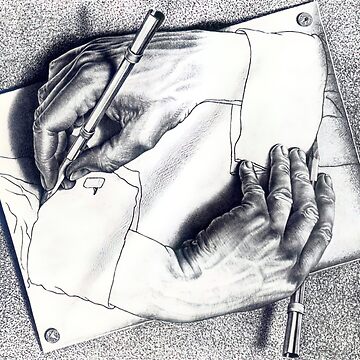
"Grab your right hand with your right hand and report back." — Wayfarer
IMPOSSIBLE IDEA : AS-IF not as-is
-
Sleeping Through The Hard Problem of Consciousness
If you don't know the mechanism or cause of consciousness, you can't claim to know what the necessary conditions are or the sufficient conditions are. You can make arguments as you did that brains are enough, but the hard problem is precisely how does it arise. And we don't know that? We don't even know where it isn't. We do not places where it is. And those places are able to do all sorts of cognitive functions, like remember, and generally report. But we have no idea if these functions are necessary for raw experiencing. So, I see two problems with the OP: it doesn't actually address the hard problem - which is how does consciousness arise? and then since it doesn't address the how, we can't even know where to limit consciousness to. — Coben
I agree that it's very likely that I'm completely mistaken here. I have a simple request: Can you give me synopsis of your views on what explanations are? -
Sleeping Through The Hard Problem of Consciousness
Some people are of the opinion that the hard problem's solution will be found in solutions to the "easy" problems although how exactly is beyond me. — TheMadFool
Daniel Dennett, who is Chalmer’s most obvious opponent, doesn’t believe there’s any hard problem whatever. But then, he can’t, because if there is one, then his life’s work is up the chimney (which is where it belongs, in my view.)
Amusing anecdote: One of Dennett’s early books was called ‘Consciousness Explained’. It was almost immediately re-titled ‘Consciousness Ignored’ by many of his learned critics.
All of the above taken into account, the takeaway here is that qualia or other subjectivity based arguments most assuredly do not entail dualism. — TheMadFool
What is it about dualism that you so desperately want to avoid? What’s the matter with it?
Oh, and thank you for being such a polite interlocutor. -
Does the "hard problem" presuppose dualism?
How can the "easy" problem explain anything without partially explaining the "hard" problem? Even separating these two problems suggests that the aspect of consciousness which is "hard" to explain has no function for the workings of the brain or human behavior generally. The very notion separating these two isn't just a resort to dualism but a resort to the kind of dualism in which the "mental" element is ultimately irrelevant. -
Why is the Hard Problem of Consciousness so hard?
One problem with this whole way of setting up the issue, however, is that it presupposes we can make sense of the very notion of a single, canonical, physicalist description of the world, which is highly doubtful, and that in arriving (or at any rate approaching) such a description, we are attaining a viewpoint that does not in any way presuppose our own cognition and lived experience. In other words, the hard problem seems to depend for its very formulation on the philosophical position known as transcendental or metaphysical realism. From the phenomenological perspective explored here, however — but also from the perspective of pragmatism à la Charles Saunders Peirce, William James, and John Dewey, as well as its contemporary inheritors such as Hilary Putnam (1999) — this transcendental or metaphysical realist position is the paradigm of a nonsensical or incoherent metaphysical viewpoint, for (among other problems) it fails to acknowledge its own reflexive dependence on the intersubjectivity and reciprocal empathy of the human life-world. — Joshs
That's a fascinating point. -
The Hard Problem of Consciousness & the Fundamental Abstraction
-You are wrong. You are trying to make an argument from ambiguity by using lame or specific meanings on both concepts.Sorry, I just don't think you've grasped the distinction between definition and theory. — bert1
-" I grant that it's not always possible to clearly separate the two."
-Of course it is...you just need to define them before use .
-Strawman, I just posted the definition used by science .
My goal in providing this definition was to point out a practical need for labeling a far more fundamental property than that suggested "(us being aware of our ability to understand).
To be aware of stimuli (internal (other mental properties) and external) is far more basic.
Our ability to project meaning in our thoughts is just one more (secondary)property of the mind.
A label for that mental property already exists in Cognitive science (Intelligibility or Symbolic Language and Thinking).
i.e. https://www.worldscientific.com/doi/10.1142/S0218127404009405
So once again Philosophers fail to identify and distinquish basic Mental Properties of the Mind.
Again A theory is the narrative that glues together definitions, descriptive theoretical frameworks, mathematical formulations,Evidence etc. This is the scientific definition of a Theory and this is how I use it.That's interesting. Sorry I still haven't read your article in detail yet, but I'm curious on where you think this definition likes on the spectrum of theory to definition. How theory laden is this? Is this what people in general mean, when talking about the hard problem? Is this what Chalmers means, for example? — bert1
Now the text I quoted is a DEFINITION of what science identifies as consciousness and the second part points to the Necessary and Sufficient mechanism needed for a conscious state to emerge. (I also included a link of the paper where you can find the definition).
I don't know why this is so difficult for you.....
What people or Chalmers mean when they talk about the Hard problem doesn't have any value.
In order to be able to talk about the problems one needs to be educated on the latest epistemology. Chalmers's why questions are pseudo philosophical questions (Sneaks in Intention and purpose in to nature). -
The Hard Problem of Consciousness & the Fundamental Abstraction
I really don’t accept that. You’re talking about him as if he lived in Medieval Europe. He had a career spanning 50 years, which wasn’t even 100 years ago. — Wayfarer
Again, you are committing a Strawman and a false authority fallacy. I am NOT talking "about him". I am criticizing the obvious teleological error in his so called "Hard problem".
The longevity of his carrier or his academic accolades do not guarantee the truth or logic in his ideas. All claims rise and fall on their own merits.
Anil Seth, true Authority on the problems of consciousness verifies my objections on Chalmers's idea.
The auxiliary principles he uses place his idea in the Medieval period, not my critique of doing so.
...but you insist on mentioning the longevity of his carrier ?It wasn’t so much an appeal to authority, — Wayfarer
It wasn’t so much an appeal to authority, but the observation that a lot of people say that Chalmer’s work is pseudo-philosophy, without, I think, demonstrating an understanding of the rationale behind his ‘hard problem’ argument. And indeed, that single paper launched Chalmers into a career as an internationally-renowned and tenured philosopher, which says something. — Wayfarer
-Without demonstrating or understanding? Does the term fallacy mean nothing to you? I literally named the fallacy he is committing and I quoted his 2 fallacious questions while pointing out that he needs to demonstrate Intention and purpose in natural process, not assert them.
AGAIN here are his questions :
1.Why are physical processes ever accompanied by experience?
2.why does a given physical process generate the specific experience it does, why an experience of red rather than green, for example?
http://www.scholarpedia.org/article/Hard_problem_of_consciousness
The answer for the first question is Survival advantage(Evolutionary Principles) and for the second "because it does".
So the first one can be answered Through science as if it was a "how" question while the second is just nonsensical. -
The Hard Problem of Consciousness & the Fundamental Abstraction
Its like asking "why previously exited electrons produce a particle out of thin air"....the answer to all this type of questions is "because they do". — Nickolasgaspar
Cool. End of philosophy.
You are confusing the ability to be conscious with the quality of a conscious experience. — Nickolasgaspar
No not it. Rather, how is it that experience is at all, along with biochemical processes. Just the piling on of more biochemical (or any physical) processes is not going to get you closer to that answer. It simply answers the easier problems of what events we can observe correlating with subjectivity/experientialness.
-That is a mental state. Your Central Later Thalamus has the ability to connect different areas of your brain, specialized in Memory/past experience, logic, Abstract thinking, Symbolic language, Critical thinking, Imagination etc and introduce content in that specific mental state....and all this is enabled by your Ascending Reticular Activating System. — Nickolasgaspar
Yeah now you are just making categorical errors all over the place.. You went from "mental state" (the thing in question), to its physical correlates, but no closer to how the correlates ARE the mental state (ontologically). Homunculus here and there and everywhere. You do not seem to be getting the hard problem or are obstinately ignoring it.
-Of course it answers a huge part of that answer and not only that!!!! We can use this knowledge either to force a brain to recreate that specific state, we can read brain scans and based on the brain patter we can accurately (up to 85%) decode the conscious thought of the subject, we have designed Surgery and Medical protocols that can reestablish or improve specific mental states in patients and we can make Accurate diagnoses by looking at the physiology and function of brains and by analyzing the symptoms of a patient's mental states. We can predict mental malfunctions by studying the pathology of brains...and the list goes on. — Nickolasgaspar
So now it really does show you do not know the difference between easy and hard problem and are repeating this error over and over. I can try to explain it better if you want, but I feel that I have in my last post so not sure what else to say but you are not getting it.
-Why gravity has the quality it has...why it pulls but never pushes. Why conductivity manifest solely in metals. Why electricity passing through silicon ICs can produce images on a TFT or LED panel.
Why molecules act differently in different temperatures.
The answer is always "because they do". — Nickolasgaspar
That's not scientific at all. The very thing that is most well known to us (our own subjective experience) you are just saying "It is". Not very scientific. The other stuff you mentioned, ironically can go straight into the realist versus idealist debate for if those phenomena (scientific or otherwise) are anything beyond our empirical observation of it. -
The Hard problem and E=mc2
Actually, there is one substance in the world with the consistent property of causing change. That universal Substance (Aristotle's essence)*1 functions like an enzyme in the world : it causes Change, but does not itself change. That substance is what we call "Energy". It is invisible & intangible & immaterial, but it's what makes the world go 'round.There only has to be one substance with the "stable property" of "change". — Benj96
"Change" is incompatible with "stable property" — Metaphysician Undercover
With regard to the "hard problem" of Consciousness, one form of Energy may be essential to understanding how Awareness emerged from dumb Matter. Modern physicists have equated Energy with Information*2 : the invisible, intangible, immaterial contents of Minds. Claude Shannon discovered that problems with communication of Information -- from one mind to another -- were due to Entropy. And Entropy is the inverse of Energy. Which is why physicists refer to the opposite of negative Entropy as positive Negentropy. In math, the negative of a negative is positive. The general role of Energy is to cause change; and the role of Entropy is to destruct what was constructed by positive Energy. Ironically, we don't have a proper name for that constructive causation. Until now.
Negentropy is an efficacious form of Energy, but the label doesn't sound positive. That's why I like to call it -- in this context -- Enformy*3. So, the role of Enformy in the world is to produce constructive change : to Enform ; to give form to the formless. It's the creative force in the world that counteracts destructive Entropy. And, since the original (pre-Shannon) meaning of "information" referred to mind-stuff, it may also be the positive constructive causal force behind Consciousness, which creates ideal mental models of the real world. So, if you can accept that shape-shifting Information is also the essence of Consciousness, then the so-called "Hard Problem" becomes simpler. You do the math. :smile:
*1. Substance and Essence in Aristotle :
focusing on Aristotle's account of form or essence.
https://www.cornellpress.cornell.edu/book/9780801421266/substance-and-essence-in-aristotle/#bookTabs=1
*2. The basis of the universe may not be energy or matter but information :
If the nature of reality is in fact reducible to information itself, that implies a conscious mind on the receiving end, to interpret and comprehend it.
https://bigthink.com/surprising-science/the-basis-of-the-universe-may-not-be-energy-or-matter-but-information/
Note -- Quantum physicist John A. Wheeler's "it from bit" hypothesis "anticipated ongoing speculation that consciousness is fundamental to reality".
*3. Enformy :
Just as Entropy is sometimes referred to as a "force" causing energy to dissipate (negative effect), Enformy is the antithesis, which causes energy to agglomerate (additive effect).
https://blog-glossary.enformationism.info/page8.html
-
Why the Hard Problem is so Relevant to Axiology and Ethics
Both objects and subjects (i.e. phenomenally self-referring/reflexive objects) are emergent "effects of the universe" ... neither of which "matter" on the cosmic scale. — 180 Proof
Correct (doesn't matter on a cosmic scale). That is why I said, to the universe a rock breaking and head rolling doesn't matter (obviously).
"Consciousness" seems the phenomenal illusion of being 'more than an object', even somehow separate / alienated from the rest of universe of objects – more bug than feature; I think, instead of "consciousness", adaptive intelligence (by which knowledge of the universe is created) is the property, or functionality, that distinguishes mere objects from mattering objects. — 180 Proof
Does changing the word to adaptive intelligence change much? The hard problem lies in the slippery word "created". That is the hard problem that needs explaining itself. Are we getting diamonds from coal here? Enough computation = subject? What is the dividing line other than what we know on either side of that line (plant / primitive animal perhaps).
A planet exploding matters not to the planet. A black hole sucking in matter matters not to the matter. Space warping matters not to space. A subject however, is where "matter" and "value" come into play. The universe is full of explosions and destruction of objects. It only matters once there are subjects. No problems occur until subjects. Nothing matters in the universe other than some relation to a subject. -
A potential solution to the hard problem
But any theory that requires positing a "mental representation" which implies an internal observer (visible in the diagrams of the brain after the paragraph beginning "The key to acquiring phenomenal properties..."} is postponing the hard problem and for that reason seems implausible to me. — Ludwig V
Easy problems can be quite elaborate and even proven accurate, but still don’t actually touch upon the hard problem itself.Homunculus fallacy — Wiki -
Intentional vs. Material Reality and the Hard Problem
It is quite common to believe that intentional realities, as found in conscious thought, are fundamentally material -- able to be explained in terms of neurophysiological data processing. This belief has presented metaphysical naturalists with what David Chalmers has called "the Hard Problem." It seems to me that the Hard Problem is a chimera induced by a provably irrational belief.
By way of background, I take consciousness to be awareness of present, typically neurophysiologically encoded, intelligibility. I see qualia as of minor interest, being merely the contingent forms of awareness.
I am not a dualist. I hold that human beings are fully natural unities, but that we can, via abstraction, separate various notes of intelligibility found in unified substances. Such separation is mental, not based on ontological separation. As a result, we can maintain a two-subsystem theory of mind without resort to ontological dualism.
Here are the reasons I see intentional reality as irreducible to material reality.
1. Neurophysiological data processing cannot be the explanatory invariant of our awareness of contents. If A => B, then every case of A entails a case of B. So, if there is any case of neurophysiological data processing which does not result in awareness of the processed data (consciousness) then neurophysiological data processing alone cannot explain awareness. Clearly, we are not aware of all the data we process.
2. All knowledge is a subject-object relation. There is always a knowing subject and a known object. At the beginning of natural science, we abstract the object from the subject -- we choose to attend to physical objects to the exclusion of the mental acts by which the subject knows those objects. In natural science care what Ptolemy, Brahe, Galileo, and Hubble saw, not the act by which the intelligibility of what they saw became actually known. Thus, natural science is, by design, bereft of data and concepts relating to the knowing subject and her acts of awareness. Lacking these data and concepts, it has no way of connecting what it does know of the physical world, including neurophysiology, to the act of awareness. Thus it is logically impossible for natural science, as limited by its Fundamental Abstraction, to explain the act of awareness. Forgetting this is a prime example of Whitehead's Fallacy of Misplaced Concreteness (thinking what exists only in abstraction is the concrete reality in its fullness).
3. The material and intentional aspects of reality are logically orthogonal. That is to say, that, though they co-occur and interact, they do not share essential, defining notes. Matter is essentially extended and changeable. It is what it is because of intrinsic characteristics. As extended, matter has parts outside of parts, and so is measurable. As changeable, the same matter can take on different forms. As defined by intrinsic characteristics, we need not look beyond a sample to understand its nature.
Intentions do not have these characteristics. They are unextended, having no parts outside of parts. Instead they are indivisible unities. Further, there is no objective means of measuring them. They are not changeable. If you change your intent, you no longer have the same intention, but a different intention. As Franz Brentano noted, an essential characteristic of intentionality is its aboutness, which is to to say that they involve some target that they are about. We do not just know, will or hope, we know, will and hope something. Thus, to fully understand/specify an intention we have to go beyond its intrinsic nature, and say what it is about. (To specify a desire, we have to say what is desired.) This is clearly different from what is needed to specify a sample of matter.
4. Intentional realities are information based. What we know, will, desire, etc. is specified by actual, not potential, information. By definition, information is the reduction of (logical) possibility. If a message is transmitted, but not yet fully received, then it is not physical possibility that is reduced in the course of its reception, but logical possibility. As each bit is received, the logical possibility that it could be other than it is, is reduced.
The explanatory invariant of information is not physical. The same information can be encoded in a panoply of physical forms that have only increased in number with the advance of technology. Thus, information is not physically invariant. So, we have to look beyond physicality to understand information, and so the intentional realities that are essentially dependent on information. -
Sleeping Through The Hard Problem of Consciousness
As I understand it, the hard problem of consciosuness claims that there exist subjective mental experiences (qualia) that can't be explained in physical terms, herein meant the brain. In other words, (physical) brain activity is not sufficient to explain subjective mind experiences.
That out of the way, let's look at sleep and how that weighs in on the issue.
An awake state and a sleep state correlate with an active brain and an inactive brain respectively. Before a person sleeps i.e. when she's awake, she has all the subjective mind experiences (qualia), the feature we need to keep an eye on, anyone possibly can. In the awake state this person's brain has activity.
When a person sleeps, brain activity ceases in relevant respects and this person stops having any and all subjective mind experiences. This implies that brain activity is necessary for subjective mind experiences.
As a person awakens, brain activity resumes, and all subjective mind experiences are restored. What this means is that brain activity is sufficient for subjective mind experiences.
In summary:
1. Brain activity is necessary for subjective mind experiences
2. Brain activity is sufficient for subjective mind experiences
Ergo,
3. Brain activity is both sufficient and necessary for subjective mind experiences (1 & 2)
Ergo,
4. There is no hard problem of consciousness.
:chin: -
Solution to the hard problem of consciousness
I have been watching videos and reading a little bit about the hard problem of consciousness and also about qualia. It seems like philosophers are discussing how the physical can create our experiences, or our consciousness. This is what I assume is called the "explanatory gap".
As someone with a computer science background with a little experience with AI & machine learning, I was wondering whether or not consciousness can be simulated and what that would "mean"?
I was about to submit a discussion post called "Can consciousness be simulated" but I saw that a post with the same exact name and pretty much the same content was made 2 years ago.
https://thephilosophyforum.com/discussion/6539/can-consciousness-be-simulated/p4
So after a bit more reflection on questions like why does consciousness, this universe, or even existence "exists", I began to think that maybe it's our understanding of consciousness that makes the problem seem "hard".
I now think that asking why consciousness exists is like asking why does the number 2 exists. And asking how the physical/material could create* our conscious experience is like asking how when we put 1 + 1 in the calculator, it creates* the number 2.
* create meaning bringing to existence
What is everyone's thought on this subject? -
Does The Hard Problem defeat Cogito Ergo Sum?
First, I wouldn't say that the cogito employs some narrow sense of "think" so that simply being aware wouldn't be sufficient to count as thinking.
Secondly, "I am aware" isn't simply being aware; it's thinking even in a narrower sense of thinking.
Finally, I've always disagreed that the cogito implies anything ontologically other than the fact that phenomenal thought occurs, thus it must exist, whatever it turns out to be (a property of), exactly.
So no, not knowing or understanding something on a noumenal level isn't going to impact the cogito at all.
Also, we have to pretend that the "hard problem" is a problem in the first place, hard or not. ;-) -
Does The Hard Problem defeat Cogito Ergo Sum?
Descartes proves self existence from extreme skepticism.
He assumes that all he knows is subject to doubt including his own existence.
In order to even doubt that you exist requires that you do in fact exist.
That is to say that if you do not exist then your doubts would also be non-existent.
Therefore if you doubt your existence, you must exist.
This argument got watered downed into "cogito ergo sum."
The hard problem does not say that we can doubt without any existence so the hard problem does not challenge the Descartes method.
You see Descartes argues that the absence of existence would be the absence of doubt as well so that where there is doubt there must also be existence.
So we can be sure we do in fact exist, that is unless you want to argue that non-existent things can have doubt. -
Does The Hard Problem defeat Cogito Ergo Sum?
Descartes proves self existence from extreme skepticism.
He assumes that all he knows is subject to doubt including his own existence.
In order to even doubt that you exist requires that you do in fact exist.
That is to say that if you do not exist then your doubts would also be non-existent.
Therefore if you doubt your existence, you must exist.
This argument got watered downed into "cogito ergo sum."
The hard problem does not say that we can doubt without any existence so the hard problem does not challenge the Descartes method.
You see Descartes argues that the absence of existence would be the absence of doubt as well so that where there is doubt there must also be existence.
So we can be sure we do in fact exist, that is unless you want to argue that non-existent things can have doubt. — m-theory
Fair enough, but I am saying that there is no "you" or "I" to claim exists. There is an awareness that no ownership can be placed over.
I agree with you that if I didn't exist, I could not doubt anything. So in the same way perhaps I am not doubting at all and it just feels like I am because it feels like I exist even though I don't because there is no I. This is the crux of my argument, that you can't prove you exist just by the fact that you are self-aware. Again, perhaps I am not doubting at all and it just feels like I am because it feels like I exist even though I don't because there is no I. -
A Way to Solve the Hard Problem of Consciousness
The hard problem, of course, is how to reconcile subjective experience with an objective world of causal
processes. — Joshs
On the one hand, there is an objective world of causal processes, and on the other there is a subjective world of experience. This called indirect realism. All experience is subjective, and therefore the experiencer has no direct access to the objective world. Yet, by realist hypothesis, the experiencer is part of the objective world that he has no access to.
Subjectivity is undeniable, and therefore objective. But we have no access to the objective. Therefore we have no access to the subjective.
But we do have access to the subjective, and therefore we have access to the objective. Direct realism does not have this hard problem, because the world is what I partly experience and what I am part of. -
A Way to Solve the Hard Problem of Consciousness
The hard problem, of course, is how to reconcile subjective experience with an objective world of causal processes. — Joshs
There is a metaphysical view called Russellian monism according to which physics and mathematics only describe relations (including causal relations) but relations cannot exist without "things" that stand in those relations. The "things" are not relations or structures of relations and therefore they are also non-mathematical and indescribable. Their indescribability is due to the fact that every description is based on relations - for example, if you want to describe a car, you can do so by referring to its properties or to its parts, that is, by presenting the car in relations to other things than the car itself (various properties or parts); but the car itself is a thing, not its relations to other things. The "essence" of the car is indescribable, just as the "essence" of (the experience of) red color is indescribable even though you can describe red by referring to tomatoes, blood, a specific range of fequencies of electromagnetic radiation and whatnot.
This view solves the hard problem of consciousness by killing two birds with one stone: it shows why there are indescribable (ineffable) things such as qualia in addition to mathematically or verbally describable relations, and why these indescribable things are related to other things, like qualia are related to neural processes (neural correlates of consciousness).
However, if you want to regard all indescribable things as qualia (consciousness) you should at least differentiate the level or intensity of consciousness, because some things are apparently more conscious than others (humans are more conscious than flowers or rocks). -
Intentional vs. Material Reality and the Hard Problem
What is interesting is the ''hard'' in The Hard Problem of Consciousness. Why didn't Chamlers use ''impossible''?
It seems that Chamlers was aware and wanted to convey to his readers that an explanation of consciousness was/is nonexistent but couldn't rule out one in the future.
Are you taking this a step further and claiming this is the IMPOSSIBLE problem of consciousness?
If you are can you clarify further. Thanks.


Welcome to The Philosophy Forum!
Get involved in philosophical discussions about knowledge, truth, language, consciousness, science, politics, religion, logic and mathematics, art, history, and lots more. No ads, no clutter, and very little agreement — just fascinating conversations.
Categories
- Guest category
- Phil. Writing Challenge - June 2025
- The Lounge
- General Philosophy
- Metaphysics & Epistemology
- Philosophy of Mind
- Ethics
- Political Philosophy
- Philosophy of Art
- Logic & Philosophy of Mathematics
- Philosophy of Religion
- Philosophy of Science
- Philosophy of Language
- Interesting Stuff
- Politics and Current Affairs
- Humanities and Social Sciences
- Science and Technology
- Non-English Discussion
- German Discussion
- Spanish Discussion
- Learning Centre
- Resources
- Books and Papers
- Reading groups
- Questions
- Guest Speakers
- David Pearce
- Massimo Pigliucci
- Debates
- Debate Proposals
- Debate Discussion
- Feedback
- Article submissions
- About TPF
- Help
- Other sites we like
- Social media
- Terms of Service
- Sign In
- Created with PlushForums
- © 2026 The Philosophy Forum