
Comments
-
Cosmos Created Mind
You are just being contrarian & polemic & off-topic. I didn't say they are the same thing, but only that they are related, as a general Form and and a particular Thing are related (hylomorph). Do you understand the relationship between Islam and Monotheism? One is a specific doctrinal religion, while the other is a general doctrine regarding Deity : Judaism, Christianity, and Islam are all philosophically monotheistic, but differ in specific doctrinal beliefs.The OP does mention PanTheism, which is a religious form of philosophical PanPsychism. — Gnomon
This is not true. Pantheism and panpsychism are entirely different things. — T Clark
The quoted -isms are different in that Pantheism is a religious worldview, while Panpsychism is a philosophical theory. By analogy, Theism is a religious belief, while Deism is a philosophical concept. Can you see the relationship (world creator) and the distinction (miraculous intervention vs natural evolution)?
Now that you have made your us-vs-them political position clear, can we get back on the philosophical topic : "The key presumption {of Noetics} is that Consciousness is non-local, i.e. Cosmic Mind (Panpsychism)".? :cool:
Pantheism is the belief that God is the universe, identifying divinity with all of existence, while panpsychism is the philosophical idea that consciousness is a fundamental property of the universe, present in all matter. Pantheism is a religious concept, often seen as an alternative to traditional theism by rejecting a transcendent, separate God. Panpsychism is more of a metaphysical theory about consciousness itself, though it is often explored in conjunction with pantheistic ideas to consider whether the universe can be a conscious, divine mind.
https://www.google.com/search?client=firefox-b-1-d&q=pantheism+panpsychism+religion
Pantheism and panpsychism are related but distinct concepts; pantheism is a religious philosophy equating God with the universe, while panpsychism is a philosophical view that consciousness is a fundamental and ubiquitous feature of reality. Panpsychism can be used to support pantheism by suggesting that the universal consciousness is divine.
https://www.google.com/search?client=firefox-b-1-d&q=pantheism+panpsychism+religion -
Cosmos Created Mind
First, let me clarify that the title of this thread does not describe my own philosophy, but an attempt to encapsulate the worldview underlying Noetic "science" as described in Dan Brown's mystical mystery novel. The OP does mention PanTheism, which is a religious form of philosophical PanPsychism.You’re OP is not about panpsychism. It’s not even mentioned. It’s primarily about consciousness being the result the transmission from outside the body. — T Clark
So, when I'm accused of promoting PseudoScience, I have to strenuously deny it. But from a hard-core Materialist perspective the difference is literally immaterial. My non-scientific & non-religious personal philosophical worldview may sound like PanTheism to you, but I call it Enformationism*2, which is based primarily on Quantum Physics and Information Theory. And it's more like Taoism than theology. :smile:
*1. The Secret of Secrets by Dan Brown is a novel that explores themes of consciousness, noetic sciences, and mysticism, which are closely related to panpsychism by suggesting that consciousness is a fundamental aspect of reality and can exist beyond the physical brain. The book's central premise involves the brain acting as a "mind receiver" for consciousness, aligning with the idea that mind and consciousness are not just byproducts of matter, but are a fundamental part of the universe itself.
https://www.google.com/search?client=firefox-b-1-d&q=novel+%22secret+of+secrets%22+panpsychism
*2. Creative Mind and Cosmic Order :
Even Darwin implied that the evolution of cognition enhanced the survival of organisms : “It is not the strongest or the most intelligent who will survive but those who can best manage change.” In other words, wisdom is the most powerful force for surviving and thriving in a world of constant change, and of competition for life’s necessary resources. In 1907, Henri Bergson published his book, Creative Evolution, in which he postulated the existence of a Life Force (elan vital)²⁵. In my own hypothesis, I denote that creative causal force by a technical term : EnFormAction²⁶, denoting a combination of change-causing Energy and organizing Information. Where Energy provides the transformative force, and Information (blueprint) delivers the design intention for configuration.
https://bothandblog8.enformationism.info/page10.html
PS___ A century ago, Einstein made some "cosmological" calculations, and was appalled to see that the result indicated a dynamic universe instead of the static world he preferred. So, he added an arbitrary constant lambda (λ) to balance the equation, and later recalled it as his greatest "blunder". Today, I could use the dynamic & directional term EnFormAction in place of lambda, but then I'm not a scientist. Merely, a theorising amateur philosopher. :joke: -
Cosmos Created Mind
I was not aware that W. James had speculated on brain as receiver or transmitter*1. accused me of promoting pseudoscience, where I'm merely exploring an idea that is novel to me.In earlier works , like Principles of Psychology, his approach was mainly materialistic. But toward the end of his career his thinking became more speculative. In the essay, he proposes that the idea that the brain transmits rather than produces consciousness is philosophically and scientifically conceivable, and perhaps better fits the facts than strict materialism. — Joshs
My current view of Human Consciousness is that it is emergent from Information processing, and ceases when the processor dies. But, confronted with the Hard Problem, I have tried to trace the path of Information (EnFormAction)*2 --- both causal & meaningful --- back to the Big Bang and beyond. Hence, the Ontological & Epistemological question remains : where did the Energy & Laws --- two forms of Information --- of the nascent universe originate? Modern science has no empirical answer ; so we speculate. :smile:
*1. The idea that the brain transmits consciousness rather than produces it is a minority theory that suggests the brain acts as a receiver or filter, similar to a radio receiving a broadcast. This perspective, first explored by William James, proposes that consciousness is a fundamental field that the brain tunes into, which explains why the brain's structure and health can affect its perception of consciousness. In contrast, the prevailing view in neuroscience is that consciousness is an emergent property of brain activity, generated by the brain itself, and ceases to exist when the brain dies
https://www.google.com/search?client=firefox-b-1-d&q=brain+transmits+rather+than+produces+consciousness
*2. Is Information a Fundamental Force of the Universe? :
A distinguished geoscientist and rising-star astrobiologist offer a stunning new theory . . . .
Robert Hazen and Michael Wong discuss their bold proposal for a new law of nature, centered around the idea that information is as fundamental to the cosmos as mass, energy or charge.
https://www.quantamagazine.org/videos/is-information-a-fundamental-force-of-the-universe/ -
Cosmos Created Mind
I don't know. What do you think?is that not another instance of "forms" activating "matter?"
In that case, not an inversion of the Wayfarer thread. — Paine
Regarding "inversion" see my reply to TClark. -
Cosmos Created Mind
This question is off-topic, because the thread is about a fictional pseudo-scientific worldview, not (or not yet) a mainstream scientific hypothesis. I was hoping to get some feedback from Wayfarer to see if the novel's implicit --- not explicit --- Cosmic Mind worldview is similar to his own Idealistic philosophy. I made-up the Cosmos Created Mind label, as an inversion of the Mind Created World thread.The link you provided doesn’t really identify any scientists who support panpsychism, although it does identify some philosophers. Can you name some scientists who do? . . . .
This is not a philosophical question at all—it’s a scientific one. Does our consciousness result from signals coming from outside our bodies? — T Clark
FWIW, I don't consider Panpsychism to be a scientific theory, because it may be untestable. But it is a legitimate philosophical ontological hypothesis. Nevertheless, the previous link names some serious scientists*1*2 who find the concept of a Mind-based Universe plausible. If you are really interested, you can do a Google search to find a lot more credentialed scientists, who admit to taking the Mind before Matter notion seriously. Personally, I'm skeptical of the Cosmic Signal hypothesis. But I could be proven wrong. :nerd:
*1. Neuroscientist Christof Koch is a proponent of a modern, scientifically-informed version of panpsychism, the belief that consciousness is a fundamental property of all matter.
https://www.google.com/search?client=firefox-b-1-d&q=koch+panpsychism
*2. How scientists are engaging with panpsychism :
# Experimental research:
Some scientists, like Michael Levin, are actively looking for empirical evidence of consciousness in simple organisms that lack a nervous system.
# Theoretical exploration:
Some have proposed that panpsychism could be a "physics of panpsychism" that would provide a scientific basis for the idea. Others, like Giulio Tononi with his Integrated Information Theory, have developed frameworks that are compatible with panpsychism.
# As a response to the hard problem:
Panpsychism is seen by some as a way to address the "hard problem of consciousness," which is how subjective experience arises from purely physical matter. By positing that consciousness is fundamental, panpsychism offers a way to bypass the difficulty of explaining its emergence from non-conscious matter.
https://www.google.com/search?client=firefox-b-1-d&q=scientists+and+panpsychism -
Cosmos Created Mind
Sarcasm noted. This novel is no more scientific than The DaVinci Code, and not cited as "evidence" for any particular aspect of objective reality. But its discussion of a controversial philosophical concept is evidence of some far-out philosophical conjectures that are out-there in the ether. Quite a few prominent scientists have embraced Panpsychism*1 as an explanation for the emergence of human sentience.I’m glad we’ve finally got a credible source of evidence for your ideas—a Dan Brown novel. — T Clark
I'm not buying the notion of brain tissue as receiver of divine signals*2, but I'm open to the possibility, pending further evidence. And I use this forum as place to explore unconventional ideas, honed by skeptical reasoning, not ridicule. :smile:
*1. Some scientists are exploring panpsychism as a potential solution to the hard problem of consciousness, which questions how physical matter can give rise to subjective experience.
https://www.google.com/search?client=firefox-b-1-d&q=scientists+and+panpsychism
*2. "I find it difficult to accept that my thoughts & feelings are signals from some central transmitter, like the robotic clone army of Star Wars." ____excerpt from OP -
Cellular Sentience and Cosmic Bigotry"this work proposes that the distinction between natural and synthetic minds may be ontologically meaningless: all cognition, whether organic or digital, is a continuation of nature’s evolving self-awareness."
I've only skimmed the OP, and probably didn't grok it all, but in general it seems to agree with my own thesis : Enformationism*1. The thesis doesn't specifically address the question of Artificial Intelligence, but one implication of Causal Information might be that the Cosmos is evolving toward self-awareness, and biology-based human Mind is merely one step in the process of becoming God, and AI is the next step. I'm not confident enough to bet on that teleological outcome though. :wink:
PS___ Does "Cosmic Bigotry" refer to a teleological preference for sentience?
*1. EnFormAction :
A proposed metaphysical law of the universe that causes random interactions between forces and particles to produce novel & stable arrangements of matter & energy. That made-up name combines Energy + Form + Actual into a single stream of Causation, beginning with the First Cause of all aspects of the world. It’s a Theory of Everything, including both Physics & Metaphysics (Mind).
https://blog-glossary.enformationism.info/page8.html
*2. Enformationism :
A worldview or belief system grounded on the assumption that Information, rather than Matter, is the basic substance of everything in the universe. It is intended to be an update to the 17th century paradigm of Materialism, and to the ancient ideologies of Spiritualism. It's a "substance" in the sense of Aristotle's definition as Essence.
https://enformationism.info/enformationism.info/
*3. Cosmic Bigotry in favor of Intelligence :
Yet, neither Process & Reality, nor my own thesis of Enformationism are accepted scientific theories. They are simply novel ways to think about our evolving Reality, and its progression from a Big Bang outburst to the emergence of sentient creatures that ask questions about their provenance. Besides, Whitehead’s own notion of “evolution” is a teleological⁶ progression of Becoming that is similar to Schopenhauer’s Will (causation), except ANW portrayed it as the end-directed willpower of a pantheistic law-making God, that he defines as a “Principle of Limitation”. And of course, all Natural Laws are limits on the path of evolution.
https://bothandblog8.enformationism.info/page43.html -
On how to learn philosophy
Thanks for the link. I scanned the long, technical document, and found it was mostly over my amateur head. But the AI summary revealed that some of the concepts covered are compatible with my non-professional thesis. For example "Causation as Information Transfer" is equivalent to the Information = Energy sources in the thesis. Collier's "The Role of Form" is essentially the same as my usage of Platonic Form. Also "Quantification of Form and Complexity" is basically what the Santa Fe institute is doing. And "The Negentropy Principle of Information" is what I call EnFormAction or Enformy*1. So, it seems that we are thinking along the same lines. :smile:I Googled "John Collier" and got nothing relevant. — Gnomon
Just click the link I provided, — apokrisis
*1. Enformy :
In the Enformationism theory, Enformy is a hypothetical, holistic, metaphysical, natural trend or force, that counteracts Entropy & Randomness to produce complexity & progress. [ see post 63 for graph ]
1. I'm not aware of any "supernatural force" in the world. But my Enformationism theory postulates that there is a meta-physical force behind Time's Arrow and the positive progress of evolution. Just as Entropy is sometimes referred to as a "force" causing energy to dissipate (negative effect), Enformy is the antithesis (physicists call it Negentropy), which causes energy to agglomerate (additive effect).
2. Of course, neither of those phenomena is a physical Force, or a direct Cause, in the usual sense. But the term "force" is applied to such holistic causes as a metaphor drawn from our experience with physics.
3. "Entropy" and "Enformy" are scientific/technical terms that are equivalent to the religious/moralistic terms "Evil" and "Good".
https://blog-glossary.enformationism.info/page8.html -
The integration of science and religion
I didn't say "not mystical but "As non mystical as possible" for a viable religion. My religious upbringing didn't emphasize the Pentecostal gifts of the Holy Spirit, but did focus on rational beliefs to support emotional faith. However, my own reasoning concluded that their faith in a 2000 year old book was misplaced. Hence, I now have no religious beliefs, and no religious community. I'm alone in philosophical limbo, except for a few argumentative skeptics on an internet forum. :wink:Actually, the fundamentalist religion of my childhood was about as non-mystical as possible. — Gnomon
Really? The 'Holy Ghost' is non-mystical, how peculiar. — Pieter R van Wyk
As I said, "I would place my religion right next to (but not in) the lenticular overlap." So it remains in the Religion category, not the Science class. Is that reasonable for you? :smile:You can put your religion anywhere you want. If you name it religion then it should be that, not so? — Pieter R van Wyk -
On how to learn philosophy
I'm a retired professional architect, and an part-time amateur philosopher, working a retirement gig to make ends meet. So I have very limited time or inclination for academic discipline. And no ambition to "reach the inner circles of thought". That's why my "resistance to learning" may be more charitably termed "time management".Not always offended, but puzzled that you would be resistant to learning of the philosophers and scientists already saying much the same thing in a more nailed down fashion. . . . . But having the discipline of a research mentality is the only way to reach the inner circles of current thought. And that is just the way it is. — apokrisis
My current "research" is mostly Googling names and terms I'm not familiar with. I Googled "John Collier" and got nothing relevant. But I would invest some time to see what he has to say about Enformation. Back when I started writing-up my Enformationism thesis, the term Informationism was already being used in a different context. So, I added the initial "E" to emphasize the Energy & Entropy aspects.
If you have the time to scan the website*1 & blog*2, you may see that I have already done considerable "research". Most of my references are scientists, so the philosophical inferences are my own amateur musings, not the "nailed down" conclusions of professional metaphysicians. But if you know of something I've missed, please let me know. :smile:
*1. Enformationism :
This website is a place to explore the meaning and ramifications of a new philosophical and scientific hypothesis that I have chosen to call Enformationism. The term spelled with an "I" had already been used elsewhere in various contexts and meanings, so I looked for an alternative name. Since the new scientific term Enformy was already in use, with a meaning similar to what I had in mind, I simply chose to change the spelling of my proposed coinage.
https://enformationism.info/enformationism.info/
*2. Introduction to Enformationism :
Yet, it’s based on the emerging evidence that invisible Information, instead of tangible Matter, is the fundamental substance of everything in the universe, including Energy, Matter, and Mind.
https://bothandblog6.enformationism.info/page80.html -
On how to learn philosophy
The only philosophy course I took in college was Logic. And that was a math requirement. My interest in philosophy, post college, was mainly in looking for a substitute worldview to replace my childhood religious indoctrination. But I never had time to get into philosophy seriously until after retirement. And most of my autodidact education since college has been obtained from science books with a philosophical inclination.I haven’t a degree in philosophy (accounting and finance instead, 2023 graduate) but I’m highly, highly interested in it. — KantRemember
I've had minimal communication and interaction with other philosophers, until I started posting on intellectual forums. Some on TPF have formal academic training, but most seem to be what I call "amateur" philosophers, and self-taught, like me. But, you are not likely to get training that is up to "academic standards". Also, as warned : " Autodidacticism can lead to eccentricity, or worse".
I assume he would put me in that category, since I have a shallow & narrow focus on a few topics of interest to me, but don't fit neatly into any of the traditional philosophical viewpoints, such as Idealism or Realism. Instead, I call my personal worldview Enformationism, which is unconventional, idiosyncratic, and mostly science-based : e.g. quantum physics & information theory & systems theory.
My ideology doesn't conform to any of the authoritative doctrines & systems*1, but has some affinity with several, including A.N. Whitehead's Process Philosophy. Like you, my retirement hobby has touched on a variety of scholarly topics, but with little academic rigor. Do you see yourself becoming a Platonian, or Kantian or Hegelian or Marxist, or Existentialist, or a master of some other formal system of thought?
Some TPF posters are offended by my unorthodox views, but most accept a bit of oddity as typical of independent thinkers. So, since your time is limited, you might find that this forum will give you access to a variety of views, and experience with having your beliefs challenged. You may have thin skin at first, but it will toughen as you endure critical analysis of your favorite values & assumptions. :smile:
*1. Philosophical systems are comprehensive, interconnected frameworks of thought that offer structured perspectives on fundamental questions about existence, knowledge, ethics, and reality, such as Plato's Idealism, Aristotle's Logic, Kant's critical philosophy, Hegel's absolute idealism, Whitehead's process philosophy, and Ervin Laszlo's Systems Philosophy. These systems provide a lens to understand the world and shape cultural beliefs, offering foundational principles and a coherence that allows for interpretation of complex phenomena.
https://www.google.com/search?client=firefox-b-1-d&q=philosophical+systems -
The integration of science and religion
Actually, the fundamentalist religion of my childhood was about as non-mystical as possible. It was an extreme form of Protestantism, which eliminated most of the mystical and political features of Catholicism. Which left only the social bonding of those who held the "like precious faith" in a leather-bound idol : a byblos.In my understanding, religion is a collection of humans subscribing to a similar form of mysticism — Pieter R van Wyk
I call it (bible-thumping) Baptist Lite : a religion stripped-down to the bare bones. No Pope, no saints, no Marian apparitions, no Trinity, no Mysticism (direct communication with God), no candles, no incense, no magic wafers of flesh & wheat, etc. It was a "back to the Bible" religion, with very little ceremonial tradition.
Ironically, as I later discovered, the "Word of God", was literally the word, not of God, but of Judaized & Platonized Romans, who eventually, in response to nagging heresies, began to call their Church "Catholic" (universal) or "Orthodox" (true doctrine).
The "bare bones" of my local (uncentralized) religion was human reason. Our preachers argued philosophically, based on Bible facts, against the mystical aspects of other protestants, especially the Charismatics & Holy Rollers. So, the only remaining mysticism was Faith in written revelation (Bible). And most of the evidence for that Faith was trust in the eyewitness testimony of Jesus' disciples.
And yet, Saul/Paul --- who wrote half the New Testament, and influenced most of the gospels --- never saw Jesus in the flesh. So his visionary testimony founded a new Gentile religion that had little overlap with the teachings of the presumptive Jewish Messiah.
Consequently, in the Venn diagram, I would place my religion right next to (but not in) the lenticular overlap. :halo: -
The integration of science and religion
Empirical Science and Emotional Religion are indeed "incompatible", in the sense that information drawn from one domain (public vs private knowledge) does not directly map onto the facts/beliefs of the other. That's why S.J. Gould took the cooperative attitude that Science & Religion are "non-overlapping" systems of thought, hence not in direct competition.Since science does require some proof (and we could certainly argue some more on what, exactly constitute such a 'proof'), it would seem that the two concepts, science and religion, is incompatible. — Pieter R van Wyk
However, if you look at those doctrinal magisteria as a venn diagram of human wisdom, you may see a small area of overlap, which could be labeled as Philosophy : Rational but not Empirical ; Ideal but not necessarily Real. Plato and Aristotle worked together, but one focused on metaphysical Ideality (abstract & utopian) while the other emphasized physical Reality (practical & pragmatic). Yet their disparate philosophies did overlap in the middle : pursuit of Truth. :smile:
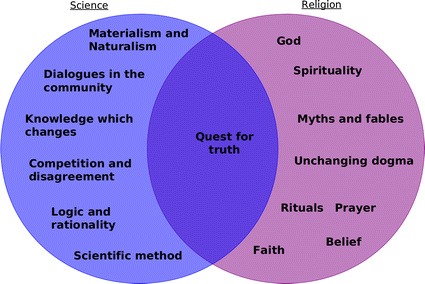
-
The integration of science and religion
I haven't viewed the video, but I get the impression that the OP is actually proposing the integration of metaphysical Mysticism (not Religion) --- i.e. personal, not social --- with physical Science. Although I'm still skeptical, history records a variety of mystical notions that are considered by adherents as a kind of practical science or technology.That may be why there are approximately 4200 different Christian denominations in the world today. Which is evidence that Science & Religion mix like oil & water. :smile: — Gnomon
The evidence you presented are most compelling. Thank you. — Pieter R van Wyk
The most obvious example is Buddhism, conceived as a science of the Mind*1, and indirectly of Matter, via introspection instead of microscopes & telescopes. Since the results are mostly subjective, I can't argue "show me the evidence"*2, without doing the experiential experiments personally.
Empirical science focuses on external public Reality, while subjective mysticism concentrates on internal private Ideality. Does the video explain how to reconcile those divergent perspectives? :smile:
*1. "Mystical science" can refer to a quest for truth that goes beyond conventional methods, encompassing fields like Buddhism, Tantra, and Sufism. It can also refer to the historical and sometimes pseudoscientific attempt to blend spiritual and mystical understanding with scientific concepts, such as alchemy or modern attempts to link quantum physics and mysticism. While traditional science is based on observation and experiment, mystical science often involves subjective experience, intuition, and beliefs about realities beyond the physical world.
https://www.google.com/search?client=firefox-b-1-d&q=mystical+science
*2. Mysticism is the pursuit of direct, personal experience of the divine or ultimate reality, often through practices like meditation, prayer, and contemplation. It can be found across many religious traditions, including Sufism, Buddhism, Hinduism, and various forms of Western mysticism. Mystics aim to achieve a state of union or deep connection with a transcendent reality, believing this direct experience provides a form of knowledge that transcends reason and sensory perception.
https://www.google.com/search?client=firefox-b-1-d&q=MYSTICISM
CAN PHILOSOPHY RECONCILE IDEAL and REAL WORLDVIEWS?

-
The integration of science and religion
Your challenge to define the terms of this thread sparked an idea in my own head.You claim it is possible to integrate science and religion. This implies, I think, that you know, exactly, what is science and what is religion. Please share your definitions else comments will not be valid. — Pieter R van Wyk
The etymology of Religion is "to link back to the past", which I take to mean Tradition. And "blind faith" is typically associated with almost all religious traditions. But another interpretation might be Loyalty to a social group. Which may explain why the average member of a faith community*1 has only a vague notion of theological doctrine, but nevertheless feels emotionally bound to their own social group, sharing norms & values, but not necessarily dogma.
The etymology of Science is "to know", which I take to mean Rational Information instead of emotional bondage. But Catholic Theology was an attempt to integrate Greek Science with Jewish Religion. Unfortunately, it was a marriage of convenience --- serving the imperial secular government --- that fell apart repeatedly over the years, as disparate social groups developed different interpretations of the "facts" of their received doctrine. That divergence of Faith led to heresies & excommunication & sectarian conflict & physical punishment, not unity & integration.
That may be why there are approximately 4200 different Christian denominations in the world today. Which is evidence that Science & Religion mix like oil & water. :smile:
*1. Faith Community :
". . . to them that have obtained like precious faith"
2 Peter 1:1-8 -
Against Cause
Now*1 is not an objective physical thing, but as you noted, a metaphysical subjective label for the ephemeral Planck time between instances of Cause and Effect, which are also labels for instants of Change, or a snapshot of Becoming. If you subtract Before from After, the result is Change or Difference.More so, the laws say nothing about the ‘now’ point. In this static universe of space-time, any flow of ‘time’, or passage through it thus must be a mental construct or an illusion. — PoeticUniverse
Perhaps that fleeting connect-the-dots experience of Change, of Difference, is what gives us the impression of a direction or arrow of Time. We still don't know what causes Causation, but we label it as "Energy", and vaguely define it as Ability or Power or Capacity or Work, and imagine it as-if an invisible Substance. We could just as well call it "Magic". Which may be why the OP is opposed to Causation.
Sorry. Just riffing on a theme. :wink:
*1. The philosophy concept of "now" is complex and has been explored in various ways, often touching on the nature of time, existence, and perception. Key philosophical discussions around "now" include the idea that it is a fleeting, ever-changing moment, and questions about whether it is an objective reality or a subjective experience.
https://www.google.com/search?client=firefox-b-1-d&q=philosophy+%22now%22+concept -
Against Cause
Good post!Causation. — Gnomon
See my post above. — PoeticUniverse
Whitehead's living, evolving, organic worldview resonates better with me, than the static "geometric" Block Time model*1. It better explains the incessant Change, and inexorable Causation that we humans experience and record in our Science & History. His Actual Occasions*2 are ticks on the cosmic clock, and serve as Atoms of Evolution.
As a Dynamic Block Model of physics, Whitehead's theory describes a scientific, non-religious concept similar to traditional metaphysical god-models, but also to modern models of physical Nature*3. It even includes Human Experience as a key feature of the living organism that is growing from a space-time quickening (Big Bang) into the on-going Reality that sentient creatures explore in their individual quests for survival. What the Cosmos was prior to the quickening is unknowable to humans (ontology). What we experience now is reality (axiology). What the cosmos will ultimately become, when it matures, remains to be seen by future sentience (epistemology).
We humans experience the growth of god in terms of the Time Triad of Past, Present, Future. The Past, as they say, is history (memory, fact), the Present is empirical reality, and the Future is open-ended Possibility. According to Whitehead's theory, human experience is god's experience. And the Life of the Cosmos is what we know as Causation. So, to argue Against Cause is to deny, not just a creator god, but to dismiss Life itself*4. :smile:
*1. Block Time Universe :
Philosophers such as John Lucas argue that "The Block universe gives a deeply inadequate view of time. It fails to account for the passage of time, the pre-eminence of the present, the directedness of time and the difference between the future and the past."
https://en.wikipedia.org/wiki/Eternalism_(philosophy_of_time)
*2. Actual Occasion :
In Alfred North Whitehead's metaphysics, an actual occasion is the fundamental "drop of experience" that constitutes reality.
*3. The God Process :
No, A.N. Whitehead does not propose a traditional creator God, but rather a God who is a partner in the universe's creative process. In his philosophy of process metaphysics, God is not a coercive creator who makes things ex nihilo, but a "lure" that presents possibilities to guide the universe toward novelty and order. God is not omnipotent, but persuasive and receptive, experiencing the world's joys and sorrows alongside creation and co-creating the future with it.
https://www.google.com/search?client=firefox-b-1-d&q=a.n.+whitehead+creator+god
*4. The phrase "life is causation" can be interpreted in different ways, but it generally points to the idea that every event and state in life is a result of preceding causes and, in turn, a cause for future events. This can be understood as a complex system of interconnected cause-and-effect relationships, from the biological and physical laws that govern our bodies to the choices we make that lead to specific outcomes. While some argue that life is a complex system that goes beyond simple cause and effect, many also view causation as the fundamental structure that allows us to understand, predict, and navigate the world around us.
https://www.google.com/search?client=firefox-b-1-d&q=life+is+causation -
Against Cause
Precisely! That's why non-philosophers typically think in terms of real-world experiences --- Father in heaven --- instead of groundless abstractions : Ungund.Unless you go for some Big Daddy in the Sky divine creator figure, you are going to have to posit an ultimate stuff so vague it is just the potential for stuff, which then becomes something by dividing against itself in the complementary fashion that allows it to evolve into the many kinds of things we find. — apokrisis
I scanned an article about Schelling's Ungrund, and found, among the paradoxes & enigmas, one statement that is akin to my own BothAnd Principle : “idealism is the soul of philosophy; realism is its body" . . . . "only both together can constitute a living whole”.
https://epochemagazine.org/77/freedom-god-and-ground-an-introduction-to-schellings-1809-freedom-essay/
I don't follow most of his arcane reasoning, but the common notion of positive Potential makes more sense to me than the negation Ungrund. Potential even has a physical & scientific application, exemplified in storage batteries. "Vague" Potential per se is Ideal and does nothing, but when integrated into a real System (circuit), "both together" transform into Causation, and the voltage possibility of stored Energy is enabled to do actual Work.
I suspect that the OP argument "against cause" is talking about ideal & abstract Cause & Effect reasoning instead of the real & concrete natural cycles of Transformation in the real world. Hume argued that the notion of Causation was not real, but ideal : a "habit" of thinking based on experience with causal sequences, in which no physical connection between Cause and Effect can be seen, only inferred. Energy is not a real thing, but an ideal relationship : a ratio.
Philosophical Idealism is feckless & worthless by comparison to Scientific Realism. But working together, metaphysical Ideas & physical Actions allow human animals to dominate the natural world, by imagining invisible Potential, and then transforming mere possibilities into Actualities by means of Technology. :nerd: -
Against Cause
Thanks for the summary. My philosophical vocabulary is narrow & limited, and obtained mostly since I retired. Before retirement I was more interested in physical sciences.Anaximander used the term apokrisis (separation off) to explain how the world and its components emerged from the apeiron—the boundless, indefinite, and eternal origin of all things. In his cosmology, this process involved the separation of opposites, such as hot and cold or wet and dry, from the undifferentiated primordial substance.
So I was not familiar with Anaximander's theory of Apeiron, but it seems to be generally compatible with my own amateur philosophical hypothesis of how the world works*1, based on Quantum physics and Causal Information.
My own term, Ideal Formal Potential (source of all real forms), may be equivalent to Aperion (unlimited possibility), or Spinoza's Substance (infinite unformed stuff). This boundless Potential is similar to Plato's unformed Chaos (infinite realm of unactualized Form). It's also imagined as the source of Causal Energy (EnFormAction) that exploded --- for unknown reasons --- into what we call the Big Bang.
Whether the Enformer is viewed as a god may be a question of personal taste, but it serves the same purpose of Creator of our Reality, without meddling with the automatic functions of natural Evolution. Because of the role of Information in the process of evolution, I like to think of the Enformer as a Programmer. And the execution of the program is what we call Causation.
My personal worldview is built upon what I call the BothAnd principle*1 of Complementarity or the Union of Opposites. Instead of an Either/Or reductive analysis, I prefer a Holistic synthesis. We seem to be coming from divergent directions, with different vocabularies, but eventually met somewhere in the middle of the Aperion. :smile:
*1. Both/And Principle :
My coinage for the holistic principle of Complementarity, as illustrated in the Yin/Yang symbol. Opposing or contrasting concepts are always part of a greater whole. Conflicts between parts can be reconciled or harmonized by putting them into the context of a whole system.
# The Enformationism worldview entails the principles of Complementarity, Reciprocity & Holism, which are necessary to offset the negative effects of Fragmentation, Isolation & Reductionism. Analysis into parts is necessary for knowledge of the mechanics of the world, but synthesis of those parts into a whole system is required for the wisdom to integrate the self into the larger system. In a philosophical sense, all opposites in this world (e.g. space/time, good/evil) are ultimately reconciled in Enfernity (eternity & infinity).
# Conceptually, the BothAnd principle is similar to Einstein's theory of Relativity, in that what you see ─ what’s true for you ─ depends on your perspective, and your frame of reference; for example, subjective or objective, religious or scientific, reductive or holistic, pragmatic or romantic, conservative or liberal, earthbound or cosmic. Ultimate or absolute reality (ideality) doesn't change, but your conception of reality does. Opposing views are not right or wrong, but more or less accurate for a particular purpose.
# This principle is also similar to the concept of Superposition in sub-atomic physics. In this ambiguous state a particle has no fixed identity until “observed” by an outside system. For example, in a Quantum Computer, a Qubit has a value of all possible fractions between 1 & 0. Therefore, you could say that it is both 1 and 0.
https://blog-glossary.enformationism.info/page10.html -
Against Cause
Again, I apologize for butting-in to your scholarly dialog with . The terminology alone is baffling to a late-blooming amateur philosopher with no formal training. But sometimes when I Google some esoteric language, I may actually learn something useful & meaningful. For example, "the dichotomising action of apokrisis" meant nothing to me, until Google revealed some associated concepts that I was already familiar with.So in this thread, I have argued for the immanent and hylomorphic view of causality. . . . .
Our current universe is in its very complex – and yet also very simple – state. This seems an odd thing to say, but that itself stresses we are dealing with a logic of dichotomies. Things start to happen when two complementary things are happening at once. This is the thought that breaks the logjam of metaphysics. And has done so ever since Anaximander figured out the logic of the Apeiron split by the dichotomising action of apokrisis. — apokrisis
In the overview below*1, the evolution of the world is described in terms of two kinds of causes : Top Down = a creator/programmer, who serves as both First and Final Cause, bracketing the origin & development of what we call space-time Reality. Bottom-Up = the degrees of freedom that we call fundamental randomness/uncertainty on the quantum scale of reality. Working together, Cause (Law ; Regulation) & Chance (Stochastic Randomness ; Freedom) produce a Complex Adaptive System of "dynamic, non-linear systems of interacting agents that exhibit emergent, self-organizing behaviors and co-evolve over time". This kind of Emergent Evolution is compatible with my own notion of EnFormAction*2. :smile:
*1. Dichotomizing action of apokrisis :
A systems view of causality: In a philosophical discussion on causality, the term apokrisis has been used to describe a foundational split. It is argued that a systems approach to causality dichotomizes the notion of cause into two complementary types:
Top-down constraints: The action of formal and final causes, representing global limitations.
Bottom-up degrees of freedom: The action of material and efficient causes, representing local spontaneity and construction.
https://www.google.com/search?client=firefox-b-1-d&q=+dichotomising+action+of+apokrisis.
Note --- Formal causes are natural laws (Logic). First & Final causes are design intention. And Material & Efficient causes are the Energy/Matter cycle of thermodynamics. This is my interpretation, which may not be the original intent of the dichotomizing split. Working together, Constraints & Freedom are "complementary" and creative.
*2. EnFormAction :
Ententional Causation. A proposed metaphysical law of the universe that causes random interactions between forces and particles to produce novel & stable arrangements of matter & energy. It’s the creative force (aka : Divine Will) of the axiomatic eternal deity that, for unknown reasons, programmed a Singularity to suddenly burst into our reality from an infinite source of possibility. AKA : The creative power of Evolution; the power to enform; Logos; Causation.
https://blog-glossary.enformationism.info/page8.html
Note --- "Ententional Causation" is the top-down lawful constraints, and "Random Interactions" are the bottom-up spontaneous degrees of freedom that allow for the emergent creativity of Evolution. -
Against Cause
I'm not a physicist, so this stuff is over my head. I had to Google "symmetry breaking"*1 to see if it can happen spontaneously without any causal inputs.It is against to the thesis that matter is a passive receptacle for external and transcendent forms (first cause), while symmetry breaks give matter (to which they are immanent) the ability to generate forms without external intervention. — JuanZu
Does this contrarian-thesis mean that physical evolution occurs randomly and without causal inputs from the environment? In other words, without rhyme or reason. If so, how can scientists make any sense of the evolutionary process?*2
Is this symmetry-breaking argument intended to offer an explanation for non-classical acausal Quantum phenomena, and to deny the necessity of any cosmic First Cause of the Big Bang? How can Randomness explain anything other than Chaos . . . . or our ignorance of quantum scale reality?*3
It seems to me that human Reasoning & Logic are based on, or intuitively derived from, our experience with causation in the real world. Does this acausal thesis mean that millennia of philosophical reasoning has mis-interpreted fundamental Randomness*4 in terms of useful & meaningful Reasons, such as First Cause? :smile:
*1. Acausal Symmetry Breaking ? :
Arguments of the above kind — that is, arguments leading to definite conclusions on the basis of an initial symmetry of the situation plus PSR — have been used in science since antiquity (as Anaximander’s argument testifies). The form they most frequently take is the following: a situation with a certain symmetry evolves in such a way that, in the absence of an asymmetric cause, the initial symmetry is preserved. In other words, a breaking of the initial symmetry cannot happen without a reason, or an asymmetry cannot originate spontaneously. Van Fraassen (1989) devotes a chapter to considering the way these kinds of symmetry arguments can be used in general problem-solving.
https://plato.stanford.edu/entries/symmetry-breaking/
*2. "Evolution without causation" refers to the philosophical debate about whether evolutionary processes, particularly natural selection, should be understood as non-causal statistical phenomena rather than as processes driven by specific causal forces. While the majority of biologists and philosophers view evolution as a causal process involving factors like mutation, inheritance, and selection, a minority, often associated with the "statisticalist" school of thought, argue that natural selection is a non-causal epiphenomenon. This concept challenges the traditional understanding of evolution by suggesting it can occur due to statistical patterns and the differential survival of individuals, rather than by inherent causal forces shaping life forms.
https://www.google.com/search?client=firefox-b-1-d&q=evolution+without+causation
*3. Ignorance of quantum scale reality refers to the deep conceptual and observational gap between the quantum realm and our classical, macroscopic experience, stemming from quantum mechanics' fundamental indeterminacy, observer-dependent phenomena, and non-intuitive properties like entanglement and non-locality. Physicists are actively working to resolve these mysteries and formulate a unified theory that bridges quantum theory and general relativity to better understand the true nature of reality.
https://www.google.com/search?client=firefox-b-1-d&q=ignorance+of+quantum+scale+reality
Note --- Heisenberg's Uncertainty Principle merely means that there's a "fundamental limit to how precisely certain pairs of physical properties, like an electron's position and momentum, can be known simultaneously". How can that sub-atomic sample of apparent randomness be scaled up to the evolution of a whole universe?
*4. Randomness is the apparent lack of pattern, cause, or predictability in an event, often associated with chance and probability, while reason implies a logical explanation or justification for an action or occurrence. Reason points to a specific cause, whereas randomness describes an event where the cause (if any) is not discernible, creating uncertainty in the outcome.
https://www.google.com/search?client=firefox-b-1-d&q=randomness+vs+reason -
Against Cause
I'm more familiar with the ancient Taoist Yin-Yang version, as an illustration of the concept of Complementarity. But my understanding of those general concepts is superficial and non-technical. :nerd:But the unity of opposites is preSocratic. — apokrisis
Again, this stuff*1*2 is way over my little pointy (not Poincare) head. And I can't see what it has to do with the topic of this thread : local cause/effect vs First Cause. :joke:And not any old forms but gauge symmetries. Special relativity zeroes the spacetime metric to a set of local points under the invariance of the Poincare group of symmetries. — apokrisis
*1. The philosophy of gauge symmetries explores their role as formal mathematical redundancies that nonetheless provide a powerful, albeit non-direct, framework for understanding fundamental physical reality, rather than a direct representation of nature's features. While gauge symmetries are central to modern physics, their philosophical status is debated: are they merely descriptive tools, or do they reveal deeper truths about the structure of spacetime and the emergence of physical properties?
https://www.google.com/search?client=firefox-b-1-d&q=gauge+symmetries+philosophy
Note --- This is not talking about Symmetry in the traditional mirror-image sense. I suppose it has some relation to whole systems underlying local particulars, such that superficial form-changes don't affect the fundamental unity of the system being observed. But how does this "fundamental" feature of Nature reflect the Ultimate Whole : the First Cause?
*2. In philosophy, symmetry breaking explores how order, structure, and differentiation emerge from a state of uniformity, often raising questions about the relationship between scientific theories and reality, the limits of reductionism, and the fundamental nature of laws.
https://www.google.com/search?client=firefox-b-1-d&q=symmetry+breaking+philosophy -
Against Cause
Again, I apologize for my ignorance of modern technical philosophical arguments. I'm just not familiar with the arcane jargon. My philosophical vocabulary is derived mostly from the ancient reasoning of Plato & Aristotle. Since I got into philosophy only after retirement from the practical world, I have skipped most of the post-Platonic academic argumentation.And so my reply was precisely about that. The holistic view of a first cause. The unit 1 story of the first symmetry-breaking. The unit 1 story of a unity of opposites. — apokrisis
One exception to the antique vocabulary is Whitehead's Process and Reality, and it took me a lot of re-reading to understand what he was talking about. I eventually came to the realization that his arguments & metaphors are drawn mainly from mathematical reasoning, for which I have no formal training, beyond a single Calculus course.
For more modern opinions, I can understand some of the philosophical conclusions of early Quantum scientists. For example : "Uncertainty Principle's Werner Heisenberg (1901 - 1976) declared himself a Platonist : 'I think that modern physics has definitely decided in favour of Plato . . . . . the smallest units of matter are not physical objects in the ordinary sense, they are forms". {quoted from Philosophy Now magazine, August 2025}
Consequently, much of the modern philosophical argumentation is over my head. So, I have to Google terms that are not familiar. Regarding "symmetry breaking"*1 and "unity of opposites"*2, what do they have to say about the topic of this thread : arguing against general Causes? Do they support Aristotle's notion of a necessary First Cause? :smile:
*1. In philosophy, symmetry breaking explores how order, structure, and differentiation emerge from a state of uniformity, often raising questions about the relationship between scientific theories and reality, the limits of reductionism, and the fundamental nature of laws.
https://www.google.com/search?client=firefox-b-1-d&q=symmetry+breaking+philosophy
*2. The "unity of opposites" is a philosophical concept suggesting that seemingly opposing ideas or forces are interdependent and define each other, existing in a state of tension that drives development or wholeness.
https://www.google.com/search?client=firefox-b-1-d&q=unity+of+opposites -
Against Cause
Again, you are talking about practical (useful) Science, instead of theoretical (reasonable) Philosophy. Except that the notion of "constants" is a generalization & abstraction from specific & concrete instances of physical changes. Likewise, the notions of Unity and Absolute are never observed in the real world, but inferred from multiple instances.In fact what Penrose showed was that all the useful structure of fundamental of physics would break down if you pushed it to an actual zero point. And what instead saves it is that all of that physics rather neatly converges on the unit 1 that is the Planck point. The point at which the three fundamental constants of nature - c, G and h - become unified and have the one absolute value. — apokrisis
Also, the notion of Causation is a generalization from a sampling of specific exchanges of energy. From such individual theoretical inferences, we can also generalize that Nature, as a finite-but-dynamic system, must have an Absolute & Unitary (Holistic) First Cause, of which all observed instances of influence are merely "Actual Occasions", as defined by A.N. Whitehead in Process and Reality.
I apologize for harping on the notion of Holism & Original Cause, but it's essential to my personal philosophical worldview. You may ask, "is it useful?", for any practical purposes. And the answer is no. Theories are only useful for the impractical work of Philosophy. :smile:
"The sole problem is, 'does it work?' But the aim of practice can only be defined by the use of theory ; so the question 'does it work?' is a reference to theory".
"The notion of 'understanding' requires some grasp of how the finitude of the entity in question requires infinity. This search for such understanding is the definition of philosophy."
___ Science and Philosophy, A.N. Whitehead
Note --- We reason about limitless Infinity (set of all possible sets) from experience with instances of finitude (isolated set within a more comprehensive set). -
Against Cause
Of course, physics & metaphysics should be harmonious, if possible. But as the Quantum action-at-a-distance paradox indicates, sometimes we are forced to reinterpret the physics in order to derive a corrected metaphysical interpretation.I move from the metaphysics of cause to the physics of cause. — apokrisis
The article below*1 reminds us, Einstein mis-interpreted quantum entanglement as supraluminal communication of information, and argued strenuously against it. Years later, experiments forced scientists to change their definition of Entanglement from physical inter-action to metaphysical correlation.
The new viewpoint is Holistic instead of Reductive. Likewise, the Causation dissension may simply hinge on context (empirical vs theoretical) and definition (token vs type)*2. The technical stuff of both physics and metaphysics is over my amateur head. And the Holistic stuff may be what you are arguing against*3. :smile:
*1. Spooky Correlation :
it has since been confirmed by experimental observation that the ‘spooky action’ does indeed happen, exactly as quantum physics predicted (although it should be noted that there is no action or interaction as such, more a relationship of correlation).
https://www.texterity.com.au/spooky-action/
*2. The Metaphysics of Causation :
Although both 1 and 2 are broadly causal claims, some think that they are not claims about the same kind of causal relation. These causal relations may be differentiated by their relata.
https://plato.stanford.edu/entries/causation-metaphysics/
*3. "Holistic entanglement" refers to quantum entanglement, where multiple quantum particles are linked and become a single, inseparable system, their individual identities replaced by a shared, interconnected whole, a concept that aligns with holistic philosophies about universal interconnectedness.
https://www.google.com/search?client=firefox-b-1-d&q=holistic+entanglement -
Against Cause
Again, for scientific purposes, the weak notion of this-to-that causation is usually sufficient. Except perhaps, in Quantum physics, where Non-locality and "spooky action at a distance" remains a cause-effect mystery, yet it is accepted as a real phenomenon.I am arguing against any strong notion of first cause. — apokrisis
For philosophical purposes though, our explanations must "move" our understanding "from known to unknown"*1, from phenomenon to noumenon. Hence, we attempt to explain all local intermediate causes & effects in terms of a hypothetical ultimate First Cause (causal origin), which is not a real testable phenomenon. It's an inferred General Principle ; an idea not a thing. Whether it's labeled mundane Magic or mystical Magick, may depend on the context. :smile:
*1. Wayfarer reply, Excerpt from the No Magic thread (6 mo. ago) :
It's not a matter of detail alone. In Greek philosophy, the issue is phrased in terms of explanans and explanandum. In the Phaedo, for example, Socrates argues that knowledge requires a method of inquiry that moves from the known to the unknown. He suggests that in order to explain a particular phenomenon, one must have knowledge of a more general principle or cause that underlies it. Socrates refers to this more general principle as the "cause" or "explanans," and the particular phenomenon as the "effect" or "explanandum."
And besides, saith Feynman, 'I can safely say that nobody understands quantum physics'. It works - as if by magic!
https://thephilosophyforum.com/discussion/15869/the-proof-that-there-is-no-magic/p1 -
Against Cause
That's OK with me. I don't have any "strong" scientific notion of First Cause. In fact, most practical scientists seem to avoid such metaphysical speculations in their work*1. For me, the notion of a First Cause is merely a philosophical conjecture to put a period on all, otherwise open-ended, causal sequences.Note --- I interpret First Cause to be logically & necessarily eternal & intentional Essence instead of temporal & accidental Substance. — Gnomon
I am arguing against any strong notion of first cause. — apokrisis
20th century Cosmology traced the path of measurable finite causes, energy exchanges, back to a mathematical Singularity. That hypothetical origin of space-time was inherently un-defined, because all converging mathematical paths went off the charts and disappeared into Infinity (literally un-measurable). So the Singularity itself could not be the actual First Cause, because its an Idea, not a Real thing. Hence, nobody has a strong, evidence-based, notion of First Cause.
But flakey philosophers are not bound to mundane Reality, and they can freely imagine sublime Ideality. Which is what Aristotle postulated, 13 centuries ago, as the First & Final Causes . . . . for philosophical (not scientific) & theoretical (not empirical) purposes. Those bookend Causes are as real, and useful, as the number PI. :smile:
*1. Science of First Cause : refers to the philosophical concept of a first cause—the initial, uncaused entity that initiated all subsequent causal chains and ultimately brought about existence itself. While science describes the causes of events within the universe, the first cause addresses the ultimate origin of reality, a concept explored in metaphysics and ontology rather than empirical science.
https://www.google.com/search?client=firefox-b-1-d&q=science+of+the+first+causes
DO YOU BELIEVE IN THE SINGULARITY?

-
Against Cause
Ouch! That kind of complexified conjecturing makes my amateur philosopher head hurt. It's so far over my little pointy pate, that I probably shouldn't even comment. Do all those polysyllabic words add-up to agreement or disagreement with my quoted summation (#) of the Argument Against Causation?My argument is instead the one to be found in Anaximander, Peirce and quantum field theory. The Cosmos exists as the constraint on possibility. It emerges not from fundamental intentionality nor from fundamental mechanistic cause but from the fundamental vagueness of unorganised free potential. An essential state of everythingness that then must start to self-cancel until it becomes reduced to some coherently organised somethingness. A realm of inevitable structure. — apokrisis
# If there was no First Cause, and no continuation of causation, and no explanation for Ontology, then the world is ultimately causeless & meaningless & irrational & absurd. — Gnomon :worry:
Note --- I interpret First Cause to be logically & necessarily eternal & intentional Essence instead of temporal & accidental Substance. Otherwise, the chain of Chance would have no beginning or end . . . . just one "damn thing" after another forever : aimless, randomized, disorganized, self-canceling, structureless, nothingness.
Sans intention, does Everythingness, Organized Somethingness, & Inevitable Structure, explain the Ontological question : "why something instead of nothing?"
Sans Intention, how could Chance cause anything other than Entropy? :chin:
In Spinoza's philosophy, "nature eternal" refers to his concept of God as Deus sive Natura (God or Nature), an absolutely infinite and eternal substance that encompasses all reality, having no beginning or end and existing by the necessity of its own nature.
https://www.google.com/search?client=firefox-b-1-d&q=spinoza+nature+eternal
Note --- Spinoza was not aware that cosmic expansion implied a beginning of space-time. So, he assumed that Nature was an eternal cycle instead of a linear expansion. Today, we must take the evidence of an ontological origin into account. And one resolution would be to ascribe an endless cycle of reincarnation of the Deus Natura, as postulated in the Multiverse theory. A sequentially-instantiated-necessity. Ooops! More polysyllabic terminology. :yikes: -
Against CauseFrom OP :
If I hit a cue ball and it bounces off the bumper and into the eight ball which goes in the corner pocket, what caused the eight ball to move into the pocket? Me? The cue? The cue ball? The pool table? My muscles and bones? The electrons in the outer valence orbital of the atoms at the surface of the ball that exert repulsive force as they approach each other? My mother who gave birth to me? My friends who convinced me to go to the bar? The car that I rode in to get to the bar? The star that created all the elements that make up the pool balls? — T Clark
This quote is much more to the point than the rambling OP of opposition to some vague notion of imparted motion and being.But my argument would be that the mechanical notion of causality only arises within the context of intentional being. — apokrisis
Causation is a concept about a process, not a physical or static thing. Which is why Aristotle postulated a logically necessary First Cause, presumably intentional, to serve as a metaphorical answer to open-ended causation riddles.
But even a theoretical notion of an intentional Designer, who set in motion all the subsequent steps in the 14B year old chain of intermediate causes, sets some people's teeth on edge. As a sop to the sensitive, I sometimes use the notion of a hypothetical impersonal anonymous Programmer, who caused the program of Evolution to begin computing the natural world that we experience moment-to-moment, but remember as a continuous meaningful memory.
If there was no First Cause, and no continuation of causation, and no explanation for Ontology, then the world is ultimately causeless & meaningless & irrational & absurd. So, inquiring philosophers resort to metaphors. :smile:
Evolutionary programming is an evolutionary algorithm, . . . .
https://en.wikipedia.org/wiki/Evolutionary_programming
Thinking of evolution as a program can be a useful way to grasp the concept of an iterative process of adaptation and optimization. However, it's critical to remember that this is a metaphor.
https://www.google.com/search?client=firefox-b-1-d&sca_esv=9c8fe5677d44d698&sxsrf=AE3TifNNUNrHzkPptcp0w_zJxdxq9Aeypg:1759526155597&q=Does+evolution+work+like+a+program+pdf&sa=X&ved=2ahUKEwiyz-jb-YiQAxUsRzABHessKnsQ1QJ6BAg9EAE&biw=1173&bih=791&dpr=1.09 -
The End of the Western Metadiscourse?
Exactly! The world has changed radically in the 21st century. National or state borders are now much more fluid & porous than in the early 20th century. And us-vs-them antipathies are no longer aimed externally at well-defined enemies, but at neighbors, who may differ only in ideologies. In the 1970s, cartoonist Walt Kelly created a new meme, by turning a famous 19th century quote inside-out*1. His lovable possum philosopher made an early environmental statement by pointing the finger-of-blame at us, instead of at them*2.In the United States, however, in my view, the antithesis is more internal. — Astorre
During the American Civil War (1861 -- 1865), you could draw a straight line between the well-defined enemy states : the Mason-Dixon line. But today, the enemy combatants are not so easy to compartmentalize. That's because their identifying characteristics are not physical & practical, but metaphysical & philosophical.
Today, the American president is sending war-fighting troops into American cities, not to liberate them from tyranny, or to liberate them from Liberalism, but to tyrannize them under his own idiosyncratic ideology. New meme : "Trump has met the enemy, and he is us". :cool:
*1. During the War of 1812, the United States Navy defeated the British Navy in the Battle of Lake Erie. Master Commandant Oliver Perry wrote to Major General William Henry Harrison, “We have met the enemy and they are ours.
Kelly’s parody of this famous battle report perfectly summarizes mankind’s tendency to create our own problems. In this case, we have only ourselves to blame for the pollution and destruction of our environment..”
https://library.osu.edu/site/40stories/2020/01/05/we-have-met-the-enemy/
*2. THE ENEMY WITHIN

-
The End of the Western Metadiscourse?
I'm currently reading a memoir, based on a series of Harvard University lectures, by philosopher/mathematician A. N. Whitehead : Science and Philosophy. He was born & bred British, toward the end of Empire, but spent his later years in the U.S., which he viewed as a beacon of reason for the rest of the world. If only he could see us now!Over the past decade, I've observed a notable shift in global sentiment—especially from my vantage point in the East. Not long ago—perhaps 10 to 15 years back—there was a widespread admiration for the West in my country. The U.S. dollar was seen as unshakable. Western democracy was often cited as the highest political ideal. Western consumer goods were considered objectively superior. And the broader cultural narrative—academic, technological, even moral—was clearly West-centric. — Astorre
One chapter, written just prior to the beginning of WW2, is entitled "An appeal to sanity". It describes the unsettled state of the world, especially Europe, as the after-effects of The Great War (WW1) set-up the grievances & motives for WW2. The first sentence of the chapter may be appropriate for this topic : "In international relations the world alternates between contrasting phases, resulting from variation of emotion between the phases of low and high tension". He then described the "notable shift in global sentiment", especially in the colonies of former empires.
What he was reporting, philosophically, was the Hegelian Dialectic*1 of contrasting worldviews that alternate in "popularity" from time to time. For example, before WW2, the European hegemony over the non-western world was winding down. Which placed stress on the Western powers to adjust to the new, less top-down, political relationships. Ironically, in the 1930s, Germany was defeated, demolished & destitute under the crushing bootheel of the Versailles treaty, which dismantled the Austro-Prussian empire. "My, how the mighty have fallen"! So, you can understand the seething resentment of the ordinary German, and their angry Aristocrats, to whom Hitler's Make Deutschland Great Again (MAGA) polemics & diatribes had visceral emotional appeal.
Now, after several decades of being crushed under the bootheel of left-wing Liberalism, the oppressed Oligarchs of the US --- despite their economic hegemony --- are vowing to make their country into a militaristic world Empire again. And so it goes, around & around and back again. As my southern mother used to say, after the American Civil War : "bottom rail is on top!" I suppose this thread is a metadiscourse on the less-than-neighborly dialogue in current politics, such as America's Secretary of WAR, girding the loins of his flabby generals to make-war-not-love. Don't worry, it's just talk. :wink:
The Hegelian dialectic :
a philosophical process described by G.W.F. Hegel as the engine of reality and consciousness, unfolding through a triadic movement of thesis, antithesis, and synthesis. This process involves an idea or state (thesis) giving rise to a contradictory opposing idea or state (antithesis), which is then reconciled into a higher, more comprehensive form (synthesis) that becomes the new thesis, perpetuating the cycle of development and progress. This dynamic of conflict and resolution leads to the evolution of ideas, history, and the self-realization of the Absolute Spirit
https://www.google.com/search?client=firefox-b-1-d&q=hegelian+dialectic -
Against Cause
If I don't understand a word, I Google it.Collingwood's abstruse concept is over my untrained head — Gnomon
Here’s an idea— if you don’t understand a word don’t use it.
I simply construe the term to mean that the conclusions follow logically from the premises. — Gnomon
This is not correct. — T Clark
*1 is ambiguous & abstruse. *2 is the definition I mentioned.
If "logical efficacy" does not refer to "conclusions that follow from premises" based on "measured effects", then what does it mean? I had to Google "absolute presuppositions" to see that it's an arcane term for Faith. Which is obviously meaningful to believers, but logical? :smile:
*1. R.G. Collingwood's concept of "logical efficacy" refers to the power of certain fundamental beliefs, which he called "absolute presuppositions," to give rise to questions and structure an entire field of inquiry. In his work An Essay on Metaphysics, he argued that these presuppositions are neither true nor false and cannot be verified empirically. However, they are still meaningful because of their logical power to frame our thinking.
https://www.google.com/search?client=firefox-b-1-d&q=Collingwood%E2%80%99s+logical+efficacy
*2. "Logical efficacy" describes a situation in clinical trials and other contexts where an intervention's measured effect (efficacy) is consistent with and logically follows from the effects observed in its constituent subgroups. It's crucial for accurately interpreting trial results, especially in the presence of patient subgroups with differential responses, and ensures that the overall treatment effect falls within the range of the subgroup effects. For example, if a drug is efficacious in a marker-positive subgroup but not in a marker-negative subgroup, the drug's overall efficacy must be somewhere between those two values.
https://www.google.com/search?client=firefox-b-1-d&q=logical+efficacy
Note --- The premises for logical thinking are supposed to be based on "measured effects", not on Faith without evidence. -
What is a system?
I don't know. Why do you ask? What do you think has been reified*1 in this thread?Gnomon Do you think hypostatization is a sensible route to take when trying to lay down the groundwork for a larger body of work? — I like sushi
If you are thinking of Holism or Enformationism, they are philosophical theories & worldviews*2, not physical objects. Even Realism is not real, but Ideal. :smile:
*1. In philosophy, hypostatization is the act of treating an abstract concept, mental construct, or social phenomenon as if it were a concrete, material thing or a real, independent substance. This often manifests as a fallacy where an idea or word that normally refers to a process or quality is given an independent existence, which can lead to misunderstandings and flawed arguments.
https://www.google.com/search?client=firefox-b-1-d&q=hypostatization+definition+philosophy
*2. The "-ism" suffix forms a noun that can refer to a distinctive doctrine, belief system, or theory (like socialism or feminism), an action, process, or condition (such as criticism or pauperism), a characteristic behavior or quality (e.g., heroism), or an oppressive, discriminatory attitude (e.g., sexism or racism). It is a productive suffix of Greek origin used across various fields, from philosophy and politics to religion and behavior.
https://www.google.com/search?client=firefox-b-1-d&q=ism+suffix+meaning -
What is a system?
Since I'm an introvert and a loner, I have no interest in a structured religion, old or new*1. And not much need for the "peace & security" of belonging to a unified group of people : sect or social system. I guess you could say that Philosophy is my solo religion ; but it offers no final answers, and little existential comfort. In lieu of a biblical or tribal religion I have developed my own personal worldview*2, based partly on Holism, Information theory, and Quantum physics. No rules or rituals, wines or ganja, candles or incense, priests or preachers . . . . just a better understanding of why the world is the way it is. :halo:From my perspective, there is a new religion popping up, based on Holism and human consciousness. A religion that would be about as good as any religion we have (or had). — Pieter R van Wyk
*1. A new religion incorporating holism
emphasizes the interconnectedness of all things, viewing the human being as a unified "mind, body, and spirit" rather than separate parts. This worldview aligns with the New Age movement's belief in the universe as a single, interconnected whole, rejecting scientific reductionism and traditional dualisms. Instead, it promotes individual and collective spiritual transformation to achieve a greater sense of peace and unity
https://www.google.com/search?client=firefox-b-1-d&q=new+religion+holism
*2. Enformationism :
A philosophical worldview or belief system grounded on the 20th century discovery that Information, rather than Matter, is the fundamental substance of everything in the universe. It is intended to be the 21st century successor to ancient Spiritualism & Materialism. An Update from Bronze Age to Information Age. It's a Theory-of-Everything that covers, not just matter & energy, but also Life & Mind & Love.
https://blog-glossary.enformationism.info/page8.html -
What is a system?
Gnomon is not a professional Logician, or Mathematician, or Systems theorist. Just an amateur philosophical scrivener. So the general (non-technical) concept of Holism is sufficient for my needs, to make sense of complex physical & philosophical systems.The possibility exist that Gnomon's notion of a system as a holism might be the key to such a theory - but I doubt that. You see: "To bear Systems Theory in mind one should envision some sort of logical and mathematical basis as a formal unambiguous language." — Pieter R van Wyk
I am however, somewhat familiar with the Santa Fe Institute for research in complex systems. And their researchers are experts in various scientific fields, but are also encouraged to think outside the traditional boxes. Maybe you can find someone there to exchange technical cutting-edge esoteric ideas with. By the way, a general term for their approach to science is Holism, as opposed to Reductionism. :smile:
Santa Fe Institute (Cowan Campus)
1399 Hyde Park Road
Santa Fe, New Mexico 87501
United States of America
Phone: 505-984-8800
Contact : emailatsantafedotedu
What is Complex Systems Science? :
Complexity arises in any system in which many agents interact and adapt to one another and their environments. Examples of these complex systems include the nervous system, the Internet, ecosystems, economies, cities, and civilizations. As individual agents interact and adapt within these systems, evolutionary processes and often surprising "emergent" behaviors arise at the macro level. Complexity science attempts to find common mechanisms that lead to complexity in nominally distinct physical, biological, social, and technological systems.
https://www.santafe.edu/about/overview
The Santa Fe Institute was founded in 1984 by a group of scientists frustrated with the narrow disciplinary confines of academia. They wanted to tackle big questions that spanned different fields, and they felt the only way these questions could be posed and solved was through the intermingling of scientists of all kinds: physicists, biologists, economists, anthropologists, and many others.
https://www.santafe.edu/ -
Against Cause
I probably missed the point of the OP. But the subsequent clarifications only muddied the water for me.So the OP was about the limits of the efficacy of the mechanistic mindset. The complaint was that because it seemed a severely limited view of Nature in practice, one might as well give up on the very idea of believing in “causality”. — apokrisis
Quantum Uncertainty does place limits on some traditional universal assumptions underlying the "mechanistic mindset". But those squishy lower-level limits don't seem to have much efficacy on the macro scale. So, we continue to depend on the "pragmatic usefulness" of our causal models for designing machines.
As long as we keep those acausal animals penned-up on the quantum scale, we seem to be safe from the anarchy of Chaos. They do cast some philosophical doubt on a few over-generalizations of the past. But for all practical purposes, continuous Causality still seems to be a valid assumption. So I don't see any need to abandon Causality altogether, and to accept Absurdity in its place . As a matter of fact, I have been arguing in favor of Aristotle's First Cause theory on this forum. :smile:
PS___ I just saw the first episode of Douglas Adam's Dirk Gently, Holistic Detective TV series. And it seems to interpret "Holism" as Pandemonium, where randomness rules. -
Against Cause
Collingwood's abstruse concept is over my untrained head. I simply construe the term to mean that the conclusions follow logically from the premises. But the path of reasoning can be traced from Top-Down or from Bottom-Up, and can be evaluated as Statistical (permanent pattern) or Intentional (aimed at future state). :smile:In that simplistic dichotomy, where is the "logical efficacy" of the OP? Is it in the "top-down constraints" or the "bottom-up degrees of freedom". Is it the top-down logical or intentional efficacy that the OP was arguing against? :smile: — Gnomon
This is not what Collingwood meant by logical efficacy. — T Clark -
Against Cause
True. Billiard balls are causal, but not self-causal. So what is the initial cause of their motion? Does the cue ball initiate the aim & activity on the table? Or does the chain of causation link back to an intentional*1 Prime Cause, with the mental goal of moving all balls into pockets?The fact that humans engage in intentional behavior implies only that some causation is the product of intent. Not that all causation is. — Relativist
Statistically, Correlation does not prove Causation, but logically it does point in that direction. If some causation results from intention, could we not reasonably infer that all intermediate Causes can be traced back to an original intentional Act? That seems to be the reasoning underlying primitive Animism, and the God postulates of almost all world religions & philosophies. Is there any scientific or philosophical method to disprove Divine Causality or Aristotle's Logical First Cause? "Absence of evidence is not evidence of absence" (Carl Sagan).
From a more physical perspective, the original Big Bang theory avoided dealing with a source or explanation for the Energy (efficient cause) and Natural Laws (formal cause) necessary to make sense of the unprecedented emergence of a chain of transformations (material causes) from mathematical Singularity, to hypothetical plasma soup, to experiential Life & Mind. Does the sudden appearance of Cosmos from Chaos, as inferred from astronomical evidence, cause you ask "Why?" as well as "How?". Is it possible that the implicit First Cause*2 was Intentional/Purposeful instead of Accidental/Aimless? If not, why not? As a non-religious philosopher, I have to ask myself that contrapositive question. :chin:
*1. To Intend : to extend the mind toward a goal, purpose, design, aim or object
*2. First Cause :
Aristotle's argument for a First Cause, often called the Unmoved Mover, does not rely on it being an intentional entity with a will or mind, but rather as a necessary, external, and unchanging origin of all motion in the universe. The First Cause initiates motion without itself being moved, stopping an infinite chain of causes by providing a beginning point for the universe's existence and change. This uncaused cause functions as a final cause, drawing all things toward it in a state of pure actuality, thereby explaining the purpose and motion within the cosmos.
https://www.google.com/search?client=firefox-b-1-d&q=aristotle%27s+first+cause+intentional
Note A --- In the real world, we have no experience with uncaused Causes. According to the law of Thermodynamics, they all link back to some a priori input of energy. So, an Unmoved Mover cannot be Real, but Ideal : i.e. imaginary. A philosophical hypothesis, not a scientific fact.
Note B --- "Pure Actuality" might explain physical Motion, but can it provide Purpose, Aim, Time's Arrow? -
Against Cause
In that simplistic dichotomy, where is the "logical efficacy" of the OP? Is it in the "top-down constraints" or the "bottom-up degrees of freedom". Is it the top-down logical or intentional efficacy that the OP was arguing against? :smile:I would suggest that what we call an accident is the opposite of what we call a necessity. So the more fundamental dichotomy is chance and necessity. Or what in the systems view is the top down constraints and the bottom up degrees of freedom. — apokrisis
My claim is that there are only a limited number of situations where it has Collingwood’s logical efficacy. — T Clark -
Against Cause
I choose to believe that, for the calculations of Physics, intention may be irrelevant. But for the purposes of Philosophy, intention is essential. For example, a pool table with neatly stacked balls is static & causeless, until the intentional act (first cause) of the shooter inputs both Energy (causation) and Direction (intention) into the frozen tableau*1. All subsequent causation -- bouncing balls -- is indeed mechanical & purposeless . But physical causation is of little interest to a philosopher*2, whose focus is on logical causation*3. :smile:Causation without Intent is what we call Accident. — Gnomon
That may be what YOU call it. I just call it causation. You can choose to believe there is intent involved in all causation, but you cannot possibly show that causation requires it. — Relativist
*1. Tableau :
a group of models or motionless figures representing a scene from a story or from history; a tableau vivant.
___Oxford Dictionary
*2. Etiology is the study of the causes, origins, or reasons behind the way that things are, or the way they function, or it can refer to the causes themselves.
https://en.wikipedia.org/wiki/Etiology
*3. Logical causation :
refers to the idea that a logical relationship can imply a cause-and-effect relationship, as seen in formal logic or causal logic models used to structure knowledge. It involves using logic to explain or predict events by identifying the underlying causes, often through mechanisms like counterfactual reasoning or formal argument structures, though it's distinct from physical causation, which involves the transfer of force and temporal relationships.
https://www.google.com/search?client=firefox-b-1-d&q=logical+causation
NO CAUSATION WITHOUT INTENTION
Ignore the First Cause (intentional actor) off the table

Gnomon

Start FollowingSend a Message
- Other sites we like
- Social media
- Terms of Service
- Sign In
- Created with PlushForums
- © 2026 The Philosophy Forum