
Comments
-
Cosmos Created Mind
Ironically, I originally got the idea, from your screenname Boundless, that our philosophical positions might be somewhat compatible, but then we seemed to diverge on the mundane topic of Energy. Yet today, I happened to notice the uncommon term "Panentheist"*2 in the thread About Time. So, maybe we have something else to dialogue (both agree and disagree) about.↪Gnomon
I won't reply to all your points because I believe that there is a deeper difference between our positions and I think it is possible we will simply "agree to disagree". — boundless
In recent years, I found A.N. Whitehead's Process Theology *2 compatible with my own secular metaphysical (philosophical) worldview, which, when pushed, I sometimes identify as PanEnDeism, to distinguish it from traditional doctrinal theological religions. For me though, the hypothetical First Cause of the natural world is not experienced as a "feeling, responsive entity". Instead, the "evolving, relational whole" of the Cosmos is an intellectual concept, not a mystical being that I can communicate with & relate to emotionally.
Actually, I emphasize the Causal function (Energy ; EnFormAction) of the supposed Programmer of Big Bang Evolution over the Feeling function of love for humanity. To wit : It only took the God of Genesis seven days to produce living & thinking beings, but the Programmer of Panendeism took over 13 billion years to evolve shrew-like mammals that eventually transformed into animals capable of thinking philosophically.
The concept of computer-like Causation (1s & 0s, positive & negative) gives me more philosophical meat to chew-on than of a Human-like creator, who made us featherless bipeds in his image, then left us alone to deal with the physical & philosophical Problem of Evil. I view Panentheism and PanEnDeism as philosophical cousins, not siblings. So, we should have some relevant notions to both Agree and Disagree on. :halo:
*1. :
Oddly, enough, as a (panen)theist, I actually agree that 'things' arise thanks to a rational mind that is able to distinguish, classify 'things' etc.
https://thephilosophyforum.com/discussion/16337/about-time/p1
*2. Whitehead's panentheism (Process Theology) posits that God is both immanent within the world (in it) and transcendent beyond it (more than it), with the universe existing within God's being, making God and the cosmos an evolving, relational whole, unlike traditional views where God is static; God has a primordial (unchanging) nature and a consequent (changing, experiencing) nature, growing and feeling with the world, offering persuasive, not coercive, power, and being a feeling, responsive entity rather than a distant, impassive one
https://www.google.com/search?client=firefox-b-1-d&q=whitehead+panentheism
*3. Panendeism is a philosophical concept blending pantheism (God is everything) and deism (God created but doesn't interfere), proposing a God who pervades the universe (like pantheism) but also transcends it (like deism), existing beyond it while remaining the all-encompassing divine mind, often with a non-interventionist, "hands-off" approach. It suggests God is both in the universe and greater than the universe, a cosmic intellect or force that is the source of reality but doesn't actively manage day-to-day affairs, unlike traditional theism
https://www.google.com/search?client=firefox-b-1-d&q=panendeism -
Cosmos Created Mind
The Planck scale was computed to establish the universe's minimum physical limit, beyond which material things can no longer be measured (i.e. information extracted). For the purposes of Philosophy though, Information is not a physical object, it's an abstract metaphysical (cognizable) pattern. Yet in Science, those meaningful patterns can be associated with physical things. But, while your eyes cannot see information, your mind can infer meaning. And, as a fundamental element of reality, mental Information applies at all conceivable scales down to Infinity*1.*4. Information and the Nature of Reality: From Physics to Metaphysics is a book edited by Paul Davies and Niels Henrik Gregersen that explores the concept of information as a fundamental aspect of reality, bridging physics, biology, philosophy, and theology. — Gnomon
Look beneath the Planck size, but you may get eyestrain. — PoeticUniverse
However, John Wheeler, in his attempt to reconcile Quantum Physics with theories of Gravity, postulated*2 that Quantum Foam might exist at or below the Planck scale, making it difficult or impossible to measure. Hence, you can only imagine the foam, not see it. Therefore, materialists might get Mind-strain from the attempt to percieve what can only be conceived. In the century since, Quantum Foam has not been detected, only conceptualized*3.
I suspect that some commentors in this thread have the mistaken idea that, by "EnFormAction", I'm talking about some eternal spiritual power. Yet, my philosophical thesis does not speculate beyond the available evidence for the Big Bang. So, to keep it real, I try to avoid peering beyond Nature, into SuperNature. Here's an excerpt from a recent blog post. :smile:
Panpsychism vs Enformationism
In Post 130, I discussed the philosophical distinction between the ancient & modern notions of Consciousness as a fundamental force in the world, and my own hypothesis of Causation as more elementary than Mind. Hence, what we know as Mental phenomena — thoughts, percepts, concepts, feelings, etc — did not exist in the physical world until a few million years ago. What necessarily did exist, in order to power the creation of a cosmos from a void or chaos or nothingness, was Causation : the power to create from scratch, and/or to transform from one Form to another. I’m not talking about raw random power, like dynamite, but about Creative Power guided by an “organizational factor”.
That organizing force in Nature is not some supernatural agency, but merely the combination of causal energy and directional information that went Bang about 14B years ago. It is about creativity inherent in nature. The eventual emergence of natural hierarchies & categories is of significance in the evolution of both sentience and knowledge, with the animal and human kingdoms both having sentience, and the human having self-consciousness and knowledge propagation, especially through language for the social development of philosophical notions, such as Panpsychism.
In my own personal philosophical worldview, that "organization factor" is called EnFormAction¹, and the "creative" trend of evolution is Enformy². Both terms are derived from an Information-Centric philosophy³, in which Generic Information works like a computer program in the physical world. It's a combination of Causal Energy and Logical Information. And it assumes that En-formation (power to transform) is more essential than Matter. Hence, Consciousness is an emergent⁴ quality, and not fundamental as Panpsychism postulates.
https://bothandblog9.enformationism.info/page48.html
*1. "Fundamental information" refers to the essential, basic facts forming a foundation for understanding, but in physics, it also describes the radical idea that information (bits), not matter or energy, might be the most basic constituent of reality, with the universe acting like a giant quantum computer processing these bits, potentially explaining dark matter and dark energy through quantum memory
https://www.google.com/search?client=firefox-b-1-d&q=information+fundamental
*2. Postulate : suggest or assume the existence, fact, or truth of (something) as a basis for reasoning, discussion, or belief.
___ Oxford Dictionary
*3. Quantum Foam is Stephen Hegarty's first collection of poetry. It takes as an impetus the baffling realm of quantum theory, which tells us a strange, unknowable fuzziness governs the fundamental nature of reality. The elementary particles are not real, after all; they form a world of potentialities and possibilities rather than one of things or facts.
https://www.amazon.com/quantum-foam-Stephen-Hegarty/dp/9369542930 -
Cosmos Created Mind
"Scientific facts change because science is a dynamic process of discovery, not a static collection of absolute truths"The point being that Energy is an Idea (mental inference), not a real thing (physical observation) — Gnomon
This is simply mistaken. Drop that phrase into Google Gemini and see what comes back. No amount of verbalisation is going to alter the facts. — Wayfarer
180woowoo is getting an ego-boost from your materialist comments, and hard facts. :up:
I don't have Gemini. But here's what Google AI Outlook says :
Yes, energy is fundamentally an idea, a powerful mathematical concept and property in physics that quantifies the capacity for work or change in a system, rather than a tangible "thing" or substance itself, though it describes real physical processes like motion (kinetic) or stored capacity (potential). It's an abstract, conserved quantity, a numerical tool allowing us to predict how the universe behaves and transforms, like a car slowing down (losing kinetic energy, gaining heat).
https://www.google.com/search?client=firefox-b-1-d&q=is+energy+an+idea
I'm aware that most Physical scientists like to imagine that Energy is a real substance. And it works, on a superficial level. When you touch a hot stove, you sense the changes in your finger as-if it is caused by flowing Energy. But the molecular form changes are actually caused by transfer of Quantum Information. That statement won't make sense to you, if you are not familiar with the latest, post-Shannon, science of Information*1*2. But most scientists will be reluctant to draw philosophical inferences about a "deeper level"*3. Yet again, EnFormAction is a philosophical metaphysical concept, not a scientific physical fact. :smile:
*1. The relationship between energy and information is profound, suggesting they are deeply linked, with energy required to process information, and information defining how energy is used, often connected through concepts like entropy and thermodynamics (Landauer's Principle linking information erasure to heat), while also showing potential for energy savings via information technologies and a fundamental cycle where structure, energy, and information interact in physical systems, including life.
https://www.google.com/search?client=firefox-b-1-d&q=energy+information+relation
*2. "Energy is information" is a profound concept in physics and philosophy suggesting a deep link, not identity, where information needs energy to exist physically, but energy needs information to do useful work, with some theories proposing information as fundamental to the universe's structure, linking matter, energy, and organization through concepts like entropy and quantum mechanics. It highlights that organized matter (information) extracts energy, while energy itself is just potential until described or ordered.
https://www.google.com/search?client=firefox-b-1-d&q=energy+is+information
*3. Scientific American article :
The flow of energy in human societies is regulated by the tiny fraction of energy that is used for the flow of information. Energy and Information are also related at a much deeper level.
https://www.esalq.usp.br/lepse/imgs/conteudo_thumb/Energy-and-Information.pdf#:~:text=Today%20we%20know%20that%20it%20takes%20energy,of%20information%20began%20only%20with%20Claude%20E.
PS___ I seem to remember that you have quoted astrophysicist Paul Davies before. This is what he says about a concept of Information*4 that is similar to my notion of EnFormAction.
*4. Information and the Nature of Reality: From Physics to Metaphysics is a book edited by Paul Davies and Niels Henrik Gregersen that explores the concept of information as a fundamental aspect of reality, bridging physics, biology, philosophy, and theology.
https://www.google.com/search?client=firefox-b-1-d&q=paul+davies+information+and+the+nature+of+reality -
Cosmos Created Mind
My point is not that potential EnFormAction (EFA) is thermodynamic Energy, but that Energy is merely one form of Universal Causation*1. which is an abstract concept : an idea. You seem to be taking my analogies literally. But the Map is not the Terrain. So, pardon the riposte, but your physicalist interpretation of EFA is "fatuous". I would expect that from 180poopoo, but not from you.The point remains that energy is an abstract but universal, constant, and predictable property of matter - precisely measurable to minute degrees of accuracy. It is not a material substance, but the matter-energy equivalence has been demonstrated in Einstein’s famous equation e=mc2. Ghosts are in no way measurable or observable whatever. So the comparison is fatuous. — Wayfarer
As I said, even though Energy is invisible & intangible & immaterial, it is considered to be physical precisely because it has measurable effects in the natural world*2. I compared Energy to ghosts, because some people have claimed, throughout centuries of civilization, to find measurable effects of spirits (e.g. ectoplasm) despite their being invisible & intangible & immaterial. The point being that Energy is an Idea (mental inference), not a real thing (physical observation)*3. One of my footnotes above said that Energy is a philosophical "postulation" (from reasoning) not a sensory object. Hence, Energy is Ideal, not Real : like a ghost. For the record, I don't believe in Ghosts, but I do believe that the mental concept of Souls, having demonstrable effects on bodies, has been a fertile notion in the history of philosophy and religion. What did Plato mean by "Soul"?*4
Take biological Evolution for example. Darwin did not observe the process of evolution. He only observed instances of form change in living creatures, and inferred the causal (transforming) procedure by reasoning. He explained his imaginary process (series of actions) in terms of form variation (mutation) and natural selection (conscious Choice?). But what is Nature in this context, but a generalization or reification or representation of a mental concept, not a material object. Science deals with observed particulars, but Philosophy deals with inferred universals.
The evolutionary process could be described physically as the momentum of matter following the Big Bang impetus of cosmic scale Energy. But momentum alone, sans Laws, would result in a brief flash of light, and quick disappearance, like New Year fireworks. However, a more philosophical way to look at Evolution is as a living organism, born in a state of low Entropy and high Energy. How it got in that state, contrary to the Second Law of Thermodynamics, is another question for conjecture. In addition to the propulsion of the boundless "Bang", evolution has been guided by limiting "Natural Laws". Which are not observed material objects but inferred forms of Information*5.
If you think my philosophical "comparison" of local Energy with universal EnFormAction is "fatuous", what do you thing about Federico Faggin's similar concept of Live Information : "makes no sharp distinction between energy, matter, and information"? Similarly, I use EFA to include all kinds of causes in the universe : from Big Bang singularity, to the transformation of Plasma into Matter, to the Momentum of cosmic expansion, to expansion-slowing Gravity, to atomic Power, to un-actualized Potential, to E = MC^2, to the eventual emergence of Life and Mind. All are the result of causal en-formation (form change). But only Energy is associated with the Second Law of Thermodynamics. Do you understand the philosophical implications of the scientific sources I'm quoting? :nerd:
*1. For Plato, Forms are the ultimate causes, acting as eternal blueprints or essences that explain why physical things are the way they are.
https://www.google.com/search?client=firefox-b-1-d&q=plato+form+as+causation
*2. Likewise, EFA has measurable effects in the world : Matter as a form of physical Energy, Living creatures as a form of biological Vitality, Thinking beings as a form of Information Processing activity.
*3. "Inference not observation" highlights the crucial difference between observing (using senses to gather direct facts) and inferring (using logic and prior knowledge to interpret those facts and draw conclusions). An observation is what you see, hear, smell, taste, or touch, while an inference is the guess or explanation you form because of those observations.
https://www.google.com/search?client=firefox-b-1-d&q=inference+not+observation
*4. Soul : Plato didn't have a concept of modern physical "energy" (\(E=mc^{2}\)), but his philosophy touched on related ideas through concepts like the soul's parts (rational, spirited, appetitive) as driving forces, the "Forms" as perfect essences, and his emphasis on ethereal, unchanging ideals versus the changing physical world (like fire/spirit pointing up vs. earth/body pointing down). He viewed true reality as immaterial Forms, suggesting a different kind of "power" or "being" (essence) than the physical world's constant flux, linking to spiritual or intellectual dynamism rather than kinetic/potential energy.
https://www.google.com/search?client=firefox-b-1-d&q=plato+notion+of+energy
*5. Yes, natural laws can be viewed as fundamental information about how the universe or human morality works, describing inherent patterns (physics) or universal ethical principles (philosophy) that are discovered through reason, not invented by humans, providing foundational data for both scientific understanding and moral governance. These laws act as inherent instructions or rules for behavior, whether physical (gravity) or ethical (inherent rights)
https://www.google.com/search?client=firefox-b-1-d&q=natural+laws+are+information
Note --- For extra credit : Who or What was the Enformer, the Instructor, the Rule-maker? Are those powers inherent in Matter? The Ontological status of the Singularity was originally viewed by Cosmologists as a mathematical limit where the matter & laws of physics disappear into immeasurable infinity. Quick quiz : Was Mother Nature originally a ghost, or an infinity of material worlds? -
Cosmos Created Mind
My definition of Energy : A. not a tangible material substance B. postulated immaterial causal force C. that can have detectable (actual) effects in the real world. Yet we don't measure Energy directly, but indirectly by quantifying its effects on matter.My point was simply that Energy is not a tangible material substance, but a postulated immaterial causal force (similar to electric potential) that can have detectable (actual) effects in the real world : similar to the spiritual belief in ghosts. — Gnomon
I'm afraid this is a terrible analogy (and many others would describe it much more harshly).
I tried to point out that in physics, 'energy' has a precise definition and meaning, which I think you were disregarding, in order to use the term in a particular way to suit your polemical framework. — Wayfarer
Now, what part of the "precise" physics definition is that description "ignoring" C ? A functional description of a Ghost D has most of those same aspects. But EFA adds some Mental implications to Causation, similar to the old Ghost In The Machine E & G. But it's not a Mind/Body dualism, since the essence & substance of both are merely different manifestations (forms) of the universal power of Causation, So It's a Monism.
My coined term for the multi-functional role of Causation (processes) in the world is EnFormAction (EFA). It's the power & direction of Evolution. It's an update of Aristotle's Theory of Causation F. But he went beyond Material & Efficient aspects to impute Design (Form), and Purpose (Final) causes. Likewise, my analogy to Energy, goes beyond its physical forms, to include meta-physical forms & functions like Planning & Intention. The bottom line is that EFA combines Idealism & Realism into a unified BothAnd worldview.
I can understand why 180prove-it-physically would disapprove of a causal role for Mind (information processing) in the world. But it should be compatible with some moderate forms of Idealism. :smile:
A. No, energy isn't a material substance
; it's a property or capacity of physical systems, representing the ability to do work, though it's often conceptualized as flowing like a substance (e.g., electricity). While energy isn't "made of" anything, it's deeply linked to matter, as matter itself has mass-energy (E=mc²) and energy can exist in various forms like kinetic (motion), potential (stored), thermal (heat), or electromagnetic (light).
https://www.google.com/search?client=firefox-b-1-d&q=is+energy+material
B. Yes, energy acts as a causal agent
because it's the capacity to do work, meaning applying a force to cause displacement or change motion, so energy is fundamentally linked to causes and effects in physics, even though force is what directly pushes or pulls, while energy quantifies that ability to cause change over distance. Energy isn't a type of force itself (like gravity), but rather the transferable ability that forces utilize to produce motion, making it a crucial part of the cause-and-effect chain, as seen when potential energy converts to kinetic energy, causing movement
C. We know energy exists because we observe its effects:
movement, heat, light, sound, and the ability to do work (like lifting a rock or stretching a spring) are all manifestations of energy changing forms, governed by the fundamental principle of energy conservation, meaning it's transformed, not created or destroyed. Physics models, like Noether's Theorem, link conserved quantities to symmetries (like time invariance), confirming energy's role as a real, measurable property that allows us to describe and predict the universe
https://www.google.com/search?client=firefox-b-1-d&q=how+do+we+know+energy+exists
Note --- How do we measure a Property? How is a Property different from a Qualia?
D. A functional description of a ghost involves it being the lingering energy or spirit of a deceased person, appearing as an apparition (invisible, wispy, or lifelike) that interacts with the living world by causing sensory phenomena like cold spots, sounds (whispers, knocks), moving objects (poltergeist activity), or manipulating electronics, often linked to an unresolved emotional state or unfinished business, functioning as a psychic residue that might manifest for communication, warning, or just existing in a liminal state between worlds.
https://www.google.com/search?client=firefox-b-1-d&q=functional+description+of+a+ghost
E. Neither Ghost Nor Machine :
This book is a 2017 sequel to Terrence Deacon's Incomplete Nature, How Mind Emerged From Matter (2012). Sherman and Deacon have worked together for over 20 years to develop the counter-intuitive and "paradigm challenging" concept of "Absence" as a causal influence in the natural world.
https://bothandblog3.enformationism.info/page20.html
F. Aristotle's theory of causation explains change and existence through four causes: Material (what it's made of), Formal (its shape/blueprint/design), Efficient (the agent causing change), and Final (its purpose or telos). This framework provides a complete understanding of "why" something is moving, beyond simple agents, to include its nature, structure, and ultimate goal, essential for true knowledge, especially in the natural world.
https://www.google.com/search?client=firefox-b-1-d&q=aristotle+causation+theory
G. The "ghost in the machine" is a term originally used to describe and critique the concept of the mind existing alongside and separate from the body.
"Ghost in the machine" is a philosophical term coined by Gilbert Ryle to criticize René Descartes' mind-body dualism, describing the mistaken idea of a non-physical mind (ghost) controlling a physical body (machine).
https://www.google.com/search?client=firefox-b-1-d&q=ghost+in+machine -
Cosmos Created Mind
I apologize for double-posting, but 's critique of my analogous comparison of scientific physical Energy with philosophical metaphysical Causation, and your comment about orthodox Facts and un-orthodox Definitions, got me thinking . . . .definitions specifically tailored to the subject matter. — Gnomon
Discussion is one thing, but re-definition in support of an argument is another. 'Everyone has a right to their own opinions, but not to their own facts' ~ Daniel Patrick Moynihan. — Wayfarer
After the post above, I happened to open the 2018 book by Judea Pearl, The Book of Why, The New Science of Cause and Effect. Like Faggin, he's a computer scientist and philosopher. But, unlike idealist Faggin, he doesn't claim to have had a transforming spiritual experience. Anyway, pragmatic Pearl --- an Israeli, but not a practicing Jew, and "not a creationist" --- began the book with "in the beginning" , and a review of the Genesis account of Adam & Eve. "God asked 'what' and they answered "why". What & How are scientific questions, and Why is a philosophical query.
Then he noted that "The world is not made up of only dry facts (what we might call data today); rather these facts are glued together by an intricate web of cause-effect relationships." And it's those philosophically-inferred relationships that I refer to as Causation, and use physical Energy as an analogy for how the world works on multiple levels. Including Ontology and Epistemology. However, I don't mean that physical Energy is the same thing as metaphysical Causation.
In hopes of avoiding that physical-metaphysical confusion, I coined a novel term : EnFormAction, combining all forms of change & evolution --- Material, Formal, Efficient, and Final --- into one generalization : Energy + Form + Causation. Obviously, I have failed to overcome the power of Physicalism in common languages.
Again, like Faggin, Pearl attempts to answer the scientific & philosophical question : can computers have consciousness & free will? Short answer : no. He goes on to quote Yuval Harari on the human “capacity to imagine nonexistent things” (i.e. imaginary abstractions like Energy as a fluid). Then he asserts that the “connection between imagining and causal relations is almost self-evident”. And finally, he concludes that "the thinking entity must possess, consult, and manipulate a mental model of its reality".
I mention these relevant-to-OP opinions, because my Enformationism thesis is intended to be a 21st century update of the 17th century Newtonian classical model of physics and philosophy. Which seems to be how some posters on this forum still understand the physical and metaphysical aspects of reality. Although the OP asked about a radical concept of Consciousness, most of the responses have ignored the specific notion of Noetics, and focused on typical forum arguments about separation of church & state or science & religion. It was never my intention to make this thread about Religion. Instead, I want to keep it secular and philosophical.
The current issue of Philosophy Now magazine has an article about the philosophy of 18th century artist/poet William Blake, and also Hume and Newton. The author contrasts Blake's "God as a living presence and spirit" with "Hume concluded therefore that scientific knowledge rests on an act of faith. With his critique of generalizations, such as Natural Laws, "Hume therefore formulated a challenge to the reputation of science as a fully justified path to knowledge". Regarding Isaac Newton, the author noted that "the hero of Baconian science was explicit that generalisations such as natural forces . . . . may be useful, but are only postulations". In other words, the Laws and Facts of Science, such as Thermodynamics, may be useful for Technology, but are not necessarily the final word on Ontology & Epistemology.
Therefore, I don't view Scientific Facts as capital T truth, but as the current best physical model of the natural world. And my amateur metaphysical postulations are not talking about replacing those definitions with my own opinions, but about offering some novel opinions for discussion on this forum. Boundless repeatedly warned me to avoid crossing the line between Facts and Fantasy. And now you warn me about substituting my own "facts" (opinions) for those of the priests of Reality. I didn't expect that from you. :nerd:

-
Cosmos Created Mind
What "re-defined facts" are you referring to?definitions specifically tailored to the subject matter. — Gnomon
Discussion is one thing, but re-definition in support of an argument is another. 'Everyone has a right to their own opinions, but not to their own facts' ~ Daniel Patrick Moynihan. — Wayfarer
Boundless is quibbling about the equation of Energy and Information*1, which is not my redefinition, but that of a scholar & scientist : Lienhard Pagel, among others. He's also concerned about my use of the philosophical term Causation as equivalent to the physical term Energy. Although, he doesn't make clear what his objection is, I suspect that he thinks I'm using the concept of Energy as a code word for Spiritual Force. But I've never said or implied such a thing.
Since this thread is discussing Cosmic Consciousness, among other topics, do you think making a philosophical argument based, in part, on Causation and Information should stick to the standard scientific & materialistic definitions of those terms? In my posts, I'm careful to define what I mean by unfamiliar usages, and provide links to technical articles for more information on the terms & topics. So, I'm not trying to deceive anyone. Besides, when the topic is Consciousness, what are the hard "facts"?
In Federico Faggin's new book on Consciousness, Life, Computers, and Human Nature, the first half of the book mostly uses conventional Quantum Physics & Computer terminology. But in the second half, he coins several novel terms, such as Consciousness Units, and adapts archaic terms, Seity, that are "tailored to the subject matter", and are defined in the glossary. He also uses the term Live Information, which was new to me. but fits my thesis, because "it makes no sharp distinction between energy, matter, and information". Do you think he is "re-defining" terms "in support of an argument"? Even if he is, is that an illicit tactic in philosophy? :smile:
*1. I can see that. But IMO 'energy' isn't the right thing to appeal to for 'form'. I believe that Bohm and Hiley's 'active information' is much more congenial to your purposes. ___Boundless -
Cosmos Created Mind
So, you think a Philosophy Forum is not a "proper context" for discussing Scientific terms? Or, to put it differently, that Science and Philosophy are, in S.J. Gould's phrasing, Non-overlapping Magisteria*1? If this was a Physics forum I would agree. But, on TPF, I disagree. Science (natural philosophy) and Philosophy (metaphysical science) are a continuum. And I could give you a long list of professional scientists, such as Einstein, who felt free to cross the invisible, and debatable, line between Empirical Factual science and Theoretical Speculative philosophy.As I said various times, I am not, in fact, making a critique of your metaphysical view from a purely meyaphysical standpoint. Rather, what I am trying to say is that it is not correct, in my opinion, to use out of their proper context terms that have a defined meaning in a given particular context. By doing this, there is a problem of (at least possible) equivocation that it is needed to be addressed. — boundless
In my Enformationism thesis, the inspiration came from cutting edge Quantum & Information science, but I made no claim to be doing Science per se. Instead, I was deriving metaphysical implications from physical observations. The thesis has a glossary*2, where I take a scientific term, and re-define it for application to a new context. If I wanted to "equivocate"*3 or "prevaricate", I wouldn't go to the trouble to provide both the Scientific and Philosophical meanings side-by-side. Like many philosophers before me, I present an "unconventional worldview", but you are free to compare it with the generally accepted version, to see if the new perspective has any metaphysical validity. Notice, that I don't quote religious authorities, but scientific professionals, who are willing to cross the taboo line between Physics and Metaphysics.
Therefore, I would prefer that you "make a critique of my metaphysical view from a purely metaphysical standpoint". When you criticize my posts on The Philosophical Forum from a physical standpoint, you are completely missing the point. :smile:
PS___ The OP was not a statement of my beliefs, but an invitation to discuss an unconventional philosophical/religious interpretation of human Consciousness, that I find hard to believe. I'm not defending that worldview, but trying to see if I should adapt my Information-based view to align with the notion of Noetics.
I too, have enjoyed the give-&-take dialog. It exercises my brain. Another respondent on this thread, may agree with your general opinion, but his inarticuate arguments tend to be boring repetitions of "Boo-Hiss, Poo-Poo, Woo-Woo nonsense". For which there is no philosophical substance to sustain a dialog. So, I appreciate your willingness to actually engage in discourse. :cool:Anyway, I believe that we are talking past of each other now. So, I'll give you the last word if you wish.
In any case, I truly enjoyed the chat. Thanks for the exchange. — boundless
PPS___ Your screenname, Boundless, sounded like you would be open-minded toward novel concepts that go beyond outdated conventional orthodoxy. As I said, I find the Philosophy of Materialism/Physicalism to be incompatible with 21st century Natural Science.
*1. The idea of science and philosophy being non-overlapping usually refers to Stephen Jay Gould's Non-Overlapping Magisteria (NOMA), which separates science (the what and how of the empirical world) from religion (ultimate meaning and moral value), but this concept is debated, as philosophy fundamentally underpins science by examining its assumptions, methods, and concepts (like time, knowledge, and ethics), creating significant overlaps rather than distinct realms, especially in areas like the philosophy of science and ethics.
https://www.google.com/search?client=firefox-b-1-d&q=science+and+philosophy+non-overlapping
*2. Glossary Introduction :
The BothAnd Blog and the Enformationism website are written for laymen who are well-read in Science, Philosophy, and Religion topics. But since they are based on an unconventional worldview, many traditional terms are used in unusual contexts, and some new terminology has been coined in order to convey their inter-connected meanings as clearly as possible. This glossary is intended to supplement the website articles and blog posts with definitions specifically tailored to the subject matter. For the most comprehensive understanding though, I recommend starting with the website, which has its own glossary and references from several years ago.
https://blog-glossary.enformationism.info/page2.html
*3. Equivocation : the use of ambiguous language to conceal the truth or to avoid committing oneself; prevarication. -
Cosmos Created Mind
Do I need to remind you that this is a Philosophy Forum, not a Physics Seminar? Philosophy deals with Meaning & Metaphor, while Physics is supposed to stick to Empirical Facts and Mathematical Measurements. I think you may be confusing the semantic-vs-structure*1 and physical-vs-metaphysical*2 distinctions between scientific and philosophical language regarding "Energy" and "Structure". Do you think Philosophy is "anti-realist" because it deals in Ideas? Do you think physical language is more appropriate than philosophical terminology for discussions on a philosophy forum?However, when one sees how the concept is defined in physics, it is evident for me that it is merely a property of a system ('realist' view of energy) - or, rather, even an useful way to 'quantify' such a property ('anti-realist' view of energy). When one sees this, it is not possible to think that 'energy' can have a structure, an order and so on. Physical systems might have such an order, but energy itself doesn't — boundless
Ironically, most energy-related terms used by Physicists were adopted from historical philosophical notions. For example, what is a Property*3? Is it something you can see or touch? How is an objective physical Property different from a subjective metaphysical Qualia*4? Is a Property an observation or an inference? Are you aware that "Structure" is an abstract idea to an engineer, but a concrete thing to a builder?
Because ordinary human languages are inherently Materialistic & Objective, and philosophical language tends to be Idealistic & Subjective, I always try to clarify my terminology. When I use the term "Energy" I'm referring to its scientific & physical context. And when I talk about "Causation" or "Change", the intended context is philosophical & metaphysical, even though they are basically different words for the same thing. Some people imagine Energy as-if it's a material substance with a physical structure. But philosophically, Causation is an insubstantial inference from reasoning --- post hoc, ergo propter hoc --- not a sensory observation.
Do you think my philosophical concept of Causation, EnFormAction, is "anti-realist" or absurd? If so, that may be due to my use of Quantum instead of Classical physics concepts. Nobel laureate, Richard Feynman, not a fan of philosophy, made a strange observation of his professional field : QED (causation on the sub-atomic scale). He wrote, "from the point of view of common sense, quantum electrodynamics describes an absurd theory. . . . . I hope you will be able to accept Nature for what it is : absurd."*5 "Absurd" meaning : not what you expect, based on common sense.
When Feynman says that "light does not move", he's making a philosophical distinction between what light appears to do when measured classically --- follow a linear path from A to Z at lightspeed--- and what it actually does quantumly --- explore all possible paths simultaneously. Scientifically, that distinction makes no difference to our measurements. But philosophically, it forces us to distinguish between the superficial appearances of classical physics, and the functional foundations of reality. To common-sense thinkers, that may sound anti-realistic, but in the context of 21st century physics and philosophy, it is as Feyman said "in perfect agreement with the experimental data". :smile:
*1. Semantic focuses on meaning, while structure deals with arrangement, but they are deeply intertwined
https://www.google.com/search?client=firefox-b-1-d&q=semantic+vs+structure
*2. Science studies energy as a measurable, quantifiable physical property (like kinetic, potential, thermal) using experiments and math (physics); philosophy explores energy's fundamental nature, meaning, origins, and implications for reality, consciousness, ethics (e.g., "everything is energy," "philosophy of energy") through conceptual analysis, logic, and thought experiments, with philosophy laying groundwork for science but science focusing on how (mechanisms) and philosophy on what and why (existence, value).
https://www.google.com/search?client=firefox-b-1-d&q=%22energy%22+science+vs+philosophy
*3. Properties are objective, measurable features (like a tomato's wavelength of light), while qualia are the subjective, felt qualities of experience (like the redness you see), representing the "what it's like" aspect of consciousness, often considered non-physical or intrinsic to our perception, and are central to debates about mind-body relationship and consciousness. The distinction contrasts external, physical attributes with internal, phenomenal experiences that can't be fully captured by objective description
https://www.google.com/search?client=firefox-b-1-d&q=property+vs+qualia
*4. In Aristotelian philosophy, the distinction between physical and metaphysical properties relates to how objects are studied and defined : physical properties are tied to matter, change, and the natural world, while metaphysical properties, particularly the form or essence, are related to a thing's fundamental "being" and are the subject of "first philosophy".
https://www.google.com/search?client=firefox-b-1-d&q=aristotle+physical+vs+metaphysicalproperty
*5. Absurd Physics : https://www.google.com/search?client=firefox-b-1-d&q=feynman+from+the+point+of+view+of+common+sense%2C+quantum+electrodynamics+describes+an+absurd+theory. -
Cosmos Created Mind
Yes. Physicalists are aware that material bodies have immaterial functions (processes), such as Life & Mind. But they view the real Matter as fundamental, not the ideal Mind. Idealists, on the other hand, would also agree that objective physical bodies have subjective functions that cannot be seen or touched, but only inferred rationally. Yet they differ in their understanding of which is essential : spiritual Mind or physical Matter. My Reality includes both Subjective and Objective elements.Strangely enough, many physicalists would actually say that you agree with them. If the mind is merely "what the brain does" it is ontologically not different from, say, digestion, which is a process that the digestive apparatus does. — boundless
Therefore, my holistic BothAnd*1 interpretation avoids the contentious reductive Either/Or debate, by adopting a moderate inclusive position like Aristotle's pragmatic alternative to Plato's "spiritual" Idealism. Ari's HyloMorph hybrid includes both Physical and Mental aspects, without making a god-like assertion of which is more elementary. My 21st century version of HyloMorph is EnFormAction. Instead of Plato's pure heavenly Form, it suggests that, like Energy, EFA swings both ways : Causation & Constitution, Mind & Matter, Structure & Substance, Process & Purpose, E = MC^2. ☯︎
Again, the debate between Physicalists and Mentalists hinges on which is more important : public empirical Matter or private theoretical Mind. Since I don't know the Mind of God, I simply assume that both Body and Mind are important to human philosophers : No body, no mind ; no mind, no philosophy. :wink:However, the 'feeling', the qualitative experience itself is not accessible to a public perspective. It is private. — boundless
Yes. A structural engineer deals with Ideal structure in the form of relationship diagrams, but a builder has to haul around Real structure (e.g. steel beams). But both are necessary to create a building on an empty site : the mental plan and the material building ; the abstract design and the concrete implementation. BothAnd. :grin:If you think about it, a dead body differs form a living body in the structure rather in the 'stuff' it is made of. — boundless
Empirical Energy is defined in terms of an abstract physical quantity, even though a Volt cannot be seen or touched, but inferred in qualitative terms : an ability, capability, potential, etc. Likewise, a Vital Force can only be known in its effects.I don't think that 'vital force' can be thought to be a 'physical quantity'. As I said, rather than a 'force' or a 'substance' it is more useful to think about an 'order', a 'structure'. — boundless
For example, to convert a dead lump of matter into a dynamic animated structure of flesh & bone. Remember the Miller-Urey attempt to create life by zapping inert chemicals with electricity. Or picture Frankenstein attempting to animate a corpse with lightning, then exclaiming "it's alive!". Both mistook physical quantitative electrical Energy as a metaphysical qualitative Vital Force. :cool:
*1. Both/And Principle :
My coinage for the holistic principle of Complementarity, as illustrated in the Yin/Yang symbol. Opposing or contrasting concepts are always part of a greater whole. Conflicts between parts can be reconciled or harmonized by putting them into the context of a whole system.
https://blog-glossary.enformationism.info/page10.html -
Cosmos Created Mind
When I said that Mind is what the Brain does, thinking & feeling, I was taking a Functionalist stance instead of a Substance position on the Hard Problem. A function emerges from doing. The "inner aspect" notion could mean that Mind is like the Soul, an immaterial add-on (spiritual substance) to the material body ; or it could merely refer to a feature or function of the human body/brain. An "aspect" is simply a way of looking at something. So, I guess we're just quibbling about words, about appearances : how things seem to the observer. :smile:I wouldn't say that 'mind' is a 'function'. Rather something more like an 'inner' aspect of an entity. In other words, you can't detect qualitative experience ('qualia') precisely because the mind isn't 'public' like the body. — boundless
When you say "its form is incompatible with life", I read that its conceptual design is lacking some essential feature or factor (the right stuff)*2. I'm familiar with Plato's and Aristotle's usage of the term Form to describe something similar to the mathematical description, or conceptual design, of a material body. But I tend to favor a more modern understanding of the underpinnings of reality. Whereas Aristotle mixed material Hyle and immaterial Morph to produce the things we see in the world, I prefer to combine causal Energy and meaningful Information into a vital force (EnFormAction)*2, that evolved from a primordial burst of Energy (Big Bang) into the living & thinking features of our current reality. This does not invalidate Ari's hybrid stuff, but it's just a more up-to-date way of describing how Life & Mind --- both invisible & intangible, known (detectable) only by what they do (their function) --- emerged from eons of material evolution. :nerd:The ancients viewed the 'soul' as the 'life principle'. So, a 'soulless' body is a dead body because its 'form' is incompatible with life, not because the body has lost 'something material' that could be detectable. — boundless
Yes & no. Actually, "information" is merely the "pattern" by which we know things and ideas. Our modern understanding of Energy is not as a material substance, but as a wave pattern in the universal quantum field of relations. Since that grid-like pattern is not a material substance, but a set of inter-relations, it can transform from one thing into another (E = MC^2). Energy is a causal relation that produces form-change in matter*3. :wink:Are you aware that scientists have recently discovered that mental Information & physical Energy are interchangeable? — Gnomon
Are you sure that they aren't comparing perhaps information to the 'patters' in which energy is stored and transferred rather than to 'energy' itself. — boundless
*1. "The mind is what the brain does"is a popular phrase summarizing the functionalist view in philosophy and neuroscience, meaning mental experiences (thoughts, feelings, consciousness) are the activities and functions performed by the physical brain, much like pumping blood is what the heart does. It emphasizes that the mind isn't a separate entity but emerges from complex neural processes, where brain injuries can alter mental states, linking them inextricably.
https://www.google.com/search?client=firefox-b-1-d&q=mind+is+function+of+brain
*2. The Right Stuff to Evolve Consciousness : So I'm guessing that the non-sentient precursor of Mental Processes (e.g. linguistic) was more likely the non-spatial, massless stuff of Causation : Energy E in all its forms. Note that E = M C² has no symbol for matter. Even Mass M is only a mathematical measurement of resistance to Force, and C is a cosmological constant, not a measurement of a material object. Therefore, I can agree with both sides of the Matter-Mind argument, but with a twist : massless, spaceless Energy is capable of transforming into both Matter and Mind. But Consciousness is not a "separate, non-physical entity", it's an active meta-physical brain Process⁷, with no mass or inertia.
https://bothandblog9.enformationism.info/page11.html
*3. Energy as a pattern refers to the observable, often fractal or dynamic, arrangements and flows of energy in nature, technology, and psychology, such as toroidal flows in atoms/galaxies, branching systems in biology, cycles in human productivity, and predictable forms in code, all revealing underlying structures and processes that govern how energy organizes and moves. Recognizing these patterns helps us understand systems, from cellular function to climate dynamics and personal well-being, showing that energy isn't just a quantity but a fundamental organizer of reality.
https://www.google.com/search?client=firefox-b-1-d&q=energy+as+pattern -
About Time
Yes. That something added back-in, on top of what actually is (from a divine objective perspective), is the seeming of human inference. Steven Hawking did not believe in a creator God, but he used the god-concept as a metaphor to illustrate what a universal observer might see*1. Apparently, even atheists aspire to know what is top-down, instead of observing reality from the bottom-up, and inferring only what seems to be. :smile:But we only know this within our frame of referents as observers. You're removing an observer, than adding something an observer would include back in. — Philosophim
Yes. Although we humans are integral elements within the Cosmos, the universe-as-a-whole can be construed as physically independent of us parts, and seems to have gotten-along fine without us for over 13 billion years. But, I suspect that might have a different concept of the omniscient omnipresent Observer, similar to the God in the Quad limerick*2. :wink:Right, we are observers who measure what is independent of us. My point is that we cannot be observers without the notion of something independent that we observe. Under what logic can we say that if we remove observers, what is independent of us will also cease to be? — Philosophim
Yes, again. Qualia (what it's like) are inherently known & felt from a personal subjective perspective. But idealist philosophers, since Plato, have striven to imagine what-it's-like from the impersonal perspective of an omnipresent observer. Is that reliance on rational inference a human failing, or the mark of god-within-us?Logically, time as a qualitative concept or 'change of states' would have to be as that is independent of us. Our measurement of that independent state would vanish, but not the independent state itself by definition. — Philosophim
Some idealists, such as Bernardo Kastrup, view "God" as not a separate being (or observer) from humans, but the universal Mind in which we human beings participate*3. I'm still chewing on that extra-hard-problem of Consciousness, as I read Federico Faggin's book, Irreducible, in which he refers to what physicists call Universe (one all-encompassing physical circle)*4, as simply The One (cosmic consciousness or metaphysical circle) : there is no separate Other. Personally, I've never experienced the qualia of being one-with-god. :nerd:
*1. To Know the Mind of God :
Stephen Hawking concluded that God did not create the universe, stating "there is no God" and that science provides a more compelling explanation for existence through natural laws, arguing the universe could spontaneously create itself from nothing due to laws like gravity. He believed that once we understand the complete theory of everything, we would "know the mind of God," but this mind wouldn't be a human-like being, and he ultimately identified as an atheist, seeing religion as an outdated attempt to explain phenomena now understood by science.
https://www.google.com/search?client=firefox-b-1-d&q=physicist+to+know+the+mind+of+god
*2. Limerick on Berkeley's omnipresent observer :
God in the Quad
There was a young man who said "God
Must find it exceedingly odd
To think that the tree
Should continue to be
When there's no one about in the quad."
Reply:
"Dear Sir: Your astonishment's odd;
I am always about in the quad.
And that's why the tree
Will continue to be
Since observed by, Yours faithfully, God."
*3. Participation in God-mind :
In idealism, God is often seen not as a separate creator of matter, but as the ultimate Mind or Consciousness within which all reality (including the universe and humanity) exists as ideas or perceptions, providing ultimate grounding, continuity, and structure to existence, with thinkers like Berkeley suggesting God's constant perception maintains the world when humans aren't looking. God becomes the fundamental reality, the source of all knowledge, and the ground for objective moral laws, making the world a manifestation of divine thought rather than purely material substance.
https://www.google.com/search?client=firefox-b-1-d&q=idealism+god+perspective
*4. SUB-VERSES WITHIN ONE CIRCLE

-
About Time
Maybe the difference, between your concept of Time, and Wayfarer's, can be demonstrated in a poster's screen-name : Esse quam videri*1 (to be rather than to seem). God-only-knows (metaphor) what actually IS, from a universal-eternal perspective. And a scientist or philosopher only sees (observes) a narrow view (to seem ; appearances) of Ontology. Neither perspective is fully objective. So we can only interpret sample measurements, and infer or imagine or guess how that evolving aspect of Being would appear to omniscience : its cosmic function and meaning. Einstein inadvertently summarized this distinction in his Theory of Relativity and the Block Universe model.We can measure this quantitatively with time, but the qualitative concepts still exist without our measurement or observation. — Philosophim
Therefore, as I interpret 's intent : we humans only know how Time seems (subjectively) to us star-gazing animals, who measure Change in terms of astronomical or historical events*2. But the universe is, compared to us earthlings, near infinite. Therefore, based on the incomplete information of our native senses, and our artificial extensions, we can only know how Time appears to us (subjective observers) from our ant-like perspective. Even methodical & mathematical Science can only approximate what Time is*3 for the practical purposes of dissecting reality. But overweening philosophers and cosmologers attempt to read the Mind of God.
Consequently, quantitative scientific-measurements-of-appearances, and qualitative philosophical-inferences-of-meaning only tell us --- "late arrivals in the long history of the universe" --- how Cosmic Change seems to us, not how it absolutely IS, beyond the scope of our measurements or meanings. Wayfarer openly acknowledges the practical utility of quantitative Time, but on this forum, prefers to focus on its qualitative features & functions : how it seems to time-bound eternity-imagining creatures. :smile:
*1. Esse quam videri is a Latin phrase meaning "To be, rather than to seem."
Note --- In this context, I interpret the phrase as a reference to Absolute ontological Truth (to be), as contrasted with Relative experiential truth (to seem).
*2. What is Time : In philosophy, time is explored as a fundamental dimension, a mental construct, or an illusion, with major debates focusing on whether it's an absolute container (Newton) or relative to events (Leibniz/Aristotle), and if only the present exists (Presentism) or past, present, and future are equally real (Eternalism), questioning its flow, reality, and relationship to change, consciousness, and space. It's viewed as the measure of change (Aristotle), a framework for our minds (Kant), or a feature of the illusory world (Advaita Vedanta), often contrasting physical time with our subjective experience.
https://www.google.com/search?client=firefox-b-1-d&q=philosophy+%3A+what+is+time
*3. In physics, time is a fundamental quantity measuring the progression of events, the interval over which change occurs, and a dimension in the spacetime continuum, treated as the fourth dimension. -
Cosmos Created Mind
So you do distinguish between the material (plastic) and it's function (bottle). Materialism does try to "reduce" mind (function) to brain (matter). But we don't have to deny the substantial role of Brain in order to discuss the essential role of Mind. Holism is Both/And not Either/Or. :smile:Personally, I think that I am mind and body. As an analogy, think of a 'plastic bottle'. The 'plastic bottle' is both 'plastic' and 'a bottle'. Neither of them describe what a 'plastic bottle' is in its entirety. And you can't 'reduce' one into the other. — boundless
I agree. A Soul without a body is a Ghost. And a ghost is an incomplete person. I've never met a person with only a body/brain, or without a soul/mind. But Christian dualism views the Soul as distinct from the body*1. In other words, a body without a soul is dead meat. In my own musings though, I try to avoid getting into theology, by using scientific terms where possible. Hence a human Person is more than a body/brain, she is a complex adaptive system of physical Matter and metaphysical Mind. So, mind without body is a disembodied spirit, and body without life/mind is road kill. Note that I combine Life & Mind to imply that those two functions are on the same continuum of Causation. :cool:Interestingly, in Christian theology the 'human being' is complete if both 'soul' and 'body' are present. Anyway, the dualism of Aristotle and the Christians wasn't like Cartesian dualism. The latter asserts that the 'mind/soul' and the 'body' are different substances. Aristotle and the Christians held that they are two essential aspects of the same substance.
This is quite close to my own view. — boundless
My use of the physical term for causation, Energy, is merely for ease of understanding in common language. In my thesis, physical Energy is merely one of many manifestations of general universal EnFormAction*2. Are you aware that scientists have recently discovered that mental Information & physical Energy are interchangeable?*3 :nerd:I can see that. But IMO 'energy' isn't the right thing to appeal to for 'form'. I believe that Bohm and Hiley's 'active information' is much more congenial to your purposes. — boundless
I would prefer to say that both light and matter are emergent forms of Energy/Causation*4. Photons are often imagined as particles of Matter, even though they are holistic Fields of Energy that have the potential to transform into particular bits of matter. The "structure" of a Field is mathematical/metaphysical, while the structure of Matter is empirical/physical. Anyway, I too understand both physical arrangements and metaphysical patterns as different configurations of Platonic Form. But our materialistic language makes it hard to express those concepts without sounding abstruse. :wink:Both 'light' and 'matter' would actually be forms of 'matter'/'body'. Their structure perhaps is something more understandable as 'form'. — boundless
*1. "Soul as substance" views the soul as a fundamental, independent entity (substance) that constitutes a person, distinct from the physical body, often described as an immaterial form or principle giving life and identity, prominent in philosophies like Aristotle's (as the body's form) and Christian thought (as an immaterial, personal essence). This contrasts with viewing the soul merely as an emergent property or function of the brain, proposing it's a real, enduring entity that can potentially survive physical death, forming the basis of substance dualism.
https://www.google.com/search?client=firefox-b-1-d&q=soul+as+substance
*2. EnFormAction : A term coined specifically to indicate that physical Energy is a particular form (manifestation) of a broader concept of Causation that includes Information. It is similar to Bohm's Active Information, but also to many other causal & consciousness concepts over the ages.
"They are all subsumed under the thesis-coined concept of EnFormAction (EFA), which bears an uncanny resemblance to ancient & modern hypothetical notions of evolutionary emergence such as Stoic Vitalism, Spinoza’s Conatus, Bergson’s Elan Vital, Schopenhauer’s Will-to-live, and A.N. Whitehead’s Process Philosophy." https://bothandblog9.enformationism.info/page13.html
*3. Information is Energy: Definition of a physically based concept of information
https://www.amazon.com/Information-Energy-Definition-physically-information/dp/3658408618
*4. Photon is Form : A photon isn't a traditional "state of matter" like solid, liquid, or gas because it's a massless particle of pure energy, the quantum of light, exhibiting wave-particle duality. While it's not matter (which has rest mass), it carries energy and behaves like a wave or particle, making it fundamentally different from objects with mass, though it's sometimes described as a "massless particle" or part of a "photon gas" in extreme conditions.
https://www.google.com/search?client=firefox-b-1-d&q=what+state+of+matter+is+a+photon -
About Time
This will be an interesting thread, but I doubt that it will lead to a true or false conclusion. That's because human language is intrinsically materialistic*1. I suspect that ancient philosophers, especially Plato & Aristotle, understood that physicalist prejudice, and tried to develop a special metaphorical language for exchanging knowledge obtained by inferential Reason instead of by sensory Observation. Aristotle's both/and hybrid term Hylomorph --- real material (hyle) and ideal form (morph) --- may have been intended to overcome the linguistic bias toward public objective denotation over private subjective connotation*2. Some TPF posters seem to assume that literal (physical) definitions are necessarily true, but metaphorical (metaphysical) meanings are, if not absolutely false, then somewhat ambiguous, equivocal, and vague.I will argue that time itself is inextricably bound up with observation, and that this is the seat of a genuine paradox - one that an appeal to the geological or evolutionary facts, taken on their own, does not resolve. — Wayfarer
Even Time's Arrow*3 is an interpretation, not an observation. We see multiple instances and infer post hoc, ergo propter hoc. From observations of Quantum Physics, scientists have found that mental & mathematical measurements of time are ambiguous, even though our human stories of Time & Change tend to be unidirectional. For example, I have no personal experience of time prior to my birth, but society views birth as the first step toward death. And modern science typically portrays cosmic time as a near-infinite thermodynamic downhill run from low Entropy (order) to high Entropy (disorder) in terms of Energy digression. On the other hand, traditional historians have usually described the passage of time in terms of Hegelian dialectic, with an overall direction of progression. Even our word for ongoing Change, Time, is typically defined as irreversible succession of events from past to future.
For most practical scientific applications, the conventional progressive meaning of Time is useful. But for theoretical philosophical purposes, the meaning of Change is debatable. :nerd:
*1. The phrase "language is materialistic" suggests language isn't just abstract but deeply tied to physical reality, social structures, and material practices, moving beyond simple representation to actively shaping and being shaped by the world, seen in how words become physical (writing) and how language use reflects/reinforces economic systems, bodies, and cultural values. It's a concept explored in theories like new materialism, viewing language as an embodied activity embedded in concrete social situations, not an isolated system
https://www.google.com/search?client=firefox-b-1-d&q=language+is+materialistic
*2. Denotation : the literal or primary meaning of a word, in contrast to the feelings or ideas that the word suggests.
Connotation : an idea or feeling that a word invokes in addition to its literal or primary meaning.
*3. The arrow of time in physics refers to the unidirectional flow of time from past to future, a concept coined by Arthur Eddington. While fundamental physical laws are time-symmetric, our experience shows time's irreversible march, primarily explained by the second law of thermodynamics, which states that the entropy (disorder) of an isolated system always increases, defining the thermodynamic arrow of time (e.g., an egg breaking, not unbreaking). Other arrows include the cosmological arrow (universe expansion) and quantum arrow (wave function collapse). -
Cosmos Created Mind
So you don't distinguish between the living and thinking aspects of your being? Do you think you are all Mind, or all Body? The all-body view, with Mind minimized as epi-phenomenon, is known as Materialism or Physicalism. Yet, that physical-only perspective limits your ability to do Philosophy of Metaphysics, Ontology, Epistemology, and Ethics.My own view is that mind and the body are more like two 'sides of the same coin' rather than two separate things. But, again, there is so much unknown...
I'm not a fan of the 'software/hardware' analogy because it risks to lead us to either anthropomorphize machines or to think that we are 'like machines'. — boundless
That's why the early philosophers, such as Plato & Aristotle adopted the worldview now known as Dualism. Aristotle tried to avoid Supernaturalism though, by postulating two different kinds of Substance : Hyle (matter) and Morph (form). Ironically, early theologians labeled those substances as physical Body & metaphysical Soul. However, I have adopted a 21st century version of Aristotle's Morph, with the modern concepts of Energy and Information*1 in place of Plato's supernatural Form. That way, I can have the best of both worlds : physical Science (hyle) and metaphysical Philosophy (morph).
You could say that my version of the Mind/Body duality is also "two-sides of the same coin". But in this case, the "coin" is Causal or Active Information*2*3, in the same sense that Energy can take-on the radically different forms of both Light and Matter (E = MC^2). To get into that complex unconventional worldview (Reality + Ideality) would require a separate thread. :wink:
PS___ Metaphorically, we are like machines, except in the sense of self-consciousness : knowing that we know. AI knows a lot of stuff, and uses self-reference, but it will admit that it doesn't feel what it's like to know itself.
*1. En-Form-Action is a metaphysical concept, primarily discussed on philosophy forums, that describes the inherent power or process within the universe to transform potential (information, design, essence) into actual (form, structure, matter), acting as a bridge between pure information and physical reality, often linked to physics concepts like \(E=mc^{2}\) but with deeper philosophical implications about creation, causality, and the nature of mind and matter. It's seen as a "creative power" or "intentional causation" that drives evolution and complex arrangement, proposing a deeper layer to materialism by integrating information/ideal forms with the physical world.
https://www.google.com/search?client=firefox-b-1-d&q=enformaction
Note --- this is a Google AI overview, not my words
*2. Causal Information theory blends information theory with causality, using concepts like information flow and conditional independence to quantify relationships, discover causal structures in data (like causal skeletons), and understand how much control one variable has over another, moving beyond simple correlation to identify directed influences, especially in complex systems like turbulence or deep learning, offering tools for causal inference where experiments are hard. It provides measures like "causal information gain" (reduction in uncertainty from intervention) and is used in AI/ML for robust generalization, with applications in analyzing neural networks and designing experiment
https://www.google.com/search?client=firefox-b-1-d&q=causal+information+theory
Note --- Useful for the "hard" problem of Consciousness.
*3. Active Information Theory isn't one single theory but refers to concepts where information isn't just passive data but an active physical entity influencing reality, notably in David Bohm's quantum physics (information as activity), and in Active Inference (ActInf), a framework where agents (like brains) minimize "surprise" (prediction errors) by updating models (perception) and acting on the world (action) to maintain existence and reach expected states. It bridges perception and action, explaining how organisms predict and interact, often linked to minimizing free energy and updating internal generative models, with applications from neuroscience to robotics.
https://www.google.com/search?client=firefox-b-1-d&q=active+information+theory -
Cosmos Created Mind
The hardware/software metaphor --- figure of speech --- for the human brain/mind is intended to evoke similarity, not sameness or identity. I did not intend to imply that computers have qualitative experiences. In fact, the book I'm currently reading --- Irreducible, by computer scientist Federico Faggin --- is explicitly intended to deny that materialist implication. Unfortunately, his philosophical counter-theory might not appeal to you, and I have difficulty with it myself. But it would be appropriate for this thread, if somebody else wanted to defend his model of brain as receiver of consciousness. :smile:Yes and No. Yes, because in some sense the 'hardware-software' two different 'aspects' of a computer. However, 'no' because it suggests that human minds and computer softwares are more similar than what they are. It doesn't seem the case that computers have qualitative experiences and deliberation. — boundless
Are you implying that I don't know the difference between Physics and Philosophy? Are you mistaking my philosophical metaphors for scientific facts? This is a philosophy forum, so why would I be making empirical assertions? Do you think I should refrain from speculation on The Philosophy Forum? I'll let you argue with Faggin --- inventor of microprocessors --- about the "role" of consciousness in quantum physics. I find his "speculation" hard to believe, but I can't deny that his detailed reasoning points in the direction that the OP found hard to accept : that Consciousness is not generated by the brain, but received from an external source.Here's the problem of 'mixing' concepts of different contexts. Yes, the 'hard problem' is very relevant. But there is no compelling evidence that 'consciousness' has a special role in quantum mechanics. And even those who does give consciousness some kind of 'role' in quantum mechanics generally say that consciousness doesn't 'do' anything to physical reality. Rather, QM is a tool that is used to predict how the knowledge/beliefs of observers evolve in time. . . .
It is good to be aware of that before taking speculation as 'scientific evidence'. — boundless
in the early days of Quantum Physics, the "mixers" of those empirical & theoretical concepts were "hard" scientists, who were also trained in "soft" philosophy in European schools*2. They were clearly aware of the difference between evidence and speculation, but they combined those categories anyway. Later, Richard Feynman, who denigrated philosophy, advised his students to "shut up and calculate"*3. On the other hand, the policy of The Philosophy Forum might be "shut up and speculate". :nerd:
*1. A metaphor compares two different things by saying one is the other (e.g., "Love is a battlefield"), creating a strong, direct connection, while a simile says one thing is like or as another (e.g., "Love is like a battlefield") using "like" or "as" for a clearer, less forceful comparison, both aiming to highlight shared qualities without being literally true, unlike an analogy, which explains a complex idea by showing how two things are similar in a more logical, extended way (e.g., brain is like a computer)
https://www.google.com/search?client=firefox-b-1-d&q=metaphor+similar+not+same
Note --- Philosophers are not scientists, and don't deal in empirical Facts, but in imaginary metaphors, similes, and analogies. But on this forum, some posters cross the line in the opposite direction from your warnings to "be careful". Asserting that computers can think like humans, including the experience of Qualia.
*2. Werner Heisenberg One of the pioneers of quantum mechanics, Heisenberg viewed science and philosophy as inseparable. He saw his uncertainty principle as a reflection of the limits of human knowledge and was influenced by philosophical ideas in developing his theories.
Erwin Schrödinger A Nobel-winning physicist, he also had a deep interest in philosophy, and his famous cat thought experiment was designed to highlight the counter-intuitive philosophical implications of quantum theory.
https://www.google.com/search?client=firefox-b-1-d&q=quantum+scientists+trained+in+philosophy
*3. The phrase "Shut Up and Calculate!" is often misattributed to Richard Feynman; it was actually coined by physicist David Mermin to describe the pragmatic, instrumentalist approach to quantum mechanics, which focuses on mathematical predictions rather than deep philosophical interpretations, though Feynman also expressed skepticism about understanding quantum mechanics' deeper meaning, advocating a similar focus on results. The saying signifies relying on quantum theory's powerful predictive tools (like the wave function) without getting stuck on its baffling conceptual paradoxes (like measurement), a method Mermin later acknowledged as incomplete but effective.
https://www.google.com/search?client=firefox-b-1-d&q=shut+up+and+calculate+feynman
Note --- In other words, leave the "conceptual paradoxes" to the feckless philosophers. Ironically, Pragmatism is a philosophical attitude, and approach, to controversial & confusing ideas. But Faggin goes beyond the empirical evidence to conclude that quantum physics has a deeper meaning than the pragmatic, results oriented, instrumentalist approach. Are you warning me to avoid such heresies to scientific Truth? Or would you agree, that the fact that quantum physics is the foundation of modern technology, does not deny that it has "deeper" implications for philosophy? -
Cosmos Created Mind
In a technical "scientistic" context, computer software does not work like the human mind. But in a philosophical (metaphorical) context, the human mind's relation to the brain is analogous to the software of a computer. Can you accept that notion, for the sake of philosophical reasoning? :chin:My 'suggestions' do not come from a 'scientistic' perspective or anything like that. Rather, they come from a desire to clarify the use of concepts in their own context. To make another example, the 'software' of a computer isn't like our mind, in my opinion. — boundless
Again, you seem to be seeking a hard line to distinguish empirical science from theoretical philosophy. But in practice, those categories overlap ; making the dividing "line" difficult to draw. For example, Einstein was a theoretical scientist, not an empirical technician*1. Someone asked him, "if you're a scientist, where is your laboratory?" He smiled, and simply held up a pencil. So, his revolutionary ideas --- challenging classical physics, and opening Pandora's Box of quantum physics --- went beyond the current ability of lab-rats to verify or falsify. So, was he a hard scientist, or a soft philosopher?Again, I believe it is useful to clarify where the 'science' stops and where 'philosophy' begins. Many physicists would deny that the 'mind' has some kind of special role. And those who do assign a role to the 'observer' generally believe that the role is purely epistemic, — boundless
When you say, "Many physicists would deny that the 'mind' has some kind of special role."*2, you are ignoring the many scientists (Kristof Koch, et al) who affirm that the human mind is unique in nature. Hence, the "hard problem" of science. And you are taking sides in a long-running philosophical debate, that cannot be falsified by empirical evidence. So yes, the human mind is "purely epistemic", and not empirical. Hence, philosophical, not scientific ; and appropriate for discussion on a philosophy forum, not a physics seminar. :wink:
*1. Albert Einstein was fundamentally a scientist (a theoretical physicist) whose groundbreaking work in relativity and quantum mechanics profoundly impacted science, but he was also deeply engaged with philosophy, especially the philosophy of science, questioning core assumptions about reality, knowledge, and ethics, bridging the gap between the two fields. While not a professional philosopher, his philosophical mindset drove his scientific inquiries and led him to comment extensively on life, morality, and humanity, making him both a towering scientist and a significant philosophical thinker.
https://www.google.com/search?client=firefox-b-1-d&q=einstein+philosopher+or+scientists
*2. Role of Mind is an epiphenomenon : That statement reflects a prevalent viewpoint within the physics community, where most physicists argue against the 'mind' having a special or non-physical role in the universe [1]. This perspective generally aligns with physicalism or materialism, the philosophical stance that everything that exists is purely physical.
https://www.google.com/search?client=firefox-b-1-d&q=Many+physicists+would+deny+that+the+%27mind%27+has+some+kind+of+special+role.
Note --- As the quote indicates, the dismissal of Mind as a real phenomenon is not a scientific conclusion, but a philosophical belief. Those -isms are belief systems, not factual statements*3.
*3. Materialism is fundamentally a philosophy, but it strongly influences (and is often confused with) science, acting as a foundational assumption for much of natural science by asserting only matter and physical laws are real, though critics argue this stance is limiting and doesn't fully explain consciousness or subjective experience, pointing to an "explanatory gap" between matter and feeling. While materialism (the belief that only matter exists) underpins much scientific inquiry by defining what's investigable, it's a metaphysical stance, not a testable scientific theory itself, and some argue science can progress better with broader philosophical perspective
https://www.google.com/search?client=firefox-b-1-d&q=materialism+is+philosophy+not+science -
Cosmos Created Mind
Nor am I. But the 17th century Enlightenment revolution (Age of Reason) tried to draw a hard line between rational Science & emotional Religion, between empirical Physics and theoretical Metaphysics. Thereafter, "soft" Philosophy was typically lumped, by hard rational scientists, into the off-limits Religion category. And that Mind/Matter segregation worked for several centuries. Eventually though, 20th century Quantum Physics turned the Either/Or hard line into a Both/And probability wave. Today the Matter/Mind line of distinction is between Hardware and Software, but the mechanical stuff doesn't work without the mental stuff.Not sure why you would say this. I am neither against religion nor philosophy. What I want to point out is to be careful to 'mix' them with science. — boundless
Why I would say that you are afraid of crossing that line in the sand? It's because you repeatedly warn me to be "careful". But I don't accept that arbitrary division of Philosophy into Nature and Supernature. For me, it's all Science and all Philosophy, and Nature includes both Mind and Matter, both flesh and emotions. The human Mind (consciousness, "soul", software) seems to be a product of eons of material evolution. So the study of the intangible, immaterial aspects of Nature should not be taboo for Science or Philosophy*1.
Physics may try to limit its subject matter to Matter only. But Quantum Physics made that policy of apartheid very difficult*2. So, I don't accept that, no longer valid, distinction between Matter Science and Mind Science. Which is why I label my personal philosophy as BothAnd*3. :smile:
*1. Mixing science and philosophy involves using philosophy (like logic, epistemology, metaphysics) to clarify scientific concepts, guide research, interpret findings, and explore implications, while science provides empirical data to inform philosophical questions about knowledge, reality, and ethics, creating a symbiotic relationship where philosophy shapes the 'why' and 'how' of science, and science grounds philosophy in reality. This interplay, historically linked as "natural philosophy," helps refine scientific methods, address biases, and understand humanity's place in the universe.
https://www.google.com/search?client=firefox-b-1-d&q=mix+science+and+philosophy
*2. Yes, quantum physics explores the link between mind and matter, suggesting consciousness (mind) influences physical reality (matter) through concepts like wave function collapse and the observer effect, where attention changes outcomes, leading to theories like the "quantum mind" that propose consciousness isn't just a brain byproduct but a fundamental aspect of the universe, influencing matter's emergence.
https://www.google.com/search?client=firefox-b-1-d&q=quantum+physics+includes+mind+and+matter
Note --- The "line" between Mind & Matter is described as a "link" not a divide.
*3. BothAnd vs Either/Or Philosophy :
The BothAnd philosophy requires holistic spectrum thinking instead of reductive & exclusive, black/white, & all-or-nothing reasoning. It assumes that the thinker has no privileged god-like perspective on the world, but instead, a private relative point-of-view. So, its conclusions are not absolute Either/Or, but more like probable Bayesian beliefs. Yet, why would anyone prefer the uncertainty of Probability (maybe-maybe not) to the confidence of two-value (either/or) reasoning? Some philosophers aspire to a complete & perfect Ideal model of the world, but others are content to construct a more realistic interpretation of the data & facts available to human observers.
https://bothandblog9.enformationism.info/page14.html
Note --- Materialism is a hypothetical & idealized model of the natural world, which somehow evolved Minds capable of inferring natural laws and ideal models. -
Cosmos Created Mind
Again, you seem to be afraid of crossing the Enlightenment line between Science and Religion. But Philosophy is similar to Religion only in its focus on the non-physical (mental, spiritual) aspects of the world. Philosophy has no Bible and no Pope. So each thinker can be a rogue priest. My childhood religion was antithetical to Catholicism, in that it downplayed rituals & miracles, and focused on reasonable verifiable beliefs. I still retain some of that skeptical rational attitude, even though I no longer congregate with those of "like precious faith". In fact, Faith is a four-letter word for me.Yes, but I'm still convinced that you're reading too much into the concept. Note however, that this doesn't mean that your metaphysical outlook is 'off' or anything. — boundless
Before I retired, my education was mostly Pragmatic & Realistic. And my only college course related to philosophy was Logic, but that was a math requirement, and not very philosophical. Even though I am now exploring some Idealistic concepts mainly associated with Philosophy, most of my reading sources are professional scientists, not academic philosophers. But if I "go beyond" the bounds of materialistic Physics, my direction is influenced mainly by astro-physicists (cosmologist), such as Paul Davies, and Quantum physicists, such as Albert Einstein, Niels Bohr, Werner Heisenberg, Erwin Schrödinger, and Max Planck. If you are interested enough to invest some time, I can show you how 17th century notions of practical Potential became idealized & philosophized in the 20th century*1. :nerd:Nothing in here and in the reference you quoted go beyond the 'realist' interpretation that is admissible in physics. But despite the appearances it isn't like a 'potential' in the metaphysical sense. — boundless
Of course, the primitive philosophers 1500 years ago, did not have the detailed scientific knowledge of the 21st century. So, their concepts were more general & visionary than our modern technical details. So, as you say, "those ancient concepts are not wrong", but they are more philosophical than physical. Speaking of "physical" can you define Dynamics, Energy, and Potential in material terms --- without using abstract philosophical notions such as "capacity", "ability", "causal" & "essence"? What is Energy made of? Where can I find Potential in the real world? :wink:I dispute the fact that these philosophers had what we label as 'energy' in mind when they talked about 'dynamis', 'energeia' and 'potentiality'. These concepts might have inspired later physicists to develop the concept of 'energy' but they aren't necessarily referring to the same thing.
Also, this doesn't mean that these ancient concepts are wrong. — boundless
Again, you seem "careful" to draw a hard line between Physics and Philosophy. But, especially since the quantum revolution, Physics was forced, by the Uncertainty Principle and the indeterminacy of quantum phenomena, to resort to philosophical reasoning for descriptions & interpretations of the real world's ideal foundation*4. Physics is no longer purely mechanical, nor purely philosophical, but a complex adaptive system of both. :cool:Yes, hence the confusion. Actually, I believe that physicists themselves should be more careful in how to explain the concepts they use. . . . .
I say 'controversial' because it is unclear if such a concept is amenable of scientific research or if it still purely philosophical. — boundless
*1. The word "potential" maintained its core meaning of "possible as opposed to actual" across both the 17th and 20th centuries, but its usage evolved significantly, particularly with its development as a specific scientific term in the later period.
https://www.google.com/search?client=firefox-b-1-d&q=potential+17th+century+20th+century
Note --- That "later period" was the era when Einstein's Relativity, Shannon's Information, and Quantum Physics revolutionized the science of Physics. Possible does not "go beyond" Actual & Real, it is a priori and Ideal. Potential is not a physical thing, it is a Metaphysical concept.
*2. Energy : In essence, while energy's definition (ability to do work) remains, quantum physics reveals its granular nature, probabilistic behavior, and mathematical description through operators and wave functions, revolutionizing our understanding of the microscopic world.
https://www.google.com/search?client=firefox-b-1-d&q=what+is+energy+in+quantum+physics
*3. Yes, quantum physics is deeply intertwined with philosophy, especially the philosophy of physics, because its strange findings (like superposition, non-locality) challenge our fundamental understanding of reality, causality, and knowledge, forcing physicists and philosophers to debate interpretations of what the math truly means for the universe, moving beyond simple "shut up and calculate" to explore profound questions about what exists.
https://www.google.com/search?client=firefox-b-1-d&q=quantum+physics+is+philosophy
*4. Quantum idealism connects quantum physics's strangeness (like wave-particle duality and measurement problems) with philosophical idealism, suggesting reality isn't independent but depends on observation or mind, proposing that physical properties only manifest upon interaction. While early founders like Bohr and Heisenberg hinted at this, modern physics often uses decoherence to explain collapse without consciousness, though some philosophers and physicists still link quantum phenomena to mind-dependent reality or information.
https://www.google.com/search?client=firefox-b-1-d&q=quantum+physics+idealism -
Cosmos Created Mind
Have you ever looked at the concept of Energy from a philosophical perspective? You ought to try it sometimes. It might broaden your understanding of Philosophy itself. Humans have been puzzled by the mysterious invisible cause of physical change for thousands of years. Primitive notions of Animism*1. imagined that living things were motivated by some spiritual agency, similar to the invisible wind that causes trees to sway & tremble as-if internally energized.You're free to use the word 'energy' in a way that is different from the way it is used in Physics. However, you might encounter a problem when you try to equate the two concepts or say that they are equivalent in some sense. I was just pointing to this.
Ironically, I actually believe that a 'non-realist' view of physical quantities actually is a problem for some forms of 'metaphysical physicalism'. — boundless
The ancients viewed Causation as purposeful. But modern Physics*2 imagined Energy as some intangible eternal property/quality of inert temporal matter that could be quantized (a quart of vacuum) for practical applications. 19th century pragmatic Science conveniently ignored the ultimate Cause of Change, and focused on the proximate instances of Transformation. Do you think we should not equate Energy with such creative processes as Metamorphosis (form change) and Evolution (physical change over eons of time)?
Ancient Greeks began to formulate primitive ideas about Causation & Change that would later influence modern physics. For example, Plato talked about dunamis (dynamics) and energeia (power). Even pragmatic Aristotle*3 characterized what we now call Energy, as un-actualized Potential seeking to become real in a process-of-becoming called Telos (purpose or goal).
Modern Physics uses the same old terms, but avoids any teleological or philosophical implications. Early on, quantum physics imagined Energy as tiny billiard balls, called Photons. But eventually, scientists were forced by the evidence to define the fundamental level of physics, not as tiny particles of matter, but as wishy-washy waves in a universal Field of potential (statistical) mathematical relationships.
Practical Physics is content to say that "sh*t happens", as long as it can quantize each event. But Theoretical Philosophy goes beyond observations of what happens to ask "why?" Are Energy & Causation & Transformation "unreal"*5 for you? :smile:
*1. Animism is a worldview, often found in indigenous cultures, that believes spirits or souls inhabit all things—living and non-living, like animals, plants, rocks, and rivers—giving them a spiritual essence, volition, and power, contrasting with Western ideas of separate mind/matter, and viewing the world as interconnected, where appeasing these powerful spirits through rituals maintains balance and well-being. It's seen less as a specific religion and more as a fundamental way of relating to a world full of conscious, experiencing entities, where human life and natural phenomena are deeply intertwined, influencing health, fortune, and history.
https://www.google.com/search?client=firefox-b-1-d&q=animism
*2. In physics, energy is the fundamental property of matter and systems that quantifies their capacity to do work or cause change, existing in diverse forms like kinetic (motion), potential (stored), thermal, chemical, or electromagnetic, and crucially, it's a conserved quantity, meaning it can transform but never be created or destroyed, only converted.
https://www.google.com/search?client=firefox-b-1-d&q=what+is+energy+in+physics
*3. In philosophy, "energy" (from Greek energeia) originally meant activity, actuality, or being "at work," a concept developed by Aristotle to describe something in motion or fulfilling its function (telos), contrasting with potentiality (dynamis). While modern physics defines energy quantitatively (ability to do work), philosophical uses remain broad, encompassing mental/spiritual forces (psyche), vital life forces (pneuma, ka), and the fundamental "stuff" of the universe, linking to ideas of consciousness, being, and transformation beyond just physics.
https://www.google.com/search?client=firefox-b-1-d&q=what+is+energy+in+physics
*4. Causality in philosophy explores the fundamental relationship where one event (cause) produces another (effect), investigating what makes this link real, how we know it, and its role in explaining the world, moving beyond mere correlation to understand necessary connections, agency, and purpose, a concept debated from Aristotle's Four Causes (Material, Formal, Efficient, Final) to Hume's skepticism about observing actual force, highlighting its importance for logic, science, and understanding reality's progression.
https://www.google.com/search?client=firefox-b-1-d&q=philosophy+of+causation
*5. Metaphysics isn't "real" in the sense of a tangible object, but it's a fundamental, "real" branch of philosophy exploring the nature of reality (existence, mind, time, causality, etc.), using logical reasoning, not empirical science, to ask questions science can't always answer, though some critics find its abstract speculation unfruitful compared to scientific reality. Its reality lies in its existence as a field of study and its foundational role in shaping how we understand the world, not in providing provable facts.
https://www.google.com/search?client=firefox-b-1-d&q=is+metaphysics+reality
Note --- Physics explores Nature, while Metaphysics (philosophy) explores Human Nature. -
Cosmos Created Mind
As you say, I'm "reading" Energy" in a "Metaphysical way" instead of a Physical way. If this was a Physics forum, that interpretation --- as a non-physical Qualia --- would be inappropriate. However, Please note that I never said or implied that Energy is not a physical Quantity. In philosophy though, we don't measure ideas in terms of numbers, but of meanings. Physically, Energy is measured in units of change : before & after difference*1, not in terms of substance. In philosophy, Causation & Change are measured in terms of information value*2 (meaning), not thermodynamic units.In the case of energy, I believe you're reading too much in that physical quantity. . . . .
Note that this isn't a direct criticism on your own metaphysical position. It is just an observation on how careful I think we should be in interpreting physical quantities in a metaphysical way. — boundless
I'm currently reading a book by Federico Faggin, who is not a philosopher, but a scientist : the inventor of the first practical microprocessor. However, this book, Irreducible, is about a philosophical worldview. Specifically, the nature & role of Consciousness in the real world. In his first two chapters, though, Faggin makes a philosophical distinction between Physical Reality and Quantum Reality. He says, "we experience and know the physical world around us, as well as our inner world, through Qualia." He goes on to divide Consciousness into three categories : perception, emotion, and qualia. He notes that "the third category is thoughts, although most scholars do not regard thoughts as qualia." Then he discusses how the human mind translates private immaterial meanings into public words that other humans can understand. "We are so used to the automatic reification of thoughts into symbols that we have stopped noticing the 'quale' which is the sentient experience of a thought."
Your comment seems to be implying that we should express units of Energy in physical Joules, instead of metaphysical meanings. However, I'm not a physicist, so in my philosophical thesis, I look at Energy from a different perspective*2. I take an abstract concept, which is invisible & immaterial --- known only by its effects on matter --- and represent it in concrete metaphors & analogies. That's the opposite of reification*3. Therefore, I am not denying that Energy has physical effects in the Real world*4. I'm merely noting the metaphysical*5 implications of that causal power in the mental meanings of human conception. On this forum, I do have to be very "careful" when I discuss distinctions between Physics and Meta-Physics. :smile:
*1. Information :
Knowledge and the ability to know. Technically, it's the ratio of order to disorder, of positive to negative, of knowledge to ignorance. It's measured in degrees of uncertainty. Those ratios are also called "differences". So Gregory Bateson* defined Information as "the difference that makes a difference". The latter distinction refers to "value" or "meaning". Babbage called his prototype computer a "difference engine". Difference is the cause or agent of Change. In Physics it’s called "Thermodynamics" or "Energy". In Sociology it’s called "Conflict".
https://blog-glossary.enformationism.info/page11.html
*2. Energy :
Scientists define “energy” as the ability to do work, but don't know what energy is. They assume it's an eternal causative force that existed prior to the Big Bang, along with mathematical laws. Energy is a positive or negative relationship between things, and physical Laws are limitations on the push & pull of those forces. So, all they know is what Energy does, which is to transform material objects in various ways. Energy itself is amorphous & immaterial. Therefore, if you reduce energy to its essence of Information, it seems more akin to mind than matter.
https://blog-glossary.enformationism.info/page8.html
*3. Reify : to represent something abstract as-if it's concrete.
Note --- In my post I was not reifying an abstraction, but just the opposite. Some people tend to imagine abstract Energy as-if (counterfactual) a material substance : "misplaced concreteness". Instead, I was Idealizing & generalizing the causal forces of the cosmos in terms of philosophical metaphors & analogies.
*4. Yes, energy is real, but it's best understood as a fundamental property of matter and fields, not a physical substance you can hold; it's the capacity to do work, always conserved (never created or destroyed), and manifests as motion (kinetic), stored potential, heat, light, and mass itself, allowing us to see its effects (movement, heat, light) even if energy itself isn't a tangible "thing" like a ball.
https://www.google.com/search?client=firefox-b-1-d&q=is+energy+real
*5. Meta-Physics :
Physics refers to the things we perceive with the eye of the body. Meta-physics refers to the things we conceive with the eye of the mind. Meta-physics includes the properties, and qualities, and functions that make a thing what it is. Matter is just the clay from which a thing is made. Meta-physics is the design (form, purpose); physics is the product (shape, action). The act of creation brings an ideal design into actual existence. The design concept is the “formal” cause of the thing designed.
https://blog-glossary.enformationism.info/page14.html -
Cosmos Created Mind
This is a philosophy forum, not a physics seminar. So why not reify that which is invisible & intangible? Energy is a non-thing concept, it's a knowable-but-not-seeable relationship between things. Energy is unreal & unbound Potential or Probablity that temporarily takes on actual bound forms (matter), causes change of shape or position, and then returns to its unreal immaterial state as latent possibility. Matter dissolves as energy dissipates, but only the Energy is conserved, in its formless form.I wouldn't 'reify' energy as I wouldn't reify any other physical quantities. — boundless
Energy is an abstract ethereal concept, which is easier to conceive in the form of material metaphors or physical analogies. For example, Gravity was long imagined as-if a pulling force on an invisible rope, But the falling apple was not attached to a rope. So Newton defined his unseen force in abstract mathematical terms, and Einstein re-imagined it figuratively as curved empty space, even as he redefined it as a geometrical ratio. Can you imagine the number 5 without reifying it as something concrete? :wink:
THE GRAVITY GRID IS IMAGINARY. We reify what we know but can't see.
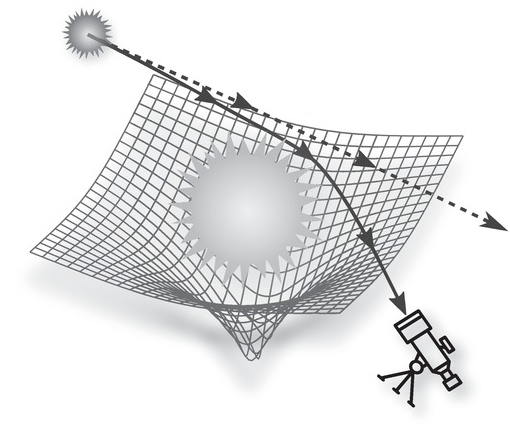
-
Cosmos Created Mind
According to the Buddha, my Reality is an Illusion based on a misinterpretation. Presumably, the Reductionism of modern Science constructs an illusory, yet practical, model of reality, that allows humans to control Nature for their own ends. Hence, for practical purposes, in the physical world, we don't need to know much about the ghostly metaphysical Ideality that supposedly surrounds us. Knowledge of Metaphysical Truths is only useful for arguing with other philosophers about True Reality. Ideality is how we imagine how the world ought to be.↪Gnomon
I was hoping that someone else could explain how they know that the Cosmic Mind is transmitting thoughts into human brains.
Well the way I envision this is that I consider the idea that separation is illusory. In which case there is no requirement for anything to be transmitted. The information is already at its destination. In a sense our whole world, body, brain, mind is an elaborate mechanism preventing us consciously accessing the information that we already know. — Punshhh
I'm currently reading Federico Faggin's, Irreducible, which also posits that Mind (Consciousness) per se is the true Reality. He calls that universal Mind : The One*2, which is defined as the Whole of which we human persons are a minuscule particle. It's as-if the metaphorical One is an ocean and I am a sentient molecule of water, ignorant of its own all-encompassing habitat. Or another metaphor is that The Cosmos is like a sentient being, and I am just a single semi-sentient cell in her body.
However, lacking a direct revelation from the Cosmic Consciousness, my local physical & mental reality is all I can know for sure. Which is why I no longer accept the Judeo-Christian-Islam scriptures as evidence of a higher reality : they don't speak directly to me. So I would have to accept their Holy Word on blind faith. The scriptures explain that my own self-conceit is what "prevents" me from conceiving of The Cosmic Self. I can accept The One as an allegory --- God knows or realizes Herself via humans --- but not as an actual loving Being. If I already possess that divine "information", I am not aware of it. :smile:
*1. In Buddhism, the "illusion"isn't that nothing exists, but that our perception of reality is fundamentally distorted by ignorance, leading to suffering (dukkha). Key Buddhist illusions include the belief in a permanent, independent self, clinging to impermanent things as lasting, and seeing the continuous world as static. By understanding these misperceptions through practices like meditation, one can dismantle the ego and realize interconnectedness, achieving liberation from suffering.
https://www.google.com/search?client=firefox-b-1-d&q=buddha+illusion
Note --- I have my little aches & pains, but very little emotional suffering. So, my attempts at meditation didn't provide much Moksha. And I'm too close to The End for the impermanence of life to be scary.
*2. "The One" : refers to physicist and inventor Federico Faggin's theory of consciousness, where "the One" is a universal, holistic quantum field that is the fundamental basis of reality, desiring to know itself through self-reflection, with individual consciousnesses as points of view within this unified field, bridging science and spirituality through concepts like love and unity. Faggin, known for inventing the microprocessor, experienced a profound spiritual awakening that shifted his focus from materialist science to consciousness as the ground of being, exploring how mind and matter interconnect.
https://www.google.com/search?client=firefox-b-1-d&q=faggin+the+one
Note --- Faggin obviously has broad & deep knowledge of Science and Philosophy. But how does he know what the universal quantum field "desires"? Can I choose to accept or to block Mystical Knowing? -
Cosmos Created Mind
Yes. Energy is the cause of physical change, while material particles are the things that are in flux. Change >>> Time ; Matter >>> Space. The initial state of the Big Bang theory required two pre-bang things that can't be accounted for : Causal Energy and change-regulating Natural Laws. Both must be pre-existent in order to explain the something-from-nothing event*1 that Cosmologists have calculated by back-tracking current events. So, if Cause & Laws pre-date the space-time bubble we now inhabit, then for all practical purposes, they are eternal. Hence, Energy must be "conserved" because it is essential to the continuing existence of the physical universe.The problem with 'energy' is that it is defined in physics as a property of physical objects and physical systems. And while, for instance, in experiments it has been observed that energy is conserved while particles are not. . . . .
In the same way, energy is not a substance that composes matter. — boundless
And yes, Energy is not a physical or material substance, but a quality or property of the world that transforms & sustains the stuff we, and the world, are made of*2. Aristotle knew nothing of modern physics, but he inferred from his observations of Nature (Phusis) that the "stuff" of reality (hylomorph) is a combination of tangible Matter (raw potential : e.g. clay) and knowable Conformation (Platonic Form ; design pattern : sculptural intent). Therefore, Energy is the immaterial power (essence) that causes Matter to take-on different forms.
The physical Universe is known to be temporary, but the metaphysical Cosmos may be eternal*3 (i.e. the source of Cause & Laws that powered and enformed the Big Bang). The OP noted that the philosophy of Noetics postulates that the eternal Cosmos is the "Mind of God". And that the cosmic Mind somehow transmits Ideas (morph ; form) into human Brains (hyle ; matter). I can understand that as a philosophical metaphor, but how could we confirm that spooky notion as a scientific fact? Is Energy a signal from Cosmos to local minds & matter? :wink:
*1. The Big Bang theory describes the universe expanding from an incredibly hot, dense state about 13.8 billion years ago, marking the beginning of space, time, matter, and energy, but it doesn't fully explain what caused that initial state or what existed "before". Modern physics suggests "nothing" isn't truly empty; quantum fluctuations in a pre-existing quantum vacuum might have seeded the Big Bang, or theories like cosmic inflation describe the rapid growth from a near-nothing state, with ideas like the "Big Bounce" suggesting a previous universe's end catalyzed ours
https://www.google.com/search?client=firefox-b-1-d&q=big+bang+something+from+nothing
*2. Substances : primary realities ; qualities, quantities, etc., depend on them for existence.
Matter : The physical stuff, changeable, potential.
Form : The essence, structure, or universal definition that makes something what it is
https://www.google.com/search?client=firefox-b-1-d&q=aristotle+substance
*3. "Space-time bounded by eternity" suggests a concept where the vast, four-dimensional fabric of the universe (space-time) isn't infinite but exists within a greater, timeless reality (eternity) or that all of time and space exist simultaneously as a fixed "block," challenging our perception of linear time, often explored in physics (eternalism) and philosophy to reconcile the universe's existence with timeless concepts of God or ultimate reality, implying our experienced time is just a slice of an ever-present whole.
https://www.google.com/search?client=firefox-b-1-d&q=space-time+bounded+by+eternity -
Cosmos Created Mind
misinterpreted my reference to Energy as a "postulated force"*1, analogous to "spiritual energy"*2. That was not intended as a religious assertion, but simply as a philosophical (metaphysical) concept. Over the years, scientists have postulated the existence of things they couldn't demonstrate. For example Einstein's postulate of curved space sounded silly, but it's now accepted by physicists as a "basis for reasoning"*3. Likewise, some religious believers postulate the existence of ghosts, as a basis for "belief", even though the only evidence may be vague wispy light reflections or spooky sounds.energy isn't just a 'postulated force' — Wayfarer
When one gets tired, it isn't that one is low on energy, but that one is low on useful energy - the kind that the muscles need. The quality of energy can decay, but never its quantity. — PoeticUniverse
Energy, even in the form of photons, is invisible & intangible until it is transformed into matter. But it is capable of causing phenomenal changes in the real world. So, what you mean by "quality of energy" may refer to the distinction between "free" (causal) energy and "bound" energy (matter). In my own thesis, Energy is described as a "shape-shifter" : changing form from qualitative Potential to quantitative Actual and back again.
Free Energy (useable, available, potential) is also associated with mental processes*3, such as Inference & FreeWill. Likewise, my notion of Universal Causation (EnFormAction) applies to both physical Energy and metaphysical Inference. So, when your muscles get tired, available physical/material energy (e.g. ATP) has been transformed into motion, and then into waste energy (CO2 & H2O). But the latter are only Potential (metaphysical), not Actual (physical) Energy, until a causal transformation recombines them via form change. :nerd:
*1. Postulate : a thing suggested or assumed as true as the basis for reasoning, discussion, or belief.
Planck's Quantum Postulate
Bohr Model Postulates
Conservation of Energy
Schrödinger Equation Postulates
In essence, "energy is postulated" means these core ideas about energy's behavior are fundamental assumptions upon which larger, successful physical theories are built, often confirmed by experiments
https://www.google.com/search?client=firefox-b-1-d&q=energy+is+postulated
*2. "My point was simply that Energy is not a tangible material substance, but a postulated immaterial causal force (similar to electric potential) that can have detectable (actual) effects in the real world : similar to the spiritual belief in ghosts."
*3. The free energy principle is based on the Bayesian idea of the brain as an "inference engine." Under the free energy principle, systems pursue paths of least surprise, or equivalently, minimize the difference between predictions based on their model of the world and their sense and associated perception.
https://www.google.com/search?client=firefox-b-1-d&q=%22free+energy%22+faggin
Free Energy
The wind is free, the machine is not.
You ether build, or pay a lot.
If you look, and really see.
Nothing is, truly free.
By Josefh Lloyd Murchison -
Cosmos Created Mind
My point was that Energy is logically inferred, not physically observed. I was not implying that it is not a real phenomenon. But over many centuries, various "energies" have been postulated or dismissed as spiritual (metaphysical) forces. Personally, I don't think in terms of spiritual forces*1, or deeper essences, or degrees of reality. However, I do use the term "physical energy" as an instance of a Universal Causal Force*5 in the world : EnFormAction. Which I label as metaphysical*4, because it is inferrable, but not observable. It's intended to be a science-based update to ancient spiritual speculations.My point was simply that Energy is not a tangible material substance, but a postulated immaterial causal force (similar to electric potential) that can have detectable (actual) effects in the real world : similar to the spiritual belief in ghosts. — Gnomon
The comparison to a 'spiritual belief' misses the mark because energy is a strictly defined physical property, not a metaphysical posit. While it isn't a 'tangible substance' like a rock, it is inextricably linked to matter via e=mc2. It has measurable physical effects, including gravity. — Wayfarer
In my reply to I noted : "Scientists & philosophers have for many years attempted to account for the otherwise inexplicable evolutionary emergence of Life (animated matter) and Mind (thinking matter) with a variety of hypothetical postulations : ancient Greek vitalism, Eastern Chi or Prana*2, Bergson's elan vital*3, Schopenhauer's will-to-live, and more recently Whitehead's Process philosophy (evolutionary change over time)". :smile:
*1. Spiritual energy is an invisible life force connecting all living things, known by names like prana, chi, or life force, felt as a subtle vibration influencing physical, mental, and emotional well-being, fostering peace or depletion based on balance. It's seen as a deeper essence of life, linking individuals to the universe and a greater purpose through practices like self-care, compassion, and connecting with nature, art, or community, often managed through energy centers like chakras
https://www.google.com/search?client=firefox-b-1-d&q=spiritual+energies
*2. In Hinduism, Prana (प्राण) is the Sanskrit word for "life force" or "vital energy," the universal principle that animates all living beings, flowing through the body in channels (nadis) and associated with breath, which is a primary way to absorb and control it. It's considered the subtle energy that fuels our physical, mental, and spiritual existence, categorized into five vital airs (Vayus) like Apana, Samana, Vyana, and Udana, with practices like Pranayama (breath control) used to balance and direct it for health, focus, and spiritual growth.
https://www.google.com/search?client=firefox-b-1-d&q=prana+hinduism
*3. Élan vital (French for "vital impetus" or "vital force") is a philosophical concept by Henri Bergson describing the creative, driving force behind evolution, an inner push that makes life complex and diverse, diverging from simple matter and mechanical processes. It's a dynamic, non-physical energy that propels living organisms to adapt and grow, contrasting with materialistic views and influencing ideas on consciousness, creativity, and the spirit of life itself.
https://www.google.com/search?client=firefox-b-1-d&q=elan+vital
*4. Gravity waves, both atmospheric (in fluids like air/water) and spacetime ripples (gravitational waves), are fundamentally physical phenomena, described by physics, but they intersect with metaphysics in deeper questions about the nature of spacetime, quantum gravity, and reality itself, especially when trying to unify relativity and quantum mechanics. While the observation and description are physics, interpreting their ultimate nature (e.g., is spacetime truly a "thing"?) delves into metaphysical realms.
https://www.google.com/search?client=firefox-b-1-d&q=gravity+waves+physical+or+metaphysical
*5. Federico Faggin "Vital Force" refers to the theories of physicist and microprocessor inventor Federico Faggin, who posits that consciousness is fundamental to reality, not a byproduct of matter, and is the "vital force" driving the universe, explaining quantum physics and free will. He developed Quantum Information Panpsychism (QIP) suggesting consciousness is a primary quantum phenomenon, with matter as the "ink" it uses to know itself, bridging science and spirituality
https://www.google.com/search?client=firefox-b-1-d&q=faggin+vital+force -
Cosmos Created Mind
My comment was a response to your post about philosophical notions on the Reality vs Ideality of Potential vs Actual*1. I was simply referring to a common scientific/philosophical position on a practical distinction between objective observed concrete Knowable Reality and subjective imaginary abstract Hypothetical Concepts .Energy is considered a real thing even though it's knowable only in its effects, not in its material substance. — Gnomon
Nope. Not the point. The profound point is that there are real degrees of reality. — Wayfarer
My point was simply that Energy is not a tangible material substance, but a postulated immaterial causal force (similar to electric potential) that can have detectable (actual) effects in the real world : similar to the spiritual belief in ghosts. The mundane implication is that Potential is functionally not-yet-real, but I made no assertion about its parallel existence in an immaterial invisible realm of Platonic Forms. Which I don't envision as a higher plane of existence, but merely a concept about a possible unknown source of ideas for the human mind. Perhaps a mythical Cosmic Mind as in Noetics.
But your Point is that reality is a simultaneous multi-level phenomenon??? Is that similar to the belief that there are "degrees" or levels-of-reality*2 that are obvious to our physical & technological senses, and other realms (parallel universes?) that are invisible and occult, except to extra-sensory perception, or through the eyes of Faith? Sadly, I seem to be blind to Hyperreality*3. :wink:
*1. From Wayfarer post above :
"In the... paper, three scientists argue that including “potential” things on the list of “real” things can avoid the counterintuitive conundrums that quantum physics poses."
Note --- That sounds like an arbitrary assignment to a category, not a verifiable class of "things".
*2. "Degrees of reality" refers to philosophical ideas that existence isn't all-or-nothing, but rather a hierarchy where some things are "more real" than others, often based on independence (like Plato's Forms vs. physical objects) or structure (like Descartes' substances vs. modes). These concepts vary, ranging from objective vs. subjective views (scientific facts vs. beliefs) to layered realities (personal, social, physical) or even spiritual levels (Plotinus's God, intellect, soul, matter).
https://www.google.com/search?client=firefox-b-1-d&q=degrees+of+reality
*3. Hyperreality describes a state where simulations and representations become indistinguishable from, or even preferred over, genuine reality, a concept developed by Jean Baudrillard in postmodern culture,
https://www.google.com/search?client=firefox-b-1-d&q=hyperreality -
Cosmos Created Mind
No. It doesn't make sense to me. That's why I posted the reference to Noetics (study of sentience & intellect) in the OP. I was hoping that someone else could explain how they know that the Cosmic Mind is transmitting thoughts into human brains. So far, no-one has commented on the Noetic angle, but merely continue the ancient & everlasting Idealism vs Realism arguments that make-up the bulk of diametrically opposed TPF threads. Panpsychism*3 is not exactly the same as Noetics, but quite a few serious secular scientists have publicly stated that they accept it as an axiom for cracking the Hard Problem of Consciousness. My personal Noetic nut-cracker is EnFormAction*4. :smile:The key presumption is that Consciousness is non-local, but Cosmic (Pantheism ; Panpsychism). — Gnomon
Could you please explain how and why this is the case? Does it make sense? — Corvus
*1. From OP --- Background : I recently finished Dan Brown's new novel, Secret of Secrets, and enjoyed the intellectual thrill ride completely. Spoiler Alert! : If you are not familiar with the book, I'll reveal the "secret" hidden in plain insight : human consciousness, and its alter ego The Mind, is not generated by the brain, but is instead a signal from out there somewhere*2b. If so, what are the special "Noetic faculties" of the human animal*3? Are these spiritual signals the distinguishing factor of homo sapiens?
Note --- The notion of the human brain receiving broadcasts from the universal Mind is merely a fictional device used by Brown to serve as the spooky "secret" in his novel. But Noetics is a real philosophical position postulated by real people. But, as I said in the OP : " I find it difficult to accept that my thoughts & feelings are signals from some central transmitter, like the robotic clone army of Star Wars."
*2. Noetics and idealism are related philosophical concepts concerning the nature of reality and knowledge, with idealism being a metaphysical stance and noetics a branch of philosophy focused on the mind and intellect. Noetics is often explored within an idealist framework.
https://www.google.com/search?client=firefox-b-1-d&q=noetics+vs+idealism
*3. Scientists and philosophers are increasingly exploring panpsychism, the idea that consciousness is fundamental to the universe, not just complex brains, to solve the "hard problem" of consciousness, though it faces challenges like the "combination problem" (how micro-consciousness forms macro-consciousness) and lacks direct experimental proof, with some physicists and neuroscientists supporting it as a valid scientific avenue for integrating mind into matter, while others remain skeptical, calling for concrete physics.
https://www.google.com/search?client=firefox-b-1-d&q=scientists+and+panpsychism
*4. "Enformaction" isn't a standard English word but appears in philosophical discussions (especially on The Philosophy Forum) to describe the concept of information as potential or the power to change form, linking energy, form, and action in a metaphysical sense, suggesting information is the underlying "structure" or "ideal" behind physical reality. It's used to explore how abstract data (like ideas or memories) can manifest physically (on paper, hard drives) and vice versa, emphasizing that the physical carrier (paper, disk) matters less than the information itself.
https://www.google.com/search?client=firefox-b-1-d&q=enformaction
Note --- This is an AI version of my concept of EnFormAction, not in my own words. -
Cosmos Created Mind
Yes. I suppose it's accounting for physical changes that would otherwise seem like magic. Give it a mundane name, and it sounds more technical, and seems less spooky. In my thesis, I call that "deeper structure" EnFormAction*1. Scientists & philosophers have for many years attempted to account for the otherwise inexplicable evolutionary emergence of Life (animated matter) and Mind (thinking matter) with a variety of hypothetical postulations : ancient Greek vitalism, Eastern Chi or Prana, Bergson's elan vital, Schopenhauer's will-to-live, and more recently Whitehead's Process philosophy (evolutionary change over time).Energy is an accounting number, its conservation suggesting some deeper structure. — PoeticUniverse
But all of these motivating & transforming forces seem similar, in causal effect, to the modern notion of physical Energy (power, ability, potential, capability), in various invisible intangible forms : gravity, photons, vacuum energy, virtual particles, etc. So, I lump them all together into the concept of EnFormAction*2. Note the Cosmic Mind interpretation below that may be relevant to the OP. What makes the world go round : energy or conatus? :smile:
*1. The concept of a river of causation running through the world in various streams has been interpreted in materialistic terms as Momentum, Impetus, Force, Energy, etc, and in spiritualistic idioms as Will, Love, Conatus, and so forth. EnFormAction is all of those.
https://blog-glossary.enformationism.info/page8.html
*2. EnFormAction :
As a supplement to the mainstream materialistic (scientific) theory of Causation, EnFormAction is intended to be an evocative label for a well-known, but somewhat mysterious, feature of physics : the Emergent process of Phase Change (or state transitions) from one kind (stable form) of matter to another. These sequential emanations take the structural pattern of a logical hierarchy : from solids, to liquids, to gases, and thence to plasma, or vice-versa. But they don't follow the usual rules of direct contact causation.
Expand that notion to a Cosmological perspective, and we can identify a more general classification of stratified phase-like emergences : from Physics (energy), to Chemistry (atoms), to Biology (life), to Psychology (minds), to Sociology (global minds). Current theories attribute this undeniable stairstep progession to random accidents, sorted by “natural selection” (a code word for “evaluations” of fitness for the next phase) that in retrospect appear to be teleological, tending toward more cooperation of inter-relationships and entanglements between parts on the same level of emergence. Some AI enthusiasts even envision the ultimate evolution of a Cosmic Mind, informed by all lower level phases.
https://bothandblog3.enformationism.info/page23.html
# Some people said that energy doesn't exist physically and it is not fundamental, but it is a relationship between other fundamental things.
https://physics.stackexchange.com/questions/484707/does-energy-exist-or-is-it-just-a-relationship-between-other-fundamental-things

-
Cosmos Created Mind
Yes. In modern physics, Energy is considered a real thing even though it's knowable only in its effects, not in its material substance. Energy as potential is an Aristotelian "substance" only in the sense of an invisible essence that is capable of transforming into the tangible substance we know as Matter.↪Paine
↪Gnomon
↪Esse Quam Videri
(I have to briefly sign back in - shhhh - to mention an article I've found interesting, about how Heisenberg re-purposed Aristotle's 'potentia' in respect to quantum physics Quantum mysteries dissolve if possibilities are realities:
In the... paper, three scientists argue that including “potential” things on the list of “real” things can avoid the counterintuitive conundrums that quantum physics poses. — Wayfarer
Ari's notion of two-phase substance (potential & actual) has always been confusing from a materialist perspective. In my own thesis, I combined potential Energy & Information into the coinage EnFormAction : the power to transform potential Form (design, essence, information) into actual Shapes (structure, matter, hylomorph) and vice versa. Which is what Einstein's equation spells out : (E = MC^2). :smile:
Energy, in the form of Light, is not a local thing, but a dynamic "disturbance" propagating through the universal quantum Field of mathematical points. What we experience locally as Mass (matter) is proportional to the speed of light, which slows-down to form particles of rest-mass-matter. Unfortunately, our matter-based language makes it difficult to express such immaterial (knowable but unsensable) essences & transformations in words. :nerd: -
Cosmos Created Mind
I'll have to admit that Aristotle's definition of a Soul is not clear to me. But it reminds me of similar definitions of Energy as the capacity or ability or potential for work (i.e. material change). In that case, the capacity is not the same as the actuality. It seems more like the potential for actualization, to become realized. So perhaps his Soul is more like our modern notion of Energy : both potential (abstract) and actual (embodied). Embodied Energy is transformed into Matter [E=MC^2, where E is just a number or value, and M is the property (inertia) that makes matter seem actual & real to us]. Anyway, I'm not an Aristotle scholar, so I won't press the issue. :cool:Your depiction of Actual and Potential reverses their roles given in Aristotle's writing:
"But our view explains the facts quite reasonably for the actuality of each thing is naturally inherent in its potentiality, that is in its own proper matter. From all this it is clear that the soul is a kind of actuality or notion of that which has the capacity of having a soul" — Paine
The statement "soul is a kind of actuality" comes from Aristotle's philosophy, specifically his work On the Soul (De Anima), where he defines the soul as the "first actuality (entelecheia) of a natural body that has life potentially". This means the soul isn't just a potential (what a body could be) but the very realization or form that makes a body actually living, like the knowledge a person has even when sleeping, making it the principle that brings matter into a living organism.
https://www.google.com/search?client=firefox-b-1-d&q=soul+is+a+kind+of+actuality+ -
Cosmos Created Mind
Most of the posts on this thread seem to be various philosophical opinions favoring either traditional Idealism (transcendentalism) or Realism (immanentism). But I just came across a book in my library that offers a scientific version of the Cosmic Mind concept. Music publisher, Howard Bloom's 2000 book, Global Brain, presents his postulation of "collective information processing"*1*2*3 on a universal scale. Which is relevant to my own amateur philosophical thesis of Enformationism. Bloom is also the author of The God Problem : How a Godless Cosmos Creates.what is the relationship between World-at-large & local Brain & personal Mind? — Gnomon
Obviously, Global Brain is a speculative hypothesis, and there is no more empirical evidence for a GB than for a Transcendent Deity. In the Prologue, Bloom says, "we living beings have been modules of something current evolutionary theory fails to see". He goes on to postulate that "we are parts of a greater mind constantly testing fresh hypotheses". Do these statements sound more like religion than science? Note --- the use of "brain" instead of "mind" may be an attempt to avoid spiritual connotations.
Has anyone else read the book? How do you think it relates to the theme of this thread? Is there a Cosmic Mind, and are human minds the offspring of that mysterious progenitor? Is human culture on Earth just one element of a top-down Universal Intelligence? Or are human agents, inadvertently and unwittingly, in the process of creating a Cosmic Mind --- or a Singularity --- from the ground-up, so to speak? :smile:
*1. The concept of a "global brain" relates to the theory that humanity, together with its technological agents and communication networks like the Internet, is evolving into a single, interconnected, information-processing system, which functions as the nervous system for a social superorganism
https://www.google.com/search?client=firefox-b-1-d&q=global+brain+study+group+superorganismic+intelligence
*2. Global Brain : The Evolution of Mass Mind from the Big Bang to the 21st Century by Howard Bloom argues that life on Earth is a single, evolving "global brain," a complex adaptive system where individuals are part of a larger social learning machine, from bacteria to humans. The book traces this evolution from the Big Bang, showing how groups (like bacterial colonies, insect swarms, and human societies) have always functioned as collective intelligences, using mechanisms like conformity and diversity to test ideas and adapt, with the internet being the latest phase of this process.
Group Selection :
Bloom posits that evolution isn't just about individual genes, but about groups competing and learning from each other, with successful group traits being passed on.
Social Learning Machine :
He proposes that all life forms, from microbes to humans, are part of a massive, interconnected system for processing information and learning.
Mechanisms of the Global Brain :
The system relies on elements like "conformity enforcers" (to maintain stability) and "diversity generators" (to innovate), which are seen in everything from bacterial colonies to human cultures.
Historical Examples :
The book uses examples like marching lobsters, bee colonies, and ancient Sparta to illustrate how different species have engaged in collective problem-solving and social learning.
The Internet as a New Phase :
The World Wide Web is presented as the most recent and powerful stage in the evolution of this global brain.
Key Takeaway
The book challenges traditional Darwinian views by suggesting that the purpose of life is not just individual reproduction, but the exploration and survival of the "mass mind" through group-level experimentation and competition.
https://www.google.com/search?client=firefox-b-1-d&q=howard+bloom+global+brain
*3. A global brain emergent structure is the concept that the interconnected internet, social media, and AI form a planetary-scale, self-organizing information system, analogous to a biological brain, where collective human and machine intelligence arises from countless interactions, creating higher-level cognition for problem-solving, though decentralized and without a single controller, much like neurons forming a brain. This emergent intelligence processes information globally, similar to how neural networks function, allowing for complex, large-scale tasks beyond individual capacity.
https://www.google.com/search?client=firefox-b-1-d&q=global+brain+emergent+structure -
Cosmos Created Mind
Aristotle distinguished between Soul & Body, just as he made a distinction between abstract Form & concrete Matter. The quote doesn't say this specifically, but I interpret the Soul (ousia, essence, form -- subject?, person?) as Transcendent & Potential, and Body (matter, flesh, substance) as Immanent & Actual.The passage is no starting point for the distinction between immanence and transcendence in the theological sense because nothing is possible if it is not "natural." Aristotle questions the freedom of the "Craftsman" in the Timaeus. A topic that leads to the third paragraph:
412a16. Since it is indeed a body of such a kind (for it is one having life), the soul will not be body; for the body is not something predicated of a subject, but exists rather as subject and matter. The soul must then, be substance qua form of a natural body which has life potentially. Substance is actuality. The soul, therefore, will be the actuality of a body of this kind. — ibid. 412a16 — Paine
So when Potential is Actualized --- e.g. sperm & egg quicken to become one person --- Soul & Body are united into a living-thinking Hylomorph. Theologians later interpreted the Soul as existing eternally and supernaturally, so at death the Soul separates from the natural concrete material body, and returns to its supernatural abstract potential form. Hence, the imaginative notion of a disembodied ghost lurking in some intermediate realm between Nature and Super-nature.
But, going back to the OP, where does the human Mind & Person come into play? Does the transcendent Soul think like a mind? If so, what does it think about? What is it like to be a disembodied Mind? Does the non-personal Cosmic Potential (Nature) somehow create the actual embodied Mind by joining Form & Flesh (abstract essence & concrete substance) into a natural person? :chin: -
About Hume, causality and modern science
Perhaps Hume somehow anticipated the discovery of Quantum Causation*1, which is statistical & uncertain & non-local instead of actual & deterministic & particular. From a local close-up position, we see only single pairs of cause & effect elements. Yet, from a few causal experiences, we can generalize and infer that this current causal event is an effect of a prior cause, and an unbroken chain of causes extending back into infinity. For example, scientists concluded from snapshots of the current expanding astronomical state, we can trace cause & effect back 14 billion Earth-years to a hypothetical physical First Cause : the Big Bang.I just find that Hume's sceptical account of everyday causality, very true in itself, doesn't really take into account the advances of modern science, say like theoretical physics. — hwyl
Therefore, from a cosmic perspective (imaginary of course) we can "see" long chains of cause & effect, or possible teleological trends in transformation. So, by combining a few direct observations with creative conceptualization, we derive the common and scientific notion of energetic-transfer causation.
Hume's skeptical & reductionist & purposeless view disallows optimistic & holistic interpretations of world processes*2. But from a more open-minded perspective*3, the Cosmos seems to show signs of Progression & Teleology*4. :nerd:
*1. Quantum Causality : Bell's Theorem shows that conditions of "local causality" in experiments involving quantum entanglement result in non-classical correlations predicted by quantum mechanics. Despite these subtleties, causality remains an important and valid concept in physical theories.
https://www.google.com/search?client=firefox-b-1-d&q=quantum+causality
*2. David Hume's view on causality argues that we don't perceive a necessary connection between cause and effect, only a "constant conjunction" of events (Event A always followed by Event B). This repeated experience creates a mental habit or expectation, leading us to believe in a necessary power or link, but this isn't a logically certain or empirically observable feature of the world; it's a psychological projection, making causality a matter of custom, not reason or direct perception, a core tenet of his empiricism.
https://www.google.com/search?client=firefox-b-1-d&q=hume+causality
*3. Kant agrees with Hume that neither the relation of cause and effect nor the idea of necessary connection is given in our sensory perceptions; both, in an important sense, are contributed by our mind. For Kant, however, the concepts of both causality and necessity arise from precisely the operations of our understanding—and, indeed, they arise entirely a priori as pure concepts or categories of the understanding.
https://plato.stanford.edu/entries/kant-hume-causality/
Note --- Correlation does not prove Causation. But it does seem "necessary" to our normal "operations of understanding". An event that does not seem necessary feels like magic.
*4. Whitehead's process teleology : posits that the universe isn't moving toward a fixed goal but is inherently driven towards the production and intensification of beauty, understood as the harmonious contrast of diverse experiences, lured by a divine "primordial nature" that presents possibilities for richer, more complex unifications. This teleology is open and creative, meaning purpose emerges from each moment (actual occasion) making decisions about possibilities (eternal objects) to form new experiences, leading to an evolving, never-finished cosmos where beauty, novelty, and value are intrinsic aims, not just human constructs
https://www.google.com/search?client=firefox-b-1-d&q=whitehead+process+teleology
WHAT IS THE CAUSE OF APPARENT COSMIC EXPANSION?
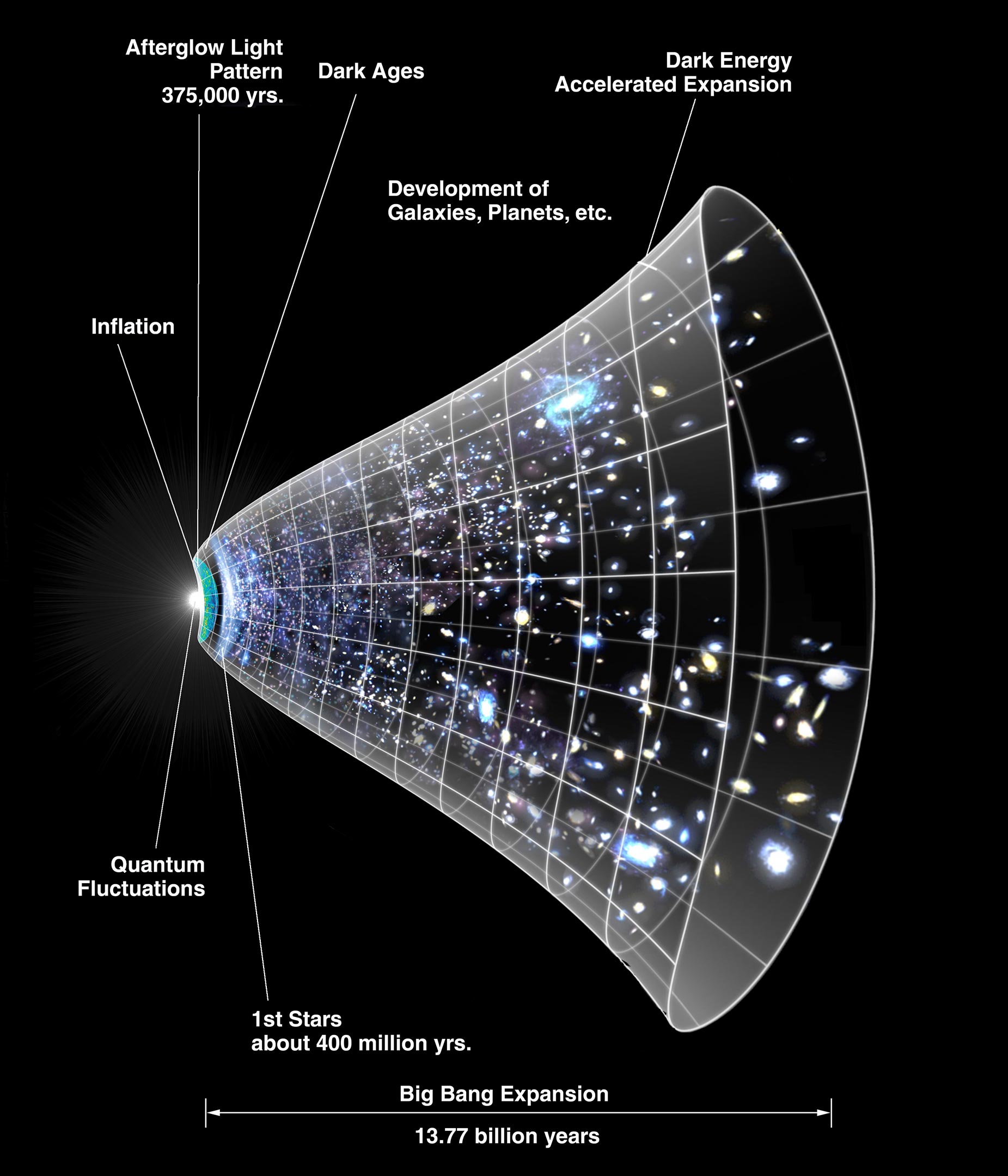
-
Cosmos Created Mind
Apparently, disagrees with your definition of Philosophical questioning. He seems to picture himself as a Socratic gadfly, arguing against the Sophists, whose fallacious logic and situational rhetoric was goal-oriented instead of truth-seeking. In my early reading about Philosophy, Socrates was portrayed (by Catholic theologians?) as the good-guy, separating True from False, and the Sophists*1 were bad-guys, preaching relativity & subjectivity. Yet, unlike 180's sneering & disparaging & humiliating trolling-technique, Socrates' philosophical method*3 was dialectical & didactic & persuasive.How else do we know "what is true"? — Gnomon
Notice that in the context of science, this is usually limited to a specific question or subject matter, but can also then be expanded to include general theories and hypotheses. Philosophical questions are much more open-ended and often not nearly so specific. That is the subject of another thread, The Predicament of Modernity. — Wayfarer
Now, I'm beginning to see that the Sophists' "practical wisdom" may have been anticipating the subjective relativity*2 of Einstein. Today, the notion of absolute Truth is relegated to revealed religions, while pragmatic Science makes-do with Bayesian truths. My own "open-ended" BothAnd philosophy is holistic & complementary & inclusive, instead of a dogmatic Either/Or belief system, which is reductive, binary, & exclusive.
I guess the Predicament of Modernity is highlighted by the Classical (deterministic) vs Quantum (probabilistic) revolution in worldviews. Transcendent truths are inherently subjective conjectures, not objective observations. So, how does 180 know what is objective capital-T-truth*4, while I have to get by with my little subjective perspective? :cool:
*1. The Sophists were ancient Greek thinkers who emphasized relativism, believing truth, knowledge, and morality are subjective and depend on human perspective, famously stated by Protagoras' maxim, "Man is the measure of all things". They taught rhetoric as a vital skill for success in politics, focusing on practical wisdom and the power of persuasive speech (logos) to shape reality, often contrasting with Socrates' search for universal, objective truths. Key beliefs included skepticism, conventionalism (laws are human-made), and humanism, seeing humans and their needs at the center of philosophy, not divine mandates.
https://www.google.com/search?client=firefox-b-1-d&q=sophists
*2. Einstein's Relativity fundamentally changed philosophy by showing space and time aren't absolute but relative to an observer (Special Relativity) and that gravity is the curvature of spacetime (General Relativity), challenging concepts of universal "now" and introducing a geometric view of the cosmos, influencing epistemology, metaphysics (reality of space/time), and even religion through his idea of a "cosmic religion" based on nature's order.
https://www.google.com/search?client=firefox-b-1-d&q=einstein+relativity+philosophy
*3. The Socratic Method is a teaching and discussion technique named after Socrates, using persistent, probing questions to guide individuals toward deeper understanding, uncovering assumptions, identifying contradictions, and fostering critical thinking rather than simply giving answers. It's a dialectical process of dialogue, discovery, and self-examination, moving from what a person knows to complex truths by systematically challenging ideas through carefully planned questions, aiming for clearer, more consistent thought
https://www.google.com/search?client=firefox-b-1-d&q=socratic+method
*4. "Capital T Truth" (or Big T Truth) refers to universal, absolute, objective reality or fundamental principles beyond personal belief, contrasting with "little t truths," which are subjective, contextual, or individual perspectives/facts (e.g., "my truth"). Think of it as the ultimate, overarching reality versus specific, smaller truths or experiences, often used in philosophy and religion to discuss transcendent concepts like Beauty, Good, or Truth itself, as opposed to mere factual statements
https://www.google.com/search?client=firefox-b-1-d&q=capital+t+truth -
Cosmos Created Mind
Ha! I don't do a lot of "presuming" about such technical questions, because that is peripheral to my amateur philosophy hobby. But I'm currently reading a book by Federico Faggin*1, who is a credentialed expert in computer-related technology. And he details a variety of "problems" and "specific issues" that could limit software & hardware design from reaching the goal of duplicating human reasoning.You're presuming that "real world" human reasoning is somehow beyond duplicating. I don't see any problems at all, because any specific issue you might bring up could be dealt in the design- either in software or hardware. — Relativist
Faggin seems to be an Idealist, who believes that Consciousness is fundamental, and the human Mind is irreducible to physical processes. Personally, I have a slightly different view of the foundations of human thought. But hey! What do I know? I'm just an untrained amateur philosopher, and he is an experienced computer guru. :smile:
*1. Irreducible : Consciousness, Life, Computers, and Human Nature is a 2024 book by Federico Faggin, the inventor of the microprocessor, that argues consciousness is a fundamental quantum phenomenon, not an emergent property of complex computation, challenging the idea that humans are just biological machines.
https://www.google.com/search?client=firefox-b-1-d&q=irreducible+book -
Cosmos Created Mind
Of course fuzzy logic is algorithmic to some degree or it wouldn't be programmable for digital computers. But it's much more flexible & adaptable to the non-algorithmic real world than sharp line-item programming. Perhaps it was attempt to simulate human-style Bayesian logic*1 (degrees of truth) by introducing uncertainty & probability into an otherwise deterministic & predictable program.Fuzzy logic and paraconsistent logic ARE algorithmic- it's feasible to program these. The programmming could keep it predictable (a given input will necessarily produce the same output), or randomness could be introduced. — Relativist
Footnote*2 indicates that just fuzzing the algorithms was not enough to make computers think like humans. AI and ChatBots are getting closer to that dumbing-down goal by introducing human-like if-then rules. But self-awareness seems to require something a bit beyond just fuzzing the focus : a generalized contextual worldview and an embodied subject. :smile:
*1. "Non-algorithmic fuzzy logic"generally refers to the conceptual foundation of fuzzy logic (dealing with degrees of truth and human-like reasoning), distinct from the specific algorithms or hardware implementations that make it work in computer systems.
https://www.google.com/search?client=firefox-b-1-d&q=non-algorithmic+fuzzy+logic
*2. Fuzzy logic was an overhyped 90s phenomenon that was largely based on the belief that one could design a control system without an understanding of control theory and somehow it would magically turn out better. That reality never materialized. . . . .
fuzzy logic is itself a mathematical concept born out of fuzzy sets and probability. It's basically just a tool to describe imprecise or incomplete information when working in a discrete system.
https://www.reddit.com/r/engineering/comments/pwht4f/whatever_happened_to_fuzzy_logic/ -
Cosmos Created Mind
That's an interesting way to look at the consciousness conundrum. Living organic plants could not survive if they didn't sense their environment, and interact with it in a manner controlled by self-interest. The Consciousness definition below includes a social factor (with) that might help to distinguish human-style awareness from plant & amoeba sensitivity to internal needs and external goods. As social beings, we need to be aware of what our fellows are aware of. :smile:Now I hold that plants are conscious, just not like us. But they are alive and present and conscious in a more meditative state than us, because they don’t have a brain. . . . .
Describing and recording data about something and transferring that data to us. But just in a different way, a way that includes conscious behaviour, but which the tree is entirely unconscious of, rather like the way the AI is entirely unconscious of what it is doing. — Punshhh
*1. The word consciousness comes from Latin conscientia, meaning "shared knowledge," combining con- (with) and scire (to know), initially implying joint awareness or a shared secret. It evolved in English in the 17th century, first meaning "internal knowledge," then expanding to "awareness of one's own mind" (1670s) and later "awareness of anything" (1740s). The term has roots in the Latin conscius (knowing with) and its Greek predecessor syneidesis, highlighting a core idea of knowing alongside or within oneself.
https://www.google.com/search?client=firefox-b-1-d&q=consciousness+etymology -
Cosmos Created Mind
Yes. As an anti-social introvert, I am not temperamentally attracted to emotional social religions. I suppose dull rational internet philosophy is my religion substitute. :nerd:There's also the matter of temperament. Some are temperamentally drawn to religious ideas, others are temperamentally averse to them. — Wayfarer
Gnomon

Start FollowingSend a Message
- Other sites we like
- Social media
- Terms of Service
- Sign In
- Created with PlushForums
- © 2026 The Philosophy Forum