
-
 hwyl
88I just find that Hume's sceptical account of everyday causality, very true in itself, doesn't really take into account the advances of modern science, say like theoretical physics. It's not about any crude empirical observations about repeating things, it's getting into the actual structure and nature of physical processes, making predictions that have been impossible to test in their time and only long afterwards verified. Having theorems that might actually be permanently impossible to test empirically. I think this is a category rather separate from things regularly falling from heights in the late 18th century.
hwyl
88I just find that Hume's sceptical account of everyday causality, very true in itself, doesn't really take into account the advances of modern science, say like theoretical physics. It's not about any crude empirical observations about repeating things, it's getting into the actual structure and nature of physical processes, making predictions that have been impossible to test in their time and only long afterwards verified. Having theorems that might actually be permanently impossible to test empirically. I think this is a category rather separate from things regularly falling from heights in the late 18th century.
Though I suppose on some exceedingly remote metaphysical and unreal "ultimate" level we still are observing objects seemingly regularly repeating things, but is it really very insightful to say that as long as we will remain human that there will be room for doubt? That should surely be pretty much self-evident by now. -
 L'éléphant
1.7k
L'éléphant
1.7k
You just pinpointed what is Hume's empirical observation -- it's not about theory or logical deduction. It's about an ordinary person's direct experience or observation at the moment.I just find that Hume's sceptical account of everyday causality, very true in itself, doesn't really take into account the advances of modern science, say like theoretical physics. — hwyl
So if that's your criticism on Hume's skeptical account of causality, then you're not disagreeing with him. -
 BC
14.2kjust find that Hume's sceptical account of everyday causality, very true in itself, doesn't really take into account the advances of modern science, say like theoretical physics. — hwyl
BC
14.2kjust find that Hume's sceptical account of everyday causality, very true in itself, doesn't really take into account the advances of modern science, say like theoretical physics. — hwyl
Hume died in 1776; he wasn't in a very good position to account for developments in physics (relativity, all that) which began around 1900. -
 SophistiCat
2.4kThough I suppose on some exceedingly remote metaphysical and unreal "ultimate" level we still are observing objects seemingly regularly repeating things, but is it really very insightful to say that as long as we will remain human that there will be room for doubt? — hwyl
SophistiCat
2.4kThough I suppose on some exceedingly remote metaphysical and unreal "ultimate" level we still are observing objects seemingly regularly repeating things, but is it really very insightful to say that as long as we will remain human that there will be room for doubt? — hwyl
Hume was an austere kind of empiricist (not unlike Logical Positivists in the 20th century, who valorized him). He accepted that we could, albeit fallibly, discover laws of nature through observation, but he rejected theorizing about ultimate natures ("hypotheses non fingo," as Newton put it and Hume agreed). Along the same lines, he was an anti-realist about unobservable theoretical entities like force and energy, accepting them only as a theoretical convenience.
None of this is in serious tension with modern science - indeed, there are contemporary philosophers who are Humean to some extent. And besides, Hume lived right smack in the middle of the Newtonian revolution. I can think of few examples from the history of science that had as much intellectual impact as that. Darwin comes to mind; Einstein and quantum mechanics - probably not as much. -
 Manuel
4.4kAnd Hume was a mitigated skeptic to boot. He is sometimes caricatured as being a total skeptic. But this is not what he says:
Manuel
4.4kAnd Hume was a mitigated skeptic to boot. He is sometimes caricatured as being a total skeptic. But this is not what he says:
“Shou’d it here be asked, whether I sincerely assent to this argument… whether I be one of those scpetics, who hold that all is uncertain, and that our judgment is not in any thing possest of any measures of truth and falsehood; I shou’d reply, that this question is entirely superfluous, and that neither I, nor any other person was ever sincerely and constantly of that opinion."
In light of this, yes. His attitude is quite compatible with modern science. We do not know if a different result could happen from an experiment we have done thousands of times. -
 Gnomon
4.3k
Gnomon
4.3k
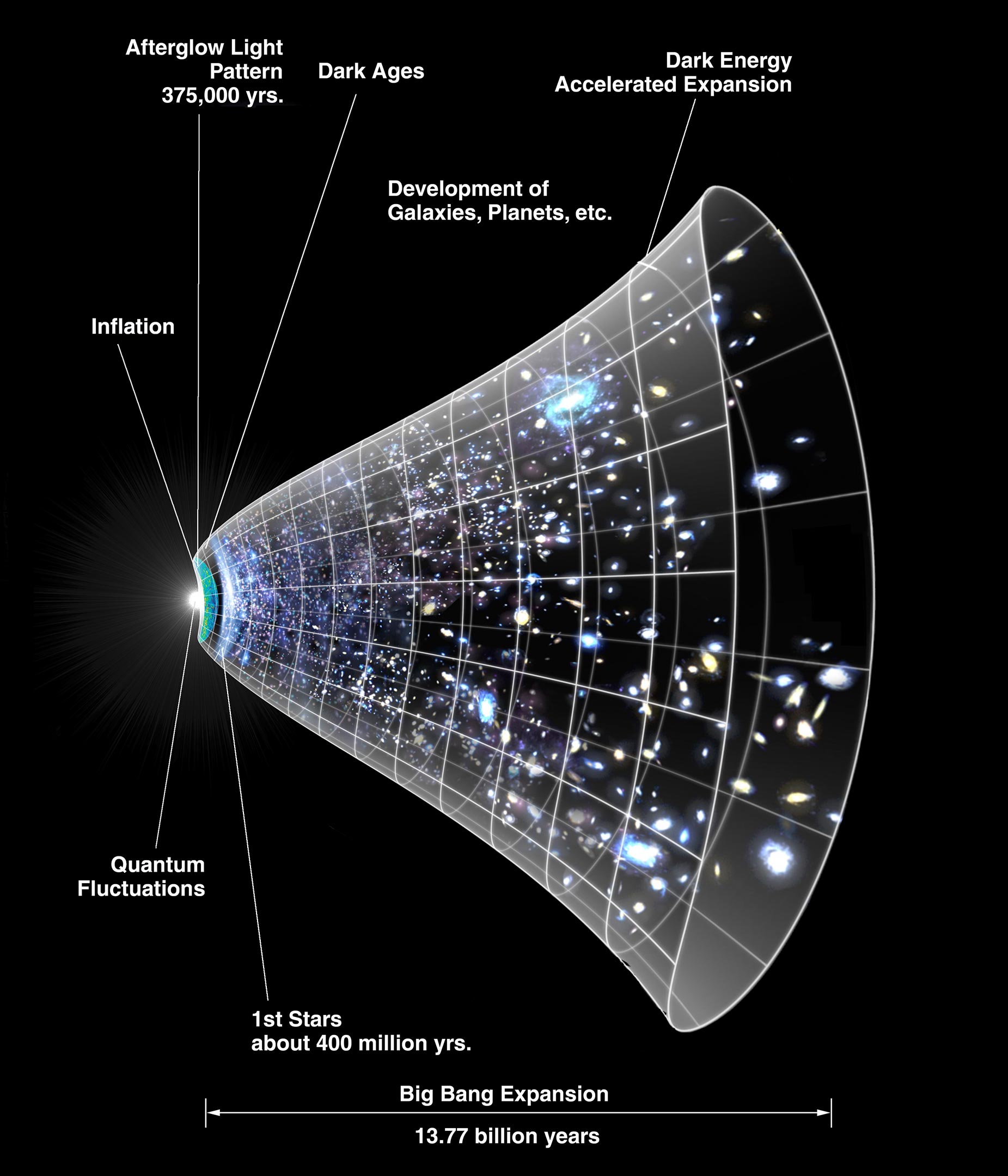
Perhaps Hume somehow anticipated the discovery of Quantum Causation*1, which is statistical & uncertain & non-local instead of actual & deterministic & particular. From a local close-up position, we see only single pairs of cause & effect elements. Yet, from a few causal experiences, we can generalize and infer that this current causal event is an effect of a prior cause, and an unbroken chain of causes extending back into infinity. For example, scientists concluded from snapshots of the current expanding astronomical state, we can trace cause & effect back 14 billion Earth-years to a hypothetical physical First Cause : the Big Bang.I just find that Hume's sceptical account of everyday causality, very true in itself, doesn't really take into account the advances of modern science, say like theoretical physics. — hwyl
Therefore, from a cosmic perspective (imaginary of course) we can "see" long chains of cause & effect, or possible teleological trends in transformation. So, by combining a few direct observations with creative conceptualization, we derive the common and scientific notion of energetic-transfer causation.
Hume's skeptical & reductionist & purposeless view disallows optimistic & holistic interpretations of world processes*2. But from a more open-minded perspective*3, the Cosmos seems to show signs of Progression & Teleology*4. :nerd:
*1. Quantum Causality : Bell's Theorem shows that conditions of "local causality" in experiments involving quantum entanglement result in non-classical correlations predicted by quantum mechanics. Despite these subtleties, causality remains an important and valid concept in physical theories.
https://www.google.com/search?client=firefox-b-1-d&q=quantum+causality
*2. David Hume's view on causality argues that we don't perceive a necessary connection between cause and effect, only a "constant conjunction" of events (Event A always followed by Event B). This repeated experience creates a mental habit or expectation, leading us to believe in a necessary power or link, but this isn't a logically certain or empirically observable feature of the world; it's a psychological projection, making causality a matter of custom, not reason or direct perception, a core tenet of his empiricism.
https://www.google.com/search?client=firefox-b-1-d&q=hume+causality
*3. Kant agrees with Hume that neither the relation of cause and effect nor the idea of necessary connection is given in our sensory perceptions; both, in an important sense, are contributed by our mind. For Kant, however, the concepts of both causality and necessity arise from precisely the operations of our understanding—and, indeed, they arise entirely a priori as pure concepts or categories of the understanding.
https://plato.stanford.edu/entries/kant-hume-causality/
Note --- Correlation does not prove Causation. But it does seem "necessary" to our normal "operations of understanding". An event that does not seem necessary feels like magic.
*4. Whitehead's process teleology : posits that the universe isn't moving toward a fixed goal but is inherently driven towards the production and intensification of beauty, understood as the harmonious contrast of diverse experiences, lured by a divine "primordial nature" that presents possibilities for richer, more complex unifications. This teleology is open and creative, meaning purpose emerges from each moment (actual occasion) making decisions about possibilities (eternal objects) to form new experiences, leading to an evolving, never-finished cosmos where beauty, novelty, and value are intrinsic aims, not just human constructs
https://www.google.com/search?client=firefox-b-1-d&q=whitehead+process+teleology
WHAT IS THE CAUSE OF APPARENT COSMIC EXPANSION?


Welcome to The Philosophy Forum!
Get involved in philosophical discussions about knowledge, truth, language, consciousness, science, politics, religion, logic and mathematics, art, history, and lots more. No ads, no clutter, and very little agreement — just fascinating conversations.
Categories
- Guest category
- Phil. Writing Challenge - June 2025
- The Lounge
- General Philosophy
- Metaphysics & Epistemology
- Philosophy of Mind
- Ethics
- Political Philosophy
- Philosophy of Art
- Logic & Philosophy of Mathematics
- Philosophy of Religion
- Philosophy of Science
- Philosophy of Language
- Interesting Stuff
- Politics and Current Affairs
- Humanities and Social Sciences
- Science and Technology
- Non-English Discussion
- German Discussion
- Spanish Discussion
- Learning Centre
- Resources
- Books and Papers
- Reading groups
- Questions
- Guest Speakers
- David Pearce
- Massimo Pigliucci
- Debates
- Debate Proposals
- Debate Discussion
- Feedback
- Article submissions
- About TPF
- Help
More Discussions
- Other sites we like
- Social media
- Terms of Service
- Sign In
- Created with PlushForums
- © 2026 The Philosophy Forum