
-
 Truth Seeker
1.2k
Truth Seeker
1.2k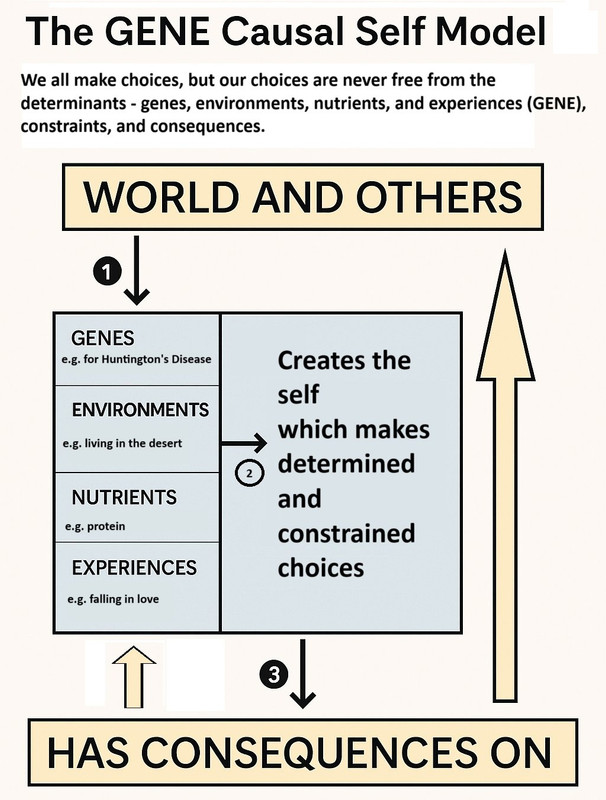
Creatine Transporter Deficiency (CTD) Inside the GENE Causal Self Model
Let’s examine how Creatine Transporter Deficiency (CTD) fits into the GENE framework step by step.
CTD is caused by mutation in the SLC6A8 gene, which encodes the creatine transporter. It is typically X-linked and results in impaired transport of creatine into brain cells.
Creatine is essential for ATP buffering in neurons. When transport fails, brain energy metabolism is compromised.
Now let’s map this directly into my GENE model.
1. GENES
In the GENE model:
GENES → create the self
In CTD:
Mutation → defective creatine transporter → reduced neuronal energy availability → altered neural development → constrained cognitive architecture.
The “self” that develops is already shaped by this constraint before any conscious choice occurs.
This is not philosophical speculation. It is biochemical causation.
2. NUTRIENTS
Creatine is related to nutrients.
However, in CTD:
Adequate dietary creatine ≠ adequate brain creatine.
The problem is not nutrient availability.
The problem is nutrient transport.
So this demonstrates something important in the GENE model:
Nutrients only matter insofar as genes allow them to be processed and used.
This is a G × N interaction.
3. ENVIRONMENTS
Environmental factors still matter:
• Early intervention
• Speech therapy
• Special education
• Structured caregiving
These can improve functional outcomes.
But they operate within biological limits set by the mutation.
So we have:
Genes constrain → Environment modifies within bounds.
4. EXPERIENCES
Because of cognitive and communication limitations, individuals with CTD may experience:
• Frustration
• Social exclusion
• Reinforcement of maladaptive patterns
• Dependency on caregivers
These experiences further shape the developing self.
So the causal chain becomes:
Gene mutation → neurodevelopmental constraint → altered experiences → further shaping of behaviour and identity.
5. CHOICE UNDER CONSTRAINT
Executive functions commonly affected in CTD include:
• Working memory
• Language processing
• Impulse inhibition
• Planning
• Emotional regulation
So the available action space is smaller.
Not metaphorically smaller.
Computationally smaller.
Choice is downstream of neurobiology.
6. CONSEQUENCES AND FEEDBACK
The individual’s actions affect:
• Family dynamics
• Educational systems
• Healthcare resources
• Social responses
Those responses then feed back into:
Environment and Experience variables in GENE.
The model is recursive.
What CTD Demonstrates About the GENE model
CTD clearly shows:
1. A single gene mutation can alter the trajectory of the self.
2. Cognitive capacity depends on metabolic constraints.
3. Executive control is biologically instantiated.
4. “Freedom” is bounded by neurobiology.
5. Moral responsibility must be graded.
When constraints are obvious (as in CTD), everyone recognises reduced responsibility.
The GENE model simply extends that same principle to all cases in degree.
In CTD, we can trace:
Gene mutation
→ Impaired creatine transport
→ Reduced ATP buffering
→ Altered neural development
→ Reduced executive function
→ Constrained choice space
→ Altered consequences
→ Environmental feedback
The system is causally continuous.
There is no metaphysical gap where an uncaused “free self” appears.
CTD, therefore, serves as a concrete neurological case study supporting the GENE Causal Self Model.
But if:
• God creates the person,
• God creates their temperament,
• God creates their environment,
• God foreknows every outcome,
then ultimate moral responsibility cannot rest on the creature.
Foreknown certainty + deliberate creation = responsibility at the highest causal level. If God is real, all suffering, injustice and death are 100% God's fault. -
 BC
14.2kBut if:
BC
14.2kBut if:
• God creates the person,
• God creates their temperament,
• God creates their environment,
• God foreknows every outcome,
then ultimate moral responsibility cannot rest on the creature. — Truth Seeker
It seems like one could make this statement about anything and everything, and religious literalists do say "God is in charge of everything. We have no control over anything." Those same religious literalists then go about their day as if they were in charge of their own lives, in charge of their children, in charge of their farm, factory, firm, or whatever.
On the other hand, there is the 13+ billion year old universe doing its part in shaping our past, present, and future. The galaxies aren't dictating what you or I write, but all sorts of physical and chemical conditions act upon us and our forebears (going back to the simplest one-celled life) to shape what we wish, fear, do, can, can not, and/or don't do. Maybe, somewhere in the mess of causation there is a choice every now and then that makes a difference.
If God is in charge of everything, he has a lot of explaining to do. -
Truth Seeker
1.2kI agree that if God is real, he has a lot of explaining to do. We do make choices, but they are not free from the determinants, i.e. genes, environments, nutrients, and experiences. If you behead a human, he or she can't grow their head back, and he or she will die. If you behead a planarian flatworm, he or she will grow his or her head back and live. The average human born in an English-speaking country can communicate in English, but an average planarian flatworm can't communicate in English or any other human language. The desires and capacities of sentient biological beings are determined and constrained by their genes, environments, nutrients, and experiences.
-
 Corvus
4.8kif God is real, — Truth Seeker
Corvus
4.8kif God is real, — Truth Seeker
Don't you have to prove that God is real prior to further points? Your are introducing a dubious premise which has no proof or foundation here. Until it is proved and accepted as a valid premise, any arguments relating to the dubious premise will remain fictitious. -
BC
14.2kWe do make choices, but they are not free from the determinants, i.e. genes, environments, nutrients, and experiences. — Truth Seeker
then ultimate moral responsibility cannot rest on the creature.
Foreknown certainty + deliberate creation = responsibility — Truth Seeker
Leaving out "ultimate" we generally assign moral responsibility to individuals. Sometimes that is entirely appropriate, because healthy, intelligent individuals plan to maximize success. In the case of crime, prudent criminals try to leave no tracks behind and cover up clues. After all that, they try to avoid prosecution. All very reasonable from the perp's POV. And all that leaves prosecutors with no doubt about moral responsibility.
But... Then there are the cases of children who were abused, subjected to violence, experienced head injuries, lead poisoning, and so on. They grow up with the deck stacked against them, and they may behave criminally. Now assigning moral responsibility is much more difficult. These difficult situations are not rare.
There are millions of cases (billions?) of cases where we behave in ways that, though not criminal, are problematic to ourselves and people around us. If we are careful, we can perhaps see that our behavior was influenced by factors beyond our control.
It takes a lot of self-examination (the considered life) to sort our own behavior. -
Truth Seeker
1.2kIt's not really possible to prove or disprove Gods if they are outside the universe and don't interact with the universe we live in. I am an Agnostic Atheist.
-
Truth Seeker
1.2kBC, I think we are actually closer than it might appear.
You’ve just articulated the gradient problem that my position is built on.
You note:
• In many ordinary cases, we assign responsibility without hesitation.
• In abuse, trauma, neurological damage, toxin exposure, etc., responsibility becomes harder to assign.
• Much of our everyday problematic behavior is influenced by factors beyond our control.
• It takes deep self-examination to untangle this.
Exactly.
That progression is not a side note. It is the core insight.
What you’re describing is a sliding scale — a responsibility gradient. The more we understand causal determinants, the less confident we become in simple, binary moral blame.
The “healthy, intelligent criminal who plans carefully” looks maximally responsible — until we zoom in:
• Why does he value success over empathy?
• Why does he possess higher executive function but low affective concern?
• Why was he not shaped by early attachment bonds that suppress antisocial strategy?
• Why did his neurodevelopment produce his particular reward circuitry?
At each layer, we uncover determinants.
Genes.
Prenatal biology.
Nutrition.
Attachment patterns.
Cultural reinforcement.
Peer modelling.
Socioeconomic pressures.
Education.
Trauma exposure.
Neurochemistry.
Chance encounters.
Change one variable, and you alter the trajectory.
The “deck stacked” cases simply make the determinants more visible. The high-functioning criminal case hides them better.
The fact that we struggle more with assigning blame in trauma cases is not an exception to the rule — it reveals the rule.
Now, to your point about “leaving out ultimate.”
In everyday practice, yes — societies assign proximate responsibility. We have to. Law operates pragmatically.
But the philosophical question I raised concerns ultimate grounding.
If:
• A being creates a person,
• Designs their temperament,
• Selects or permits their environment,
• Foreknows every choice with certainty,
then the causal chain never escapes that originating will.
That is not about everyday courtroom attribution. It is about metaphysical authorship.
And here is the crucial distinction:
In a naturalistic determinist model, no biological organism is ultimately responsible — because no biological organism authored the entire causal web.
In a theistic creation model with foreknowledge, God did.
That is why “Foreknown certainty + deliberate creation = responsibility.”
You are absolutely right that self-examination reveals how little control we truly have over our behavioral formation.
But that insight strengthens the determinist critique — it doesn’t weaken it.
The more we understand psychology, neuroscience, trauma, epigenetics, and social conditioning, the less coherent retributive blame becomes.
Which is why I advocate:
• Protection where necessary.
• Rehabilitation where possible.
• Prevention wherever feasible.
• Compassion universally.
Not because actions don’t matter.
But because people are causal systems — not self-originating authors.
And if one posits a self-originating Creator who set the entire chain in motion with full foresight, then the responsibility question moves upward, not downward.
You’re already halfway there in your analysis.
The hard part is following the logic all the way through. -
Corvus
4.8kIt's not really possible to prove or disprove Gods if they are outside the universe and don't interact with the universe we live in. I am an Agnostic Atheist. — Truth Seeker
Outside the universe sounds another unverified concept. What is outside the universe? -
Truth Seeker
1.2kI don't know. There could be an infinite number of universes. We don't have the ability to travel between universes right now. It doesn't mean we won't ever develop such technology.
-
Corvus
4.8kFair enough. One of the philosophical methods is to read, and analyze writings in the discussion, and clarify any obscure or unverified concepts and statements. Hence I was trying to apply the method to the posts in discussions that I am reading. It helps avoiding talking nonsense wasting lots of time when we employ the analytic method.
-
 Ecurb
141• God creates the person,
Ecurb
141• God creates the person,
• God creates their temperament,
• God creates their environment,
• God foreknows every outcome,
then ultimate moral responsibility cannot rest on the creature. — Truth Seeker
We've had this argument before. Foreknowing the outcome does not preclude free will. The sentence, "I freely chose to go to the store yesterday," is coherent and meaningful, even though no other
"choice" can now be made.
The standard Christian response is that God made humans in His own image -- and therefore gave them free will. Love, faith and hope (these three, Paul called them in his letter to the Corinthians) lose their merit if they are not freely chosen. This is obvious. Those of us who have had love affairs marvel at the miracle that (as Jerome Kern wrote), "Out of all the world you've chosen me." Whether God can see the future (as we can see the past) is irrelevant to freedom of choice, and the moral responsibility of the individual. -
BC
14.2kAnd if one posits a self-originating Creator who set the entire chain in motion with full foresight, then the responsibility question moves upward, not downward. — Truth Seeker
Is that the second half of the logical chain?
At some point in middle age I decided (free will or caused?) that in order to have an explainable universe, God had to go. I was raised in mainline Protestantism and had been intermittently active in church. I believed in God because I had been taught and trained by family and community to believe. Belief cracked when I became sexually active as a gay man in the late '60s. Sex won out. The second big crack in belief came later in middle age with involvement in socialism and materialism (I was late to the party; I moved leftward as I got older.) Along with the left, was a gradually accumulating sophistication about science (I had been an English major).
It took me a good 50 years to clear out the ultimately responsible self-originated creator.
So it is just us.
The more we understand psychology, neuroscience, trauma, epigenetics, and social conditioning, the less coherent retributive blame becomes. — Truth Seeker
But in a lot of ways humans are not nice. We have all these positive and negative emotions we inherited and then we have this big cognition system to carry out our basest emotional drives. We can be exceptionally nasty animals. (Sometimes we are exceptionally nice, too.).
Psychopathy occurs when the brain fails to build an adequate pathway between the amygdala (emotions) and the prefrontal cortex (executive). A psychopath can behave very badly without feeling guilt. The condition exists in degrees between severe and mild. Mildly psychopathic individuals make very good executives because they can act on behalf of the company's best interests without feeling much about their employees. If it's in the company's interest to layoff 1000 workers on Christmas Eve, fine. No guilt. What's next on the agenda?
Psychopaths are born, not made, but they don't get much sympathy when it comes time for retributive justice. They may be guilty, but they are not responsible. Fortunately for us, psychopathy isn't common. -
Truth Seeker
1.2kI agree that foreknowledge does not preclude free will. However, predestination does preclude free will. Also, determinants (i.e. genes, environments, nutrients, and experiences) preclude free will because biological organisms do not choose all of their determinants.
-
Truth Seeker
1.2kThank you for sharing your journey with us. Well done for outgrowing the indoctrination you received. I am an Agnostic Atheist. I agree that humans can be very nasty and also very nice. It's a good thing psychopathy is not common.
-
Ecurb
141However, predestination does preclude free will. Also, determinants (i.e. genes, environments, nutrients, and experiences) preclude free will because biological organisms do not choose all of their determin — Truth Seeker
Of course our environment and experiences and biology influence our choices. How could it be otherwise? That's not what we mean by "free". "Free" means "not under the control or in the power of another; able to act or be done as one wishes." What we wish for may be the result of our biology and environment -- but our ability (or lack thereof) to act on it is either "free" or "constrained".
When Martin Luther said, "Here I stand and I can do no other," he was constrained not by "another", but by his own conscience. No doubt his conscience developed based on certain variables, but so what? That doesn't make his will less "free".
The problem with reductionist explanations for (in this case) choices is that they fail to explain anything. WE don't know what experiences, biological nuances, or environments lead to which choices. So what good does it do to claim they control us? You might as well say, "God controls us." Each statement is meaningless, because it is beyond our comprehension. and fails to allow us to predict or explain behavior. -
 Janus
18kHowever, predestination does preclude free will. Also, determinants (i.e. genes, environments, nutrients, and experiences) preclude free will because biological organisms do not choose all of their determin — Truth Seeker
Janus
18kHowever, predestination does preclude free will. Also, determinants (i.e. genes, environments, nutrients, and experiences) preclude free will because biological organisms do not choose all of their determin — Truth Seeker
Of course our environment and experiences and biology influence our choices. How could it be otherwise? That's not what we mean by "free". "Free" means "not under the control or in the power of another; able to act or be done as one wishes." What we wish for may be the result of our biology and environment -- but our ability (or lack thereof) to act on it is either "free" or "constrained". — Ecurb
You are each talking about different notions of free will. The libertarian notion admits of no determinants which are not strict restraints on freedom like being locked up or subject to natural laws such as gravity.
The compatibilist view simply redefines free will as the capacity to act free of "extraneous" restraints yet under the control of, that is not free of, natural and cultural determinants such as genes, cultural conditioning, psychological development, intelligence and so on.


Welcome to The Philosophy Forum!
Get involved in philosophical discussions about knowledge, truth, language, consciousness, science, politics, religion, logic and mathematics, art, history, and lots more. No ads, no clutter, and very little agreement — just fascinating conversations.
Categories
- Guest category
- Phil. Writing Challenge - June 2025
- The Lounge
- General Philosophy
- Metaphysics & Epistemology
- Philosophy of Mind
- Ethics
- Political Philosophy
- Philosophy of Art
- Logic & Philosophy of Mathematics
- Philosophy of Religion
- Philosophy of Science
- Philosophy of Language
- Interesting Stuff
- Politics and Current Affairs
- Humanities and Social Sciences
- Science and Technology
- Non-English Discussion
- German Discussion
- Spanish Discussion
- Learning Centre
- Resources
- Books and Papers
- Reading groups
- Questions
- Guest Speakers
- David Pearce
- Massimo Pigliucci
- Debates
- Debate Proposals
- Debate Discussion
- Feedback
- Article submissions
- About TPF
- Help
More Discussions
- Other sites we like
- Social media
- Terms of Service
- Sign In
- Created with PlushForums
- © 2026 The Philosophy Forum