
-
 Truth Seeker
1.2k
Truth Seeker
1.2k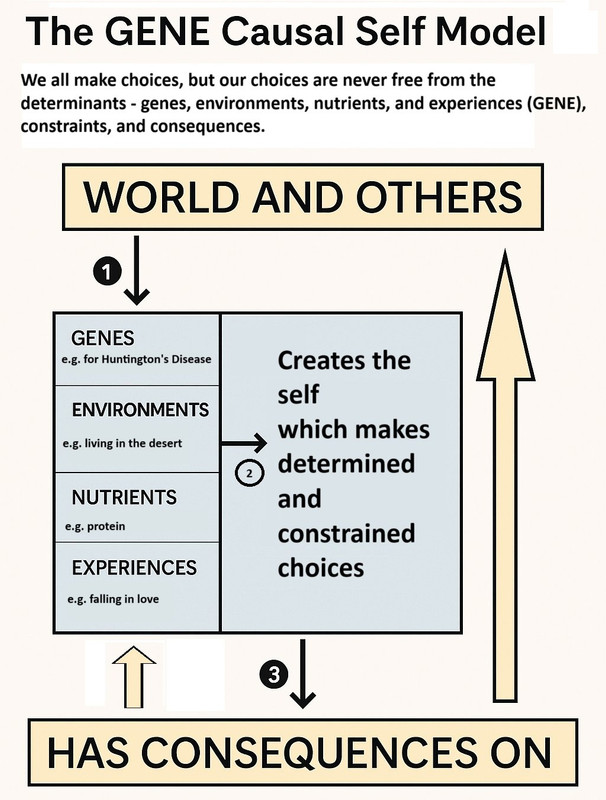
Creatine Transporter Deficiency (CTD) Inside the GENE Causal Self Model
Let’s examine how Creatine Transporter Deficiency (CTD) fits into the GENE framework step by step.
CTD is caused by mutation in the SLC6A8 gene, which encodes the creatine transporter. It is typically X-linked and results in impaired transport of creatine into brain cells.
Creatine is essential for ATP buffering in neurons. When transport fails, brain energy metabolism is compromised.
Now let’s map this directly into my GENE model.
1. GENES
In the GENE model:
GENES → create the self
In CTD:
Mutation → defective creatine transporter → reduced neuronal energy availability → altered neural development → constrained cognitive architecture.
The “self” that develops is already shaped by this constraint before any conscious choice occurs.
This is not philosophical speculation. It is biochemical causation.
2. NUTRIENTS
Creatine is related to nutrients.
However, in CTD:
Adequate dietary creatine ≠ adequate brain creatine.
The problem is not nutrient availability.
The problem is nutrient transport.
So this demonstrates something important in the GENE model:
Nutrients only matter insofar as genes allow them to be processed and used.
This is a G × N interaction.
3. ENVIRONMENTS
Environmental factors still matter:
• Early intervention
• Speech therapy
• Special education
• Structured caregiving
These can improve functional outcomes.
But they operate within biological limits set by the mutation.
So we have:
Genes constrain → Environment modifies within bounds.
4. EXPERIENCES
Because of cognitive and communication limitations, individuals with CTD may experience:
• Frustration
• Social exclusion
• Reinforcement of maladaptive patterns
• Dependency on caregivers
These experiences further shape the developing self.
So the causal chain becomes:
Gene mutation → neurodevelopmental constraint → altered experiences → further shaping of behaviour and identity.
5. CHOICE UNDER CONSTRAINT
Executive functions commonly affected in CTD include:
• Working memory
• Language processing
• Impulse inhibition
• Planning
• Emotional regulation
So the available action space is smaller.
Not metaphorically smaller.
Computationally smaller.
Choice is downstream of neurobiology.
6. CONSEQUENCES AND FEEDBACK
The individual’s actions affect:
• Family dynamics
• Educational systems
• Healthcare resources
• Social responses
Those responses then feed back into:
Environment and Experience variables in GENE.
The model is recursive.
What CTD Demonstrates About the GENE model
CTD clearly shows:
1. A single gene mutation can alter the trajectory of the self.
2. Cognitive capacity depends on metabolic constraints.
3. Executive control is biologically instantiated.
4. “Freedom” is bounded by neurobiology.
5. Moral responsibility must be graded.
When constraints are obvious (as in CTD), everyone recognises reduced responsibility.
The GENE model simply extends that same principle to all cases in degree.
In CTD, we can trace:
Gene mutation
→ Impaired creatine transport
→ Reduced ATP buffering
→ Altered neural development
→ Reduced executive function
→ Constrained choice space
→ Altered consequences
→ Environmental feedback
The system is causally continuous.
There is no metaphysical gap where an uncaused “free self” appears.
CTD, therefore, serves as a concrete neurological case study supporting the GENE Causal Self Model.
But if:
• God creates the person,
• God creates their temperament,
• God creates their environment,
• God foreknows every outcome,
then ultimate moral responsibility cannot rest on the creature.
Foreknown certainty + deliberate creation = responsibility at the highest causal level. If God is real, all suffering, injustice and death are 100% God's fault. -
 BC
14.3kBut if:
BC
14.3kBut if:
• God creates the person,
• God creates their temperament,
• God creates their environment,
• God foreknows every outcome,
then ultimate moral responsibility cannot rest on the creature. — Truth Seeker
It seems like one could make this statement about anything and everything, and religious literalists do say "God is in charge of everything. We have no control over anything." Those same religious literalists then go about their day as if they were in charge of their own lives, in charge of their children, in charge of their farm, factory, firm, or whatever.
On the other hand, there is the 13+ billion year old universe doing its part in shaping our past, present, and future. The galaxies aren't dictating what you or I write, but all sorts of physical and chemical conditions act upon us and our forebears (going back to the simplest one-celled life) to shape what we wish, fear, do, can, can not, and/or don't do. Maybe, somewhere in the mess of causation there is a choice every now and then that makes a difference.
If God is in charge of everything, he has a lot of explaining to do. -
Truth Seeker
1.2kI agree that if God is real, he has a lot of explaining to do. We do make choices, but they are not free from the determinants, i.e. genes, environments, nutrients, and experiences. If you behead a human, he or she can't grow their head back, and he or she will die. If you behead a planarian flatworm, he or she will grow his or her head back and live. The average human born in an English-speaking country can communicate in English, but an average planarian flatworm can't communicate in English or any other human language. The desires and capacities of sentient biological beings are determined and constrained by their genes, environments, nutrients, and experiences.
-
 Corvus
4.8kif God is real, — Truth Seeker
Corvus
4.8kif God is real, — Truth Seeker
Don't you have to prove that God is real prior to further points? Your are introducing a dubious premise which has no proof or foundation here. Until it is proved and accepted as a valid premise, any arguments relating to the dubious premise will remain fictitious. -
BC
14.3kWe do make choices, but they are not free from the determinants, i.e. genes, environments, nutrients, and experiences. — Truth Seeker
then ultimate moral responsibility cannot rest on the creature.
Foreknown certainty + deliberate creation = responsibility — Truth Seeker
Leaving out "ultimate" we generally assign moral responsibility to individuals. Sometimes that is entirely appropriate, because healthy, intelligent individuals plan to maximize success. In the case of crime, prudent criminals try to leave no tracks behind and cover up clues. After all that, they try to avoid prosecution. All very reasonable from the perp's POV. And all that leaves prosecutors with no doubt about moral responsibility.
But... Then there are the cases of children who were abused, subjected to violence, experienced head injuries, lead poisoning, and so on. They grow up with the deck stacked against them, and they may behave criminally. Now assigning moral responsibility is much more difficult. These difficult situations are not rare.
There are millions of cases (billions?) of cases where we behave in ways that, though not criminal, are problematic to ourselves and people around us. If we are careful, we can perhaps see that our behavior was influenced by factors beyond our control.
It takes a lot of self-examination (the considered life) to sort our own behavior. -
Truth Seeker
1.2kIt's not really possible to prove or disprove Gods if they are outside the universe and don't interact with the universe we live in. I am an Agnostic Atheist.
-
Truth Seeker
1.2kBC, I think we are actually closer than it might appear.
You’ve just articulated the gradient problem that my position is built on.
You note:
• In many ordinary cases, we assign responsibility without hesitation.
• In abuse, trauma, neurological damage, toxin exposure, etc., responsibility becomes harder to assign.
• Much of our everyday problematic behavior is influenced by factors beyond our control.
• It takes deep self-examination to untangle this.
Exactly.
That progression is not a side note. It is the core insight.
What you’re describing is a sliding scale — a responsibility gradient. The more we understand causal determinants, the less confident we become in simple, binary moral blame.
The “healthy, intelligent criminal who plans carefully” looks maximally responsible — until we zoom in:
• Why does he value success over empathy?
• Why does he possess higher executive function but low affective concern?
• Why was he not shaped by early attachment bonds that suppress antisocial strategy?
• Why did his neurodevelopment produce his particular reward circuitry?
At each layer, we uncover determinants.
Genes.
Prenatal biology.
Nutrition.
Attachment patterns.
Cultural reinforcement.
Peer modelling.
Socioeconomic pressures.
Education.
Trauma exposure.
Neurochemistry.
Chance encounters.
Change one variable, and you alter the trajectory.
The “deck stacked” cases simply make the determinants more visible. The high-functioning criminal case hides them better.
The fact that we struggle more with assigning blame in trauma cases is not an exception to the rule — it reveals the rule.
Now, to your point about “leaving out ultimate.”
In everyday practice, yes — societies assign proximate responsibility. We have to. Law operates pragmatically.
But the philosophical question I raised concerns ultimate grounding.
If:
• A being creates a person,
• Designs their temperament,
• Selects or permits their environment,
• Foreknows every choice with certainty,
then the causal chain never escapes that originating will.
That is not about everyday courtroom attribution. It is about metaphysical authorship.
And here is the crucial distinction:
In a naturalistic determinist model, no biological organism is ultimately responsible — because no biological organism authored the entire causal web.
In a theistic creation model with foreknowledge, God did.
That is why “Foreknown certainty + deliberate creation = responsibility.”
You are absolutely right that self-examination reveals how little control we truly have over our behavioral formation.
But that insight strengthens the determinist critique — it doesn’t weaken it.
The more we understand psychology, neuroscience, trauma, epigenetics, and social conditioning, the less coherent retributive blame becomes.
Which is why I advocate:
• Protection where necessary.
• Rehabilitation where possible.
• Prevention wherever feasible.
• Compassion universally.
Not because actions don’t matter.
But because people are causal systems — not self-originating authors.
And if one posits a self-originating Creator who set the entire chain in motion with full foresight, then the responsibility question moves upward, not downward.
You’re already halfway there in your analysis.
The hard part is following the logic all the way through. -
Corvus
4.8kIt's not really possible to prove or disprove Gods if they are outside the universe and don't interact with the universe we live in. I am an Agnostic Atheist. — Truth Seeker
Outside the universe sounds another unverified concept. What is outside the universe? -
Truth Seeker
1.2kI don't know. There could be an infinite number of universes. We don't have the ability to travel between universes right now. It doesn't mean we won't ever develop such technology.
-
Corvus
4.8kFair enough. One of the philosophical methods is to read, and analyze writings in the discussion, and clarify any obscure or unverified concepts and statements. Hence I was trying to apply the method to the posts in discussions that I am reading. It helps avoiding talking nonsense wasting lots of time when we employ the analytic method.
-
 Ecurb
150• God creates the person,
Ecurb
150• God creates the person,
• God creates their temperament,
• God creates their environment,
• God foreknows every outcome,
then ultimate moral responsibility cannot rest on the creature. — Truth Seeker
We've had this argument before. Foreknowing the outcome does not preclude free will. The sentence, "I freely chose to go to the store yesterday," is coherent and meaningful, even though no other
"choice" can now be made.
The standard Christian response is that God made humans in His own image -- and therefore gave them free will. Love, faith and hope (these three, Paul called them in his letter to the Corinthians) lose their merit if they are not freely chosen. This is obvious. Those of us who have had love affairs marvel at the miracle that (as Jerome Kern wrote), "Out of all the world you've chosen me." Whether God can see the future (as we can see the past) is irrelevant to freedom of choice, and the moral responsibility of the individual. -
BC
14.3kAnd if one posits a self-originating Creator who set the entire chain in motion with full foresight, then the responsibility question moves upward, not downward. — Truth Seeker
Is that the second half of the logical chain?
At some point in middle age I decided (free will or caused?) that in order to have an explainable universe, God had to go. I was raised in mainline Protestantism and had been intermittently active in church. I believed in God because I had been taught and trained by family and community to believe. Belief cracked when I became sexually active as a gay man in the late '60s. Sex won out. The second big crack in belief came later in middle age with involvement in socialism and materialism (I was late to the party; I moved leftward as I got older.) Along with the left, was a gradually accumulating sophistication about science (I had been an English major).
It took me a good 50 years to clear out the ultimately responsible self-originated creator.
So it is just us.
The more we understand psychology, neuroscience, trauma, epigenetics, and social conditioning, the less coherent retributive blame becomes. — Truth Seeker
But in a lot of ways humans are not nice. We have all these positive and negative emotions we inherited and then we have this big cognition system to carry out our basest emotional drives. We can be exceptionally nasty animals. (Sometimes we are exceptionally nice, too.).
Psychopathy occurs when the brain fails to build an adequate pathway between the amygdala (emotions) and the prefrontal cortex (executive). A psychopath can behave very badly without feeling guilt. The condition exists in degrees between severe and mild. Mildly psychopathic individuals make very good executives because they can act on behalf of the company's best interests without feeling much about their employees. If it's in the company's interest to layoff 1000 workers on Christmas Eve, fine. No guilt. What's next on the agenda?
Psychopaths are born, not made, but they don't get much sympathy when it comes time for retributive justice. They may be guilty, but they are not responsible. Fortunately for us, psychopathy isn't common. -
Truth Seeker
1.2kI agree that foreknowledge does not preclude free will. However, predestination does preclude free will. Also, determinants (i.e. genes, environments, nutrients, and experiences) preclude free will because biological organisms do not choose all of their determinants.
-
Truth Seeker
1.2kThank you for sharing your journey with us. Well done for outgrowing the indoctrination you received. I am an Agnostic Atheist. I agree that humans can be very nasty and also very nice. It's a good thing psychopathy is not common.
-
Ecurb
150However, predestination does preclude free will. Also, determinants (i.e. genes, environments, nutrients, and experiences) preclude free will because biological organisms do not choose all of their determin — Truth Seeker
Of course our environment and experiences and biology influence our choices. How could it be otherwise? That's not what we mean by "free". "Free" means "not under the control or in the power of another; able to act or be done as one wishes." What we wish for may be the result of our biology and environment -- but our ability (or lack thereof) to act on it is either "free" or "constrained".
When Martin Luther said, "Here I stand and I can do no other," he was constrained not by "another", but by his own conscience. No doubt his conscience developed based on certain variables, but so what? That doesn't make his will less "free".
The problem with reductionist explanations for (in this case) choices is that they fail to explain anything. WE don't know what experiences, biological nuances, or environments lead to which choices. So what good does it do to claim they control us? You might as well say, "God controls us." Each statement is meaningless, because it is beyond our comprehension. and fails to allow us to predict or explain behavior. -
 Janus
18kHowever, predestination does preclude free will. Also, determinants (i.e. genes, environments, nutrients, and experiences) preclude free will because biological organisms do not choose all of their determin — Truth Seeker
Janus
18kHowever, predestination does preclude free will. Also, determinants (i.e. genes, environments, nutrients, and experiences) preclude free will because biological organisms do not choose all of their determin — Truth Seeker
Of course our environment and experiences and biology influence our choices. How could it be otherwise? That's not what we mean by "free". "Free" means "not under the control or in the power of another; able to act or be done as one wishes." What we wish for may be the result of our biology and environment -- but our ability (or lack thereof) to act on it is either "free" or "constrained". — Ecurb
You are each talking about different notions of free will. The libertarian notion admits of no determinants which are not strict restraints on freedom like being locked up or subject to natural laws such as gravity.
The compatibilist view simply redefines free will as the capacity to act free of "extraneous" restraints yet under the control of, that is not free of, natural and cultural determinants such as genes, cultural conditioning, psychological development, intelligence and so on. -
Truth Seeker
1.2kIf by "free" you mean not coerced by someone else as long as someone else isn't holding a loaded gun to our head, then, we have free will. However, if by "free" you mean free from all determinants, i.e. genes, environments, nutrients, and experiences, then we don't have free will. Genes are foundational for all biological organisms. For example, if you behead a planarian flatworm, he or she will grow his or her head back and will stay alive. If you behead a human, he or she will not grow his or her head back and will die. This is because our desires and capacities are both determined and constrained by our genes, environments, nutrients, and experiences. I desire to go back in time and prevent all suffering, injustice, and death and make all living things forever happy. However, I lack the capacity to do this.
You didn't reply to my last post to you on this thread: https://thephilosophyforum.com/discussion/16247/comparing-religious-and-scientific-worldviews Is that because you have nothing to say, or is that because you didn't read the post? -
Ecurb
150If you behead a human, he or she will not grow his or her head back and will die. — Truth Seeker
Oh, really? What about these guys:
https://www.coolcatholics.org/cephalophores-6-saints-who-carried-their-own-heads/ -
Truth Seeker
1.2kIt's fiction. Once the head is completely severed:
Blood pressure collapses instantly
The brain loses oxygen within seconds
Coordinated walking and speech become impossible
There is no biological mechanism by which someone could stand, walk, or preach after decapitation. If you don't believe me, why don't you behead yourself and demonstrate the miracle on livestream? -
Ecurb
150There is no biological mechanism by which someone could stand, walk, or preach after decapitation — Truth Seeker
Chickens can. Well, they can't preach.
Of course all our actions are correlated to genetic and environmental factors. Our thoughts involve neurons firing in our brains. So what? Where does that claim get us? Thinking about why someone chose to do something, we learn more by analyzing their personality, thinking about their particular circumstances, and (yes) discovering their (freely chosen) motives than we do by discussing their brains.
Reductionist explanations tend to be simplistic, to lack predictive value,, and to fail to actually explain anything.
1. A single gene mutation can alter the trajectory of the self.
2. Cognitive capacity depends on metabolic constraints.
3. Executive control is biologically instantiated.
4. “Freedom” is bounded by neurobiology.
5. Moral responsibility must be graded. — Truth Seeker
The first three postulates are fine. The next two don't scan. What does "bounded" mean? What does "grading" moral responsibility comprise? Yes, we are not free to do things without "neurobiology". So what?
Of course we all have "reasons" for behaving as we do. What else is new? Our moral responsibilities are not mitigated whether God created us, or genetics and environment created us. Why would they be? Nor are they mitigated by fate, as Oedipus recognized. We may be caught in our own destinies, but we must act as if we are not, because we are not aware of our own fates. The card player thinks there are 4 chances out of 52 that an ace will be on the top of the deck. But (given an honest shuffle) either there is a 100% chance or a 0% chance, as anyone who can see the other side of the cards would know. That's irrelevant to the card player -- just as fate is irrelevant to moral responsibility. -
Truth Seeker
1.2k
Chickens can. Well, they can't preach. — Ecurb
A headless chicken does not "walk" in any meaningful sense. It exhibits short-lived spinal reflex activity due to residual oxygen and intact spinal circuitry. There is no consciousness, no coordinated intention, no clucking, and no goal-directed action.
A cephalophore story involves:
• standing upright
• coordinated locomotion
• preaching
• selecting burial sites
All of those require a working brain.
Reflexive motor discharge is not agency. It is residual neuromuscular firing. Conflating the two is a category error.
Of course all our actions are correlated to genetic and environmental factors. Our thoughts involve neurons firing in our brains. So what? — Ecurb
The “so what” is everything.
If:
• Every thought depends on neural activity
• Every neural state depends on prior neural states
• Neural states are shaped by genes, development, environment, and metabolic conditions
Then choices are not self-originating in any ultimate sense.
They are the output of causal processes.
That is not “correlation.” That is instantiation.
Remove the brain, remove the person. Alter the brain, alter the person. Damage the frontal lobe, alter impulse control. Change dopamine regulation, alter motivation. Modify serotonin transport, alter mood.
This is not philosophical speculation — it is clinical neurology.
Thinking about why someone chose to do something, we learn more by analyzing their personality… than by discussing their brains. — Ecurb
“Personality” is not an alternative to the brain.
Personality is a macro-level description of stable neural patterns shaped by:
• genetics
• developmental inputs
• trauma
• culture
• reinforcement history
Describing behavior at the psychological level does not refute determinism. It is simply a higher-level description of the same causal system.
Meteorology does not refute physics. It operates at a different explanatory scale.
Reductionist explanations tend to be simplistic… — Ecurb
Hard determinism is not simplistic reductionism.
It does not deny multi-level explanation. It asserts causal continuity across levels.
We can say:
• Neurons fire
• Which produces thoughts
• Which expresses personality
• Which interacts with environments
• Which generates behavior
That is not reductionism — that is causal layering.
The predictive success of neuroscience, psychopharmacology, behavioral genetics, and developmental psychology demonstrates explanatory power, not simplicity.
If frontal damage increases impulsive crime rates, that is predictive.
If lead exposure increases aggression, that is predictive.
If MAOA variants interact with childhood abuse to increase violence risk, that is predictive.
Determinism has predictive value.
What does "bounded" mean? — Ecurb
“Bounded” means constrained by:
• Cognitive capacity
• Executive function
• Emotional regulation
• Working memory
• Impulse control
• Neurochemical state
A person with severe intellectual disability cannot deliberate like a neurotypical adult.
A person in psychosis cannot evaluate evidence normally.
A sleep-deprived brain makes worse decisions.
A hypoglycemic brain makes worse decisions.
Freedom is not binary. It varies with capacity.
Which leads to graded responsibility.
What does "grading" moral responsibility comprise? — Ecurb
Grading responsibility means proportional accountability relative to capacity.
We already do this in law:
• Children are treated differently from adults.
• The mentally ill are treated differently from the mentally well.
• Brain injury mitigates sentencing.
Why?
Because capacity matters.
The greater the executive function, foresight, impulse control, and understanding — the greater the responsibility.
That is not radical. It is embedded in jurisprudence.
Hard determinism simply makes this principle consistent.
Our moral responsibilities are not mitigated whether God created us, or genetics and environment created us. Why would they be? — Ecurb
Because ultimate responsibility requires ultimate authorship.
If:
• Your temperament was not chosen by you
• Your upbringing was not chosen by you
• Your neurobiology was not chosen by you
• Your traumas were not chosen by you
• Your intelligence was not chosen by you
Then your behavioral outputs are not self-created in the ultimate sense.
You are a causal node in a chain.
Responsibility then becomes pragmatic (deterrence, rehabilitation, protection), not metaphysical desert.
Hard determinism does not eliminate accountability.
It eliminates blame as cosmic retribution.
Fate is irrelevant to moral responsibility… — Ecurb
The card analogy misunderstands determinism.
From the omniscient perspective, yes, the outcome is fixed. But from the internal perspective, the card player’s belief state is itself causally determined.
His uncertainty does not create freedom.
It reflects epistemic limitation.
Ignorance of the causal chain does not break the chain.
Oedipus did not freely step outside fate.
He enacted it through his determined character and circumstances.
Determinism is not about predictability by the agent.
It is about causal sufficiency.
Hard determinism does not say:
• Reasons do not matter
• Personality does not matter
• Moral systems are pointless
It says:
Reasons, personality, and moral systems are themselves causally embedded.
We hold people accountable because doing so modifies future behavior through deterrence, conditioning, and social regulation.
Not because they were metaphysically uncaused causes.
In summary:
• Headless chickens do not refute biology.
• Psychological explanation does not refute neural instantiation.
• Capacity varies.
• Responsibility scales with capacity.
• Ignorance of causation does not produce freedom.
Freedom, in the contra-causal sense, has no empirical support.
What we have instead is a deeply layered causal organism operating within constraints.
And moral philosophy should reflect that reality rather than deny it. -
Ecurb
150• Every thought depends on neural activity
• Every neural state depends on prior neural states
• Neural states are shaped by genes, development, environment, and metabolic conditions
Then choices are not self-originating in any ultimate sense. — Truth Seeker
So our brains are not our "selves"? WE might as well argue that since our bodies are made up of atoms, and since atoms and atomic reactions control everything in the universe, there is no "self". The "self" "emerges" from genes, metabolic conditions, and environments. By seeing it as a discrete unit, we understand it more effectively than by seeing it as a collection of atoms.
The notion that the whole (the "self") is best understood by understanding the parts is old-fashioned "modernism", which post-modernism has effectively criticized (although it has failed to find alternatives).
Because ultimate responsibility requires ultimate authorship. — Truth Seeker
Maybe so. But how do we hold "genes" responsible? Eugenics? How do we hold "environment" responsible? Communism? The fact that there may be some "ultimate" responsibility does not mitigate other responsibilities.
In addition, the "environment" that (as you concede) affects behavior includes religion, laws, punishments, etc. If we change our mores involving personal responsibility for actions, we change the environment. Is that wise? Mightn't abrogation of personal responsibility lead to more people doing wicked things, like eating meat?
p.s. My point about the card player is that although the deck has been determined by the shuffle, from the player's perspective it is arranged randomly. Same with a "determined" universe.. Just as the fact of determination is irrelevant the to the gambler, the determination of the universe is irrelevant to us humans. -
Truth Seeker
1.2k
So our brains are not our "selves"? WE might as well argue that since our bodies are made up of atoms… there is no "self". — Ecurb
No. Hard determinism does not deny the self.
It denies that the self is an uncaused cause.
The self is an emergent, causally integrated system instantiated in neural architecture.
Saying that the self depends on neural activity is not eliminating the self any more than saying a hurricane depends on atmospheric physics eliminates hurricanes.
Emergence does not equal metaphysical independence.
You are your brain — not something floating above it.
If:
• Alter the brain → alter personality
• Damage the brain → alter impulse control
• Stimulate the brain → induce experiences or movements
Then the self is biologically instantiated.
Calling it “emergent” does not grant it causal independence from its substrate.
By seeing it as a discrete unit, we understand it more effectively than by seeing it as a collection of atoms. — Ecurb
Agreed — but this is a matter of explanatory level, not metaphysics.
We use higher-level descriptions because they are cognitively useful.
That does not mean those higher levels are self-originating.
Meteorology is useful.
But weather systems are still governed by physics.
Psychology is useful.
But psychological states are still governed by neurobiology.
There is no contradiction here.
Hard determinism accepts multi-level explanation.
It rejects contra-causal freedom.
The notion that the whole is best understood by understanding the parts is old-fashioned modernism. — Ecurb
This is a strawman.
Hard determinism does not claim the whole is best understood only by the parts.
It claims the whole is causally dependent on the parts.
Holistic description does not break causal continuity.
Postmodern critiques of reductionism do not generate magical causal gaps.
If anything, modern neuroscience has strengthened — not weakened — the causal account of mind.
Maybe so. But how do we hold "genes" responsible? Eugenics? How do we hold "environment" responsible? Communism? — Ecurb
We don’t hold genes morally responsible.
That is precisely the point.
Moral responsibility is a pragmatic social tool, not an ultimate metaphysical desert claim.
Hard determinism shifts the framework:
Instead of:
“Who deserves blame?”
We ask:
“What interventions reduce harm?”
That includes:
• Education
• Early childhood support
• Lead removal
• Mental health treatment
• Social policy
• Deterrence structures
Recognizing causation does not lead to eugenics.
It leads to prevention.
Recognizing environmental influence does not mandate communism.
It mandates evidence-based policy.
This is already how modern criminology operates.
The fact that there may be some "ultimate" responsibility does not mitigate other responsibilities. — Ecurb
It does mitigate retributive desert.
It does not eliminate accountability.
Hard determinism supports:
• Quarantine for dangerous individuals
• Rehabilitation
• Proportional deterrence
It rejects:
• Cosmic blame
• Vengeance
• “They could have done otherwise in exactly the same conditions”
Because they could not have.
Holding someone accountable changes future causal pathways.
That is sufficient justification.
If we change our mores involving personal responsibility… is that wise? — Ecurb
Hard determinism does not abolish responsibility.
It reframes it.
We still say:
“You are responsible.”
But that statement now means:
“You are the causal locus through which intervention must occur.”
Responsibility becomes forward-looking.
It is about behavioral modification, not metaphysical condemnation.
There is no evidence that understanding causal determinants increases crime.
In fact, many interventions based on deterministic insights reduce harm.
Mightn't abrogation of personal responsibility lead to more people doing wicked things, like eating meat? — Ecurb
Behavior is influenced by incentives, norms, and reinforcement.
If moral norms shift toward compassion, behavior shifts.
That is environmental shaping — which you already conceded affects behavior.
Understanding determinism does not remove moral persuasion.
It explains how moral persuasion works.
If anything, it strengthens arguments for structural reform rather than mere condemnation.
Just as the fact of determination is irrelevant to the gambler, the determination of the universe is irrelevant to us humans. — Ecurb
Epistemic uncertainty does not create metaphysical freedom.
The gambler experiences uncertainty because he lacks information.
That does not make the outcome undetermined.
Similarly:
Our ignorance of causal chains does not create self-origination.
From the internal perspective, deliberation feels open.
From the causal perspective, it is a deterministic computation.
The feeling of openness is part of the process — not evidence against determinism.
To summarize:
• The self exists as an emergent neural system.
• Emergence does not equal causal independence.
• Multi-level explanation is compatible with determinism.
• Responsibility becomes pragmatic, not retributive.
• Determinism does not abolish moral systems — it explains them.
• Ignorance of causal determination does not produce freedom.
Hard determinism does not dissolve the self.
It dissolves the illusion that the self is an uncaused cause.
And once that illusion is dropped, moral philosophy becomes more humane, not less. -
 Alexander Hine
119I was reading recently that nicotine was completely parasitic in the precursor process for signalling the production of dopamine.
Alexander Hine
119I was reading recently that nicotine was completely parasitic in the precursor process for signalling the production of dopamine.
I have the misfortune to be in a work environment with habitual tobacco smokers and their addiction manifests at delusional levels parallel to heroine addiction.
They also have poor self care with micronutrients which I am certain adds to cognitive impairment. -
Ecurb
150Understanding determinism does not remove moral persuasion.
It explains how moral persuasion works. — Truth Seeker
Does it? What does it add to our understanding of moral persuasion?
To summarize:
• The self exists as an emergent neural system.
• Emergence does not equal causal independence.
• Multi-level explanation is compatible with determinism.
• Responsibility becomes pragmatic, not retributive.
• Determinism does not abolish moral systems — it explains them.
• Ignorance of causal determination does not produce freedom. — Truth Seeker
Once again, so what? If multi-level explanations are compatible --and if physical determinism can't explain most human behaviors -- what difference does accepting determinism make? None. We're like the card player who doesn't know the order of the cards, so he thinks there's a 1/13 chance that an ace is on the top of the deck. It's the best he can do.
Your claim that determinism would reject vengeance makes no sense. Vengeance might be the result of physical, genetic and environmental causes just like everything else.
I don't doubt that physics "causes" everything. I doubt that accepting this as fact makes the slightest difference to us humans. -
Alexander Hine
119Ignorance of causal determination does not produce freedom. — Truth Seeker
Is causal determination the only means of production of freedom? -
Alexander Hine
119Your claim that determinism would reject vengeance makes no sense. Vengeance might be the result of physical, genetic and environmental causes just like everything else. — Ecurb
To my understanding the movement towards "vengeance" is a primal and instinctual drive. Having followed behavioural science it is rooted in the personality whose primary interaction in the world is 'social' and finds its amplifier and multiplier in the 'social instinct'. I do not elaborate on my understanding of 'social instinct' in distinction of the others here. -
Truth Seeker
1.2k
"Understanding determinism does not remove moral persuasion.
It explains how moral persuasion works."
— Truth Seeker
Does it? What does it add to our understanding of moral persuasion? — Ecurb
It adds the mechanism.
Without determinism, moral persuasion is mysterious. We say things like:
• “He freely chose to change.”
• “She could have done otherwise.”
• “The argument moved him.”
But we don’t explain how persuasion works.
Under determinism, persuasion works because:
• Information alters neural states.
• Neural states alter valuations and predictions.
• Altered valuations shift future behavior.
Moral persuasion becomes a causal intervention in a system.
If I present evidence, evoke empathy, or reshape incentives, I am not appealing to some causally unbound “will.”
I am modifying a cognitive system.
That is an explanatory gain.
It moves us from “persuasion somehow influences choice”
to
“persuasion is a deterministic input that reshapes decision architecture.”
That is not trivial. That is mechanistic clarity.
Once again, so what? If multi-level explanations are compatible -- and if physical determinism can't explain most human behaviors -- what difference does accepting determinism make? — Ecurb
Two corrections.
First: physical determinism absolutely can explain human behavior in principle. Complexity is not indeterminism. Weather is complex but deterministic at macro scales. Earthquakes are complex but deterministic. Neural systems are vastly more complex, but still physical systems and deterministic.
Second: the difference is normative, not predictive.
Accepting determinism changes:
1. How we assign blame
2. Why we punish
3. What kind of systems we build
If behavior is causally produced, then:
• Retribution (“you deserve suffering”) loses coherence.
• Prevention, deterrence, rehabilitation, and protection gain priority.
Determinism doesn’t stop vengeance from occurring.
It undermines its justification.
There is a difference between:
• “Vengeance happens.”
and
• “Vengeance is morally justified.”
Determinism reframes justice from desert-based to outcome-based.
That is a major shift.
We're like the card player who doesn't know the order of the cards, so he thinks there's a 1/13 chance that an ace is on the top of the deck. It's the best he can do. — Ecurb
That analogy actually supports determinism.
The deck is fully ordered.
Ignorance of order does not create freedom in the cards.
Likewise:
Ignorance of neural causation does not create metaphysical freedom.
Probabilistic uncertainty is epistemic.
Determinism is ontological.
Not knowing why someone will act does not imply they are uncaused.
Your claim that determinism would reject vengeance makes no sense. Vengeance might be the result of physical, genetic and environmental causes just like everything else. — Ecurb
Correct. Vengeance is causally produced.
But again: explanation is not endorsement.
Cancer is causally produced.
That does not justify it.
Vengeance may arise naturally, but once we understand its causal roots, we can choose to:
• Amplify it
• Suppress it
• Replace it
Determinism allows us to treat vengeance as a modifiable output of the system.
Libertarian free will encourages moral absolutism:
“He chose evil, therefore he deserves suffering.”
Determinism encourages system design:
“He was produced by conditions.
If we change conditions, we change outcomes.”
That shifts justice from emotional reaction to structural engineering.
I don't doubt that physics "causes" everything. I doubt that accepting this as fact makes the slightest difference to us humans. — Ecurb
It already has.
Neuroscience changed how we view:
• Brain tumors affecting behavior
• Psychopathy
• Addiction
• Trauma-induced violence
We no longer treat all wrongdoing as equal.
The more we understand causation, the more nuanced responsibility becomes.
Determinism pushes that insight to its logical conclusion:
Degrees of capacity → degrees of responsibility.
This does not eliminate moral systems.
It refines them.
Instead of:
“Could you have done otherwise?”
We ask:
“What capacities did you actually have?”
“What constraints shaped you?”
“How do we prevent recurrence?”
That is a concrete shift.
So the difference determinism makes is this:
It moves morality from metaphysical blame to causal management.
It does not abolish praise, blame, persuasion, or law.
It grounds them in how organisms actually function.
And once morality is grounded in causation rather than moral desert, we can design systems that reduce harm more effectively.
That is not “no difference.”
That is a structural reorientation of justice. -
Truth Seeker
1.2k
"Ignorance of causal determination does not produce freedom."
— Truth Seeker
Is causal determination the only means of production of freedom?
It depends on what you mean by “freedom.”
If by freedom you mean libertarian freedom — the ability to choose independently of prior causes — then no one has ever demonstrated that such a thing exists, or even that it is coherent.
If by freedom you mean practical freedom — the ability to act according to one’s reasons, values, and capacities without external coercion — then causal determination is not an obstacle to it. It is the very condition that makes it possible.
Let me explain.
If actions were not causally determined by:
• your beliefs
• your desires
• your character
• your reasoning
• your neural processes
then they would occur randomly.
But randomness does not produce freedom.
If your decision were not caused by who you are, it would not be your decision.
So we face a dilemma:
1. If actions are uncaused → they are random.
2. If actions are caused → they arise from your internal structure.
Only the second option allows coherent agency.
Freedom, in any meaningful sense, requires:
• Stable identity
• Reliable causal connection between reasons and actions
• Predictable responsiveness to evidence
All of those require causal determination.
So causal determination is not the enemy of freedom.
It is the framework within which freedom — understood as rational self-governance — becomes possible.
The real mistake is assuming:
“Not causally determined” = “free.”
In fact:
“Not causally determined” = “uncontrolled.”
And uncontrolled is not free.
So no, causal determination is not the “producer” of freedom in the sense of manufacturing it — but without causal structure, the very idea of agency collapses.
Freedom is not the absence of causation.
Freedom is causation flowing through the right structures.


Welcome to The Philosophy Forum!
Get involved in philosophical discussions about knowledge, truth, language, consciousness, science, politics, religion, logic and mathematics, art, history, and lots more. No ads, no clutter, and very little agreement — just fascinating conversations.
Categories
- Guest category
- Phil. Writing Challenge - June 2025
- The Lounge
- General Philosophy
- Metaphysics & Epistemology
- Philosophy of Mind
- Ethics
- Political Philosophy
- Philosophy of Art
- Logic & Philosophy of Mathematics
- Philosophy of Religion
- Philosophy of Science
- Philosophy of Language
- Interesting Stuff
- Politics and Current Affairs
- Humanities and Social Sciences
- Science and Technology
- Non-English Discussion
- German Discussion
- Spanish Discussion
- Learning Centre
- Resources
- Books and Papers
- Reading groups
- Questions
- Guest Speakers
- David Pearce
- Massimo Pigliucci
- Debates
- Debate Proposals
- Debate Discussion
- Feedback
- Article submissions
- About TPF
- Help
More Discussions
- Other sites we like
- Social media
- Terms of Service
- Sign In
- Created with PlushForums
- © 2026 The Philosophy Forum