
-
The Hard Problem of Consciousness & the Fundamental AbstractionAs I previously quoted...
These premises clearly give the conclusion that there is in nature some bodily substance other than the formations we know, prior to them all and more divine than they. (On the Heavens Book 1, part 2) — Fooloso4
A simile comes to mind: imagine that 'the idea of the cat' is a silhouette in front of a light-source through which light is projected so as to create an image of the cat on a surface. But the surface on which the light is projected is irregular, so the image is always slightly different each time it is projected. In this simile, 'the silhoettte' is 'the form', but the actual impression is 'the particular' - due to the irregularities on the surface on which it is projected each image is slightly different, thereby making each one 'an individual'. The key point being, there is only one silhouette, but the resultant images are all different due to the irregularities - 'accidents' - of the surface on which it is being projected.
Valid simile, do you think? -
The Hard Problem of Consciousness & the Fundamental AbstractionThere are two principal senses of "form" for Aristotle, hence primary and secondary substance. The one sense refers to human abstractions, conceptions, the formulae which we employ — Metaphysician Undercover
I'm going to stop arguing this point, you've been telling me this over and over for years, and I just don't think it stacks up. Over and out. -
The American Gun Control DebateHey I know, I've got immediate family in the US, son and family live in a really nice town in Wisconsin and I visit there regularly (last there in August). I never really seen any gun violence when I'm there, but then it's a pretty genteel part of the country.
-
Our relation to EternityThat's more like it! I think the religious idea of 'the life eternal' is meaningful (although hardly anyone here will agree). In the popular imagination, it is often depicted as living forever in physical form, but I don't think it means that at all. In philiosophical spirituality, such as neoplatonism, it is more a matter of realising that your real nature is not separate from the same intelligence that animates the Universe itself. A similar intuition runs through Hindu and Buddhist literature, but in secular culture this tends to be scorned.
Check out a book that was very popular in the 1970's by a writer who has come back into fashion on Youtube. The book is The Supreme Identity, by Alan Watts. He had a big influence on me and many others back in the day. It turned out he was a pretty hardcore alchoholic, which was a let-down, but his brand of philosophical spirituality is very approachable still and he's an excellent prose stylist. -
The American Gun Control DebateHow does one try to protect one's self or family? — jgill
There are places where I would want to own a gun if I were to live there. New Guinea, for instance, is said to be a very dangerous place to live, with frequent home-invasions and assaults. But living in Sydney Australia, I've never felt the need. Gun ownership is very low, by US standards, and I've never seen a gun drawn or heard a single shot fired (outside a firing range during Cadet training in my teens.) So it's likely that the huge numbers of guns in circulation in the US and the extraordinary number of gunshot deaths, becomes, as I said, a vicious circle - fear of being shot drives the uptake of guns, which dramatically increases the risk of being shot. Classic vicious circle. -
Our relation to EternityI deleted my comment. I will try and make a more serious point. Merely declaring that 'everything is meaningless in the light of eternity' is a kind of nihilistic attitude.It is true that when you consider the vastness of the universe and deep time, we humans seem insignificant. But on the other hand, we're the only beings we know of who are even aware of that immensity. That itself has significance. As has sometimes been said by evolutionary theorists, in h. sapiens the process of evolution becomes self-aware.
The philosopher Neitszche predicted an upsurge of nihilism in Western culture, due to the erosion of traditional religion and it's anchoring for morality. But, contrary to his prediction, religion has not, in fact, died, and I for one never accepted his proclamation of the 'death of God'. While it's true there is a crisis of meaning in Western culture, there doesn't have to be, and a sense of meaning can be recovered, if one seeks it. -
What is computation? Does computation = causationIs there such a thing as uninterpreted information? Put another way, how does anything constitute information until its been interpreted? I mean, the genetic information transmitted by DNA is interpreted by ribosomes. But in the non-organic realm, what sense does it make to speak of information at all? Sure, we can ascertain vast amounts of data about the Universe, which then constitutes information, but does the Universe itself constitute 'information' in any meaningful sense?
-
What is computation? Does computation = causationIs this the case? Doesn't water eroding topsoil generate information about its passage in the form of riverbeds? — Count Timothy von Icarus
But that's informative to us. The difference with the information encoded in DNA is that it is morphogenetic, i.e. it causes things to happen, it transmits and stores information. THat is why some (although not all) biologists recognise an ontological distinction between life and non-life - living things are different in kind, not just in degree, to the elements of the periodic table.
Aren't our own minds the objects of direct perception? Arguably this is the only thing we observe directly, depending on how you define direct. Light, apples, cars, these are all filtered through the mind, Kant's old trancendental and all. — Count Timothy von Icarus
Very tricky distinctions, but I say that it's not. The mind is primarily the subject of experience, that which objects are perceptible to. We can't stand outside of the mind and make it an object in the same sense we can objectify perceptibles. We can obviously talk about our state of mind and mental events, but the question of what the mind is, that has these experiences, is a deep one. There's a theme in current phenomenology about this idea, along the lines of 'the mind knows but is not known', as it is always the subject or recipient, never amongst the objects of perception. It's a question with an ancient heritage, and of course, you're right in mentioning Kant. -
The Dialectic of Atheism and Theism: An Agnostic's PerspectiveClearly existence (the uncreated void) — EnPassant
'The existent' and 'the uncreated' are different domains in classical metaphysics.
Lawrence Krauss published a book 10 years ago, A Universe from Nothing, which proposed to account for how fluctuations in quantum fields give rise to the Universe (hence the title!) It was subject to some pretty savage review, see here and here, which give some insight into the difficult metaphysics of these questions. -
The Hard Problem of Consciousness & the Fundamental AbstractionI'm certainly not claiming any kind of enlightenment on my part, but I'm not prepared to agree that the whole Platonic tradiition merely ends with questions that can never be answered.
-
The Hard Problem of Consciousness & the Fundamental Abstraction'We', eh? ;-) There is in the later Platonic and neo-Platonic corpus a philosophy of illumination, much of it later incorporated into Christian mysticism. I don't think it is prudent to simply write that off, as if it has no value or never occured.
-
The American Gun Control DebateBiden's Chip Act has had a massive impact, Intel and TSMC are both building multi-billion dollar plants in the US (unlike DJT's much-touted refrigerator factory in Pennsylvania that transferred most of its operations to Mexico as soon as he walked out the door.) I've just read some fantastic books on the tech industry, Chip Wars, Chris Miller, and Silicon, by Federico Fagin (who desiged the first microprocessor.)
I fear for Taiwan, after what the PRC did to Hong Kong. Of course, we've stopped hearing about that now - wonder why that is? - but Taiwan is a proud and functioning democracy and a highly functional culture. It would be a travesty to see the communist jackboot on its neck (apart from being a possible cause of a global conflagration.) It's one of the scariest tensions in the world right now.
(Anyway I've drifted totally off-topic now so we better leave it for this thread, take it up elsewhere.) -
What is computation? Does computation = causationIt seems difficult to have information be mind independent but not computation. I won't comment on the status of such things in theoretical "mindless universes," but in the real universe meaning, at least at the level of reference to something external to the system, absolutely seems to exist sans observers, e.g. ribosomes are presumably not conscious but can read code that refers to something other than itself, and they in turn follow the algorithm laid out in the code to manufacturer a protein. — Count Timothy von Icarus
Interesting that the only place outside human activities and animal communications that something like transmission of information occurs is in living organisms and DNA, isn't it?
Humans are part of nature. Human minds presumably have natural causes and thoughts/subjective meaning are part of this natural world. — Count Timothy von Icarus
The mind is not something observable in nature. We can observe that other creatures are conscious and presume that they too have minds, but the mind is never a direct object of perception.
As for the interpretation of numbers and so on, humans inhabit a 'meaning world'. It doesn't comprise only objects, but also consists of a continuous process of interpretation, whereby we assign meaning to everything we encounter. Within that matrix, what is objective and what is subjective arise together - we don't see the world as if from no viewpoint, although we think it's easy to do so. But even the imagined panorama of an empty universe is organised around a point of view, without which there would be neither scale nor perspective. -
The Hard Problem of Consciousness & the Fundamental AbstractionSince form is the principle of intelligibility, each and every difference which is apprehended by a human being, as a difference, must be a difference of form. If it was not a difference of form, we would not perceive it as a difference. — Metaphysician Undercover
There is a reason the forms are also known as universals. If they were specific to each and every particular, the whole idea would crumble. -
The Dialectic of Atheism and Theism: An Agnostic's PerspectiveAssume X has the property 'existence'. In this respect we see X and existence as distinct entities. Now ask 'Does X exist? — EnPassant
That leaves aside a whole class such as numbers, conventions, principles, universals, and related. the question as to the sense in which number exists is an entire topic in philosophy. What about possibilities? There is a 'realm of possibility' - what might happen - and while none of its inhabitants exist, they are real possibilities (as distinct from things which could never happen). Similarly there are logical possibilities which might never exist, but which are real in some sense.
You're venturing into fundamental metaphysics, but I don't know if trying to re-create it from scratch will be a fruitful undertaking.
There are journal papers which differentiate being, reality and existence. Also an Oxford University external studies course of the same name. -
Our relation to EternityEssentially my actions and life and all my accomplishments being reduced to nothing. — invicta
Be sure that’s not an excuse for not trying. It easily morphs into the nihilism which is an affliction of our age. -
The Hard Problem of Consciousness & the Fundamental Abstractionthe word "phantasia" meant "the external appearance of something" and it originated from the verb "phaínō" (pronounced "faeno"), which mainly means "I show, I make appear", and which in passive voice becomes "phainomai" (pronounced "faenomae"), which mainly means "I appear (as something), I am visible*. — Alkis Piskas
Same root as 'phenomena' - very interesting. I had the idea that 'phantasia' came to mean 'mental image' in later philosophy. -
The “Supernatural”Supernatural as a concept is intelligible. But declaring something supernatural seems, to repeat myself, presumptuous and foolish. — Art48
'Miracles are not against nature, but against what we know of nature' ~ Augustine. -
What is computation? Does computation = causationA bundle of sticks that looks like this: VIII with no one to observe it is a bundle of sticks. It can't ever be more than that without some mind observing it and attaching additional signifiers. However, when the bundle of sticks is observed by someone who knows Roman Numerals, it's a bundle of sticks AND it picks up a new attribute courtesy of the mind observing it: it's a bundle of sticks and the roman numeral for 8. — RogueAI
Know exactly what you mean. I had a marathon thread here in the past about just this kind of thing. The broader situation is, modernity divides the Universe into subjective and objective. Then it says that the objective domain is entirely devoid of meaning, because meaning resides in the subject. Then it asks, why is it meaningless? -
The American Gun Control DebateSorry about that. Figure of speech connoting deadly warrior.
-
The “Supernatural”people lving near elephants and then some non-African visitors thought that elephants could communicate over long distances - one non-African actually could feel what later was discovered to be the method of communication. — Bylaw
There's a well-known story of the death in Africa of a man called Anthony Lawrence, in 2012, who was known as the 'elephant whisperer' for his work in wildlife conservation and in particular helping elephants. When he died a herd of elephants appeared outside his home, although obviously they had obvious way of knowing what had happened. It's been documented often in the intervening years, here is an account by his widow. -
The American Gun Control Debate:lol: But the thought of going up against X million Taiwanese
ninjassoldiers ought to give anyone pause (even the PRC).
A lot of what goes under the banner of Christianity in today's America is deeply aberrant.

although I have to believe that it's not all it is. -
The American Gun Control DebateD’oh! Not Taiwan invading Australia! China invading Taiwan! :brow: That’s been a headline hypothetical in the local media the last two days, and it’s frighteningly plausible, with Australia being caught up in it as a US ally.
-
The American Gun Control DebateThat's the ticket! Appeal to fear and division. Just your kind of schtick.
The fear is not China invading Australia, but Taiwan, which then turns into a global nuclear confrontation. Gun ownership won't have any bearing on that either. It'll be fought by remote control. -
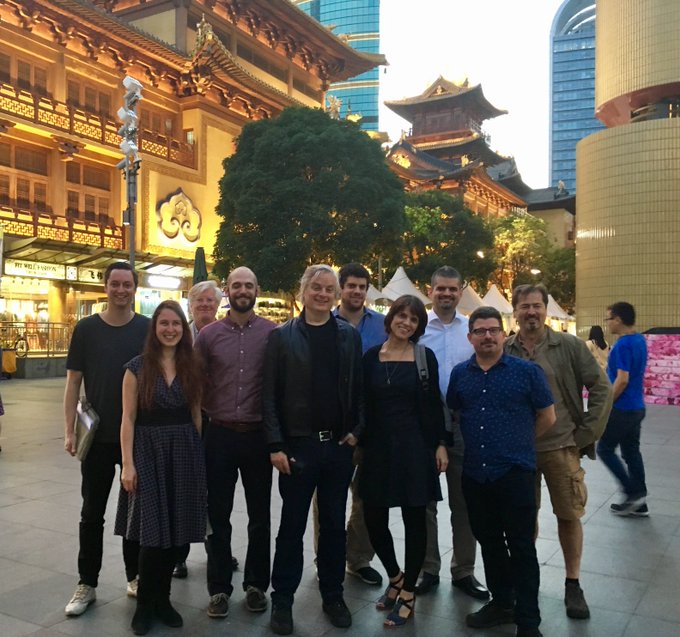
External world: skepticism, non-skeptical realism, or idealism? PollHe's not that new-found. He was mentioned here a few years back and promptly laughed off as a crank. But since then he's published quite a bit and he's become one of members of the choir.
Kastrup at Conference in Shanghai, 2017, with David Chalmers, Galen Strawson, Howard Robinson, Daniel Stoljard, et al. -
The American Gun Control DebateThe identification of gun ownership with appeals to Jesus is itself a particularly revolting aspect of American conservatism. Really signals a very deep and dangerous confusion as far as I can tell. It's diabolical.
-
The Hard Problem of Consciousness & the Fundamental AbstractionThere must be a form for each and every individual. — Metaphysician Undercover
that's where we differ. I don't think that's what 'form' means. Socrates truly is the form 'man' but the form 'man' is common to all men. Likewise for forms generally. I'd like to hear @Fooloso4's view on that, though.
//ref// https://faculty.washington.edu/smcohen/320/1ovrmany.htm
In his work On Interpretation, Aristotle maintained that the concept of "universal" is apt to be predicated of many and that singular is not. For instance, man is a universal while Callias is a singular. The philosopher distinguished highest genera like animal and species like man but he maintained that both are predicated of individual men. This was considered part of an approach to the principle of things, which adheres to the criterion that what is most universal is also most real. Consider for example a particular oak tree. This is a member of a species and it has much in common with other oak trees, past, present and future. Its universal, its oakness, is a part of it. A biologist can study oak trees and learn about oakness and more generally the intelligible order within the sensible world. Accordingly, Aristotle was more confident than Plato about coming to know the sensible world; he was a prototypical empiricist and a founder of induction. Aristotle was a new, moderate sort of realist about universals. — Wiki -
The Hard Problem of Consciousness & the Fundamental AbstractionClearly, then, each primary and self-subsistent thing is one and the same as its essence. — Metaphysics Bk 7 Ch 6 1032a
Socrates is an instance of the form ‘man’ but not all men are Socrates. There are not a multitude of forms as there are multitudes of individuals. -
The American Gun Control DebateThat story is the first I'd heard of him, it appeared in my newsfeed.
In fairness that is a brief excerpt from an entire book, not yet published but highly relevant, I feel. I'm continually baffled by the American attitudes towards ownership of guns as a fundamental right. Why not poisons, explosives, torture instruments? I just don't see the rationale, other than it being a vicious circle - because so many others have guns, I need one also. I'm sure that's also why there are so many police shootings - they never know whether the guy they just pulled over in a traffic stop has a gun, so it's shoot first, ask questions later. In any case, I don't see any solution on the horizon, we all know that it's only a matter of time - and not much of it - until the next mass shooting death in America comes over the airwaves, and I don't see anything changing it. -
What is computation? Does computation = causationWhatever is recorded by instruments remains data until it's interpreted. Data comprises units of information which in themselves do not carry any specific meaning. Information is a set of data units that collectively carries a logical meaning. It also should be recalled that computers are human instruments, extensions of human sensory and intellectual capacities, designed to perform those tasks.
-
External world: skepticism, non-skeptical realism, or idealism? PollKastrup has two PhD’s, a large and growing publications list, and is very much becoming part of the global philosophical dialogue on consciousness, as the inclusion of his work in Chalmer’s paper indicates. If you read him or listen to his online debates, he’s a model of lucid analysis. So he may be a lot of things, but mad ain’t one of them.
-
External world: skepticism, non-skeptical realism, or idealism? PollOh in your book, definitely, but it’s a dull read :-)
-
External world: skepticism, non-skeptical realism, or idealism? PollGood to see Kastrup makes it into that discussion. I'll find time to read it later.
(In relation to which, he notes that Kastrup's 'dissociated identify model' 'makes our ordinary mode of existence pathological, since in this mode we are unaware of the vast majority of experiences we are having.' with the footnote to that remark 'According to some versions of this view, we can occasionally get hints of other fragments of our experience, or become more lucidly aware of our underlying cosmic experiences. For example, some Buddhist traditions suggest that certain meditative practices (e.g., Dzogchen practice in Tibetan Buddhism) can help us experience the fundamental mode of consciousness.') -
The Dialectic of Atheism and Theism: An Agnostic's PerspectiveWhat matters is the fact that there is existence — EnPassant
Again, here, the distinction of 'what exists' and 'what is' has to be discerned. 'Existence' pertains strictly to particular existents. The meaning of the term means 'is apart from' or 'is outside of'. The fact of being is more general , and so 'what is', is not necessarily synonymous with 'what exists'. In philosophical theology, this is the rationale behind for erxample Paul Tililch's insistence that God does not exist - that while God is, God is not 'an existent' which reduces God to a being, one being among others. See for elaboration God Does Not Exist, Bishop Pierre Whalon. -
The American Gun Control DebateWriter Paul Auster on the violence endemic to American culture
“American society was built by religious fanatics who promoted armed struggle, conflict, war, violence, annihilation, and what we today would call genocide,” says Auster. He notes how the Declaration of Independence that the Continental Congress approved on July 4, 1776, announced the separation of 13 North American British colonies from Great Britain. The second paragraph states that all men are created equal, and they are endowed by their Creator with certain unalienable rights. Namely: life, liberty, and the pursuit of happiness.
Auster describes this bedrock credo on which the American republic was founded “as a hypocritical lie”. He has a point. Slavery, after all, was still legal at the time the words were written. “Violence, from the very beginning, was embedded in the whole American project,” says Auster. “The United States is an invented country, based on the premise of capitalism, where there is conflict, competition, and winners and losers.”
He then spends significant time and ink deconstructing the wording of the Second Amendment of the US Constitution. Passed in 1789, along with nine other amendments known as the Bill of Rights, it reads: “A well-regulated militia, being necessary to the security of a free state, the right of the people to keep and bear arms, shall not be infringed.”
Auster says: “The Second Amendment is so confusingly worded that no one can really make sense of it. It seems to suggest that Americans have the right to set up militias. But it has nothing to do with individual ownership rights [of guns].”
Today, many Americans continue to interpret those words in different ways.
“Right now, there are tens of millions of diehard Second Amendment advocates who feel that owning guns is essential to the American way of life,” says Auster. “In fact, it serves no other purpose than to kill people. A gun is an instrument of destruction.”
https://www.smh.com.au/culture/books/america-built-by-religious-fanatics-who-promoted-armed-struggle-paul-auster-20230306-p5cpqm.html -
What is computation? Does computation = causationGiven a mindless universe, could universals/abstract objects exist? I would tend to think not, but that's pretty far afield. — Count Timothy von Icarus
Do they ever exist? Certainly not in the sense that gas clouds and galaxies exist. But wherever sentient beings evolve they will be able to discern them. So they're real as intelligibles, not as phenomena per se.
This output will include the pages of every novel ever written by a human being, plus many yet to be written. — Count Timothy von Icarus
Are you sure about that? I recall reading Simon Conway Morris about the mathematics of the 'protein hyperspace', the number of possible combinations of molecules that could form proteins - and that if these combinations were made by a purely random process, then it would take far longer than the age of the known universe to hit upon the specific combinations that actually comprise working proteins (see his book Life's Solution for details).
Likewise with your imaginary symbol-generation algorithm, whilst one can imagine the possibility of such a computation, it might require vast amounts of time to output all of the actual books, alongside the enormously greater number of 150-page collections of meaningless symbols. Maybe it will produce more 150 page collections than the total mass of the universe. It strikes me as simply a more abstract version of the 'millions monkeys' thought experiment.
Conway Morris' view is that in evolutionary time-scales, some forms are much more likely to emerge than others, because they solve problems (hence, the book's title). Wings and eyes and photosynthesis have evolved numerous times along completely different pathways to solve the same kinds of problems often by drawing on completely different elements and components. -
The Hard Problem of Consciousness & the Fundamental AbstractionDo you agree that a particular object, an individual, is a composition of matter and form, according to Aristotle? — Metaphysician Undercover
Yes. But forms, as a matter of principle, are not themselves particulars. There is not a separate form for each individual. That's the 'principle of individuation' which is subject of a long-standing discussion about Aristotle's metaphysics (SEP.)
How is it that Aristotle is mortal but his active intellect is not? Well, we still read Aristotle. His intellect is at work on us. — Fooloso4
See Mark Johnston, Surviving Death (another book I must get around to reading.) -
External world: skepticism, non-skeptical realism, or idealism? PollI don’t know if current physics does constitute materialism. There are plenty of idealist aspects within it.
-
External world: skepticism, non-skeptical realism, or idealism? PollAll true but how does it show that the elements of experience have any ultimate material constituent? What is this ‘matter’ that all is hewn out of? Sure ain’t teacups.
Wayfarer

Start FollowingSend a Message
- Other sites we like
- Social media
- Terms of Service
- Sign In
- Created with PlushForums
- © 2026 The Philosophy Forum