
Search
-
Philosophical justification for reincarnation
So what I didn't make clear is that this is all me. It's my argument: that if my knowledge is recollection, then either there must be an infinite chain of lives and no one ever learns (which would probably fit with some forms of Neoplatonism since it says that our own minds are reflections of the Divine Mind), or there had to be an Adam, whose learning screws up Plato's argument.
I'm sure somebody else noticed this about Plato's solution to Meno's paradox in the last 2400 years, but I don't know who and I don't know how they dealt with it. So from my point of view, you're continually trying to teach me my own argument and nitpicking at the edges. You're concentrating on how it might screw up what Plato is commonly thought to have said.
Since it occurred to me immediately upon reading Phaedo, I just reworked his story so that it makes more sense. I guess I was influenced by new age ideas prevalent at the time, but I don't remember thinking of it that way. -
Euthyphro
Turning to the gods (or more precisely priests) to learn what righteousness demands is moral externalism. Things are changing, though.
True, the forms are independent, but we seem to know them by an internal source. Socrates is said to have followed an internal voice, so with Phaedo, Meno, and to some extent Euthyphro, we have a rising tide of internalism: justifications can be found within.
To the east of Athens, the Persians are also headed toward the idea that you're born with the knowledge of good and evil. It could be that Plato knew about that, or it could just be convergent evolution.
Do you agree with any of that? — frank
There is no reason why I should disagree with any of it. In fact, I have been saying that myself. There was a general movement from the concrete to the abstract and thus from the external to the internal. When we analyze external reality in mathematical terms as Pythagoras did, we internalize it.
Interiorization of consciousness is central in Plotinus but it started with Plato. The direction is absolutely clear. It describes the journey of return from the periphery of the circle or sphere of reality back to the center. The external Gods are interiorized and replaced with ideas, forms or patterns leading to the unfathomable and indescribable One within us and above us.
It may well be possible to see this in latent form in the Euthyphro. In fact, as already noted, we can be certain that Plato himself and his immediate disciples saw it this way. But this is far from explicitly stated and it doesn’t change much about my central argument.
Socrates has refuted Euthyphro’s belief that the pious is loved by the Gods because it is pious, but not that the pious is pious because it is loved by the Gods. As that is the definition of "the pious" (to hosion), he cannot reject it, and nor does he attempt to.
He does not deny the existence of the Gods, either. Therefore, it stands to reason to say that the Gods love the pious because it is good and just, at the very least. And because the good and the just are attributes or properties of the divine, we may even say that the Gods love or approve of the pious because it is divine.
Though the dialogue appears to end in “aporia”, this is no reason to claim that it has nothing else to offer and that we can’t draw any positive conclusions from it other than atheism and nihilism as some seem to do here. -
What is "the examined life"?
As the Wiki article goes on to note, the nature of the distinction between nous and "the processing of sensory perception, including the use of imagination and memory, which other animals can do" was and is a highly contested topic. — Valentinus
I still don't understand why it's a distinction that is so hard to make. And the sentence you just read - 'why is it like that?' - that is characteristic of reasoning, is it not? And it has little or nothing to do with sensory perception. When you read that and formulate a response, your mind will search through memory, cases, examples, instances. That is an ability unique to rational intelligence.
The passage you quote addresses a larger issue, which is the immortality of the soul, or what faculty of the soul lends immortality. But I don't think that is necessary to simply establish the distinction between reason and sensation, or to ground the claim that humans possess a faculty of reason which other creatures don't (although apparently this is a highly controversial claim nowadays.)
I think the problem stems from seeing Plato and company through modern secular eyes, as skeptics, giving them more skeptical credit than they're due, when in fact it would be more appropriate to see them as religious preachers. — baker
Plato went to enormous lengths NOT to preach. To see him as a preacher is an injustice to his memory. His dialogues are models of reasoned persuasion. They sometimes contain exhortations and obviously have a religious aspect to them, but characterising him as a preacher looses the very real distinction between philosophy and religion. I think we tend to characterise it like that, because we tar anything religious with the same brush.
Don't you find it odd that people who supposedly were so skeptical about their own abilities to obtain proper knowledge, nevertheless had so much to say, with utter certainty, about gods and ideas and a number of other things? — baker
If by 'people', you mean those who speak through the Platonic dialogues, many of their utterances were not at all marked by 'absolute certainty'. There is much weighing up, arguments for and against, doubts raised and not always dispelled. Plato himself is very diffident in respect of his arguments about philosophical ultimates. He's no tub-thumper. Of course for subsequent generations Platonism became absorbed into the Christian corpus, and then it began to assume a dogmatic character that it originally didn't have.
This doesn't answer the question. If there were some determinable truth about "life the universe and everything" which was directly and infallibly knowable when one reaches the requisite level of consciousness, then all the sages everywhere who had reached that level of consciousness would agree with one another as to that truth. But this is patently not the case. — Janus
I'm familiar with 'the conflict argument' - that, because 'religions' disagree with each other, then only one of them is right, or more likely all of them are wrong. That too I see as an echo of Christian triumphalism, the idea that the Christian faith has a monopoly on truth, and also the logic that arises from that, via the opposition of exclusive and exhaustive truth claims.
But the reality is far more complex than that. Allow me to quote Albert Einstein - 'I am not an Atheist. I do not know if I can define myself as a Pantheist. The problem involved is too vast for our limited minds. May I do not reply with a parable? The human mind, no matter how highly trained, cannot grasp the universe. We are in the position of a little child, entering a huge library whose walls are covered to the ceiling with books in many different tongues. The child knows that someone must have written those books. It does not know who or how. It does not understand the languages in which they are written. The child notes a definite plan in the arrangement of the books, a mysterious order, which it does not comprehend, but only dimly suspects.' Obviously his particular genius was scientific, but the point I want to call out is the 'vastness' of the problem. It's not a simple matter, and not amenable to simplistic analysis.
From a religious pluralist:
The basic principle that we are aware of anything, not as it is in itself unobserved, but always and necessarily as it appears to beings with our particular cognitive equipment, was brilliantly stated by Aquinas when he said that ‘Things known are in the knower according to the mode of the knower’ (S.T., II/II, Q. 1, art. 2). And in the case of religious awareness, the mode of the knower differs significantly from religion to religion. And so my hypothesis is that the ultimate reality of which the religions speak, and which we refer to as God, is being differently conceived, and therefore differently experienced, and therefore differently responded to in historical forms of life within the different religious traditions.
What does this mean for the different, and often conflicting, belief-systems of the religions? It means that they are descriptions of different manifestations of the Ultimate; and as such they do not conflict with one another. They each arise from some immensely powerful moment or period of religious experience, notably the Buddha’s experience of enlightenment under the Bo tree at Bodh Gaya, Jesus’ sense of the presence of the heavenly Father, Muhammad’s experience of hearing the words that became the Qur’an, and also the experiences of Vedic sages, of Hebrew prophets, of Taoist sages. But these experiences are always formed in the terms available to that individual or community at that time and are then further elaborated within the resulting new religious movements. This process of elaboration is one of philosophical or theological construction. — John Hick, Who or What is God
If you study comparative religion, as I did, there are discernable principles and commonalities. Huston Smith wrote in his introduction to Forgotten Wisdom, twenty years after he wrote The World's Religions (originally published as Religions of Man), that he came to understand the "core" worldview common to all religions.
That "core view" is this: there are "levels of being" such that the more real is also the more valuable; these levels appear in both the "external" and the "internal" worlds, "higher" levels of reality without corresponding to "deeper" levels of reality within. On the very lowest level is the material/physical world, which depends for its existence on the higher levels. On the very highest/deepest level is the Infinite or Absolute, depicted (paradoxically) in many different ways.
Far from showing that all religions are somehow "the same," Smith in fact shows that religions have a "common" core only at a sufficiently general level. What he shows, therefore, is not that there is really just one religion, but that the various religions of the world are actually agreeing and disagreeing about something real, something about which there is a real matter of fact, on the fundamentals of which most religions tend to concur while differing in numerous points of detail (including practice).
Of course any two religions therefore have much more in common than any single religion has with materialism. In fact one way to state the "common core" of the world's religions is simply to say that they agree about the fallacy of materialism.
And of course, you are free to say, as you're likely to, that you don't believe it. But I still agree with him, that there is a fact of the matter, which is occluded by the constitution of modern culture.
To be free of ego and it's delusions would be to wake up. But the further claim is that the awakened sage knows the truth about life and death. I say that they may be convinced that they do, but that would only be on account of their lack of understanding of what knowledge consists in. — Janus
If indeed through this 'awakening' one realises an identity beyond birth and death, then what could possibly exceed that? That is why there are references to 'eternal life' or 'Life' capital-L. This is mostly represented in mythological form, which has degenerated, in popular culture, to Christmas-card images. But what if there is a core of truth? I mean, for example, the immortality of the soul is precisely the subject of the Phaedo, which has been subject of another thread. And speaking of threads, this concern is a thread which runs through all world cultures and philosophies.
I do believe that, to the extent that one can be free from egoistic concerns, that that is the most profound transformation people may be capable of experiencing, because their whole orientation to life would necessarily become radically different than the ordinary. — Janus
:ok: Quite right. It's as simple, and as difficult, as that. -
What is "the examined life"?
I answer your questions when they are directed to comments I make. I don't when they refer to arguments you are having with others. — Valentinus
Well, you are systematically siding with @Fooloso4 and your own comments are indistinguishable from his.
Here is one of your staple comments:
The inquiry does lead to aporia. — Valentinus
My question was, if philosophical inquiry leads to aporia, then why would anyone engage in philosophical inquiry?
The way I see it, and this is the traditional view, philosophy is a quest for knowledge.
According to Socrates, knowledge of higher realities can be acquired only by looking into them with the soul alone by itself.
Therefore, the true philosopher (or lover of wisdom) practices "dying" which is separation of the conscious soul from the body and the material world (Phaedo 67e). (Obviously, as far as possible and for the duration of a particular session of intense inquiry.)
It isn't my fault that Plato has Socrates make those statements. I am simply following those statements to their logical conclusion.
Others may think that Socrates and Plato are either ignoramuses of fraudsters whose only teaching is "ignorance and aporia".
This is why communication between the two sides is impossible and there is no point in getting upset over it. I don't see Plato or Socrates getting upset over anything :smile: -
What is "the examined life"?
Well, the mistake or misunderstanding is entirely yours. As I said before, you can try actually reading what people are saying, for a change. :smile:
Anyway, I fail to see why I would need to explain something that is perfectly obvious.
Plato is not saying that he knows the truth, he is simply suggesting the WAY to the truth.
Socrates explains it in very clear terms. He even uses the term “hunt” with reference to non-physical realities.
The philosopher, i.e. lover of wisdom or seeker after knowledge, can hit upon reality only by hunting down each reality alone by itself and unalloyed (Phaedo 66a).
How do we hunt down (thereuomai) an animal? By following its tracks until we see it. Alternatively, we lie in wait until it appears in our field of vision.
Similarly, we follow the Sun’s tracks or reflections in water, etc., then follow its light, and, when our eyes have become accustomed to its brightness, we can look straight at the Sun itself (at least for a brief time) and see it as it is in itself (99e).
The same is true of the Forms. We follow their tracks in the images of particular objects of perception, we look into the truth of arguments about them, and when we have sufficiently trained our mind to become receptive and alert, we can start looking into the Forms themselves, by using thought alone by itself and unalloyed, and separated as far as possible from eyes and ears and virtually from the entire body (66a).
Plato does no more than to put us on the right track. The Truth-hunting has to be done by each lover of wisdom or seeker after truth, personally.
Likewise, the decision to go on the hunt is entirely for the individual to take. Plato puts no obligation on anyone to look into higher truth. People can still be good citizens and enjoy a life of peace and happiness by being righteous and wise.
Platonism offers something to everyone, including materialists. And those who like to find their supreme satisfaction in doubt, “aporia”, and similar things are at liberty to do so.
At any rate, I think we are more likely to arrive at truth by actively hunting for it than by perpetually questioning things and living a life of self-imposed ignorance, uncertainty, and doubt. -
An analysis of the shadows
I am asking you to ask yourself if this is something you know rather than a belief or opinion or just a possibility you don't want to deny. — Fooloso4
I had some vivid experiences in my early years which were like recollections. Part of it was realising that I am the necessary ground of all experience (not myself personally but the self of all beings). That is what lead to my interest in Eastern philosophy. I also had an acute sense of having known something of great importance at a time that must have been before I was born. It was a momentary realisation but very persuasive. It wasn't anything like remembering a previous identity, although I've read such accounts and they seem authentic.
what is edifying is not the same as what is true — Fooloso4
This is the crux of the issue. I think this is where the influence of modern culture frames the interpretive picture. The background to modern thought is that the Universe is valueless in itself, that it's up to humans to create and maintain a value system.
From the thesis I did in Buddhist philosophy:
Williams says that 'In the Indian context it would have been axiomatic that liberation comes from discerning how things actually are, seeing the true nature of things ('yathābhūtaṃ'). That 'seeing things how they are' has soteriological benefits would have been expected, and is just another way of articulating the ‘is’ and ‘ought’ dimension of Indian Dharma. The ‘ought’ (pragmatic benefit) is never cut adrift from the ‘is’ (cognitive factual truth).' (Quoted in Fuller, P. 2005. The Notion of Ditthi in Theravada Buddhism. New York, Curzon.)
Fuller points out that the ‘is/ought’ distinction is a modern one, originating with Hume. (Fuller, 2005, p9). The ‘is/ought’ distinction is now, however, very much a part of modern life, and it is generally taken for granted that science assumes a Universe which is inherently devoid of value; these are internal to human minds and are ultimately derived from, and reducible to, the requirements of survival.
As you recall from the thread on the Phaedo, Socrates rejects Anaxagoras' naturalist account of causation because it gave only explanations in terms of 'air and aether' and the like, which he compares tto 'bones and sinews' rather than 'real causes' which, he says, are intentional 98e.
That is just prior to Socrates' (and so, Plato's) introduction of the 'theory of forms'. I don't believe they are presented as an edifying tale, but as a hypothesis (although obviously not what we would regard as a scientific hypothesis).
. The story of Forms is not exempt from the Socratic practice of critical inquiry. — Fooloso4
According to Norman Gulley 'Plato's Theory of Knowledge', Plato introduces the theory of forms and anamnesis (Meno) because of his awareness of the limitations of the Socratic method of questioning, and in the attempt to develop a constructive theory of knowledge.
The tendency to facilitate the apprehension of the idea of Good is to be found in all studies that force the soul to turn its vision round to the region where dwells the most blessed part of reality, which it is imperative that it should behold (Rep. 526e) — Apollodorus
A comparison from Buddhist literature:
I wish here to say a few words concerning the important psychological event known as Parāvṛtti in the Lanka and other Mahayana literature. Parāvṛtti literally means "turning up" or "turning back" or "change"; technically, it is a spiritual change or transformation which takes place in the mind, especially suddenly, and I have called it "revulsion" {nimmita) in my Studies in the Lankavatara, which, it will be seen, somewhat corresponds to what is known as "conversion" among the psychological students of religion.
It is significant that the Mahayana has been insistent to urge its followers to experience this psychological transformation in their practical life. A mere intellectual understanding of the truth is not enough in the life of a Buddhist; the truth must be directly grasped, personally experienced, intuitively penetrated into; for then it will be distilled into life and determine its course.
This Parāvṛtti, according to the Lanka, takes place in the Alaya-vijnana (All-conserving Mind), which is assumed to exist behind our individual empirical consciousnesses. The Alaya is a metaphysical entity, and no psychological analysis can reach it. What we ordinarily know as the Alaya is its working through a relative mind The Mahayana calls this phase of the Alaya tainted or defiled (klishta) and tells us to be cleansed of it in order to experience a Parāvṛtti for the attainment of ultimate reality.
Parāvṛtti in another sense, therefore, is purification (visuddhi). In Buddhism terms of colouring are much used, and becoming pure, free from all pigment, means that the Alaya is thoroughly washed off its dualistic accretion or outflow (asrava), that is, that the Tathagata has effected his work of purification in the mind of a sentient being, which has so far failed to perceive its own oneness and allness. Being pure is to remain in its own selfhood or self-nature (svabhava). While Parāvṛtti is psychological, it still retains its intellectual flavour as most Buddhist terms do. — D. T. Suzuki, The Lankavatara Sutra -
Science, Objectivity and Truth?
Therefore these passages you have quoted, which were derived from that intuition, ought to be dismissed as misguided. — Metaphysician Undercover
It looks like you are dismissing a lot of passages there. In fact, far too many for your argument to hold. :smile:
And they both said that we ought to try to approach the divine as much as humanly possible, as evidenced by the quote I just gave you, from your own reference — Metaphysician Undercover
Of course both Plato and Aristotle say that the philosopher ought to try to approach the divine as much as humanly possible, this is precisely why I quoted Aristotle on it!
But we ought, so far as in us lies, to put on immortality, and do all that we can to live in conformity with the highest that is in us [which is immortal and divine] (Nicomachean Ethics 1177b30). — Apollodorus
How do you reckon the philosopher is supposed to "approach the divine"? Surely, not with the body or mind that according to Aristotle perish at death? He can approach the divine only with the intellect or nous which Aristotle clearly says is immortal, eternal, pure, and divine.
This is exactly what Plato states in the Phaedo and elsewhere when he says that only what is pure can approach the pure.
So, I would suggest you stop "dismissing" passage after passage that contradicts your interpretation and try to look at the contradictions in your own statements.
You said that “there is no such thing as "pure, unaffected intelligence" in human beings.”
Yet Aristotle says that the intellect is “pure (unmixed) and unaffected”:
It is this [active] intellect which is separable and impassive and unmixed, being in its essential nature an activity. For that which acts is always superior to that which is acted upon, the cause or principle to the matter … But this intellect has no intermittence in its thought. It is, however, only when separated that it is its true self, and this, its essential nature, alone is immortal and eternal (De Anima 430a23).
When we are in deep, dreamless sleep, for example, our intelligence is pure and unaffected by thoughts, emotions, or sense perceptions.
Moreover, as can be seen, Aristotle himself defines active intellect here as an “activity”, which is “uninterrupted thinking”.
And since the active intellect, when separated from the body-soul compound (syntheton), is its true self and nothing else, the only thing it can “think” about is itself in an act of self-reflexive awareness. Self-reflexivity is a defining property of intellect or consciousness. There is no self-reflexivity in any other part of the soul, be it sense-perceptions, emotions, or thoughts.
Incidentally, this self-reflexive awareness is to some extent present even in deep sleep, i.e., it is ever-present and ever-active, as Aristotle says.
In any case, it is clear that the whole discussion is about thinking in the human soul – the whole book is entitled “On the Soul” (Peri Psyches) – and that Aristotle uses the intellect’s self-reflexivity to argue for its incorporeality and immortality. He does NOT "refute" this anywhere.
Of course, God or the Prime Mover is also intellect or consciousness but he is Universal Consciousness whilst a human being's “active intellect” is individual consciousness.
However, the two are essentially identical and the recognition of this identity leads to the self-realization of individual intellect or consciousness.
This is achieved "as far as humanly possible" during embodied existence and more fully after death when, as Aristotle says, the intellect, nous, or spirit is separated from the body-mind compound and therefore free to unite with the divine.
"Approaching the divine" is nothing but "unity with the divine" when once all factors that separate the two divine elements, the individual and the universal, have been removed.
Pretty simple and easy to understand IMO. And it doesn't require dismissing any passages either from Aristotle or Plato .... -
What is it to be Enlightened?
Of course, Plato should ideally be read in the original Greek. But I think even an English (or any other modern) translation will convey enough of Plato's actual teachings for the reader to form a fair idea of what he is talking about.
The crucial approach is to read Plato himself before reading modern interpretations of him. What is interesting is that in my experience at least, if you do that, you will be far more likely to find traditional readings like Plotinus and Proclus more in agreement with your own than those of modern scholarship.
To me, this suggests that a break must have occurred at some point in the interpretative tradition and that modern scholars have hopelessly lost the thread - and sometimes the plot - as noted by Gerson.
Incidentally, another key element that can be added to the list of East-West (or Greek-Indian) parallels is the conception of spiritual or philosophical practice as a process of purification, which goes hand-in-hand with the concept of liberation or release:
And therefore those who care for their own souls, and do not live in service to the body, turn their backs upon all these men [the lovers of money and other material things] and do not walk in their ways, for they feel that they know not whither they are going. They themselves believe that philosophy, with its deliverance (lysis) and purification, must not be resisted, and so they turn and follow it whithersoever it leads(Phaedo 82d).
Again, "purification" here may be interpreted as a process by which consciousness is gradually cleansed of ignorance until the knowledge or wisdom inherent in consciousness or intelligence alone remains.
But what I find particularly interesting, and commendable, is the "whithersoever-it-leads" attitude which indicates a rather philosophical openness that I believe should form the basis of authentic philosophical or spiritual effort. -
Why Science Has Succeeded But Religion Has Failed
I appreciate your "constructive criticism" by contrast with 180boo's dueling physicists. Although you have been influenced by the anti-design arguments, you remain open-minded to alternatives*1.180 Proof, for my money, has one gripe against your theory viz. the fact that it seems impossible to retain design (Enformy, teleology, etc.) without a designer implicit. So thought you try valiantly to distance yourself from religion, it comes off as incoherent at best or deception at worst.
Another thing, please take this as constructive criticism, your theory relies on controversy (dueling physicists) rather than solid facts - its home is in the darkness of our ignorance rather than the light of our knowledge. Given your caliber, I'm expecting a first class response from you. — Agent Smith
Yes, I have concluded that the apparent design*2 -- the "marvelous structure" (Einstein) -- of the universe logically implies a designer, planner, creator. That's why Einstein, and several of the founding fathers of Quantum Theory reached that same conclusion. So, since 180boo responds to my theories with dueling physicists, I'll be glad to let him argue with Einstein. What say you : does the "comprehensibility" of the universe imply a random accidental origin, or an intentional designer*3 of some kind? Even Atheists admit that the emergence of a self-organizing system of Causation (energy) & Regulation (laws) requires something more than shuffling cards for a long, long time.
I have indeed, distanced myself from all religions -- including the indoctrination of my childhood. And I have no inclination to worship the Enformer of my own thesis. It's just an idea. But it's an informed idea : a philosophical hypothesis, like Plato's Logos*4. Since there is no empirical proof for any of the postulated precedents of our universe, your guess is as valid as mine, but mine has a detailed thesis (philosophical argument) to support that logical conclusion.
Regarding "controversy" vs "solid facts", are you aware of any philosophical concept that is uncontroversial? It's the job of empirical science to provide "solid facts" to put an end to controversies, such as phlogiston. But, are you aware of any "solid facts" that terminate all Ontological questions? Are you afraid of controversial topics and the darkness of our Ignorance? If so, you should shy away from philosophical forums. :smile:
*1. I too, reject the magical implications of Intelligent Design proponents, but not necessarily the physical & philosophical evidence they present. As you well know, I don't depend on Biblical authority to support my ideas. Instead of the Instantaneous Design by Fiat of Genesis, I have adopted the Gradual Design by Evolution of Darwinian Teleology. I simply call it "Intelligent Evolution", guided by Laws, not by Chance.
*2. What is the basic definition of design? :
to create, fashion, execute, or construct according to plan
https://www.merriam-webster.com/dictionary/design
*3. The Enformer :
AKA, the Creator. The presumed eternal source of all information, as encoded in the Big Bang Sing-ularity. That ability to convert conceptual Forms into actual Things, to transform infinite possibilities into finite actualities, and to create space & time, matter & energy from essentially no-thing is called the power of EnFormAction. Due to our ignorance of anything beyond space-time though, the postulated enforming agent remains undefined. I simply label it "G*D".
http://blog-glossary.enformationism.info/page8.html
Note -- I don't quote the Bible to support the Enformer hypothesis, but the opinions of professional scientists. So, the Enformer is not identical with any of the traditional creator gods, but merely a novel theoretical Principle derived from 21st century science. AFAIK, that hypothetical entity is worshiped by no religion, and has made no threats of eternal damnation. Hence, it's no more scary than the only viable alternative : an eternal regression of self-existent & self-organizing worlds (Multiverse).
*4. LOGOS :
With Plato the story gets a bit more complex, since he had a variety of ways he used this term. Maybe the most straightforward one would be the understanding of logos as opposed to mythos (μῦθος), where logos is perceived as the true, analytical account.
In Phaedo, Plato explained that the characteristic of the true knowledge is the ability to give account, logos, of what one knows. In Theatetus, Socrates described logos as the distinguishable characteristic of a thing.
With Aristotle, we approach the definition of logos that is close to Latin ratio, as well as the modern notion of logos. Aristotle understood logos as the reason and rationality, especially in the ethical sense.
He also used it in the meaning of a mathematical proportion, which we can see in the English word ratio, but this can probably be traced back to Pythagoras.
https://www.pbs.org/theogloss/logos-body.html -
Vogel's paradox of knowledge
It seems as if you are a platonist. Is that fair? — Ludwig V
No. I make a distinction between Plato and Platonism. By Plato I mean the dialogues. As I think you pointed out, Plato never speaks in the dialogues.In the Seventh Letter he says:
There is no treatise (suggramma) by me on these subjects, nor will there ever be. (341c)
I feel I want to ask you where you are going with this? — Ludwig V
I'm not going anywhere. I can't find my car. I thought I knew where it was but I was wrong!
Seriously, I'm just trying to put some things together from the dialogues around the question of the difference between knowledge and opinion or belief.
One thing I was trying to make clear is that the centrality of the question of the good is not about claims such as this is the best possible world. In the Phaedo Socrates "second sailing" (99d) is a shift from Anaxagoras' claim that Mind orders all things, to the way Socrates mind orders or make sense of things. A second sailing is when the ship cannot move because the wind fails and one must take to the oars. it is in line with this that the good comes into play. Concerns for knowledge is not separate from concerns for the knower.
But I have taken the ship off course. -
The Hard Problem of Consciousness & the Fundamental Abstraction
In the Phaedo Socrates calls the hypothesis of the Forms "safe and ignorant". In addition to the forms he adds natural causes such as fire. (105b-c)
Answer me then, he said, what is it that, present in a body, makes it living?
Cebes: A soul. (105c)
The answer is no longer life but soul.
In the Timaeus the fixed intelligible world of forms is regarded as inadequate. They do not account for motion or change.
Plato was aware of the problem and Aristotle was aware that Plato recognized the problem. The point being, we should not, as is commonly assumed, read Aristotle as a rejection of Plato. An adequate account of the causes of living things must include physical or material and active causes. Certainly more than a concept or representation or map. -
The Hard Problem of Consciousness & the Fundamental Abstraction
those who accept the Forms — Metaphysics, 1071b12–22, translated by C.D.C Reeve
We might assume Aristotle is talking about Plato and this is not entirely wrong, but the argument in the Timaeus acknowledges the problem of the Forms and:
some starting-point that is capable of causing change. — Metaphysics, 1071b12–22, translated by C.D.C Reeve
In the discussion of astronomy in the Republic Socrates says:
Perhaps your belief is a fine one and mine innocent. (229c)
This echoes Socrates' discussion of the inadequacy of the Forms in the Phaedo, where he calls the hypothesis "innocent".
So, by those who accept the Forms I think he means those who accept them and are unaware of the problems Plato raises.
On the issue of the starting point Plato and Aristotle take opposite sides, but agree that it:
must be grasped by argument and thought, not sight. (529c-d)
Aristotle's argument is:
There must, therefore, be such a starting-point, the very substance of which is activity. — Metaphysics, 1071b12–22, translated by C.D.C Reeve
A reasonable argument, but reasonable and true are not necessarily the same.
Timaeus says:
So then, Socrates, if, in saying many things on many topics concerning gods and the birth of the all, we prove to be incapable of rendering speeches that are always and in all respects in agreement with themselves and drawn with precision, don’t be surprised. (29c)
The question is whether Aristotle accepts what is reasonable as true. Surely he is aware of the problem of giving an account of the arche.
I started a discussion of the limits of knowledge in Aristotle's Metaphysics. -
Crito: reading
one in which the real Socrates is allowed to speak.
— frank
For much of the dialogue he speaks on behalf of the city and its laws — Fooloso4
I meant that this has traditionally been thought to be about Socrates' real views as opposed to Plato's. The Republic, Phaedo, and Phaedrus are commonly thought to be expressions of Plato's views rather than Socrates'. Of course there isn't anything about Plato that's pinned down. At one time or another the authenticity of every work attributed to him has been questioned by some historian.
For much of the dialogue he speaks on behalf of the city and its laws. — Fooloso4
Right, as the dialog emerges, we'll find that Socrates is a strong advocate of the rule of law (although we could ponder whether that's the right way to put it.) We can compare and contrast other prominent views, like the Stoic view. It comes down to how one thinks about one's place in society.
We can see from the beginning of the dialog that the concept of individuality is in clear view, since it seems perfectly reasonable to Crito and his friends that Socrates should reject the judgement and run. That concept of individuality probably won't be eclipsed again until the middle ages.
Athens was a democratic regime. Socrates was convicted by a majority decision. His low opinion of public opinion, raises questions about how wise he thought the city and its laws actually were. And yet Socrates defends the city and its laws and abides by them. — Fooloso4
So we'll look into his reasons for abiding by the law and discuss whether this is a proto-form of social contract theory. -
Best Arguments for Physicalism
The Platonic concept of Body/Soul integrity, as a harmonious interaction, is new to me.
Just to clarify though, the body/soul - instrument/harmony analogy is Pythagorean, not Platonic. Plato has Socrates argue against the analogy in the Phaedo. It's in the context of Plato's arguments in favor of the immortality of the soul. Plato doesn't like the analogy because it would imply that the soul (harmony) must disappear when the body (instrument) is destroyed. -
Best Arguments for Physicalism
The framing of the problem is the problem. Body and soul are treated as if they are two things, with the former dependent on the latter. — Fooloso4
A lyre that is not in tune cannot play a tune in tune. The harmony is not what is played on the lyre it is the condition of the lyre, the proper tension of the strings in ratio to each other that allow it to play in harmony. A body that is not in tune cannot function properly. When it is far enough out of tune it cannot function at all. — Fooloso4
Simmias says, 85e-86d:
One might make the same argument about harmony, lyre and strings, that a harmony is something invisible, without body, in the attuned lyre, whereas the lyre itself and its strings are physical, bodily, composite, earthy and akin to what is mortal. Then if someone breaks the lyre, cuts or breaks the strings and then insists, using the same argument as you, that the harmony must still exist and is not destroyed...
If then the soul is a kind of harmony or attunement, clearly, when our body is relaxed or stretched without due measure by diseases and other evils, the soul must be immediately destroyed... — Plato, Phaedo
Socrates' refutation of 'the soul is a harmony' (92-94) consists of three distinct arguments. Each one argues a slightly different principle. Each argument is aimed against the idea that the soul is a composite thing, it is composed from the elements of the body coexisting in a specific tension, resulting in a "harmony". From the elements of the body, the harmony is composed last, and first destroyed in corruption of the instrument. In modern terms we might consider this "harmony" to be a balanced state of existence, or equilibrium, of the composite material parts.
The first and third argument attack the fact that the harmony is posterior to the bodily composition which produces it, yet common understanding of "the soul" puts the soul as prior to the bodily composition. These are simple arguments but rely on the common notion of "the soul" for their effectiveness. That is what Foolos4 rejects with "The framing of the problem is the problem. Body and soul are treated as if they are two things, with the former dependent on the latter." But this dismissal is unacceptable because proposing that the soul is a harmony, already in itself, as a primary proposition, assumes this body/soul separation, as "the harmony" is expressed as something distinct from the material body which produces it (described by Simmias above). So this rejection would only be acceptable if we remove the primary proposition 'the soul is a harmony', but then there is nothing to argue. The point to argue might then be 'there is no soul'. But Socrates' argument is against the Pythagorean position that 'the soul is a harmony'. So it is the Pythagoreans who have already framed the argument in this way.
The second argument is more complex and difficult, involving the difference between "equilibrium" (as the harmonized state), and "equality", as what all equilibriums might have in common. The argument seems to be that a harmony is an equilibrium, and all physically existing equilibriums partake of varying degrees of equality. That would dictate their stability. The soul on the other hand is more like "equality" itself, that which all equilibriums have in common, as an order state of being.
So in the first argument, Socrates appeals to another principle, 'knowledge is recollection' and shows how this is inconsistent with 'the soul is a harmony'. Knowledge is a property of the soul, so if the knowledge which an individual will have, pre-exists the person's bodily existence, then so does the soul. This is inconsistent with the soul being a harmony which arises from the well-tuned elements of the body. In modern terms we can think of the preexisting knowledge as innate knowledge, intuition and instinct, knowledge which is supported by genetics and DNA. If this is a type of knowledge which an individual has, and knowledge is the property of a person's soul, then the person's soul must precede the person's body.
The second argument concerns the various degrees of tuning which are possible. We can say that an instrument is better tuned or worse tuned depending on the amount of dissonance inherent within the harmony produced. Each bit of dissonance which exists within the harmony is a degree of unharmony. Since a harmony is never absolutely perfect, there is always various degrees of dissonance within the occurring harmony itself, and this is a case of the opposite of the thing, occurring, or inherent within, the named thing, Due to a lack of perfection, there is always some degree of 'not-harmony' within the harmony. As analogy we could consider instances of "hot". Each hot thing still has some degree of cold inherent within it, unless it is the absolute hottest possible thing.
If the soul was like this, admitting to various degrees of "soulness", harmony and dissonance, then we'd have to say that an evil person has less of a soul than a good person. But this is not the case, we say that all souls are equal, as souls, and the evil person has no less of a soul than the good person. Furthermore, all the living creatures are equal in the sense of having "a soul", and despite the vast variety of difference that we notice amongst the living creatures, one is not more in tune than the other, as is the case with the difference between harmonies, one having more dissonance than another. All the souls of living creatures are equal, as souls.
The third point is that the soul is said to rule the various part of the body, making them do, at times, what is contrary to their very nature. If a man is hot and thirsty yet the water is known to be bad, the soul prevents the man from drinking. Likewise with food. If the soul was a harmony, it could do nothing but follow the plucking of the strings, the soul would be directed by the affections of the body, following them, never being in opposition. But this is not the case, we see that men, with the power of will, are capable of inflicting all sorts of punishments on their bodies in many different ways, directing the parts in ways very contrary to the nature of the part. It is impossible that a harmony could do this, directing the activities of the composite parts of the lyre, as this would alter the tuning, corrupting the harmony which is "the harmony"'s very existence.
In order not to get too far off topic I will only say that Plato also gives us reason to doubt the argument provided. — Fooloso4
Can you show me the reasons given by Plato, to doubt the arguments presented by Socrates, as paraphrased above. -
How May Esoteric Thinking and Traditions be Understood and Evaluated Philosophically?
"Effing the ineffable" is the job of art and poetry, not rigorous philosophical discussion. Poetry may be evocative, but it presents no arguments. That which cannot be tested empirically or justified logically is outside the scope of rational argument. That doesn't mean it has no value, so don't mistake me for saying that. — Janus
Much of what we find in Plato, including the ascent to a transcendent realm of Forms in the Republic is philosophical poetry. In the Phaedo, in order to save philosophy from the failure of rational argument Socrates resorts to mythos to overcome misologic. (89d)
Wittgenstein said:
(Culture and Value)Philosophy ought really to be written only as a form of poetry.
and:
(Culture and Value)When you are philosophizing you have to descend into primeval chaos and feel at home there.
Those who love Plato's image of clear unambiguous world of Forms bristle at what Aristotle calls Plato's "indeterminate dyads".These dyads include:
Limited and Unlimited
Same and Other
One and Many
Rest and Change
Eternity and Time
Good and Bad
Thinking and Being
Being and Non-being
Each side stands both together with and apart from the other. There is not one without the other.
Ultimately, there is neither ‘this or that’ but ‘this and that’. The Whole is not reducible to One. The whole is indeterminate. -
What the science of morality studies and its relationship to moral philosophy
I was just rereading Boethius' "The Consolation of Philosophy," and I've decided it might be the pound for pound greatest moral work of all time. It's quite short and packed with great verse, symbolism on every page, and probably the single best display of "philosophy as therapy."
It occured to me that the science of morality is just about useless for Boethius as he sits in his prison cell awaiting his torture and execution for not not allowing corruption. His problem is that he is wallowing in self-pity and ruled over by his emotions (surrounded by the Muses). He is in the situation described by Plato in the Phaedo, "nailed to the body" by extreme pain (or pleasure).
Where science is probably most helpful is in knowing what to do and how to do it, rather than in being motivated to do the good (or to bother discovering it). Science would be extremely helpful to Boethius while he is still Consul and dealing with the intricacies of public policy.
Could it still be useful for him as he sits in his prison cell? To some degree, in that it might help him with self-knowledge. But its uses seem fairly limited in comparison to Lady Philosophy's weak and strong medicines.
The first medicine she applies is Stoicism, showing Boethius how the fruits of fortune cannot be the source of a stable human flourishing, how money, power, glory, and pleasure do not "make one good." The second medicine, which can only be applied after Boethius is liberated from the passions and appetites, is the philosophical ascent into the transcendent and the consideration of the good in itself and the nature of being.
Point being, science, and techne in general, is only useful once one is already self-determining to some degree. Being "ruled over by the rational part of the soul," ends up being a prerequisite for good science and for making use of science (https://thephilosophyforum.com/discussion/15027/plato-as-metaethics). Science can only do so much to help us make the jump from continence to virtue, from doing the good to loving it.
Boethius' complaints line up to Plato's three parts of the soul. He laments being in prison and having lost his wealth and comforts (appetitive and spirited/emotional complaints). He also is upset by the lack of justice in his situation (spirited and rational complaints). Finally, he has the same deep existential questions as Job, "if God, from whence evil," and why does God not punish the injustice?"
Like Job, he is answered by a divine theophany, Lady Philosophy recalling the personified Wisdom (Sophia) of Proverbs, Sirach, and The Wisdom of Solomon. But Philosophy itself ends up sitting somewhere between the human and the divine. Boethius describes her height as variously shifting between the "measure of mortal men," and her crown touching the heavens. Philosophy then is a bridge, whereas Job's problem is that there is no bridge — he is "a worm" and there can be no intercessor between him and God (e.g. the great lines in Job 40 where God asks Job out of the whirlwind if he can do what God can, lay all the proud low at will, garb himself in glory — "then I shall admit that thine own right hand can save you.")
Science then, lies in Lady Philosophy's ambit, but not Lady Philosophy within the compass of science. This makes it a tool/art relationship, rather than a grounding one.
(There is also something interesting in the positing of Sophia/Chokmah, the Incarnate Logos, or emanated Nous as the necessary intercessor between created man and the Absolute - the problem brought up in Job, which has a lot of parallels with Boethius) -
Graham Oppy's Argument From Parsimony For Naturalism
But one of the comparisions Murti makes is between the 'two-truths' teaching of Madhyamaka and the Kantian distinction between phenomena and the noumenal. Conventional truth, samvritti, corresponds with the phenomenal realm, paramartha is ultimate truth, but at the same time, empty of own-being and beyond predication, as it were. Nāgārjuna (who authored the principle text) said he makes no claims and holds no thesis of his own. He has no absolute truth to proclaim and writes only as a kind of propadeutic. The analogy is, words are like a stick used to stoke the fire, but once the fire is ablaze, the stick is thrown in with it.
Reminds me of Plato's Divided Line and his difference between opinion (about mutable things) and knowledge (about things that are always true). It struck me a while back that the Platonic preference for this sort of knowledge is essentially reborn in modern philosophy's preference for Humean "relations of ideas" or Kantian analyticity. The whole idea of "a priori" truths is very akin to the theory of remembered truths, known prior to all sensory experience, in the Phaedo.
But this is a point where I tend to go over more to Aristotle, even if I generally find more to like in Plato. We learn from sensory experience and from experience of our own thoughts. Plato might be right to preference the realm of being over becoming to some extent, but it isn't true that all knowledge is of being alone.
For example, imagine, to take your example, there are five basic atoms which everything is ontologically reducible to. Imagine a theist says “this ‘atomic five theory’ doesn’t account for miracles”, and we need to posit God to explain them. IF the ‘atomic five’ naturalist can explain sufficiently such “miracles” under their theory, then it seems, to me, to be more ontologically parsimonious, even though God would provide a form of monism whereas ‘atomic five theory’ does not because the latter doesn’t have to posit a whole new category of entities.
Yes, this makes sense. And I think it applies to the "classical theism" of most contemporary philosophy of religion, where God is just a very powerful entity outside the world who created the world and occasionally intervenes in it against the normal "laws of nature."
Religion is only more parsimonious in systems where there is a higher level reality that the world of appearances is plausibly reducible to. This tends to be true in panentheistic systems, whereas pantheism would seem to require an identical number of entities to naturalism and theism additional entities. Advaita Vedant, Neoplatonism, and most Catholic and Orthodox theology would seem to fit the bill here. The reduction flows from a vertical conception of reality based on what is more essential.
The Catholic Mass has a line where everyone says something to the effect of "praise God in whom 'live and move and have our being'" (from The Book of Acts 17:28). God's essence is said to be identical to God's being, but this is true of nothing else. All created things are a sort of derivative partial being, existing according to their essence. All essence is derivative of the Logos (Christ) in the same way light comes in many colors but is one thing. Being is God's being alone (existence, haecciety), which is incarnated/instantiated in Logos according to essence, where essence is derivative of Logos. This maintains a true ontological God/creation distinction unlike Advaita, but it nonetheless collapses the plurality of ontological entities. But there is also a personalist trend here (normally associated with the Holy Spirit) that also tends to make persons ontologically basic, which increases the number of entities.
But a thing cannot be the opposite of what it is. What are we to make of this puzzle Bob Ross?
Dialectical. A thing is / encapsulates its opposite (Eriugena, Boehme, Hegel, etc.) . :cool: -
Pragmatism Without Goodness
Yes, I see.
As with a tornado, half the job of being alive and mindful is done. Then life and mind become a simple, mechanical, addition to the organic flows - semiotic codes colonising the great entropy gradients like the original "earth battery" of plate tectonics that drove the sea vent origins of life, and the daily solar flux that eventually put life on a much more generic photosynthetic footing
And as you can see, I wasn't at all hostile to the approach, but I still don't think it answers a single one of the points I brought up.
It also seems like that view is going to run into another problem. Lots of systems function like organisms: ant hives, ecosystems, cities, corporations. They are all shaped by selection forces and are explicable in terms of entropy gradients, and can certainly be described as self -organizing structures. "The Ascent of Information," is a neat, light popsci book on just this sort of take. But then it seems we should actually have tons of minds nested within each other. This is a problem for many formulations of IIT too, you get group minds everywhere, which seems to strain credulity. If Toyota, the City of Miami, and memes are all "concious" they seems to be so in at best an analogous way.
But against this, we might consider global workspace models of conciousness and the decent empirical support that suggests they get something right, which would seem to suggest that something much more definiteness is required to result in phenomenal awareness than having a metabolism, etc.
The solution is even older, it gets posed by Plato in the Phaedo and is there ascribed to the Pythagoreans. The material metaphysics is familiar, since it really hasn't changed much. For the Pythagoreans life was a process. It was said to be analogous to a harmony (tuning) on a lyre. The strings are what we observe around us, matter, the harmony, is us experiencing things. The harmony just is the vibration of the strings (ignoring the air for now).
But as Plato points out, this implies something like causal closure. If intentionality just is mechanism "seen from the inside" it can never have any sort of causal relationship with mechanism, they are the same thing. Their relation is identity.For Plato, this is a reductio because, clearly, we sometimes do things because we choose to do them, because we find them pleasant, etc.
So I think the same issues show up there. If our experiences were just mechanism as seen on the inside then there is no reason for the content of those experiences has to have anything to do with the underlying mechanism. You need some sort of explanation why mechanism must produce experienced that are "like" the mechanism that causes them. This seems hard to do if they just are the same thing, but maybe it's possible. Such an explanation doesn't exist though. That, and there seems to be a lot of good empirical support that experience "feels the way it does," in order to motivate us to do things, including misrepresenting reality for selection advantage.
I consider this a difficulty for panpsychism as well. Even if we assume panpsychism, why do we assume that it has to result in experiences that relate closely enough to the underlying/flip side mechanism for us to trust our observation?. There is no prima facie reason they seem to need to. And then there is the issue I pointed to before which is that the psych part of panpsychism is seemingly unobservable "from the outside" and so not only unfalsifiable but also seemingly unconfirmable except maybe by process of elimination of plausible alternatives. This isn't true for all panpsychism, really just those ones that say there isn't anything more to explain because experience is just one side of the dual aspect of one thing, but that's the most common sort. -
WHY did Anutos, Melitos and Lukoon charge Sokrates?
This amplifies and justifies one of the prominent themes of the Apology, that he does not fear death, because no harm can touch a good person. It is a radical and new thesis in Greek times, and completely counter-intuitive in that culture (and pretty astonishing in this one). Aristotle takes a different view, in the Nicomachaean Ethics. — Ludwig V
I doubt a guarantee of "no harm" was given but there are certainly many who do read it that way. Apart from that, there are a number of ways that Socrates' theme of a person suffering the evil done to others was developed in traditional poetry and mythology.
Bear this in mind, kings, and straighten your discourses, you gift-eaters, and put crooked judgments quite out of your minds. A man contrives evil for himself when he contrives evil for someone else, and an evil plan is most evil for the planner. Zeus’ eye, which sees all things and knows all things, perceives this too, if he so wishes, and he is well aware just what kind of justice this is which the city has within it. Right now I myself would not want to be a just man among human beings, neither I nor a son of mine, since it is evil for a man to be just if the more unjust one will receive greater justice. But I do not anticipate that the counselor Zeus will let things end up this way. — Hesiod, Works and Days, 260, translated by Glenn W. Most
This can be applied directly to the designs of Antyus but also to the arrogance of Euthyphro, who would speak of knowing the intentions of the gods. Saying as much is not to deny that Plato was challenging traditional customs and means of education. Nonetheless, a lot of what is virtuous and villainous is baked into human life.
BTW, if you have not already taken on board that Plato is not writing history, look up the symptoms of hemlock poisoning and compare them to the picture he gives us of Socrates' death. — Ludwig V
Yes, Plato wrote a hagiography of Socrates along with a context for his philosophy. It is interesting how he brings the responses to hemlock into the dialogue:
“What else, Socrates,” said Crito, “other than that the man who is going to give you the poison has been telling me for some time that you must be advised to talk as little as possible? You see he says that people get heated through talking too much and that you mustn’t do anything like this to affect the action of the poison. eIse not, those who do that kind of thing are sometimes forced to drink it two or three times.”
Socrates said: “Well, take no notice of him. Just let him be prepared to give me a second dose of his stuff, and a third if necessary.”
“Well I more or less knew you’d say something like that,” said Crito, “but he’s been pestering me for some time.” — Phaedo, 63e, Chris Emlyn-Jones and William Preddy -
How 'Surreal' Are Ideas?
It may point to questionable areas about ideas as 'forms', beyond the physical. — Jack Cummins
What is meant by the "physical" is something I challenge as a self-evident idea. That is why I quoted Plotinus earlier in your OP. Plotinus speaks as a matter-of-fact what Plato always referred to through myths, legends, and possible stories. In Timaeus and Phaedo, for example, he repeats that he does not know what happens beyond life's end. The metaphor that life is a kind of prison is a feature of Plotinus' cosmos where Plato points to a tragic failure applicable to unknown causes. The gap between life and death is wider for Plato than for Plotinus.
Is there something in the Murdoch text that speaks to that difference? -
Why ought one do that which is good?
I'd say it's question begging sophistry (in precisely the way Plato frames sophistry). To make the distinction is to have already presupposed that there are not facts about what is good. Now, thanks to the theological issues I mentioned earlier in this thread, such a position was already common by Hume's time. It went along with fideism and a sort of anti-rationalism and general backlash against the involvement of philosophy in faith (and so in questions of value), all a century before Hume.
Hume argues to this position by setting up a false dichotomy. Either passions (and we should suppose the appetites) are involved in morality or reason, but not both. Yet I certainly don't think he ever gives a proper explanation of why it can't be both (univocity is a culprit here of course). For most of the history of philosophy, the answer was always both (granted, Hume seems somewhat unaware of much past philosophy, and his successor Nietzsche seems to get his entire view of it from a particularly bad reading of the Phaedo and not much else from Plato).
It's sophistry because it turns philosophy into power relations and dominance. Hume admits as much. "Reason is, and ought only to be the slave of the passions” (T 2.3. 3.4)." This is Socrates fighting with Thacymachus, Protagoras, and that one guy who suggests that "justice" is "whatever we currently prefer" in the Republic (his name escapes me because he has just one line and everyone ignores him, since, were he right, even the sophists would lose, since there is no need for their services when being wrong is impossible). The only difference is that now the struggle is internalized. This certainly goes along with Hume (and Nietzsche's) view of the self as a "bundle of sensations" (or "congress of souls"). Yet, Plato's reply is that this is simply what the soul is like when it is sick, morbid.
Just from the point of view of the philosophy of language it seems pretty far-fetched. Imagine someone yelling:
"Your hair is on fire."
"You are going to be late for work."
"You're hurting her."
"Keep doing that and you'll break the car."
"You forgot to carry the remainder in that calculation."
"You are lying."
"You didn't do what I asked you to."
"That's illegal."
"You're going to hurt yourself doing that."
"There is a typoo in this sentence."
...or any other such statements. There are all fact claims. They are all normally fact claims people make in order to spur some sort of action, and this is precisely because the facts (generally) imply oughts. "Your hair is on fire," implies "put the fire on your head out." And such an ought is justifiable by the appetites (desire to avoid pain), passions (desire to avoid the opinions of others related to be disfigured or seen to be stupid), and reason (the desire to fullfil rationally held goals, which burning alive is rarely conducive to).
At least on the classical view, the division is incoherent. There are facts about what are good or bad for us. To say "x is better than what I have/am, but why ought I seek it?" is incoherent. What is "truly good" is truly good precisely because it is desirable, choice-worthy, what "ought to be chosen" (of course, things can merely appear choice-worthy, just as they can merely appear true). Why should we choose the most truly choice-worthy? We might as well ask why we should prefer truth to falsity, or beauty to ugliness or why 1 is greater than 0. — Count Timothy von Icarus
Part of what philosophy does is seek the truth. I think that in seeking the truth we find out that the myth of the charioteer is a fantasy born of the ancient's preoccupation with invulnerability -- the invulnerable man could guide the horses, the truly great man would be in control of the self, etc.
However I think what we learn from psychology is that people do not control themselves in this manner. There isn't a charioteer that's part of the soul, but rather, this is an image to aspire to that no one achieves.
This is because we are human. It's our finitude.
What this doesn't do is say there are no facts involved in moral decisions. Rather, in order to make an inference with an "ought", one needs a passion to connect the fact to the "ought". There is no "normal situation" which these statements sit within wherein they can be generically evaluated as usually this or that way -- or, rather, we can but all it really says is "This is what I think", or "Where I come from, this means that"
Nor does it turn philosophy into a power struggle. It's an honest appraisal of what makes the philosopher tick: a love for wisdom. The philosopher isn't any less human than anyone else, they just care about reason more than most do. Were it a power struggle then reason wouldn't be the tool being used. Guns are better at that than words.
In the 19th century there were many competing theories of heat and electromagnetism. There was phlogiston, caloric, aether, etc. Are we best of returning to the specific, isolated theories, or looking at how what is good in each can be unified?
You might say "but the natural sciences are different, they make progress." And I would agree. It's easier to make progress when one studies less general principles. Yet they don't always make progress. Recall the Nazi's "Aryan physics" or Stalin's "communist genetics." The natural sciences can backslide into bad ideas and blind allies. It is easier for philosophy to do so. — Count Timothy von Icarus
Heh -- I would not say that the natural sciences make progress in any way which differentiates it from the other disciplines of human beings. Human beings continue to engage in various practices, and they change based upon what those human beings care about and do. Theatre has advanced from a previous period, and yet it has no ultimate teleology towards which it should strive. Likewise for science, and philosophy.
Progress is a measure of how impressed people are with a series of events, rather than a thing which happens.
In that vein it seems to me that going back to Aristotle as if he knew the good is definitely a step back. If someone owned slaves I sort of have to take what they have to say about goodness with a grain of salt -- we clearly have different priorities. -
What is an idea's nature?
I very much want to know why it is, how it can be the case that the supernatural (non-pejoratively) arises within the natural. I believe this is the explanation of reason that Nagel also wants. Considered from a certain angle, there is something absolutely fantastic, or fantastical, about it -- how could such a fact have arisen? — J
The way I think about it is very much shaped by evolution (and anthropology) in that whatever is said about it must be able to accomodate the facts that have been disclosed by science about evolution. But the way I think about it is that h.sapiens crossed a threshold, past which they are no longer determined in purely biological terms and in that sense have transcended biology (not that we're not still biological beings). A large part of that is bound up with reason, language, symbolic thought, and technē. (Terrence Deacon explores this in his book The Symbolic Species. It is also the main area in which Alfred Russel Wallace differed with Charles Darwin for which see his Darwinism Applied to Man.)
So with the benefit of hindsight, we now know that we can grasp 'the idea of equals' (The Phaedo, referred to above) not because 'the soul learned it prior to this life' but because h.sapiens, the symbolic species, is uniquely able to perceive such 'truths of reason'. But then again, how different are those two accounts, really? Plato may not have understood the biological descent of h.sapiens, but we now believe that we first appeared perhaps 100,000 years prior. Considering the amount of time that has passed between us and Plato, that is a very, very large number of generations. Surely there was the discovery of fire, of art, language, story-telling, and so on. So Plato's surmise that the ability to perceive the ideas was acquired 'prior to this life' may be considered a mythological encoding of prior cultural and biological evolution.
So maybe the “absolutely fantastic” fact isn’t that reason is supernatural intruding into nature, but that nature itself is fecund enough to give rise to symbolic beings whose grasp of universals is more than merely biological. That’s both a naturalistic story and a recognition that reason points beyond naturalism.
Have you read Logos, by Raymond Tallis? A good discussion of this issue. — J
Thanks for the tip. I have Aping Mankind but not that one. Reading about it, it seems just the kind of book that discusses this issue, The Symbolic Species being another.
Another thing is that in the pre-modern world, the possibility of the world being the product of blind chance and physical energy was barely conceivable. There might have been individuals that would believe such things, but the pre-modern vision of the Cosmos was of a harmonious and rational whole - which is what 'Cosmos' actually means. Alexander Koyre's book From Closed World to Infinite Universe is all about that. So within the context, 'reason' was naturally assumed to be 'higher' in the sense that it was nearer to the source or ground of being, whether that was conceived in theistic terms or not (for example in Plotinus). Whereas reason when seen in terms of adaptation naturally tends to 'deflate' it to the instrumental or pragmatic - it looses that sense of connection with any form of extra-human intelligence. Hence the prevailing view that reason is 'the product of' the hominid brain.
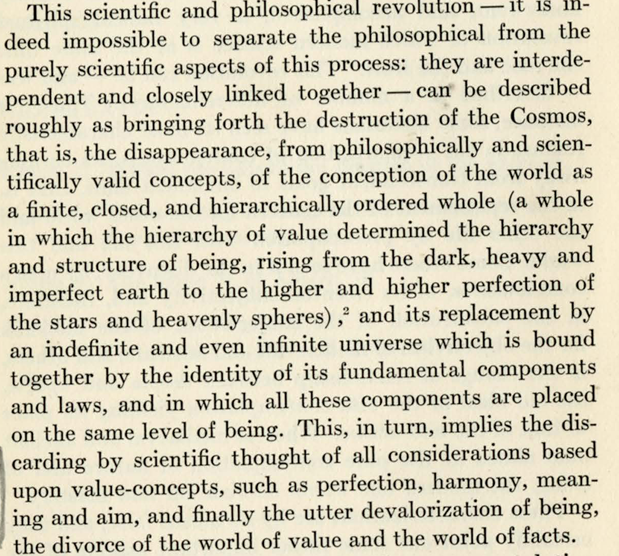
From Alexander Koyré
(Vervaeke considers a similar idea in one of his lectures The Death of the Universe.) -
Machiavelli and Stilbo: a contrast of ancient and modern
Thanks for the Xenophon quote. It seems not to require more context for understanding, yet I am perplexed by it: how would Socrates’ acceptance of death because he was already naturally so close to it show that he wasn’t lying about the daimon? Because a man near death is prone to tell the truth?
But ppl commonly carry secrets to the grave. My maternal aunt had an affair with a barber and bore her only son (she had already two daughters from her husband), yet she never confessed this to anyone, not even the grown son, before her death—which was not sudden, but, rather, prolonged— and even though she may have suspected that the truth either was already being whispered in the community, or might come out after her death.
Yet it appears that that is the force of Xenophon’s argument: that Socrates wouldn’t lie, being so close to either death, or to that death-in-life, when the mental faculties have declined to the point that life is no longer worth living.
we know from the Phaedo that he had a young son — Fooloso4
I think he had at least two, but that is irrelevant: I think your point is that he had someone to live for. But I think I remember reading somewhere that his sons were rather dull. Were he to choose to live, wouldn’t he do so rather for his “spiritual” sons? the Platos and Xenophons and others with whom he felt a kindred soul, and whom he had led out of the darkness of the cave into the light of philosophy? rather than for his natural family?...yet he chose to die despite all the appeals of his friends that he live.
I think I remember reading elsewhere also that he could count on his friends to take care of his family after his death. Sorry: I can’t quote any passage to affirm this: it is just an old memory (the sort that can be as untrustworthy as its opposite).
there are no accounts, as far as I know, in either Plato or Xenophon of any infirmity. — Fooloso4
There didn’t have to be an existing infirmity for Xenophon to express this sentiment: he was speaking of what was likely to come for Socrates, who, obviously, judging by how he behaved in his last days, was not yet prone to mental infirmity. Nevertheless, it could reasonably be expected to come in the ensuing years, since he was, at 70 years, of what was anciently considered “the full years of a man” (according to Biblical scripture), after which dementia was likely to set in, just as it is today after the age of 80.
does Bloom explain how this might help philosophy? — Fooloso4
I could look the quote up for context, but I don’t think I need to. Bloom meant that Socrates chose to be philosophy’s martyr: that by dying unjustly at the hands of the state he might secure future sympathy for the philosopher...which, if true, shows he cared more about his “spiritual” than his temporal offspring.
By instructing the rulers Machiavelli helps shape the conditions in which the philosopher is free to follow his pursuits. — Fooloso4
Yes! That was his brilliant innovation; no ancient philosopher dared or even thought to attempt the same, though several were involved in politics to a higher degree than Machiavelli ever was...
...I’ll tell you my intuition; I don’t know the exact timeline on these matters, but it seems to me that, just about the time of Niccolo, natural philosophy was coming to the fore, with men like Galileo making discoveries, and carving a path that might have made certain suggestions to political philosophy: either emend the old worn-out systems to protect us, and align yourself with us, or remain in the old paths and be relegated to “the dustbin of history”. I suspect you have superior knowledge of this, and I look forward to your opinion.
But the goal is not simply to make the city safe for philosophy but to make philosophy safe for the city. — Fooloso4
But philosophy, true philosophy, cannot be made safe for the city; for, as I have pointed out, the priorities of the two are at odds: the latter will not broach any contradiction that their family or community or god is the greatest good; while the former is born to ask “what is the good?” and therefore question what his community accepts a priori.
But real cities must be a continuation of the city as it already exists. — Fooloso4
Exactly! Which is evidence that Plato never believed his imaginary city was practicable. What he meant to do was show us the ideal city; the theoretical one by which all practical ones would be measured. In this way he was behaving just like a natural scientist who perceives a mathematical formula that comprehends all the messy phenomena he sees in the real world, as Galileo (or was it Newton?) showed that all bodies must fall to the earth at the rate of 32ft/sec squared...though all “real” bodies do not obey that law.
like the harm caused by medicine, — Fooloso4
This is incomprehensible to me, O Morosophos; for I am not aware of any harm the ancient physicians caused the city...so, I would like for you explain that. -
The Greatest Music
I am the hysterical side of the partnership. The one who has to be talked down from quitting out of anger, getting into needless conflicts, or arrested — Paine
Thanks for the insight into part of your life.
Use of the word 'hysterical' bothered me a little, given its medical history. In ancient Greece, hysteria (Hysterikos) was thought to be a woman's disease, related to the womb. Later (17th century) the emphasis moved to the brain and a disorder of the nervous system, also affecting men. Emotions became relevant; passions arising in the brain, not 'vapours'.
https://www.sciencedirect.com/science/article/abs/pii/B9780128017722000011
It occurred to me that if the aim of Plato/Socrates is for us to lead the best life, wellbeing clearly involves health, food and medicine, why is the focus more on concepts and character. What 'the philosopher' should be.
If we practise philosophy why would we need someone to talk us down or out of anger and its effects.
Wouldn't it be wonderful if we could take the heat out of America. What would it take?
We need to do all we can to lower the anger pervading American politics
Robert Reich
Trump’s messages to his followers during this election season has had a constant undercurrent of violence
https://www.theguardian.com/commentisfree/article/2024/jul/17/trump-campaign-martyrdom
It's all very well diagnosing the problem, but where are the positive, political healers - words are empty without action. Where to start? With yourself? Change the diet?
Back to Socrates, then, and his last words. What did they mean?
Crito, we owe a cock to Asklepios - Pay it and do not neglect it.
Plato’s dialogues show that Socrates saw Asklepios as more worthy of emulation than the warlike gods of the state-supported Greek pantheon.
While dying from the executioner’s hemlock, Socrates asks his friend Crito to pay the traditional thank offering given to the physician-god: a cock symbolizing rebirth. He looks to the only god then known to revive the dead to help his ideas and spirit live on. Socrates’s last words thwart Athenian authorities’ attempts to silence him, issue a call for Asklepian ideals to prevail in the city of Athens, and identify the selfless caring for others exemplified by Asklepios as the highest duty for all humans. Socrates calls us from the past to remember timeless Asklepian physician duties to self, patients, and community. Socrates reminds modern physicians of their personal duty to make their own spiritual health their first priority, their professional duty to comfort the sick and alleviate suffering, and their societal duty to advocate for the vulnerable, sick, and suffering and the health of the public. — Socrates last words - An ancient call for a healing ethos in civic life
@Fooloso4 - I think we discussed the meaning of Socrates last words in your thread?
https://thephilosophyforum.com/discussion/10914/platos-phaedo/p1 -
The Argument from Reason
I just reread Phaedo last week so I will be curious to have a look at the thread. — Leontiskos
A couple of years ago I started a thread on Phaedo. When I completed it I compiled my separate posts so that they can be read through without having to read the whole thread. I would be interested in your comments.
1. https://thephilosophyforum.com/discussion/10914/platos-phaedo/p1
2. https://thephilosophyforum.com/discussion/comment/534860
3. https://thephilosophyforum.com/discussion/comment/535343
4. https://thephilosophyforum.com/discussion/comment/535924
5. https://thephilosophyforum.com/discussion/comment/536573
6. https://thephilosophyforum.com/discussion/comment/537114
7. https://thephilosophyforum.com/discussion/comment/537698
8. https://thephilosophyforum.com/discussion/comment/538481
9. https://thephilosophyforum.com/discussion/comment/539501
10. https://thephilosophyforum.com/discussion/comment/540733 -
The kalam/cosmological argument - pros and cons
Interesting, I will acquire the book - it's as subject I've been interested for a very long time, especially in-so-far as it relates to Plato/Socrates, so thanks for bringing that up.
Well it depends on the subject about which you wanted to know. For example, wanting to know in detail about the afterlife is a waste - the focus should be being a good man here on Earth. A vague notion will suffice. So there is something very harmful about an inordinate desire for knowledge - first the fact that it doesn't consider human limitations, second because it is knowledge which is not of importance in this life.But I wanted to know. I didn't want to believe in 'pie in the sky when you die'. I said there was a way of knowing about ultimate truths, not simply standing in the congregation and mouthing the words. — Wayfarer
Sometimes in order to know one must be led, and one must believe. Some knowledge is not achievable except by first making the "leap of faith".The gnostic is concerned with knowing, not being lead or believing what s/he's been told. — Wayfarer
Yes - do you suppose that a society can be organised where everyone adopts a gnostic orientation and wants to know everything through their own experience? Imagine the resulting chaos. The limitations of belief are necessary for order and stability. Knowledge is not necessarily good - it can lead to arrogance, disdain, and a feeling of superiority. "They are sheep, I am not" - that is very harmful.That is one of the reasons why the mainstream adopted the pistic orientation - believers are much easier to manage, they're like sheep. 'Believe this!' says the preacher. 'Baa, baa....' say the sheep. Not for nothing all the references to 'flocks and sheep' in scripture. — Wayfarer
Interesting but don't forget about Socrates in the Phaedo - he states that he does not know about the afterlife. There is no certainty. Either there is a soul which survives after death, or there is none. But nevertheless, he believes that there is a soul which survives after death. Why? Because it is beautiful to believe so, and it seems just that it is so - and so his love of the Good makes him believe.Beliefs, doxai, are deficient cognitive attitudes. In believing something, one accepts some content as true without knowing that it is true; one holds something to be true that could turn out to be false. Since our actions reflect what we hold to be true, holding beliefs is potentially harmful for oneself and others. Accordingly, beliefs are ethically worrisome and even, in the words of Plato’s Socrates, “shameful.” -
Decisions we have to make
From Wikipedia:
In the year 399, Xenophon was soldiering with the Greek mercenary army of the Ten Thousand (cf. Anabasis); hence was not in Athens for the trial of Socrates
According to Plato in his Phaedo there were several people. This dialogue is one recollection of what happened, according to dialogue Plato was sick. -
Decisions we have to make
According to Plato in his Phaedo there were several people. This dialogue is one recollection of what happened, according to dialogue Plato was sick. — Cavacava
I am sure I said this, "And that part about Socrates and death was before his execution, it was when Xenophon was trying to talk him into escape." -
Suicide and hedonism
Plato wasnt infallible. He was human, and it is pretty obvious when reading him. His worshiping of distinctions between what is and what becomes but really isnt is in a way a prejudice, and his worship of opposites is something worth questioning. Just because I can imagine a straight line doesnt mean there must be one. And if there is, who cares in the end? He is one of those philosophers whose hatred of the body and the physical I cant stand. Nor can I stand what seems to be an underlying death wish. He was definitely one of those great men of many true insights who loved wearing many masks. Even in his quest for truth and virtue one can smell something hidden... A mask(referring to our discussion in the other thread). I still really like Plato though, especially for his great prose. I also hate his hatred of arts and agree with Popper's criticism of him.
I have read Apology, Crito, Phaedo Gorgias, Symposion, Phaedro and the Republic. I Will soon read Timaeus, which I have heard many consider to be his greatest work.


Welcome to The Philosophy Forum!
Get involved in philosophical discussions about knowledge, truth, language, consciousness, science, politics, religion, logic and mathematics, art, history, and lots more. No ads, no clutter, and very little agreement — just fascinating conversations.
Categories
- Guest category
- Phil. Writing Challenge - June 2025
- The Lounge
- General Philosophy
- Metaphysics & Epistemology
- Philosophy of Mind
- Ethics
- Political Philosophy
- Philosophy of Art
- Logic & Philosophy of Mathematics
- Philosophy of Religion
- Philosophy of Science
- Philosophy of Language
- Interesting Stuff
- Politics and Current Affairs
- Humanities and Social Sciences
- Science and Technology
- Non-English Discussion
- German Discussion
- Spanish Discussion
- Learning Centre
- Resources
- Books and Papers
- Reading groups
- Questions
- Guest Speakers
- David Pearce
- Massimo Pigliucci
- Debates
- Debate Proposals
- Debate Discussion
- Feedback
- Article submissions
- About TPF
- Help
- Other sites we like
- Social media
- Terms of Service
- Sign In
- Created with PlushForums
- © 2026 The Philosophy Forum