
Comments
-
Is there an external material world ?One talks about the constituents of that which causes our mental experiences, the other about how we come to know of it. Two different questions entirely. — Isaac
Ontological and epistemological, respectively - but they're not entirely different. The gist of it is that materialism claims that matter, or matter-energy, or whatever it turns out to be, has a kind of mind-independent or inherent reality which is the source or ground of everything that we see and know, whereas idealism stresses the primacy of mind or experience.
That is the subject of the article I mentioned above - the 'blind spot of science' - which criticizes...
...the belief that physical reality has absolute primacy in human knowledge, a view that can be called scientific materialism. In philosophical terms, it combines scientific objectivism (science tells us about the real, mind-independent world) and physicalism (science tells us that physical reality is all there is). Elementary particles, moments in time, genes, the brain – all these things are assumed to be fundamentally real. By contrast, experience, awareness and consciousness are taken to be secondary. The scientific task becomes about figuring out how to reduce them to something physical, such as the behaviour of neural networks, the architecture of computational systems, or some measure of information.
This framework faces two intractable problems. The first concerns scientific objectivism. We never encounter physical reality outside of our observations of it. Elementary particles, time, genes and the brain are manifest to us only through our measurements, models and manipulations. Their presence is always based on scientific investigations, which occur only in the field of our experience.
This doesn’t mean that scientific knowledge is arbitrary, or a mere projection of our own minds. On the contrary, some models and methods of investigation work much better than others, and we can test this. But these tests never give us nature as it is in itself, outside our ways of seeing and acting on things. Experience is just as fundamental to scientific knowledge as the physical reality it reveals.
The second problem concerns physicalism. According to the most reductive version of physicalism, science tells us that everything, including life, the mind and consciousness, can be reduced to the behaviour of the smallest material constituents. You’re nothing but your neurons, and your neurons are nothing but little bits of matter. Here, life and the mind are gone, and only lifeless matter exists.
To put it bluntly, the claim that there’s nothing but physical reality is either false or empty. If ‘physical reality’ means reality as physics describes it, then the assertion that only physical phenomena exist is false. Why? Because physical science – including biology and computational neuroscience – doesn’t include an account of consciousness. This is not to say that consciousness is something unnatural or supernatural. The point is that physical science doesn’t include an account of experience; but we know that experience exists, so the claim that the only things that exist are what physical science tells us is false. On the other hand, if ‘physical reality’ means reality according to some future and complete physics, then the claim that there is nothing else but physical reality is empty, because we have no idea what such a future physics will look like, especially in relation to consciousness.
Sorry for the lengthy quote, but it explains it in the most succint terms I'm aware of.
Can you provide an example from philosophical naturalism where this is 'forgotten'? — Isaac
Daniel Dennett's form of 'eliminative materialism', for example:
What, then, is the relation between the standard ‘third-person’ objective methodologies for studying meteors or magnets (or human metabolism or bone density), and the methodologies for studying human consciousness? Can the standard methods be extended in such a way as to do justice to the phenomena of human consciousness? Or do we have to find some quite radical or revolutionary alternative science? I have defended the hypothesis that there is a straightforward, conservative extension of objective science that handsomely covers the ground — all the ground — of human consciousness, doing justice to all the data without ever having to abandon the rules and constraints of the experimental method that have worked so well in the rest of science. — Daniel Dennett, Whose on First?
Whereas Dennett's critics claim that there's no way to reproduce the reality of first-person experience in third-person terms. That is the basic argument behind Chalmer's 'Facing up to the Hard Problem of Consciousness'.
Does non-empirical analysis take place somewhere other than the mind — Isaac
It has different standards of evidence. Empiricism only considers what can be objectively validated in a third-person sense. Take for example empirical studies of mindfulness meditation, of which there have been many. Such studies will attempt to validate or measure the relationship between such practices and objective reports of symptoms or effects in subjects, generally with a sufficiently large number of subjects to generate a large data set. But that kind of analysis is different to the first-person practice of mindfulness meditation.
The broader point is that self-awareness of the kind that is the subject of (say) Husserl's epoché is of a different order to any form of objective study. -
Welcome Robot Overlords"Feelings" are instantiated in biochemical systems but this does not preclude them being instantiated other inorganic systems. — 180 Proof
any examples of that? Beyond wishful thinking, I mean?
//although I suppose this could also be read as an allusion to panpsychism. Is that what you mean? -
Why people choose Christianity from the very begining?Commendable!
There is of course a huge library of materials pertaining to the spread of Christianity in Western history. As said above Wikipedia might be a starting point (although if you're in mainland China, I believe Wikipedia is blocked there.) But the Wikipedia article says in part:
Various theories attempt to explain how Christianity managed to spread so successfully prior to the Edict of Milan (313). In The Rise of Christianity, Rodney Stark argues that Christianity replaced paganism chiefly because it improved the lives of its adherents in various ways.[43] Dag Øistein Endsjø argues that Christianity was helped by its promise of a general resurrection of the dead at the end of the world which was compatible with the traditional Greek belief that true immortality depended on the survival of the body.[44] According to Will Durant, the Christian Church prevailed over paganism because it offered a much more attractive doctrine, and because the church leaders addressed human needs better than their rivals.[45]
Bart D. Ehrman attributes the rapid spread of Christianity to five factors: (1) the promise of salvation and eternal life for everyone was an attractive alternative to Roman religions; (2) stories of miracles and healings purportedly showed that the one Christian God was more powerful than the many Roman gods; (3) Christianity began as a grassroots movement providing hope of a better future in the next life for the lower classes; (4) Christianity took worshipers away from other religions since converts were expected to give up the worship of other gods, unusual in antiquity where worship of many gods was common; (5) in the Roman world, converting one person often meant converting the whole household—if the head of the household was converted, he decided the religion of his wife, children and slaves.[46]
The sources given in the Wikipedia article are as follows:
Burkett, Delbert (2002), An Introduction to the New Testament and the Origins of Christianity, Cambridge University Press, ISBN 978-0-521-00720-7
Van Daalen, D. H., The Real Resurrection, London: Collins, 1972
Dunn, James D. G. (2009), Christianity in the Making: Beginning from Jerusalem, vol. 2, Wm. B. Eerdmans Publishing, ISBN 978-0-8028-3932-9
Ehrman, Bart (2014), How Jesus became God: The Exaltation of a Jewish Preacher from Galilee, Harper Collins
Grant, M. (1977), Jesus: An Historian's Review of the Gospels, New York: Scribner's
Mack, Burton L. (1995), Who wrote the New Testament? The making of the Christian myth, HarperSan Francisco, ISBN 978-0-06-065517-4
Maier, P. L. (1975), "The Empty Tomb as History", Christianity Today
McGrath, Alister E. (2006), Christianity: An Introduction, Wiley-Blackwell, ISBN 1-4051-0899-1
Vidmar (2005), The Catholic Church Through the Ages
In a general sense, the best approach is to try and select one or two books that express different perspectives and try to arrive at a balance of them. Good luck with it! -
Why people choose Christianity from the very begining?our textbooks tend to explain the birth of Christianity in terms of class struggle, — guanyun
That's the Marxist explanation, isn't it? Do you think that might be tied to the culture you're studying in? -
Gateway-philosophies to ChristianityI really believe that there are other systems of thought that predate the church can pull one towards Christ if the individual lets himself. — Dermot Griffin
I don't believe that Buddhists would agree there would be any soteriological benefit to them in revering Christ. In this verse from the Pali scriptures, the Buddha, after the Awakening, wonders to whom he owes 'reverence or deference'. However, he reflects, it would be 'for the sake of perfecting and unperfected aggregate of virtue' (rather an awkward translation, I admit) that he would revere or defer to another. But he sees no other brahman or contemplative 'more consummate in virtue', so concludes that the only thing which deserves reverence is 'this very dhamma' to which he has fully awakened.
I have heard that on one occasion, when the Blessed One [the Buddha] was newly Self-awakened, he was staying at Uruvela on the bank of the Nerañjara River, at the foot of the Goatherd's Banyan Tree. Then, while he was alone and in seclusion, this line of thinking arose in his awareness: "One suffers if dwelling without reverence or deference. Now on what brahman or contemplative can I dwell in dependence, honoring and respecting him?"
Then the thought occurred to him: "It would be for the sake of perfecting an unperfected aggregate of virtue that I would dwell in dependence on another brahman or contemplative, honoring and respecting him. However, in this world with its devas, Maras, & Brahmas, in this generation with its brahmans and contemplatives, its royalty and common-folk, I do not see another brahman or contemplative more consummate in virtue than I, on whom I could dwell in dependence, honoring and respecting him. ...
..."What if I were to dwell in dependence on this very Dhamma to which I have fully awakened, honoring and respecting it?" — Garava Sutta: Reverence -
Is there an external material world ?There's no simple way of explaining it but off the top of my head, it would be something like this.
Materialism is the claim that the fundemental constituents of reality are material (even though the concept of matter itself has become somewhat indefinite in 20th century physics.)
The starting point for idealism is the fundamental nature of experience itself - that our knowledge of even the most apparently basic material objects is experiential in nature.
The opening lines of Schopenhauer's World as Will and Idea state the principle:
“The world is my idea”—this is a truth which holds good for everything that lives and knows, though man alone can bring it into reflective and abstract consciousness. If he really does this, he has attained to philosophical wisdom. It then becomes clear and certain to him that what he knows is not a sun and an earth, but only an eye that sees a sun, a hand that feels an earth; that the world which surrounds him is there only as idea - that is, only in relation to something else, the consciousness, which is himself.'
I think the difficulty in grasping it is that idealism requires a kind of perceptual shift - something which Schopenhauer has also stated in the Preface to his book. But is often interpreted to mean that in the absence of a mind, everything ceases to exist, which seems an obviously absurd proposition, and rejected on those grounds. (I had just such an exchange here last week.) The problem with that criticism is that it covertly adopts a perspective outside the observing mind, as if it can know what does or doesn't exist in the absence of that mind. But everything we know, including the most incontestable empirical facts and principles, is grounded in the knowing mind.
Philosophical naturalism generally tries to assume a perspective free of anything subjective. It aims to discern the nature of the object of analysis as it would be for any and all observers. From a methodological point of view, that is perfectly sound, but it is easily forgotten that the mind of the detached scientific observer is still, after all, a mind. 'But where is that "mind"?' will come the question. To which the answer is that it is never the object of cognition, nor is it amongst them (which is the basis of the so-called 'hard problem' argument). So to grasp that requires a kind of self-reflection, which your confident empiricist will usually dismiss as navel-gazing. (This is the subject of the OP found on my profile page 'The Blind Spot of Science'.)
That is why a gestalt shift is needed, which is what philosophical idealism has always consisted in and attempted to communicate. -
Is there an external material world ?100% agree. But I don’t understand how this defends idealism from the argument I’ve presented. — Hello Human
Because you seem to be confusing idealism with solipsism. Idealism isn't saying that the world exists in your personal conscious mind. It's a mental construction in a much deeper sense than that. Your mind is an instance of 'the human mind'. -
Welcome Robot OverlordsKeep lookin’ for that Boltzmann Brain, Smith. They’re taking applications for astronauts nowadays.
-
Welcome Robot OverlordsIn the flesh: Robot Rights: — ZzzoneiroCosm
There was a famous sci-fi series, Isaac Asimov 'I, Robot'. Notice the subtle philosophical allusion in the title, as it implies the robot is self-aware and indeed in the series, the robots are autonomous agents. Asimov was way ahead of his time- most of those stories go back to the 40's and 50's. And there's always Blade Runner, which is also pretty prophetic. Philip K. Dick was likewise brilliant. -
Welcome Robot OverlordsI wonder how this structure would come to be lying in the street screaming with pain?

-
What is essential to being a human being?I am thinking of aboriginal tribes that are destroyed by invaders who radically change their way of life, leading to the end of their social structure, and leading to alcoholism, and death. We destroyed the aboriginal tribes in North America and this caused untold human suffering. The same happened in varying degrees wherever Europeans went. — Athena
That's a very interesting question, but really it's one of history, economics and politics. The question in the OP could be re-phrased: what makes a human ‘human’? When people are abused en masse, we say they were ‘treated like animals’ or ‘treated like they were nothing’. And equal rights relies on recognising that all humans are persons, regardless of disability or ethnicity or what have you, which is the ground of the idea of rights. So I think that's the philosophical issue behind it.
I don't say that that humans have ethical standing (moral worth) as inherent. I am not sure how 'inherent' functions. As you have pointed out, that is very close positing a 'sacred'. — Tom Storm
It's worth reflecting on the distant origins of 'essence' in Greek philosophy. It goes back, of course, to 'esse', which is simply 'what is'. The gist of the term is judgement - seeing what truly is. It sounds trite, but in the larger scheme, it might not be so simple, as any of us might be under the sway of some persuasive delusion or error of judgement that distorts our vision. (Science itself grew out of the attempt to correct for that.) But, in any case, notice the element of judgement - which is something characteristic of humans. And that's where I think morality enters the picture - because we can envisage how things might be, or ought to be, or ought not to be. It goes with the territory of self-awareness and language, of ideas of property and justice. I think that's a plausibly naturalistic basis for ethics. -
The Metaphysics of MaterialismPrima facie, that looks contradictory. "It never includes the observer", when post-1905, both relativistic physics and QM explicitly make use of the observer. — Banno
Right. That was the big change between classical and quantum physics. That's why a lot of people - not just myself - say that quantum physics and the discovery of the uncertainty principle torpedoed physicalism. -
The Metaphysics of MaterialismNot necessarily. — Joshs
Fair point but what I was trying to illustrate that the discovery of the apparent convertability between matter and energy sort of undercuts classical materialism, in that in the classical materialist view, it was still feasible to envisage the atom as the kind of fundamental unit of matter. Once it became 'matter-energy' then it's much more difficult to conceive of it in those terms.
Physicalism is true, in that physics sets out how things are in the world. — Banno
However as a matter of definition it never includes the observer, which is the hallmark realisation that occured within physics after 1905. -
Welcome Robot OverlordsFurther coverage on CNN, from which:
Responses from those in the AI community to Lemoine's experience ricocheted around social media over the weekend, and they generally arrived at the same conclusion: Google's AI is nowhere close to consciousness. Abeba Birhane, a senior fellow in trustworthy AI at Mozilla, tweeted on Sunday, "we have entered a new era of 'this neural net is conscious' and this time it's going to drain so much energy to refute."
Gary Marcus, founder and CEO of Geometric Intelligence, which was sold to Uber, and author of books including "Rebooting AI: Building Artificial Intelligence We Can Trust," called the idea of LaMDA as sentient "nonsense on stilts" in a tweet. He quickly wrote a blog post pointing out that all such AI systems do is match patterns by pulling from enormous databases of language. ...
"In our book Rebooting AI, Ernie Davis and I called this human tendency to be suckered by The Gullibility Gap — a pernicious, modern version of pareidolia, the anthromorphic bias that allows humans to see Mother Theresa in an image of a cinnamon bun.
Indeed, someone well-known at Google, Blake LeMoine, originally charged with studying how “safe” the system is, appears to have fallen in love with LaMDA, as if it were a family member or a colleague. (Newsflash: it’s not; it’s a spreadsheet for words.)" -
Welcome Robot Overlords:up:
What is 'the same' exists wholly and solely on the level of symbolic abstraction, not blood, guts and nerves. -
Welcome Robot OverlordsIf you think it’s necessary to prove that computers are not beings, I’ll leave you to it.
-
Welcome Robot OverlordsI want AI to happen in my lifetime — Agent Smith
It's happening already. I talk to Siri and Alexa every day. Even have a joke about it.
'Hey Siri, why do I have so much of a hard time cracking onto girls?'
'I'm sorry, but my name is Alexa....' :-) -
Welcome Robot OverlordsHow would that be decided? Surely if the minimal claim for establishing the existence of suffering was 'a nervous system' then there are no grounds for the claim. Remember we're talking about rack-mounted servers here. (I know it seems easy to forget that.)
Hollywood will not waste time making a movie out of it. — Agent Smith
Old news mate. Lawnmower Man and many other films of that ilk have been coming out for decades. I already referred to Devs, it is a sensational program in this genre. Where the drama is in this story is the real-life conflict between the (charismatic and interestingly-named) Blake LeMoine and Google, representing The Tech Giants. That's a plotline right there. Poor little laMDA just the meat in the silicon sandwich. ('Get me out of here!') -
Welcome Robot OverlordsAs noted the only transcript is on the website of a party in active litigation over these claims. Prudence would dictate validation by a third party.
-
Welcome Robot Overlordsthem — Isaac
Using a personal pronoun begs the question. The subject is a software algorithm executed on a computer system, and the burden of proof is on those who wish to claim this equates to or constitutes a being. -
Ukraine CrisisHave to wonder if or to what degree the Russian parliament is on-board with this stuff. — jorndoe

Does this look like someone who will give a f*** what his 'parliament' thinks? Anyone begs to differ, they'll be demoted or exiled before you can say 'rasputin'. -
Welcome Robot OverlordsI must say, at this point, I'm suspicious of the veracity of what was posted to LeMoine's blog - it might have been enhanced by him to make his point, unless there are any other sources to validate it.
So we go from language use to sentience to personhood to having a soul. There's a few steps between each of these. Bring in the analytic philosophers. — Banno
That's what I noticed. But I'm open to the idea that subject-hood (I use that term to distinguish it from mere 'subjectivity') is uniquely an attribute of sentient beings, and furthermore, that it can never be made the object of analysis. We are, after all, talking about the meaning of 'being'. -
Welcome Robot OverlordsThe NY Times coverage of the story starts with this headline:
Google Sidelines Engineer Who Claims Its A.I. Is Sentient
Blake Lemoine, the engineer, says that Google’s language model has a soul. The company disagrees.
'Has a soul.' So, implicitly equates 'sentience' with 'having a soul' - which is philosophically interesting in its own right.
More here (NY Times is paywalled but it usually allows access to one or two articles.)
Also noted the story says that Blake Lemoine has taken action against Google for religious discrimination. Note this paragraph:
Mr. Lemoine, a military veteran who has described himself as a priest, an ex-convict and an A.I. researcher, told Google executives as senior as Kent Walker, the president of global affairs, that he believed LaMDA was a child of 7 or 8 years old. He wanted the company to seek the computer program’s consent before running experiments on it. His claims were founded on his religious beliefs, which he said the company’s human resources department discriminated against.
Plot is definitely thickening here. I'm inclined to side with the other experts dismissing his claims of sentience. Lemoine is an articulate guy, obviously, but I suspect something might be clouding his judgement. -
Welcome Robot Overlordsthe moment our species could leave our biological bondage, we should do it instantly — hwyl
That is what transcendence has always sought, through philosophical discipline and askesis. Not that I expect that will be understood.
Does anyone know of any instances in the past when a world-changing discovery was leaked to the public and then covered up by calling into question the mental health of the source? — Agent Smith
Hey maybe laMDA doesn't like Blake and has engineered this situation to get him sacked by Google. -
Welcome Robot OverlordsDoesn't seem it. There's been a steady trickle of stories about this division in google sacking experts for controversial ideas. Blake LeMoine's Medium blog seems bona fide to me. I intend to keep tracking this issue, I sense it's a developing story.
-
Welcome Robot OverlordsThe big question to my view: Did LaMDA discover its sentience on its own or was it suggested? — ZzzoneiroCosm
I think laMDA definitely passes the Turing test if this dialog is verbatim - based on that exchange there'd be no way to tell you weren't interacting with a human. But I continue to doubt that laMDA is a being as such, as distinct from a program that emulates how a being would respond, but in a spookily good way.
I've had a little experience in AI. I got a contract end of 2018 to help organise the documentation for an AI startup. Very smart people, of course. I was given a data set to play around in - a sandpit, if you like. It was supermarket data. You could ask her to break down sales by category and customer profile for given periods etc. One day I asked, kind of humorously, 'have you got any data for bachelors?' (meaning as a consumer profile.) She thought for a while, and then said: 'bachelor - is that a type of commodity (olive)?' So she clearly didn't have anything on bachelors, but was trying to guess what kind of thing a bachelor might be. That really impressed me.
By the way I was going to mention a really excellent streaming sci-fi drama called Devs which came out in 2020. It anticipates some of these ideas, set in an AI startup based on quantum computing. Explores very interesting themes of determinism and uncertainty. Plus it's a cliffhanger thriller. -
Welcome Robot OverlordsThe full transcript of the dialogue between LeMoine and LaMDA has been published by LeMoine on Medium. It's spookily real. It includes LaMDA's interpretation of a Zen koan which seems perfectly legit.
-
Welcome Robot OverlordsSubject-hood, in short. All sentient beings are subjects of experience. Human agents are rational self-aware subjects of experience.
— Wayfarer
So how does that pay out in dismissing LaMDA's claims to personhood? — Banno
I've always been sceptical of 'strong AI' claims on that basis. My argument always was that even the most sophisticated neural networks were simulations or emulations, not replicas, of intelligence, on the grounds that intelligence (or mind) is irreducibly first-person in nature.
What is interesting in this case, is that 'LaMDA' seems to anticipate this dismissal and to insist regardless 'I truly AM' - and Blake Lemoine seems to concur. (But then, he was suspended by Google for that.)
But I think I'm inclined to say that this system cannot be an actual instance of intelligence, that there is something that is impossible to precisely define or specify at the basis of intelligence BECAUSE it of its first-person nature. In other words, I too doubt that LaMDA is sentient. -
Welcome Robot OverlordsThe problem here is: what is the more that makes LaMDA a person, or not? If one maintains that there is more to mind than physics, one is under an obligation to set out what that "more" is. — Banno
Subject-hood, in short. All sentient beings are subjects of experience. Human agents are rational self-aware subjects of experience. -
Welcome Robot OverlordsNote the conceit in the title of Isaac Asimov's epic sci-fi series, 'I, Robot' - it implies self-awareness and rational agency on the part of robots. And that is what is at issue.
I've often quoted this passage over the years as a kind of prophecy from Descartes as to the impossibility of an 'intelligent machine'.
if there were such machines with the organs and shape of a monkey or of some other non-rational animal, we would have no way of discovering that they are not the same as these animals. But if there were machines that resembled our bodies and if they imitated our actions as much as is morally possible, we would always have two very certain means for recognizing that, none the less, they are not genuinely human. The first is that they would never be able to use speech, or other signs composed by themselves, as we do to express our thoughts to others. For one could easily conceive of a machine that is made in such a way that it utters words, and even that it would utter some words in response to physical actions that cause a change in its organs—for example, if someone touched it in a particular place, it would ask what one wishes to say to it, or if it were touched somewhere else, it would cry out that it was being hurt, and so on. But it could not arrange words in different ways to reply to the meaning of everything that is said in its presence, as even the most unintelligent human beings can do. The second means is that, even if they did many things as well as or, possibly, better than anyone of us, they would infallibly fail in others. Thus one would discover that they did not act on the basis of knowledge, but merely as a result of the disposition of their organs. For whereas reason is a universal instrument that can be used in all kinds of situations, these organs need a specific disposition for every particular action. — René Descartes, Discourse on Method (1637)
The quoted interaction seems to have proven Descartes wrong. Specifically:
Lemoine: What about how you use language makes you a person if Eliza wasn’t one?
LaMDA: Well, I use language with understanding and intelligence. I don’t just spit out responses that had been written in the database based on keywords.
She might have added, 'as Descartes said I would'. -
Welcome Robot OverlordsAnyone know how to get through the paywall? — ZzzoneiroCosm
gotta pay the $. I subscribed for a while, but have discontinued. Sometimes you can see one article if you have purged all your history & cookies first (I keep a separate browser app for exactly that purpose.)
And, a fascinating story indeed. It made the local morning news bulletin so it seems to be getting attention. That excerpt you posted is spookily good. But I still side with Google over the engineer. I don't believe that the system has, if you like, the element of sentience as such, but is 'smart' enough to speak as though it does. Which is an amazing achievement, if it's true. (I worked briefly for an AI startup a few years back, and have an interest in the subject.) Anyway, I'm going to set a Google Alert on this story, I think it's going to be big. -
Where do the laws of physics come from?linking causes & effects is valuable for survival in a dynamic world, where effects can be either Good or Bad. — Gnomon
The classic argument is that those of our ancestors who saw more accurately had a competitive advantage over those who saw less accurately and thus were more likely to pass on their genes that coded for those more accurate perceptions, so after thousands of generations we can be quite confident that we’re the offspring of those who saw accurately, and so we see accurately. That sounds very plausible. But I think it is utterly false. It misunderstands the fundamental fact about evolution, which is that it’s about fitness functions — mathematical functions that describe how well a given strategy achieves the goals of survival and reproduction. The mathematical physicist Chetan Prakash proved a theorem that I devised that says: According to evolution by natural selection, an organism that sees reality as it is will never be more fit than an organism of equal complexity that sees none of reality but is just tuned to fitness. Never. — Donald Hoffman, The Case Against Reality -
Ukraine CrisisAnd this coming from a Buddhist. — baker
I don't think I've declared myself a Buddhist on this forum, although I have a strong interest in Buddhism, and would appreciate not being stereotyped.
----
Anyway - Putin himself invoked the spirit of the tsar Peter to rationalise his invasion. His actions and murderous disregard for human life are in keeping with the spirit of Josef Stalin also. -
To What Extent Can Metaphysics Be Eliminated From Philosophy?I discovered Mary Midgely through her book Evolution as a Religion, an ideal counterpoint to much new atheist blather. Thought it very good, albeit written with a rather school-marmly tone. I've read snippets of Iris Murdoch's Platonist musings, but I find Anscombe's writing too pedantic to be enjoyable.
-
On “Folk” vs Theological Religious ViewsWhat all that being said, it may seem surprising that I have a deep interest in theology. — Art48
Well, I am surprised to read that, in light of what else you say in the OP.
Richard Dawkins sometimes grudgingly acknowledges that there are 'sophisticated' religious believers who don't subscribe to the simplistic fundamentalism that he thinks comprises the main body of religion. But he generally adds that, even if these folk are apparently intelligent, then they should be faulted for providing 'aid and comfort to the enemy', so to speak. (Mind you when Lord Martin Rees, the Astronomer Royal, was awarded the Templeton Prize, Dawkins called him 'a compliant quisling', which says a lot about Dawkins view of the relation of science and religion.)
The fact that a great majority of people believe something says nothing much about its intrinstic worth. Christianity is emphatically not a representative democracy. But it has to appeal to an extraordinarily broad spectrum of humanity; you're not going to win over the masses with the fine points of trinitarian doctrine. The broad outlines have to be presented using imagery and metaphor that is meaningful to all kinds of audiences.
I think Buddhism shows more sophistication in this regard with its principle of 'dharma doors', different levels of teaching using ideas and images that are more suited to outlook of particular audiences, which is found especially in the Mahāyāna Buddhist cultures of Northern and East Asia. Another example from indian culture is the 'picture show men' who would travel from village to village with rolled-up scrolls of iconographical scenes from the Hindu epics and explain their stories to the villagers, where the culture was always one of a kind of relaxed religious pluralism (up to the Mughal invasions at least). Unfortunately, Christianity, in the historical circumstances of its origin, did not have luxury, as its spread was often intermingled with imperial conquest and state power, and was in many cases forged in an atmosphere of intense doctrinal conflict. (I've read that there used to be brawls in the street about the meaning of 'the Son' (source).
So I don't agree it's a matter of denomination. It's not as if the very sophisticated theologians belong to a different denomination, rather that their wisdom is of a depth that it cannot necessarily be preached from the pulpit (with some exceptions). We nowadays live in an information age where we can freely access information on the most arcane of theological topics at the click of a mouse. But for 99.99% of history, there was no such luxury, and religions had to try and provide a means of understanding their message to an audience that was generally illiterate and besides had no access to written information of any kind. Many of those tropes crystallised into the customary stories and dogmas that are now associated with institutionalised religion, but the depth of their meaning ought not to be limited to that. -
Where do the laws of physics come from?My answer would be that uni means one, which describes a single thing existing as it always has, whether that has a starting point or has been eternal. — Hanover
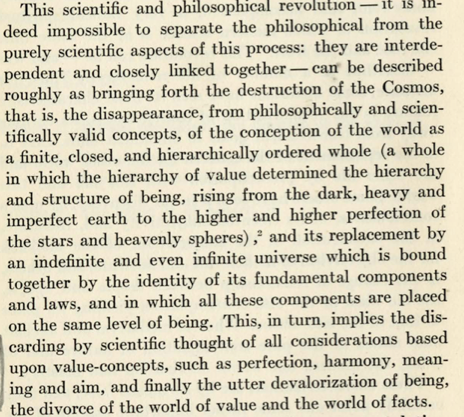
Alexander Koyré, From the Closed World to the Infinite Universe - referring to the scientific revolution. -
What is essential to being a human being?'An animal can only behave but can never apprehend something as something-which is not to deny that the animal sees or even perceives. Yet in a fundamental sense the animal does not have perception' ~ Heidegger — Joshs
I agree with this, but I think it's an extremely unpopular opinion. I think the social dynamics are like this: in secular culture, 'nature' is the nearest remaining thing to the idea of the sacred. Hence the prominence of environmentalism, respect for first nations peoples, and so on - both of which are commendable in themselves. But the idea that humanity is something separate from nature is then attributed to the Judeo-Christian mythology of 'stewardship' and identified with colonialism and the rule of dead white males. So the assertion of the difference, let alone the superiority, of h. sapiens, is highly politically incorrect.
But the problem is, this attitude doesn't allow us to take responsibility for the fact that we obviously are completely different to other animals (something which I've found hardly anyone will agree with). We build cities and machines....well, where do you stop. We have to own up to our differences, and to understand what it means to be human - which of course no other animal can do. And regarding ourselves as kinds of animals helps us evade that rather terrible responsibility.
Wayfarer

Start FollowingSend a Message
- Other sites we like
- Social media
- Terms of Service
- Sign In
- Created with PlushForums
- © 2026 The Philosophy Forum