
Comments
-
The Naive Theory of ConsciousnessThat's why all that remains in the realm of groundless speculation and faith. — Janus
How about phenomenology? Does that belong in the realm of 'groundless speculation and faith'? Kant and Heidegger? Indian philosophy? All depicted as 'groundless speculation and faith' because they can't be accomodated in your procrustean bed of anglo positivism. -
The Naive Theory of ConsciousnessI’m with you on all that. Except to recall that metaphysics, in the post-Kantian sense, comprises conjecture of what must be the case for the world to be as it is - what are the explanatory metaphors or paradigms that best account for what we experience as the world. But it has a broader remit than science, because its concerns include the subjective realm, it doesn’t stop at the analysis of objects and forces. That includes consideration of the human condition and its discontents, few of which are amenable to a strictly scientific formulation, and also where in the general scheme of things humanity belongs (from a broader perspective than is provided by evolutionary biology.)
As for the facing the hard problem of consciousness argument, it is aimed specifically at the kind of physicalism paraded about by Daniel Dennett et al, and I think it does a perfectly good job of puncturing it - something that I don’t think this particular OP comes to terms with in my view. -
The Naive Theory of ConsciousnessMust admit I didn’t read that implication into it. Oh, and who?
-
The Naive Theory of ConsciousnessI think it's just a much easier way of absorbing complex texts. (I've got the audio book of Being and Time, though haven't made a lot of progress with it yet.) But it would be great if Alexa or Siri could deal with exercise plans, reading material, meal planning, motivational talks, morning meditation topics.... Just tried Google Bard for the first time, I'm going to explore that also.
(Anyway, we're derailing, I will shutup now :yikes: ) -
The Naive Theory of ConsciousnessWhere in the animal kingdom does sentience begin? — Janus
I am attracted by the idea that the emergence of life IS the emergence of sentience in the Universe. I found an Evan Thompson paper on that Could All Life be Sentient? (which I'm in the process of reading.)
But I agree that AI, no matter how powerful, is insentient, although clearly it can mimic some aspects of sentience. I've been using ChatGPT since the day it came out, and I can imagine it becoming ever more person-like in its responses - it already 'apologises for the confusion' and says 'thanks for providing additional context' and things like that. I rather like the idea of, say, having an AI guide to Plato's Dialogues, which would read the text on demand, and then also provide commentary from authors of your choosing. I'm sure all this is going to be happening soon. -
The Naive Theory of ConsciousnessYes, I agree with you, and that's what I had always said. But what made me realise the cogency was the discussion about whether AI is sentient, which is kind of a hot-button topic. I mean, how could you tell if it had become sentient? Me, I don't believe it can or ever will, but the fact that it's a contested subject says something about the presence of consciousness not being empirically verifiable.
-
The Debt Ceiling IssueYou forgot 'legalising child labour'.
Still has to go through Senate. And still an outside chance one of the Republican hard-heads will call for a spill of the Speaker's chair. -
The Naive Theory of ConsciousnessThe law of identity, the fact that I’m here and you’re there, the fact that you do not have a single cell I have, proves there is nothing about us that is identical. — NOS4A2
That we're not the same people means nothing to a biologist.
If I’m to avoid question-begging and deification, — NOS4A2
I'll happily accept deification, thanks!
He (David Chalmers) gives the crowd what it wants. — apokrisis
You don't get academic tenure for that, and his books are certainly not written as crowd pleasers.
I've come to realise the cogency of the 'philosophical zombies' argument, having always dismissed it up until now. The point of the argument is that if there were a creature that looked and acted like a human being, there would be no empirical way of telling whether they were subjects of experience or not. It shows that consciousness cannot be solely explained by physical processes because the physical processes that can were exhibited by those creatures the absence of subjective experience would provide no way of telling whether they were really subjects of experience or not. I still don't like the argument much, but at least I think I get it. -
The Naive Theory of ConsciousnessIt doesn't even make metaphysical sense — apokrisis
Not if your metaphysics is physical, it don't. -
The Naive Theory of ConsciousnessAwfully loose usage of "identical" there. — wonderer1
We are biologically identical in a way that you and an orangutan is not. -
Atheist Dogma.I was going to say you're providing a stellar example thereof, but I'll let it go.
-
About algorithms and consciousnessI think when people start uploading videos of themselves abusing AGI humanoid robots, there's going to be a reaction. — RogueAI
There was an Australian TV feature on AI recently, which featured a very articulate guy who had a humanoid-looking doll - actually a sex doll, but not the point, as he didn't want a sexual relationship - linked to an AI chatbot. Fascinating insight. I can imagine the day when I converse frequently with a chatbot about subjects that interest me, which in fact I already do - been using ChatGPT since the day it launched. -
Atheist Dogma.in order for salvation to take place, first you have to be damned — Vera Mont
Yes, the jealous god dies hard.
Plenty of atheist dogma on display in this thread, but then, that's what you're going to get as soon as post an OP with such a title. Like tossing bloodied meat into the Piranha River. -
Science as MetaphysicsI wasn't referring to atomism — L'éléphant
Oh. I took that to be the meaning of the 'smallest unit', which is typically considered the atom.
The ultimate reality -- what is the smallest unit they could reduce existence and still be true to the real. — L'éléphant
Parmenides who couldn't stay away from shaping the truth into something we mortals could grasp, even though he purportedly rejected the sensible world. — L'éléphant
Parmenides was a mystic. He had more in common with the Vedic sages than with moderns. -
About algorithms and consciousnessThe only reason its controversial to think that physical combinations of matter and energy can have consciousness is because people think there is a soul — Philosophim
Given that 'soul' is a translation from the Greek 'psyche', and that 'psyche' can also be translated as 'mind', do you think that people have minds? -
The Naive Theory of ConsciousnessHere's a rather long extract by the author of What it is Like to be a Bat which makes a similar point:
The scientific revolution of the 17th century, which has given rise to such extraordinary progress in the understanding of nature, depended on a crucial limiting step at the start: It depended on subtracting from the physical world as an object of study everything mental – consciousness, meaning, intention or purpose. The physical sciences as they have developed since then describe, with the aid of mathematics, the elements of which the material universe is composed, and the laws governing their behavior in space and time.
We ourselves, as physical organisms, are part of that universe, composed of the same basic elements as everything else, and recent advances in molecular biology have greatly increased our understanding of the physical and chemical basis of life. Since our mental lives evidently depend on our existence as physical organisms, especially on the functioning of our central nervous systems, it seems natural to think that the physical sciences can in principle provide the basis for an explanation of the mental aspects of reality as well — that physics can aspire finally to be a theory of everything.
However, I believe this possibility is ruled out by the conditions that have defined the physical sciences from the beginning. The physical sciences can describe organisms like ourselves as parts of the objective spatio-temporal order – our structure and behavior in space and time – but they cannot describe the subjective experiences of such organisms or how the world appears to their different particular points of view. There can be a purely physical description of the neurophysiological processes that give rise to an experience, and also of the physical behavior that is typically associated with it, but such a description, however complete, will leave out the subjective essence of the experience – how it is from the point of view of its subject — without which it would not be a conscious experience at all.
So the physical sciences, in spite of their extraordinary success in their own domain, necessarily leave an important aspect of nature unexplained. Further, since the mental arises through the development of animal organisms, the nature of those organisms cannot be fully understood through the physical sciences alone. Finally, since the long process of biological evolution is responsible for the existence of conscious organisms, and since a purely physical process cannot explain their existence, it follows that biological evolution must be more than just a physical process, and the theory of evolution, if it is to explain the existence of conscious life, must become more than just a physical theory. — Thomas Nagel, The Core of Mind and Cosmos -
The Naive Theory of ConsciousnessThis also accounts for why I cannot see from your perspective, which is the perspective of your particular and discrete biology — NOS4A2
We are biologically identical, to all intents and purposes. Sure, science can tell our DNA apart but from a biological perspective, we're both members of the same species, and all our fundamental biological traits are identical.
We do not need to stir in fictions like experience, consciousness, and mental properties, because all states of experience (as Chalmers called them) are states of the body. — NOS4A2
States only experienced by a conscious sentient being. Not an anaesthetized being, nor a corpse. -
About algorithms and consciousnessI've often thought that if it were true that AI became sentient, could it then be accorded rights, analogous to human rights? That it would deserve respect as a being, not simply an invention or a device. But again, I don't think this day will ever come, although I can see how it could be a source of huge controversy (with Blake LeMoine as poster-boy).
-
Atheist Dogma.Nature works. Just go out in the woods, or walk along a beach; gaze at stars or learn about coral reefs. — Vera Mont
Something not often commented, is that nature has a different meaning for moderns. In the past, nature was not only nurturing but also destructive, and it was widely understood that everything in nature is subject to death and decay as well as birth and life. The point of the idea of salvation whether in Semitic or Asiatic religions, was to transcend nature, to realise one's identity with what is beyond coming-and-going, birth-and-death. Whereas for our culture, having rejected any idea of the supernatural, nature herself now becomes the only real representation of purity, through the 'awe of nature' and the supposed innocence of the natural environment and first-nations peoples.
In traditional theology and metaphysics, the natural was largely conceived as the evil, and the spiritual or supernatural as the good. In popular Darwinism, the good is the well-adapted, and the value of that to which the organism adapts itself is unquestioned or is measured only in terms of further adaptation. However, being well adapted to one’s surroundings is tantamount to being capable of coping successfully with them, of mastering the forces that beset one. Thus the theoretical denial of the spirit’s antagonism to nature – even as implied in the doctrine of interrelation between the various forms of organic life, including man – frequently amounts in practice to subscribing to the principle of man’s continuous and thoroughgoing domination of nature. Regarding reason as a natural organ does not divest it of the trend to domination or invest it with greater potentialities for reconciliation. On the contrary, the abdication of the spirit in popular Darwinism entails the rejection of any elements of the mind that transcend the function of adaptation and consequently are not instruments of self-preservation. Reason disavows its own primacy and professes to be a mere servant of natural selection. On the surface, this new empirical reason seems more humble toward nature than the reason of the metaphysical tradition. Actually, however, it is arrogant, practical mind riding roughshod over the ‘useless spiritual,’ and dismissing any view of nature in which the latter is taken to be more than a stimulus to human activity. The effects of this view are not confined to modern philosophy. — Max Horkheimer, The Eclipse of Reason, P11 -
The Debt Ceiling IssueHouse passes Debt Ceiling legislation.
71 Republicans, 46 Democrats voted no.
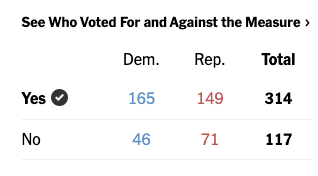
Telling that more Dems than Republicans voted Yes
On to the senate, where a single no vote could still trigger default. :yikes: -
About algorithms and consciousnessAgree many think Penrose eccentric on that question but as I say, it does highlight the issue of whether consciousness really is understandable as an algorithm.
I think what's really interesting about this question, is that there's no obvious empirical method to determine the answer to that question - especially now ChatGPT has blown the Turing Test out of the water. What that tells me is that the nature of consciousness is not necessarily determinable by empirical methods. Personally, I don't believe in sentient AI, but that there's no easy way to prove the case says something, I think. -
The Naive Theory of ConsciousnessChalmers was a big hit because he was "making it respectable to be a Cartesian dualist again". That was literally the gleeful response of the philosopher sat next to me when Chalmers gave the hard problem talk that made his name. — apokrisis
Chalmers proposes the concept of "naturalistic dualism" as an alternative to traditional Cartesian Dualism. According to this view, consciousness is a fundamental property of the universe, irreducible to physical processes, but it is still causally linked to the brain and the physical world. Chalmers suggests that consciousness may be a fundamental aspect of reality, akin to space, time, and matter, but which may not be fully explicable within physicalist scientific frameworks.
I agree with him, although I know it's not very satisfactory from an engineering perspective.
A sociological side-show in other words. — apokrisis
Yes, it's annoying that he's gone on to become a tenured academic at New York University, author/editor of half a dozen anthologies on philosophy of mind, and that rarest of things, a well-known philosopher. You'd think we could have expected something better from a Bronze Medallist at the International Mathematics Olympiad.
What am I not grasping? — NOS4A2
The point of the paper you're quoting. This passage by Dashiell is very similar to Gilbert Ryle's criticism of Descartes' in his famous book, The Ghost in the Machine:
“Consciousness, properly an abstract term which, like “happiness”, “graciousness”, or “thoroughness”, refers to some quality of the human being taken in abstracto. However, the hypostatizing tendency of human thinking has led to its use as if referring to something existential. Since a man may be conscious, it is easy to fall into the assumption that he may have consciousness, then that something like a consciousness exists.
Here, I take it that the word 'existential' means 'existing'. So he's accusing Chalmer's of 'reifying consciousness', of making it out as some thing. But Chalmers doesn't do that.
The problem is: when we look around for what it is Chalmers is talking about we come up empty-handed. — NOS4A2
That is because it is not visible to the objective sciences, which is not a shortcoming of Chalmer's theory, but the point, which you're not seeing.
But upon an objective analysis we find there is only one state and it is wholly biological. — NOS4A2
Presumably, you would agree that there is a difference between a non-sentient organism, such as a tree, a simple sentient organism, such as a fish, complex sentient organisms such as elephants and primates, and complex, rational, sentient beings, such as humans. All can be understood through the perspective of biology, but biology does not necessarily extend to, or explain, the nature of what differentiates the complex-sentient and rational-complex-sentient beings from trees and comb jellies. They are subjects of experience - something which is not plausibly deniable. At issue is what it is that gives them this quality of subjective awareness. -
About algorithms and consciousnessOnly when that method fails due to accidental circumstances our consciousness will take action to correct our actions. — Ypan1944
That's more a matter of attention than consciousness. In performing routine actions you're deploying what adult learning models describe as 'unconscious competence' i.e. doing something that doesn't require conscious effort because you know it so well. But you're still conscious, you're just not paying particular attention to what you're doing until something non-routine happens.
Overall, I think the issue with your OP is that you're assuming that conscious actions can be reduced to or described in terms of algorithms. Is this a valid assumption? Algorithms are used by computer science for modelling all kinds of complex actions and situations, but does that mean that conscious activities actually are algorithms? A dissenting opinion is given by Roger Penrose, in Emperor's New Mind, who argues that human consciousness is a capability that goes beyond what can be captured by algorithms. He believes that human understanding and insight involve non-computable processes that are not reducible to simple algorithms and that cannot be derived by mechanical procedures. He bases his argument in part on Godel's theorem, saying that these demonstrate that within any formal system of logic, there will always be true statements that cannot be proven within the system itself, meaning that there are limits to what can be achieved through purely algorithmic or mechanical processes.
Of course, many people disagree with Penrose, but at least the debate shows that the question of the algorithmic nature of consciousness is, well, debatable. -
Atheist Dogma.It effectively is as you can find thousands of examples of that, even to this day. Religion was an old form of trying to understand the world but as time moved forward it became evident that it wasn’t as more scientific explanations proved better. — Darkneos
They're not equivalent. Science provides a wealth of quantitative data, better adaption to circumstances, and so on, but it is not concerned with existential truths. -
Atheist Dogma.It would seem kinder to the author to assume he wasn't claiming that Jesus said "I am the truth, the truth and the truth" but drew a distinction between "the truth" and "the way" and "the life." Regardless, though, it's clear that Jesus is portrayed as claiming he alone is the way, the truth and the life. — Ciceronianus
I would prefer to believe that Christ was speaking from a universalist perspective, rather than proclaiming the requirements of a sectarian religious affiliation ("Yo! Christians! Form a queue to the right! Others - outer darkness!'). The question is, does the ‘I’ in Jesus’ statements about himself refer to that particular individual at a specific time and place? Recall the statement of God’s identity in Exodus,’I AM THAT I AM’ (Ex 3:14) and Jesus 'Before Abraham was, I AM’ (John 48). Advaita Vedanta would interpret those statements as affirmations that 'the Truth, Light and Way' just IS the Self (Ātman) which is the ground of being of every individual, to which it is the task of their religious discipline to awaken. (The fact that Christians might not concur is irrelevant from a philosophical perspective.)
What do we mean by dogma? — Moliere
Dogma is not only religious. 'The central dogma of molecular biology is a theory stating that genetic information flows only in one direction, from DNA, to RNA, to protein, or RNA directly to protein.' Political orthodoxies have their dogmas, as do many other disciplines - Soviet Communism was notoriously dogmatic. Dogma is simply the regular form of an accepted principle or axiom. In itself it is not necessarily problematic, but becomes so when it is allied with authoritarianism, which is often is.
it kind of depends on the kind of atheism one is listening to or supports. — Manuel
Listening to many of the voices on this forum, you'd be convinced that the history of religion is the history of evil and that all we can do is struggle to free ourselves from it. What that doesn't see is what calls forth the need for religion in the first place (because anthropology and history have shown that it is utterly ubiquitous in human culture). That is invariably depicted by atheism as a kind of sense of dependency which also needs to be thrown off. This is a quote from an analysis of the philosophy of religion of Josiah Royce which I think captures more of the original impetus towards spiritual belief:
The religious person perceives our present life, or our natural life, as radically deficient, deficient from the root (radix) up, as fundamentally unsatisfactory; he feels it to be, not a mere condition, but a predicament; it strikes him as vain or empty if taken as an end in itself; he sees himself as homo viator, as a wayfarer or pilgrim treading a via dolorosa (path of sorrows) through a vale that cannot possibly be a final and fitting resting place; he senses or glimpses from time to time the possibility of a Higher Life; he feels himself in danger of missing out on this Higher Life of true happiness. If this doesn't strike a chord in you, then I suggest you do not have a religious disposition. Some people don't, and it cannot be helped. One cannot discuss religion with them, for it cannot be real to them. It is not, for them, what William James in "The Will to Believe" calls a "living option," let alone a "forced" or "momentous" one. -
Science as MetaphysicsDid you know what Parmenides and his contemporaries wanted to know? The ultimate reality -- what is the smallest unit they could reduce existence and still be true to the real. — L'éléphant
That was Democritus and Leucippus, the atomists. Parmenides was not an atomist. -
Why Monism?People adopt them on account of what seems most plausible to them, but as I keep saying, that will depend on what one's own set of unargued premises or presuppositions are. — Janus
Not unargued. The argument is that logical necessity can't be accounted for in terms of physical causation as a matter of principle. -
Why Monism?But the challenge is, how can any kind of 'either/or' thinking or logical argument, in general, be explained in terms of the kinds of physical causation that characterises brain states? What I was challenging was the assertion that:
In the cause of physical brains, the brain state will be the configuration required to instantiate non-physical mental content. — Mark Nyquist
So, how to validate that statement is what is at issue. How do you think you could ascertain the empirical fact of that statement, on the basis of neuroscience. -
Why Monism?One line of argument against that is a variation of what is known as 'the argument from reason'. This says that, whatever we understand 'brain states' to be, if we are arguing that they are physical in nature, then they're incommensurable with propositional content (incommensurable meaning not able to be judged by the same standards; having no common standard of measurement.) Why? Because propositional content is wholly dependent on the relationship of ideas and if-then statements - if this is the case, then that is so. Any arguments relying on rational inference or logical syllogisms make use of something like this, and are instances of logical necessity - that is [x] is the case, then it must also be that [y]. But physical causation is of a different order to logical necessity. — Wayfarer
-
Why Monism?Do you think your intuitive preconceptions about how things must be are the last word on how things actually are? — Janus
I actually offered an argument, not an 'intuitive preconception'. If you would like to address the argument, then I might respond. -
Why Monism?The wave particle duality may well be an heuristic device, but anyway, doesn’t have any bearing.
-
The Debt Ceiling Issue‘House Rules Committee voted to clear the way for a debate on the plan on Wednesday,’ - NY Times. First hurdle cleared.
-
A Case for Analytic Idealism@Fooloso4 - you have said there are no immaterial minds - how would you even go about looking for such a mind (I hesitate to say 'phenomenon')? We have physical instruments that can detect electromagnetic and sub-atomic phenomena with exquisite accuracy, but how would you even go about investigating such a question?
The point is that we know objects persist — Janus
Rather, we assume they do. If you read my posts more carefully, you would see that I am saying that both the posits of 'existing' or 'non-existing' are mental constructions or surmises. -
The Debt Ceiling IssueThe Freedom Caucus are vowing to torpedo it - have a listen to the video in this NYT article.
“Not one Republican should vote for this bill,” Representative Chip Roy, a Texas Republican and influential member of the ultraconservative House Freedom Caucus, said at a news conference outside the Capitol. “We will continue to fight it today, tomorrow, and no matter what happens, there’s going to be a reckoning about what just occurred unless we stop this bill by tomorrow.”
Another member of the group, Representative Dan Bishop of North Carolina, said he considered the deal grounds for ousting Mr. McCarthy from his post, something that any one lawmaker can attempt thanks to a rule Mr. McCarthy agreed to while he was grasping for the votes for his job.
I knew there'd be calls for McCarthy's head.
Hakeem Jeffries (House minority leader) is saying there needs to be 150 Republican votes. But
Two of the Rules Committee’s arch-conservative members, Mr. Roy and Representative Ralph Norman of South Carolina, could vote against allowing it to move forward, in a sharp rebuke to the speaker. If they were joined by another Republican on the committee, they could sideline the agreement before it even reached the floor.
Going to an exceedingly tense week in Washington. -
Why Monism?In the cause of physical brains, the brain state will be the configuration required to instantiate non-physical mental content. — Mark Nyquist
Not what I had in mind. The philosophical question is, how could you account for propostional content in terms of brain-states. The brain-mind identity theorists hold that states and processes of the mind are identical to states and processes of the brain. It's a complicated subject in philosophy of mind (Stanford article).
One line of argument against that is a variation of what is known as 'the argument from reason'. This says that, whatever we understand 'brain states' to be, if we are arguing that they are physical in nature, then they're incommensurable with propositional content (incommensurable meaning not able to be judged by the same standards; having no common standard of measurement.) Why? Because propositional content is wholly dependent on the relationship of ideas and if-then statements - if this is the case, then that is so. Any arguments relying on rational inference or logical syllogisms make use of something like this, and are instances of logical necessity - that is [x] is the case, then it must also be that [y]. But physical causation is of a different order to logical necessity. This is the subject of this thread from about a year ago.
Back on the topic of monism - I'm convinced that the original monist systems were derived from 'the unitive vision' in, for example, Plotinus. It is a fact that the word 'Cosmos' means 'ordered whole', and it was the conviction of many pre-modern cultures that the Universe functions as an ordered whole. Cosmology began as an attempt to conceive of the nature of that order. But the prospects of seeing the universe as an ordered whole in our day and age are very slight indeed, what with the multiverse conjecture and the realisation of the inconceivable vastness of the Universe. Maybe is beyond the intellectual powers of anyone to imagine the cosmos in those terms any more. 'All the kings horses and all the kings men, couldn't put Humpty together again.' -
The Naive Theory of ConsciousnessAgain, nothing has “arisen” from this state, forever discounting the claim that it “gives rise” to something — NOS4A2
What about the computer you're writing this on? The house you're sitting in while writing it? The products you use every moment of every day? How were they made? By unconscious automata? Did they spontaneously form from the aggregation of materials? Of course not. They were built by human designers and inventors.
'Reification of consciousness' is definitely a problem, but it is not Chalmer's problem. The root of reification is 'reify' meaning 'to make a thing out of', from the Latin root Res, 'thing'. And it was Descartes that designated the mind as 'res cogitans', literally a 'thinking thing' (not even thinking being.) This has had many profound and deleterious consequences, crystallised in the depiction of the mind as 'the ghost in the machine'.
I think what your OP demonstrates is the failure to grasp Chalmer's argument. -
A Case for Analytic IdealismThis is what supports Aristotle's definition of "man" as rational animal. — Metaphysician Undercover
Agree. I also think that rationality is often deprecated by modern philosophy, due to the animosity towards the idea of innate abilities on the part of empiricism, and also because it seems politically incorrect to say that humans are different to animals.
In the ancient world sacred lore was indeed committed to memory, and the feats of memory that were accomplished seems amazing to us now. The entire corpus of the Vedas and all the early Buddhist texts were preserved orally for centuries before being committed to writing. (There is still a term in Islam, ‘hafiz’, for those who have memorised the entire Koran, which seems an astounding feat.) -
Atheist Dogma.2. Establish the scientific method with truth as the only and unquestionable value. — unenlightened
I agree, with the caveat that ‘truth’ ought to be replaced with ‘objective fact’ or ‘measurable outcome’ as the sole arbiter of reality.
However I also think a case can be made that religious authoritarianism and sectarian conflict is what gave rise to the reaction against religion that characterised the Enlightenment. The Articles of the Royal Society, the first true scientific society, specifically prohibited fellows from involvement in questions of metaphysic which were the province of the religious. In part this was because making pronouncements on such matters could result in serious consequences. But these are all very complicated historical matters. -
A Case for Analytic IdealismPretty darned close. I first learned about Kant in a 1955 book, The Central Philosophy of Buddhism, T R V Murti, which draws many comparisons between Kant and the Madhyamaka (Middle Way) philosophy of Buddhism.
Wayfarer

Start FollowingSend a Message
- Other sites we like
- Social media
- Terms of Service
- Sign In
- Created with PlushForums
- © 2026 The Philosophy Forum