
Comments
-
Epistemology – Anthropic RelativismThe dilemma with epistemology is the concept of epistemology itself, because it suggests that there is a cognition machine in our head that is capable of knowing the world, and that in a transcendent sense. — Wolfgang
That would be what is referred to as metacognitive insight - knowing how we know. Kant was a signficant figure, in that regard but then so too was Plato.
Excluding all metaphysical and transcendental ideas means focusing on this one world of ours and ensuring that it is preserved. — Wolfgang
Metaphysics is inextricably associated with religion in western culture, which can be misleading. That arose because of the assimilation of Platonism by theology in the early Christian era. But the origin of metaphysics proper was in my opinion with Parmenides and Heraclitus, subsequently interpreted by Plato and then Aristotle. They were not expllicitly religious in today's sense but deeply questioned the nature of knowledge and the meaning of being. I think that they would say that 'this world of ours' actually lacks any inherent reality, due to its transitory nature, and that what reality it possesses is imputed by us on the basis of reason, and that they were engaged in interrogating what that means. In particular, they were struck by the power of reason to penetrate beyond the sensible domain so as to reveal a realm of unchanging truths. Your reflection on 'worlds 1 and 2' is similar, but obviously Aristotle doesn't reject metaphysics in the peremptory way that you do. Perhaps yours is a consequence of its association with religion and the generally empiricist cast of modern culture.
Epistemologically, we move on a surface whose “depth” we do not know, cannot know and do not have to know. — Wolfgang
You may not have to know it, but you suspect it's there!
Like a long-legged fly upon the stream
His mind moves upon silence. — W B Yeats
Epistemologies are therefore to be understood as tools that we can use to understand and shape our environment. This position was mainly held by Pierre Duhem. — Wolfgang
Duhem was an instrumentalist in some respects but it is not what he was known for. Duhem argued that scientific theories cannot be tested in isolation, and they are always interconnected with auxiliary hypotheses. This means that when an experiment or observation contradicts a theory, it's not always clear whether the theory itself is false or if some auxiliary hypothesis is at fault. This idea has important implications for the philosophy of science and the interpretation of scientific theories. His work was precursor to Michael Polanyi and Thomas Kuhn.
Every species and - if this were possible - every inanimate particle has its own world 2. — Wolfgang
That's similar to panpsychism, isn't it? But Inanimate objects don't exhibit the drive towards homeostasis and self-maintenance - the will to survive - that is characteristic of even the most basic life-forms. So I can see the case as far as organisms are concerned, but not on the level of inorganic matter.
A final point - take a good look at the abstracts for Mind and the Cosmic Order, Charles C. Pinter. He was a mathematics professor, deceased July 2022. He had an interest in neurological modelling, cognitive science and philosophy, quite relevant to the concerns you're expressing. Most interesting book I've read in this space in the last several years. -
How Different Are Theism and Atheism as a Starting Point for Philosophy and Ethics?Then would it be the God in Christianity or Judaism with emotions and passions like those of humans'? — Corvus
Does God have emotions and passions like humans? I would regard that as anthropomorphic projection.
Vedanta is one of the philosophical schools of Hinduism, based on the Upaniṣads. Advaita Vedanta, non-dualism, has been very influential in contemporary culture, courtesy such figures as Swami Vivekananda and Ramana Maharishi. -
How Different Are Theism and Atheism as a Starting Point for Philosophy and Ethics?My question is still is there anything which represents "substance" in the actual world? — Corvus
As I said, 'substance' is a (mis)translation of the Greek word, 'ouisia', which is a form of the verb 'to be', so it's nearer in meaning to 'being' than what we call 'substance' in everyday speech. Those two refs I linked to in the post above provide more detail.
Spinoza's God is not a traditional religious God in Christianity or Judaism. His God seems to be nature itself. But then what is the point of God? Why not just call it nature rather than God? — Corvus
That's a good question, and what I think enables secular philosophers to claim Spinoza as one of their own, notwithstanding the mystical implications of his 'intellectual love of God'. But again, if Spinoza is translated as saying there is one real Subject or Being, I think it conveys his meaning better than saying there is a single substance. It is very close in spirit to some forms of Indian Vedanta philosophy. -
Best Arguments for PhysicalismSo, again: what would scientific evidence for physicalism look like? Thread is called 'best arguments for physicalism', so take your shot.
-
James Webb Telescope:party: Good news for them! Although I seem to recall another article that one of its ancillary bots had photographed it, and it was lying on its side, so it's not totally out of the woods (not that there's any woods :yikes: ). Still, good news for the team.
-
Best Arguments for PhysicalismYou never show any specific knowledge of philosophy of mind, and you equate any questioning of philosophical materialism with religious fundamentalism. And you didn't answer the question.
-
Donald Trump (All General Trump Conversations Here)I was reading how the economy was under his leadership and the economy was actually going well. — L'éléphant
Trump never exhibited leadership. Everything he says and does is only for the sake of himself. If the economy goes well, he will claim credit (he did it yesterday, even though he's not in office) but when it goes badly, it's never his responsibility. -
Best Arguments for PhysicalismDo you seriously think there is no scientific evidence that minds are a result of physical neurological processes? — wonderer1
Philosophim asks me that all the time. I don't think you, or he, have any background in philosophy of mind, or why philosophy of mind is different to neuroscience. So it just strikes you as preposterous that anyone can question that.
statements such as the quote above might as well be an announcement of invincible ignorance on your part. — wonderer1
It might also be evidence that you don't understand the arguments. Most people nowadays simply assume the meta-scientific narrative, in which evolutionary theory has supplanted the religious creation mythology, but without really considering all of the philosophical implications of that.
So, again, with respect to science: what would scientific evidence of physicalism look like? What branch of science would you look to, in particular, to prove or to show that everything is, or reduces to, the physical?
Again, it might help if you can point to some section of the SEP: Physicalism article to show what you have in mind. -
Donald Trump (All General Trump Conversations Here)Is it psychologically uncomfortable for you to ponder that soon Trump could be president again? — L'éléphant
In my view, it plays into the narrative of the MAGA/Trump mediaverse, which is investing a lot of hype and hot air into bringing about this outcome. And believing it means they're succeeding, so I refuse to believe it! Trump squeaked in the first time, and he and the Republican Party have lost ground since, by ever-increasing margins, in each election. Trump in all likelihood will this year be convicted of very serious crimes against the state, and I believe he'll see the inside of a federal penitentiary before he sees the inside of the Oval Office again. -
Best Arguments for PhysicalismIt would behove anyone reading this thread to go back to the SEP article on Physicalism that it started with, from time to time. It's a difficult and in some ways irksome article but it focuses the discussion on what precisely is being talked about.
-
Best Arguments for PhysicalismThe scientific evidence is rather overwhelming. But then most people don't put a lot of effort into apprising themselves of the scientific evidence. — wonderer1
There is no scientific evidence for physicalism. Rather, physicalism is an operating assumption on the grounds that science proceeds in terms of what is objectively measurable, which is best conceived of against an assumption of physicalism. But physicalism itself is actually a metaphysical axiom, not a scientific theory as such. Furthermore many aspects of current science cast doubt on materialism or physicalism as it was traditionally conceived.
The second point is more cultural than philosophical. It is that secular culture has abandoned the kinds of frameworks of belief within which alternatives to physicalism are meaningful or intelligible. That parallels the ascendancy of science over religion as a kind of over-arching cultural narrative. But this forgets that science principally deals with falsifiable hypotheses, not claims about broader questions which include ethics and the meaning of existence. Scientifically-oriented people will often put aside or shelve such questions as imprecise, but that is just further evidence of the presumptions under which science generally operates.
But mostly, it's just an assumption about 'the way things are', with science being held up as the arbiter of judgement about such matters. -
Donald Trump (All General Trump Conversations Here)The question I've been asking since 2021, is 'How can someone who has demonstrably attempted to derail the presidential succession be allowed to participate in the electoral contest?' Now, that is the question at the basis of the disqualification case that the Supreme Court is hearing on February 8th. There is now an advocate for his disqualification in the form of Michael Luttig, a retired federal appellate judge and prominent conservative jurist who is arguing before the Supreme Court of the United States:
Trump incited, and therefore engaged in, an armed insurrection against the Constitution’s express and foundational mandates that require the peaceful transfer of executive power to a newly-elected President,” the brief said. “In doing so, Mr. Trump disqualified himself under Section 3 (of the Constitution).
A just-released PBS documentary, Democracy on Trial, explores these questions in depth and detail. Herewith an excerpt feauturing the testimony of Rusty Bowers, an Arizona state election official who Trump and Guiliani tried to pressure into replacing Biden's electors with Trump's, and who is a major witness at the forthcoming January 6th trial. He's a tried and true Republican, a traditionalist, who found Trump and Guiliani's attempts to have him throw the election both ridiculous and deeply offensive.
-
Objective News Viewership.I have found that Fox shows the inconvenient and or irrefutable halves of truths that the left leaning networks wont. Anyone out there afraid to try and objectively view Fox News? — Steven P Clum
Fox News had to pay an almost million dollar fine for propagating lies, and there's an even bigger lawsuit in the pipeline. They have no interest in truth, only in in dollars.
His stumbling and bumbling? Do the website search on each website. — Steven P Clum
US economy surprises with faster than expected growth
Falling inflation, rising growth give U.S. the world’s best recovery
By the Numbers: U.S. Economy Grows Faster than Expected for Year and Final Quarter of 2023
Trump claims credit for record-high stock market under Biden -
How Different Are Theism and Atheism as a Starting Point for Philosophy and Ethics?Note this remark in the IEP entry on Aristotle, written by Joe Sachs, whom I believe to be a noted scholar, in respect of 'substance' in philosophy:
a word designed by the anti-Aristotelian Augustine to mean a low and empty sort of being turns up in our translations of the word whose meaning Aristotle took to be the highest and fullest sense of being. Descartes, in his Meditations, uses the word 'substance' only with his tongue in his cheek; Locke explicitly analyzes it as an empty notion of an I-don’t-know-what; and soon after the word is laughed out of the vocabulary of serious philosophic endeavor. It is no wonder that the Metaphysics ceased to have any influence on living thinking: its heart had been cut out of it by its friends. -
How Different Are Theism and Atheism as a Starting Point for Philosophy and Ethics?He seems to be using the concept of "Substance" to attribute the concept of God.
Any idea what the "substance" meant in Spinoza? Could it be Aristotelian? Or something else? — Corvus
The meaning of 'substance' in philosophy is anything but obvious, but it's much nearer in meaning to what we would think of as 'subject' or 'being' than what we would usually call 'substance' in the day-to-day sense. The philosophical term 'substantia', 'what lies underneath' or 'the bearer of attributes', was a Latin neologism used to translate 'ouisia' in Aristotle's works. For the meaning of 'ouisia' see
The Meaning of Ouisia in Plato (and the following section for Aristotle).
Also 17th Century Theories of Substance.
From which
In contrast to contemporary philosophers, most 17th century philosophers (Spinoza, Leibniz, Descartes) held that reality comes in degrees—that some things that exist are more or less real than other things that exist. At least part of what dictates a being’s reality, according to these philosophers, is the extent to which its existence is dependent on other things: the less dependent a thing is on other things for its existence, the more real it is.
That is also reflected in the Christian doctrine that souls are created directly by God, and so are in greater proximity to the divine nature than material particulars. Also that the word 'creature' reflects the etymology of 'created being' (whereas God is 'uncreated being', and knowledge of God 'the wisdom uncreate').
So in this sense, Spinoza's 'single substance' might be better conceptualised as a 'single subject', although with many caveats and qualifications.
Naturalist philosophers have to do more work, since they don't have this handy fits-all puzzle piece. — Relativist
But this misses the point, which is that for those who actually believe in God, it has real consequences. Whereas to believe that it's simply a 'puzzle-solver is a meaningless hypothetical. -
Paradigm shifts in philosophyThe real power of modern physics is to render the goings-on of material bodies amenable to mathematical logic, and to extend it by methodically devising new mathematical concepts to describe as far as possible the unexpected behaviours of bodies. This enables great power by the application of logic to science and engineering with no regard for any purpose save the instrumental, the effective, to ‘what works’.
-
Donald Trump (All General Trump Conversations Here)He's a kind of outlaw hero now. — Tom Storm
And as such Trump has thoroughly corrupted the body politic, although the rot had already had to have set in. -
Best Arguments for PhysicalismI'm guessing public education taught you wrong and you just need to reset. — Mark Nyquist
I've at least bothered to read some books on it.
I'm guessing public education taught you wrong — Mark Nyquist
That is an ad hominem argument. -
Best Arguments for PhysicalismThe person who wrote the book is the source of the information (in his brain). He encodes it into a book. The book is encoded physical matter. The person reading the book hopefully decodes the book in the way it was intended. — Mark Nyquist
But your description is simplistic and vague. There are many unknowns in all phases of this process. What the relationship is between the physical activities of the brain, and the symbolic forms that characterise language and logic, is not at all understood. And furthermore, they belong to completely different kinds of description.
An example I often give is that an idea (like a formula or a recipe) can be represented in all kinds of different languages and symbolic forms without loosing its meaning. The representational medium, paper and ink, or physical bits on a hard drive, is different in each case, but the meaning stays the same. So how can the meaning be something physical when it can be transformed into different physical media and symbolic systems? The form changes, but the meaning remains constant through such transformations. And I say that challenges a physicalist account.
Simply asserting that conceiving of a universal is not the outcome of a physical process is unpersuasive in light of understanding things like this: — wonderer1
That's a good video, and a good source, but I would question the sense in which neural networks are a purely physical process. Such systems are reliant on human invention and programmed by humans to produce outcomes. They reflect and embody human intentions. Surely all of those processes are instantiated in physical systems, but the overall process is intellectual rather than physical, as it relies on ideas. Saying that it 'proves' or 'shows' that intelligence is physical begs the question, by assuming that the computing process can be wholly understood in physical terms, when an intrinsic foundation of the process is mathematical in the first place. And it's far from settled that mathematics can be reduced to the explained in physical terms. In fact it seems rather the contrary, as physics itself is highly dependent on mathematical abstractions. -
Donald Trump (All General Trump Conversations Here)an all-out what? Trump is subject to enormous amounts of media coverage. There's regular media - NY Times, Washington Post, CNN, MSNBC, critical of Trump. Then there's Trumpworld media, which will back him and repeat his lies ad nauseum. Why he's the favourite, nobody really can tell - it has to do with the way he's captured the grievances of a large section of the electorate who generally hate politics and politicians and feel that he represents them and who for various reasons buy into his delusions. Although it seems obvious to anyone not inside the bubble that it's a con.
-
Paradigm shifts in philosophy“Physicists believe in a “true world” in their own fashion…. But they are in error. The atom they posit is inferred according to the logic of the perspectivism of consciousness—and it is therefore itself a subjective fiction ~ Nietszche — Joshs
An intriguing passage, but even if atoms are not the supposed ultimate indivisible particles of atomism, they are also something more than a subjective fiction.
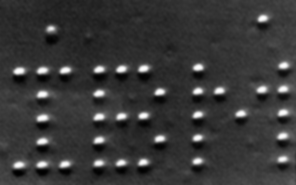
'IBM in atoms' was a demonstration by IBM scientists in 1989 of a technology capable of manipulating individual atoms. A scanning tunneling microscope was used to arrange 35 individual xenon atoms on a substrate of chilled crystal of nickel to spell out the three letter company initials using single atoms. It was the first time that individual atoms had been precisely positioned on a flat surface (wiki).
On a side-note, do you think Nietzche's 'will to power' can be traced back to Schopenhauer? -
Donald Trump (All General Trump Conversations Here)I think Trump is going to win the Republican caucus. — L'éléphant
He will likely win the most number of delegates, but the nomination conference is not until July, and there are, shall we say, legal issues which might become apparent well before then. -
Paradigm shifts in philosophyNewtonian mechanics never purported to deal with the microphysical, so they are not really bets understood as different paradigms, but as different areas of investigation. — Janus
not the point. Newtonian mechanics ushered in the 'scientific revolution' which was another paradigm shift. It was far more than just 'accurate observations' as it involved the collapse of an entire cosmology and the ushering in of a wholly new worldlview.
Your remark reminds me of a famous anecdote, that on the day after the sinking of the Titanic, an Aberdeen newspaper was headlined 'Aberdeen Man Lost at Sea' ;-) -
Paradigm shifts in philosophyThey're both paradigms, as per Kuhn's terminology. Quantum physics represented a significant departure from classical physics, particularly in its rejection of deterministic, Newtonian mechanics and its introduction of probabilistic and wave-particle duality concepts. Kuhn used quantum physics as an example of a scientific revolution because it challenged and replaced the existing paradigm of classical physics. The transition from classical to quantum physics marked a fundamental change in the way scientists viewed and understood the physical world, and it exemplifies Kuhn's idea of paradigm shifts in scientific development. He gfives the Copernican Revolution as another example to illustrate how scientific revolutions occur when a new paradigm replaces an older one. The acceptance of the heliocentric model required a significant change in the way scientists thought about the cosmos, and it represents a classic case of a paradigm shift in the history of science.
-
Best Arguments for PhysicalismHowever the form,
Brain; (mental content) — Mark Nyquist
How about the relationship between books and stories. In what sense is the meaning of a story contained by a book? Is it physical in the sense that the ink and paper is physical? -
Paradigm shifts in philosophyThe previous one was the shift to the Copernican solar system and the ensuing 'scientific revolution'.
-
Paradigm shifts in philosophyHow about the 1927 Solvay Conference in Physics as the mother of all paradigm shifts in modern science and philosophy? I say it marks the boundary between the Modern and Post-Modern periods. The subject was Electrons and Photons and the world's most notable physicists met to discuss the newly formulated quantum theory. The leading figures were Albert Einstein and Niels Bohr. Seventeen of the 29 attendees were or became Nobel Prize winners, including Marie Curie who, alone among them, had won Nobel Prizes in two separate scientific disciplines. ... Essentially all of those names who had contributed to the recent development of the quantum theory were at this Solvay Conference and the essentials of the newly-devised quantum mechanics were presented and discussed. (wiki)
Not only did these advances make possible almost all the technological breakthroughs seen in the 20th century, it also undermined many previous assumptions about the nature of matter, not least the supposed mind-independence of the objects of physics. This in turn gave rise to the philosophical conundrums posed by wave-function collapse and entanglement, still the source of unresolved debates about the nature of reality and the mind's place in it.
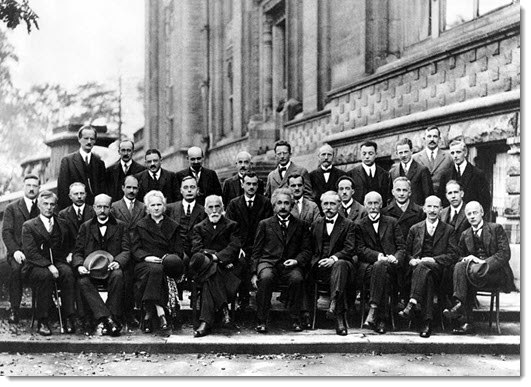
Participants at the 1927 Solvay Conference: A. Piccard, E. Henriot, P. Ehrenfest, E. Herzen, Th. De Donder, E. Schrödinger, J.E. Verschaffelt, W. Pauli, W. Heisenberg, R.H. Fowler, L. Brillouin; P. Debye, M. Knudsen, W.L. Bragg, H.A. Kramers, P.A.M. Dirac, A.H. Compton, L. de Broglie, M. Born, N. Bohr; I. Langmuir, M. Planck, M. Curie, H.A. Lorentz, A. Einstein, P. Langevin, Ch. E. Guye, C.T.R. Wilson, O.W. Richardson -
Human Essence. And, they want to know what his essence is — Rob J Kennedy
But do they use that actual terminology: 'what is your essence'?
Do you remember Gattica, a 1997 movie set in a future society where genetic engineering and DNA testing are used to determine a person's potential and worth? The main character, Vincent Freeman, played by Ethan Hawke, has inferior genetics and must fake his DNA identity in order to pursue his dreams and goals. The film explores themes of genetic discrimination and the consequences of a society where DNA determines one's destiny. Now that would be 'ascertaining essence'. Otherwise the kind of surveys your friend undertakes are more likely just 'wellness checks' and what HR departments do to monitor staff. The most recent contract I had, those surveys were sent out automatically every fortnight, eliciting my workplace responses. Pretty standard business practice. -
The Eye Seeking the Iwhy is it the things that by nature must necessarily be the closest to us, most intimately connected to us, the things that must be us, are the hardest things to see? How is it I could be a mind that cannot know what a mind really is? — Fire Ologist
Excellent question. Isn't it because it is too near to us to grasp? Focus requires some distance, you can't see something pressed right against your eye, although that analogy also fails, because whatever is pressed is still something other to you, a foreign object of some kind.
I'm inclined to the view that the self is both unknown and unknowable. And that what we think of as the self, mainly comprises those things and circumstances to which we are attached and that we identify with. And a lot of what we cling to as self, is precisely to avoid the unknowability of the self, by identifying with something habitual and familiar.
If that sounds Buddhist, it is, not that I write as a Buddhist but as someone who has committed some time to studying the topic. There's a specific book: Early Buddhism, the I of the Beholder, Sue Hamilton-Blyth (and note the similarity with the thread title). This explicates this analysis in great detail (although it's a hard book to get and quite expensive).
But overall, I think you're on the right track, and asking the right questions. -
Loving Simone de BeauvoirAnother saying comes to mind, from the ascerbic G B Shaw - 'youth is wasted on the young'. (Something to which I can personally attest, having wasted a fair bit of mine.)
-
Donald Trump (All General Trump Conversations Here)He also said recently that he hopes the economy will crash in the next twelve months so that he doesn't have to take the blame for it if it crashes later. As always, his only interest is self-interest.
-
Donald Trump (All General Trump Conversations Here)**this OP should be merged into the Trump thread**
-
Paradigm shifts in philosophyMedicine has specific areas of applicability, obviously a very important one, but not medicine is not applicable to everything.
-
The Blind Spot of Science and the Neglect of Lived ExperienceI’ll look into it! And Tallis wouldn’t know who I am - I emailed him after picking up a copy of Aping Mankind about 10 years ago, and got a reply, that’s all. I’m not overly familiar with all his output, but I know he’s critical of Darwinian materialism.
Wayfarer

Start FollowingSend a Message
- Other sites we like
- Social media
- Terms of Service
- Sign In
- Created with PlushForums
- © 2026 The Philosophy Forum