
Comments
-
Is god a coward? Why does god fear to show himself?Peer pressure — Gnostic Christian Bishop
Big indoctrination, from which not so many can recover.
Life’s cruelty satisfies all repentance,
So this credit give me when Thy sentence,
While here, too, I sin to cancel Your debt,
And away from the holy mosque jump the fence.
The Christian God is vengeful, demands of,
And tortures us with threats of Hellish shove.
Well, if I were a God and ruled above,
You could remove all my powers but love.
There’s no external creative deity.
Don’t worry, this verse has no impiety,
For we are the creative principle;
Intuitive strength is our propriety. -
Implications.What if it was a mathematical proof that eternity exists as . TRUE ? As in a fully logical irrefutable proof that all there is is eternity ? — Steven Twentyman
The Fundamental Eterne has to exist, as ever, for there is something existent for sure and it cannot have come from nonexistence. Thus, there is no alternative to existence. -
Is god a coward? Why does god fear to show himself?rue but he can make moral people call his immoral ass good. — Gnostic Christian Bishop
Believers tremble in fear of the Big Bad Boss,
His immorality untrusted not to cause loss—
Insanity hidden in ‘mysterious ways’;
They accept, so He them into Hell doesn’t toss. -
Determinism vs. Predictability
-
Determinism vs. PredictabilityThat's not what I meant. I was trying to say that I don't think science needs determinism as defined in the OP conceptually in order continue successfully. — T Clark
Quantum Mechanics' probabilistic outputs are used to build many great devices that work. -
Omar KhayyamHigh Noon at the OK Corral – Part 2 — Toasting Death
Chrysanthemums drink the mellow day;
Falling petals carry the light away.
The autumn fog enswirls, the mist upcurls;
Into nothingness the wisp slow unfurls.
I see Danton walking by, but I remain quiet, for he is not exactly acting exuberant.
Danton O’Day had been using our quantum tunnel portal chamber to transport himself into the rare book rooms of our Partner Libraries, some of which had over 4000 Rubaiyats, in order to hopefully quickly finish his search for a few missing artists of the Rubaiyat for his next series, covering thee illustrations from 1914-1929, by checking there personally in the rare book rooms if perhaps the cataloging had been wrong or incomplete, with the book actually sitting there on the shelves somewhere, or behind, or even lying on the floor.
If not, then the only hope was the posted appeal to the public, especially to collectors, in case they had a copy.
If still not, then some of the illustrator samples might have to be left out, after some reasonable waiting time had expired, which, for those impatient like me, would be about a week or less, for I really want to read his next series, even if it only 99.9% covers the period.
I’m not about to tell Danton to publish right away just what he has, lest he suggest in return that I cut a lot of my art from my big fat 14x11 400 page edition of The Ultimate Rubaiyat of Omar Khayyam that hit a wall when the PrestoPhoto book making place informed me that the binding might not hold up beyond 275 pages, and, to boot, that it would cost $420 to print 400 pages. Oh well, I guess a lot of ink has to be consumed.
There is still my potentially endless Apple ibook edition, now at 589 pages, which is logically even more than that, given that some of its landscape view pages contain two facing portrait style images.
Ima Beloved, my elfin muse, reappears and proposes a toast for All Soul’s Day:
A Toast to Death
Time, death, and stardust duly
Made for our birthright fully.
Death chose the useful from the useless
And the pointed from the pointless,
But it took the long of time of yore,
Since Death was the only evaluator.
Eons and ages passed in time’s acumen
For us to evolve from stardust into humans.
Time, death, and stardust’s paths
Write our epitaphs as well, just
As they writ our birthright past.
When our time expires, of the cleft,
Death will come, our living bereft,
And only our dust will be left.
She adds, “I know the poem needs to be worked on some more, plus having quatrains derive from it.” and continues…
Our minds,
Like Shelley’s prisms of many-colored glass,
Strain the white Radiance of Eternity into our lives—
Until Death tramples us—
And then back we go to stardust
After relentless time has wasted us away.
We are devoured us in order to return
That life-dream which was lent to us.
I reply, “I’ll see what I can do with it. Your musings always build into something useful. The themes are great, of course, but they have some repetition and perhaps they explain too much, one stanza might still stand alone for a quatrain, and some rhymes are too forced, plus we probably don’t really need to borrow Shelly’s interpretation, although it’s memorable in his original terms.”
She wanders off, happy to have planted another seed.
I take a short nap outside.
(Click to run.)
“I’ve got something, Ima, three quatrains. You can fiddle with them some more. I’m not completely satisfied with them, but they’re good enough for now.”
Heaven’s stars spread the primeval dust eterne;
Time’s deep seas to evolve the species in turn.
From time, death, and dust we at last became,
And to this, thus, and that we must return.
Time and stardust made us Earth’s living guest,
For quick death sifted the rest from the best.
Those, our birthright, wrote our epitaph, too:
RIP; time expired, death came, dust was left.
Death, evolution’s lone selector,
Stalked the sillier from the wise of yore,
Preserved the more useful from the useless,
And favored the pointed o’er the pointless. -
Why are you doing something in a certain situation?You have to yield, for there is a yield sign there to you.
-
Implications.Grand Unified Theory — Steven Twentyman
Then all the forces would be unified, even gravity, and then our species would continue on just about as it does now. A Theory of Everything, though, would shock the world. -
Alternatives to 'new atheism'The best responses to theism are materialist (physicalist) metaphysics and cosmology. Every argument I've seen for God are based on arguments from ignorance or based on unstated metaphysical assumptions. — Relativist
Ah, good, and on topic.
(No "slime", apart from that we evolved from it.) -
A diary entry of mine regarding free will, determinism and its implication for moralityWithout you being who and what you are, the future causal chain (your output) would be different. — Relativist
And, yet, the actuality of one being in the chain trumps the "if's" and "could haves" of not being there. -
A diary entry of mine regarding free will, determinism and its implication for moralityFreedom and Determinism — ho ching leung
Excellent essay.
In this lost haunt, out on the Orion arm
Of the Milky Way—where safe from the core’s harm;
The philosophers gather in the forum,
As new Sherlocks unweaving the Cosmic yarn.
‘Magic’ has fallen by the wayside, it
As trancendence an intangible writ,
Unable to be distinct from matter,
Having to talk/walk the talk/walk of it.
The Fundamental Eterne of the causeless,
Whose state cannot have inputs to its mess,
Dooms ‘God’, along with any specifics—
The bedrock of All must be randomness.
Of the random base, some small parts endure,
And code as quarks, which code for atoms pure,
As at each new realm new laws determine—
But for when bedrock’s touched—effects for sure.
Conscious qualia reflect the just past,
Decisions and thoughts produced, though it’s fast,
The mechanizations not apparent,
Their constancy such that on Earth we’ll last. -
Alternatives to 'new atheism'So, then, now Purple Pond is well on his way to dealing with the believers.
-
Is god a coward? Why does god fear to show himself?This link speak to theistic evolution.
http://www.smithsonianmag.com/smart-news/pope-would-you-accept-evolution-and-big-bang-180953166/?no-ist
If theistic evolution is true, then the myth of Eden should be read as a myth and there is not really any original sin. — Gnostic Christian Bishop
"God is not a magician" is the beginning of the downfall of 'God' for the Catholics, it demonstrating that the Bible contains fairytales. -
Omar KhayyamHigh Noon at the OK Club — Part 1 — Obits
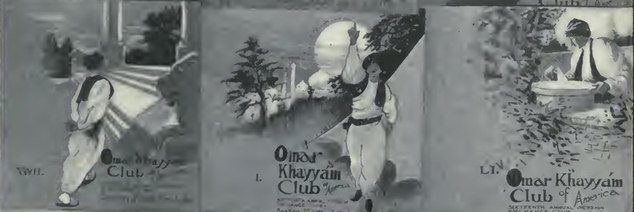
(Men on the menus!)
Should we call the above ‘Womenus’, to whet women’s appetites?
From the Halloween lunch buffet I grab some Lady Fingers, Jello worms, and then stare back at the eyeball pasta, but then choose dog Kibbles instead.
I ponder Ima’s ‘Smoothly Rolling Now’ notion that makes for our extended present and ever continuing stream of consciousness… I realize that the basis of it must be of short term memories seamlessly stitched together.
Whens
Life is a web, of whos, whys, whats, and hows
Stretched in time between eternal boughs.
Gossamer threads bear the beads that glisten,
Each moment a sequence of instant nows.
I now head to step out a back exit of the Club for a bit, with a different drink in each hand and goodies in my pockets, and pass through our Obituarium, which displays in posters our lives’ full and spirited doings, with even the future parts included of all that we’ll thereby have to live up to.
At the end of the room, there is an ornate, otherworldly type door, with a sign written in gold above that reads:
The Great Equalizer stalks all creatures made,
Lying ever just ‘round the corner in the shade,
Taking both human and the beetle as one,
After their lives are spent from rolling some dung.
The door creaks as I pass through its way and into our cemetery to look about the souls’ resting places.
(Click to run.)
A brand new inscription appears on the main stone:
Summer passed away in his sleep last night,
Autumn, sweet and plump, carries his offspring.
The year dies in the night, ghostly winter comes—
Yet spring’s flower is already in the seed.
We’d just had our first frost, but the sun has melted it.
The smile meets the tear—
Fall’s embers last through December.
I look into the distance, noting the endless rows of tombstones in this ‘Land of Epitaphs’. I tilt my drink to pour a few drops into the grass,
Here, a few drops I pour onto the ground,
That precious drink of the quatrains profound.
It through the soil trickles and seeps…
And to his thirsty lips the way it found.
…and lift the drinks to my lips, Sipping From The Rubaiyat’s Chalice (Book by Martin Kimeldorf), then drink Mehdi Aminrazivi’s The Wine of Wisdom from my other hand.
Another epitaph catches my eye:
The Last Remembrance
Engraved is ‘The End’ of your Earthly sigh;
Six sides surround: five are dirt, one is sky.
Shov’ling, Death speaks to you at last, and says,
“What were you doing during all of nigh?”
I sit on a stone bench and paint a cemetery scene that I’ll need for another post.
Back inside, I obtain another drink and turn to the next page of the Jewett Illustrated Rubaiyat, savoring the details, it filling my entire table in its 8K 3D resolution, but I can only show it as a smaller 2D image here:
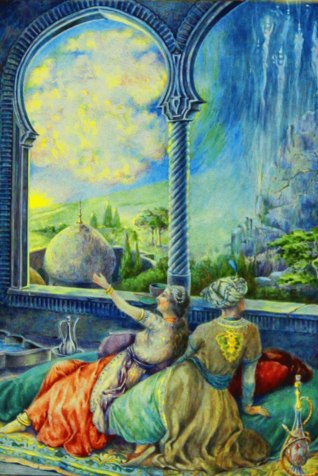
(Click to run.)
-
I don't think there's free willWe are all dominoes forever falling into each other and constantly reshaping each other's velocities and directions of travel. — rlclauer
In learning this, our fixed will expands to grant us the peace of less worthy blame and shame, although, too, less worthy fame, plus more compassion for those who are really stuck because they can't learn well. Now that the horror of randomness drops as the other shoe, we can better embrace the unliked original shoe of the fixed will's consistency, and because that's, well, how it is, and so it shall be, plus whatever will be will be, pending whatnot, which we could put on statues everywhere.
Fixed unfree will is probably the greatest revelation ever to humankind, if they came to realize it; much of the nonsense would fall. -
Alternatives to 'new atheism'Interesting. So you would see ideology as a rewiring of the brain, then? — thewonder
Yes, one can totally become what sees a lot. Be careful not to play too many video games, and especially don't get hooked on watching Wrestling Shows! -
The basics of free will…there is no such thing as a "free will" or an "agent which causes." — rlclauer
All good stuff. Although reality isn't the way that some fantasize it to be, it appears to be the only way it could be and work (as a consolation prize), via the consistency of the fixed will (of the instant, which can ever progress to a new and better fixed will) helping us to survive.
The 'I' of the moment would be the part of the self currently in the mind and the whole repertoire of the brain would be the whole 'self', potentially, I guess.
Some people talk to themselves, which is perhaps a better fixed will talking to a previous lesser fixed will, or a higher self to a lower self, saying the likes of "What the Hell were you thinking when you did that!" -
I don't think there's free willSo I guess where you and I would have difference, is you believe there is some kind of meta phenomenon of the mind, some will, which affects reality — rlclauer
No, no differences, for the 'will' is merely some part of the brain, and the same for the 'mind'. No metaphysics here; all is physical. No supernatural, no intangible, no hocus-pocus. Those distinct realms fail because they'd still have to exchange energy in the materialistic way, and so they wouldn't be non physical. It's like that someone wants there to be 'free will' because we can pick up other people's brainwaves. Well, who knows if that is, but it doesn't matter, for it would just be another input for the fixed will to chew on. The wider the dynamically changing fixed will becomes, via learning and experience, the better its fixed results. We may do or think something tomorrow that we wouldn't have done today. -
The basics of free will…Until, for some, informed by science, who realize that there is an opaque first storey of the neurological beneath our second story.
Could you elaborate on this? — rlclauer
'Storey' is like as used for the first storey of a house, while 'story', while having truth, has some illusion.
We don't see the subconscious brain gears of neuron connections firing, introspectively, nor do we realize (until informed by science) that these figurings took some time, 300-500 ms, all of this finished by the time our consciousness (also a brain process) always sequential to it receives the product of the figurings, this scene also taking time to get painted, unified, and integrated seamlessly with the previous.
We could have an executive function, but this is not a ghost in a machine, but rather, is itself another deterministic program which serves supervisory functions. — rlclauer
You hit on it well.
As so, other or higher brain areas can then access the global result/qualia produced and represented in consciousness, and go deeper with it, if need be, this being part of why the brain evolved consciousness as useful. The brain developed its own symbolic internal language, using qualia symbols (which is quite amazing), and so it could be that these are good shortcut notation for the brain to continue on with, and also, as another part of usefulness, would be good to put into memory as a whole, to have more quickness when referenced. -
I don't think there's free willOk, then it seems like we both agree, randomness does not generate free will. I had a very hard time understanding your poem, so take that for what it's worth. If you could speak less obscurely it might help my pea brain out. — rlclauer
Yes, and so it turn out that free will, as other than the will being free to operate when there is no coercion (which is trivial and not the same 'free'), has nothing to be free of—it just kind of sounds like a great thing to have.
The will is just as ‘free’ as random is.
(In other words, not free, for random harms.)
Though we’re determined to survive each quiz,
(The consistency of the will aims toward us having a future.)
A spanner sometimes gets thrown in the works,
(A tool falls into a machine, preventing from working as designed.)
Preventing the fixed will from being a wiz.
(The wizard of the will can not effectively collapse scenerios of consequence when disrupted.)
Yeah, it was a bit obscure, as 'spanner' is more used in England and a 'quiz' is our daily labyrinth to be navigated.) -
The basics of free willHence, why don't people just stop pretending that this idea of free will is even coherent? — rlclauer
Because… such as we want to say "I love you" to a lover rather than something literal along the lines of that our love has to be so because our bonding hormones match. although it is kind understood that there can be chemistry between lovers.
Seriously, though, it is that nature has led us into the illusion that when a thought comes along seemingly out of nowhere that we thought of it instantly in consciousness, thinking we have conscious agency.
…Until, for some, informed by science, who realize that there is an opaque first storey of the neurological beneath our second story. -
Alternatives to 'new atheism'Do you mean something like that Christians don't really believe in God, but, rather, that they believe in the desire for there to be a God? — thewonder
No, they believe because they so much want it that they suspend other thinking, unknowingly, as a kind of being in denial. Every time they look to their thoughts, 'God is' appears because their brain wires so often fired together that they became wired together. -
Alternatives to 'new atheism'Like I said, you can only ever suspend your disbelief to a certain extent, but it does get suspended. — thewonder
So then, getting back to the OP, might it be that believers so much want their belief that it becomes to them as real? -
I don't think there's free willrandomness = free — rlclauer
More like randomness = harm (to the will). -
The basics of free willIn order for the will to be free, it essentially must be able to manifest uncaused causes. — rlclauer
And even this hope falls apart, for the uncaused has no information going into it, making it to be random, which also dooms 'God'.
criminal justice — rlclauer
Justice of 'coercion' versus 'responsible' is fine for protecting society by holding one's unfree will responsible, the philosophers still knowing that the perpetrator had to do it, although the courts don't much get into that, for ‘determined vs undetermined’ is orthogonal. In the same way, we would wish to imprison hurricanes if we could. -
I don't think there's free willrandomness at best — rlclauer
Usually worst?
The will is just as ‘free’ as random is.
Though we’re determined to survive each quiz,
A spanner sometimes gets thrown in the works,
Preventing the fixed will from being a wiz. -
Omar Khayyam'word magic' — fresco
FitzGerald the transmogrifier brought forth Omar's Arabic into Victorian English so exquisitely that most of the world had to obtain a copy of his version of the Rubaiyat, and over the other poets and literalists. His other works of literature paled in comparison to the magnificence of his book of quatrains.
— The Book of Quatrains —
Now, for the golden verse, as the first.
For its olden age, it is none the worse.
Although day-tide has just barely spoken,
I no less will open our precious token,
This mystery book of poetry sealed,
With waxen shield, it having been concealed
For hundreds of years in the secret chamber
Of the old library’s remainder.
Ope it as one would a tender lover.
A bottle’s encased inside the cover.
Its spirit’s mist apparently escaped
As our fuminous volume was undraped.
I’m captivated by the Persia fumes.
As I. It’s the perfume of ageless rhymes,
From those grand, learnéd Sufi looms of time.
We’ll have to learn how to read between the lines.
The tome is written in foreign language,
In fine verses of thirteen syllables,
Epigrammatic, in four-line stanzas,
It having many swirlas and circulas.
It’s written in middle Persian, I’ve looked,
Having handled many such foreign books—
My editor’s role in the abbey’s nooks;
I thought to hide it in one of the rooks.
The library’s most valuable book!
For I’ve illuminated and unhooked
Many of the monastery’s great books.
For it a long and joyous month I took.
It was the only writing I could save,
Yet it’s the only book we’ll ever crave.
— The Transmogrification —
They watch the book moving about, amazed;
Sparkles and twirls whirl out of the pages.
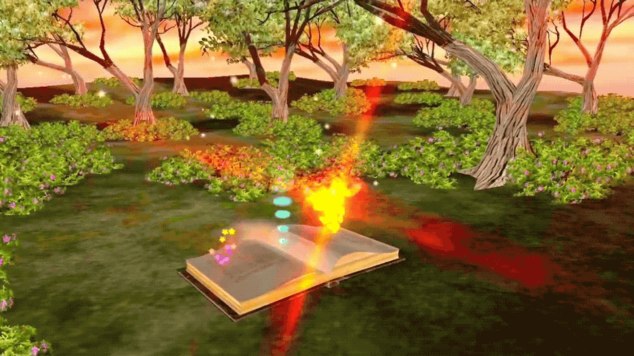
(Click to run the GIF)
It’s rising, breathing, and coming to life,
As husband in the presence of his wife.
Words bounce around; over the page they run,
They often changing into English ones.
Even whole verses are now roundly dancing—
Of the Arabic world—dervishes whirling.
They’re trying to settle from the struggle,
But the words do again jump and juggle,
Some hanging back, then ever surging forth,
Darting around through the poem’s long course,
Then make stanzas, to form a brighter source,
From aspects of the pervading concepts.
’Tis as if this transmogrification
Is trying to preserve all relation
Of the original schema throughout,
The whole translation process devout,
Including literal means, rhythm, rhyme,
Melody, syllable, meter, and time;
But this doesn’t seem to be workative,
And so it follows that something must give,
And this might well sadly be the ration
That is usually lost in translation.
See! Out of that desperation, uncaged,
The verses are jumping right off the page,
Splashing into the bottle of perfume,
Wherein they are redistilling, subsumed.
Now they’re leaping back out, onto the page,
Recomposing themselves, for this time—our age,
Whereupon they’re condensing, restaging,
Into Victorian verse, over paging—
Original concepts forming new quatrains
In which Omar’s meaning’s essence remains.
The lines are now ten English syllables,
Rather than the Arabic thirteen quills,
Yet holding even more related meanings,
Heretofore unnoted, yet the verses
Are still in groups of four lines per stanza,
And the correct lines still rhyme, per lingua,
Although some of the ending quatrain schemes
Don’t seem to have quite the same rhyming means.
Yes, only the unneeded has been lost;
A charm has been added, the good not tossed;
It is something somehow much better told,
Yet e’er within the spirit of the old. -
Alternatives to 'new atheism'I've lost some of my ability to defend myself from attacks on my atheistic beliefs. — Purple Pond
Finally, the dialog comes to an end:
So, my friend, how is 'God' standing now?
He is teetering on the edge of non-existence, given that complexity can't be Fundamental/First; I cling to the notion somewhat less, I guess.
What would the Fundamental basis really be like, given not anything could have gone into it?
Random, such as QM suggests.
Indeed, Anton Zeilinger has confirmed that randomness is the bedrock of reality to several sigma. Now what?
The Fundamental cannot be anything in particular. God cannot be random; God has faded.
It was a nice wish—for whatever good would have come out of it.
Yeah. -
I don't think there's free willnot predetermined entirely by the past — Eric Jenkins
I'll have to seize on the good, creative random deviation results when my will gets disrupted. -
Predestination and Forgivenessindeterministic effects on the quantum scale have been shown to affect the nervous system, which means that our choices are not predetermined. — Eric Jenkins
Even some well figured decision might fail, due to the damage from 'random'. Everything leaks! If only we had three brains we could let the majority rule (that's what some computers do.) -
Cosmology and "the prior"if energy is the foundation of causality, motion, and force, wouldn't it first have to have been in a state of perfect stillness? How could it get, from itself, from that state into the complex universe we experience? — Gregory
No, no stillness, for the base of reality would have no further input, making its outputs random—and this means motion, as ever, like in the quantum fluctuations.
Forget 'spiritual'; they would have no input either, no design, no further point for specific definition, etc, meaning no particular state, i.e., random. -
I don't think there's free willdetermined by non determinate things, which means that we have free will — Eric Jenkins
No wonder the free-via-random will sometimes makes big mistakes, for its consistency gets harmed and thrown off. Well, we can't have everything go right, even if it was built to work. 'Random' seems to stem from the bottommost ground of reality having no further inputs, such as the proposed quantum foam.
I wouldn't jump off of a high bridge, but I think it would be best if I never stood on one, for my will might go haywire from a random fluke. -
The basics of free willDo you understand the reference? Do you know why Einstein said it? Do you know what, if anything, it has to do with determinism? — Wayfarer
Yes, Einstein was against QM's randomness/uncertainty/probabilities, thinking that Nature wouldn't play dice (as random), and for hidden variables indicating determinism, when talking to Born.
I'm noting that the Ground of All would produce outputs from no inputs, i.e., random, such as in the posit of quantum fluctuations. -
The basics of free willgod playing dice — Wayfarer
The bedrock of existence, having no input, whether 'God' or not, would have to play dice. -
Predestination and ForgivenessI would also like to add that i believe in time travel to some extent. — christian2017
To some slight extent, we all travel into the future.
When you do your time travel back into the past, can you arrange to get rid of mosquitos in such a way that the food chain still works well? -
Is god a coward? Why does god fear to show himself?I want to bring good news to their egos and minds by improving their thinking, not bad news that their god is dead. If dead, he will just be replaced. Let him live as an example of evil. — Gnostic Christian Bishop
He might as well be living, per the believers' beliefs, and it's tough to replace dogma.
Per the OP:
We search for 'God', high and low, here and there,
Far and wide—He's said to be ev'ry where;
But no omens are found: quasars abound;
So, He hides out or He's truly nowhere. -
Omar KhayyamMid-Morning at the OK Club — Part 2a — Rubaiyat II
My dream becomes to write a sequel to the Rubaiyat…
Preface
مقدمه
The light of Omar Khayyam shines again, in this epic successor to the FitzOmar Rubaiyat, via Omar’s quatrain conversations with his Beloved female, the Moon of his Delight who know’st no wane, as they wander far from the noise of politics, wars, and mosques, in and about enchanting forests, on green-grassed river banks, through fabulous gardens, and up and down the Djinn mountains, whilst in between they haunt the taverns and therein engage in philosophical and religious discussions.
In Naishàpùr, Persia, rose gardens sing,
Then shed their blossoms at the end of spring.
Likewise, Old Khayyàm’s Earthly splendor flew,
Yet, his Bird of Time still lives, on the wing.
The fumes of ageless rhymes from ancient times
Waft from the Persian verse, as some chimes
New are mixed with the spirit of the old,
Deftly rendered for Victorian climes.
Across Khayyàm’s gravestone blows the simoom,
Carrying forth Omar’s Persia-fume.
Redressed in the versifier’s costume,
It’s remade into Victorian perfume.
In his flowered bed, Omar reposes,
Resting in the earth in peace, one supposes;
Yet, beneath these words and themes on roses
In my quatrain-poems, Old Khayyàm composes.
Foreword
مقدمه
Rubaiyat II is an illustrated epic poem, ideally to be read slowly and thus savored in the now of its present tense. It is a sequel, yes, but it is extended, and thus more in depth, expanding on themes that were just touched upon or implied in the FitzOmar Rubaiyat.
Omar and his Beloved finally appear after about 25 pages of Persian background descriptive quatrains. Later on, it takes them about 16 quatrains just to wake up. They ever speak in quatrains, and the ongoing conversations, sometimes with others, dominate the remainder of the work. They’ve returned to life, via djinn, and science and philosophy have progressed over the years, yet still in the way as ever first identified by Khayyam.
This back and forth method of quatrain dialog, along with the continuity from similar subject matter within a particular time of day, serves to energize the work by weaving a continuous story. Also, the topics versus their illustrations play off each other, this synergy spiraling into added resonance.
There are 4 main sections, in 6 hour periods, of the day’s 24, midnight to morning, morning to noon, noon to evening, and evening to midnight, these roughly corresponding to youth, young age, middle age, and old age, as well as to the seasons of spring, summer, autumn, and winter.
The 3000+ quatrains are mostly my own, as inspired by Omar or by themes I’ve reflected on, but for about 134 public domain translated quatrains from the Calcutta manuscript or from Whinefield, retransmoggrified, and about 186 quatrains contributed by Positor. Most of my 158 retransmogrified Bodliean manuscript quatrains appear. I have also derived about 17 quatrains from Gallienne’s fine prose. These uses are cited in the Appendix.
The longest sections are the evening tavern talk sessions, way later on. Well before that, and throughout, Omar and his Beloved discuss similar Rubaiyat universal topics while here, there, and about. Yes, I have been overwhelmingly overtaken by the Persia-fumes.
Some other long sections are of the olden folklore of the language of the flowers and of the otherworld, peri/pari (fairy-djinn) realm of Omar’s djinni Beloved, as well as several particular philosophies expounded upon. Take heart, for though they may be extensive, they are beautiful and flowing to read.
There is also much of Omar and Beloved enjoying the glorious nature of the wilderness, as well as ever-present romance, mystery, metaphysics, thinking, drinking, and adventure, which the ideal for a far reaching epic.
I’ve drawn from just about everything that I’d ever thought of in life, as well as some new ideas, and so this, probably being my last long book, is the only book of summary that I’ll ever need.
The illustrations were made in Poser, DAZ3D, and iclone, all of which applications allow the user to own whatever is produced. Not all the illustrations can be embedded herein, but can be seen in videos.
Such it begins in earnest:
0.
PROLOG
پرولگ
(0. 1 q1-8)
1
— The Persian Climate and the Poetic Temperament —
هویت ایرانی و احساسات شعری
Persian life simplifies to the extremes,
Loving or fierce, to have or not the means,
Twin Genii granting the best and the worst—
Beyond the Sultan’s favor and Fate’s gleams.
The subsistence aplenty engendered
By the sun’s bounty and breezes rendered
Contrasts to the simoom, the plague, the wars,
The mirage, and the beasts endangered.
Desert life hangs by a skin of water—
In a realm so large to die no better
From a freeze in the north to suffocate
From the heat in the south, weather-whether.
The Patience Stone is the most empathetic
Of listeners, absorbing into it
The pains and sorrows of the one telling.
When it’s full of ache it bursts into bits.
Temper’s all poetry and religion,
And there are but two days distinction—
The Day of the Lot—origination,
And the Day of Judgement—destination.
A-tween, inexorable Destiny
Weaves life’s braided wave, warp, and woof, Sufi,
Whose virtue is courage and submission
To what has been appointed so surely.
Exquisitely pleasured by poetry,
The sense excites beyond rein, dearly,
Through verses chanted, that drive the fearless—
Then grant reward, returned from victory.
Verse exhilaration bests the grapevine,
For quatrains and couplets exceed fine wine.
Flowers and tenders are as drink-spirits,
With the rose gleam a dram of hashish shine.
(0. 1 q9-16)
Poetry dresses the phantasmic new
By enshrining the apparitional brew,
Captured and bottled as aqua-vita—
Wisdom’s pearls, from the evanescent dew.
The Persian pearls bear the down of the lip,
The mole on the cheek, the eyelash, tulips,
Lilies, roses, jasmines, pearls, musk, birds, song—
Epigrammatic, and often epic.
The cedar, the cypress, the palm, the olive,
The willow, and fig-tree, and birds therein,
Are ne’er wanting in the musky verses,
Nor the flower legends, as well as wind.
What’s pent and smouldered as the numb and dumb
Is not spent in the poet, but from a crumb
Rises and grows over into new form,
As relief, in creation through the plumb.
Of a keen bodily sense with sensation,
With a deep intellectual passion,
Poets wing far between Heaven and Earth—
As delight in the two’s composition.
A snatch of poem the camel-driver sings,
And paints with sun-beams what his vision brings—
Of the waving veils adorning the tent,
Of the pipe-dreams floating up in smoke rings…
Which fumes are as sighs sent to Heaven far,
For consideration, from his altar
On this bubbled puff of a worldly sphere,
In case Destiny wishes to shake its jar.
The fence is a temptation for a flout,
But souls are the breezes that have no route.
Were that I was her soft breath in and out,
I could e’er on my way kiss her lips’ pout.
-
Schopenhauer's DeprivationalismAcceptance obtains if all can be shown have to be what it is, more or less.
PoeticUniverse

Start FollowingSend a Message
- Other sites we like
- Social media
- Terms of Service
- Sign In
- Created with PlushForums
- © 2026 The Philosophy Forum