
Comments
-
Omar KhayyamMid-Morning at the OK Club — Part 2
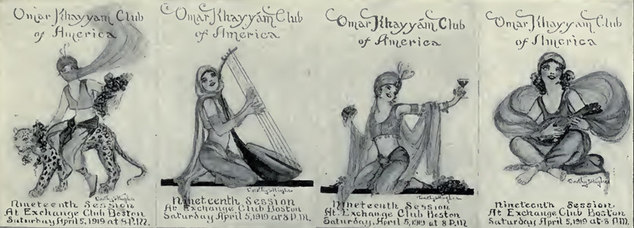
My reverie took flight, with autumn’s sight,
For I was abstracted, entranced, and light.
I beamed to the site suffused with insight:
The solutions are deep within the mind,
Reachable by dreams of the lucid kind.
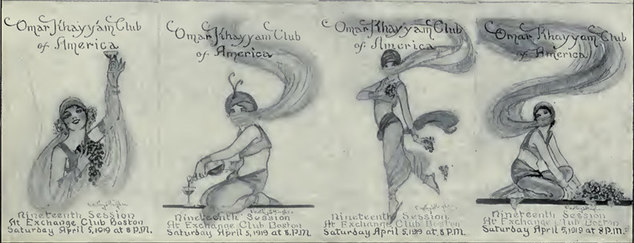
While I am listening to Afsoon Elmy’s CD of FitzOmar’s quatrains singing, a poetess/songstress, Ima Beloved, arrives, and offers me a walk outside into the warming autumnal haze. We take off and stroll afar through the countryside, scuffling through the leaves.
The weed flowers came, marking autumn’s track,
The blossoms that almost brought the spring back.

She says, “Here’s a wide log; let us sit on it to rest a while,” then hums the Pachelbel Canon, mild, adding words to it from a poem that we know, thereby creating a song, music through and thru! It goes something like: Then, where and when will we touch again…”
“Why do people take to songs so heartily?” I ask.
“Because songs can touch one’s spirit truly, so very deeply and thoroughly.”
“But how? Why?”
“There are wordless rhythms in what we call the ‘soul’. Poetry, in a rather approximate way, I’m told, attempts to translate the soul’s rhythms into words. Melody, on the other hand, being already wordless, plays directly on the heart’s strings. A song, being a poem set to music, sings, and thus causes heart and soul to ring and blend into one unified and glorious experience.”
“Yes, and it all seems to flow so smoothly. And, by the way, your words of prose seem to both rhyme and sing, my dear.”
“Music, like life, consists of the ‘what-how’ of what I would call a ‘smoothly rolling now’.”
“I feel that I know your meaning, but, please explain the further seaming seeming.”
“Well, the total effect of music comes from, I’m sure, the smooth transition through past, present, and future, this, thanks to a correspondence rationed, in memory, sensation, and imagination. Memory recalls the past few musical tones that have come just before the ‘now’ that we own; sensation lives ever in the ‘now’ as known, and therefore it savors the present tones; imagination looks to the future rounds, anticipating the coming sounds.”
“Ah, I get it, and it’s poetic. The delight in such as is known is as none of the three could produce alone!”
“Yes, that’s it, my man, as you’re a poet, too, a fine conclusion, and similarly, there is a life award: for each one of life’s moment’s words contains eternal reward, since both past and the future are smoothly rolled up thereinward.”
“We live in the paradisal ‘now’, at last, wherein each moment is eternally vast,” I state, poetically.
“Now, let us consider the quatrain,” she says, “for it can encapsulate and condense a lot of wordiness into something more succinct, as like a pearl produced from an oyster’s digestion—please excuse me for that last part.”
I write, juggling the words and the rhyme sound, after having to end up using 12 syllable lines:
Memory’s ideas recall the last heard tone;
Sensation savors what is presently known;
Imagination anticipates coming sounds;
The delight is such that none could produce alone.
(Ima’s winter garment of repentance thrown off in the spring)
(Click on the GIF image above to run it.) -
I don't think there's free willmental content — Andrew4Handel
Same as saying 'qualia', for the content is a product of a brain process with consciousness also being a step in the brain process, there being no need to call 'dualism' because the content is so unique.
Consciousness is like a tourist along for the ride if all ended there.
Fixed will is simply the will doing as it must. No one would want to be free of the will. -
Is god a coward? Why does god fear to show himself?Gnostic Christian Bishop — Gnostic Christian Bishop
R.I.P. The Biblical 'God' idea — PoeticUniverse
So, how are those descriptions for getting the Biblicals to think deeper? -
Can something exist by itself?I don't think so. Try this...
https://arxiv.org/ftp/arxiv/papers/1309/1309.0132.pdf — fresco
This is good, in that with no outside to Totality that could. have absolutes, all within would be relative.
Rovelli's latest book is where he has covariant quantum fields remaining as all that is. -
Alternatives to 'new atheism'So, then, as Cosmic and Biological evolution was not instant, but rather took such a long time, the supposed Deity or Theity couldn't create all at once, as well as it being problematic that He could foresee and seed all the developments that would lead toward life, this in addition to the quandary of a Mind System being able to precede all else, given that systems always have parts.
-
Cosmology and "the prior"but motion being prior to time is the topic I would like to discuss — Gregory
We can know for sure that motion is ever, else all would have long since stopped in an impossible Stillness, indicating that something energetic is fundamental or derives.
Real time is perhaps meaningful change of something that persists more than a but, leaving sub-time or useless change to be such as certain quantum fluctuations that don't amount to much of anything more. -
Predestination and ForgivenessDoes predestination make you feel less guilty about whatever mistake you made in the past — christian2017
One need'nt feel shame and blame about mistakes, since they are past and we can't go back and they had to happen that way. -
The basics of free willWhen we see potential, we not only see what’s possible, but also how it can become actual. — Possibility
The brain/will collapses scenarios of consequences into a choice, in regular dimensions. -
Alternatives to 'new atheism'How, then, is the supposed God Fundamental as a system of Mind and Emotion as a Person? Even a proton cannot be fundamental, for quarks are its parts. All that we see proceeds from the very simple to the more composite and complex, even into our future, where we can expects beings higher than ours.
Well, that's a tough one, even fatal, but our life, to be so, appears to require a Higher Life to make it.
This Golden Template fails instantly after its first and only usage, requiring God's Life to have to come from a HIGHER LIFE, and so forth.
Damn, it doesn't work!
And for the fine-tuning, I'll give you that it seems so, but how does your not all smart Scientist God foresee enough to make the tunes, or at least some?
Well, as said, He didn't really know All, but probably threw stuff together time and time again until one universe went along much further than the others.
You have just defined the multiverse.
Yeah.
And your God seems to be constrained to operate identical to the way nature would if there were no God, such as that extinctions could be natural, and more.
Back to the drawing board. -
Is god a coward? Why does god fear to show himself?So, then, what kind of a 'God' came forth in the imaginings of the ancients that became the dogma that our karma now runs over (as contradictions we've attended to elsewhere in the threads)?
At least with the many gods and entities of old, the bad stuff could all be relegated to a few of them; however, all these old separate entities were amalgamated in the One True God (as claimed).
The dogma written in stone still lives on, unchanged, for it can't change or it wouldn't be dogma, but we can wonder why it is that we wouldn't follow the Example. How about that the invented 'God' doesn't have good character? And even that He has bad character. It is easy to out think Him; He is the easiest target ever dreamt up.
(God: The Non Role Model)
‘Tis lucky for us that God doesn’t exist,
For in breaking the rules He’d ever persist.
Even His own commandments wouldn’t be sacred,
Since He’d murder His own forms created.
Well, this would be goof, big time, a mistake,
So then a joyous rainbow He might make,
To show He’d no more rain a worldly lake,
But He could still destroy us all by earthquake!
He’d slay by flame and flood excruciate;
He’d entrap; he’d blame us for His mistake;
He’d hold grudges for our ancestors’ sins;
He’d throw tantrums and fits; his name, God’s Sake!
Other loves would not allowed by this Jealous One,
For He’d be the only one to enjoy the fun,
For His low esteem our adoration would be required,
This request being much like singing to the choir.
Would He have to rest on the 7th day,
After working 24-6 on making universal hay?
Or would He use boundless energy reserves,
Such that He could do it all in an instant blurb?
Would God’s last name be known as ‘Dammit’,
With ‘Herald’ His name on Earth’s planet,
And would be ‘Art’ named, when up in Heaven?
Would we swearest in vain these names never taken?
We’d have to be so lazy on the Sabbath day,
Not even lifting up a finger or even wave a bug away,
Keeping holy and wholly the laundry on Sunday,
Even avoiding polo, as the Pope doth say.
Cripes, He’d be in the right place at the right time,
Not ever having been made, not even costing a dime.
What luck to be unborn with so much talent,
Never having earned the spot with any effort spent.
Well, we’d still humor our dear parents,
Not telling them where we’d been apparent,
Honoring her offer, on her and off her;
Yet, we’d soon learn, through human nature.
If this non God we’d emulate, we could kill
Those who solicitate, and e’en more kill,
Even time, spouses, bugs, microbes, and other swill,
And, of course, outlaws, and, especially in-laws.
So, if God’s a good role model, a leader,
Someone that we would follow, imitate,
Emulate, be like, adore, or follow,
What else would his fine example allow?
We could jail people for the sins of their
Ancestors, exterminate humanity,
Allow known evil to exist and tempt,
And devise devious entrapment plans.
We could have temper tantrums and outbursts,
Envy, not permit competitors,
Grant free will only it matched our own,
And covet worship, adoration, and praise.
Now, as to the commandment sultry;
Yes, we should surely admit adultery.
Would we banish all thoughts impure?
Well, that’s simply our human nature.
Now, if He’d wanted us not to be naked, say,
Then surely we’d have been born that way.
As for padding, that would false witness be,
So, please, please keep a-breast of reality.
And no loving thy neighbors much too much,
By coveting their Heavenly bodies such,
But thy own ass do covet; it’s not free;
Follow Moses, by always tying it to a tree.
There are stealers about, another shalt not,
Who take office supplies home a lot,
And take various and sundry restaurant items,
As well as keeping every quill, never buying them.
Now, really, ever do one to others, too,
Before they can do one to you,
And never lie in court; no, not you;
Just let your lawyer do it for you!
Now, walking on water is very much out,
Unless there is solid ice, winter, no doubt,
And always know that sin is fun’s evil twin,
And ever enter that evil Sin-a-God.
So, what more would this invented God be,
The One with neither paternity nor maternity?
Would we then be made so specially
That we’d be rewarded for all eternity?
If we’d worship Him from fear of Hell,
Then He’d rightly cast us into it;
If we’d worship Him from a desire for Paradise,
Then He’d deny us entrance into it.
Well, He’s still on His meds, so we say,
For He works in mysterious, insane, ways.
The free will to us given is ever free,
Unless it doesn’t match His own entirely.
He’d still detest evil so totally completely,
That he’d allow the Devil to tempt us mercilessly.
And sins, even the most horrible ones, well,
No big deal; just repent them to avoid Hell.
Rigged and jigged, God’s perfect plans would be done,
But he’d long for some surprises yet to come,
So He might even roll the dice, it being ‘random’;
‘Damn!’ He’d say, ‘I already know the outcome!’
One-night stands with engaged young virgins
Would be alright, but those are not good urgins;
And no fighting, especially if you are weak;
So, when one kisses your ass, turn the other cheek!
The Diviner would just sit around, with nothing else to do,
His mind already full with what would become as new.
He couldn’t play dice, scrambling the forecast,
For He would know all of which the die was cast.
R.I.P. The Biblical 'God' idea -
How Do You Do Science Without Free Will?Intelligence, study, imagination, genetics, nurture, experience and more can make one good at something. Issac Asimov was good at a lot, but he declined credit, saying something like that he was a natural at it.
Fixed will is dynamic; it grows, as it must, to a better, wider fixed will every moment, to whatever degree. -
The basics of free willmy capacity to manipulate that occurrence operates in the realm of 5D experience — Possibility
The sizing up of all possible world-lines unto all their ends to see what works the best, and then in 6D jump into the best one? -
An argument for atheism/agnosticism/gnosticism that is impossible to disputesensorily — Maureen
A sensation may be present, but who's to really say what is the basis of it.
Also, thinking of something a lot can make it come to mind a lot more. -
I don't think there's free willquailia — Andrew4Handel
Hi Andrew,
Qualia cannot be useless, or they wouldn't have evolved. Since the brain expresses results in its own symbol language of qualia, then it has to be in this same language that the product has to go into further usage, such as to memory and as input for further brain analysis (as we the brain) by other brain areas. Perhaps it is a good shortcut due to its holistic form; who knows. Perhaps it's a way for the brain to perceive and experience itself; who knows. Perhaps the brain is a bunch of smaller brains, more of which get alerted by qualia; who knows.
Although qualia are ever but showing what's past and done with, there's no good reason for qualia to just dead-end and not get used, for a heck of a lot goes into the production of qualia, as in their unity and their continuity and more.
Yes, lots of 'who knows', but we do know that conscious is sequential to the brain's figurings of what ends up in it, up to 500 ms after the figurings begin subconsciously. -
I don't think there's free willI do not see the point of any qualia if you cannot act on it. — Andrew4Handel
The brain would go on to attend to it and to act on it. I don't know why the brain does it this way, if so. -
I don't think there's free willPain — Andrew4Handel
Any qualia would be the brain's way of broadcasting a product so that other brain areas could attend to the result. -
The mild torture of "Do something about it!" assumptionswashing the dishes — schopenhauer1
I use paper plates, but, after a week, I have to take out the trash. -
Is god a coward? Why does god fear to show himself?The ancients found themselves here and not there,
Yet to fathom earth, fire, water, and air,
Asking why life was not square, as unfair,
So invented the Bad Role Model’s Care.
They looked unto their calamities,
Their powerful rulers and enemies,
Toward their olden family structure’s way,
Of strict father, and mother with no say.
This Father Notion they based on themselves,
As the best answer that was ever delved:
The demanding Male Mind who was called ‘God’,
An idea for some to this day, well trod.
The Christian concept of reward and punishment
Handed out by an omnipotent, omniscient God,
Is derivative of the family experience,
The child and parent, a conception of our world.
Answers were needed for them to persist:
They extended the Notion with more myths
And legends into lore layered upon,
Inventing all the scrolls of scripture on.
‘God’ brought both fear and comfort in those days,
Making people better through fearsome ways,
Although worse for some—the unchosen tribes,
Protecting their notions, as taught by scribes.
A wasteland of superstition plod,
Instantiates a meaning for ‘God’.
Emotion e’er sets up a firm blockade
When thoughts fired more build a stockade. -
The basics of free willPart 2 of a series…
Willing the Will That Wills?
What is the ‘secret’ of human behavior,
One that’s really so much the savior
That we may even keep it from ourselves
Rather than very far into it try to delve?
What is it that should be so confidential,
Classified, and undisclosed—its potential
Kept under wraps, so very contra;
Informally: hush-hush; formally: sub rosa?
Well it’s a revelation of splendor,
One that’s often good to surrender
But is also very well to remember.
Is the will free to will one’s actions otherwise?
Can antecedent conditions be ignored?
Can the self be an unmoved mover?
And what of those tendencies of evo’s realm
That have been imprinted on one’s genetic film—
Those of temperament, role preferences,
Emotions, responses,
And even one’s most revered moral choices—
Those invoices from which one rejoices?
Well these are not choices
At all in and of any free will voices;
In essence, from the basis of one
And from all that one has become
From life’s total behavioral reactions,
There are probabilities of actions—
Some patterns that are very likely
And some patterns highly unlikely.
Is free will a necessary fiction,
A kind of a religion?
No and yes if it’s to provide an essential berth
For one’s morality, meaning, and worth.
So then, with this ‘free will’ become,
One might then succumb
To systematic deception
About one’s causal connection
To that of nature,
A roadblock, a detour
That’s neither possible,
Necessary, nor desirable.
The enemies to these willing motifs
Would be the mythical cultural beliefs
That explain behaviors and feelings
In terms of unknowable forces and beings.
But to protect one’s moral virtues
Should one still believe oneself’s purview
To be as an ultimately responsible agent, lo—
A self creation ex nihilo,
A God-like, miniature first cause who chooses
Without it being determined by one’s own muses?
Well maybe, but nay, really not, nil,
For there is no contra-causal free will.
What the good then of this fix we’re in?
Such it is then that we can gain a measure of peace
Rather than the anger of resentment’s crease
When someone does or says something bad,
Even those close relatives you once had.
Should we imprison for punishment?
For the civil-law-breakers
And all those ungiving takers
We’ll no longer incarcerate
For punishment, being so irate at the jail’s bait,
But so that society will be protected
And that they might emerge corrected
From the swill of a prison mill,
Fulfilled with a new fixed will
That points more toward goodness
Or at least away from badness.
Thus the action
Of metaphysical justification
For a total retribution
Then greatly softens,
A relief from the stress so often,
For it’s no longer induced
From the abuse produced.
Really?
Truly.
Indeed, we become less self-conscious,
More playful, less noxious, more gracious,
Less callow, and less likely to wallow
In the sorrow that is so hollow and shallow
In its excessive self-blame, pride,
Envy, or resentment—now all put aside.
Aren’t we changing the will here as we go?
Yes, but the will adds what we can know.
Then we are learning—
The only hope for larger earnings
From the will’s then wider yearnings!
Yes, we’re overturning.
What if to learning we are averse?
What a curse! Might as well call the hearse.
So then, all in all, though a tempt,
It is that we humans are not exempt
From the laws of physics—as a preempt,
Although we’ve been wired to make the attempt—
A seeming violation by nature
Of its own universal law and structure.
No, it’s not a violation I would call,
For science still does tell us all.
It’s all part of the structure;
One can never cheat Mother Nature.
Hail, then, to the physic.
Well it’s not so bad, is it?—
Although we can never will the will,
Its motives ever our intent to fulfill;
It is that we have no free will.
True, plus we can expand the will’s horizoning
Through our broader learning’s wisening.
Yes, learn today and by tomorrow, say,
The will may have a different sway.
I wouldn’t want it any other way,
For then I wouldn’t be me—my screenplay.
What other ways can we improve the play?
Well, we have patience and delay,
For we don’t have to act right away.
Until a more creative solution appears?
Yes, from any frontier, Shakespeare.
Hear, hear! -
Omar KhayyamMid-Morning at the OK Club Part 1 — The Smallest Book
(Click to play this GIF? Let me know.)
In this continuing series, posted from the virtual OKCA Building (which anyone else could submit to), I wander about the Club, meet people, mention goings-on, refer to books, display quatrains, give a nod to the season, indulge in Omaresque musings, tie some threads together, and perhaps float on apparent flights of fancy—some of which hopes, wishes, and projections may even be real or at least eventually actualize.
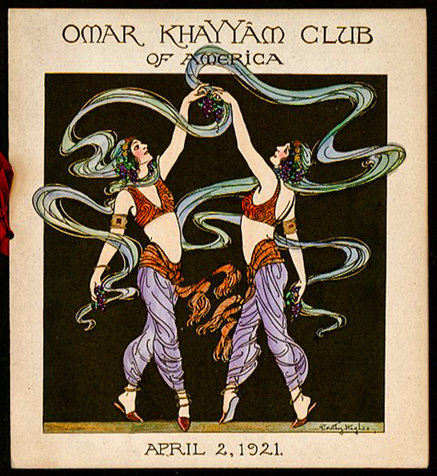
The Rubaiyat Quatrain Poetic Form
The verses beat the same, in measured chime.
Lines one-two set the stage; one-two-four rhyme.
Verse three’s the pivot around which thought turns;
Line four delivers the sting, just in time.
At 10 AM each day, a different Rubaiyat song softly plays throughout the Club a few times, and today’s is a Dylan-like rendition by Michel Montecrossa, called ‘Calm Beauty’, consisting of several Rubaiyat quatrains. Note that a few obscure words have been changed/bettered for singing/understanding.
https://www.youtube.com/watch?v=5DITr464OOQ
The playing of a song is the signal to Martin at the bar to supply from his Mixology book a special free drink of the day to all comers, served in a gold and silver chalice.
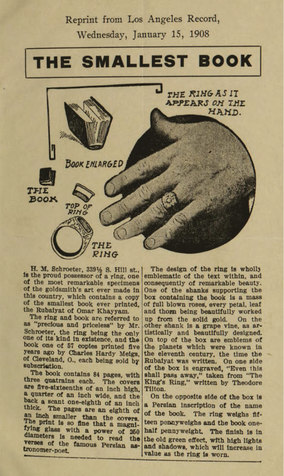
My good friend, Ohow Dryiam, an Omarian scholar from Flunck University, East Carolina, arrives, and comes over, holding out his hand, saying, “You’ll hardly believe what I have right here: the tiniest book ever made, and it's a Rubaiyat, crafted in the very early 1900s!”
I don’t see anything but a ring on his finger. “Don’t tell me it’s so small that it’s invisible, written by lining up atoms, such as IBM did with its logo, in 1989?”
“No, they couldn’t do that way back then. It took seven months to make. Look closer.”
-
Absolute rest is impossible - All is motionI think your intuitions are accurate in the larger sense - i.e. absolute zero - which would be the absence of all motion - has been proven to be theoretically unreachable fairly recently. — Pantagruel
Yes, as in a post I put an article saying it would take forever, which means never.
My list of impossibles: Stillness, Beginning, End, Infinite, Nothing, Free Will, He, and maybe Forever. -
An argument for atheism/agnosticism/gnosticism that is impossible to disputeSo therefore how would you know they existed in the absence of religion? — Maureen
One might likely suppose that the Earth got made by a larger version of us, since we make smaller things. -
The basics of free willThe first of a series, although rather basic…
The Other Shoe Drops
Determinism doesn’t sit well, at first;
Its flavor does not quench the thirst,
For then it seems we but do as we must,
But, we’ll see a way that in this we’ll trust.
We wish that our thoughts reflect us today,
Our leanings, for it could be no other way.
To know, let us turn to the ‘random’ say
To see whatever could make its day.
Shifting to this other, neglected foot,
What could make the ‘random’ take root?
It would have no cause beneath to explain
The events, they becoming of the insane.
We could pretend, imitating air-heads,
Posting nonsense on purpose in the threads,
But that then we meant to do this way,
Too, so, such a ‘random’ holds not much sway.
Seems less problem of a determined Nature
Than the same in our individual nature,
But, sense isn’t made from ‘random’ direction
That relies on naught beneath its conception.
Would we wish it to be any other way?
Doing any old thing of chance that may?
The ‘random’ foot then walks but here and there,
Not getting anywhere, born from nowhere.
The unrooted tree lives magically, unfathomed.
Is not then ‘randomness’ but a fun phantom?
The opposite of determined is undetermined,
The scarier ghost that’s never-minded. -
An argument for atheism/agnosticism/gnosticism that is impossible to disputeHow else would any human have been aware of its presence? — Maureen
As you say, God cannot be witnessed, so, no one is aware even now, in any way that can be proved; so, then, even religions say that in lieu of fact, there is but 'faith' that the unknown unshowable intangible is God.
Remember that the most often asked question is something like "Where did everything come from?". -
Agnosticismae — thewonder
Maybe 'AE' for God, but 'ae' elsewhere is some kind of a diphthong thing or something.
We can't really show invisible realms being so or not so. This does, though, show that no one can ever be blamed for not accepting the invisible realm. -
An argument for atheism/agnosticism/gnosticism that is impossible to disputeThis would indicate that they in fact only exist as a result of their religions. — Maureen
The particular God definition, as a Christian-type God, didn't exist before it was defined, but that type of God might well exist before anyone defines Him. -
Multiculturalism and Religious FundamentalismHow should you approach traditionalism in general? — thewonder
Live and let live, and even more so, if that's possible, because they have to do it, which fixed will understanding all the more lessons any possible aggravations. Even seek out other nationalities for their uniqueness. -
Is a "non-denominational" Christian church just trying not to offend any denomination or trying toSounds like your not a Christian. lol Please don't reply with the typical response "and proud of it". Try to make your response not sound like it was copy pasted from some other Atheist on some other philosophy forum. Readers enjoy comedy and originality. — christian2017
No, I'm not a Christian, but kind of an honorary one, since I take someone to the Vineyard Church and go to their events. I don't attend the services. All posted poems are my own, and I would attribute when they aren't. Don't worry about your thinking otherwise. The denomination joke is common, though, and not mine, as a nod to churches needing money, too, to survive. -
Is a "non-denominational" Christian church just trying not to offend any denomination or trying toMany churches are changing, lest they keep on evaporating as the more strict believers die off. They are saying such as "It's not about religion, but community…", but change is slow and they still mostly have the silliness of the Biblical God who has poor character.
Eventually…
The stodgy elevation of doctrine over ethics
Will no longer carry the day, and there will be less
Emphasis on believing, with more on belonging.
All will become more democratic, with much singing.
The Bible will be seen to be of human construction,
A result of human instinct, frailty, fear, and no wisdom;
So people actively speaking to each other, with laughter,
Will come to replace passive readings from scripture.
(In my church, all denominations are accepted: twenties, fifties, and hundred dollar bills.) -
Omar Khayyamthis is definitely a cool post. Thanks. I plan on watching until my attention span wanes out. — christian2017
The OP videos are rather long, as setting the stage, but the great words, colorful art, animation, and music (even as quatrains sung) blend into a phantasmagorical experience—and there's philosophy, too. -
Alternatives to 'new atheism'to reinforce my atheistic beliefs — Purple Pond
Perhaps they have to lean more toward agnostic, but still unlikely toward God, but there is more to consider…
Another believer comes along, one without all the Biblical bluster of damnation from a bad Role Model type of God who had the worst character ever in literary fiction …
Hello, and good riddance to the God of religion.
Yes, what a horror made in the image of bad human nature.
Yeah, humans can be terrible, and life, it’s only in modern times that we humans have a bit of relief. Even as recent as a century ago, life was much tougher, not that it’s always a picnic.
This is God’s world, as you would have it.
Indeed, for how could I say otherwise, for the ‘fall from grace’ was but a myth based on disputes between farmers and shepherds long ago, as if there was such a great difference.
Hey, you are a good believer to talk with; no Hellfire and and that mush.
Yeah, I have a good boloney detector. It seems that our human race of life evolved from the basis of the nature of the universe, and so, in looking at ourselves we might get a big clue as to the very nature of the universe, that is, that our life could be from a Larger Life, called ‘God’.
I see that you allow that there was evolution. Also, it’s good to propose a resemblance. I’ve used that in noting our holistic versus detail alternating viewpoints.
Yes, presumably God and Existence are one and the same, eternal, as the All and/or the basis of the All, but since life arose eventually, what life is here now had to be inherent in existence all along, as a God life-full-ness principle.
Good thinking about what is here now had to be there in the beginning, or forever. It’s just that we surfers of light are but 5% of the types of matter out there. Dark energy and dark matter dominate. We appear to be an after effect.
God utilized these to create a workable area; He can only do what He can do, and so an instant creation wasn’t possible. He threw some stuff together, and then Cosmic and biological evolution had to be relied on. I’m not nutty enough to insist that God places souls in humans, plus, I don’t need any of that jazz. God is merely the highest being, and that’s that.
Well, I do have to admit that the universe has been found to be ‘unnatural’ by physicists, in that it seems fine-tuned for life to appear. Whenever and wherever we look back, we see ‘fortunate’ events; however, why did seven extinctions wiping out most all progress have to happen?
God, not being all powerful, had to resort to using this sledgehammer effect, which was the best He could do, to try to open the field for mammals to evolve, by wiping out 95% of all life, as in the last, Permian, extinction.
So, initially, God put some stuff together, namely parts of Himself, I suppose, that might lead to some kind of life that He could later steer, albeit in a clumsy way. He’s kind of a Deity, not a Theory, then.
Yes, he is kind of a great scientist who could predict somewhat, but couldn’t foresee everything down to the last detail; that’s impossible. He was creative and wanted to achieve something.
So far, I see that nature’s way and God’s way can’t be told apart, although I’m aware of the need to explain the fine-tuning some other way if there’s no God. I’m not yet convinced that an extra step of God is required, as a Person how He could be just sitting around, as First and Fundamental.
Yeah, First and Fundamental is a problem. As for fine-tuning, and playing the Devil’s advocate here, that’s something I can even help you look into, later, because I want to shore it up to be more sure of my God premise. What do you think, for now?
I still have to grant a ‘maybe’ God.
And I still have to grant a ‘maybe’ no God. -
Alternatives to 'new atheism'Islam IS by far the most evil religion in the world today, because of its extremists. They are without question the most extreme and dangerous. — DingoJones
It's not much advertised, but drones this very day and everyday are assassinating terrorists, thus preventing many big and bad plans. -
Alternatives to 'new atheism'I didnt read any of his books, Im not even a particular fan of his but it provokes my sensibilities when people, anyone even someone like Trump, are demonised. If someone is evil or otherwise shitty, then an honest and fair treatment will bare that out. — DingoJones
His 'The God Delusion' book would apply here. Although the Biblical, fundamentalist 'God' is an easy mark, he also includes evolution science and more. With such great writing, he needn't use anger in public to bolster his case, for it drives people away to be insulted, but, as we've found from the 'free will' threads, people have to do what they do, and, lacking learning to chill out, keep on doing it. -
Multiculturalism and Religious Fundamentalismnot really my place to say how it is that a Muslim woman should dress. — thewonder
Yes, and it is also that the whole of a woman's body needs to be covered, for modesty, I suppose, which is mostly so but varies by the local Islamic law. Men need to cover up from their belly buttons down to their knees. Their religion is such to say that Allah has an interest in clothing the body.
The differences between cultures goes a long way to causing trouble, for human nature is not all that great about dealing with differences. Somehow, people think the credibility of their own culture gets diminished via the mere existence of the others (especially with differing religious beliefs). -
Alternatives to 'new atheism'I think I've lost something. More specifically, I've lost some of my ability to defend myself from attacks on my atheistic beliefs. — Purple Pond
OK, PurplePond, so far, we've given the believers their 'maybe', but will call them out as being dishonest for preaching the 'maybe' as if it were truth, which is a fair and decent step, and one that can be applied to any discipline touting 'perhaps' as fact.
Next, the Biblical version of 'God' was demolished, which takes a lot away, but there can still be people saying different to you than of the holy-holy religious aspect, those who have a plain old regular person God responsible for everything. For them, we'll have to access the probability of a fully intact Person being able to be First and Fundamental, but there will be no real win either way. -
Alternatives to 'new atheism'Dawkins — DingoJones
He's rather a grouch, but his books are great. Evidently, he doesn't realize that people have to do what they do. Yes, there can be learning, but there's still a 'maybe' to the 'God' idea, which he allows as a slim chance. Since rewards are said to await in Heaven, it's understandable that people would want it. He is one extreme and severe 'invisibility disorder' is the other. -
Omar Khayyamruby yacht — Ciceronianus the White
She, Ruby Yacht, will be a character herein, at the club. It's interesting that she was named after a yacht instead of the usual naming of the boat after her. She might look in the water and see the trustful SpongeBob bobbing. -
What is science founded on?Saying either that laws can change or that new laws from, say, another dimension will start kicking in are not different with regard to a methodology of science. — Gregory
Science results are provisional, not written in stone. -
Is god a coward? Why does god fear to show himself?Blameless, Shameless, and Fameless
Human nature’s ranges of inclinations
Will, to no surprise, express themselves
Far and wide, as such they ought, regardless
Of that constitution being intended.
Especially if the human recipe
Was thought out, planned, designed notably,
And so implemented accordingly,
Then the results will be just as they should be.
If mistakes crept into the formulas,
Then we’re still as made, outcomes expected,
So, one’s own creation’s still respected—
No shame for all, obviating the blame.
PoeticUniverse

Start FollowingSend a Message
- Other sites we like
- Social media
- Terms of Service
- Sign In
- Created with PlushForums
- © 2026 The Philosophy Forum