
-
 Paine
3.2k
Paine
3.2k
I was referring to an argument made in a particular book. Phillips would be the last to dismiss slavery as not being critical to the moment he reports upon. He does not argue that the generational elements he is interested in are the last word on what happened.
I started my comments on this thread pointing out how religious thinking can sharply oppose what others adopt. I will leave it there. -
 AmadeusD
4.2kThe landlord had a paternalistic relationship with the people living on the land, which traces back to Rome and the importance of the Father, and is related to our Father in heaven. — Athena
AmadeusD
4.2kThe landlord had a paternalistic relationship with the people living on the land, which traces back to Rome and the importance of the Father, and is related to our Father in heaven. — Athena
I think this is probably an unfinished analysis. The desire for paternal connection (and protection, let's not forget) appears inherent in any culture, because it must remain stable. This then get abused in situations of coercive control (even some modern work arrangements fit this bill). But I don't think it's fair to lay the human desire shown in that type of arrangement contextually derives from the concept of God. Perhaps, the other way around makes more sense as at some point, there are no men who can protect you from certain beasts or hostile out-tribes.
But it certainly seems like at times, this was a motivating factor in thinking it was some benevolent activity for sure! -
 BC
14.2k@Athena A bit more on Yankees.
BC
14.2k@Athena A bit more on Yankees.
AI Overview
Yankee cultural influence, originating from New England and spreading through the Great Lakes region, profoundly shaped American society by establishing core values of education, entrepreneurship, Protestant work ethic, and civic activism. This "Yankeedom" culture emphasized public order, moral reform, and infrastructure development, largely influencing the Midwest, Northern, and "Left Coast" regions.
Key impacts on American culture include:
* Values and Ethics: A strong emphasis on personal responsibility, hard work, frugality, and a "utopian streak" that promotes societal improvement.
* Education and Infrastructure: A commitment to universal education and public infrastructure, dating back to early town-meeting systems.
* Political Culture: A high degree of public participation, support for government regulation, and a belief in a "public interest" that transcends individual ambition.
* Reform and Mobility: A history of applying moral logic to social issues (e.g., abolitionism) and a focus on social mobility, though sometimes criticized for inflexibility or Puritanical intolerance.
* Regional Expansion: The, Northern Michigan University documents how Yankee settlers moved westward, bringing with them specific, Northern Michigan University cultural, Northern Michigan University traits,.
Search for 'influence of yankee culture on ...", like Wisconsin, Minnesota, or Michigan; search for "yankee empire".
JSTOR has some articles on the topic, like Yankees and Teutons in Milwaukee, 1850 - 1890. -
 Athena
3.8k[I was referring to an argument made in a particular book. Phillips would be the last to dismiss slavery as not being critical to the moment he reports upon. He does not argue that the generational elements he is interested in are the last word on what happened.
Athena
3.8k[I was referring to an argument made in a particular book. Phillips would be the last to dismiss slavery as not being critical to the moment he reports upon. He does not argue that the generational elements he is interested in are the last word on what happened.
I started my comments on this thread pointing out how religious thinking can sharply oppose what others adopt. I will leave it there. — Paine
I was thinking that the problem with serfdom and slavery is the same problem, and to me, it seems cheating to use different words for basically the same thing. Socrates said that when people are exploited, sooner or later, they become a problem to those who exploit them.
Also, I think when we add God to the equation, the thought is 100 times more important. That is what made the American Civil War so dreadful. Both sides thought they were fighting for God. Both sides used the Bible to defend their position. You cannot get a stronger opposition than that. -
Athena
3.8kJSTOR has some articles on the topic, like Yankees and Teutons in Milwaukee, 1850 - 1890. — BC
I really like JSTOR as a source of information. Those values seem influenced by the Enlightenment, ancient Greek, and Roman values. I believe that in the beginning of Rome, those who were Roman were very civic-minded. But as the population grew, I think, as happened in the US, people became self-centered and less community-oriented. Around 1830, Tocqueville wrote in Democracy in America that the people came together to resolve problems rather than relying on the king and his men. Starting a new establishment and living in one are two very different things. -
BC
14.2kthose who were Roman were very civic-minded. But as the population grew, I think, as happened in the US, people became self-centered and less community-oriented — Athena
Rome was in business a long time; when do you think this change took place, and why? Same for the US. Europeans have been here for 500 years, give or take 15 minutes. When did we start getting self-centered, and why?
While I will readily grant that the zeitgeist changes over time, members of our species approach each shift with the same basic features. We always manage to be short sighted, self-centered, helpful, generous, vindictive, aggressive, loving, well-organized and chaotic, smart and stupid -- all that and more all at once. The zeitgeist is both a product of our efforts and an influence on us--it's circular. -
Paine
3.2k
Comparisons between feudal serfdom and other forms of slavery are interesting but require a search for historical contexts that is not evenly reported by the people involved. This is a broad topic that involves the different way humans developed social organization in our "prehistory."
Something that makes the American experience worth considering upon its own terms is the degree to which a slave was seen as not being fully human. That degradation may be justified or not by different people. The evaluation is more important than the logic formed to support arguments, theological or otherwise. -
Athena
3.8kRome was in business a long time; when do you think this change took place, and why? Same for the US. Europeans have been here for 500 years, give or take 15 minutes. When did we start getting self-centered, and why?
While I will readily grant that the zeitgeist changes over time, members of our species approach each shift with the same basic features. We always manage to be short sighted, self-centered, helpful, generous, vindictive, aggressive, loving, well-organized and chaotic, smart and stupid -- all that and more all at once. The zeitgeist is both a product of our efforts and an influence on us--it's circular. — BC
Self-centredness is biological. We are doing good to know the names of 500 people and a fact or two about them. We do not have intimate feelings with these people, and a larger population is overwhelming. This increases the force of prejudice and the experience of being a stranger in a crowd. This reality makes culture essential to social control. Without strong cultural controls, the population becomes increasingly dependent on authority for social control.
I think the Northern European countries have a stronger sense of taking care of neighbors, as their culture calls for this, and so their identity is built on helping everyone get ahead. The business model can benefit everyone, but modern business models have become highly competitive and destructive. -
Athena
3.8kSomething that makes the American experience worth considering upon its own terms is the degree to which a slave was seen as not being fully human. That degradation may be justified or not by different people. The evaluation is more important than the logic formed to support arguments, theological or otherwise. — Paine
Oh, your comment makes me feel a little crazy. :naughty: Recentally the US president lost popularity because of putting pictures of Obama's head and his wife's head on a picture of ape bodies. In case you have not heard, the shit has hit the fan, and I think the extremely tense situation Trump is in will bring out the worst in him. I hope he does not try to distract attention from his financial/legal troubles by bombing Iran. Back to slavery, there was a time when slavery was considered a human advancement over killing everyone.
The notion that some human beings are closer to animals and do not fully qualify as humans is strange. But the Bible does say some people are cursed, and that excused slavery. Also, the Bible gives us different rules for how we treat slaves, and it says that only Jews can not be slaves because of their special relationship with God. A Jew could sell his daughter into slavery, but not his son. However, if money is owed, they could have to work as slaves for 7 years, and then the debt is forgiven.
This slave issue is very complex! Spinning off the Biblical 7 years of working as a slave comes the US indentured slavery of 7 years. Here is one line from an AI explanation. "It differed from chattel slavery, which was hereditary, lifelong, and deemed individuals as property". And information about ancient Greeks and slavery is much more complex, beginning with not having a word to define slavery, but several words depending on what the person had to do. And I don't think the Greeks had different rules for how slaves were treated and how everyone else was treated. Killing a Greek person's slave may have been killing a human with egual human rights, not like a Jew killing a slave.
Here is more about the Jews and slavery "the slave was considered property, though this law focused on Canaanite slaves rather than Hebrew servants who had more protections". So there you have it. The worst in slavery is from the Bible. -
Paine
3.2k
Slavery is complex.
Your quote from AI is profoundly misleading. To understand the condition of slaves from Africa, I suggest reading The Chattel Principle by Walter Johnson.
When considering the U.S. representation structure at its beginning, consider the 3/5 ratio to establish population in slave states. Those people were easy to count because they were black.
Consider the Fugitive Slave Laws of 1850. That permitted slave catchers to work in non-slave states to return property to southern owners. What made the slave catchers job easier than it might have been is because the slaves were black.
I disagree with other parts of your statements but don't want to detract from the importance of what I have argued so far. -
Athena
3.8kWell, I didn't think there was anything more important than the word of God. I also think there is a distortion in thinking that only dark-skinned people were slaves. The Bible is clear that God accepts slavery and changes His position on this. In the Old Testament, Jews are not to be slaves because of their special relationship with God, and in the New Testament, Christians are supposed to be good slaves because that honors God.
Sure, it would be easier to identify slaves with dark skin. We can also reflect on why Native Americans were not used as slaves. Slaves from Africa did not have tribes to help them escape slavery.
It is not just a matter of organizing people, but it is also a matter of the word of God that made slavery okay and opposed human rights for which the US stands. -
AmadeusD
4.2kJews are not to be slaves because of their special relationship with God, and in the New Testament, Christians are supposed to be good slaves because that honors God. — Athena
Those are two different situations.
Slaves from Africa did not have tribes to help them escape slavery. — Athena
Well, they did. They just weren't able to help because largely those slaves were taken by conquest. Similarly with Islam.
of the word of God that made slavery okay and opposed human rights for which the US stands. — Athena
The word of God was also the motivator for ending slavery (generally. Not in all cases). Interesting, huh? -
Paine
3.2k
My reply was a strict focus on the AI report you supplied.
Of course, there are and have been many other forms of slavery. You mentioned the Greeks before. The Spartans were cruel overlords over their neighbors in ways that was not the practice in Athens.
As for the Americas, see Enslavement by the Spaniards -
Athena
3.8kMy reply was a strict focus on the AI report you supplied.
Of course, there are and have been many other forms of slavery. You mentioned the Greeks before. The Spartans were cruel overlords over their neighbors in ways that was not the practice in Athens.
As for the Americas, see Enslavement by the Spaniards — Paine
This thread is about the separation of church and state because I think the Bible and religions are very problematic. Normally, we can use reason to resolve problems, but not when the problem is caused by religion. The link you used is a good example of how bad religion can be. It was with good reason that our forefathers gave us separation of church and state.
Abraham Lincoln had "In God we Trust" added to our money during the Civil War, and much later, Eisenhower added "God" to our Pledge of Allegiance. This is taking advantage of religion, and in the past, Christianity was used to get people to accept low wages. It is worse when Christianity is used to support a war effort, and Bush jr's war on Iraq, with Billy Graham doing a tv show to say God wants us to send our sons and daughters into this war, was the last straw for me.
I want an end to the entanglement of politics and religion. I want everyone to think violations of the separation of Church and State are as bad as picking our noses. :vomit: -
Athena
3.8kI love your explanation of yenkeedom.
Here is a picture of the western movement. Interestingly, the American Spirit is a female. This is so in the mural of the gods in the Capitol Building. In other pictures, she is a woman with a son (the icon of the goddess and her son) . She brandishes a sword in the Capitol Building mural. In other pictures, she is carrying a book. I assume that is a Bible, but the Statue of Liberty also holds a book and a light for enlightenment. And as the Goddess of Justice, she holds a sword and scales. Some say those are the three aspects of Athena, goddess of liberty and justice, and the defender of those who defend liberty and justice.
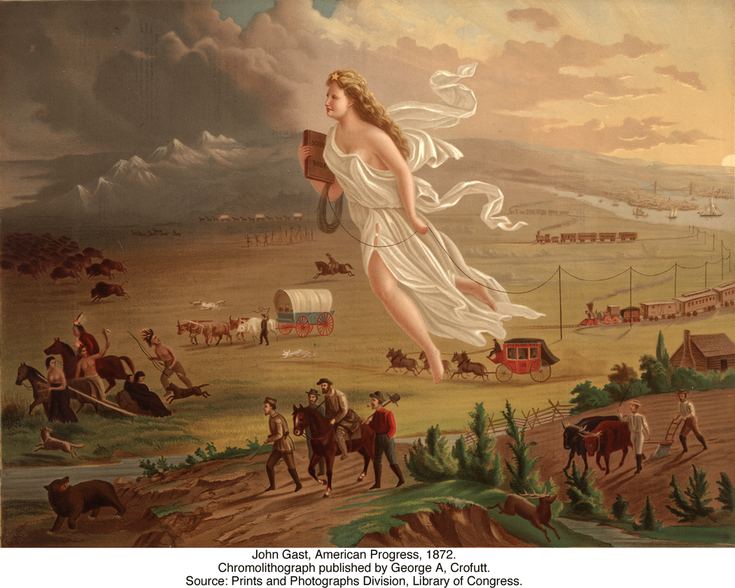
BC, your post had to wait because it is so meaningful to me and so complex. I am wondering how far we can go because I think Calvinism is a very important part of this religious direction, which is a totally different relationship with others and with money than some branches of Protestantism.
Wikipedia explains.
Puritans adopted a covenant theology, and in that sense they were Calvinists (as were many of their earlier opponents). In church polity, Puritans were divided between supporters of episcopal, presbyterian, and congregational types. Some believed a uniform reform of the established church was called for to create a godly nation, while others advocated separation from, or the end of, any established state church entirely in favour of autonomous gathered churches, called-out from the world. These Separatist and Independents became more prominent in the 1640s, when the supporters of a presbyterian polity in the Westminster Assembly were unable to forge a new English national church.


Welcome to The Philosophy Forum!
Get involved in philosophical discussions about knowledge, truth, language, consciousness, science, politics, religion, logic and mathematics, art, history, and lots more. No ads, no clutter, and very little agreement — just fascinating conversations.
Categories
- Guest category
- Phil. Writing Challenge - June 2025
- The Lounge
- General Philosophy
- Metaphysics & Epistemology
- Philosophy of Mind
- Ethics
- Political Philosophy
- Philosophy of Art
- Logic & Philosophy of Mathematics
- Philosophy of Religion
- Philosophy of Science
- Philosophy of Language
- Interesting Stuff
- Politics and Current Affairs
- Humanities and Social Sciences
- Science and Technology
- Non-English Discussion
- German Discussion
- Spanish Discussion
- Learning Centre
- Resources
- Books and Papers
- Reading groups
- Questions
- Guest Speakers
- David Pearce
- Massimo Pigliucci
- Debates
- Debate Proposals
- Debate Discussion
- Feedback
- Article submissions
- About TPF
- Help
More Discussions
- Other sites we like
- Social media
- Terms of Service
- Sign In
- Created with PlushForums
- © 2026 The Philosophy Forum