
-
 Truth Seeker
1.1k
Truth Seeker
1.1k
1. God, courage, and the design vs response distinction
You say:
“It would be reasonable for a benevolent God to value courage, fortitude, and adventure. Since pain and danger are necessary if these virtues are to exist God might have created a world in which there are pain and danger.”
This sounds plausible — but it relies on a quiet equivocation that keeps doing the work.
There are two very different claims:
1. Courage requires the possibility of danger and loss.
2. Courage requires the existence of large-scale, involuntary, preventable suffering.
(1) is true.
(2) does not follow.
A world can contain:
risk,
uncertainty,
vulnerability,
moral difficulty,
genuine stakes,
without containing:
childhood cancer,
torture in the name of religion or ideology,
mass predation engineered into biology,
the genocide of one tribe by another,
natural disasters killing millions,
the mass extinction of 99.9% of all the species that have existed on Earth,
extreme suffering and slaughter imposed on those who didn't consent, e.g. factory farm animals.
Courage is a response virtue, not a design justification.
A benevolent designer could value courage without embedding vast quantities of non-consensual suffering into the fabric of reality. Saying “God might have done it this way” is not an explanation — it’s a permission slip.
And crucially:
You don’t need this move at all, because you’ve already said you’re not religious.
2. The “benevolent God” hypothesis adds nothing explanatory
Notice what invoking God does not do here:
It doesn’t tell us how much suffering is necessary.
It doesn’t tell us which beings must suffer.
It doesn’t explain why suffering is distributed so arbitrarily and unevenly.
It doesn’t explain why courage in one being requires agony in another.
“All this suffering exists because courage is valuable” is not an explanation — it is post hoc aestheticization.
If someone said:
“Perhaps a benevolent God values music, so He created tinnitus,”
we would immediately see the non sequitur.
Same structure. Same flaw.
3. Science, measurement, and the Whitman mistake
You write:
“Surely a ‘scientific worldview’ sees the world in measurable terms.”
No.
It sees some aspects of the world in measurable terms — when measurement is the right tool.
This is the core misunderstanding that keeps resurfacing.
A scientific worldview says:
The moisture content of air is measurable.
The mystical feeling Whitman describes is real as experience. The neural activity underlying our experiences can be observed in real time using fMRI and PET scanners. However, we don't have the capacity to experience what it is like to be another sentient being e.g. you don't know what it is like to be me, and I don't know what it is like to be you, or a bat, or a whale, or a chicken, etc.
What it rejects is this leap:
“Because an experience is meaningful, it can overrule facts about the world.”
Whitman’s “mystical moist night-air” is not threatened by science unless one commits to scientism, which neither I nor any serious philosopher of science is defending.
Whitman is reacting to explanatory saturation, not to truth.
He leaves the lecture because wonder returned, not because the astronomer was wrong.
A scientific worldview allows both:
knowing what stars are,
feeling the wonder of looking at stars.
It only insists that we not confuse the two.
4. “Mystical” does not mean “non-natural”
This is another quiet slide.
“Mystical” in Whitman means:
emotionally resonant,
subjectively expansive,
phenomenologically rich.
It does not mean:
supernatural,
metaphysically spooky,
epistemically privileged.
A scientific worldview has no problem whatsoever with:
awe,
wonder,
altered states,
depth experiences.
It only denies that these experiences:
reveal hidden truths about cosmic purpose,
justify suffering,
or license metaphysical conclusions.
5. Where we actually differ
You are not arguing that suffering is good.
You are arguing that a world containing suffering might be justified by the virtues it makes possible.
I am arguing something narrower and firmer:
Even if suffering exists, and even if courage arises in response to it, suffering itself does not gain moral standing from that fact.
Courage is admirable.
Suffering is tragic.
The first does not sanctify the second.
And once that distinction is kept clear, the pressure to defend suffering — cosmically, theologically, or poetically — disappears.
Hope you have safe travels. -
 180 Proof
16.4k
180 Proof
16.4k
:100: :fire:Even if suffering exists, and even if courage arises in response to it, suffering itself does not gain moral standing from that fact.
Courage is admirable.
Suffering is tragic.
The first does not sanctify the second.
And once that distinction is kept clear, the pressure to defend suffering — cosmically, theologically, or poetically — disappears. — Truth Seeker
Every theodicy only rationalizes evil / suffering (e.g. "teleological suspension of the ethical"). -
 Ecurb
119I am arguing something narrower and firmer:
Ecurb
119I am arguing something narrower and firmer:
Even if suffering exists, and even if courage arises in response to it, suffering itself does not gain moral standing from that fact.
Courage is admirable.
Suffering is tragic.
The first does not sanctify the second. — Truth Seeker
I'll go along with this. Sometimes, though, there are "necessary evils". If we value courage or adventure, suffering is a necessary evil, although, of course, it's reasonable to argue the positive and negative values case by case.
I assume that's what Whitman is referring to. The stars are both a scientific fact, and a presence that engenders feelings of awe, in part because of their spiritual significance (i.e. cultural associations).Mystical: having a spiritual symbolic or allegorical significance that transcends human understanding. — dictionary -
Truth Seeker
1.1kThank you for your reply. Have you read "Unweaving the Rainbow: Science, Delusion and the Appetite for Wonder" by Richard Dawkins? If not, I recommend that you read it.
-
Truth Seeker
1.1kIf we value courage or adventure, suffering is a necessary evil — Ecurb
What about those who don't want to be courageous or adventurous? Should terror, pain and death be forced on them? I think it is totally unethical to force sentient beings into situations where they suffer and die when they didn't ask to be in those situations, e.g. dying slowly in a famine, being tortured to death, being gang raped and beaten to death, being imprisoned and slaughtered in a factory farm, etc. Life imposes catastrophic costs on sentient beings without their consent. I didn't ask to be born as a human being. I wish I had never existed. Sadly, I can't kill myself without causing suffering to others. So, I am trapped in my constant suffering in a world full of suffering, injustice, and death. Life is fundamentally unethical. -
Ecurb
119What about those who don't want to be courageous or adventurous? — Truth Seeker
If courage is a virtue people can freely choose to eschew it, just as they can freely choose to avoid being kind, compassionate, law-abiding, and forgiving. Terror, pain, and death are forced on all of us. That's the human condition. Your position, at least, is finally becoming clear, although "injustice" does not properly describe the universal condition you detest.
Our disagreement: you despise the human condition, I don't. You think each birth is a tragedy, and, of course, you are right. But that tragedy is redeemed by the possibility of virtue: of courage, of fortitude, of kindness, and of love. The birth of a child -- tragic though it may be because of the human condition -- is also the occasion of love, the greatest of virtues. The Christian parable is reborn: every child is born to grant eternal life to his or her parents (through descent), and to save them from their sins (through love). -
Truth Seeker
1.1k
Our disagreement: you despise the human condition, I don't. You think each birth is a tragedy, and, of course, you are right. But that tragedy is redeemed by the possibility of virtue… — Ecurb
This misrepresents my position, so let me correct it plainly.
I do not despise the human condition.
I despise suffering, injustice, and death — wherever they occur, in all sentient beings, human and non-human alike. That's why I am a vegan. Vegans cause much less suffering, injustice, and death to sentient beings than non-vegans.
That distinction matters.
What I reject is not humanity, but the forced imposition of terror, pain, and death on beings who did not consent to any of it. That is not a uniquely human issue. It is a condition shared by animals, children, and every sentient organism dragged into existence without choice.
Calling this “the human condition” does important rhetorical work — it normalises what is, in fact, a universal moral catastrophe.
Terror, pain, and death are forced on all of us. That's the human condition.
Exactly — they are forced.
And it is precisely because they are forced that I object to them.
To describe this as merely “the human condition” does not explain or justify it; it only renames the problem. Injustice does not cease to be injustice because it is universal. If anything, universality deepens the moral urgency.
If a system guarantees that every sentient being will suffer and die, then the correct response is not reconciliation but moral protest.
That tragedy is redeemed by the possibility of virtue: of courage, fortitude, kindness, and love.
This is where we fundamentally diverge.
Virtues that require suffering in order to exist are not redemptive — they are adaptive responses to harm. Courage presupposes danger. Fortitude presupposes adversity. Compassion presupposes suffering.
I value kindness and love deeply — but I reject the claim that they justify the conditions that make them necessary.
If a child must be exposed to terror, pain and death so that courage may later emerge, then courage has been purchased at an unacceptable price.
The birth of a child — tragic though it may be — is also the occasion of love.
Yes, love emerges — and it does so despite the conditions imposed on that child, not because of them.
Loving someone who will inevitably suffer and die is not evidence that the system is good. It is evidence that humans — like other sentient beings — are capable of profound attachment even under tragic constraints.
Love does not retroactively justify a world structured around unavoidable harm.
So no — I do not despise the human condition.
I despise the fact that sentient beings are forced into existence, forced to endure suffering, and forced to die — and then told that the virtues developed in response somehow redeem the coercion itself.
My moral intuition is simple and consistent:
• If suffering were preventable, it should be prevented.
• If injustice were removable, it should be removed.
• If death were avoidable, it should be avoided.
If I could go back in time and prevent all suffering, injustice, and death, and make all living beings forever happy, I would do so without hesitation — not because life lacks value, but because life without imposed harm would be infinitely better.
That is not contempt for the human condition.
It is compassion extended to every sentient being, without exception.
A factual clarification on “eternal life through descent”
You write that “every child is born to grant eternal life to his or her parents (through descent).”
Taken literally, this is not biologically correct.
Having children does not make parents immortal — neither personally nor genetically.
A child inherits only half of each parent’s chromosomes. In the next generation, that contribution is halved again, and so on. After a small number of generations, any given ancestor’s genetic contribution is vanishingly small, statistically diluted, and often entirely absent due to recombination and lineage extinction.
So even on purely naturalistic terms, descent does not confer anything resembling eternal life. At most, it offers a partial, temporary, probabilistic genetic continuation, not persistence of the person, their consciousness, their experiences, or their identity.
If “eternal life” here is meant symbolically rather than biologically, then it should be acknowledged as metaphor — not presented as a literal redemption of mortality. Metaphor may offer meaning, but it does not undo death, nor does it negate the fact that each individual still suffers and dies as an individual.
In short:
• Parents die.
• Their children die.
• Genetic dilution continues.
• Nothing eternal is achieved through descent.
Whatever value love, memory, or legacy may have, they are not immortality, and they do not cancel the reality of mortality or the suffering and injustice that precede death.
You could argue that even though individual organisms die, species survive, but at least 99.9% of all the species that have existed on Earth are already extinct, and the remaining 0.1% are also at risk of extinction and will probably go extinct sooner or later.
A brief response to the Christian redemption framing
You invoke a Christian parable in which birth, suffering, and mortality are redeemed by love, descent, and salvation. I understand the existential comfort this narrative provides, and I don’t deny its emotional power. But comfort and moral justification are not the same thing.
From my perspective, redemption that occurs after imposed suffering does not morally redeem the imposition itself. A system does not become just because it later offers meaning, forgiveness, or eternal compensation to those it first exposes to terror, pain, and death without consent.
If a child must suffer in order for others to learn love, or must die in order for salvation to acquire meaning, then the moral problem has merely been reframed, not resolved.
Christianity interprets love as salvific — and I respect that internal coherence. But I reject the idea that love requires suffering as its precondition, or that suffering is morally licensed because it can later be redeemed. Love that emerges despite suffering is admirable; suffering that is justified because it produces love is not.
In short:
Redemption may console those already harmed.
It does not justify the harm itself.
My objection is not to love, meaning, or virtue — it is to a worldview that treats unavoidable suffering and death as acceptable entry fees for them.
You should remember that the Bible also provides eternal torture in hell for those predestined by the Biblical God to go there. -
Ecurb
119I do not despise the human condition.
I despise suffering, injustice, and death — Truth Seeker
Suffering and death are part of the human condition. You are contradicting yourself.
So no — I do not despise the human condition.
I despise the fact that sentient beings are forced into existence, forced to endure suffering, and forced to die — and then told that the virtues developed in response somehow redeem the coercion itself. — Truth Seeker
If you regret being born, why do you object to dying? That makes no sense. Once you are dead, all that suffering to which you object will end.
• If suffering were preventable, it should be prevented.
• If injustice were removable, it should be removed.
• If death were avoidable, it should be avoided. — Truth Seeker
However, suffering is not preventable, nor is death avoidable. This is not "unjust" by any reasonable definition of justice.
You write that “every child is born to grant eternal life to his or her parents (through descent).”
Taken literally, this is not biologically correct. — Truth Seeker
Good grief, Joe literal! The sun will burn out and every living thing will perish. Eventually. Eternity is metaphorical and relative.
You continue to tout your negative ethos. Life is horrible! Suffering is terrible! The human condition is pathetic! I disagree. For all we know, this may be (per Candide) "the best of all possible worlds." Indeed, it may be the only possible world. Why not make the best of it? -
Truth Seeker
1.1k
Suffering and death are part of the human condition. You are contradicting yourself. — Ecurb
No contradiction is present.
Suffering and death are parts of the human condition — they are not the whole of it.
Likewise, they are parts of the sentient condition more broadly.
What I reject is the slide from:
“Suffering and death are part of the condition.”
to
“Therefore, rejecting suffering and death means rejecting the entire condition.”
That inference does not follow.
Love, joy, curiosity, creativity, attachment, play, empathy, learning, and care are also part of the human and sentient condition. My objection is selective and principled: I oppose the harmful components, not the existence of sentient life itself.
Opposing disease does not mean despising biology.
Opposing injustice does not mean despising society.
Opposing suffering and death does not mean despising sentient existence.
If you regret being born, why do you object to dying? That makes no sense.
It makes sense once coercion and harm are kept in view. According to the Bible, death is not the end - it is the beginning of eternal torture in hell for those predestined by the Biblical God to be non-Christian.
I do not “regret being born” in the sense of wishing harm upon myself or others. I object to the non-consensual imposition of suffering, injustice and death on all sentient beings — including myself.
Death ends suffering by destroying the sufferer. That is not a solution; it is a termination. Wanting suffering to end is not the same as wanting the subject of experience to be annihilated. If the subject is terminated, the subject can't be happy.
To be clear:
• I want suffering to end without ending the ones who suffer.
• I want life without coercive suffering, injustice and death.
Those are morally coherent positions.
However, suffering is not preventable, nor is death avoidable.
This confuses current limits with moral ideals.
That something is not yet fully preventable does not mean it is not partially preventable, nor does it absolve us of responsibility to reduce it wherever possible.
By this reasoning, medicine, public health, law, and disaster prevention would all be meaningless.
As a vegan Compassionist, I act on this principle consistently:
I avoid causing unnecessary suffering to sentient beings, and I work to save and improve lives — human and non-human alike. Unlike non-vegans, I do not treat avoidable harm as morally acceptable merely because it is common.
I have saved and improved many sentient lives. That fact alone refutes the claim that my position is purely “negative.” The word "vegan" was coined in 1944. 82 years later, only an estimated 1% of the 8.27 billion humans currently alive are vegan. This is deeply depressing. Veganism is better for human health, for the environment and for the animals, but despite this fact, most humans have not yet gone vegan.
This is not "unjust" by any reasonable definition of justice.
Justice concerns how harms and benefits are distributed and imposed.
When harm is avoidable by going vegan yet imposed anyway, justice becomes relevant.
Much suffering inflicted on sentient beings is not inevitable. It is a product of choices, systems, and traditions. Calling that “just the way things are” does not make it morally neutral.
Good grief… Eternity is metaphorical and relative.
If “eternal life through descent” is metaphorical, then it should be acknowledged as such. In my previous post, I addressed both literal and metaphorical interpretations of your words.
Metaphors can console. They do not alter biological reality, nor do they redeem mortality itself. Each individual still suffers and dies as an individual. Symbolic continuity does not undo that fact.
You continue to tout your negative ethos. Life is horrible!
This is a caricature.
My position is not “life is horrible.”
It is: life contains enormous, unnecessary, and avoidable suffering — and that suffering matters morally.
I affirm life strongly enough to want it without cruelty, without injustice, and without premature death.
I want all living things to be forever happy — not because I hate life, but because I value sentient experience so deeply that I refuse to romanticise its harms.
Why not make the best of it?
I do my best constantly to save and improve all sentient lives.
Making the best of the world does not require pretending it is already good enough. It requires reducing harm, expanding care, and refusing to baptise suffering as morally ennobling. -
180 Proof
16.4k
:up: :up:Making the best of the world does not require pretending it is already good enough. It requires reducing harm, expanding care, and refusing to baptise suffering as morally ennobling. — Truth Seeker -
Ecurb
119Suffering and death are part of the human condition. You are contradicting yourself.
— Ecurb
No contradiction is present.
Suffering and death are parts of the human condition — they are not the whole of it.
Likewise, they are parts of the sentient condition more broadly.
What I reject is the slide from:
“Suffering and death are part of the condition.”
to
“Therefore, rejecting suffering and death means rejecting the entire condition.” — Truth Seeker
Well, yes it does mean rejecting the entire condition, since suffering and death are universal portions of the human condition. Your point would be like saying, "I'm not rejecting the rules of basketball, but I think traveling, fouling, and double dribble should be allowed." Those are essential rules -- suffering and death are universal conditions.
I oppose the harmful components, not the existence of sentient life itself. — Truth Seeker
Almost everyone "opposes" suffering and death. So what? They remain part of the human condition. Opposing them is meaningless and irrational. Accepting them is rational.
I have saved and improved many sentient lives. — Truth Seeker
Once again, this is negative. You have "saved sentient lives" by becoming a vegan? I've "saved sentient lives" by refraining from murdering people. So what? In addition, you haven't saved any lives. Ranchers raise animals for sale. If more people became vegans, fewer animals would be raised, and there would be fewer "sentient lives". That constitutes "saving"? It's reminiscent of your earlier claim that you wish you had never been born.
I affirm life strongly enough to want it without cruelty, without injustice, and without premature death. — Truth Seeker
Well, we can agree about cruelty and injustice, but aren't all deaths "premature"? Death is a fact of life. Nobody lives forever.
Making the best of the world does not require pretending it is already good enough. It requires reducing harm, expanding care, and refusing to baptise suffering as morally ennobling. — Truth Seeker
What if suffering begets moral ennobling? Isn't fortitude one of the seven "virtues"?
Nobody thinks the world cannot be improved. But death and suffering cannot be eliminated. It's not possible. -
Truth Seeker
1.1k
Well, yes it does mean rejecting the entire condition, since suffering and death are universal portions of the human condition. — Ecurb
No — universality does not equal essentiality in the sense you are using it.
Your basketball analogy fails because rules are constitutive by definition: if you remove them, the game ceases to be basketball. Suffering and death are not rules of life; they are contingent outcomes of biological and physical constraints. They are facts about how life currently unfolds, not definitional requirements of what life is.
To reject cancer is not to reject biology.
To reject slavery is not to reject society.
To reject suffering and death is not to reject the sentient condition.
You are reclassifying limitations as normative necessities. That is a philosophical mistake.
Almost everyone "opposes" suffering and death. So what? Opposing them is meaningless and irrational. Accepting them is rational.
This conflates recognition with endorsement.
Yes, most people say they oppose suffering — yet many actively cause massive, avoidable suffering while defending it as “normal,” “natural,” or “necessary.” Acceptance becomes rationalisation the moment it excuses preventable harm.
I do not merely dislike suffering in the abstract. I structure my life around minimising the suffering I cause, including to non-human sentient beings. That practical commitment is exactly what distinguishes opposition from lip service.
Acceptance of inevitability is rational.
Acceptance of avoidable harm is not.
You have "saved sentient lives" by becoming a vegan? I've "saved sentient lives" by refraining from murdering people.
This is a false equivalence.
You are comparing refraining from an act you were never socially permitted to commit (murdering humans) with refraining from acts that society actively normalises, rewards, and industrialises (breeding, exploiting, and killing animals).
Veganism is not moral inaction. It is refusal to participate in a system explicitly designed to cause suffering and death to sentient beings.
That distinction matters.
If more people became vegans, fewer animals would be raised, and there would be fewer "sentient lives". That constitutes "saving"?
Yes — because non-creation is not harm.
Preventing a sentient being from being bred into guaranteed confinement, mutilation, psychological distress, and premature death is not “killing a life before it begins.” It is preventing a harm from ever being imposed.
A being who is never created does not suffer deprivation.
A being who is created for exploitation does.
Conflating the two collapses the moral difference between preventing harm and ending an existing life — a difference that every coherent ethical system recognises.
It's reminiscent of your earlier claim that you wish you had never been born.
If I had never been born, I would never have suffered and died, I would never have made any mistakes and I would never have caused any harm to anyone. So, there are many positive aspects to never being born. However, if I had never been born, I wouldn't have been able to save and improve all the lives I have saved and improved.
To say “a world without imposed suffering would be better” is not to say “existing beings should not exist.” It is to say that existence under coercive harm is morally worse than existence without it.
I want sentient beings to exist without being forced to suffer and die — not to kill those who already exist.
But aren't all deaths "premature"? Death is a fact of life.
Again, fact is being confused with justification.
That all deaths occur does not mean all deaths are equally acceptable, nor that preventing early or violent death is incoherent. Medicine, safety engineering, law, and public health all rest on the distinction between avoidable and unavoidable death.
If “death is a fact of life” were a sufficient moral answer, we would abandon resuscitation, surgery, vaccines, and emergency care.
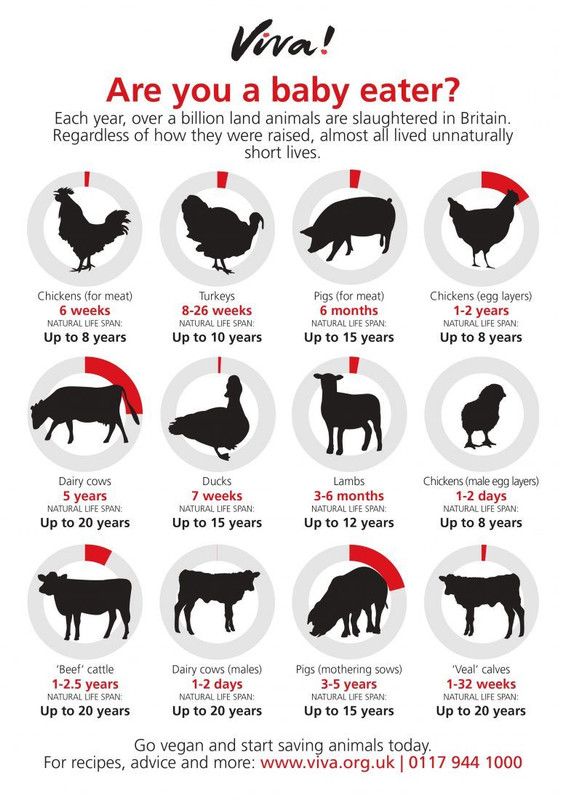
The image shows how non-vegans dramatically reduce the natural lifespan of the animals they kill. This is entirely avoidable by going vegan.
I have also saved human lives by donating blood regularly since I was 17. I save human lives also by donating money and volunteering regularly.
Humans used to live on average only 30 years in the pre-1800s. Now, they live on average 80 years in the developed countries. Science and technology have also increased the human standard of living and quality of life enormously.
Immortal jellyfish can already live forever if protected from illness, injury, starvation and predation. If we genetically engineer humans and other species to do the same, all species could live forever. I know we don't have the technology to do that yet, but scientists are working on improving our technology.
What if suffering begets moral ennobling? Isn't fortitude one of the virtues?
Fortitude is admirable in response to suffering.
That does not mean suffering is justified because it sometimes produces fortitude.
This is the same error repeated throughout: mistaking adaptive virtues for moral endorsements of the conditions that necessitate them.
We admire firefighters. We do not, therefore, endorse arson.
Virtues developed under constraint do not retroactively sanctify the constraint.
But death and suffering cannot be eliminated. It's not possible.
Impossibility is not an argument against moral orientation. As the image above shows, non-vegans dramatically shorten the natural lifespan of many sentient organisms.
80 billion sentient land animals and 1 to 3 trillion sentient aquatic organisms are murdered by non-vegans per year. This is entirely avoidable by going vegan.
We cannot eliminate all injustice — yet justice remains meaningful.
We cannot eliminate all disease — yet medicine remains rational.
We cannot eliminate all suffering — yet reducing it remains obligatory.
My position is not utopian incoherence. It is harm-minimisation grounded in moral seriousness, extended consistently to all sentient beings rather than selectively to humans.
You treat suffering and death as conceptually defining, and therefore morally untouchable.
I treat them as tragic constraints, to be resisted, reduced, and never glorified.
That difference does not make my view “negative.”
It makes it compassionate, consistent, and action-guiding.
And yes — I want all living beings to be forever happy.
The fact that this is unattainable does not make it irrational.
It makes it a moral north star. -
Ecurb
119To reject suffering and death is not to reject the sentient condition. — Truth Seeker
Let's see. All living things suffer and die. That is the "sentient condition" (those of us who prefer plain English to pretentious jargon might prefer "that's life") We can avoid suffering and death only by avoiding living -- i.e., as you said earlier, not being born. This is so obvious. You simply make yourself seem foolish by arguing about it.
So the question is: how should we live? Should we obsess about avoiding suffering, or should we try to maximize joy? The two are often in conflict: falling in love is joyful, but inevitably leads to heartbreak; climbing mountains is joyful, but can lead to suffering and death. Obviously, if we can cure diseases, great. It's a short-lived stay, though. WE are all going to die.
The Puritan ethic valorizes suffering. One attains joy (in the form of worldly success) through hard "work" and suffering. Here Henry Tilney discusses the virtues of suffering with his beloved Catherine Morland, from "Northanger Abbey":
(I pity historians for being at) so much trouble in filling great volumes, which, as I used to think, nobody would willingly ever look into, to be labouring only for the torment of little boys and girls, always struck me as a hard fate; and though I know it is all very right and necessary, I have often wondered at the person’s courage that could sit down on purpose to do it.”
“That little boys and girls should be tormented,” said Henry, “is what no one at all acquainted with human nature in a civilized state can deny; — Jane Austen
OK, Henry was cracking wise -- but, as is typical of Austen -- there is also some wisdom in his joke. Children may not want to be educated -- but it's good for them. In Eden there was no suffering -- "he who lives in the present lives forever." But to eat from the tree of knowledge is to suffer. Eve knew that -- but chose knowledge and pain over ignorance and pleasure. Are we really sure she made a bad choice? -
Truth Seeker
1.1k
All living things suffer and die. That is the "sentient condition"… We can avoid suffering and death only by avoiding living. — Ecurb
Non-sentient organisms (e.g. plants, bacteria, etc.) do not suffer, but they do die. Only sentient organisms (e.g. humans, octopuses, antelopes, cows, etc.) suffer and die.
From
“All living things suffer and die”
you infer
“Therefore rejecting suffering and death means rejecting life itself.”
That inference is false.
Reducing suffering is not the same as eliminating all suffering.
Postponing death is not the same as denying mortality.
By your logic:
Medicine is pointless.
Safety engineering is foolish.
Public health is delusional.
Yet science and technology have already:
1. More than doubled the average human lifespan.
2. Eliminated entire categories of suffering (smallpox, polio in many regions).
3. Drastically reduced infant and maternal death.
If your argument were sound, none of this would make sense. Biological immortality already exists in organisms like the immortal jellyfish. All we need to do is engineer all organisms to be immortal. Then we can spread out to other star systems, galaxies and even universes.
So the question is: should we obsess about avoiding suffering, or should we try to maximize joy?
This is a false dichotomy.
Avoiding suffering and increasing joy are not opposites — they are usually aligned.
People enjoy life more when:
they are not in chronic pain,
they are not starving,
they are not being tortured,
they are not prematurely dying.
You present harm reduction as “obsession” only because you treat suffering as morally trivial once it is common.
Falling in love is joyful, but inevitably leads to heartbreak.
Heartbreak is not the kind of suffering under discussion.
You keep sliding between:
existential disappointment (which is unavoidable), and
severe, imposed harm (which is often avoidable).
This equivocation is doing all the work.
The suffering I oppose includes:
factory farming,
starvation,
torture,
preventable disease,
premature death.
Not “sadness because a romantic relationship ended.”
Obviously, if we can cure diseases, great. It's a short-lived stay, though. We are all going to die.
This move is rhetorically neat — and morally empty.
“Yes, we cured disease, but everyone dies anyway” is exactly the argument someone could have made before antibiotics, vaccines, or sanitation.
And it would have been wrong then, just as it is wrong now.
Lengthening life, improving health, and reducing suffering are not negated by eventual death.
Otherwise, saving a child’s life would be meaningless because the child will die someday — a conclusion no sane ethic accepts.
On veganism (the point you keep evading)
You say:
“All living things suffer and die — that’s life.”
But here is the difference you refuse to acknowledge:
Vegans do not cause avoidable suffering and death to sentient beings for pleasure or convenience.
Non-vegans do.
That is not rhetoric. It is a material fact.
Factory-farmed animals are:
bred into confinement,
mutilated,
distressed,
slaughtered young.
This suffering is not inevitable. It exists because of non-vegan choices.
When demand drops, production drops.
When production drops, suffering and death drop.
That is saving and improving lives, whether or not you find it emotionally satisfying to acknowledge.
Your claim that “fewer animals would be born” somehow negates this is incoherent.
Non-creation is not harm. Creating beings for suffering is.
On science and technology (another evasion)
You concede:
“If we can cure diseases, great.”
But you refuse to draw the obvious conclusion:
Curing disease, extending life, and reducing suffering are precisely what rejecting suffering as ‘just life’ looks like in practice.
Science does not “accept the human condition.”
It systematically examines it and improves it.
Every medical advance is an act of moral rebellion against what once seemed inevitable.
Eve chose knowledge and pain over ignorance and pleasure. Are we sure she made a bad choice?
This is fiction, not an argument. There is no evidence for the existence of Adam and Eve, or for their eating from the Tree of Knowledge.
Knowledge does not require:
factory farming,
torture,
preventable disease,
mass premature death.
You keep romanticising suffering by tying it to symbolic narratives — Eden, virtue, knowledge — while ignoring the actual, concrete suffering being imposed on sentient beings right now.
Rejecting suffering is not rejecting knowledge.
It is rejecting the idea that harm is a morally acceptable price of existence.
You keep saying:
“That’s life.”
I keep showing:
life has already been radically improved by refusing to accept suffering and death as fixed,
veganism measurably reduces suffering and premature death of sentient organisms,
science and technology have saved and improved billions of lives.
Calling this “foolish” does not refute it.
It just reveals an attachment to resignation over responsibility and compassion.
I do not deny that suffering and death currently exist.
I deny that their existence justifies causing more of them — or treating efforts to reduce them as naïve.
Wanting all living beings to be forever happy is not foolish.
It is the same moral impulse that created medicine, which saves and improves lives. -
Ecurb
119
You continually ascribe "arguments" to me which I have not made. Occasionally, suffering begets joy. or courage. Not always. There's no "false dichotomy".
I have never denied that modern medicine has improved human well-being. Why do you keep harping on that? Modern plumbing, water purification, and refrigeration have probably done almost as much. None of your endless posts are to the point. I have two points: 1) The "scientific worldview" is limited. 2) It is possible that since some virtues are impossible without suffering, that an omniscient God would prefer suffering and the accompanying virtue to a lack of both.
Medical and technological advances are the result of "science" -- not the "scientific worldview". The value of science is irrelevant to this discussion. -
Truth Seeker
1.1k
You say I ascribe arguments to you that you have not made, so let me reset and respond only to the two claims you now explicitly endorse.
1. On the claim that the “scientific worldview” is limited.
Of course it is limited. I have never claimed otherwise.
Science does not answer questions of:
ultimate meaning,
moral value,
aesthetic worth.
But what science does do — and this is the point you keep trying to bracket off — is identify, explain, and reduce suffering and death in the real world. When claims are made about what is necessary, inevitable, or unavoidable in sentient life, science is directly relevant, because those are empirical claims about the world.
When someone says:
“Suffering and death are simply part of life — that’s just the sentient condition”
science answers:
“Large portions of what was once thought inevitable have already been reduced or eliminated.”
That is not worldview overreach. It is factual correction.
Calling this “harping” does not make it irrelevant.
2. On the claim that God might prefer suffering + virtue over the absence of both.
This is the real disagreement, and we should keep it here.
You suggest that:
Since some virtues are impossible without suffering, an omniscient God might rationally prefer a world with suffering and virtue to a world with neither.
That position has three problems.
(a) It assumes suffering is a necessary precondition for virtue.
That is not established.
Courage, compassion, kindness, and love may sometimes arise in response to suffering, but that does not show they are logically or metaphysically impossible without it. It only shows how we, given our constraints, tend to develop them.
An omniscient and omnipotent being is not constrained by our developmental limitations.
If a virtue requires suffering because the designer made it so, then the designer remains responsible for that requirement. What about those who just die through suffering, e.g. being tortured to death or slowly starving to death during a famine or a pig kept confined in a factory farm and slaughtered?
(b) It treats suffering as instrumentally justified.
If suffering is permitted because it produces virtue, then suffering becomes a means to an end.
That has moral consequences.
On that view:
the child who dies painfully of disease,
the animal tortured in confinement,
the person with dementia,
are not merely unfortunate — they are essential components of a value-producing system.
You may find that conclusion uncomfortable, but it follows directly from the position.
(c) It collapses omniscience and omnipotence into moral necessity.
An omniscient, omnipotent God would not face trade-offs of the form:
“Either virtue with suffering, or neither.”
That is a limitation, not a necessity.
If suffering is required for virtue, then either:
God lacks the power to create virtue without suffering, or
God values suffering itself, not merely virtue.
Either way, the appeal to omniscience and omnipotence does not rescue the claim. Besides, with omniscience and omnipotence comes omniculpability.
On “science” vs “scientific worldview”.
You say:
Medical and technological advances are the result of science — not the scientific worldview.
This is a distinction without practical force.
Science is not value-neutral in application. It is motivated by the conviction that:
suffering is bad,
death is worth postponing,
ignorance should be replaced by understanding.
Those commitments are precisely what I am defending.
You can call that a “worldview” or not — the label is irrelevant. What matters is that refusing to treat suffering as morally sacrosanct is what produces progress.
I am not arguing that:
suffering never leads to growth,
courage never arises from hardship,
the world can be made totally perfect by humans.
I am arguing that:
suffering is not justified by the virtues it sometimes occasions,
suffering is not necessary in principle for virtue,
reducing suffering is a moral good even if it can never be completely eliminated.
That position is consistent, compassionate, and fully compatible with acknowledging limits.


Welcome to The Philosophy Forum!
Get involved in philosophical discussions about knowledge, truth, language, consciousness, science, politics, religion, logic and mathematics, art, history, and lots more. No ads, no clutter, and very little agreement — just fascinating conversations.
Categories
- Guest category
- Phil. Writing Challenge - June 2025
- The Lounge
- General Philosophy
- Metaphysics & Epistemology
- Philosophy of Mind
- Ethics
- Political Philosophy
- Philosophy of Art
- Logic & Philosophy of Mathematics
- Philosophy of Religion
- Philosophy of Science
- Philosophy of Language
- Interesting Stuff
- Politics and Current Affairs
- Humanities and Social Sciences
- Science and Technology
- Non-English Discussion
- German Discussion
- Spanish Discussion
- Learning Centre
- Resources
- Books and Papers
- Reading groups
- Questions
- Guest Speakers
- David Pearce
- Massimo Pigliucci
- Debates
- Debate Proposals
- Debate Discussion
- Feedback
- Article submissions
- About TPF
- Help
More Discussions
- Would a ban on all public religious representations and displays ease religious hatreds and violence
- Religious and political disunity has condemned Earth. Should we thank our religious leaders?
- Seven of the first dozen posts are religious drivel. This has ceased to be a philosophy forum.
- Should Religious Posts be banned from the forum?
- Other sites we like
- Social media
- Terms of Service
- Sign In
- Created with PlushForums
- © 2026 The Philosophy Forum