
-
 frank
19kIf they're different, why do you call them both "Trump"? — Hanover
frank
19kIf they're different, why do you call them both "Trump"? — Hanover
Say you watched a Jimmy Cagney movie. You report that you saw Jimmy Cagney in the movie, though you also know what you saw was a representation.
Is this because there's no reasonable basis to maintain a distinction between Jimmy and his re-presentation? -
 Hanover
15.2kSay you watched a Jimmy Cagney movie. You report that you saw Jimmy Cagney in the movie, though you also know what you saw was a representation.
Hanover
15.2kSay you watched a Jimmy Cagney movie. You report that you saw Jimmy Cagney in the movie, though you also know what you saw was a representation.
Is this because there's no reasonable basis to maintain a distinction between Jimmy and his re-presentation? — frank
So you're acknowledging rampant equivocation, where we call objects and representations the exact word in all cases outside philosophical circles. The noumenal Cagney and the phenomenonal Cagney are always called "Cagney."
Under what scenario do you distinguish the noumenal from the phenomenonal, and can you tell me the specific difference between the two? If you use the term interchangeably, and you don't even know how the two are different from one another, what exactly are you protecting?
And to be clear, I'm not denying our brain does all the things you say. I'm just asking what we're doing by protecting this entirely indescribable distinction between the true thing and the true thing with mental baggage added on. -
frank
19kSo you're acknowledging rampant equivocation, where we call objects and representations the exact word in all cases outside philosophical circles. The noumenal Cagney and the phenomenonal Cagney are always called "Cagney."
Under what scenario do you distinguish the noumenal from the phenomenonal, and can you tell me the specific difference between the two? If you use the term interchangeably, and you don't even know how the two are different from one another, what exactly are you protecting? — Hanover
There are a couple of issues here, but what I'd like to first square away is the notion that philosophy results in delusional behavior. Jimmy Cagney is dead. You didn't actually see Jimmy Cagney in the movie. You saw a representation.
Can we first agree that there is a difference between Jimmy and his representation? -
Hanover
15.2kCan we first agree that there is a difference between Jimmy and his representation? — frank
Of course. But we"re equivocating here on what we mean by representation. In the context of the thread, representationalism draws a distinction between the veridical state (what actually is) and the delusive state (what is imposed by us on the object). Those terms appear in Austin.
Therefore, the representation (assuming indirect realism) would be of the object Cagney versus the phenomenal Cagney or it could be of the picture of Cagney versus the phenomenal state of the picture. As you've described it, you have the real Cagney versus a picture of Cagney. That is not the sort of representationalism we're interested in here. -
frank
19kTherefore, the representation (assuming indirect realism) would be of the object Cagney versus the phenomenal Cagney or it could be of the picture of Cagney versus the phenomenal state of the picture. As you've described it, you have the real Cagney versus a picture of Cagney. That is not the sort of representationalism we're interested in here. — Hanover
I don't understand what you're saying here. I'll leave you with a painting by Magritte (I had a poster of it on my wall as a teenager.) It's about indirect realism.

-
Hanover
15.2kI don't understand what you're saying here. — frank
What I'm saying is that indirect realism is the view that there is a ship at sea that is a real ship, but what you perceive in your head is a representation of it, altered by light, your retina, your CNS, etc. You therefore don't have a perception of the ship directly, but indirectly.
When you said a picture of Cagney is a representation of Cagney, that's true, but it's a different sort of representationalism than what we're talking about. That's just a picture.
Cool pic. -
frank
19kWhen you said a picture of Cagney is a representation of Cagney, that's true, but it's a different sort of representationalism than what we're talking about. That's just a picture. — Hanover
I know. There's also a homunculus problem with using Cagney as an example, but I wasn't trying to say that watching a movie is a comprehensive analogy for perception. My point was that highlighting the fact that we call Cagney's representation "Cagney" is not philosophically significant. It does not at all imply that we don't know the difference between the thing and its representation.
I don't see how we can move on to the real philosophical problems with indirect realism if we're stuck on an inflationary reading of common speech ("inflationary" in that it's drawing conclusions about the state of things by various turns of phrasing.) -
 RussellA
2.6k@Michael
RussellA
2.6k@Michael
I would appreciate it if sometime you could find any flaws in my main argument against Direct Realism (both Phenomenological Direct Realism (PDR) and Semantic Direct Realism (SDR)).
1 - Both the Indirect Realist (IR) and Direct Realist (DR) agree that there is something in the mind-external world that initiates a causal chain that eventually leads to a perception in our mind.
2 - The IR and DR agree that the links of this causal change chain may change in form, ie, from a wavelength of light to an electrical signal in the optic nerve
3 - The DR believes that a change in form of the link does not mean that the content of the link changes. IE, the DR believes that they still directly perceive what initiated the causal chain.
4 - The IR and DR agree that all our information about the mind-external world comes through our senses.
5 - My argument, as an IR, is that even if one knew one link in the causal chain, it is logically impossible to know either the form or content of a prior link. One can, however, infer to the best possible explanation.
For example, seeing a broken window, it is logically impossible to work backwards through a causal chain to know what initiated the causal chain and thereby know what broke the window.
Also, when a detective sees a crime scene, it is logically impossible for the detective to work backwards through a causal chain to know what initiated the causal chain and thereby know who committed the crime.
Also, when seeing snooker balls at rest on a snooker table, it is logically impossible to work backwards through a causal chain to know what initiated the causal chain and thereby know where the snooker balls were a moment earlier.
6 - Therefore, as it is logically impossible to know the form or content of a prior link in a causal chain, it is logically impossible to know what initiated the causal chain.
7 - But we do perceive things such as the Sun and a wavelength of light. As it is logically impossible to know what initiated the causal chain that gave us the information from the mind-external world, we cannot be directly perceiving what initiated the causal chain, whether the Sun or a wavelength. Therefore we can only be perceiving the phenomenal experience itself. From this phenomenal experience we can infer to the best explanation that in the mind-external world there is something we conceptualise as the Sun and wavelength of light.
8 - As an IR, I accept that it is not logically possible to know either the form or content of a prior link in the causal chain.
9 - The Direct Realist (both PDR and SDR) is basing their belief on a logical impossibility, that it is possible to know either the form or content of the prior link in a temporal causal chain. -
 Michael
16.8kI believe this is where we keep talking past each other. I reject the above. — Esse Quam Videri
Michael
16.8kI believe this is where we keep talking past each other. I reject the above. — Esse Quam Videri
Reject what specifically?
1. That colours and pain are mental phenomena
2. That colours and pain are directly present to the mind in phenomenal experience
3. The transitive law that therefore mental phenomena are directly present to the mind in phenomenal experience
4. That distal objects are not directly present to the mind in phenomenal experience
5. That the phrase "to directly perceive X" as used by traditional direct and indirect realists means "X is directly present to the mind in phenomenal experience"
Out of curiosity, for the indirect realist described above, what is the relationship between multi-modal sensory data (redness as-seen, loudness as-heard, etc.) and the judgement that expresses the claim “that’s a truck”? — Esse Quam Videri
Are you asking about the binding problem? We don't have a good explanation of that yet.
Also, what does it mean to say that multi-modal sense data are “directly present” to the mind? — Esse Quam Videri
That this sense data is a literal constituent of phenomenal experience. Taken from the problem of perception, "the character of your experience is explained by an actual instance of [a white circle] manifesting itself in experience". This is something that both direct (naive) and indirect realists believe, but with direct (naive) realists believing that this circle is a mind-independent object and its whiteness is a mind-independent property and indirect realists believing that this white circle is a mental phenomenon (e.g. of the kind that also occurs during hallucinations and dreams), (usually) caused by but wholly separate to the mind-independent object and its properties. -
Michael
16.8kAren't you asking what difference any of this makes? As in, if I think even to another extreme that we live in the matrix and we're all hooked up in pods and none of this is real, we're still going about this conversation just the same. That is, it'd be the same with direct realism, indirect realism, idealism, and evil genius land.
And that's the Austin approach. Why all the complicated explanations and not just say WYSIWYG? — Hanover
Because we're interested in how perception and the world actually works. As I said before, Austin and Wittgenstein aren't "deflating" philosophy, they just seem to be refusing to do philosophy — at least as you and Banno are presenting them. They're welcome not to, but that doesn't suffice as a refutation of those who do. -
 Esse Quam Videri
392The DR agrees that they perceive a Sun because of a causal chain, but as it is logically impossible to know what initiated any causal chain arriving at our senses, what the DR is perceiving cannot be something in the mind-external world.
Esse Quam Videri
392The DR agrees that they perceive a Sun because of a causal chain, but as it is logically impossible to know what initiated any causal chain arriving at our senses, what the DR is perceiving cannot be something in the mind-external world.
If the DR is not perceiving a “worldly object”, then they can only be perceiving something in their mind. — RussellA
This does not follow. You are trying to argue from epistemic limits to an ontological conclusion. Even granting the contestable claim that it is "logically impossible" to know what initiated the causal chain, all that follows is that we can't be certain of what we perceive. Fallibility doesn't imply indirectness.
But how can something persist in a mind-external world, if persists means exists at different times, and in Presentism only one moment in time exists — RussellA
Persistence on Presentism is cashed out in terms of tensed truths and causal continuity, not simultaneous existence at multiple times.
I thought that DR requires that perception is grounded in a mind-external object. This mind-external object may in fact initiate a causal chain, but it is not the causal chain that the perception of the DR is grounded in. — RussellA
The causal chain doesn't interpose something between subject and object; it's the means by which the object is perceptually available.
In what sense is judging that in the mind-external world there is a Sun different to inferring from my sensations that in the mind-external world is a Sun? — RussellA
Judgment is the movement from sensory data to existential affirmation by way of insight and understanding, whereas inference is a movement from premises to conclusion by way of logical rules. -
Esse Quam Videri
392Reject what specifically?
1. That colours and pain are mental phenomena
2. That colours and pain are directly present to the mind in phenomenal experience
3. The transitive law that therefore mental phenomena are directly present to the mind in phenomenal experience
4. That distal objects are not directly present to the mind in phenomenal experience
5. That the phrase "to directly perceive X" as used by traditional direct and indirect realists means "X is directly present to the mind in phenomenal experience" — Michael
I pretty much reject all of them as stated. I'll be brief:
(1) Rejected because it reifies experiential data into mental objects.
(2) Rejected because experience is not object-presentation.
(3) Rejected because the ontology and the inference both misdescribe consciousness.
(4) Rejected because experience is not object-presentation, whether distal or proximal.
(5) Rejected because it misdefines perception at the wrong level of analysis.
Are you asking about the binding problem? We don't have a good explanation of that yet. — Michael
No, I'm not asking about neural mechanisms, I am asking about the epistemic relationship between the two.
Taken from the problem of perception, "the character of your experience is explained by an actual instance of [a white circle] manifesting itself in experience". — Michael
On this view, what is the difference between a white-circle "manifesting" itself within experience and a boat "manifesting" itself in experience? -
RussellA
2.6kThis does not follow. You are trying to argue from epistemic limits to an ontological conclusion. Even granting the contestable claim that it is "logically impossible" to know what initiated the causal chain, all that follows is that we can't be certain of what we perceive. Fallibility doesn't imply indirectness. — Esse Quam Videri
A stick in water looks bent. The Semantic Direct Realist’s (SDR) position is that of indirect perception but direct cognition. The SDR is saying that in the mind-external world is a straight stick, and it appears bent. There are many instances of where perception is fallible.
The Indirect Realist (IR) is not saying that fallibility implies indirectness. The IR is saying that i) there is no stick in the mind-external world in the first place, ii) the fact there is no stick in the mind-external world is what implies indirectness, iii) the stick we perceive exists as a concept in the mind, not as a fact in the mind-external world.
===================
Persistence on Presentism is cashed out in terms of tensed truths and causal continuity, not simultaneous existence at multiple times. — Esse Quam Videri
The persistence of the Sun has a different meaning to the IR and DR.
For the IR, the Sun exists as a concept in the mind, and as a concept persists from the past to the present. This is reasonable.
For the DR, the Sun exists in the mind-external world. Accepting Presentism, an object cannot persist through different times when only one time exists. The tensed truth “The Sun exists now” is true now has no relation to “the Sun persists now”.
For the Sun to persist makes sense for the IR, but not for the DR.
=====================================================
The causal chain doesn't interpose something between subject and object; it's the means by which the object is perceptually available. — Esse Quam Videri
As I see it:
I would appreciate it if sometime you could find any flaws in my main argument against Direct Realism (both Phenomenological Direct Realism (PDR) and Semantic Direct Realism (SDR)). — RussellA
========================
Judgment is the movement from sensory data to existential affirmation by way of insight and understanding, whereas inference is a movement from premises to conclusion by way of logical rules. — Esse Quam Videri
Suppose that many times I perceive the combination yellow circle.
Our ideas about the nature of a mind-external world is not subjective judgement alone, such as “we are a mind in a vat” nor objective inference alone, as we are reasoning about the subjective nature of the mind.
I both judge and infer that there must be a regularity in the mind-external world causing these regularities in my phenomenal experiences. -
Michael
16.8k(1) Rejected because it reifies experiential data into mental objects.
(2) Rejected because experience is not object-presentation.
(3) Rejected because the ontology and the inference both misdescribe consciousness.
(4) Rejected because experience is not object-presentation, whether distal or proximal. — Esse Quam Videri
I think you're reading too much into the word "object" — and note that I didn't even use the word "object" in the context of mental phenomena. Whatever pain is, it is a literal constituent of phenomenal experience, unlike the fire that is causally responsible for this phenomenal experience by burning the nerve endings in my skin.
(5) Rejected because it misdefines perception at the wrong level of analysis. — Esse Quam Videri
It's unclear what you mean here.
Are you saying that direct and indirect realists are using the word "perception" wrong? What counts as the "right" use? Why not just interpret it, as I've suggested earlier, as them using the word "perception" to mean one thing and you using the word "perception" to mean another thing? So perception is indirect according to what they mean by the word "perception" (and the word "indirect") and direct according to what you mean by the word "perception" (and the word "direct")?
Or are you saying that direct and indirect realists are using the word "perception" (and the words "direct" and "indirect") in the same way that you but are wrong about what would satisfy "direct perception" and about what would satisfy "indirect perception"?
I am asking about the epistemic relationship between the two. — Esse Quam Videri
I don't know how to answer that. What is the epistemic relationship between the words I'm reading and World War II, or between the radio I'm listening to and the distant events being reported on? The brain and/or mind is somehow able to interpret visual and auditory sensations into a meaningful experience that brings about understanding of and/or intentionality towards other things. As I asked Hanover, why does it matter if we move the line further back "into the head"? Mental phenomena, whatever they are, are as real as anything else in the world and we can extrapolate from them as well as we can extrapolate from vibrations in the air.
On this view, what is the difference between a white-circle "manifesting" itself within experience and a boat "manifesting" itself in experience? — Esse Quam Videri
For there to be a token identity between the features of the experience and the features of the thing experienced. I believe something I said earlier in the discussion is relevant here:
The direct realist argues that a) the boat appears blue because b) the boat is blue and c) the boat is manifested in experience.
The meaning of the term "manifested" is such that if (a) and (c) are true then (b) is true, and if (b) and (c) are true then (a) is true — and not just according to any interpretation of (b) but according to the specific interpretation that qualifies as naive colour primitivism. -
Esse Quam Videri
392The IR is saying that i) there is no stick in the mind-external world in the first place, ii) the fact there is no stick in the mind-external world is what implies indirectness, iii) the stick we perceive exists as a concept in the mind, not as a fact in the mind-external world. — RussellA
Yes, but none of this follows from anything else you've said so far. I don't deny the IR the right to believe these things, I only deny that they are rationally compelling.
For the DR, the Sun exists in the mind-external world. Accepting Presentism, an object cannot persist through different times when only one time exists. The tensed truth “The Sun exists now” is true now has no relation to “the Sun persists now”. — RussellA
Tensed truths are not only about the present, but about the past and future as well. Presentism doesn't rule out tensed truths about persistent objects.
I would appreciate it if sometime you could find any flaws in my main argument against Direct Realism (both Phenomenological Direct Realism (PDR) and Semantic Direct Realism (SDR)) — RussellA
I will try to get back to this when I get some time.
Suppose that many times I perceive the combination yellow circle. — RussellA
I think that your account of experience, understanding and judgment is overly simplistic and elides many important distinctions. For example, what does it mean to "perceive" the "combination" or "yellow" and "circle"? A "combination" is a relation. Are you saying we can perceive relations directly? "Yellow" and "circle" are classifications. Do these just "appear" within consciousness without any effort or learning on the part of the subject? -
 Astorre
413To perceive something is to be in unmediated contact with it. I take that to be a conceptual truth that all involved in this debate will agree on. — Clarendon
Astorre
413To perceive something is to be in unmediated contact with it. I take that to be a conceptual truth that all involved in this debate will agree on. — Clarendon
I'd really like to argue with this. Firstly, there's no equality here. Being near something doesn't automatically mean you perceive it: you can ignore it. Secondly, you simply might not understand what it is in order to perceive it. For example, if I've never seen, known, or heard anything about ships before, then it's quite possible I won't perceive a ship even though it's right before my eyes.
This phenomenon can be aptly demonstrated if you take a walk in the mountains with a geologist. For him, the surroundings will be a symphony of diverse rocks, while for you, it's simply identical stones. It follows that to perceive something, you need a primary conscious representation of it. Or a construct. In this sense, moderate constructivism is a preferable interpretation for me personally.
The next aspect is perception without fully contemplating an object, or constructing what you perceive in accordance with your own constructs. This is a particularly common phenomenon. For example, when I see a ship, I always see only one side of it, while my consciousness constructs the rest in accordance with my ideas. Therefore, being near a ship doesn't mean perception in the full sense you describe. Perception is both the direct contemplation of the ship and the mental construction of invisible elements. -
RussellA
2.6kI don't deny the IR the right to believe these things, I only deny that they are rationally compelling. — Esse Quam Videri
That’s the question, which of IR and DR is more rationally compelling.
========================================================
Tensed truths are not only about the present, but about the past and future as well. Presentism doesn't rule out tensed truths about persistent objects. — Esse Quam Videri
I don’t understand how the Sun can persist through different times when in Presentism there is only one time, namely the present.
I can understand, however, that as a concept the Sun persists.
=================================================
I think that your account of experience, understanding and judgment is overly simplistic and elides many important distinctions. — Esse Quam Videri
Possibly, but this is a post on the Forum, not a PhD.
=========================================
For example, what does it mean to "perceive" the "combination" or "yellow" and "circle"? A "combination" is a relation. Are you saying we can perceive relations directly? — Esse Quam Videri
Are you saying that when you look at a table, you perceive the spatial relation between the table top and table legs indirectly?
Though I believe that there cannot be a relation in the absence of anything being related.
===================================================================
"Yellow" and "circle" are classifications. Do these just "appear" within consciousness without any effort or learning on the part of the subject? — Esse Quam Videri
We need to learn the names "yellow" and “circle”, but I would have thought that our ability to perceive yellowness and circularity are innate, something we are born with. -
Esse Quam Videri
392I think you're reading too much into the word "object" — and note that I didn't even use the word "object" in the context of mental phenomena. — Michael
I'm just trying to interpret your language, which I find to be a bit opaque. In (2) you said that colours and pain are directly "present to" something -- "the mind" -- and that they are present "in" phenomenal experience. This language is strongly evocative of objects being present in a space to some observer. I'm just trying to figure out why we would use any of this language if we don't mean something like this.
Whatever pain is, it is a literal constituent of phenomenal experience, unlike the fire that is causally responsible for this phenomenal experience by burning the nerve endings in my skin. — Michael
Just trying to understand: you said in (1) above that pain is a mental phenomena. In the quote directly above, you've said pain is a "constituent of" phenomenal experience. This evokes a part-whole relationship. Is pain one part of a larger composite "thing"; namely, phenomenal experience?
Are you saying that direct and indirect realists are using the word "perception" wrong?
...Or are you saying that direct and indirect realists are...are wrong about what would satisfy "direct perception" and about what would satisfy "indirect perception"? — Michael
Neither. By "misdefined", I'm saying that the whole traditional debate presupposes a mistaken "object-presentation" model of experience. By "wrong level", I mean that I don't think that "experience" is the level at which object-directedness occurs.
I don't know how to answer that. — Michael
I’m not asking how information is causally transmitted or how the brain interprets signals. I’m asking how experiential data bear epistemically on judgment—i.e., whether they function as reasons, conditions for insight, or merely as causes.
For there to be a token identity between the features of the experience and the features of the thing experienced. — Michael
I'm puzzled by this. How does this definition apply to the white circle? What is the white circle token-identical with such that it can satisfy your criterion? -
Michael
16.8k
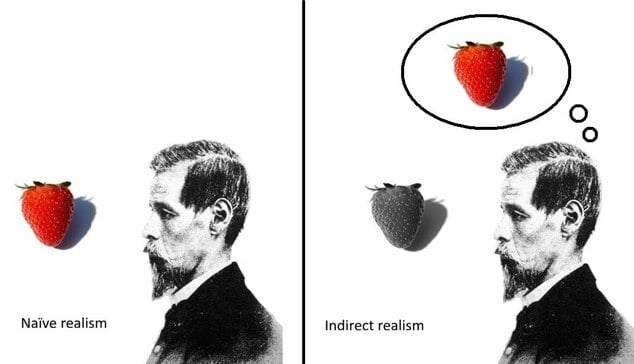
I don't think I can explain it any simpler than this picture. With naive realism, experience isn't a mental phenomenon that occurs in the head; it's an "openness to the world" (McDowell, 1994) with distal objects being literal constituents of the experience and these objects being literally coloured in the sui generis sense. It's the way children and uneducated adults intuitively think of perception and the world (hence the term "naive"). Whereas with indirect realism experience is a mental phenomenon that occurs in the head, causally determined by proximal and distal stimuli but wholly separate to them, and with secondary qualities such as colour only being properties of this mental phenomenon. It's the way physics and physiology and neuroscience tells us perception and the world works.
-
Hanover
15.2kBack to the main issue: you saw a ship. What did you perceive? Can you paint it for me? Is the painting the ship or just what you saw modified by indirect distortions and interpretation? When I see the picture, do I see what you saw, or do I see a perception of a picture now modified by me? — Hanover
I don't really understand your questions — Michael
How can you not understand them?
They go to the heart of the issue of whether a claim the ship varies from the perception offers us any added explanatory value. That is, if you can't tell me anything other than the ship you perceive looks like a ship, then how is that any different than what a direct realist would say?
That is, there is a ship at sea, your brain presents it to you as the sorts of things we know to be a ship. I ask you to tell me what you saw, so you say "a ship" and then you paint me the most perfect reproduction of the ship in your mind's eye. Of course, since indirect realism is the case, my brain interprets your statement "a ship" and it interprets the picture you painted.
You ask me what I see. I say, "the ship you saw."
My question, which I think you understand, is:
How is the ship at sea different from the ship in your head and how is the ship in my head different from the ship in your head and different from the picture you painted? Is the ship at sea green, but in your head blue? Does it have 3 sails at sea and 2 in your head? Is it a donkey at sea, but you see it as a pelican? You're asserting a modification between its appearance at sea and then in your perception, right?
If your answer is: I have no idea how it's different. I just know there was a process from at sea to my brain, and so it's indirect, and that's all I can say.
So, (1) we call the thing "ship" regardless of whether indirect realism is true and (2) we have no way of knowing if indirect realism alters how we perceive the ship.
Explain how it matters whether you're a direct realist or indirect one. It absolutely doesn't affect our manner of speaking, nor does it explain our world in a meaningful way.
In any event, at least answer my questions even should you think them irrelevant. -
Michael
16.8k
I was talking about colour and Wittgenstein's beetle, not ships. You seem to be reading more into my comments than was meant. I'm not saying that all words refer to internal mental states; I'm denying your claim that no words refer to internal mental states.
If the thing in your box is replaced with a cat then you wouldn't say "this cat is a beetle"; you'd say "my beetle has been replaced with a cat".
If I rewire your brain such that the same wavelengths of light stimulate different neurons then you wouldn't continue to say "the strawberry is red"; you'd say "the strawberry is now blue", and then be confused when nobody agrees with you.
And, most obviously, the term "internal mental states" refers to internal mental states.
The word "ships" still refers to the mind-independent ships in our shared world, even if it's possible that how they look to me is nothing like how they look to you. -
Esse Quam Videri
392
I'm familiar with the diagram you presented and with McDowell's position. Although I am heavily influenced by McDowell, I part ways with him on the question of perception.
I don't accept your claim that we are forced to choose between naive realism and indirect realism as you have laid them out. Neither do I accept your claim that my view qualifies as SDR as defined by the paper you've referenced. I'm not sure where that leaves us. -
Michael
16.8kI'm not sure where that leaves us. — Esse Quam Videri
Neither do I, but thanks for the discussion. I don't know if we can avoid going around in circles at this point so perhaps best to end it here. -
Michael
16.8kSo you are a direct realist with regard to ships? — Hanover
No, I'm saying that the word "ships" refers to ships. Perception and language are not the same thing.
Are you arguing every word has a referent? — Hanover
No, I'm arguing that some words and phrases refer to internal mental states, like "pain", "red", and "internal mental states". -
 Banno
30.6k@Hanover, how goes your reading of Austin? I saw your interaction with @Michael, and suspect we have some agreement as to where his account falls over.
Banno
30.6k@Hanover, how goes your reading of Austin? I saw your interaction with @Michael, and suspect we have some agreement as to where his account falls over.
And yes, Austin is showing that we don't need talk of mental images in some form in order to explain perception, hallucination, illusion and so on. That doesn't seem to me to be dogmatic.
The first half of the book is an assault on Ayer's essay on perception, a pretty extreme example.
See Austin: Sense and Sensibilia -
Hanover
15.2kAre you arguing every word has a referent?
— Hanover
No, I'm arguing that some words and phrases refer to internal mental states, like "pain", "red", and "internal mental — Michael
So then "pain" has a referent, which is the internal state of pain. I don't follow why "red" isn't similar to "ship," unless you buy into primary and secondary qualities, but you're going to have to offer support for why some qualities are purely internal and others external. The Lockean quality distinction seems arbitrary. I also don't follow why "ship" refers to the external ship and not the phenomenal experience of the ship, especially since we have precedent with words like "pain" where we directly refer to the phenomenal (assuming indirect realism).
Under indirect realism, for every experienced X there are two things: (1) X and (2) the experience of X. Why do words like "pain" attach to experiences but "ship" attaches to the ship at sea. What word do we use to describe the experience of the ship other than "ship"? Do we need two words?
Then we have precedent of words with no referent either phenomenal or actual, like "King of France." Why insist upon reliance upon referent at all then? Why not obtain meaning just from use without concern over the metaphysical underwriting of the term? -
Michael
16.8k... unless you buy into primary and secondary qualities — Hanover
I do.
When I look at the photo of the dress I see a white and gold dress, when others look at the photo of the dress they see a black and blue dress. This is explained by us having different phenomenal experiences and the words "white", "gold", "black", and "blue" referring to the differing characteristics of these phenomenal experiences.
This view is supported by the science of colour:
One of the major problems with color has to do with fitting what we seem to know about colors into what science (not only physics but the science of color vision) tells us about physical bodies and their qualities. It is this problem that historically has led the major physicists who have thought about color, to hold the view that physical objects do not actually have the colors we ordinarily and naturally take objects to possess. Oceans and skies are not blue in the way that we naively think, nor are apples red (nor green). Colors of that kind, it is believed, have no place in the physical account of the world that has developed from the sixteenth century to this century.
Not only does the scientific mainstream tradition conflict with the common-sense understanding of color in this way, but as well, the scientific tradition contains a very counter-intuitive conception of color. There is, to illustrate, the celebrated remark by David Hume:
"Sounds, colors, heat and cold, according to modern philosophy are not qualities in objects, but perceptions in the mind." (Hume 1738: Bk III, part I, Sect. 1 [1911: 177]; Bk I, IV, IV [1911: 216])
Physicists who have subscribed to this doctrine include the luminaries: Galileo, Boyle, Descartes, Newton, Thomas Young, Maxwell and Hermann von Helmholtz. Maxwell, for example, wrote:
"It seems almost a truism to say that color is a sensation; and yet Young, by honestly recognizing this elementary truth, established the first consistent theory of color." (Maxwell 1871: 13 [1970: 75])
This combination of eliminativism—the view that physical objects do not have colors, at least in a crucial sense—and subjectivism—the view that color is a subjective quality—is not merely of historical interest. It is held by many contemporary experts and authorities on color, e.g., Zeki 1983, Land 1983, and Kuehni 1997. Palmer, a leading psychologist and cognitive scientist, writes:
"People universally believe that objects look colored because they are colored, just as we experience them. The sky looks blue because it is blue, grass looks green because it is green, and blood looks red because it is red. As surprising as it may seem, these beliefs are fundamentally mistaken. Neither objects nor lights are actually “colored” in anything like the way we experience them. Rather, color is a psychological property of our visual experiences when we look at objects and lights, not a physical property of those objects or lights. The colors we see are based on physical properties of objects and lights that cause us to see them as colored, to be sure, but these physical properties are different in important ways from the colors we perceive." (Palmer 1999: 95)
Empirical study trumps armchair theorising, which is why I take the science to prove that this ordinary language philosophy is wrong (at least as you are presenting it), and not the other way around.
Why not obtain meaning just from use without concern over the metaphysical underwriting of the term? — Hanover
Because it would be false. Phenomenal experience does in fact exist and some of our words do in fact refer to it and its qualities. All you seem to be saying is "let's pretend otherwise".
But it's confusing because you do seem to accept that the term "phenomenal experience" refers to phenomenal experience, and maybe also the word "pain"? So what exactly are you arguing? Just that colours are mind-independent in a way that pains aren't? What about tastes and smells? -
Hanover
15.2kEmpirical study trumps armchair theorising, which is why I take the science to prove that this ordinary language philosophy is wrong (at least as you are presenting it), and not the other way around. — Michael
This comment inadvertently makes my point. Wittgenstein and Austin are fairly clear that their object is to delineate the scope of philosophical inquiry. If ever you believe that scientific evidence defeats philosophical claims, then there has been a category error, confusing science with philosophy. The purpose of philosophy under this tradition is to preserve cogent argumentation and use of language and communication. So, if you are doing science, then your debate would be among scientists. That is, stop trying to disprove my position with science. My position makes no important scientific claims.
... unless you buy into primary and secondary qualities — Hanover
I do. — Michael
This doesn't contradict your prior comment, but it presents an odd result. You claim that science answers the questions about how we perceive and not philosophers, but you then claim Locke got it right. We'd have to chalk that up to luck and science vindicating his method, which was just armchair theorizing. That is, he was right, but for the wrong reason.
This view is supported by the actual science of colour: — Michael
That does not provide support for Locke's theory. Locke posited two things: (1) Primary and (2) secondary qualities. Showing that color (a secondary quality) doesn't exist in the object doesn't prove that primary qualities (shape and size, for example) do. To stick to the science, we would show that none of the attributes of the object go unmediated by the subject, which means that I have no more reason to think a red ball is red than I do to think it's round.
Because it would be false. Phenomenal experience does in fact exist and some of our words do in fact refer to it and its qualities. All you seem to be saying is "let's pretend otherwise".
But it's confusing because you do seem to accept that the term "phenomenal experience" refers to phenomenal experience, and maybe also the word "pain"? So what exactly are you arguing? Just that colours are mind-independent in a way that pains aren't? What about tastes and smells? — Michael
The theory is a-metaphysical. It has nothing to do with science or metaphysics. It has to do with the proper role of philosophy, which is referred to a "therapeutic." In that context it, means to explain the proper role of language, communication, and discussing what can be discussed. It's about setting boundaries as to where philosophy can wander. I am therefore saying nothing about referents when interpreting meaning, not because I'm asserting there are no referents (internal or external), but that we cannot meaningfully rely upon those for comprehension. What we rely upon therefore for meaning is use, as in how the community uses a term.
Since it would be absurd to suggest I deny pain or that I deny any phenomenal experience, that could not be my argument. I think that's where this goes astray.
So, you see a ship, but it might really be red, but you see it as blue. It might "really" be 20 feet long or might be 5. You have a mental impression of X. Maybe it looks like the "real" ship, maybe not. Ok, great. I'm saying that's a fascinating scientific inquiry, but when it comes to philosophy, what do I mean when I say "I see a ship?" Do I mean "I am currently experiencing a private inner state of X that I suspect you will replicate if you look at the same Y out at sea that I do, but that is based just upon my assumption that your brain translates the myriad of variables as mine does, but that assumption is limited by the fact that I know there are delusive individuals and folks with various perceptual limitations that I've read about in the literature, like there was one guy who famously mistook his wife for a hat and a book was written about it." That means, when you say you see a ship, I have no idea what you're saying. Yet I do somehow.
In order to limit the role of philosophy, what I say is I don't know what you mean by all these "reallys." What I mean is that I use the term ship is a certain way and we get along with its use in predictable ways and I'm not entering into your theoretical scientific musings about reality.


Welcome to The Philosophy Forum!
Get involved in philosophical discussions about knowledge, truth, language, consciousness, science, politics, religion, logic and mathematics, art, history, and lots more. No ads, no clutter, and very little agreement — just fascinating conversations.
Categories
- Guest category
- Phil. Writing Challenge - June 2025
- The Lounge
- General Philosophy
- Metaphysics & Epistemology
- Philosophy of Mind
- Ethics
- Political Philosophy
- Philosophy of Art
- Logic & Philosophy of Mathematics
- Philosophy of Religion
- Philosophy of Science
- Philosophy of Language
- Interesting Stuff
- Politics and Current Affairs
- Humanities and Social Sciences
- Science and Technology
- Non-English Discussion
- German Discussion
- Spanish Discussion
- Learning Centre
- Resources
- Books and Papers
- Reading groups
- Questions
- Guest Speakers
- David Pearce
- Massimo Pigliucci
- Debates
- Debate Proposals
- Debate Discussion
- Feedback
- Article submissions
- About TPF
- Help
More Discussions
- Other sites we like
- Social media
- Terms of Service
- Sign In
- Created with PlushForums
- © 2026 The Philosophy Forum