
-
The role of observers in MWII don't think it's either obvious or insignificant. Nagel critiques "the view from nowhere" but he doesn't reject it. He instead proposes an additional subjective dimension (per the usual Cartesian subject-object dichotomy) that just entrenches the error. — Andrew M
I don’t agree that Nagel’s diagnosis is erroneous. I think he pinpoints something real and insidious.
And Bell's Theorem did nothing to validate Einstein's realist objections to 'spooky action at a distance'. Bell himself had this to say:
The discomfort that I feel is associated with the fact that the observed perfect quantum correlations seem to demand something like the "genetic" hypothesis. For me, it is so reasonable to assume that the photons in those experiments carry with them programs, which have been correlated in advance, telling them how to behave. This is so rational that I think that when Einstein saw that, and the others refused to see it, he was the rational man. The other people, although history has justified them, were burying their heads in the sand. I feel that Einstein's intellectual superiority over Bohr, in this instance, was enormous; a vast gulf between the man who saw clearly what was needed, and the obscurantist. So for me, it is a pity that Einstein's idea doesn't work. The reasonable thing just doesn't work. — John Stewart Bell (1928-1990), quoted in Quantum Profiles, by Jeremy Bernstein (Princeton University Press, 1991, p. 84) -
Meta-Philosophy: Types and Orientationsagreed with the caveat that I'm not in the last basket :yikes:
-
Meta-Philosophy: Types and OrientationsI guess, although many of the modern philosophers in the English-speaking world are pretty remote from traditional philosophy. I seem to recall Wittgenstein (and I'm not a Wittgenstein reader) declaring he had never read Aristotle. I think there's arguably more continuity between the continentals and the traditional philosophy although of course it's contestable.
-
Meta-Philosophy: Types and OrientationsFair enough! I just posted it off the top of my head, it certainly needs elaboration and refinement, but I think it might be useful regardless. Oh, and I think my interpretation of counter-cultural was very much influenced by Theodor Roszak's books, The Making of a Counter Culture and Where the Wasteland Ends.
-
The role of observers in MWIWhich is to say, there is logically no view from nowhere. — Andrew M
You’ve said that before, and even though I obviously agree, I don’t think it’s as obvious, nor as insignificant, as you make it seem. As you might know, one of Thomas Nagel’s books is called ‘The View from Nowhere’. His point is to critique the widespread understanding that science provides a ‘view from nowhere’, meaning a view that is uncontaminated by anything we deem ‘subjective’, the aim being to arrive at a view which is at once universal and objective. Whereas to me, the lesson of quantum mechanics is that we cannot obtain such a view when it comes to the purported ‘ultimate constituents’ of existence (which is where, after all, such ultimate objectivity should be sought, you would think). The fact that observation has an unavoidably subjective dimension is the very thing that Einstein strenuously objected to - ‘does the moon continue to exist when nobody’s looking at it?’, he asked. He strongly believed that there was a reality that existed just so, independently of any act of observation, and it was science’s job to discern that. Insofar as it had to make concessions to ‘the method of observation’, then quantum mechanics was, to him, obviously incomplete. Wasn’t that the gist of the Einstein-Bohr debates? -
Objection to the "Who Designed the Designer?" QuestionOne of the odd consequences of the argument against design is that the only creatures that we know of that are capable of designing is h. sapiens. All the artifacts that we have designed are examples of 'real design', but none of what appears to be design in nature is, actually, designed. Which seems odd to me.
He gets lots of practice ;-) -
Objection to the "Who Designed the Designer?" QuestionAha! That is what I call ‘hotel manager theodicy’. ‘Hey, who’s in charge here! Can’t you see people are SUFFERING! There are earthquakes, and nasty diseases. I could do a lot better, myself.’
-
Objection to the "Who Designed the Designer?" QuestionI'd like to agree with the sentiment but I don't know if the OP makes much of a case.
I suppose you could argue that the existence of order, itself, is not something that can be explained, because any explanation you might wish to offer itself depends on there being an order.
The 'appearance of there being a design' is an argument that Richard Dawkins and Daniel Dennett make - that living things appear to be designed, but that each of the components of the overall organism arises without a designer, purely as a result of chance and necessity - that some things just happen on the molecular level that then give rise to necessary outcomes due to physical laws.
I think the problem with that argument is that it envisages 'the designer' as a kind of engineer or literal architect tinkering with matter in such a way as to generate living beings - a kind of super-engineer. Again the problem with that argument is that it's a rather anthropomorphic depiction of what this supposed 'higher intelligence' must be. Again the response might be that the existence of order is something that science itself presumes, but that science doesn't explain, nor need to explain, as it's by definition a metaphysical question. -
Who Perceives What?Seeing and pain are activities of the very same body that stands before the mirror. — NOS4A2
Yes, but from different perspectives, and here the matter of perspective is significant, surely. Nobody will say that an image of a grimacing face is the same as the first-person experience of pain, would they?
(Incidentally, I want to add a meta-philosophical point here. My own approach to this issue is very much a product of my own interest in counter-cultural philosophy which was in turn influenced by popular Eastern philosophy. So it is a different orientation to that of ‘canonical Western philosophy’. Within the context of counter-cultural philosophy, the ‘separateness of knower and known’ is more than a matter for cognitive science - it represents the existential plight of individualism. It was this sense of isolation and existential angst which various counter-cultural movements intended to address. That pre-occupation is not nearly so obvious in canonical Western philosophy although it is addressed by various existentialist and phenomenological philosophers. I’m saying this to try and bring out why these kinds of dialogues often result in participants ‘talking past’ one another.) -
The Dialectic of Atheism and Theism: An Agnostic's Perspective
Not all of them. Many internet atheists, and certainly the cadre of ‘new atheist’ authors were, but there are very perceptive atheists who know what they’re rejecting. (I’m thinking Jean Paul Sartre and other atheist existentialists.)Atheists are too clueless to grasp this wonderous truth. — praxis -
Who Perceives What?I’d go along wth that, although even within that consensus, there’s room for divergent perspectives.
Therefore I see myself seeing. — NOS4A2
No you’re not. You’re seeing an external image of an inner process. If you were in pain you would see your expression of pain in the mirror, but you wouldn’t see the pain in the mirror. -
Who Perceives What?
-
Who Perceives What?Non-dualism - not two or non-divided - is not necessarily monistic in outlook. Buddhist non-dualism is not monistic, it doesn’t assert a unity to which all returns.
I think Michel Bitbol is a good source - incidentally I found his writings through this forum. But also @Joshs has a lot of understanding of the phenomenological approach. It’s not the same as the non-dual approach, but there’s an emerging consensus, arising from the seminal book The Embodied Mind (Thomson Varela et al) which attempted to combine elements of both. -
Who Perceives What?I’m trying to distinguish between the perceiver and what he perceives. — NOS4A2
I respect that, but it's a very deep question. I'm suggesting that the way you're going about it is in terms of trying to assume a perspective or point of view outside both perceiver and perceived. You're trying to imagine the issue in objective terms. But you can't do that, because you're inextricably part of the picture. To quote a hackneyed phrase by Max Planck, 'Science cannot solve the ultimate mystery of nature. And that is because, in the last analysis, we ourselves are a part of the mystery that we are trying to solve.'
The way I'm approaching it is through nondualism. It starts with a recognition of the fact that 'the eye cannot see itself'. Of course there’s then a lot more too it, but it’s a very different mindset to that of the objective sciences, although it can be understood as being complementary to them. You find some of those in e.g. the ‘consciousness conferences’ of David Chalmers et al. -
Who Perceives What?If we were to remove both those things from the man, both the perceiver and the perceived, place them on a table next to each other for observation, what would be there? — NOS4A2
You can't stand outside the act of cognition. Put another way, you can't cognise the cogniser. The act of cognition involves subjective and objective poles, but both of those poles arise as aspects of the conscious act. But framing the question the way you have introduces a kind of realist premise which is not commensurable with the kind of question you're asking, you're trying to treat 'the perceiver' as an object, which it never is.
In an optical illusion, a picture of a three-dimensional object is presented with gaps in it. The illusion is that viewers dont see the gaps. They fill them in. Where doesn’t this filling-in come from? It comes from memory. — Joshs
Notice this graphic from physicist John Wheeler's essay Law Without Law
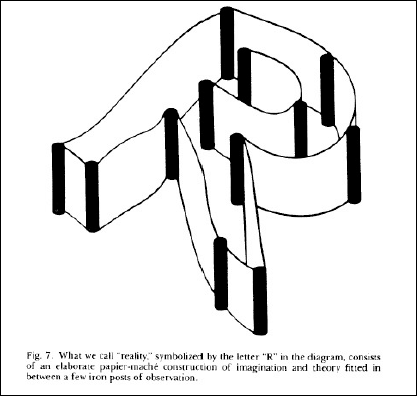
This was in the context of the construction of scientific theory, but I think it can be generalised. -
ArcheIf the Cosmos is an 'ordered whole' then the current speculative model of multiple universes does not conform to that description.
-
The case for scientific reductionismTell that Chat bot poetry composer that "how" and "know" do not rhyme. Neither do "stars" and "ours" for that matter. — Metaphysician Undercover
Yeah but I still thought it was pretty good. -
Vogel's paradox of knowledgeA posteriori, he does, but not as a necessary fact.
— Wayfarer
I don't know what this means. The echo of Kripke doesn't help. — Ludwig V
All I'm saying is the location of his car is not a necessary fact, but contingent. So his knowledge of the location of the car is also contingent on circumstances. -
Ukraine CrisisMy view is the same as the governments of Australia, US, Britain - the invasion of Ukraine is an unjustified act of aggression resulting in the deaths and displacement of millions. I’ll post links to news items here from time to time but I’m not arguing the case.
-
Ukraine CrisisThe prospect of peace lies wholly and solely with the Kremlin. They have instigated this entire catastrophe.
-
The case for scientific reductionismOh, ChatGPT, thou wondrous oracle, compose for us a brief sonnet, Shakespearean style, in praise of the power of mathematics for physics.
O wondrous numbers, that can make us see
The secrets of the universe untold,
And in their symmetry, reveal to me
The laws that govern all that's bold.
In physics, where we measure what is real,
And seek to understand the why and how,
Mathematics is the mighty steel,
That cuts through ignorance and makes us know.
For every force and motion that we see,
And every energy that lights the stars,
Is but a tale, a story writ in thee,
And all the mysteries that still confound us, thus are ours.
So here's to thee, O Math, our guide so true,
In physics, and all else, our hearts anew. — ChatGPT
Now there's a triumph of reductionism, if ever there 'twas one.
Although on further contemplation, I reject the ‘and all else’ in the last line. ‘And much else’ - that I could go with. -
Ukraine CrisisChilling story on CNN about the brutal treatement of so-called conscripts fighting for the Wagner group.
“We couldn’t retreat without orders because if we don’t comply with the order, we will be killed,” said one of the prisoners.
“One man stayed at a position, he was really scared, it was his first assault. We received an order to run forward. But the man hid under a tree and refused. This was reported to the command and that was it. He was taken 50 meters away from the base. He was digging his own grave and then was shot.”
The other fighter reported a similar situation: “Our commander was told that if anyone gets cold feet, he would have to be eliminated. And if we failed to eliminate him, we would be eliminated for failing to eliminate him.”
Meanwhile, the dreadful attrition rate of men fed into the meat grinder continues with accounts of more than 800 Russian soldiers, many of them witless consripts dragooned into the killing machine, being killed every day. -
ArcheI read David Albert's review of Lawrence Krauss Universe from Nothing. It is relevant to the OP.
The particular, eternally persisting, elementary physical stuff of the world, according to the standard presentations of relativistic quantum field theories, consists (unsurprisingly) of relativistic quantum fields. And the fundamental laws of this theory take the form of rules concerning which arrangements of those fields are physically possible and which aren’t, and rules connecting the arrangements of those fields at later times to their arrangements at earlier times, and so on — and they have nothing whatsoever to say on the subject of where those fields came from, or of why the world should have consisted of the particular kinds of fields it does, or of why it should have consisted of fields at all, or of why there should have been a world in the first place. Period. Case closed. End of story.
Krauss was furious at this review and apparently launched into a massive hissy fit at the NY Times. Never mind that David Albert is a professor of philosophy, and lectures and has published books on quantum physics and philosophy. I don't think the episode reflected well on Krauss. -
ArcheI know I'm not qualified to judge, but I suspect Sean Carroll, nice guy that he might be, is basically pretty crap at philosophy.
-
The Dialectic of Atheism and Theism: An Agnostic's PerspectiveProbably both. You know the original etymology of 'sin' is 'to miss the mark'.
Useful discussion of meaning of religion here, from which:
The religious person perceives our present life, or our natural life, as radically deficient, deficient from the root (radix) up, as fundamentally unsatisfactory; he feels it to be, not a mere condition, but a predicament; it strikes him as vain or empty if taken as an end in itself; he sees himself ashomo viator, as a wayfarer ( :yikes: ) or pilgrim treading a via dolorosa through a vale that cannot possibly be a final and fitting resting place; s/he senses or glimpses from time to time the possibility of a Higher Life; he feels himself in danger of missing out on this Higher Life of true happiness. If this doesn't strike a chord in you, then I suggest you do not have a religious disposition. Some people don't, and it cannot be helped. One cannot discuss religion with them, for it cannot be real to them. -
The case for scientific reductionismI'm struggling to do the reading. Gerson's books are about 90% addressed to other academics in defense of his interpretations, and the whole field of scholarship is so dense that it's almost impossible for the casual reader to absorb. All I've noticed is from the Gerson lectures I've listened to and read, is that Gerson seems to defend a general interpretation which I'm drawn to - anti-reductionist, anti-nominalist, and so on. Probably better not to go down that road in this thread.
The 'subject of experience' is the being to whom experiences occur. The 'problems of philosophy' are (for example) the kinds of problems about the nature of mind, nature of universals, number, ontology, metaphysics and so on. The problem of reductionism arises in the attempt to apply the quantitative approach of the sciences to the qualitative problems of philosophy. -
The Dialectic of Atheism and Theism: An Agnostic's PerspectiveWhich Christian denominations do not consider Christ their saviour? — Vera Mont
But there are very different interpretations of what that means. The Eastern Orthodox interpretation is different to the Calvinist, for instance - the orthodox don't believe in 'vicarious atonement'. In any case, it isn't my intention to get into all of those details. From the perspective of philosophy of religion, the question is what do these doctrines and ideas mean? -
The case for scientific reductionismIt's unclear to me what kind of things are "philosophical problems" or a "subject of experience". — 180 Proof
That they're 'unclear to you' is not an argument against it. It might just as well be an acknowledgement that you don't understand the problem.
The division between primary and secondary qualities is indeed central to the whole modern world-construct. As Nagel puts it succintly
The modern mind-body problem arose out of the scientific revolution of the seventeenth century, as a direct result of the concept of objective physical reality that drove that revolution. Galileo and Descartes made the crucial conceptual division by proposing that physical science should provide a mathematically precise quantitative description of an external reality extended in space and time, a description limited to spatiotemporal primary qualities such as shape, size, and motion, and to laws governing the relations among them. Subjective appearances, on the other hand -- how this physical world appears to human perception -- were assigned to the mind, and the secondary qualities like color, sound, and smell were to be analyzed relationally, in terms of the power of physical things, acting on the senses, to produce those appearances in the minds of observers. It was essential to leave out or subtract subjective appearances and the human mind -- as well as human intentions and purposes -- from the physical world in order to permit this powerful but austere spatiotemporal conception of objective physical reality to develop. — Mind and Cosmos, Pp 35-36
You can see how this provides the context for the entire 'hard problem of consciousness' debate. But then, as you think that is a pseudo problem and that there really isn't any issue to discuss, then there really isn't any issue to discuss, so let's leave it at that. -
The case for scientific reductionismLike most of the things that everyone knows about Aristotle, this one is not true.
It is not even close. It is so spectacularly wrong that it blocks the understanding of anything
Aristotle thought.
Lloyd Gerson says exactly the same in his essay 'Platonism v Naturalism'. -
The Dialectic of Atheism and Theism: An Agnostic's PerspectiveChristianity is based firmly on the sin-sacrifice-redemption dynamic, wherein the god is a discrete entity, aloof and judgmental. — Vera Mont
Christianity (and other religious and philosophical traditions) are not one exclusive model. Otherwise there wouldn't be the interminable conflicts between the various denominations. Within the Christian world there are more and less pantheist or panentheist visions. -
The Dialectic of Atheism and Theism: An Agnostic's PerspectiveI am not at all sure that there is a life beyond this one, but I'm certain that I came into this life with some memory of previous lives, ill-defined but at times vivid. So I have the tentative view that life extends beyond the bounds of an individual birth and death and so am alive to the possibility that heaven and hell are more than myth. So with that in the background, something like Pascal's wager assumes a greater urgency. I frequently contemplate the gloomy possibility that at the point of death, you will realise that your life has been misdirected, at the precise moment when you know you have no more chances to do anything about it.
What is Christian faith supposed to be about, in philosophical terms? I would put it like this: it is about realising one's identity as a being directly related to the intelligence that underlies the Cosmos, a direct familial relationship, not as abstract philosophical idea. (This is the gist of Alan Watt's book The Supreme Identity).
The name 'Jupiter' was derived from the Sansrit 'dyaus-pitar' meaning 'Sky Father'. There are versions of that name all through ancient culture. The name sounds like 'Jehovah' even though it is etymologically unrelated. But the point is, for a great many people, believers and unbelievers alike, Jehovah is conceived as a 'sky-father'. But underneath or concealed by the popular image, there's another level of meaning although it's very difficult to convey. The name 'Jehovah' was derived from the Hebrew yahweh, itself a derived from the tetragrammaton, a sequence of consonants that was literally un-sayable. In ceremonial religion, the name of God was invoked using other terms, but the 'sacred name' was unsayable because it was unthinkable, it was over the horizon of being, so to speak. By uttering the name casually, one profaned it, by bringing it into the profane world.
As a consequence of these complexities, many of the arguments about 'theism' are based on very confused accounts of what really is at issue. (David Bentley Hart's book The Experience of God addresses this confusion.) -
James Webb TelescopeWhat's been going on with JWST recently? — Changeling
James Webb Telescope question costs Google $100 billion
Google's hyped artificial intelligence (AI) chatbot, Bard, just attributed one discovery to Webb that was completely false. In a livestreamed event, blog post(opens in new tab) and tweet(opens in new tab) showing the test AI in a demo Tuesday, the chatbot was asked, "What new discoveries from the James Webb Space Telescope can I tell my nine-year-old about?"
The query came back with two correct responses about "green pea" galaxies and 13-billion-year-old galaxies, but it also included one whopping error: that Webb took the very first pictures of exoplanets, or planets outside the solar system. The timing of that mistake was off by about two decades. ...
The embarrassing error for Google caused the search giant's parent company, Alphabet Inc., to lose $100 billion in market value Wednesday, according to Reuters
---
A COSMIC RAY struck the James Webb Space Telescope (JWST) and frazzled one of its instruments, according to NASA and the Canadian Space Agency (CSA).
...The Near Infrared Imager and Slitless Spectrograph (NIRISS), experienced a puzzling anomaly on January 15, when it suffered a communications delay within the instrument. This then caused NIRISS’ flight software to time out. After a thorough review, a reboot, and a test observation, teams from both space agencies are breathing a sigh of relief. — JWST Instrument Shut Down by Radiation -
The case for scientific reductionismI think the wish to reduce everything else to physics, is because physics seems to offer the most unequivocal form of objectivity. In some fundamental way, physics deals with 'ideal object' i.e. objects whose every property and behaviour can be described unequivocally in mathematical terms - which is the ideal as far as scientific method is concerned. (Or at least that was the hope, up until the 1920's and quantum physics.) In any case, scientific method is generalised to describe everything that can be described accurately in precisely quantified terms, which is why physics and physicalism are paradigmatic for it.
Reductionism as an approach has been astoundingly successful. But difficulties arise when it is applied to philosophical problems, because these are problems that concern subject of experience, not objects which can be quantified. Nearly all the complaints against reductionism in philosophy, including Thomas Nagel's criticisms, arise from the attempt to treat subjects as objects.
The scientific revolution of the 17th century, which has given rise to such extraordinary progress in the understanding of nature, depended on a crucial limiting step at the start: It depended on subtracting from the physical world as an object of study everything mental – consciousness, meaning, intention or purpose. The physical sciences as they have developed since then describe, with the aid of mathematics, the elements of which the material universe is composed, and the laws governing their behavior in space and time.
We ourselves, as physical organisms, are part of that universe, composed of the same basic elements as everything else, and recent advances in molecular biology have greatly increased our understanding of the physical and chemical basis of life. Since our mental lives evidently depend on our existence as physical organisms, especially on the functioning of our central nervous systems, it seems natural to think that the physical sciences can in principle provide the basis for an explanation of the mental aspects of reality as well — that physics can aspire finally to be a theory of everything.
However, I believe this possibility is ruled out by the conditions that have defined the physical sciences from the beginning. The physical sciences can describe organisms like ourselves as parts of the objective spatio-temporal order – our structure and behavior in space and time – but they cannot describe the subjective experiences of such organisms or how the world appears to their different particular points of view. There can be a purely physical description of the neurophysiological processes that give rise to an experience, and also of the physical behavior that is typically associated with it, but such a description, however complete, will leave out the subjective essence of the experience – how it is from the point of view of its subject — without which it would not be a conscious experience at all. — Thomas Nagel, The Core of Mind and Cosmos -
Vogel's paradox of knowledgeLets try another tact — Philosophim
'Tack' is the expression. From what yachts do when they need to change course. (Sorry for being pedantic. I suppose it wasn't very tackful :-) -
ArcheI'm a bit confused as to why you would question the physicality of the 4 Greek elements? It seems so obvious. — Agent Smith
Only that the meaning of 'physus' was interpreted very differently in ancient philosophy, but I don't have anything further to contribute along those lines, so don't worry about it.
Wayfarer

Start FollowingSend a Message
- Other sites we like
- Social media
- Terms of Service
- Sign In
- Created with PlushForums
- © 2026 The Philosophy Forum