
-
A Case for Transcendental IdealismIt was Arthur Eddington who talked about the ‘two tables’ - the one you sit at, and the one atomic science describes, comprising mostly space strung together with forces. I don’t see that as at issue in many of these debates. The point of ‘mugs’ and ‘tables’ and ‘chairs’ is they are used as stand-ins for objects generally, in analysis of the philosophy of cognition and knowing. The naive realist hardly sees the point in any such questions, but it begs the question, why pursue philosophy at all?
-
Donald Trump (All General Trump Conversations Here)The best outcome to push back against Trumpism and the degeneracy of these people would be if he completely and openly loses it and acts out his mental breakdown in front of cameras and the world to see in such an embarrassing moment that there's no possible way to spin it into something positive, even for them. — Christoffer
He’s getting pretty damn close a lot of the time. Nancy Pelosi noted, back at the time of the Ukraine phone-call impeachment, that Trump’s entire psychological repertoire is defined by projection - he projects all of the bad things he does on others, while in his own mind, he himself is perfect and incapable of doing wrong, which has been constantly reinforced by his getting away with it. When and if he’s finally confronted with the reality of a felony conviction, it might induce such a severe cognitive dissonance that he will literally crack up and begin to rave uncontrollably. I can’t ever see him accepting any culpability, he’ll loose his mind before doing that. -
Donald Trump (All General Trump Conversations Here)Right, that one went past me. Excellent point.
-
A Case for Transcendental IdealismIt's fine to say that the scientific methodology which leaves the subject out of the picture and just focuses on the phenomena as they present themselves is a mistake if you can explain how incorporating the subject into scientific investigations would make a difference to the results and also how it could even be done. For example, how would you incorporate the subject into chemistry, biology or geology? are there any sciences that would accommodate the incorporation of the subject? I just can't see any conceivable way of doing it. Am I missing something? — Janus
I’ve noticed that physics, as an example, and up to a point, deliberately excludes the context of an observation or experiment, by concentrating exclusively on the aspects of phenomena which can be accounted for in completely quantitative and observer-independent terms. Whereas biology has had to begin to pay more and more attention to context, which appears in the form of ‘the environment’, as it has become clear that organisms can’t be completely understood except for in that context. Also because epigenetics and many features of genetic adaptation are activated by environmental factors. And quantum physics too has had to grapple with the questions of context and environment, specifically in respect of the observer or measurement issue. The realisation of the limits of objectivity is like the boundary between the ‘modern’ (period between Newton-Einstein) and the ‘post-modern’ (after quantum physics).
That touches on what I was driving at in the mind-created world argument. Objectivity assumes a very specific context, namely, one in which there is clear separation of observer and object. With the advent of physics as paradigmatic for science generally, this separation becomes kind of an unwritten assumption within philosophy also - the ego/subject in a domain of objects driven by supposedly impersonal or objective laws (the paradigm of modernity). But that is just what is called into question by transcendental idealism which points out that the ‘transcendental unity of apperception’ is never itself amongst the objects of scientific scrutiny but which is the ground of rational analysis. That dovetails with ‘the unknown knower’ analysis which is found both in non-dualist philosophy and later phenomenology (an eloquent commentary on which is provided by Michel Bitbol.)
Plenty of scientific work can proceed without paying any attention to that. Where it shows up is in questions about what it means. -
Dualism and InteractionismPoor Neils Bohr, then. He was so convinced that the discovery of the wave/particle nature of matter was of paramount importance that he reproduced the Taoist ‘Ying/yang’ symbol in the family Coat of Arms he commissioned when he received imperial honours for his achievement.

Endorsed with the Latin “contraria sunt complementa”, "opposites are complementary"
The quip by Oscar Wilde comes to mind, “The test of a first-rate intelligence is the ability to hold two opposing ideas in mind at the same time and still retain the ability to function.” -
Speculation: Eternalism and the Problem of EvilThey at least accomodate the empirical data of ‘children who recall their previous lives’ (although as previously acknowledged I’m well aware of the taboo around the subject.)
-
Donald Trump (All General Trump Conversations Here)Nevertheless if one or more states disqualifies Trump from the ballot, surely that would have to be considered by the other states, you would think. How otherwise could you have a candidate for the President of the ‘United States’? (Even allowing for the possibility that he will be a candidate which despite the opinion polls seems highly unlikely to me, considering all the other legal challenges.)
-
Speculation: Eternalism and the Problem of EvilNo, the relative pronoun is for both the quick and the dead. — Banno
You could say, ‘who was the mother of the king’ but I’m sure you wouldn’t refer to ‘the remains’ that way. You might ask ‘whose remains are those in the tomb?’ But not ‘who is in the tomb?’. (Sorry for being pedantic but it is that kind of point.)
Fair enough, as I said before I’m not trying to sell the idea, but strangely enough it seems intuitively plausible to me. -
Donald Trump (All General Trump Conversations Here)Update on same. 5 things to know about Trump’s 14th Amendment disqualification trial in Colorado.
Some highlights:
Opening remarks in the trial began Monday, where a lawyer for the plaintiffs – Citizens for Responsibility and Ethics in Washington (CREW) and six Colorado voters – argued that Trump “incited a violent mob” to attack the Capitol on Jan. 6 “to stop the peaceful transfer of power under our Constitution.” Those actions, the lawyer said, deem Trump “ineligible” to be president again.
“It was Trump’s dereliction of duty – in violation of his oath to preserve, protect and defend the Constitution – that caused the constitutional process to stop,” attorney Eric Olson said.
But the former president’s legal team argued that the “anti-democratic” lawsuit is tantamount to “election interference” in the 2024 presidential race...
Olson, the plaintiffs’ lawyer, argued that the Colorado case has four basic components: Trump took an oath as an officer of the U.S. The Capitol attack was an insurrection. Trump engaged in that insurrection. And Colorado’s secretary of state can be ordered by the court to keep him off the state’s ballot because of it.
But Trump’s counsel claimed that the plaintiff’s case is based solely on the report produced by the House committee that investigated the riot, which they described as “poison.”
Like many, I sat through many sessions of the Jan 6th Commission presentations. It was, of course, utterly compelling, and totally damning of Trump. Maybe the Jan 6th report is indeed 'poison' - poison to Trump's candidacy for the 2024 election. As it ought to be. Seems open-and-shut to me. -
Speculation: Eternalism and the Problem of EvilBut whom do you say is in the tomb? — Banno
The term 'who' refers to living persons. What is in the tomb are designated 'remains'.
Yes, but the idea seems to depend on a belief that there must be something independent and separable from the body that carries over from life to life, since the body obviously does not. — Janus
According to Buddhist theory, there is not anything that 'carries from life to life'. (There are examples in the early texts of individuals expressing this idea who were severly censured for so doing.) The processes that give rise to living beings march on - very similar to Schopenhauer's Will - while the 'habit-energies' are what gives rise to the tendencies and characteristics of particular individuals. That's why I am suggesting that the idea can be likened to the principles of process philosophy (in some respects.) -
Speculation: Eternalism and the Problem of EvilI think it's interesting that Jung came to think he was in contact somehow with an ancient Gnostic given the ways in which his modern theory coincides with a lot of quite ancient Platonist ideas. — Count Timothy von Icarus
I have no doubt Jung was gnostic.
I've always had the same problems with Plotinus, the platonizing Patristics, and Shankara: "can something be 'real illusion?'" It seems like either the illusion has some sort of ontic reality of it doesn't, and if it does have a sort of "true but lesser reality" then that needs to be explained how that works. Eriugena at least seems to answer this. — Count Timothy von Icarus
I've read a little of his dialectic of the different levels of being in the SEP entry. The underlying issue is that due to 'avidya', we don't see what is real, or we take the unreal to be real (myself included, I hasten to add!) All of the 'perennial philosophies' have some way of accomodating that. Mahāyāna has for instance the 'doctrine of two truths', that there is sense in which day-to-day knowledge and science are true (on a conventional level) but that there is a transcendent truth (paramarthasatya) which is the subject of the Buddha's wisdom.
Appreciate your erudition!
What I will say is that it seems to me that you do believe the mind is separate, or at least separable, from the brain and from the body, otherwise how could you account for rebirth? — Janus
Perhaps it's better analogized in terms of a process that unfolds over lifetimes, rather than an entity that migrates from one body to another.
Who is in the tomb? I say it is Elizabeth Windsor. What say you? — Banno
I would have thought as a devout Anglican (for that matter, the head of the Anglican Communion) Her Majesty would believe in the immortality of the soul. -
Speculation: Eternalism and the Problem of EvilOur very language is inherently dualistic and has been all along, so it's no surprise that what seems most intuitively obvious reflects the dualistic nature of language. — Janus
It's more than that - the legacy of Descartes is writ large in our culture in ways that affect it without us being aware of it. It's a large part of the intellectual background of modern culture. That sense of separateness between self-and-world, body and mind, spirit and matter, is very much the product of Cartesian dualism and the modern worldview (distinct from post-modernism).
It is what gives rise to what has been described (in The Embodied Mind) as 'the Cartesian anxiety':
Cartesian anxiety refers to the notion that, since René Descartes posited his influential form of body-mind dualism, Western civilization has suffered from a longing for ontological certainty, or feeling that scientific methods, and especially the study of the world as a thing separate from ourselves, should be able to lead us to a firm and unchanging knowledge of ourselves and the world around us. The term is named after Descartes because of his well-known emphasis on "mind" as different from "body", "self" as different from "other' — Richard J. Bernstein, Beyond Objectivism and Relativism: Science, Hermeneutics, and Praxis, 1983 -
Speculation: Eternalism and the Problem of EvilThat is probably the intuitive "folk psychology" way of imagining ideas, meanings, and thoughts — Janus
Nope. I think it is just what Talbott says: a legacy of Cartesian dualism, with mind 'in here' and the 'physical world' out there. It's also Whitehead's bifurcation of nature. -
Speculation: Eternalism and the Problem of EvilI've been referring to an essay From Physical Causes to Organisms of Meaning. It points out that all organic life instantiate processes that are different in kind from those understandable in purely physical terms (same author as the 'dead dog' quote I provided above.) But he's very careful to avoid any suggestion of vitalism.
A subject possessing a power of agency adequate to regulate or coordinate at the level of the whole organism looks for all the world like what has traditionally been called a being. But you will not find biologists speaking of beings. It’s simply not allowed, presumably because it smells too explicitly of vitalism, spiritualism, the soul, or some other appeal to an immaterial reality. ...
The accusation of vitalism seems inevitably to arise whenever someone points to the being of the organism as a maker of meaning. This is owing to a legacy of dualism that makes it almost impossible for people today to imagine idea, meaning, and thought as anything other than ghostly epiphenomena within human skulls. So the suggestion that ideas and meaning are “out there” in the world of cells and organisms immediately provokes the assumption that one is really talking about some special sort of physical causation rather than about a content of thought intrinsic to organic phenomena. That is, ideas and meanings are taken to imply a vital force or energy or substance somehow distinct from the forces, energies, and substances referenced in our formulations of physical law. Such an entity or power would indeed be a spectral addition to the world — an addition for which no one has ever managed to identify a physical basis (note similarity to Ryle's 'ghost in the machine').
But ideas, meanings, and thoughts are not material things, and they are not forces. Nor need they be to have their place in the world. After all, when we discover ideal mathematical relationships “governing” phenomena, we do not worry about how mathematical concepts can knock billiard balls around. If we did, we would have made our equations into occult or vital causes. But instead we simply recognize that, whatever else we might say about them, physical processes exhibit a conceptual or thought-like character. ...
And so, too: the meanings that give expression to the because of reason do not knock biomolecules around, but — like mathematical relations — are discovered in the patterns we see. The thought-relations we discover in the world, whether in the mathematical demonstrations of the physicist or the various living forms of the biologist, need to be genuinely and faithfully and reproducibly observed, but must not be turned into mystical forces.
Perhaps we could say that these are manifested in biological processes, whilst remaining latent in the inorganic domain. The mistake of vitalism is to mystify them, and materialism to try and reduce them.
The above passage is not incompatible with:
The disintegration occurs because the "soul" (unifying principle of life) is no longer enlivening the body. — Leontiskos
I offer it as a jumping-off point for further investigation, as well as a datum for the relationship between Kantianism and Thomism. — Leontiskos
I'm interested in what the neo-thomists have to say about Kant, but there's much to study in that area, much of it quite arcane. If I could find a brief 'Lonergan Reader' I'd be interested but his books are formidably large. -
Speculation: Eternalism and the Problem of EvilWhy do we need to think in terms of an "animating principle". — Janus
Because it's evident? Because there are processes and principles apparent in living organisms that are absent in minerals? I have been struck by the title of Aristotle's work on it, 'De Anima', from where, I think, the idea of animal and animated originates.
Cell senescence is necessary for the old to make way for the new. — Janus
'The old must cease for the new to be' -
Speculation: Eternalism and the Problem of EvilSo wouldn't that give us an account in which the process stoped, as opposed to the substance of body and spirit being split asunder? — Banno
The processes of life will have ceased in that particular dog, certainly. But an individual is also an instance of a type although that doesn’t mean that the animating principle of the dog is a separate entity. -
Speculation: Eternalism and the Problem of EvilThe theme that comes to mind is that of process philosophy - of understanding a being as a dynamic process that maintains itself in existence, as distinct from a static entity. So identity comprises the ability to maintain continuity through change. As some have noted, this has points of convergence with Buddhist philosophy which sees things in terms of process rather than static entities or the substances of traditional philosophy (i.e. as a ‘mind-stream’ rather than an ‘unchanging soul’.)
-
Speculation: Eternalism and the Problem of Evila corpse is viscerally different to a sleeping or comatose body — Banno
Think first of a living dog, then of a decomposing corpse. At the moment of death, all the living processes normally studied by the biologist rapidly disintegrate. The corpse remains subject to the same laws of physics and chemistry as the live dog, but now, with the cessation of life, we see those laws strictly in their own terms, without anything the life scientist is distinctively concerned about. The dramatic change in his descriptive language as he moves between the living and the dead tells us just about everything we need to know.
No biologist who had been speaking of the behavior of the living dog will now speak in the same way of the corpse’s “behavior.” Nor will he refer to certain physical changes in the corpse as reflexes, just as he will never mention the corpse’s responses to stimuli, or the functions of its organs, or the processes of development being undergone by the decomposing tissues.
Virtually the same collection of molecules exists in the canine cells during the moments immediately before and after death. But after the fateful transition no one will any longer think of genes as being regulated, nor will anyone refer to normal or proper chromosome functioning. No molecules will be said to guide other molecules to specific targets, and no molecules will be carrying signals, which is just as well because there will be no structures recognizing signals. Code, information, and communication, in their biological sense, will have disappeared from the scientist’s vocabulary. — Stephen L. Talbott, The Unbearable Wholeness of Beings -
Speculation: Eternalism and the Problem of EvilOrigen of Alexanderia for example, but he came before the contributions of the Islamic scholars and I don't know if he deals with this. — Count Timothy von Icarus
As I understand it (which is probably not well) Origen never explicitly endorsed metempsychosis (to use the term popular in his milieu) but was anathematised for his doctrine of ‘the pre-existence of souls’ which implied that souls were not created by God at the time of conception but existed for an indefinite period before conception.
Pythagoras as is well-known taught metempsychosis and it is at least implicit in some of Plato’s dialogues specifically in the teaching of anamnesis.
As to ‘what it is the is re-born’, the Mahāyāna Buddhists devised the doctrine of the alayavijnana (the storehouse consciousness) which is similar in some respects to Jung’s ‘collective unconscious’. It is said to be the repository of ‘seeds’ of future actions. There’s a Buddhist scholar by the name of William Waldron who has written extensively on that. It remains a controversial doctrine within Buddhism and is not endorsed by every Buddhist school. -
Speculation: Eternalism and the Problem of EvilThe problem of "who" is experiencing the mystical union, what your post gets at, is solved by positing that the self is never truly extinguished, it just appears that way phenomenologically. — Count Timothy von Icarus
Solved equally well by the understanding that it never truly existed, but only appeared to exist because of identification with phenomena. -
What jazz, classical, or folk music are you listening to?Here's a recent performance by young Sicilian guitar virtuoso Matteo Mancuso, playing the track 'Open Fields' from his recent album, The Journey. For those who haven't heard of him, I think he has a legitimate claim to being the best electric guitarist recording right now. The recording quality of this performance isn't the best, but it still conveys his virtuosity - notice he plays with his fingers, not a plectrum - and his personality, which is artistic and not at all ego-driven. If you like his style, find him on Youtube where he has a big archive, or via this story which provides more background and more examples of his astonishing technical virtuosity.
-
Israel killing civilians in Gaza and the West BankOverall I agree with your analysis. But I do wonder if the Netanyahu government in particular bears some culpability for this situation, in that the distraction caused by their political maneuverings arguably resulted in the degradation of Israeli survellience and intelligence in the southern region that excacerbated the consequences of the attack. There was a report about a week ago that the Hamas guerillas who committed the slaughter were surprised by the poor defenses they encountered when they crossed the border, saying that Israel seemed completely unprepared.
This morning the news was that the IDF has 'advised' that the main hospital in Gaza 'should be evacuated'. It's full of dreadfully injured and burned patients, and the facility is already under massive stress. It would be an enormous challenge to re-locate those patients even in ideal circumstances, let alone on the back of jeeps across the rubble-strewn streets of a war zone. So while I'm in agreement with Israel's right to defend its borders and also agree that Hamas is a terrorist organisation, not a legitimate government (remembering they took over Gaza through a military coup and that the destruction of Israel is in their founding documents), I think like many others I'm uneasy - actually, no, not uneasy, but appalled - at the price being extracted from the Palestinian populace in pursuit of its aims.
Here's a link to an OP in the SMH by a Sydney writer, who is Jewish, expressing similar concerns:
I am outraged and sickened by the atrocities Hamas perpetrated on October 7, by the rapes and abductions and the wanton slaughter of babies, children, the elderly, the disabled, pregnant women. I am also outraged – shocked to the core in fact – by the failure of some on the left to condemn these abominations.
But as a Jew I cannot stay silent in the face of the horrors now being inflicted on the people of Gaza by a lawless Israeli prime minister largely responsible for the disaster that has befallen his country. — David Leser, Stop annihilating innocent Palestinians in my Jewish name
I don't want to get drawn into a 'who's side are you on' debate, although I think Hamas' responsibility for triggering these horrors should never be overlooked or downplayed even while acknowledging that there is plenty of blame to go around. -
Speculation: Eternalism and the Problem of EvilThat the crucial factor was the ability of nous (intellect) to see 'that which is truly so' (this is the origin of the appearance/reality divide in the Western tradition.) You know the story: sensible objects are transitory, subject to change and decay, and the life governed by attachment to sense-objects has a very weak footing in reality. Mathematical and geometrical knowledge (dianoia) is higher than pistis (belief concerning visible things), whilst noesis (intuitive grasp of the Forms) is higher still. That schema is summarized on the 'analogy of the divided line' from the Republic:
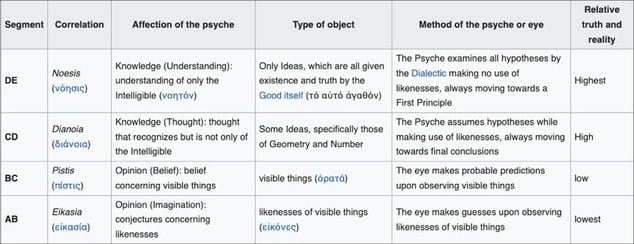
(Wikipedia)
In respect of nous, 'In the Aristotelian scheme, nous is the basic understanding or awareness that allows human beings to think rationally. For Aristotle, this was distinct from the processing of sensory perception, including the use of imagination and memory, which other animals can do. For him then, discussion of nous is connected to discussion of how the human mind sets definitions in a consistent and communicable way, and whether people must be born with some innate potential to understand the same universal categories in the same logical ways.' Aristotelian realism is preserved in the hylomorphist philosophy of Aquinas and other scholastics. It is why I believe that the Aristotelian notion of universals is significant and that the rejection of the idea of universals is an overall loss to Western culture. (Significant, I think, that Martin Luther was harshly critical of Aquinas' regard for Aristotle.)
(About the only book I know of that spells out the 'degrees of knowledge' in modern form is Jacques Maritain's volume of that name, although it's a hugely daunting read - I've taken it out a couple of times but couldn't really make progress with it, although I think I'm in agreement with the general idea.)
I am sure you are familiar with the more precise subdivisions of the mind found in Indian thought. The Western tradition does not seem to be as precise, but at times increased precision does emerge. — Leontiskos
Bertrand Russell remarks in his entry on Pythagoras in HWP, that the Western tradition encompassed the idea of arithmetic as a kind of higher truth in a way that the oriental mysticism did not, and that this has been profoundly consequential. -
Speculation: Eternalism and the Problem of Evilthanks. I've downloaded the pdf of that book, which is much more meaningful to me now than when I tried to read it many years ago. The ideas have come alive for me in the meanwhile.
-
Web development in 2023I looked up the documentation on BBCode, it's pretty basic, but I think Plush only implements a minimal set of tags. No worries, I was just wondering if there might be anything I could add to the User Tips and Tricks in that regard, but probably not.
-
Dualism and InteractionismI put the question about the nature of the wave function to ChatGPT. I don't regard it as authoritative, but it's a useful summary of the issues. But I don't think the question ought to be pursued further as it's tangential to the OP.
-
Web development in 2023Plush just confirmed to me that they will only ever support BBCode, not Markdown — Jamal
Would I be correct in saying that Plush only supports a sub-set of BBCode, i.e. not all the tags are implemented (e.g. tables)? -
The Indisputable SelfThat is the case for the premise “I am not what I am aware of; those are objects of awareness. Rather, I am awareness itself.“ But even if it’s true, so what? — Art48
I'm of a very similar view, probably due to my youthful exposure to Advaita Vedanta and other schools of Asian philosophy. But over the many years since, I've come to realise that it can easily be a shimmering mirage, the proverbial pot of gold at the end of the rainbow. Why? Because in their original context such doctrines and teachings were part of an integrated spiritual culture. There were ways of approaching these teachings, through association with teachers and spiritual movements. Plus the all-important aspect of sādhanā, spiritual discipline, which is how the transformative understanding of the nature of the psyche (mind or soul) is acquired. When elements of these traditions are extracted from that cultural milieu and presented in books or through talks, that context may not come across, and without it, they loose their meaning, or are easily misunderstood. They're also easily exploited, as the proverbial pot of gold is thought to be the solution to all life's problems, which the unscrupulous can (and often do) exploit to bilk the credulous.
None of this implies disrespect of the actual teachings nor of those who propogate them, just to point out that there's more to it than hearing the catch-phrases, 'I am That' or reading the philosophy. To penetrate the meaning of it, requires insight into the way the psyche is structured according to its conditioning and how it reflexively identifies with the objective and physical domain. That is why all such teachings were originally renunciate in nature, they were propagated by renunciate teachers who lived for the most part lives of extreme austerity. The well-known Vedantic sage Ramana Maharishi was so completely indifferent to his own body that he would have starved to death had not nearby villagers noticed him and started to provide him with nourishment.
I don't want to over-state that, I think it's quite possible to learn and benefit from Vedanta philosophy in modern culture, but reading about it or understanding on a verbal level is only one part of the picture - as I'm sure the Vedanta Society itself would say, if one were to attend their talks. Such teachings really are 'philosophy as a way of life'. Contemporary culture is generally lacking in that kind of understanding and has no way of making sense of its claims, but on the positive side, at least it provides a social framework within which they can be taught and practiced.
(Incidentally, thanks for the reminder about Vedanta Society. I knew they existed, but just now checked their site, and Swami Sarvapriyananda is indeed a wonderful speaker.) -
Teleology and InstrumentalityThomists might like to think that the correct use of reason leads to the truth, but when there is doubt, an appeal to the authority of revelation sets things right. — Fooloso4
The exclusion from consideration of anything that is associated with the domain of revealed truth is also a factor in current philosophical discourse. This shows up in many of the debates about ‘cause’, ‘purpose’, and ‘meaning’ in the presumption that the universe world must always be considered absent of them as a kind of axiom. -
What is a strong argument against the concievability of philosophical zombies?I don’t know much about ontology. — Patterner
Ontology is the broad categorisation of types of beings, derived from the Greek root, ōn, ‘being’. In traditional philosophy it was often paired with metaphysics - you would study metaphysics and ontology side by side. And as metaphysics has fallen out of favour so too has ontology in the classical sense. Nowadays you encounter it in computer science where an ontology defines a set of representational primitives with which to model a domain of knowledge or discourse. I like to think of it as distinguishing the kinds of beings there are, and also to distinguish between beings and things (this usage is not considered standard but I think it’s defensible.)
In the context of philosophical zombies and the nature of consciousness, the question revolves around the kind of being or existence that consciousness has. Materialists are compelled to argue that it has the same kind of being or existence as physical objects, as their ontology is monistic (only matter or matter-energy is real), meaning that consciousness (or mind) must be a product of (epiphenomenon of, emergent from) matter. Dualists argue that mind and the physical are a separate substances (and note, ‘substance’ has a different meaning in philosophy than in everyday speech), idealists that everything is in some sense explicable to or reducible to mind or states of being.
I tend to side with the idealists although I won’t divert this thread with that argument (for which see the OP Mind Created World.) -
Speculation: Eternalism and the Problem of Evil:clap: The 'promethean' nature of science - 'stealing fire from the Gods' - is sometimes cited.
At death breath leaves the body. It is from this natural observation that these terms go on to develop mythologies, metaphysical meaning, — Fooloso4
One of the earlier discussion you referenced contains a link to the Cornford book Plato's Theory of Knowledge from the introduction of which I copy (the 'opening discourse' is from the Phaedo):
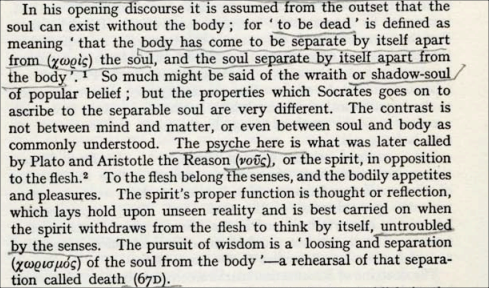
I don't find that account implausible, from a philosophical perspective. It also foreshadows the later 'doctrine of the rational soul' you find in Thomas. In that later form of hylomorphism, nous is what grasps the form or principles of things, while the senses perceive its material (accidental) features.
@Leontiskos
(As a footnote, I sometimes wonder if what is meant by 'thinking' or 'reason' in the Platonic dialogues is something completely different from what we mean by thought. I think it's referring to something much more like 'insight' or 'intuitive grasp' than the passing montage of words, images and ideas that we usually designate 'thought'. "It is by seeing what justice is that one becomes just; by seeing what wisdom is, that one becomes wise.") -
Speculation: Eternalism and the Problem of EvilI think I was the one who introduced 'children with past life memories' into the topic. Stevenson documented nearly 3,000 such cases over a 30-40 year period, each comprising hundreds of claims that were checked against documentary, historical sources and witnesses. Stevenson himself is careful not to claim this mass of data proves that there is such a thing as re-birth, only that his data suggests it. Furthermore, unlike mythological literature of the afterlife, these accounts have been subjected to empirical validation (in fact, apart from near-death experiences, past-life memories are the only kinds of such phenomena that can be subjected to empirical examination.)
I think the interesting philosophical question is that the most common reaction to Stevenson's research is that it couldn't be true, that there must be something wrong with him or his methodology, and that it can or should be ignored.
for traditional Hindus — baker
Would this include the hundreds of millions of middle-class Indians now employed in call-centres and high technology industries in Hyderabad and the like? I've worked with quite a few IT people of Indian extraction (one of whom always wore a bindu) and, although it didn't come up much, from time to time there might have been discussions of such topics as Hindu beliefs, and they didn't seem all that reticent to me. They noted approvingly of my interest in Eastern philosophy. -
Dualism and InteractionismSome of what electrons do can be interpreted as particle behavior. All of what electrons do can be interpreted as wave behavior. That means that the particle hypothesis is falsified, while the wave hypothesis is not. — Dfpolis
The wave-particle duality does not falsify either the particle or wave hypothesis. Instead, it suggests that particles like electrons exhibit properties of both particles and waves depending on the experimental context. Quantum mechanics doesn't choose between the particle or wave nature of particles; it incorporates both aspects into its mathematical framework.
Matter is what composes bodies. They are composed of wave structures. — Dfpolis
While it's true that matter at the quantum level can be described by wave functions, I understood that the wave functions themselves are mathematical representations that describe the probability distributions of finding particles like electrons in certain states or positions. Matter is composed of particles (like electrons, protons, and neutrons) that exhibit both particle and wave properties. I think it's fallacious to claim it is purely one or the other, or that bodies consist of 'wave structures'.
Being unable to predict the exact result of a measurement does not mean that it is not determined. We cannot predict turbulent flow and everyone agrees that it is deterministic. — Dfpolis
In quantum mechanics, the uncertainty principle is not about the inability to predict measurement outcomes accurately; it's about inherent limits on how precisely certain pairs of properties (like position and momentum) can be simultaneously known (which is the uncertainty principle.)
In the context of turbulent flow, while it can be challenging to make precise predictions due to the complex nature of the system and its sensitivity to initial conditions, it is still considered deterministic in classical physics. However classical determinism is fundamentally different from the quantum uncertainty principle, which arises due to the probabilistic nature of particles at the quantum level. -
Speculation: Eternalism and the Problem of Evil
Wonderer1 asked
Why don't you provide quotes, of actual statements made by the people whose views you oppose, — wonderer1
I did exactly that, and also presented some arguments as to why I differed with them, apparently to no avail. (Although I do recognise that piggybacking comments with gratuitous jibes directed at those you disagree with is part of your usual MO.) -
Speculation: Eternalism and the Problem of EvilThat might need reworking, but I gather you are asking about what happens at the point of death. The language "divided in two" is loaded with dualism. The common prejudice is that at death something leaves the body. I don't think that's right - rather the body stops doing stuff it once did. It no longer works in the same way.
— Banno
But does anyone disagree and claim that the body keeps working the same way after death? An appeal to a soul is an appeal to a reason why a body "stops doing stuff it once did." Plato would not have been surprised to hear that dead bodies act differently than live bodies. — Leontiskos
I had the idea - please correct me if I'm wrong - that in the Aristotelian tradition, 'the soul' is seen as something more like an organising principle, than a ghostly entity. That is what is meant by 'the soul is the form of the body', isn't it? I think there has been a tendency to reify that into a literal 'thinking thing' from which the issue arises of its separability from the body. -
Speculation: Eternalism and the Problem of EvilWhat I object to with determinism as usually presented is, 'hey we (scientists) know what the real causes of everything is...'
— Wayfarer
Who really says anything remotely like that? — wonderer1
The site you provided - which is a very well-presented and well argued site - says 'nature is enough'. And as the site is devoted to naturalism, then it rejects what it says can be categorised as 'supernatural', the implication being that the natural sciences are a superior source of insight to religious beliefs or philosophies. Other examples:
The naturalist doesn't suppose human beings, complex and multi-talented though they are, transcend causal laws and explanations in their behavior.
The scope of this realm as depicted in our sciences is nothing less than staggering. It is a far more varied, complex, and vast creation than any provided by religion, offering an infinite vista of questions to engage us.
He's arguing, there is no superior source of insight to science. So that is more than 'remotely like that'; it is actually that.
I quite agree that the natural sciences are indispensable across a huge range of applications, and within certain ranges are universal - but not all questions considered by philosophy are amenable to scientific or naturalistic explanation. That is particularly so in the case of ethics and philosophy of mind. Again, that site has a very rich array of arguments in support of a kind of naturalist compatibilism. But the central thesis that humans are natural beings, devoid any faculty or attribute which can be understood as transcending nature, is itself based on a methodological assumption, which then is treated as a philosophical axiom. And that is mostly framed in the context of the perceived tension or conflict in religion vs science, the subject of a sub-section on the site, Naturalism Vs Theology.
You don't understand the perspective — wonderer1
I understand it perfectly well, thank you, and in its context it is completely unexceptionable. Nothing to do with my criticism of physicalism. -
Israel killing civilians in Gaza and the West BankAn insight from today's NY Times (gift link provided)
Hamas has spent years stockpiling desperately needed fuel, food and medicine, as well as ammo and weapons, in the miles of tunnels it has carved out under Gaza. ...
Hamas has hundreds of thousands of gallons of fuel for vehicles and rockets; caches of ammunition, explosives and materials to make more; and stockpiles of food, water and medicine.... A senior Lebanese official said Hamas, which is estimated to number between 35,000 and 40,000, had enough stocked away to keep fighting for three to four months without resupply.
...The supply situation speaks to the relative sophistication of Hamas as a fighting force — an axiom among military professionals is that while amateurs talk about tactics, professionals talk about logistics. Yet with Gazans facing a humanitarian catastrophe, Hamas’s stockpiles raise questions about what responsibility, if any, it has to the civilian population. ...
Yocheved Lifshitz, 85, a freed hostage, said that while in captivity she ate the same single meal that Hamas fighters eat every day: pita bread with two kinds of cheese and cucumber.
Mr. Ghattas said there was little chance that Hamas would be willing to provide food or any other kinds of supplies to aid civilians. “The Hamas movement cares only about the Hamas movement,” he said. “The public of Gaza mean absolutely nothing for Hamas.” — As Gazans Scrounge for Food and Water, Hamas Sits on a Rich Trove of Supplies
Hamas are holding their own population hostage in support of their military and public relations aims.
Meanwhile the senior leadership of Hamas resides in relative luxury in hotels in Qatar, as well as in Lebanon, Turkey and other safe spaces well away from the conflict zone. -
Speculation: Eternalism and the Problem of EvilI don't really seek to persuade either but to present and be presented with rational arguments for beliefs and standpoints, since this is a philosophy forum and I think that activity of presenting and being presented with (hopefully) rational argument is what the critical activity of philosophy is all about. — Janus
:100:
I don't know what the significance of 'libertarian' free will is, and I recognise that the will is constrained. Kastrup says he's not for either determinism or libetarian free will, that it's a false dichotomy. From that video 'nothing in the universe knows what our pre-determined choices are going to be'. 'The universe plays itself out in our actions' - much like something Alan Watts used to say.
I think the subtle issue behind this is the question of ego. If Krishnamurti was asked whether we have free will, he would always respond that 'will is the instrument of desire'. His teaching was always 'choiceless awareness' - to see what it is that drives our likes and dislikes as they are. The will itself is not free, because it's always conditioned. But I don't think he would accept the kind of deteminism that naturalists posit either. He represents the kind of liberation which is not within the ambit of Western philosophy generally.
I added a link just before your post showed up — wonderer1
From which
Determinism holds that every thing and event is a natural and integral part of the interconnected universe. From the perspective of determinism, every event in nature is the result of (determined by) prior/coexisting events. Every event is a confluence of influences. While determinism regards humans as "one with" the unfolding matrix of the natural universe, supernaturalism and fatalism regard humans as existing outside of this system.
I think the subtle issue there is 'what does "outside" mean?' Does it mean, 'outside what we currently understand as natural causation?' Because, as per Hempel's dilemma, our understanding of what constitutes physical causation is constantly changing. What I object to with determinism as usually presented is, 'hey we (scientists) know what the real causes of everything is, and your sense of rational autonomy is illusory.' That's where it becomes scientistic rather than scientific - everything has to be explainable within the procrustean bed of physical causation.
Besides, determinism has been called into question since the discovery of quantum mechanics. Ernst Cassirer (neo-Kantian philosopher) argued that quantum mechanics did not necessarily negate determinism but instead revealed a new form of determinism that was based on probabilities and statistical laws. He saw the probabilistic nature of quantum events as a different kind of determinism, one that operated on the level of statistical regularities rather than strict, deterministic causation.
While C S Peirce's tychism predated quantum mechanics, it shares a philosophical affinity with the probabilistic and indeterministic aspects of quantum theory. Both tychism and quantum mechanics challenge the classical, deterministic worldview by acknowledging the presence of randomness and probability in the description of natural phenomena.
I also see a conflict between determinism and rational causation - that as rational agents, we are able to make decisions that can't be reduced to physical causation. (cf 'the space of reasons'.)
Kastrup is asked 'is there randomness involved' and responds 'I don't think so, I think it's the word we use when WE don't know'. He says that if we did know all the factors involved, determinism would be maintained, but that it's computationally irreducible to derive the details of the causal chain.
God works in mysterious ways!
Anyway this has drifted a long way off topic (although it is a kind of omnibus topic) but thanks to both for those resources.
Wayfarer

Start FollowingSend a Message
- Other sites we like
- Social media
- Terms of Service
- Sign In
- Created with PlushForums
- © 2026 The Philosophy Forum