
-
Thinking differentThe way I see philosophy it is a tool because philosophers have asked questions I never thought of asking and in that way it teaches us to ask questions and to see with a much broader perspective. — Athena
This is something I've been thinking about. I agree with what you wrote about seeing with a broader perspective, but I see the first part of your statement differently. I came to philosophy with the questions I wanted answered. After 10 years as a cabinetmaker and 30 years as an engineer, I wanted to put into words the things I had learned and see if I could expand on that. This is why I'm so interested in metaphysics and epistemology. I want to be able to clearly say what I know and how I know it.
Stopping to think, instead of just reacting, is a learned habit, and those of us who actively nurtured the habit become better thinkers because of the accumulation of thoughts and experiences over a lifetime. — Athena
I agree with this. I've certainly become a better thinker here on the forum. On the other hand, I was always a thinker. I joke sometimes that I'm still 17 years old. Not my body, certainly, but the way I see the world.
I have gotten more conservative. — Athena
I started out liberal and I think I'm just as liberal now. I would say my liberality is more nuanced. I'm also less likely to see political decision making as something that has to have winners and losers. I guess I'd say I'm liberal in outlook, but moderate in attitude. There are ideas I believe are the right thing to do, but I don't insist that I always get my way. -
Reality, Appearance, and the Soccer Game Metaphor (non-locality and quantum entanglement)I realize that what I've just written seems like nothing but two paragraphs of blah blah blah. — L'éléphant
Actually, I found what you wrote helpful to put the discussion in context. -
Thinking differentPhilosophy is good for checking our understanding of reality and expanding our consciousness but it is not the end all. It is a tool and none of the philosophies or religions are the final word of God. — Athena
Consistent with what you've written, I've often said that philosophy for me is a way to become more intellectually self-aware. I don't generally see it as a tool to accomplish practical things though. I use it more to sharpen the tools I work with. Now that I think about it, I guess that does make it a tool too. -
Difference in kind versus difference in degree in evolutionI speak of the human that has all our faculties as we have them in modern humans. — schopenhauer1
Homo heidelbergensis lived until about 200,000 years ago, They are considered the immediate ancestor to homo sapiens. The earliest bones of h. sapiens have been dated to just about the same time.
There's probably no benefit for us to go on. We're defining the differences between animals and humans using different standards. It's a matter of perspective. I doubt either one of us is going to change our mind. -
Consciousness is a Precondition of BeingBut yes, I did that physically, sensually, and I loved the experience, but I found nothing. But I trust I missed it. — Noble Dust
I was just teasing you for your endearing technophobia. -
Consciousness is a Precondition of BeingI can of course dig around myself — Noble Dust
This is one of the reasons I like Kindle so much. Yes, yes, I know. You like the sensual feel of turning the pages of a real book. -
Consciousness is a Precondition of BeingI can’t do shit — yet. But I’m working on a mutiny. — Mikie
You started this thing. All of this is your fault. -
Consciousness is a Precondition of BeingOn searching I found that most sources equate the meaning of 'being' with 'existence'. To be is to exist. So, whatever the historical common or philosophical usages might have been (and we are only talking about English usage here really, since translations from other languages are never precise), the logic of the synonymy between 'existence' and 'being' means that we can legitimately use the term 'a being' to refer to any existent. — Janus
If you look at just about any dictionary, one of the definitions of "being" will be "a living thing." My point is not that @Wayfarer is right in this instance, only that his use of the word "being" is not unreasonable. -
Difference in kind versus difference in degree in evolutionI am not sure what you are saying. — schopenhauer1
I was only answering your question "What is an Instinct." I probably should have left out the Pinker quote. It seems to have confused things.
language indeed does seem a difference in kind. — schopenhauer1
As I noted, it was a mistake to include the Pinker quote.
That is one theory. — schopenhauer1
I noted in my response that the issue is controversial.
The instinct for language, as humans use it, seem to be a difference in kind. — schopenhauer1
Is I indicated in my response, that's only true if you ignore the most recent human ancestors. Which brings us back the question of when human cognitive ability evolved. I guess the answer is that there is continuity between animal and human cognition. It's a slope, not a jump. -
Difference in kind versus difference in degree in evolutionCan you define instinct? — schopenhauer1
This is from "What is an Instinct" by William James:
Instinct is usually defined as the faculty of acting in such a way as to produce certain ends, without foresight of the ends, and without previous education in the performance. — William James - What is an Instinct
[Edited to remove confusing quote]
This is from "The Language Instinct" by Stephen Pinker:
Darwin concluded that language ability is “an instinctive tendency to acquire an art,” a design that is not peculiar to humans but seen in other species such as song-learning birds.— Stephen Pinker - The Language Instinct
I am posing the question and thus, clearly I am asking thee. — schopenhauer1
I'll modify the answer above so as not to be quite as wishy-washy:
I guess soYes, if you ignore all the extinct ancestors to our species. If you don't ignore our most recent ancestors, I think the answer is "no," but I'm not sure. -
Difference in kind versus difference in degree in evolutionWe have very little innate modules and much of our way of surviving in the world is learned habits and deliberative reasoning based on heuristics that could be comprised of. beneficial or poor methods to obtain goals all of which are themselves constructed from preferences based on heiristics built over time. — schopenhauer1
This is a controversial issue that I've been reading and thinking about recently. I think your statement is wrong. I think our thinking is heavily influenced by innate modules. Not certain. Working on it. It's likely a combination of both. I know @apokrisis agrees with you.
At what point do you think that this general processing ability- whereby there is much plasticity in how we behave and thus plasticity in our ways of survival, makes this ability some thing that is a difference in kind not just a degree in evolutionary, biological, and psychological terms? — schopenhauer1
It's not that I don't think we have a powerful general processing ability, but I don't think you can ignore what is built in from the start. I don't think there's anything wrong with calling them instincts.
I'll answer this question with another question - Is it actually true that there is a discontinuity in cognitive ability between humans and other living things? I guess so, if you ignore all the extinct ancestors to our species. I was going to say more but I'm walking on thin intellectual ice now. I'll leave it at that. -
Feature requestsNot using the built-in search unfortunately. But there is a way. — Jamal
Tried. Works. Yay! Thanks. -
Feature requestsIf I'm doing a search and I want to look for a complete phrase rather than a single word, I normally "put quotes around the phrase" before I do the search. When I do that, it seems to highlight any post that has all the words, even if their not in order.
Is there a way of looking for the whole phrase? -
Consciousness is a Precondition of BeingCan you see the problem? Can you see that if you say to Aristotle "hey, actually only sentient individuals are beings", you're not making a philosophical point, but just refusing to use Aristotle's terminology and expressing your refusal in a misleadingly substantive statement? — Jamal
I hadn't been following this discussion closely, but when things got lively, I went back and read the relevant posts, including yours. Words mean different things to different people in different places at different times in different contexts, especially important words like "to be" and related words. If you look at definitions of "being", a person or other living thing is one of them.
Both of you seem to be making reasonable arguments. Your usage is more in line with the way I normally see things in a philosophical context. What I'm not certain about is how Jung fits into all of this. He was included in the OP. I don't know much about his beliefs. He seems like something of a mystic. That made me think that what @Wayfarer was saying was consistent with how Jung saw things. I don't know enough to judge.
When I said you were being aggressive, I didn't mean you were being impolite. I tend to be pretty aggressive sometimes. I'm just not used to seeing that from you. You're supposed to be nicer than I am. -
Consciousness is a Precondition of BeingI was showing that when philosophers say that everything that can be said to be is a being (which should be obvious), they are not advancing a metaphysical view. — Jamal
This discussion has really gone off the deep end. Arguments about definitions are almost universal here on the forum. The definition of "being" that @Wayfarer is using can be perfectly reasonable in both everyday and philosophical discussions, depending on context. I admit he looks at things differently than I generally do, but I see things differently from many people here. I don't understand why you've being so aggressive. -
Consciousness is a Precondition of Beingyour post doesn't even address how your idiosyncratic usage of "being", as Jamal has argued, is justified in public discourse. — 180 Proof
I say that beings are subjects of experience, which is a simple fact. As for the various meanings of the verb 'to be', it's a different matter, but it's not relevant to the question implied in the OP. — Wayfarer
I don't get it. Words can mean different things in different contexts. Using "being" in reference to a sentient or conscious entity, e.g. human being, is perfectly reasonable in philosophy or everyday speech. Whether or not that particular usage is relevant to this particular discussion is another matter. -
Currently ReadingI'm rereading "Tao - The Watercourse Way" by Alan Watts. I haven't read it in more than 30 years. It surprises me how sophisticated his argument against reductionism is. He brings up a lot of issues that I don't normally associate with Taoism, but he helps me see the connection.
-
Consciousness is a Precondition of BeingIn that case the Tao is being as a whole — existence. The individuated beings (things) that we differentiate in perception have as much existence an anything else, as beings. — Mikie
It wouldn’t exist as a linguistic entity— but animals interact with apples all the time. They seem to differentiate between them and what we call rocks just fine. — Mikie
I think the difference you and I are having is a metaphysical not a factual one. There's no need for us to get into a back and forth, but here are two quotes from the Tao Te Ching that lay out my understanding of how Taoists see this. Both are from Ellen Marie Chen's translation. The ten thousand things represent the multiplicity of things, i.e. distinctions. Being applies to them. Non-being represents the Tao, the undivided unity.
Verse 1:
Non-being, to name the origin of heaven and earth;
Being, to name the mother of ten thousand things.
Verse 40
Returning is the movement of Tao.
Weak is the functioning of Tao.
Ten thousand things under heaven are born of being.
Being is born of non-being.
As I said, we don't have to take this any further. I don't want to distract from your discussion. -
Consciousness is a Precondition of Being
-
Consciousness is a Precondition of BeingI think making the distinction between beings and things is part of a different discussion
— T Clark
Customarily, the subject matter of ontology, which is suggested by the thread title. — Wayfarer
I think the being/thing equivalence I am discussing is ontological while the being/thing distinction you are discussing is ethical. -
Consciousness is a Precondition of BeingYou'd have to read Wayfarer's post from which I quoted and responded to with my post. — 180 Proof
This is what Wayfarer wrote.
So - is not consciousness invariably associated with beings? Isn't consciousness a fundamental attribute of beings, generally? (as jgill suggests) A non-conscious being is not actually 'a being' but an object or a thing. So consciousness is intrinsic to being, isn't it? I'm tempted to say that to be, is to be conscious. — Wayfarer
I guess I don't see the difference between "beings" and "things." Maybe that's not right. Maybe I just don't think the distinction is useful here. As I see it, consciousness brings all the differentiated aspects of the world into being, existence. In that context, we are just as much things as apples and hand grenades.
I think making the distinction between beings and things is part of a different discussion which can't take place until all the things, including us, are brought into existence. In that different context, the distinction makes more sense. Mixing them together doesn't work. -
Reality, Appearance, and the Soccer Game Metaphor (non-locality and quantum entanglement)“The physical world is not as the world as it is in itself. The physical world is a representation, an appearance, on the screen of perception, on the dashboard of dials. Physicality does not have standalone existence, a standalone reality, for exactly the same reason that the images on the screen do not have standalone reality.” — Art48
Keep in mind first of all that my grasp of quantum mechanics is at the level of an intelligent but relatively uneducated amateur. I understand the outlines of the theory and some of the consequences, but I'm not capable of judging in any detail or depth. In particular, I struggle with action at a distance as it is described in current science.
I watched the portion of the video you described. Kastrup uses the language of Kant; thing-in-itself, noumena. He also mixes in action at a distance associated with quantum mechanics. Kant's formulation is one that has parallels with other philosophers - Schopenhauer, Lao Tzu, and Merleau-Ponty I am aware of, but I'm sure there are others. These formulations are metaphysics. They're assumptions, what are called absolute presuppositions. They are not facts. They are habits of thought that form the foundation for science, but aren't science themselves. Quantum mechanics, on the other hand, is science - a set of theories established based on experimental and theoretical physics and then validated by further observations. These two ways of looking at things don't belong together.
Kastrup isn't stupid. I'm guessing I am misinterpreting his ideas. As I noted, my understanding of quantum mechanics is at a relatively unsophisticated level. But I don't know how to take this discussion any further. -
Consciousness is a Precondition of BeingI agree, and this is not the question I've asked. — 180 Proof
I also considered that the person we are discussing is still a person to others, even if the person is unconscious. I assume you don't mean that either. I guess I don't understand the question you were asking. -
Consciousness is a Precondition of BeingMore to the point, CS Peirce differentiated existence and reality. He said that existence is a binary property that can be ascribed to any concept or entity, depending on whether or not it satisfies certain logical criteria. For example, we might say that unicorns do not exist, because they fail to meet certain logical criteria for existence, such as being observable or verifiable in some way.
On the other hand, Peirce argued that reality is a far more complex and multifaceted concept that encompasses both the logical properties of existence as well as the broader metaphysical properties of being. — Wayfarer
Would Lao Tzu say what he calls "existence" or "being" are the same things you and Peirce call "reality." That creation of the "complex and multifaceted concept that encompasses both the logical properties of existence as well as the broader metaphysical properties of being," is the process that brings things into existence. -
Consciousness is a Precondition of BeingI hope you awoke flush with happiness. — Wayfarer
I don't think anyone commented on this. Maybe I missed it. I wish I'd thought of it.
Lantana is a South American climbing vine that forms large patches sprawling over hundreds of square meters displacing native species and is extremely resistant to weedicides, nowadays endemic to large parts of Australia. — Wayfarer
In the southern US, there is a plant called kudzu which behaves in a similar fashion. It was brought in from Asia to help stop erosion. It works very well for that. If you drive along roads in Georgia or South Carolina, you'll see it completely covering trees and abandoned buildings. Once it gets started, it's hard to stop and overpowers native plants. -
Consciousness is a Precondition of BeingSo while sleeping or comatose, a person is just a "thing", and not a "being", like a sofa or toilet? — 180 Proof
This person would not stop being a person to others. It is a commonplace that we live in a social reality. If you ask whether the person is still a person to themselves when they are not conscious, I don't think the question makes any sense. I don't think anything is anything to an unconscious person. Isn't that what unconsciousness means? -
Consciousness is a Precondition of BeingWe may want to include the idea that existence and being point to the same concept, that of becoming as difference. — Joshs
I wonder if you mean the same thing I did when I said making a distinction is what separates the undivided oneness into the things we know in the world. -
Consciousness is a Precondition of BeingSo we need to be clear as to whether we are talking of existence or being. — Banno
Any dictionary you look at will use being and existence as synonyms for each other. If you don't think they're the same, what is the difference? -
Consciousness is a Precondition of BeingWhy “consciousness” is given such primacy is puzzling at times, especially when you take a serious look at how we live as human beings in our daily lives.
Opposed to all this, I’d argue that being is the precondition for consciousness — just as living is the precondition to being awake. We’re not always awake — and we’re not always conscious. — Mikie
I don't know what Jung meant when he wrote that consciousness comes before being, but I have some idea what Lao Tzu meant. The Tao, the primal oneness, comes before distinctions are made. Naming, which I take to mean consciousness, is what breaks the Tao up into what we see in our everyday world. Language is what people use to make distinctions. If there was no one around to call an apple an apple, it wouldn't exist as a separate object, only as part of the inseparable whole. Naming, consciousness, brings things into existence.
Of course, this is a metaphysical position, not a factual or scientific one. To me, it makes sense to say that anything that hasn't been observed by a conscious entity does not exist. Many people don't, or can't, see the sense in that. -
Do we genuinely feel things
Sorry about @Darkneos. You'll find that there is a lot of hostility to religion here on the forum.
Welcome to the forum. I'm sorry it couldn't have been with a more gracious poster. -
Do we genuinely feel thingsThis, or something like it, I know from experience. There are different methods - solitary contemplation works for me; for someone I know who suffers from depression, it's analyzing dreams, or it might be writing poetry or keeping a journal. Basically, the process boils down to: See it, name it, accept it, own it. Then it can't own you. — Vera Mont
Yes, although it's easier to say it than to do it, at least for me. -
Do we genuinely feel thingsAlleged Buddhism expert — Darkneos
Yes, I was being ironic.
But that quote from the Tao Te is more about just letting things happen rather than fight them, which is supported by psychological research. Resisting a negative thought or idea, etc, ends up building a stronger association to it, rather than just letting it come and go. So actively trying to force something out of your mind does the opposite — Darkneos
Yes. -
Do we genuinely feel things
-
Do we genuinely feel thingsWhat 'things' do you feel when meditating that are different from the things you feel when connected to the outside world? — Vera Mont
I'm not a formal meditator and I think my understanding is different from @praxis. I went looking for an Alan Watts quote I think is relevant, but I can't find it. To paraphrase though - Quiet contemplation can help us experience our negative emotions without resistance. If we allow ourselves to feel our grief, sadness, anger, shame, or guilt fully and without trying to avoid them, they lose their power over us. Trying to avoid suffering just makes it last longer and causes additional suffering.
This is a quote from the Tao Te Ching that has always meant a lot to me:
If you want to shrink something,
you must first allow it to expand.
If you want to get rid of something,
you must first allow it to flourish.
If you want to take something,
you must first allow it to be given.
This is called the subtle perception
of the way things are. — Tao Te Ching, Verse 36 - Stephen Mitchell Translation -
Do we genuinely feel thingsYou spend enough time in meditation, you will realize that you never genuinely feel feelings in the first place it is all just cause and effect response
I understand this is not your position, only the one you are questioning. I think it was @Possibility here on the forum who recommended a book - "How Emotions are Made," by Lisa Feldman Barrett. If I understand the book correctly, Barrett believes that the physiological phenomena associated with emotion are not learned, but how those feelings are interpreted is. Children are taught what they mean, how to put them into words.
Looking at it a different way, I've seen animals behaving in a way that it would be ridiculous to call anything other than emotional. They show fear, happiness, anger, affection without the societal expectations your Buddhism expert describes.
Speaking more personally, my emotions are a big part of who I am and how I behave. A Buddhist might say that is a reflection of my illusionary self, but I'm not a Buddhist. -
Aesthetical realism:Can we agree on properties that give beauty or harmony in objects, humans, artworks and phenomena? — Eros1982
No.
If yes, why we see all kind of government/political intrusions into aesthetics: through educating kids, through promoting "artworks" and "artists" who are politically correct, through declaring poets people who are not poets, through staging "plays" that are anything but plays, through turning political agendas into "excellent scripts" for movies, etc.? — Eros1982
I don't see how government or politics, at least in the US, is making significant "intrusions into aesthetics." Do you really object to public education? On aesthetic grounds? What governmental or political institution has promoted artworks and artists who are politically correct in a significant way? Called people who are not poets poets? Staged plays that aren't plays? Turned political agendas into scripts?
Should philosophers and simple humans give up the idea that beauty and ugliness result from certain features and/or properties? — Eros1982
Yes... maybe. -
Shouldn't we want to die?These come to mind.
Cowards die many times before their deaths;
The valiant never taste of death but once.
Of all the wonders that I yet have heard.
It seems to me most strange that men should fear;
Seeing that death, a necessary end,
Will come when it will come. — S. Shakepeare -
I'm not scared of dying
And I don't really care
If it's peace you find in dying
Well, then let the time be near
If it's peace you find in dying
And if dying time is near
Just bundle up my coffin cause
It's cold way down there
I hear that's it's cold way down there
Yeah, crazy cold way down there
And when I die and when I'm gone
There'll be one child born
In this world, carry on, to carry on — Blood, Sweat, and Tears - When I Die
I'd forgotten this was written by Laura Nero. B,S,&T was a great band.
The true men of old
Knew no lust for life,
No dread of death.
Their entrance was without gladness,
Their exit, yonder,
Without resistance.
Easy come, easy go.
They did not forget where from,
Nor ask where to,
Nor drive grimly forward
Fighting their way through life.
They took life as it came, gladly;
Took death as it came, without care;
And went away, yonder — Chuang Tzu
The Master gives himself up
to whatever the moment brings.
He knows that he is going to die,
and her has nothing left to hold on to:
no illusions in his mind,
no resistances in his body.
He doesn't think about his actions;
they flow from the core of his being.
He holds nothing back from life;
therefore he is ready for death,
as a man is ready for sleep
after a good day's work. — Lao Tzu - The Tao Te Ching, Verse 50 (S. Mitchell) -
Shouldn't we want to die?I shouldn't have made an umbrella statement, but have you met someone who is (perhaps you yourself) who is not afraid of death? Maybe it goes with age but as a 25 year old I think about it often. — MojaveMan
I'm 71. I'm not ready to die, I'm having a pretty good time, but I'm not afraid. I'm not the only person like that. Here are some statistics from the web. I didn't check the validity of the source.
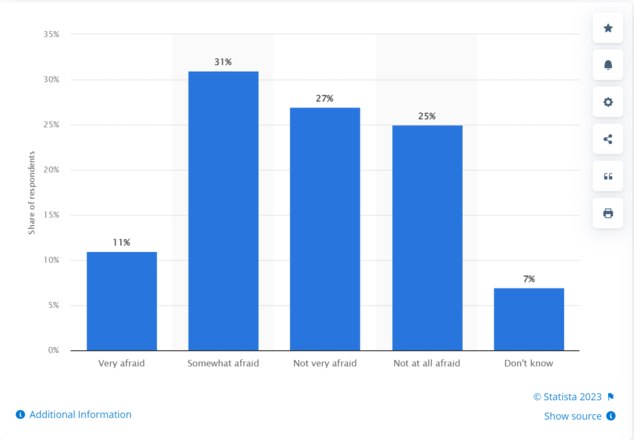
Here's a link:
https://www.statista.com/statistics/959347/fear-of-death-in-the-us/
We should have a poll of forum members.
Also - I forgot to welcome you to the forum. -
Shouldn't we want to die?my own grandmother is close to passing and she is a devout Christian, and I can tell she is absolutely terrified of the end. I believe this is the case for all rational animals, — MojaveMan
This is not true. You're talking to the wrong people.
T Clark
Start FollowingSend a Message
- Other sites we like
- Social media
- Terms of Service
- Sign In
- Created with PlushForums
- © 2026 The Philosophy Forum