
The Mind-Created World
-
The Mind-Created World
You haven't answered the question which I posed prior to Wayfarer's subsequent response which your post that I ma responding to responds to :
That said the one thing I wonder about with your saying that an artificial mind could be built that has first person experiences coupled with your saying that feelings are the only problematics is whether it would be possible to have first person experiences sans feelings. — Janus
I actually don't like the term "first person"―it is so humancentric. I also don't like the "dimensionless point" model of subjectivity.
The related question that comes to mind is whether you think consciousness is possible absent feelings and whether you equate consciousness with first person experience. Is it possible to have feelings without a sensate body? -
The Mind-Created World
The being would have experiences, that created memories that might affect its future behavior - so in that sense, it would be a sort of first-person experience. — Relativist
So, it would be no different than the LLMs in that they are changed by their experiences. -
The Mind-Created World
Truth is not subjective, although there are truths about subjective things. Objective truth: "The universe exists". — Relativist
Agree it's a difficult point to make. I'm saying that there is an implicit subject in every statement about what exists, including what exists in the absence of any observers. It is true that we can model the universe as if there were no observers in it on the practical or methodological level but it's not ultimately the case, because that model is mind-dependent. The universe exists for the subject - as you say, that doesn't preclude the discovery of objective facts about it, but their objectivity is not absolute or stand-alone. -
The Mind-Created World
I think you're saying that limiting our perspectives (our world views) to objective facts is too limiting; it leads to rejecting some philosophies that can be valuable. — Relativist
Sure, I'd go along with that. But it's the tip of a large iceberg! -
The Mind-Created World
You noted that science cannot discover God. I agree 100%. My question is: is God discoverable through some alternative, objective means? What about other aspects of reality that are beyond the reach of science ?
Why would you create duality between subjective & objective means ? If God does exist, then his being qua being would both be nondelimited prior to manifestation and delimited via manifestation in the mental & physical world (assume both categories are relative to one another).
The trick is to stop looking for God and understand he has not only always been with you but he is identical to your reality. People seem to think God is like a pseudo object which exists apart from the universe, which is just superstitious & baseless. If you want to know God, you just need to think differently of him, or to put it more succinctly, you need to stop thinking of him, as he is beyond concepts and experience as well. -
The Mind-Created World
This seems trivially true — Relativist
Not when consciousness is treated as an object (per Materialist Theory of Mind) :brow:
It’s not about falsifying the third person perspective, but pointing out its implicit limitations. -
The Mind-Created World
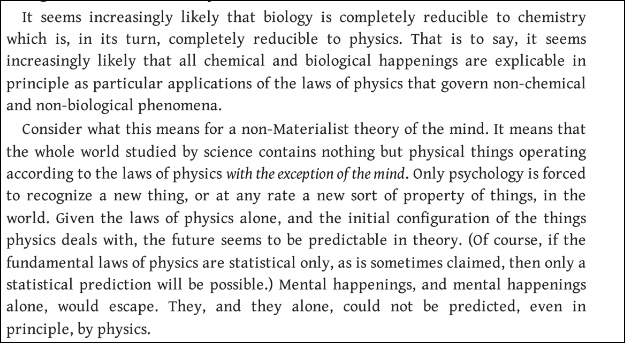
Materialist theory of mind does not entail reifying the process of consciousness- considering it a thing. — Relativist
That is exactly what this does. and when I posted it, you agreed with it.
-
The Mind-Created World
The problem isn’t that some mental states are hard to describe, or that brains are complicated. What’s at issue is something much simpler and deeper:
Every third-person account you appeal to is already framed from a first-person point of view.
A description of the brain is still a description to a conscious subject. Nothing in that description — however detailed or computable — entails that there is anything subjectively real arising from the material facts.
That’s the point physicalism doesn’t touch. It doesn’t matter how much complexity you add or how programmable the processes may be. A functional specification is not the same thing as the reality of existence — and existence is the philosopher’s concern, not the engineer’s abstraction.
So this isn’t a “Mary’s room” or communicability issue. It’s the basic fact that:
• third-person descriptions are always about objects
• consciousness is the condition for any object to appear
Until that is accounted for, saying physicalism “best explains all the facts” simply assumes what is in question. And as a software guy, you must recognise the impossibility of writing a true functional specification for the unconscious and preconscious dimensions of mind — without which consciousness would not be what it is. As Penrose notes, subjective understanding is not algorithmically compressible.
But since you continue to defer to your preferred “best explanation,” this will be my final word to you on the subject. At least we’ve made it clear where the difference lies. -
The Mind-Created World
I'm very interested in this. Can you explain? If a component is physical, why would it be undiscoverable?It may very well be that there are aspects of mental activity that are partly grounded in components of world that are otherwise undiscoverable. This is worst case, but it is more plausible than non-physical alternatives. — Relativist -
The Mind-Created World
you have given me no reason to change my view. — Relativist
No, and I fully expect that nothing ever will. It’s not the kind of view which is amendable to falsification, as it is a metaphysical belief.
You will notice, incidentally, that I do not advance a ‘theory of mind’. -
The Mind-Created World
I quite agree that, regarding consciousness, there's something undetectable we're missing.Similarly, physicalism is successful at accounting for almost everything in the natural world - so it seems more reasonable to assume there's something we're missing than to dispense with the overall theory. — Relativist
There's no need to dispense with physicalism. It's phenomenally successful and accurate in many ways. But that doesn't mean it can explain all of reality, and we have no justification for insisting it must be able to. Nobody can even describe consciousness in physical terms, much less explain it. Many people who are leaders in relevant fields - people like Anil Seth, Antonio Damasio, Peter Tse, Brian Greene, Donald Hoffman, and David Eagleman - most of whom think physicalism must be the answer, say we don't have a theory, and don't even have any idea what such a theory would look like. -
The Mind-Created World
I can see that and I can’t deny that it is compelling. I just feel it misses a lot, for me physical material is an accretion, a world of surfaces and doesn’t tell us anything about what is real. So I’m coming from the complete opposite position from you.As you noted, naturalism is more open-ended. Materialism is less so, and physicalism is most restrictive. More restrictive= a more parsimonious ontology, which is why I go with it. -
The Mind-Created World
So, in the zombie case the sights, sounds, feelings, emotions and so on were detected but never consciously, even though the zombie is able to report about what was detected in as much detail, and with as much nuance as we are.
In contrast the "blind experiencer" can detect the sights sounds and so on, perhaps not as reliably and with as much subtlety of detail as the conscious experiencer, but they cannot report on it because they believe that they have detected nothing. Let's say this is a failure of connections between brain regions or functions.
So, now it looks like the zombie and the blind-experiencer are actually similar, except that the zombie who has no experience at all nevertheless speaks as though it does, whereas the other consciously believes it has no experience, which amounts to saying it, like the zombie, has no conscious experience. However in fact it does have experiences albeit unconsciously.
The question then seems to be as to how it would be coherent to say in the case of the zombie, that all these feelings, experiences, sights, sounds and so on can be detected and yet to simultaneously say that nothing was experienced, when the zombie itself speaks about he experiences.
Another point that comes to mind is that I think we are not consciously aware of probably almost everything we experience, in the sense of "are aware of' like when, for example, we drive on autopilot. -
The Mind-Created World
That was part of my point: information does not exist in the absence of (an aspect of) consciousness. Characters on a printed page are not intrinsically information; it's only information to a a conscious mind that interprets it- so it's a relational property. — Relativist
I think you are talking about meaning, not information. Meaning is interpreted information. Also, there is no necessary involvement of consciousness. Machines can interpret information and derive meaning from it. -
The Mind-Created World
But you're making an error if you think materialism requires these scientific models to be correct depictions of reality. The metaphysics does not depend on these models to correspond to reality. — Relativist
So, what does it depend on, then? -
The Mind-Created World
Further, the error has not prevented science from learning more precise truths- such as a more precise understanding of space and time. — Relativist
I will note here my conviction that time has an inextricably subjective element, which is a specific example of the more general observation in the OP, that perspective is an irreducible element of what we perceive as external reality. There’s an interesting Aeon essay on this point, about Henri Bergson and Albert Einstein’s meeting and debate about the nature of time, n Paris, 1922:
Bergson insisted that duration proper cannot be measured. To measure something – such as volume, length, pressure, weight, speed or temperature – we need to stipulate the unit of measurement in terms of a standard. For example, the standard metre was once stipulated to be the length of a particular 100-centimetre-long platinum bar kept in Paris. It is now defined by an atomic clock measuring the length of a path of light travelling in a vacuum over an extremely short time interval. In both cases, the standard metre is a measurement of length that itself has a length. The standard unit exemplifies the property it measures.
In Time and Free Will, Bergson argued that this procedure would not work for duration. For duration to be measured by a clock, the clock itself must have duration. It must exemplify the property it is supposed to measure. To examine the measurements involved in clock time, Bergson considers an oscillating pendulum, moving back and forth. At each moment, the pendulum occupies a different position in space, like the points on a line or the moving hands on a clockface. In the case of a clock, the current state – the current time – is what we call ‘now’. Each successive ‘now’ of the clock contains nothing of the past because each moment, each unit, is separate and distinct. But this is not how we experience time. Instead, we hold these separate moments together in our memory. We unify them. A physical clock measures a succession of moments, but only experiencing duration allows us to recognise these seemingly separate moments as a succession. Clocks don’t measure time; we do. This is why Bergson believed that clock time presupposes lived time. — Evan Thompson
Bergson’s critique aligns with Kant in suggesting that time is not merely a succession of isolated moments that can be objectively measured, but a continuous and subjective flow that we actively synthesize through consciousness. This synthesis is what lets us experience time as duration, not just as sequential units. It is our awareness of the duration between points in time that is itself time. There is no time outside that awareness.
By this account, Bergson is challenging Einstein’s emphasis on clock-based measurement, pointing to the irreducibility of subjective experience in understanding time’s nature. Kant’s notion of time as an a priori intuition parallels this because he saw time as essential to organizing our experiences into coherent sequences. It’s not a feature of objects themselves but rather of our way of perceiving them—a precondition that shapes experience.
This highlights how understanding “what exists” inevitably involves interpreting it through something that only a perspective can provide. In both Kant and Bergson’s views, the subjective experience of time is foundational, suggesting that any scientific or philosophical statement about existence must, knowingly or not, rely on this element of lived experience. -
The Mind-Created World
So it is not strictly true that the guy believes his team will win. Rather, he believes it more likely than not that they will win, or that it is a near certainty, or some other probabilistic qualification. — Relativist
Using the same reasoning, then you'd claim that "it is not strictly true that I believe the sun will rise again tomorrow", this because I believe it more likely than not that it will, or that it is a near certainty, or some other probabilistic qualification. Being a fallibilist, then, I do not hold any "strictly true" beliefs. Yet, despite all this, the fact remains that I do believe the sun will once again rise tomorrow, as can be evidenced by my behaviors and preparations in relation to this belief - despite my not holding this belief to be certainty, but to instead hold a probabilistic qualification, such that it is, in technical jargon, more likely then not.
I suppose it all depends on how one qualifies belief. Still, in ordinary life, when a guy is asked, "do you believe your team will win?" or, as a different example, "do you believe she'll say 'yes'?", the guy might well honestly answer with a categorical, "Hell yea!" (rather than with a, "well, it depends") ... yet without being foolish enough to presume that this honestly held belief is in a full blown correlation to a not yet actualized future reality. But I get it, this to you would not be a "strictly true belief". -
The Mind-Created World
Fuzzy logic involves reasoning with imprecise/vague statements. Alternatively, one can cast beliefs in terms of probabilities, and utilize Bayes' Theorem.
IMO, the best thing to do is to transform one's informal statements of belief into something precise, so the formalism can be applied. — Relativist
Out of curiosity, how do you deem any of these generalities you mention to touch upon the philosophical analysis of what beliefs are and are not - this in manners that don't make use of the No True Scotsman fallacy?
---
Here, in parallel to your anticipated answer, my own philosophical appraisal of what belief in general is as presented in more precise terms:
- To believe X = via conscious, unconscious, or both means simultaneously, to impart or else endow the attribute of reality to X; i.e., to trust that X is actual and thereby real (where trust is itself understood as confidence in or dependence on)
- A belief = an instantiation of the process of believing just specified.
To my current comprehension, this definition of belief encompasses all possible instantiation of what can be referenced by the term "belief" without overgeneralizing. For one example, in the believe-that / believe-in divide this denotation will apply to all cases: e.g., To believe that extraterrestrials have visited Earth is to endow reality to (and thereby uphold the reality of) extraterrestrials having visited Earth, whereas to not believe that extraterrestrials have visited Earth is to not endow reality to this very same claim. In contrast, to believe in, for example, John's ability to pass the test is to endow reality to the future even of John's having passed the test via his efforts. It accounts for tacit beliefs just as much as it does for explicit beliefs. And so forth.
Hence, if (any degree of) reality is imparted to X by a psyche A, then X is believed (in due measure to the degree of reality one endows it with) by A. If no (degree of) reality is imparted to X, then X is not believed by A.
As such, beliefs need not be complete or absolute but can well be partial.
Does you precise definition of belief in general fair any better?
-------
@Wayfarer, my bad for this diversion from the thread's theme, but I don't have the time to create a new thread with this subject matter in manners where I could significantly participate.
However, for the sake of this thread's topic, I'll further tweak the above so as to emphasize that all beliefs - and hence anything that we can in any way take to be real - will be dependent on the occurrence of psyche. The physicality of our brains included, for one example.
--------
Edit: For improved clarity: by "degree of reality" I in the above strictly meant a shorthand form of "degree of likelihood and, hence, of probability that something is actual and thereby real". I'll leave this correction here rather than apply it to the body of this post. -
The Mind-Created World
Irrelevant to the point I was making about the terminology, and the problems of using any colloquial definition of belief. — Relativist
Maybe I jumped the gun a bit. Do you take a categorical belief to be absolute? Granting no such thing as infallible beliefs, what would an absolute belief then entail? So far, it seems to me that if a belief is not infallible, then one is aware that the belief might be wrong - and this irrespective of how well justified it might be so far. Which in turn seems to me to necessitate that all fallible beliefs are graded beliefs upon analysis, even when staunchly addressed in terms of yes/no. -
The Mind-Created World
You noted that science cannot discover God. I agree 100%. My question is: is God discoverable through some alternative, objective means? What about other aspects of reality that are beyond the reach of science ? — Relativist
There are domains other than that of objective fact. I will only say that Armstrong's style of philosophy is to assume that science provides the only valid perspective. -
The Mind-Created World
Well, glad we came to some understanding, although I wouldn't want to leave it with the tacit understanding that philosophies other the scientifically-mediated type are merely personal or subjective. -
The Mind-Created World
Do you not consider 2+2=4 a categorical belief? Is it a fallible beliefs? Are you "aware that it might be wrong?" — Relativist
To answer your questions: Yes, I consider 2 + 2 = 4 a categorical belief (for the degree of reality I endow it with is extreme). Yes, it is a fallible belief. Yes, I am aware that it might be wrong.
My reasoning for the last two answers:
I cannot find any way of demonstrating that for all time yet to come in what remains of this cosmos no sentient being (one possibly unimaginably more intelligent than any human is, was, or will ever be) will ever find a justifiable alternative to the proposition of "2 + 2 = 4" which, being a justifiable alternative, might in fact be the right interpretation of the proposition - this while I am simultaneously unable to find any infallible justification for this very same proposition. Thus, this proposition is not infallible and could in principle potentially be wrong, if not in full then at least in part.
More importantly to me, I hold the very same reasoning for the affirmation that that me (more properly, that "I") which is aware of this proposition of "2 + 2 = 4" in fact occurs while simultaneously so being aware of said proposition. That said, this affirmation that "I as a first-person point-of-view am while in any way aware of anything whatsoever" is nevertheless the strongest fallible certainty I am currently aware of.
If you or anyone else can evidence the aforementioned reasoning erroneous, more power to you. I'm however hedging my bets that no one can.
Thus, a position of global, else radical or absolute, falliblism - one which duly grants various degrees of certainty, as pertains to both psychological certainty and to epistemic certianty, and which is in no way contingent on the occurrence of doubt. I, for example, do not currently doubt anything which I've just expressed. -
The Mind-Created World
According to phenomenology, consciousness is no thing or property that may exist or not exist. “Consciousness” is the misleading name we give to the precondition for any ascription of existence or inexistence. What makes this remark obvious for phenomenologists and almost incomprehensible for physicalists, is that phenomenologists are settled in the first-person standpoint, whereas physicalist researchers explore everything from a third-person standpoint. From a first-person standpoint, anything that exists (thing or property) is given as a phenomenal content of consciousness. Therefore, consciousness de facto comes before any ascription of existence. — Michel Bitbol
@Relativist @Apustimelogist - interested in your reactions to this. (It's in a paper I'm writing an article about, 'The Roles Ascribed to Consciousness in Quantum Physics'). I think it goes to the heart of the disagreements or should I say the incommensurability of our respective viewpoints. -
The Mind-Created World
As I said, feelings are the only thing problematic. — Relativist
You say 'feelings are the only thing problematic' as if that's a minor footnote, but feelings - qualia, first-person experience - is the whole point at issue! So, why keep saying I'm the one 'missing the point', when this is the point? The very thing you constantly minimize, deprecate, even while acknowledging that it can't be explained - central to the entire debate. 'Oh, that doesn't matter. It's only a minor detail.' Like, 'hey, nice dog you got there!' 'Yeah, shame it's dead' :rofl: -
The Mind-Created World
:up: :up:I accept physicalism as inference to best explanation - it accounts for all known facts, more parsimoniously than alternatives, with the fewest ad hoc assumptions ... You [@Wayfarer] have neither falsified physicalism nor proposed a theory that is arguably a better explanation, so you have given me no reason to change my view. — Relativist -
The Mind-Created World
I can understand thinking something like dark matter must exist. Not directly detectable in any way we've thought of, but something is having a gravitational effect on things. But if there is no detectable effect, why suspect there is something undetectable present?To be discoverable, there needs to be some measurable influence on known things. So there could be particles, or properties, that have no measureable influence on particles or waves we can detect. String theory may true, but there seems to be no means of verifying that. If it IS true. there could be any number of vibrational states of strings that have no direct measurable affect on anything else. — Relativist -
The Mind-Created World
Not wanting to pre-empt Relativist's response, but given the current theoretical understanding of cosmology and physics, dark matter and dark energy are presumed to exist, due to the large-scale behavour of galaxies (the former) and the expansion of the Universe (the latter). So as far as dark matter is concerned, there is a 'detectable effect', first found by Franz Zwicky and elaborated by Vera Rubin. This is that galaxies don't rotate at a rate which is commensurable with their observable mass, so something undetectable must be an influence. Either there is some un-detectable matter, or something is the matter with the understanding of physics at galactic scales (the approach known as Modified Newtonian Dynamics). Jury is still out but the majority opinion seems to favour dark matter. -
The Mind-Created World
Yes, I understand. I didn't know where Relativist was going with the idea that there may be things with no detectable effect. -
The Mind-Created World
a natural (evolutionary) basis of morality, the nature of abstractions (including mathematics), a theory of truth. — Relativist
I don’t recognise the cogency of “evolutionary morality.” Evolutionary theory explains how biological traits are selected and propagated; it does not generate norms or obligations. Even Richard Dawkins has been explicit on this point: “survival of the fittest” is not, and must not be treated as, a moral maxim.
Likewise, I hold that mathematical entities such as numbers are real but not physical. They are not located in space-time, do not enter into causal relations, and are not products of evolutionary history, yet they retain objective necessity and normative force.
These are not peripheral disagreements but principled objections to the claim that physicalism explains morality, mathematics, or truth rather than redescribing them in ways that vitiate their real attributes.
I don't expect them to be recognised, however. -
The Mind-Created World
I only brought these up to answer your question. — Relativist
And I only wanted to make it clear that I don't think you have. But, sure, let's take them up elsewhere.


Welcome to The Philosophy Forum!
Get involved in philosophical discussions about knowledge, truth, language, consciousness, science, politics, religion, logic and mathematics, art, history, and lots more. No ads, no clutter, and very little agreement — just fascinating conversations.
Categories
- Guest category
- Phil. Writing Challenge - June 2025
- The Lounge
- General Philosophy
- Metaphysics & Epistemology
- Philosophy of Mind
- Ethics
- Political Philosophy
- Philosophy of Art
- Logic & Philosophy of Mathematics
- Philosophy of Religion
- Philosophy of Science
- Philosophy of Language
- Interesting Stuff
- Politics and Current Affairs
- Humanities and Social Sciences
- Science and Technology
- Non-English Discussion
- German Discussion
- Spanish Discussion
- Learning Centre
- Resources
- Books and Papers
- Reading groups
- Questions
- Guest Speakers
- David Pearce
- Massimo Pigliucci
- Debates
- Debate Proposals
- Debate Discussion
- Feedback
- Article submissions
- About TPF
- Help
- Other sites we like
- Social media
- Terms of Service
- Sign In
- Created with PlushForums
- © 2026 The Philosophy Forum