
Comments
-
The Problem with CounterfactualsYeah sure. Just like a coin toss. Because we can only give a probability of heads vs tails, we must abandon foolish notions about there being heads or tails. :-}
Really, you just appear to be being argumentative and not even trying. -
The Problem with CounterfactualsI just said that QM gives you a probabilty of either statement being the true one. So physics says counterfactuality is not just epistemology but looks to be ontology. Nature itself takes all its future conditionals into account in a way that is robustly measurable.
So to do physics now, we actually have to be able to sum up possibilities in concrete fashion. Counterfactuals are real not just for general physical laws (altheist's point), they are real for individual quantum events. -
The Problem with CounterfactualsA logicist concerned with the deductive truth of a conditional arguement might well think that there is a problem here in drawing a true conclusion from a false premise. The Peircean view then instead seeks to make sense of why people in fact quite routinely make use of counterfactual conditionals in their reasoning. Counterfactuality is in fact necessary for our ideas to be testable. It is the opposite of a bad practice when truth is the outcome not of deduction but an inquiry motivated by abductive/retroductive thought.
QM then is a further complication here as it says that even when the choice of future outcomes is constrained to be bivalent, all you might be able to say by way of prediction is something probabilistic. But even classically, that is the case with a coin toss - ahead of the flip, you know the outcome is going to be heads or tails, but your guess is 50/50.
So the OP raised a concern about valid deduction using counterfactuals. But they have other uses in reasoning. And even modal logic tries to get at that in imagining ensembles of worlds where it is as if some experiment has been run using an infinity of slightly different conditions. -
The Problem with Counterfactualshow do you falsify the counterfactual "if X had happened then Y would have happened"? — Michael
My point was that counterfactuality amounts to having some theory in play. You can be sure of X because you are sure of what would count as not-x. So counterfactuality becomes the basis on which we can verify or falsify.
You are thinking of counterfactual conditionals- a strictly logicist issue. I'm talking about the place of counterfactuality in pragmatic or scientific reasoning.
Remember that I was replying on your specific question about Schrödinger's cat/Peircean epistemology. So I'm talking about counterfactuality in the context of what QM would call counterfactual definiteness. -
The Problem with CounterfactualsSure, how would you distinguish between the accidental and the necessary when dealing with particular conditionals? Especially when the Peircean view - now backed by quantum theory - sees the world as irreducibly spontaneous (because never completely constrained by its own habits).
So you have to take the probabilistic big picture view - as in, Popperian falsification. Pragmatism only claims to minimise our uncertainty about some proposition. In that sense, absolute verification is a naive realist's pipedream.
[altheist beat me to it. :) ] -
The Problem with CounterfactualsSo verificationism? — Michael
Yep. In the end, the default position has to be some bare instrumentalism.
But Peircean epistemology wants to offer more that that. It recognises also the fact that we are modelling the world with evolutionary purpose. There is an internal criterion in operation because - contra the simple positivist - we have interests at stake.
So that is deflationary of our truth-making. On the other hand, accepting we are motivated by purposes in modelling means we could decide to "tell the truth of reality" as our goal - leading to the usual search for maximum invariance in statements. And also it means that we can trust to a community of like minds - expect that a common purpose will drive the evolution of ideation towards some best outcome in the long run.
Verificationism is the bare bones position. Pragmatism fleshes out that view of truth so that it gives us choices about where we might want to sit on some scale of subjectivity~objectivity. It is a model of the modelling relation. So more interesting than mere instrumentalism. -
The Problem with CounterfactualsThat is the position seemingly endorsed (at least taci — Pierre-Normand
But modern physics - the path integral or sum over histories view - is more sophisticated in realising that many possiblities are contradictory in their actuality. If a particle could take the left slit, it could equally take the right, hence self interference as a statistically real fact.
So the quantum ontological view we have been forced to is that every possiblility is "virtually" actual, and yet much of that actuality is a self contradiction that suppresses actual actualisation. Instead what exists is the counterfactuality of all those possiblities not having happened ... and yet existing in a wavefunction fashion to have definitely constrained the space of the possible.
At the quantum level, counterfactuality is very real. It is the actual constraint on possibility by possibility itself.
Of course many find this weirdness too difficult to accept - hence the retreat back into deterministic interpretations like many worlds and their actual multiverses. -
The Problem with CounterfactualsThen how do you make sense of counterfactuals being true? If the laws of nature are not such that if we had done this then that must have happened (i.e. chance is involved), then your initial explanation doesn't work. — Michael
The role of counterfactuals is provide the empirical definiteness - the possible acts of measurement - by which we can take a statement or concept to be true.
So in Peircean terms, the world may not be completely constrained in the way we like to imagine, and yet still we can impose our conceptual map on reality and read off measurements (of the presence or absence of x) as a sign of the truth of something we might say.
So in folk physics, the audience watching Peirce with his stone will have a simple counterfactually framed expectation - that stone will fall when he lets go because it is heavy. And then when it does drop, that is the observable fact which is a sign that their belief structure was true. There was no counterfactual surprise to explain.
To then talk about a theory of gravitating masses is a more sophisticated mental framework. Part of what would be the sign of the theory's truth would be to be able to measure the earth being pulled towards the stone - and were that not the observed case, the theory is in trouble.
Likewise quantum mechanic predicts certain counterfactually-based outcomes - some chance of unpredictable fluctuations. And even thermodynamics predicts the unpredictability of all the atoms in the stone happening to thermally fluctuate upwards at the instant of release. That has to be a possibility - perhaps infinitely remote - if the deterministic statements of thermodynamics are true.
So the Peircean view of truth is triadic. Concepts are truth-apt to the degree they support a counterfactual-based notion of the signs or measurements that would make them so. This puts the act of measurement back in the mind of the observer of course. But it makes what is going on explicit. Truth is based on the signs that seem close enough to what we would expect to experience if x was the case, vs not-x being the case.
So the OPs problem was with counterfactuals being granted too much apparent reality. But it is instead the notion of the factual which is granted too much realness by naive or direct realists. Truth is always a judgement that we have been given the proper sign that some thought is right. And we can only aspire to that kind of certainty if we could also know for sure what it would have looked like instead for that belief to have been matchingly false.
This really bites when our ideas are in fact framed vaguely and so we can't possibly imagine what would count as evidence either way. -
The Philosophy of MoneyFrom a natural phillosophy POV, I would say rather than distancing us from psychological value, we need to see money and power (the ability to expend energy) as a semiotic relation within which modern society inserts itself.
So the modern economic mode of life involves these two complementary kinds of abstraction. On the one hand, we have worked towards universalised flows of energy - principally the electricity networks and petrol stations that any kind of human productive activity can hook into. And then money acts as the abstract sign of the cost of a unit of material action, as in the price of a barrel of oil.
Obviously the world is more complex than that. Status matters, and so people pay a lot for paintings and other tokens of cultural value. Although conspicuous consumption is also just showing you can afford to waste energy.
But the point is that in creating these universalised energy sources and universalised energy tokens, we maximise our human freedoms then to do "anything we want to imagine" within the limits we have thus socially constructed
So rather than dollars distancing us from the true value of nature, they are our way to abstract the essence of nature itself - put a single market price on it's raw energy value - and thus give ourselves the most possible freedom to mobilise nature in ways that seem to meet our desires. -
Bringing reductionism homeThe plover when caught on its nest staggers away, feigning a broken wing. A neat little evolutionary trick known to any ornithologist.
But I'm sure this presents no problem at all for a Weinbergian metaphysics. It is all just meaningless atomic motions in the end, no messages or semiotics in play.
Or if we must admit to something more than just brute material physics here, then we can still pretend that is covered by an analysis of electrochemical action at synapses and within muscles controlling a wing. We can stick to talking about the physics of symbols rather than their meanings.
Indeed, rather like the plover frantic about the prospect of its nest being trodden on, we will be found racing about in a distracting fashion - throwing out a succession of enticingly lame evasions - in the hope of leading any pursuer far from our threatened belief system. -
Bringing reductionism homeEvery existing thing is born without reason, prolongs itself out of weakness and dies by chance.
Nothing matters. — Frederick KOH
Sounds pretty religious to me. -
Bringing reductionism homeThis locality suggests that no single metaphysical account of hierarchy for causal relations to obtain within emerges from the epistemology of scientific explanation. Instead, a pluralist perspective is recommended—many different kinds of top-down causation (explanation) can exist alongside many different kinds of bottom-up causation (explanation). — Pierre-Normand
But this confuses epistemology and ontology.
Of course our causal accounts of nature might well be varied and poorly connected due to accidents of history and differences in interests. But the naturalist perspective would expect - for rational reasons, accounted for in hierarchy theory itself - a deep unity of nature, and so the potential for some actual nested hierarchy of theories.
So sure, pluralism could be the epistemic case if we had no particular desire to get the whole story of nature right. But on the other hand, it is very reasonable to expect that nature does have its one unified story to tell - even if it is also agreed that a lot of the actual story involves historical accidents along the way that add random elements of a degree of "living" spontaneity.
A theory of birds is contingent on there being birds. Yet still that evolutionary accident fits into a greater hierarchical story of an intersection between ecological constraints and organismic possibilties. Something like a bird would have had to fill that niche.
So a totalising discourse would be ontically pluralist in that strict sense - the history of the Cosmos has its accidents too. But that still leaves as our main target the formal backbone of all that counts as its integrative necessity - the hierarchy that is simplicity building into complexity via the semiosis of level-creating symmetry breakings.
As an aside, biology is going through what could be its "standard model" style causal revolution. There is an argument that life can only exist because of the chemo-structural possibility of a respiratory chain. And that involves a symmetry breaking depending on which way protons are pushed across a membrane (in to out, or out to in). Nature of course had no choice but to do both - giving us bacteria and archaea. Then have dichotomised respiration, again it was inevitable that the two modes would become mixed in the one organism to produce the large complex cells of the eukaryota.
If this is true - and we are talking about work only a decade old - then almost all the old evolutionary contingency when it comes to the evolution of life is removed at source. There is in the whole universe only this single way that the potential of chemistry could take the next step to be organised as living dissipative structure.
And this is just like particle physics with its tale of gauge symmetry breaking. The destiny of Universe - once its bath of radiation had cooled and expanded sufficiently - was completely locked in by Platonic-strength constraints on particle production.
Even human social, economic and political structures are likely to have very little that are truly contingent about them - http://pontotriplo.org/quickpicks/constructal_theory_of_social_dynamics.html
So I would say we are learning that nature is far more unified by some general organisational principles - mainly to do with closure for causality (symmetries) and least action principles (symmetry breakings) - than we ever really expected. Simplicity and complexity are being united under the one set of metaphysical rules. -
Bringing reductionism homeWhen a protein "acts as a message to a system" the steps can either be broken down into interactions explained by chemistry or there are people trying to do that. — Frederick KOH
Hah. I'm glad this turned out to be just an extended in-joke and you don't want to make any serious point. -
Bringing reductionism homeWhat is never silly is the perspective, provided by reductionism, that apart from historical accidents these things ultimately are the way they are because of the
fundamental principles of physics. — Frederick KOH
So these "historical accidents", are they all material events or instead are some of them symbolically meaningful interactions?
When a protein acts as a message to a system, is that covered by Weinberg's reductionist ontology? And why would so many biologists strongly disagree? Are they just bad at reductionism/abstractionism?
Should they all defer to Weinberg. :)
Using calculations by hand you can't model anything more complicated than the hydrogen atom. Computers are used for more complicated atoms. — Frederick KOH
Huh? It doesn't matter how you do your calculations when it comes to NP completeness. This is about whether you can do them. -
Bringing reductionism homeOrnithologists don't expect to be able to derive everything from chemical bonds either. — Frederick KOH
So what is stopping them in your view? It would be possible right? -
Bringing reductionism homeIsn't the very idea of abstraction leaving things out? — Frederick KOH
So reductionism = abstraction? Have we changed the subject just to avoid you answering my question about a failure to be able to compute protein folding even from a complete knowledge of the local bonds in play?
And who knows whether you are defending an epistemic-strength or ontic-strength position. You are still refusing to say.
It's OK to admit to being a pragmatist on these issues you know? -
Bringing reductionism homeAll you had to do was quote a comment of mine. — Frederick KOH
All I've asked you is whether it matters that protein folding can't be completely modelled as an addition of local bonding forces. Surely you accept that as proof that "something" goes missing once one tries to reduce the rate-dependent dynamics of the real physical world to a rate-independent informational description? -
Bringing reductionism homeHave I said anything to suggest otherwise? — Frederick KOH
You tell me. I'm unclear whether you are simply defending reductionism on the grounds of epistemic utility or - as it does sound - trying to make a strained ontic claim. -
Bringing reductionism homeWould it be reductionist to say that why they and related molecules behave the way they do is because of chemistry and physics? — Frederick KOH
Does reductionism fail in your view if protein folding via free energy minimisation counts as an NP complete problem? Or is it OK to be hand-wavingly approximate about even these "simplest" computations that nature appears to carry out in holistic fashion. Does it harm your case to admit the sum of the parts are not literally "a sum" when it comes to chemical and physical systems? -
Can humans get outside their conceptual schemas?I think I answered this just a moment ago over in the "what do you care about thread".
But briefly, the very idea of making that measurement - claiming to see a constant conjuction (to the exclusion of everything else that is always going on) - is the tendentious step. We have already imposed a conception of "an event" on the world at that point.
This doesn't seem troublesome at all when it is a couple of balls colliding on a billiard table. But say you wanted to measure a particular whorl in a turbulent stream. Can you do that by dipping in a bucket and bringing it over for me to examine? In what way can I repeat the physics of the situation with sufficient completeness so that I can claim to understand its causality mechanically?
So causation is complex in reality. Yet Newtonian mechanics is an incredibly useful simplification of that causal reality - at least when our main interest lies is in building machines rather than building nature. And yes, the mechanical view of causation harbours paradoxes if you start to take its modelling literally. But why would philosophy do that? How could it become "a crisis"? -
What do you care about?Why did Hume think we couldn't perceive causation? Because we only see the constant conjunction and not the underlying cause? Hume assumed that if there is such thing as causation, it had to be something unperceived. — Marchesk
One thing not being mentioned is that causation - out there in the world - is heavily contextual. Things happen in predictable fashion because the world is organised in some way that constrains what is possible. And that history accumulates over multiple spatiotemporal scales.
So the car crash couldn't have happened at that junction unless 100 years ago the road hadn't been built. Or if two seconds earlier, the driver hadn't been distracted by the phone ringing.
But physics of course is a reductionist modelling of causality that plays the useful trick of imagining timeless laws animated by instantaneous measurements. So when it comes to conceiving and perceiving the causes of events through this lens, it leads to the Humean situation where the perceived event seems to take up no time and thus have no causal history, nor future. We imagine the event to be punctate and contain no information apart from some number that gives it an instantaneous value - like a momentum or inertial velocity.
So everyone was reacting to Newtonian mechanics - a new metaphysics that broke the world apart in this particular fashion. And if you took it literally, perception became identified with acts of measurement. It was imagined that events had punctate value that could be abstracted away from all the surrounding context. Causality became bound up in a property like momentum that a mass possessed. These values could be plugged into rules - the equations - that were like Platonic ideas.
Thus causality was pushed out of sight. It either became hidden in timeless laws. Or it was concealed within the value assigned as the identity of some timeless event. Causation was reduced to correlation as an act of the abstracting scientific imagination. Real things got replaced by the numbers that stood for them within a new system of sign.
If that's the way we find best to model causation, then it makes it quite legitimate just to count events and treat a regularity of conjunction - a matching of theory and prediction - as "seeing causality at work". The damn thing - Newtonian mechanics - works. The philosophical error is then to pretend to be confused - to start claiming an epistemic crisis like Hume, and even Kant.
Logic itself is the same trick - the abstraction to the timelessness of a syntax of rules and variables. A system of pure sign that leaves its semantics outside of it as something to be determined in some other "informal" fashion. Someone has to decide the meaning of the words in a proposition, just as they have to decide what counts as properly measuring some event in the world with sufficient care.
So it should be clear to us - as the inventors - that we have developed a powerful modelling trick (one that takes modelling itself to its formal extremes). And the world "in itself" is exactly what had to be left out so that we could choose precisely what then to include back in as the abstracted elements of a formalised and timeless approach.
Hence events became perceived as contextless, memoryless and historyless as the way to assign them some punctate value (like some weight of motion in a direction). And from there it became difficult to see why one thing leads to another except that we have constructed some laws as an act of conception. The events themselves - due to the way we measure them - can no longer give us a necessary connection to some actual lived past that is the world "in itself". We no longer seem to see (at a scientifically modelled level) what we in fact do feel we see (at a regular biological Bayesian brain level) with our own eyes.
The animal brain is evolved to reason inductively. It works by taking a guess and predicting its future states, and that creates a context in which the suprising can stand out. The unexpected - the breaks with expectable causality - is what is being looked for. The lack of Humean continguity is the feature, not the bug, as it is the failures of causal reasoning which are the teachable moments for the critter.
But philosophy turns nature on its head with this new language-based trick of deductive thought. It flips us into the timeless view of the world where causes are eternal ideals - like laws - or essentialist properties, like the numbers assigned as the values of instantaneously measured events.
And now there is no connection that can be seen between one instant and the next. But that is just the way our formalisms operate - the timeless view we have imposed so as to make time itself an abstraction within the modelling. -
Can humans get outside their conceptual schemas?If, as Kant says, our experiences are structured by features of our minds, such as time, space, cause, effect ... and our expectation that the past is a reliable guide to the future is an evolved feature of our minds, then the fact that we are not able to construct rational support for such a belief is irrelevant. — Brainglitch
Yep. If even causality is in the end merely another reasonable (from observation) hypothesis for us, then that just strengthens an epistemology that is based openly on that kind of pragmatic reasoning. Causality can be an idea we test for. -
Can humans get outside their conceptual schemas?'m a little baffled that you don't seem to know what the problem of induction is. — Mongrel
I'm explaining why a pragmatist might not be bothered. And that's because induction doesn't have to be true right now, just true in the long run. The "undisclosed" or uncertain is what gets constrained or minimised over time.
Hume may have argued the past counts for nothing. Pragmatism argues the opposite. The weight of history is the only thing that could rationally account for the inevitability of some expectable future. -
Can humans get outside their conceptual schemas?I didn't present an argument. — Mongrel
Maybe you have a short memory?
The problem of induction zeroes in on our faith in contiguity past to future. Even if we knew that X has always been true until now, that knowledge would not logically support the conclusion that X will be true five minutes from now.
Logic is not the basis of this faith. Obviously it isn't observation. So what is the basis of it?
So again, why should we believe induction has a "logical problem" (when it is viewed as the accumulation of a constraining history)? -
Can humans get outside their conceptual schemas?The problem of induction zeroes in on our faith in contiguity past to future. Even if we knew that X has always been true until now, that knowledge would not logically support the conclusion that X will be true five minutes from now. — Mongrel
But is there some "logical" reason to doubt that the past acts as a constraint on future events such that repetition becomes so likely that it approaches the status we grant "a causal law"?
There is a suppressed premise in you argument - that causation is a matter of direct control rather than indirect limitation. But a pragmatist need only presume that the past weighs heavy on the freedoms of the present and so future outcomes can become reasonably assured. -
Can humans get outside their conceptual schemas?Its natural to consciousness that it is the attempt to see through to the stability of the world - a mental picture of some panorama of predictable objects. Change is then the confusing bit where we feel instead momentarily puzzled or unfocused.
So the spatial location of a world of real things is what the naive realist presumes they ought to be able to see because that is "what's there". But if you check our visual system, it in fact relies on constant change to construct its impressions of visual stability. If an image is actually stabilised on the retina, it rapidly fades from awareness as the neurons are tuned to signalling only changes in luminance.
So if we fixate on something in the world that is not moving or changing, then our eyes have to compensate by dancing about in microsaccades - keep up a constant jitter to maintain some kind of excited surprise in the retinal cells.
The naive realist reasons the world is some located collection of objects, so the brain just has to look and can see that directly. It is a shifting and unstable world that would instead require an extra effort to decode and represent.
But the temporal nature of consciousness means the opposite. We are always projecting the future and anticipating change. If the world lacks sufficient change to keep us interested, then we start prodding it and disturbing it. We have to force it to change. Consciousness can't exist if it stays in the spatial location. It has to keep riding the edge of change - the temporal location that marks the transition between past and future.
Understood that way, the conceptual basis of awareness becomes an obvious necessity. We must start with some idea of the next moment like a scientific hypothesis to be falsified. We are projecting ourselves into the world as a set of putative actions rather than passively receiving the world as belated news of some existing set of fossilised facts. -
Can humans get outside their conceptual schemas?Yep. The usual question is how can we know what we perceive is real and not imagined. But turning it around - internalising it all - it becomes a matter of imagining the world so we can discover how we failed. The surprising becomes the sign of something we missed. The phenomenology is dualise into the expected and unexpected. The noumenal is then the third thing of that which is implied by this state of affairs.
It is thus a temporal process of reasoning. But that becomes hard to see if consciousness is being understood as a spatialised thing that exists at a location, like stuck inside the head looking out through the windows of the eyes to the world beyond. -
Can humans get outside their conceptual schemas?If "we" are trapped inside anything, it is the present moment in time. We are poised between the two kinds of world that are the past (some accumulation of definite constraints on possibility) and the future (the space of unspent but now constrained possibility). So really the experiencing of the world is the view of an observer at the point of transition in which possibility gets fixed as actuality.
As observers, we could be spatially located anywhere in the universe and it wouldn't make a difference (except in terms of our comfort). But the only place we could be in time is on the cusp of the present.
So when it comes to schemas vs naive realism, the idea of being stuck inside with our ideas, and wondering about what it would be like to jump the fence to see what is really outside, is itself a limiting schema. Conceptualisation is instead about open ended predictions. We have good reason to expect a lot of what will happen based on past experience. Yet then at the point of possibilities becoming actualised, it is the contradictions of our expectations - the differences that make a difference - that stand out in attention as what "really just happened".
The temporal view anchors consciousness. The spatial view leaves it untethered. The temporal view makes it clearer that the goal of conceptualisation is not to "give us reality" in a way that makes the world's own process of possibility-actualisation redundant. Instead, concepts are necessary to us even being sensitised to what is really happening - in terms of being that which we didn't quite manage to predict.
And that is what we can't get outside of. If we have no prior expectations, then nothing can meaningfully count as "an event". We can't construct a view of the noumenal except in terms of how there was some phenomenological surprise, some failure of a conceptual schema that we then need to correct - by a reconception that leads to better future prediction.
So a spatial metaphor of the realism~idealism issue fails because it is essentially dualistic. Minds have no real attachment to a location in space. It makes no essential difference seeing the same world from somewhere else.
But the temporal metaphor is inherently triadic and semiotic. We are located now at the one particular point which marks a transition from the possible to the actual. Until the future becomes the past, nothing is real in the naive realist sense of being some concrete state of affairs. Propositions can only be referring to probabilities and other kinds of conditional fictions.
And that fits with the natural logic of the psychological process. To be aware of the realities of the present, we must be informed by the expectations of our past. And keeping it all "internal", it is our failures of prediction which constitute our signs of what "really just happened". We know we were surprised and so by logical implication (rather than direct knowledge) it is right to suppose that there is the noumenal out there as the apophatic source of our uncertainty. -
Doubting personal experienceWhat about mental arithmetic? or mental operations of any kind? — Wayfarer
That's why you need networks of neurons. To mark a state. When you had to learn your times tables, a whole lot of neural connections grew to fix the patterns in your head.
And even if symbols are physical, the physical material they're made out of, is different to their meaning. — Wayfarer
Of course. That is how symbols get their power. They are as little physical (in an entropic sense) as it is possible for them to be.
You could chisel your thoughts on stone. But soft and erasable wax is easier. Then pen and parchment. Then word processor.
So symbols have to be material marks. But the more immaterial they can be, the more useful they actually are.
But I do see anything like 'signification' in the inorganic domain. — Wayfarer
A river tells the water which way to go as a mark on the landscape. No need to over-think it. -
Doubting personal experienceBut for me it really isn't about being faithful to anything. I'm not a Peircean historian.
So I do see him making a foundational contribution to what I would generally call the organic, or systems, or holistic vein of metaphysical thought in the Western tradition. But I don't apologise for sticking to a naturalistic reading of Peirce. -
Doubting personal experienceWhat is the 'materiality of symbols'? — Wayfarer
Symbols have to be physical marks. So they have materiality in that sense. Something needs to be scratched on a surface for it to endure as a sign.
And then the flipside is that semiosis - as acts of interpretance - must always be engaged in some world. There has to be an interaction going on - a modelling relation which is doing something physical in the end (like entropy production principally).
'Sign relations' generally only operate in the the context of life and mind, don't they? — Wayfarer
Well they definitely apply there. And the speculative metaphysical project that most interests me is pan-semiosis, where semiosis is generalised to the non-living or physico-chemical sphere. So even the Universe is explained in terms of a sign relation.
And that's not particularly mystical because it is all about regular self-organising condensed matter stuff - symmetry and symmetry breaking. Every symmetry breaking creates local information. Some kind of gradient or asymmetry is left to mark a direction in the world.
But it does mean that we can talk about everything from the mind to the cosmos in terms of a single unifying metaphysics.
This is a bit misleading. As you are no doubt well aware, although you have adopted and adapted many of Peirce's ideas in developing your version of physicalism, he explicitly rejected metaphysical materialism and characterized his own position as objective idealism. — aletheist
And you claim as your Peirce the non-scientist.
So I'm not that bothered about a notion of "the consistent Peirce" as clearly he was pulled in several directions quite powerfully as a thinker prepared to just go for it. And I can't imagine Peirce in the end making much of an impact on theism with his particular version of it (maybe you can see something different?), while with biosemiotics in particular, a lot of scientists are getting that aspect of his work. -
Doubting personal experienceAs I've read all the advanced, super-scientific, amazing scientific explanations - the ones people pay hundreds of thousands of dollars to learn, and all it is is a sleight of hand. — Rich
Cool. They couldn't fool you, eh? -
Doubting personal experienceI know all about habituation — Rich
Great. So tell me what you find so anthropomorphic about the neuronal machinery of habituation. The more usual criticism is that it is a tad mechanistic. But I'm really excited by this prospect of you pouncing. Here's the diagram you want.
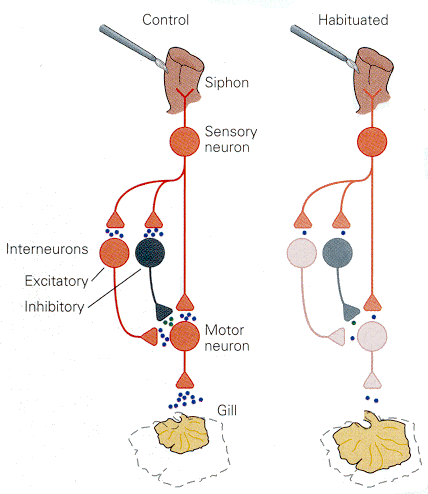
-
Doubting personal experienceNope. Not in my class. Are we talking university or primary school?
-
Doubting personal experienceWhy? Do you have a reason to think that there is no brain doing something inside your skull?
-
Doubting personal experienceDid I mention neurons?
But yes. If we were talking of mindfulness down at the level of simple creatures like sea slugs, then the habituation of neurons does become a relevant and unmystical framing of the discussion - https://en.m.wikipedia.org/wiki/Habituation -
Doubting personal experienceThe hand waving happens when science turns neurons into little humans. — Rich
What could that even mean? -
Doubting personal experienceSee what I mean by hand-wavy? You didn't mention the basal ganglia once. Instead you capitalised consciousness to show that all that messy neuroscience that fills hundreds of textbooks is stuff "you don't need to know". You can go right on talking confidently about this Consciousness as some mystic substance or plane of a creative being that all those dumb scientists have no freaking clue about.
-
Doubting personal experienceWell, yes, but you also have to acknowledge that there is a self-reinforcing tendency even amongst the intelligentsia. — Wayfarer
Sure. Scientists are human too. They have investments in belief systems. They have social boundaries to mark. They like fame and fortune as much as the next guy.
So what makes a difference is the institution of science. If that is strong, that is what shines through in the long run.
If psi exists and evidence for it is being suppressed, that would be bad news. But why shouldn't science as an institution suppress psuedo-science?
There was, or is, a group called PSICOPS (I think the name was changed) — Wayfarer
Yep. Committee for the Scientific Investigation of Claims of the Paranormal. Now called CSI - Committee for Skeptical Inquiry. http://www.csicop.org/
So we're dealing with a consensus model of reality, of the kinds of things that respectable scientists ought to study, and the kinds of things they ought not to. — Wayfarer
And what's wrong with a consensus view? Isn't that the whole bleeding point of rational inquiry into nature?
And when it comes to the careers of "respectable scientists", they don't have research careers unless they are at the fringe pushing for something new. The difference is that the existence of a consensus is what defines that fringe mostly. Scientists know where the next profitable place to dig is located.
So what we see 'scepticism' nowadays doing, is the exact opposite of what scepticism set out to do, namely, it nowadays defends the consensus reality of scientific realism, which determines the bounds of what reasonable people are supposed to think in the way religion used to do. And that is precisely the point where it morphs into scientism. — Wayfarer
So what you are describing is first the scientific mindset being born and now it being able to look back in satisfaction with all that it has achieved. Yah, boo, sucks to all the mystics out there.
Sure there is scientism - that excessive confidence in materialistic explanation. And yet it is within science that you find the best resources for also criticising that overly-reductionist viewpoint.
Sheldrake had zero impact on the state of consensus within theoretical biology. Yet holism and semiosis are alive and well in those same circles, building up their mathematical muscle.
apokrisis

Start FollowingSend a Message
- Other sites we like
- Social media
- Terms of Service
- Sign In
- Created with PlushForums
- © 2026 The Philosophy Forum