
Comments
-
Speculations in IdealismYou're right I don't understand the point of what Schopenhauer is trying to say. — Marchesk
Make an effort. He's saying: you assume the reality of the objects of experience, but what are 'objects', unless you've assimilated them into your mind via the synthesis of data, sensation, perception and understanding? What do you think your fantastically elaborated hominid forebrain spends all its time doing?
This is not a discussion about your or my personal experience, which obviously is limited by your or my death, but about the nature of knowledge, how the understanding works. It's an analysis made by standing back and reflecting on the processes implied by your seeing of the [apple/tree/chair/star].
It takes a change of perspective, but that's what philosophy requires - seeing things differently. -
Speculations in Idealismwhy experiences tend to end when a subject falls off a cliff. — Marchesk
That tells me you didn't understand the point of my post, but I've been down this rabbit hole umpteen times in the past, so I'll leave it there. -
Speculations in IdealismThis is not exacyly true. — Gregory
Disputes about Kant and Hegel and the meaning of noumena are a labyrinth which many enter but from which few emerge.
How does the idealist explain the end of their experience when hitting the bottom or dying from an infection? — Marchesk
Notice that your question assumes a perspective outside that of the subject of those experiences.
The point I’m making is that the very notion of ‘existence’ is predicated on there being defined objects arrayed in space and time. The meaning of ‘exist’ is ‘to stand apart’ - to be this, as distinct from that. And it is the mind that brings that order to the Universe. All of your statements assume that this order is real absent any point of view or perspective, not noticing that the mind creates the stage against which all such judgements are made in the first place.
The fundamental absurdity of materialism is that it starts from the objective, and takes as the ultimate ground of explanation something objective, whether it be matter in the abstract, simply as it is thought, or after it has taken form, is empirically given—that is to say, is substance, the chemical element with its primary relations. Some such thing it takes, as existing absolutely and in itself, in order that it may evolve organic nature and finally the knowing subject from it, and explain them adequately by means of it; whereas in truth all that is objective is already determined as such in manifold ways by the knowing subject through its forms of knowing, and presupposes them; and consequently it entirely disappears if we think the subject away. Thus materialism is the attempt to explain what is immediately given us by what is given us indirectly. All that is objective, extended, active—that is to say, all that is material—is regarded by materialism as affording so solid a basis for its explanation, that a reduction of everything to this can leave nothing to be desired (especially if in ultimate analysis this reduction should resolve itself into action and reaction). But we have shown that all this is given indirectly and in the highest degree determined, and is therefore merely a relatively present object, for it has passed through the machinery and manufactory of the brain, and has thus come under the forms of space, time and causality, by means of which it is first presented to us as extended in space and ever active in time. — Arthur Schopenhauer, World as Will and Idea -
Speculations in Idealismeach individual's first person perspective is unique to oneself.
— Wayfarer
That's what my intended point — Tom Storm
Each perspective is unique, but we're members of the same culture, species, tribe, language group, and so on. So we're unique in one way, but in others ways members of a group. The point being that our experiences are connected with those of others in our milieu, even if we only have first-hand knowledge of our own. (That's why the question 'how are you feeling?' is meaningful :-)
If what we take to be the physical world is the product of mentation - can you guess/describe what evolution is doing? — Tom Storm
On the one hand, the scientific attitude to evolution is non-teleological - evolution in a biological sense refers to nothing more than or other than the propogation of the genome and the evolution of species. To think of it evolving 'towards' anything, or having any particular reason, is rejected as orthogenetic. Of course there are philosophers who say those kinds of things - Henri Bergson was one, nowadays there are those who talk of 'creative evolution' or 'evolutionary enlightenment' but they're not mainstream (although there is a good deal of philosophical ferment in evolutionary biology).
So I suppose the question itself is really a metaphysical question - it's really a form of the question 'what is it all about?' I think natural science as such doesn't really consider such questions. Richard Dawkins, asked that kind of question, said, 'Why we exist, you're playing with the word "why" there. Science is working on the problem of the antecedent factors that lead to our existence. Now, "why" in any further sense than that, why in the sense of purpose is, in my opinion, not a meaningful question. You cannot ask a question like "Why down mountains exist?" as though mountains have some kind of purpose. What you can say is what are the causal factors that lead to the existence of mountains and the same with life and the same with the universe.'
Even so, both Donald Hoffman's work, and Pinter's book, assume an evolutionary stance, in that cognition is understood through the perspective of evolution. Beings have to cognise aspects of their environment in order to survive - even very simple beings. The point about beings is that they are differentiated from the environment, but have to exchange both information (in the form of stimuli) and matter-energy (nutrition) while still maintaining themselves (homeostasis). So in that sense, cognition is present in even the simplest of organisms (there are studies showing that bacteria are capable of learning). So cognition in that sense goes way back to the origin of life itself.
My intuitive belief is that as soon as life begins, there is the incipient development of a perspective, or a germinal subject of experience. Of course in bacteria and so on it's extremely vague and attenuated. So in that sense I'm getting closer to pan-psychism, with the caveat that I don't see consciousness as being at all characteristic of inorganic matter. But I mean, some of the ideas of the German idealists are all quite compatible with these kinds of ideas - not that I'm an expert in them - but Fichte, Schelling, Hegel, Schopenhauer, none of them would be particularly challenged by evolutionary theory (although I'm sure they would be critical of standard-issue neo-darwinian materialism.) (ref)
are cars, for instance, essentially the product of mentation — Tom Storm
I would've thought that pretty non-controversial. If some alien found Elon Musk's sports car sailing through space, it wouldn't see it as a natural phenomenon.
We see objects based on an inherent structure in our consciousness? — Tom Storm
Let’s begin with a thought-experiment: Imagine that all life has vanished from the universe, but everything else is undisturbed. Matter is scattered about in space in the same way as it is now, there is sunlight, there are stars, planets and galaxies—but all of it is unseen. There is no human or animal eye to cast a glance at objects, hence nothing is discerned, recognized or even noticed. Objects in the unobserved universe have no shape, color or individual appearance, because shape and appearance are created by minds. Nor do they have features, because features correspond to categories of animal sensation. This is the way the early universe was before the emergence of life—and the way the present universe is outside the view of any observer.
Pinter, Charles. Mind and the Cosmic Order (p. 1). Springer International Publishing. Kindle Edition. -
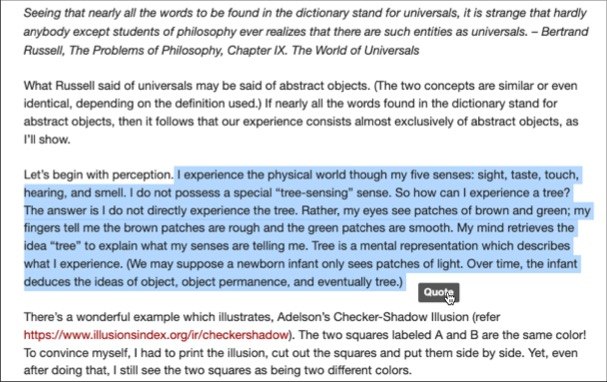
On the Existence of Abstract ObjectsI experience the physical world though my five senses: sight, taste, touch, hearing, and smell. I do not possess a special “tree-sensing” sense. So how can I experience a tree? The answer is I do not directly experience the tree. Rather, my eyes see patches of brown and green; my fingers tell me the brown patches are rough and the green patches are smooth. My mind retrieves the idea “tree” to explain what my senses are telling me. Tree is a mental representation which describes what I experience. (We may suppose a newborn infant only sees patches of light. Over time, the infant deduces the ideas of object, object permanence, and eventually tree.) — Art48
:up: Agree. Most modern philosophy forgets this fact.
By the way - to quote someone's post, select the text you want to quote and then click or tap the 'Quote' button which will hover above it. It will make the conversation easier to follow.
-
Speculations in IdealismBy 'unique' I just meant people have individual conscious experiences that don't seem connected to other's conscious experiences. — Tom Storm
But they are! We're connected with others through all of our relationships, speech, thoughts, empathy, and so on. The only sense in which we're not connected, is that each individual's first person perspective is unique to oneself. But that's also the same for everyone; everyone is 'I' from their own unique perspective. I know only my own pains, joys, and sensations directly, but I have no reason to believe that all of the other beings I'm sorrounded by do not have exactly analogous experiences of their own. Empathy is an antidote to solipsism.
That also accounts for the regularities we perceive, the fact that we all seem to see the same things. Hegel discussed that. 'Like Kant, Hegel believed that we do not perceive the world or anything in it directly and that all our minds have access to is ideas of the world—images, perceptions, concepts. For Kant and Hegel, the only reality we know is a virtual reality. Hegel’s idealism differs from Kant’s in two ways. First, Hegel believed that the ideas we have of the world are social, which is to say that the ideas that we possess individually are utterly shaped by the ideas that other people possess. Our minds have been shaped by the thoughts of other people through the language we speak, the traditions and mores of our society, and the cultural and religious institutions of which we are a part' - lecture notes.
Why is our car still in the carport the next morning after we sleep? Is the moon still there when we are not looking? — Tom Storm
It's not as if things come into and go out of existence when you or I are looking at them, or not. Existence of the car or the moon or anything else is constituted within our cognition of those objects. Furthermore, they are designated objects by sentient beings.
Presumably there was a concomitance emergence of higher consciousness in humans somewhere between being a fish and being a high functioning ape? — Tom Storm
You will often encounter those who rationalise human intelligence because of its supposed 'survival advantage'. You know, we were sorrounded by sabre-tooth tigers, but we could outwit them because of our bigger intelligence. I think that argument is dubious, because sharks, blue-green algae, and mushrooms have survived and flourished for hundreds of millions of years with little or nothing by way of rational intelligence. Second, because it subordinates reason to the exigencies of survival, which is typical of social- and some schools of neo-darwinism. It sells reason short, by equating it to mere adaptation. (Dawkins et al often commit this fallacy).
My view is, plainly h. sapiens evolved, along the lines that paleontology and evolutionary biology has discerned (although the detail are continuously changing). But the advent of speech, reasoning, story-telling and tool-making opens up a dimension of being which simply can't be explained in purely biological terms, without falling into biological reductionism. One thing I think I can state is that h.sapiens alone is able to ask 'what am I?' (I know other animals can pass the mirror test, but I don't think it counts.)
So what evolves is not reason as such, but the capacity for reason. I mean, it's not as it the law of the excluded middle, or real numbers, came into existence due to evolution. What evolved was the capacity to understand them. Which is reasonably contiguous with both evolutionary theory and Platonism, in my view.
There's another point, but it's a major argument in its own right, about whether reason can be understood in terms of biological adaptation:
the reason [Dennett] imputes to the human creatures depicted in his book is merely a creaturely reason. Dennett's natural history does not deny reason, it animalizes reason. It portrays reason in service to natural selection, and as a product of natural selection. But if reason is a product of natural selection, then how much confidence can we have in a rational argument for natural selection? The power of reason is owed to the independence of reason, and to nothing else. — Leon Wiesletier
That criticism is also the basic thrust of Plantinga's Evolutionary Argument against Naturalism, and C S Lewis Argument from Reason.
So by that token idealism makes no practical difference to a life lived? — Tom Storm
By no means! Living beings are the way in which meaning enters the universe. Rational sentient beings are those able to realise that. -
Speculations in Idealism1. How we can appear to have separate people with unique conscious experiences.
They're not totally unique. The more unique there are, the harder to communicate. Look up the meaning of 'idiosyncratic'. It basically means not understandable to others.
2. How reality (such as it is) appears to be consistent and regular.
We are all the same species, culture, language group, etc. But glaring discrepancies appear all the time. I mean, there are still people who think Trump was great.
3. How evolution tracks to idealism.
Appealing to evolution as a support for why reason might be true is the subject of Plantinga's Evolutionary Argument Against Naturalism, and also the broader Argument from Reason. Both have generated many volumes.
4. Whether we require a universal mind for idealism to be coherent. Other models?
That mind is not numerically one, but is of a kind, like space - the capacity for experience, or something of that nature.
5. Whether the Copenhagen Interpretation and the perceived flaws in a materialist metaphysics have been key in a recent revival of idealism?
If the alternative is Everett, the Copenhagen is a model of modest philosophical reasoning.
6. What might be the role of human beings in an idealist model?
Sentient life of all kinds are the way the Universe realises dimensions of being. Rational sentient beings are able to reflect on that. -
Basic Questions for any KantiansAnd I understand why that view gets a lot of pushback. We rely on our sense of reality to get our bearings and anything which challenges it has to be resisted. But challenging your sense of what is normal and real is what philosophy is for.
-
Basic Questions for any KantiansAll I'm saying is that for the purposes of human experience and understanding there are publicly accessible objects — Janus
There are no objects publicly accessible or otherwise outside the cognition of sentient beings. Science makes no assumptions about the matter, but Bernardo Kastrup, Donald Hoffman and Chris Fuchs are scientists. Pinter's only other books are on algebra and set theory. No need to bring in God, 'ultimate truth' or Wittgenstein, it is one of the things that has become apparent through 20th C science itself.
We have found that where science has progressed the farthest, the mind has but regained from nature that which the mind has put into nature. We have found a strange foot-print on the shores of the unknown. We have devised profound theories, one after another, to account for its origin. At last, we have succeeded in reconstructing the creature that made the foot-print. And Lo! it is our own. — Arthur Eddington -
Basic Questions for any KantiansIf physicists did not absolutely reliably discover the same readings, no physics would be possible. — Janus
You're just talking out of your comfortable assumed realism. Science suggests otherwise. Anyway - duty calls, I have a commercial assignment to start, so I'll bow out for now. Cheers. -
Basic Questions for any KantiansAll the experiments its theory is based on are done with "publicly accessible objects"; we rely on the measurements and results they show to derive the theory in the first place. — Janus
They're not, though. That is the whole point of the 'observer problem'. That is why Einstein had to ask his friend Michael Besso, 'doesn't the moon continue to exist when nobody's looking at it?' It is precisely the status of the observer-independence of the objects of physics that has put this all into question. -
Basic Questions for any KantiansAs you know, I respect many elements of Platonist/Aristotelian philosophy.
The basic sketch I give is ultimately Kant's - his categories were adopted from Aristotle as can be seen here. Of course it is true that the ancients, and Kant for that matter, had no idea of what modern science would discover but unlike many others here, I don't accept that this has rendered classical philosophy obsolete. Rather they're in need of commensuration - interpreting them in such a way that they're intelligible in today's context. -
Basic Questions for any Kantians
The idea that what we’re doing is measuring publicly accessible objects, the idea that objectivity results from the fact that you and I can measure the same object in the exact same situation and get the same results — it’s very clear from quantum mechanics that that idea has to go. Physics tells us that there are no public physical objects. So what’s going on? Here’s how I think about it. I can talk to you about my headache and believe that I am communicating effectively with you, because you’ve had your own headaches. The same thing is true as apples and the moon and the sun and the universe. Just like you have your own headache, you have your own moon. But I assume it’s relevantly similar to mine. That’s an assumption that could be false, but that’s the source of my communication, and that’s the best we can do in terms of public physical objects and objective science. — Donald Hoffman
Reality is not 'just an experience'. It's a constructive activity which synthesises elements of sensory data with the categories of the understanding to generate the phenomenal experience. What's being called into question is the existence of what is purportedly 'outside of' or 'independent of' those gestalts. -
Basic Questions for any KantiansBut if reality were nothing like what we experience, — Janus
He's not saying that. I don't think you've taken in what he's saying. I would say (although he doesn't say) that what he and Chris Fuchs are both calling into question is the assumption of a mind-independent reality. -
Basic Questions for any KantiansThe problem I find with Hoffmann's theory is that if reality is nothing like what we experience, then how could he arrive at the conclusion that reality is nothing like what we experience. — Janus
Through reason and experimental observation. He calls his theory 'conscious realism' - objective reality is something in the minds of conscious agents. But because we're all immersed in the same milieu, the experiences of those agents will sync to a very high degree. It there a reality 'outside of' or 'apart from' that? Well, how could you tell? You can't stand outside your own cognitive apparatus to determine that.
The idea that what we’re doing is measuring publicly accessible objects, the idea that objectivity results from the fact that you and I can measure the same object in the exact same situation and get the same results — it’s very clear from quantum mechanics that that idea has to go. Physics tells us that there are no public physical objects. So what’s going on? Here’s how I think about it. I can talk to you about my headache and believe that I am communicating effectively with you, because you’ve had your own headaches. The same thing is true as apples and the moon and the sun and the universe. Just like you have your own headache, you have your own moon. But I assume it’s relevantly similar to mine. That’s an assumption that could be false, but that’s the source of my communication, and that’s the best we can do in terms of public physical objects and objective science. — Donald Hoffman
That is compatible with QBism (not to mention a lot of the ideas that Apokrisis brings in).
QBism would say, it’s not that the world is built up from stuff on “the outside” as the Greeks would have had it. Nor is it built up from stuff on “the inside” as the idealists, like George Berkeley and Eddington, would have it. Rather, the stuff of the world is in the character of what each of us encounters every living moment — stuff that is neither inside nor outside, but prior to the very notion of a cut between the two at all. — Chris Fuchs
Which is also what Charles Pinter is saying.
(It's also what I've tried to say many times over the years in saying that reality has a subjective pole or element that is not noticed or hidden, which for some reason you kept insisting was obvious.) -
Issues with karmaI don’t need to imagine a world without religion. Only fucking fools can’t imagine such a world though, I would say. — praxis
You'd be bereft if it happened - nothing to kvetch about.
The consequences of unintentional actions are just as real as intentional ones. — Harry Hindu
With the significant caveat that they're out of our control. -
Basic Questions for any KantiansFor Hoffman it is ludicrous to talk of "neurons giving rise to minds," as such because "neurons" only exist in the minds of human beings. — Count Timothy von Icarus
That's an argument I've pursued on this forum myself. The entire problem with physicalism is the meaning of causation or 'giving rise to' when proposing a causal relationship between the brain and the mind, even though it is so widely assumed as an obvious truth. Kastrup puts it like this:
qualities have no function under materialism, for quantitatively-defined physical models are supposed to be causally-closed; that is, sufficient to explain every natural phenomenon. As such, it must make no difference to the survival fitness of an organism whether the data processing taking place in its brain is accompanied by experience or not: whatever the case, the processing will produce the same effects; the organism will behave in exactly the same way and stand exactly the same chance to survive and reproduce. Qualia are, at best, superfluous extras.
Therefore, under materialist premises, phenomenal consciousness cannot have been favoured by natural selection. Indeed, it shouldn’t exist at all; we should all be unconscious zombies, going about our business in exactly the same way we actually do, but without an accompanying inner life. If evolution is true—which we have every reason to believe is the case—our very sentience contradicts materialism. — Bernard Kastrup, Consciousness Cannot have Evolved (paywalled)
Which is precisely why Dennett wants to eliminate it ;-) (And actually, there's a connection between that insight, and the 'argument from reason', which likewise argues that to reduce reason to an evolutionary adaptation is to undermine its sovereignty.)
I read Adam Becker's book also, but I thought it got tangled in the weeds towards the end - longing for a realist conclusion which is not there to be found. Manjit Kumar's book Quantum is better IMO. I'm also impressed by QBism, which Pinter mentions.
Charles Pinter's book is an unsung classic in my view. I think it helps that he's outside academic philosophy - he's a mathematician with a long interest in neural modelling. But it's a model of clarity and conciseness and I recommend it.
A major theme of this book is that “reality” is not confined to matter and its physical properties. There is a whole firmament of appearances, sensations, perceptions, insights and wide-ranging Gestalt vision. These things exist in the minds of sentient creatures, and are often won by hard and persistent effort. It is true that they exist only in animal minds, but they are nonetheless real and indispensable aspects of the universe. What is shown above is that the very existence of hierarchically complex objects is confined to the minds of living observers. Only living minds apprehend complexity and multiplicity. Complexity exists in the universe solely because it is discerned—in fact created—in minds. It exists only in minds.
Pinter, Charles. Mind and the Cosmic Order (pp. 86-88). Springer International Publishing. Kindle Edition. -
Issues with karmaSomeone told me Steely Dan's 'Only a Fool would Say That' was written in response to John Lennon's Imagine.
Figures.
//even found a ref!// -
Do drugs produce insight? Enlightenment?'Unleashing the drugs of war' conjures up a vivid image. Kind of what the Vikings used to do with amanita mushrooms, I imagine.
-
Basic Questions for any Kantians:up: In that case, you do get it. I just thought I might have distracted you from the main point of my review with that remark about the constitution of reason which is really outside the purview of Pinter's book (though obviously not of Kant!)
-
Issues with karmaYou’ve made your view clear, but I don’t share it. It’s true that the Hindu caste system exploited the idea of karma for its purposes. As I already said, there was a large-scale social movement in India to convert the Dalits to Buddhism in large part because Buddhism doesn’t recognise the caste system. See https://en.m.wikipedia.org/wiki/Dalit_Buddhist_movement
-
Do drugs produce insight? Enlightenment?Psychedelics Give a Glimpse of Enlightenment
https://www.psychologytoday.com/us/blog/the-meditating-mind/202207/psychedelics-give-glimpse-enlightenment?eml -
Basic Questions for any KantiansI’ve only read the Hoffman article I linked to, though probably should invest some time in the book. At first I was sceptical about Hoffman but I’m beginning to see the sense in what he’s saying.
In my post about Pinter’s book above, I specifically mention where in his account he says the noumenal enters the picture. It’s not at all as I would have thought - not some ghostly backstage thingimy, but the purely quantitative attributes of the ‘simples’ of scientific analysis.
My philosophical interpretation is close to what Pinter hints at: that sentient beings bring meaning into a meaningless universe, they open up an experiential dimension to existence which is otherwise absent. (That's why we're called 'beings'!) The fundamental problem with modern philosophy and science is in regarding beings as objects, rather than recognising that their nature as beings will always elude objective analysis, and the concommitant belief that the universe depicted by science is the only real universe, thereby forgetting the role of the observing mind in bringing meaning to it. (I think this is what Heidegger means by the 'forgetfulness of being'.)
It’s also close to what Nagel says:
We ourselves, as physical organisms, are part of [the] universe, composed of the same basic elements as everything else, and recent advances in molecular biology have greatly increased our understanding of the physical and chemical basis of life. Since our mental lives evidently depend on our existence as physical organisms, especially on the functioning of our central nervous systems, it seems natural to think that the physical sciences can in principle provide the basis for an explanation of the mental aspects of reality as well — that physics can aspire finally to be a theory of everything.
However, I believe this possibility is ruled out by the conditions that have defined the physical sciences from the beginning. The physical sciences can describe organisms like ourselves as parts of the objective spatio-temporal order – our structure and behavior in space and time – but they cannot describe the subjective experiences of such organisms or how the world appears to their different particular points of view. There can be a purely physical description of the neurophysiological processes that give rise to an experience, and also of the physical behavior that is typically associated with it, but such a description, however complete, will leave out the subjective essence of the experience – how it is from the point of view of its subject — without which it would not be a conscious experience at all. — Thomas Nagel, Core of Mind and Cosmos -
Basic Questions for any KantiansI can see how this is all compatible with phenomenology. — Tom Storm
Don't miss the main point.
No, Pinter does not try and explain the origin of mind. Wise choice, I think. -
US politicswe will see Hagel’s dielectric at work. — Paulm12
You mean Chuck Hagel?
Sorry, flippant remark, I'm sure you meant Hegel.
Anyway - my view is that while there is a great deal of systematic rot in the entire American and for that matter Western political system, that the so-called 'right' - in the form of the rabid right, of the Tea Party and Trump Cult type, are the principle villians in the piece. Some of the ideological extremism of the left is also infuriating but overall, if I was American, which I'm not, although with American relatives, I would have to support the Democratic Party. -
Basic Questions for any KantiansDoes Pinter account for what generates the structure and properties of (the) mind(s) which generates the structure and properties of the world / cosmos? — 180 Proof
He does say that 'the animal sensorium' is present in even the most simple of sentient creatures - the example he gives is an insect type called fairyflies, which are tiny, 0.13 and 0.25 mm, but which have organs for digestion, reproduction etc. His view is that from the earliest species, animals form gestalts of their environment in order to negotiate it, so that what is meaningful to a species are the gestalts that are shaped by their purposes, which in turn are shaped by the exigencies of survival. He discusses Donald Hoffman for several pages.
What Hoffman claims is that the way objects appear to us is dictated by considerations of fitness and not realism. What an animal experiences seeing may be unlike a high-fidelity reproduction of reality, with all its complexity and inscrutability—yet it may be far more helpful when the animal needs to size up the current situation correctly and act appropriately. The claim is that so long as all the experiences a creature has with objects are consistent with one another—with no discrepancies of any kind—the creature is far better off interacting in mind with usefully simplified and schematized replicas.
Pinter, Charles. Mind and the Cosmic Order (pp. 12-13). Springer International Publishing. Kindle Edition.
More on Hoffman's theories can be found here. -
Basic Questions for any KantiansRe-visiting this thread because the book I've just read, Mind and the Cosmic Order, has provided a new interpretive model for 'the noumenal'.
This is the first paragraph in the introduction:
Let’s begin with a thought-experiment: Imagine that all life has vanished from the universe, but everything else is undisturbed. Matter is scattered about in space in the same way as it is now, there is sunlight, there are stars, planets and galaxies—but all of it is unseen. There is no human or animal eye to cast a glance at objects, hence nothing is discerned, recognized or even noticed. Objects in the unobserved universe have no shape, color or individual appearance, because shape and appearance are created by minds. Nor do they have features, because features correspond to categories of animal sensation. This is the way the early universe was before the emergence of life—and the way the present universe is outside the view of any observer. — Pinter, Charles. Mind and the Cosmic Order (p. 1)
What the observer brings is the picture:
When we open our eyes and observe the world around us, we don’t see a smooth, evenly distributed continuum, but a scene that is sharply and unambiguously divided into separate objects. Each of these objects is familiar to us, we know their identities, and we are able to name them. To the animal [i.e. sensory] mind, the world is subdivided into separate, discrete things. Without a separation into independent parts, nothing would be comprehensible, there could be no understanding, and thought would not be possible.
...Common sense has us believe that the world really does consist of separate objects exactly as we see it, for we suppose that nature comes to us ready-carved. But in fact, the animal visual system does such a thorough job of partitioning the visual array into familiar objects, that it is impossible for us to look at a scene and not perceive it as composed of separate things. — (p. 67)
He makes the point that the scientific 'view from nowhere' comprises nothing more than, or apart from, the formal relationships of objects and forces without any features:
with no color, appearance, feel, weight or any other discernible features. In fact, every feature which might impact the senses—hence produce an impression of some kind—is absent because in this hypothetical universe there is no life and there are no senses. Everything material may be there, but not the senses. As Kant said about the noumenal world (which is the same as the mind-independent world), nothing can be said about its objects except that they exist. — p.118
So in this usage 'the noumenal' actually conforms with its dictionary definition, that being a 'pure object of thought' (with the caveat that 'thought' here means 'quantitative expression'.) He points out that the formal objects of science do not comprise any kind of image:
When you speak of a straight line in science, you must suppress the image of the taut string in mind. You must force yourself to forgo any mental picture of what a straight line looks like, and instead, think of it as nothing but an empty word. When you use that word, you may hold the image of the taut string in mind, but that’s for your own benefit: It may guide your intuition but should not participate in your reasoning. ...If that were permitted, then the laws of science would depend on the meanings we attach to concepts—on the mental images we hold in mind. — Pp118-120
He says that science proceeds by the 'addition of simples' meaning the discovery of the simplest quantitative elements which can combine to produce complexity. But the structure of complex phenomena are brought to them by the perceiver:
Newton’s equations, which apply to pairs of bodies in space, determine the trajectories of planets around the sun. However, these trajectories are meaningful only to beings who see and conceive in Gestalts. The shape of an orbit, though it exists only in the eyes of a Gestalt observer, is a direct consequence of Newton’s laws, and no further principle is needed to account for it. Although the shapes of orbits are fully determined by the underlying physics (that is, by addition of simples), orbits exist only in the scheme of reality of Gestalt observers. The reality which a Gestalt observer perceives is quite different from that of the underlying physical world. In the Gestalt whole, the observer sees patterns—and these patterns do not exist in the ground reality because patterns emerge only in spread-out wholes and exist only in Gestalt perception. — p124
However, thoughts are real, but in a different sense to the formal objects of scientific analysis:
Sensations, beliefs, imaginings and feelings are often referred to as figments, that is, creations of the mind. A mental image is taken to be something less than real: For one thing, it has no material substance and is impossible to detect except in the mind of the perceiver. It is true that sensations are caused by electrochemical events in a brain, but when experienced by a living mind, sensations are decisively different in kind from electrons in motion. They are indeed “figments” because they exist nowhere except in awareness. As a matter of fact, they exist only as claims made by sentient beings, with no material evidence to back up those claims. Indeed, brain scans reveal electrical activity, but do not display sensations or inner experience. — (p. 52).
Pinter advocates for a form of dualism but it's exceptionally clear and quite simple. And it does dovetail quite well with Kant's transcendental idealism except that he doesn't go into the nature and structure of reason, as such - although that would have made it a completely different book. One of the main advantages of this book is its clarity and focus. It has really helped me to understand the sense in which the world is 'mind-generated' - not the world in its entirety, not the whole vast universe of space and time, but 'world' as, and insofar as it is, a meaningful whole - which is the meaning of 'cosmos' - and in which the mind plays a fundamental part.
the meaningful connectedness between things — the hierarchical organization of all we perceive — is the result of the Gestalt nature of perception and thought, and exists only as a property of mind. These insights give the first glimmerings of a new way of seeing the cosmos: not as a mineral wasteland but a place inhabited by creatures. -
Issues with karmaInteresting comment in the Brittanica entry:
The connection between the ritual and moral dimensions of karma is especially evident in the notion of karma as a causal law, popularly known as the “law of karma.” Many religious traditions —notably the Abrahamic religions that emerged in the Middle East (Judaism, Christianity, and Islam)—place reward and punishment for human actions in the hands of a divine lawgiver. In contrast, the classical traditions of India—Hinduism, Buddhism, and Jainism, much like the Vedic sacrificial theology that preceded them—view karma as operating according to an autonomous causal law. No divine will or external agent intervenes in the relationship of the moral act to its inevitable result. The law of karma thus represents a markedly nontheistic theodicy, or explanation of why there is evil in the world.
That is the reason why many 19th and 20th century Buddhist advocates would claim that Buddhism is 'scientific', where karma is portrayed as a causal law on a par with Newton's laws of motion - which of course it can't be, as there's no way of measuring it. But I still believe the idea provides a naturalistic basis for ethics. -
Issues with karmaIt's amazing how twisted up you can get over the concept that all intentional actions have consequences.
-
Issues with karma. I am not the expert, but my suspicion is that the doctrine does not come from Buddha himself, but is an accretion that probably predates him. — unenlightened
Incorrect. In the Buddha's day, meritorious karma was accrued by performing the appropriate ritual sacrifices, and for the laity by supporting the Brahmin priesthood. The Buddha kept the basic principle but attached it wholly and solely to the qualities of intentional actions and their results. For him, a brahmin is not an hereditary privilege but the mark of true virtue. It's a bedrock principle of Buddhism from the beginning, although I agree that when it is used to rationalise fatalism it has been misappopriated. Again see what Bhikhu Thanisarro has to say on it (he's an American monk alive and practicing today) https://www.dhammatalks.org/books/NobleStrategy/Section0005.html
instead of promoting resigned powerlessness, the early Buddhist notion of karma focused on the liberating potential of what the mind is doing at every moment. Who you are—what you come from—is not anywhere near as important as the mind’s motives for what it’s doing right now. Even though the past may account for many of the inequalities we see in life, our measure as human beings is not the hand we’ve been dealt, for that hand can change at any moment. We take our own measure by how well we play the hand we’ve got. If you’re suffering, you try not to continue the unskillful mental habits that would keep that particular karmic feedback going. If you see that other people are suffering, and you’re in a position to help, you focus not on their karmic past but your karmic opportunity in the present: Someday you may find yourself in the same predicament they’re in now, so here’s your opportunity to act in the way you’d like them to act toward you when that day comes.
('The first will one day be last' - some famous religious teacher.)
It fits right in with the caste system, and helps to sustain it along with rampant toxic sexism — unenlightened
Not the way the Buddha taught it. It's one of the main reasons Buddhism did not survive in India. There's been a political movement towards Buddhism amongst the Dalits (outcastes) in the 20th Century because it's outside of the caste system. -
Issues with karmaMyanmar. Plenty of instances of violence there openly encouraged by buddhist monks. — I like sushi
Yes indeed, Burmese buddhist nationalism has been a pretty horrible stain on the religion. So to the involvement of Japanese Zen Buddhists in World War 2. Although none of that invalidates the basic idea of karma, which in my view is a logical and consistent basis for ethics.
I think viewing misfortune in this life as some kind of penance for misgiving in some imagined previous life is an abhorrent idea that essentially has some people categorised as ‘deserving their fate’ by simply being born with some form of disability or other. — I like sushi
Totally agree, but I think as soon as it's used for justification of the suffering of others, it's a misreading of the principle. Also the rationalisation of disability or illness as 'bad karma' is, I think, pretty abhorent all around. When understood as a regulative principle for one's own actions it's a very different story. -
Logical Necessity and Physical CausationI don't think that Aristotle's metaphysics is consistent with what is today referred to as platonic realism. — Metaphysician Undercover
There is a difference but broadly speaking Aristotle is part of the platonist tradition. (That's why Gerson wrote a book called Aristotle and Other Platonists.) I do understand the distinction between Platonic and Aristotelian realism. But that is beside the point that I was trying to make, so if you could set that particular issue aside, you might consider it on its merits. The metaphysical/ontological issue I'm interested in, is the sense in which numbers, universals, and the like exist.
The (traditional) realist believes that universals are real; nominalists assert that only particulars are real; conceptualists that they exist as concepts in the mind. The latter sounds like a satisfactory compromise, except that it subjectivizes them, makes them the property of the mind. Whereas according to Augustine
Intelligible objects must be independent of particular minds because they are common to all who think. In coming to grasp them, an individual mind does not alter them in any way; it cannot convert them into its exclusive possessions or transform them into parts of itself. Moreover, the mind discovers them rather than forming or constructing them, and its grasp of them can be more or less adequate. Augustine concludes from these observations that intelligible objects cannot be part of reason's own nature or be produced by reason out of itself. They must exist independently of individual human minds.
Compare what Frege says of arithmetical primitives such as number:
Frege believed that number is real in the sense that it is quite independent of thought: 'thought content exists independently of thinking "in the same way", he says "that a pencil exists independently of grasping it. Thought contents are true and bear their relations to one another (and presumably to what they are about) independently of anyone's thinking these thought contents - "just as a planet, even before anyone saw it, was in interaction with other planets." '
I've been quoting both these passages on here for years but I still think they make a fundamental point regarding the reality of intelligibles. So after completing Pinter's book Mind and the Cosmic Order which is solidly grounded in empirical argument, I think I've found a way to commensurate such ideas with current science. And it's because such basic elements of rational thought are literally structures in our conscious experience and our rational grasp of the world. They're neither 'in' the world nor 'in' the (individual) mind, which is the apparent dichotomy on which every explanation seems to founder, in my view.
Consider what Einstein says here:
I believe, for instance, that the Pythagorean theorem in geometry states something that is approximately true, independent of the existence of man. — Albert Einstein
Which I agree with. But it can only be grasped by a human, or at any rate by a rational intelligence. That is the sense in which the Pythagorean theorem is a formal structure within reason. But that doesn't make it subjective, because it is the same for any mind. -
Immortality - what would it be like?Immortality and or eternal youth to me seems like my personal hell. — Benj96
Careful what you wish for! -
Can we turn Heidegger’s criticism of objectivity into a strong basis for subjectivity?I agree with the some elements of your post, but you could detach it from Heidegger and it would work just as well.
There's also a distinction that can be made between 'subjectivity' and 'subject-hood'. The latter is a rather awkward neologism, but it's supposed to get at the state of being a subject, rather than the more narrowly-defined 'defined by one's own interests'. The subject in that sense is simply the pre-condition of all experience.
In other words, something similar to the Buddhist idea that we, or our destiny, are just an element of the whole universe, so that separated subjectivities are just our mental creation. This way, there is not me, you, they, but just the whole, with some kind of apparent distinctions not very important. — Angelo Cannata
I don't know if that is 'the Buddhist idea'. The teaching of non-self, anatta, is always given adjectively, as a description of the attributes of phenomenal experience which are anatta, anicca (impermanent) and dukkha. The Buddha however does not deny personal agency, contrary to millenia of misconceptions about this point - see for instance this sutta.
The key point is that 'the subject' is unknowable - not that 'it' exists or doesn't exist - both the idea that self exists, or doesn't exist, are faulty, according to Buddhism, being the so-called 'extreme views' of eternalism and nihilism, respectively.
In Hinduism, which the Buddha differentiated his teaching from, the subject is conceived as ātman which is usually translated as something like 'transcendental ego' or 'self of all beings'. Buddhists don't recognise that idea, except in the sense that all beings have the potential capacity for enlightenment.
Have a look at It Is Not Known but it is the Knower, (pdf) Michel Bitbol. He's a philosopher of science, historian of Schrodinger's writings, and is well versed in Indian philosophy. Might be closer to what you're looking for than Heidegger. -
Is there an external material world ?What you seem to be missing is the advancements which Aristotle and Aquinas have made — Metaphysician Undercover
We've discussed that a lot, and no, I haven't missed it. As I just said, which you seem to have missed, I am quite persuaded by platonic realism - by which I also mean Aristotelian's take on it. We discussed this blog post on it a long time ago. I also frequently refer to Maritain's criticism of empiricism.

Wayfarer

Start FollowingSend a Message
- Other sites we like
- Social media
- Terms of Service
- Sign In
- Created with PlushForums
- © 2026 The Philosophy Forum