
Comments
-
Joe Biden (+General Biden/Harris Administration)True, I did use the word too loosely, but then, only one of the two parties has a standard bearer who has been indicted for interfering with the democratic process. But I’ll save any further comments on that for the Trump thread.
My view of Biden is that he’s old, but he’s tough, and he’s competent. -
Joe Biden (+General Biden/Harris Administration)best democracy in the world" — Benkei
Nowhere near. Westminster system is superior to presidential political systems. But a functioning American democracy is better than a MAGA fascist dictatorship, which are the two current alternatives. -
Climate change denialMaybe you can pull up some of those articles from those eras, warning of global warming. I'm curious. — jgill
I did mention a speech by Margeret Thatcher to the UN in 1989, warning of the looming issue of greenhouse gases, as it was mainly called then. NASA scientist James Hansen provided an urgent warning to the US Senate in 1988, which largely went unheeded. -
Climate change denialDelivery vans in Pittsburgh. Buses in Milwaukee. Cranes loading freight at the Port of Los Angeles. Every municipal building in Houston. All are powered by electricity derived from the sun, wind or other sources of clean energy.
Across the country, a profound shift is taking place that is nearly invisible to most Americans. The nation that burned coal, oil and gas for more than a century to become the richest economy on the planet, as well as historically the most polluting, is rapidly shifting away from fossil fuels.
A similar energy transition is already well underway in Europe and elsewhere. But the United States is catching up, and globally, change is happening at a pace that is surprising even the experts who track it closely.
Wind and solar power are breaking records, and renewables are now expected to overtake coal by 2025 as the world’s largest source of electricity. Automakers have made electric vehicles central to their business strategies and are openly talking about an expiration date on the internal combustion engine. Heating, cooling, cooking and some manufacturing are going electric. — The Clean Energy Future Is Arriving Faster Than You Think, NY Times
And in spite of all of the concerted efforts to block it. -
Vervaeke-Henriques 'Transcendent Naturalism'No mention of Heidegger or Dreyfus in this. — plaque flag
The Meaning Crisis episode on Heidegger is here. Dreyfus comes up in this episode and in a subsequent episode on Paul Tillich. (He specifically mentions a book by Dreyfus and Charles Taylor, Recovering Realism, which as it happens I own a copy of.)
Would this not be enabled rather than hindered by a free society ? — plaque flag
Surely, but there’s nothing native to modern liberal democracies which foster it. We have the freedom to pursue any ‘ecologies of practice’ we want to but absent the connective tissue provided by culture they can be very difficult to develop and enact. I was part of an informal Buddhist practice group for about ten years which was invaluable but it dispersed and it’s been impossible to replace.
That, by the way, is a very good overview, I hadn’t found it previously.
Watch this trailer. The full movie has been released on YouTube but the trailer is a mini-documentary in its own right. Dreyfus is in it.
-
Donald Trump (All General Trump Conversations Here)Trump could hire a team of 1,000 lawyers — Metaphysician Undercover
Trump burns through lawyers like most folks do toilet rolls, and the supply of the former is considerably more constrained than the latter. Not to mention the expense :yikes:
https://www.politico.com/news/2023/08/12/trump-legal-costs-pac-00110960 -
Donald Trump (All General Trump Conversations Here)Anti-"Deep State" Federalist Society legal scholars argue that Seditionist-Traitor-Rapist1 is CONSTITUTIONALLY DISQUALIFIED from ever being POTUS again: — 180 Proof
I read that (fooloso4 posted the link.) If the seditious conspiracy trial, now slated for Jan 2 2024, results in a guilty verdict, it wouldn’t be too much of a stretch for an interested party to file suit on this basis, with a very firm constitutional foundation. Here’s hoping it happens, and that some decent conservatives - there are such - become party to it. (Although one would have hoped that the very fact that DJT will not recognise the validity of the last election he contested would itself be sufficient grounds for disqualification from the next one. Alas, common sense does not have much footing in the current American political scene.) -
Rationalism's Flat OntologyThe Adyar Bookshops had an unmistakable atmosphere, incense-scented, full of mystical tomes and tidings. Last surviving one in my city closed early 2000’s, as I say, victim of online retailing. But all the books that really meant something to me in my 20’s and 30’s came from there.
//correction, closed 2012, story here.// -
Rationalism's Flat OntologyAll our turned toward reality in its fullness, correcting scientism without embracing irrationalism. I can only think they don't interest you as much as they might because they aren't esoteric. — plaque flag
I came into philosophy through the Adyar Bookshop.
I will say, Vervaeke’s lectures are bringing it all together for me - lashings of phenomenology, cognitive science, and sapiential wisdom teachings. -
Rationalism's Flat OntologyOne of the main tributaries of modern liberalism was, of course, Christianity. And Christianity 'levels the playing field' - it promises salvation for all (of course, on the condition that you believe in it.) Whereas philosophical spirituality, or spiritual philosophy, makes no such guarantee - it is one of the reasons that early Christianity eclipsed both philosophy and gnosticism, both of which were depicted as 'elitest' or 'intellectualist'. I think we've retained the emphasis on the uniqueness of every living soul, but without the original religious rationale for it - meaning that, in the sphere of ethics, or the qualitative dimension, we have a kind of view that all opinions about it are equal.
That reminds me of something we discussed previously, in an essay by Edward Conze about perennial philosophy - the belief that 'as far as worth-while knowledge is concerned not all men are equal, but that there is a hierarchy of persons, some of whom, through what they are, can know much more than others; that there is a hierarchy also of the levels of reality, some of which are more "real," because more exalted than others.' I think you will see versions of that in Joseph Campbell (and Jung and Hillman) but that there's a real tension between that and liberal democracies. I think that's why there is often a link between perennialism or traditionalism and right-wing political movements. -
Rationalism's Flat OntologyThe issue is again whether the rational community is the arbiter or whether a prophet who alone can the higher levels appears and takes control. — plaque flag
There is a kind of understanding that requires a transformation in the knower, that can only be known first-person. Science also requires a transformation in the sense that you have to be able to grasp the mathematical basis of many of the hypotheses, but this concerns a more immediate mode of understanding. So it might seem 'mystical or esoteric' in the absence of that.
How many people deny the existence of meaning? — plaque flag
Didn't Neitszche portend nihilism as the default condition of modern man? Heidegger had something to say about that too. So, I think the answer is, 'very many', and I think it's directly related to the loss of the vertical dimension, the qualitative dimension.
I can't help but think you are frustrated with the status of philosophy in our society. — plaque flag
I'm certainly frustrated with a lot of what passes as philosophy in our society. -
Rationalism's Flat OntologyAny postulated higher beings would have to be justified in the rational conversation — plaque flag
Isn't what you mean by 'rational' in this thread empirically or scientifically justifiable? I note that my entry reflexively provokes the objection to 'postulated higher beings'. I suppose that means that what I wrote 'sounds religious'. I will admit to that, I do often 'sound religious', in that I question the secular physicalist consensus. But can't see any choice but to do that in order to arrive at a meaningful ontology. And that inevitably provokes this kind of response. That's a kind of unstated premise in the description 'flat' - no levels!
I've been listening to the work of a Canadian professor of psychology and cog. sci., John Vervaeke, who is gathering a large popular following on Youtube (links to a series of lectures.) His starting point was what he calls 'the meaning crisis' which is manifest in almost every aspect of today's culture, and his lectures encompass many religious or spiritual themes, but he (and his many collaborators) want to stay grounded in naturalism and remain fully cognizant of science. But given that, he recognises the need for levels of being, which correspond also to different levels and kinds of knowing, to which end he adopts and adapts a version of neoplatonic ontology, culminating in what he describes in a later series of talks as 'transcendent naturalism' (that is, naturalism not confined to materialist reductionism). I won't try and break it down or present it here but suffice to note that the earlier graphic I posted would not, I think, be incompatible with the kind of structures he's proposing.
The Sellarsian idea with which McDowell begins is that this difference ought to be understood in terms of the space of reasons. — Brandom
I've explored Sellars 'space of reasons' a little (although I find Sellars very difficult reading). Suffice to say, I'm persuaded by it. @Pierre-Normand pointed out an interesting book on a similar theme, Rational Causation, by Eric Marcus (ref):
We explain what people think and do by citing their reasons, but how do such explanations work, and what do they tell us about the nature of reality? Contemporary efforts to address these questions are often motivated by the worry that our ordinary conception of rationality contains a kernel of supernaturalism—a ghostly presence that meditates on sensory messages and orchestrates behavior on the basis of its ethereal calculations. In shunning this otherworldly conception, contemporary philosophers have focused on the project of “naturalizing” the mind, viewing it as a kind of machine that converts sensory input and bodily impulse into thought and action. Eric Marcus rejects this choice between physicalism and supernaturalism as false and defends a third way.
I haven't fully explored that book, either, but suffice to say for this post, that I think the faculty of rational judgement is indeed 'ethereal' or at least incorporeal - and that this is the original meaning of the 'rational soul' in Aristotle and the Western tradition. It was originally understood as the faculty which discerns the real, albeit in a sense that was subsequently lost to contemporary culture (although arguably preserved in Hegel). That faculty, to grasp meaning or essences, is associated with 'nous' which is the source of rationality.
But the salient point here is that such an ability is 'above nature', so to speak. It is 'above' it, in the same sense that the explanans is above the explanadum - it grasps the underlying causes (logos, in the archaic sense) which make general observations, and therefore explanatory principles, possible. So, I'm persuaded that this faculty is linked to the ability to grasp universals (which have generally been rejected by philosophers since the Enlightenment). For Aristotle, this faculty - 'nous' - was distinct from the processing of sensory perception, including the use of imagination and memory, which other animals possess. For him, nous is connected to discussion of how the human mind grasps definitions in a consistent and communicable way (hence universals as a theory of predication) and whether the mind possesses an innate potential to understand them. And in the broader platonist tradition (philosophy generally) there is undoubtedly an heirarchy of being and knowing, but which has been generally occluded by the over-emphasis on empiricism.
-
If there is a god, is he more evil than not?But supposing there was a god, can we all agree that this world is sufficiently evil enough to account for an evil god? — schopenhauer1
I think there's an underlying psychological and social factor lurking here. In old-time religion, I don't know if there was ever an implicit understanding that the world ought to be, or could be, purged of illness, suffering, death, and unfairness. The world was 'a vale of tears' and Heaven 'a better place'. The underlying promise in Christianity was that faith would deliver you to that higher place at life's end for once and ever more. Worldly trials were like tests of character - 'God sends these things to try us', my highly religious paternal grandmother would say. The world was not expected to be perfect, although a Christian ought always try to do good and to help assuage the pain of others.
But the expectation of modern culture is that the world ought to be safe. As there is no other world, nor anything to look forward to beyond this life, then a pain-free existence is the best that can be hoped for. Looked at from that perspective, the world we see is obviously defective, inequitable, arbitrary and cruel. That fosters what I call the 'hotel-manager theodicy'. 'Hey, who's in charge here! Can't you see people are suffering!? What kind of manager would allow this? He must be a total jerk!'
I think the two perspectives are incommensurable. The religious understanding simply doesn't make sense from the perspective of naturalism (although that is also something that was understood in Biblical religion with 'the wisdom of the Cross' being understood as 'folly to the world'.
From another perspective, that of Advaita Vedanta, the sole source of suffering is taking the unreal for the real. We suffer because we are deeply attached to the illusory dance of māyā, mistaking illusion for reality. Only by awakening to the reality of Brahman can we realise unending bliss. However, that too is largely incommensurable with both old-school Christianity and naturalism.) -
Climate change denialClimate-change/global-warming is a very "emotional" issue. Look at how many times I have called a Denier on this discussion even though I have clearly stated that I don't dispute that climate change is happening. — Agree to Disagree
It provokes strong emotions because it's a real danger to civilisation. Countries need to work together to address it and doing so is going to be extremey challenging. So calling the science into question doesn't help to do that, other than from serious scientists who have constructive criticisms. And there are many vested interests who do have a climate-change denial agenda, so it is hardly surprising that the appearance of such claims provokes strong emotions. There is much at stake.
And while you say you agree that it happens, you also call the science into question:
"Another mistake that climate scientists make is to just use a temperature anomaly" (x2)
"Who was the “genius” who decided that the Little Ice Age (otherwise known as pre-industrial times) was the perfect temperature for the whole Earth? ... It was a Climate Scientist who doesn’t look at actual temperatures."
"Climate scientists almost always only tell the public about temperature anomalies"
"Do you mean the climate scientists who go on all expenses paid holidays each year"
"are you saying that sometimes (climate) scientists get it wrong? That their assessment of the speed of change was not correct.
How do we know that they are not wrong about other things?"
"I think that burning gigatons of fossil fuels causes some problems. ....There are many other important problems that also need our attention" — Agree to Disagree
I really don't agree that you're posting in good faith. First, you only ever post in this topic, second, with the sole purpose of questioning the science. I think it's an example of the motte-and-baily fallacy. This occurs when someone advances a controversial claim—one that's difficult to defend—and when challenged retreats to an uncontroversial claim. The bold claim is the bailey, the safe claim the motte. Here, your 'safety position' is the agreement that climate change is occuring. The bailey claim is that the scientists have it all wrong, and that you know better. That is really the only thing you show any interest in discussing.
This is a philosophy forum, on which there happens to be a thread discussing climate change. If you really want to call the science into question, then why don't you join one of the many climate change discussion forums that do have the resources to check your data, which may, for all we know, be entirely spurious. The moderators have discussed your posts, and while we're in agreement that you're in the wrong, you're not as yet breaching the terms of service, although at least one mod believes that if you have joined for the sole purpose of propogating your climate-change views, that you might have done so.
In any case, and as far as I'm concerned, you are not welcome to use this platform to disseminate your spurious opinions, and I am not going to respond to your claims henceforth. -
Climate change denialAnything wrong with the data would stick out like a sore thumb. — Agree to Disagree
Compared to what?
I decided that trying to get it peer reviewed would be a huge waste of my time because it is "at odds with the mainstream consensus". — Agree to Disagree
Typical conspiracy theorist thinking.
You challenged climate science and scientists many times in this thread based on data which you claim is valid without any support. It seems to me that your sole aim in posting in this forum is to cast doubt on climate science. -
Climate change denialAussie tech giant Atlassian has unveiled plans for a multi-story timber HQ in Sydney https://www.skyscrapercenter.com/building/atlassian-central/36458
-
Climate change denialBased on this earlier post, your interest in the subject seems more than casual:
I have been seriously interested in climate change for at least 10 years. As well as looking at temperature anomalies I have also looked in detail at actual temperatures. I have collected actual temperature data for over 36,000 locations on the earth.
After quality control I ended up with data for just over 24,000 locations on the earth. For each location the data includes:
- yearly and monthly average temperatures
- yearly and monthly average high temperatures
- yearly and monthly average low temperatures
I have grouped this data into 216 countries so that I know the average temperature, the average low temperature of the coldest month, and the average high temperature of the hottest month, for each country.
I have also combined the temperature data with population data for each country. — Agree to Disagree
Has any of this data been peer-reviewed or published? How are we to judge the truth or falsity of this analysis, which seems at odds with the mainstream consensus?
Do I sound like "just a fairly average climate denier" to you? — Agree to Disagree
No. You sound like a very well-informed climate change denier. However I have so far no reason to accept these claims as factual, beyond your assurances. -
Climate change denialA creationist and a scientist will not benefit by "listening to each other".
— BC
If a creationist and a scientist can manage to talk to each other in a respectful way then it is possible that progress can be made. — Agree to Disagree
Again there are not ‘two sides to the story’. The only progress in that scenario would be the abandonment of creationism, any other outcome would be regressive.
Later on I’ll find some of the current stories about efforts to mitigate climate change, of which there are many. For example https://wapo.st/3qj9DAh -
Climate change denialThere are many topics for debate and discussion around climate change - political, technological and social implications and solutions for example - but the basic facts of the phenomena are not up for debate.
-
Climate change denialOne of the big problems with the issue of climate-change/global-warming is that you have two sides screaming at each other and not listening to what the other side is saying. — Agree to Disagree
No, the main problem is that unequivocal evidence is being obfuscated by those with vested interests in the fossil fuel industry. They spread a lot of misinformation through social and other media which is then repeated by others for their own reasons. -
Is Philosophy still Relevant?I am questioning the notion that philosophy has a distinctiveness that holds throughout its changes. — Fooloso4
Etienne Gilson’s ‘The Unity of Philosophical Experience’ attempts to show that. In his words, ‘It is the proper aim and scope of the present book to show that the history of philosophy makes philosophical sense, and to define its meaning in regard to the nature of philosophical knowledge itself. For that reason, the various doctrines, as well as the definite parts of these doctrines, which have been taken into account in this volume, should not be considered as arbitrarily selected fragments from some abridged description of the medieval and modern philosophy, but as a series of concrete philosophical experiments especially chosen for their dogmatic significance. Each of them represents a definite attempt to deal with philosophical knowledge according to a certain method, and all of them, taken together, make up a philosophical experience. The fact that all those experiments have yielded the same result will, as I hope, justify the common conclusion...that there is a centuries long experience of what philosophical knowledge is - and that such an experience exhibits a remarkable unity.’ Although I will say that, having borrowed and read it, I found the promised ‘unity’ rather difficult to discern. -
Is Philosophy still Relevant?I stand corrected. But Cartesian coordinates, right? Pretty fundamental to all kinds of science, I had understood (per the book by Mario Livio ‘Is God a Mathematician?’)
-
Atheist CosmologyIs bio-tech just a step or two away from fabricating life from scratch? — ucarr
I was told that a journalist once asked Craig Venter, the prominent biotechnologist, if he was concerned about the accusation that he might be 'playing God'. His answer, according to the account I read, was that 'we're not playing!' It's as if, once we 'crack the code', then we might become able to engineer fully self-creating life-forms. I'm sure there are those in transhumanist circles who would dream of electric sheep. It would seem to set us free once and for all from any existential dependency on an agency other than ourselves.
The larger philosophical question also really interests me. I think Darwin's musing that life itself originated in a 'warm little pond' as a kind of spontaneous chemical reaction has had big impact on the popular imagination, even if Darwin himself didn't make too much of it. Philosophically, the religious origin story situates humankind in a cosmic context and provides a role in the grand scheme. Whereas the idea that life is a kind of runaway chemical reaction - something that materialist philosopher Daniel Dennett argues for in his infamous book Darwin's Dangerous Idea - conforms with the nihilism of the modern age. And I don't think that's just idle musing or academic speculation. A feeling of relatedness to the cosmos is to a really fundamental need and I myself am always on a quest for a philosophical perspective that provides it.
But then the scientific analysis of what the conditions were that gave rise to the first organisms is not necessarily incompatible with a religious outlook. Pierre Tielhard du Chardin seemed to be open to both perspectives. Theosodius Dobzhansky, one of the authors of the modern genetic synthesis, and originator of the phrase 'nothing in biology makes sense except in light of evolution', remained a devout Orthodox Christian. He authored a book later in life called The Biology of Ultimate Concern, philosophical reflections on the meaning of evolutionary theory. So there's no necessary conflict there, although ideologues on both sides of the debate often attempt to create them. I think provided there's a sense of respect for the mysteriousness of existence - even the existence of very simple organisms - the spiritual and scientific attitudes can co-exist quite harmoniously. -
Climate change denialTheir stuff does have a conservative bias, but nothing unholy. — frank
Well, the top paragraph of the Guardian story @jorndoe posted:
Videos that compare climate activists to Nazis, portray solar and wind energy as environmentally ruinous and claim that current global heating is part of natural long-term cycles will be made available to young schoolchildren in Florida, after the state approved their use in its public school curriculum.
Story goes on to note:
Despite its name, Prager is not an academic institution and does not confer degrees. It is a rightwing advocacy group founded in 2009 that produces various materials, including magazines and videos, that have been criticized by experts for inaccurate portrayals of slavery and racism in the US. According to McCarthy, each of the animated PragerU videos costs $25,000 to produce.
The group, which has received substantial funding from Dan and Farris Wilks, two brothers who are petroleum industry businessmen, has also been accused of spreading denial of climate science.
Florida, whose governor Ron DeSantis has called climate change “leftwing stuff”, is the first state to adopt PragerU videos, although in several other states textbooks pushed by the fossil fuel industry have included references that either downplay or deny human-caused global heating.
I don't know if 'unholy' is the right word - maybe it's not strong enough. 'Fallacious right-wing propaganda' might be more suitable.
The Conservative identification of the science of climate change with left-wing politics is extremely unfortunate, as it is, of course, complete bullshit. The most activist early climate-change politician was none other than Margeret Thatcher, who said in a speech to the United Nations in 1989
We are seeing a vast increase in the amount of carbon dioxide reaching the atmosphere. The annual increase is three billion tonnes: and half the carbon emitted since the Industrial Revolution still remains in the atmosphere.
At the same time as this is happening, we are seeing the destruction on a vast scale of tropical forests which are uniquely able to remove carbon dioxide from the air.
Every year an area of forest equal to the whole surface of the United Kingdom is destroyed. At present rates of clearance we shall, by the year 2000, have removed 65 per cent of forests in the humid tropical zones. — Margeret Thatcher
Left-wing stuff, eh? Thatcher was, before entering politics, a scientist, and as a consequence of her advocacy, the UK is ahead of the US on climate issue, as it has more bi-partisan support there (which is not to say that they don't have a very hard road ahead to meet their targets or that the fossil fuel industry does not still have a lot of influence there.) -
Atheist Cosmology. Atheism is just one thing - a disbelief in gods. — Tom Storm
I think it's much broader and more diffuse than that - it's rejection of whatever is considered 'the supernatural' or even 'the sacred' (or arguably the identification of 'the sacred' with 'the natural'). Also, that amongst the apparent proliferation of ideas, there are some unified themes around this orientation. I think @ucarr is correct in identifying the conviction that life arises from non-life (abiogenesis) is central to that belief system. That is clearly related to the question of the nature of mind (does mind arise as a byproduct of a non-intentional interaction of physical attributes?) And clearly, the nature of intentionality - as to whether that is something that can arise fortuitously from physical causes - is related to it.
It's worth recalling that early Buddhism (I distinguish it from later forms, as they are replete with celestial beings who to all intents are gods or demi-gods) eschewed all belief in a creator deity, yet one of the attributes of the Buddha is that he is 'lokuttara', meaning 'world-transcending'. So even though Buddhism is often described as a- or non-theist, it is still at odds with today's naturalism in that respect, which highlights the sense in which atheism denies more than simply belief in God.
I'm not atheist, although I have no doubt my Christian forbears would believe me so. I think the popular depictions of God are much nearer to the Roman Jupiter (a name descended from the indo-european 'Sky Father') than what I understand the name to denote. We forget that religious mythologies originate from a different epoch, and also that they are addressed to people at many different stages of understanding. In any case, the grand tradition of religion and philosophy, shorn of any idea of the sacred or of an underlying and unifying intelligence, is, in my view, always on the edge of disintegration, nihilism and irrationality, which we see writ large in social and political affairs in today's world.
(As @'ucarr' has labelled his last post as a 'closing statement', I'm inclined to leave it there, as no doubt this perennial question will continue in various guises in other threads ad infinitum.) -
Donald Trump (All General Trump Conversations Here)Thanks. There is something both absurd and deeply menacing about DJT being considered 'the leading contender' given all that has happened and is happening. I understand why Biden has to be seen not to be trying to politicize the indictments, but someone with bi-partisan authority really needs to tell the American electorate to wake up from this ridiculous fantasy of Trump as contender. Of course, the fact that the Republican senate acquitted him after the second impeachment will forever be a stain on both the party and the nation, as if he had been convicted then he would no longer be eligible to run. But his eligibility must be ruled out urgently as a matter of extreme importance considering everything that is at stake. He's literally trying to enrol the electorate in the overthrow of the Constitution - the coup attempt of Jan 6th 2021 is ongoing.
-
Kant's Notions of Space and TimeThey are early accustomed to take the hollowest jingle of words for philosophical thoughts, the most miserable sophisms for acuteness, and silly conceits for dialectic, and their minds are disorganised through the admission of mad combinations of words to which the mind torments and exhausts itself in vain to attach some thought. — Mww
Then, they start posting on Forums. -
Donald Trump (All General Trump Conversations Here)I don't buy the 'both parties are corrupt' line. American politics has been considerably worse since first the Tea Party and then the Trump-MAGA movement have appeared in it. And Biden's Presidency has actually managed an effective legislative agenda, despite the immense amount of time wasted by the 'radical right' who are only interested in acting for big business and corporate sponsorship.
They say that Trump could run or govern from a jail cell, but let's see how that works out in practice. -
Rationalism's Flat OntologyDoes the attempt to demystify the mind/matter dyad make sense ? — plaque flag
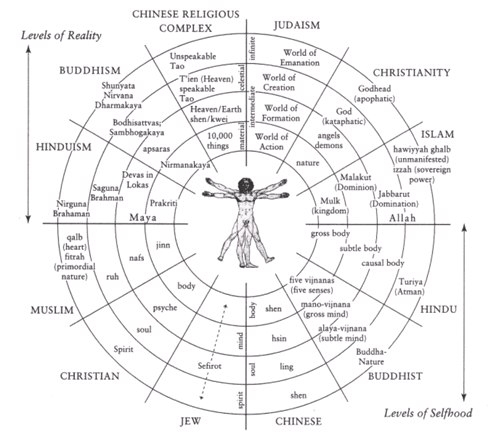
No, I don't think so. I there has to be a conception of levels or modes or domains of being. Traditionally that was cast in terms of the chain of being, but it survived even into the 17th Century:
In contrast to contemporary philosophers, most 17th century philosophers held that reality comes in degrees—that some things that exist are more or less real than other things that exist. At least part of what dictates a being’s reality, according to these philosophers, is the extent to which its existence is dependent on other things: the less dependent a thing is on other things for its existence, the more real it is.
I've been listening to installments in The Meaning Crisis by John Vervaeke (which I recommend). He too refers to the necessity of levels of being which he adapts from neoplatonist ontology. Speaking of which, here's a useful Huston Smith graphic depiction of levels of being in various traditional philosophies:
-
Hidden DualismHere's a snippet I will sometimes quote. It's from Ernst Mayr, who is a mainstream scientist, and it's about the fundamental difference between living organisms and inanimate matter. It has to do with the ability of DNA to store and transmit information for which there is not an analog in the mineral domain.
Ernst Mayr, one of the architects of the modern (neo-darwinian) synthesis, has been one of the most outspoken supporters of the view that life is fundamentally different from inanimate matter. In The growth of biological thought [15], p. 124, he made this point in no uncertain terms: ‘… The discovery of the genetic code was a breakthrough of the first order. It showed why organisms are fundamentally different from any kind of nonliving material. There is nothing in the inanimate world that has a genetic program which stores information with a history of three thousand million years!’ — What is Information?
On a more general level, it is an instance of the principle that information-based systems, which includes organisms, embody a level of organisation which defies reduction to physics and chemistry. There's an often-quoted meme by Norbert Weiner, founder of cybernetics, to wit, 'The mechanical brain does not secrete thought "as the liver does bile," as the earlier materialists claimed, nor does it put it out in the form of energy, as the muscle puts out its activity. Information is information, not matter or energy. No materialism which does not admit this can survive at the present day.' -
Hidden DualismIs the hard problem of conscious just (or equivalently) the hard problem of being ? — plaque flag
That's actually what I think. I think what David Chalmer tries to express rather awkwardly as 'what it is like to be...' is, really, just 'being'. Furthermore that we universally assume that we know what 'being' means when actually we don't. (That's where I think it dovetails with Heidegger's 'forgetfulness of being', although not having read Being and Time, I'm not sure about that.)
Can science explain that there is being in the first place ? — plaque flag
Enlightenment naturalism always begins with the apparently obvious fact of our existence as subjects in the domain of objects. It doesn't actually question the nature of being as such although due to the forgetfulness of being, it often doesn't realise the distinction between the scientific and the existential. -
Climate change denialAre the people who die from cold less important than the people who die from heat? — Agree to Disagree
This is a spurious comparison, regardless of the statistics. It's a version of whataboutism - 'what about the cold?'
For me there are no "facts" that are beyond dispute. — Agree to Disagree
'Everyone has a right to their own opinions, but not to their own facts' ~ Daniel Patrick Moynihan. -
Climate change denialI see your point, but at the same time, I am of the view that the facts that you are calling into question are beyond dispute. As I've said, I've put it to the other moderators, I'll leave it at that for now.
-
Climate change denialHold on a minute. Aren't you an anonymous poster? — Agree to Disagree
No, I'm a moderator, and well known to all the staff and posters here. I notice that all of your comments, bar one, on this forum, have been on this topic, and that all of them are essentially calling climate change science into question. I will discuss this with the other moderators. -
Climate change denialHow do we know that they are not wrong about other things? — Agree to Disagree
Yeah! I joined a forum, and there’s an anonymous poster who says they might be wrong. So they’re wrong! It’s obvious, really.
As far as I’m concerned, you’re trolling, and you can take that as a warning. -
Climate change denialPlease state clearly which you think kills more, heat or cold? — Agree to Disagree
Is it a numbers game? A scorecard? Tens of thousands have died in European heatwaves the last few years. Find me a story on ‘increased deaths through global cooling’.
Wayfarer

Start FollowingSend a Message
- Other sites we like
- Social media
- Terms of Service
- Sign In
- Created with PlushForums
- © 2026 The Philosophy Forum