
Comments
-
Thing-in-itself, Referent, Kant...SchopenhauerThe idealists have to deal with the incredulity that mind is universal in some sense, being that it seems to be empirically the case at least, that mind accompanies some sort of cellular/nervous system. — schopenhauer1
To address that, I'll refer to this:
John Locke proposed that there are primary or secondary qualities. — schopenhauer1
The division of 'primary and secondary', Descartes' divison of mind and matter, and science comprising the quantitative analysis of objective qualities, sets the framework for the modern weltanschauung. I'll refer to a paragraph I frequently cite from Thomas Nagel's 2012 book Mind and Cosmos:
The modern mind-body problem arose out of the scientific revolution of the seventeenth century, as a direct result of the concept of objective physical reality that drove that revolution. Galileo and Descartes made the crucial conceptual division by proposing that physical science should provide a mathematically precise quantitative description of an external reality extended in space and time, a description limited to spatiotemporal primary qualities such as shape, size, and motion, and to laws governing the relations among them. Subjective appearances, on the other hand -- how this physical world appears to human perception -- were assigned to the mind, and the secondary qualities like color, sound, and smell were to be analyzed relationally, in terms of the power of physical things, acting on the senses, to produce those appearances in the minds of observers. It was essential to leave out or subtract subjective appearances and the human mind -- as well as human intentions and purposes -- from the physical world in order to permit this powerful but austere spatiotemporal conception of objective physical reality to develop.
You can see how the 'problem of consciousness' arises directly out of this formulation. It's because the objective methodology of modern science deliberately excludes or attempts to 'bracket out' the subject (although this criticism can't be applied to phenomenology, which sought to remedy this.) All the 'hard problem of consciousness' argument does is point that out. And why is the mind not included? Because - and this is a deceptively simple point - mind is not an object. Here is where I find concordance with Schopenhauer:
That which knows all things and is known by none is the subject. Thus it is the supporter of the world, that condition of all phenomena, of all objects which is always pre-supposed throughout experience; for all that exists, exists only for the subject. Every one finds himself to be subject, yet only in so far as he knows, not in so far as he is an object of knowledge. ...We never know it, but it is always the knower wherever there is knowledge. — Schopenhauer, WWI
Which also finds an exact parallel in the Upaniṣads. This is from a dialogue between the sage and a questioner, with the latter asking for an explicit definition of ātman.
"Tell me directly – 'this is the ātman' – just as you say 'this is a cow, this is a horse'. Do not give an indirect definition of it as you have just done." ...Please give that description and do not simply say, 'this is that'...Yājñavalkya says: "You tell me that I have to point out the Self as if it is a cow or a horse. Not possible! It is not an object like a horse or a cow. I cannot say, 'here is the ātman; here is the Self'. It is not possible because you cannot see the seer of seeing. The seer can see that which is other than the Seer, or the act of seeing. An object outside the seer can be beheld by the seer. How can the seer see himself? How is it possible? You cannot see the seer of seeing. You cannot hear the hearer of hearing. You cannot think the Thinker of thinking.You cannot understand the Understander of understanding. That is the ātman. Nobody can know the ātman inasmuch as the ātman is the Knower of all things. So, no question regarding the ātman can be put, such as "What is the ātman?' 'Show it to me', etc. You cannot show the ātman because the Shower is the ātman; the Experiencer is the ātman; the Seer is the ātman; the Functioner in every respect through the senses or the mind or the intellect is the ātman. As the basic Residue of Reality in every individual is the ātman, how can we go behind It and say, 'This is the ātman?' Therefore, the question is impertinent and inadmissible. The reason is clear. It is the Self. It is not an object. — Source
(In the end the questioner finally 'gets it' - and falls silent.)
And there isn't really a naturalistic response to this - not in terms of standard naturalism, anyway, as naturalism assumes the subject-object division and an objective account. It's analogical to trying to develop a two-dimensional representation of a three-dimensional space. -
The von Neumann–Wigner interpretation and the Fine Tuning ProblemJust because uncertainty is a physical truth doesn't mean that the electron doesn't exist. — Moliere
What do you think the Bohr-Einstein debates revolved around? It was just this kind of question. This is why Einstein famously exclaimed one day 'Does the moon cease to exist just because nobody's looking at it?' The clear implication is 'of course it does, stop being ridiculous'. But he was compelled to ask it the question. He posed the so-called EPR paradox to once and for all disprove the anti-realist implication of quantum mechanics, but as is well known, this was torpedoed by the Bell inequalities experiments conducted by Alain Aspect and others (subject of a recent Physics Nobel, I believe.)
The view of the first-generation quantum physics was deep, subtle, and philosophically informed. Schrodinger was a lifelong student of philosophy, particularly influenced by Schopenhauer, and expressed an admiration for Advaita Vedanta. Heisenberg was essentially a Christian Platonist, who studied the Timeaus deeply in his university years. (By the way, it was Heisenberg who coined the term 'Copenhagen interpretation', in 1955, in his book On Physics and Philosophy. His writings are the canonical source for much of what goes under that name.)
This brief article is worth a read: Quantum Mysticism: Gone but not Forgotten. The author notes that it was with the migration of physics research to the US after the war, and the heavy involvement of the military industrial complex, that the 'shut up and calculate' mentality became predominant. The Americans lacked the philosophical culture of the European pioneers. (Having just watched Oppenheimer, I have no trouble believing that.)
The electron, whatever it might mean, is literally a point and a wave. — Moliere
How can 'something' be 'literally' two completely different kinds? As is well known, Bohr said that the answer to 'is it a wave of a particle?' depends on which question you asked, but it could not to be said to be anything beyond that. Heisenberg: 'What we observe is not nature itself, but nature exposed to our method of questioning.' -
The von Neumann–Wigner interpretation and the Fine Tuning ProblemAgain, there is no literal 'wave function collapse'. It's a metaphorical expression for the reduction of possibilities to a certainty. The mystery is the implication that prior to measurement, the target object cannot be said to definitely exist. And if the purported 'building blocks of reality' can't be said to exist, then you have to ask 'what is real?' which is the name of one of the books mentioned about this subject.
-
The von Neumann–Wigner interpretation and the Fine Tuning ProblemCopenhagen has a metaphysical perspective, it's one that is heavily influenced by logical positivism and Carnap — Count Timothy von Icarus
I think that's popular myth.
Some time ago there was a meeting of philosophers, most of them positivists, here in Copenhagen, during which members of the Vienna Circle played a prominent part. I (Bohr) was asked to address them on the interpretation of quantum theory. After my lecture, no one raised any objections or asked any embarrassing questions, but I must say this very fact proved a terrible disappointment to me. For those who are not shocked when they first come across quantum theory cannot possibly have understood it. Probably I spoke so badly that no one knew what I was talking about....
I can readily agree with the positivists about the things they want, but not about the things they reject. …Positivist insistence on conceptual clarity is, of course, something I fully endorse, but their prohibition of any discussion of the wider issues, simply because we lack clear-cut enough concepts in this realm, does not seem very useful to me—this same ban would prevent our understanding of quantum theory. — Werner Heisenberg, Positivism, Metaphysics, and Religion (in Physics and Beyond)
The quote 'for those who are not shocked...' is quite famous in its own right.
Did you know that Bohr adopted the ying-yang symbol for the Coat of Arms that was commissioned after the honours he received from the Danish Government? It symbolised the complementarity wave-particle duality

Michel Bitbol (French philosopher of science) argues that Bohr is nearer to Kantianism than positivism. See Bohr's Complementarity and Kant's Epistemology (recorded lecture). '"(According to Bohr) you cannot speak of attributes of objects independently of the possibility we have to explore them" (38:52) -
A Wittgenstein CommentaryI may use established sources to back up my ideas, to clarify my own ideas, to give me ideas or provide me with sentences I think especially well written, but that is not the same as copying the ideas of established sources — RussellA
:100: I do just the same. -
US Election 2024 (All general discussion)Other lowlights
- Vivek Ramaswamy being applauded for calling climate change a hoax
- 6 out of 8 candidates saying they would support Trump (you can see de Santis glancing around to make sure others were doing it first)
When the autopsy on the death of Western democracy is written, these will be mentioned in the pathologists report.
On the plus side, at least Hayley supported Ukraine. -
US Election 2024 (All general discussion)Yeah it probably does come down to too much TV.
Brian Tyler Cohen’s (democrat) take - https://youtu.be/Bqj-Doe_EzU?si=F8GCZ4xFs7nCOQh9 -
US Election 2024 (All general discussion)If behind bars his popularity will soar. — jgill
What does that say about the American electorate? That they want to vote for an outlaw as President? -
US Election 2024 (All general discussion)I reckon DeSantis has no chance, that his shctick will never extend to the US at large. It goes down OK in Florida due to favourable demographics, but he's the least likeable candidate by a country mile. The kind of guy, someone said, who would confiscate the neighboring kids' ball if it was kicked onto his lawn. All up, Trump is going to manage to completely ruin the Republican nomination process, anyway. While I believe there is absolutely zero chance of him being the eventual nominee, a huge percentage of the Republican elecorate will merrily follow him off the cliff. There's only one candidate who's really going to stand to benefit, and he's not a Republican.
-
Thing-in-itself, Referent, Kant...SchopenhauerSo which is it for Schopenhauer? — schopenhauer1
I would really have to read a whole bunch more of Schopenhauer to take a stab at that. So far, I'm pretty well on board with 'World as Idea', but I still have both gaps and doubts about 'world as will'. Hopefully some of the next chapters of Urs Apps' book might touch on that.
I think, from the perspective of Indian philosophies generally, that the 'price of ignorance' is that we have some really fundamental and basic misconception about the nature of existence. Like, we have tinted glasses on, which influence everything we see, but which we're accustomed to, so that we don't notice we're wearing them. I suppose all philosophy is like that, in a way, but I don't think there are many Western equivalents, outside Schopenhauer and the German idealists, that share that kind of understanding with Indian philosophy.
That is to say, there was a time before humans/animals and a time when humans/animals will go extinct. — schopenhauer1
Well, I might venture is that this is still implicitly naturalistic, in that it takes the empirical/sensable/phenomenal domain as primary and mind as secondary or a product of that. Indeed it doesn't seem there could be any alternative, given that the most primitive life forms are understood as the most primitive instances of mind, and that the mind evolved along with the increasing complexity of organisms over the hundreds of millions of years since. (although).
But from the perspectives of the cosmic philosophies, mind is more like the organising intelligence which gives rise to organisms in the first place (which doesn't necessarily mean theistic creation as this kind of general understanding is characteristic of e.g. neoplatonism.) So from a cosmic perspective, our embodiment in material form might be what is ultimately transient. I attended lectures by an esteemed prof of Hindu philosophy, who used to intone, in that lilting Indian school-teacherly way, that evolution was the process by which 'what is latent becomes patent' - that the whole Universe is a way for Brahman to explore horizons of being. Within that explanatory framework, mokṣa is the point where the devotee realises his/her true nature or 'supreme identity' in Watts' terms. -
The von Neumann–Wigner interpretation and the Fine Tuning ProblemIt was by no means an abuse of authority. I admit it might have been an error of judgement but it's been reversed.
-
The von Neumann–Wigner interpretation and the Fine Tuning ProblemWell sure, if we take the Copenhagen Interpretation as a given then other interpretations are wrong, but what's the grounds for doing that? — Count Timothy von Icarus
The question I have, then, is what is the problem with the Copenhagen interpretation? As I understand it, two of the main points are most controversial:
First, that it stresses the role of the observer in quantum measurements, suggesting that the act of measurement collapses the quantum wave function from a superposition of possible states to a single, definite state. Secondly its assertion that quantum objects do not have definite properties, such as position and momentum, until they are measured, suggesting that the underlying reality is essentially probabilistic and in some sense observer-dependent.
It seems to me rather a modest attitude, which acknowledges that in these cases, science is operating at the limits of what is knowable.
I think the problem for realist or objectivist views is the implication that nature of the entities in question is unknowable or undeterminable, prior to there being measured. Isn't that the aspect that most rankles its critics? -
The von Neumann–Wigner interpretation and the Fine Tuning ProblemThis is not reasonable — T Clark
The OP said nothing about 'the hard problem', that was introduced by you.
Furthermore you said:
We just finished this same argument a few days ago and I'm not ready to start up again. — T Clark
And finally, the posts were not deleted, they were moved to more relevant thread, so as to keep this thread more on topic, which is already a complex and contentius topic in its own right. -
Thing-in-itself, Referent, Kant...SchopenhauerThey're pretty clever observations, but I think we're talking at cross-purposes. To me, none of these questions are only hypothetical - there is something real at stake, but it's also very difficult to discern or fathom (and I won't for a minute claim to have done so.)
Look at Dawkins and all the rest of the popular atheists. They are optimistic about scientific innovation being the height of human achievement and thus a sort of "reason" to exist.. presumably, to have more children, even though we suffer, because "it's worth it" to see these advancements play out and do more research. — schopenhauer1
Well, yes, but as many have pointed out, Dawkins and Dennett have kind of appropriated many of the tropes of Christian humanism, but then wrapped them around the idea scientific progress. But there's a clear conflict in their philosophy, in that both of them see humans as basically gene machines or robots, but then don't seem to have the philosophical persipecuity to understand the inherent conflict in their worldviews.
this special technique that Buddha or the myth of Buddha has shared through the writings and lineage of sages. — schopenhauer1
I don't think the idea of a 'technique' or a 'method' does justice to it. It's far more radical than that. I take the major implication to be that we ourselves, insofar as we're 'normal human beings', have a defective understanding of the nature of reality. That is the meaning of avidya.
There's a school of Buddhist philosophy called Yogācāra which is often said to be idealist, although scholars point out that there are very important differences between Indian and Western idealism. It's sometimes been translated as 'cognition-only'. You can see the ChatGPT summary here. I'm interested in the common boundaries between these schools and the German idealists. -
The von Neumann–Wigner interpretation and the Fine Tuning ProblemModerator note: the comments specifically about the hard problem of consciousness have been moved to the most recent thread on that topic, so as to maintain the focus of this thread on the OP. Please feel free to carry on with that conversation in the other thread.
//update// following complaint by T Clark, this has been reversed. -
The von Neumann–Wigner interpretation and the Fine Tuning ProblemBecause unlike objective phenomena, consciousness is both the subject doing the investigating and the object of investigation.
what happens when isolated photons or protons go for a bit without interacting with anything. In this case, it seems they should have ceased to exist. — Count Timothy von Icarus
The million dollar question is, do they exist in the first place? The answer is in the wave equation - they have a tendency to exist, but their existence is indefinite (or uncertain) prior to measurement. You're being tripped up by the realist assumption that they really exist independently or outside of that. The reason quantum mechanics is called 'shocking' is because that is what is being called into question. -
Thing-in-itself, Referent, Kant...SchopenhauerBut I am refuting the metaphysical premise that there will always be representation. Representation without animal minds is not possible. So your move is to say mind is somewhere not in animals. This is always the paradox Schopenhauer and idealists and perhaps Buddhists must contend with. Otherwise, the “nihilistic” solution of passively not procreating would technically end suffering within a generation for the animal who has self awareness about this. That is to say, the unborn truly is being never born. That ends the cycle. — schopenhauer1
1. My take is that Zapfe and Benatar (not sure I've spelled them correctly) are materialist philosophers - and if you're nothing other than a physical body, then when the body dies it's all over, that is the end of it. If nonbeing or nonexistence is the final end, then that is all there is to it. There is no 'problem of existence' to solve if you don't exist!
I don't know where Schopenhauer stood on the question of life after death, but I'm sure he would not envisage any such state as 'eternal life' or an immortal soul. But he also hints that the attempt to escape from the sufferings of life through suicide cannot be successful. The relevant passage is
someone who is oppressed by the burdens of life, who certainly desires life and affirms it, but detests its sufferings and in particular does not want to put up with the difficult lot that has fallen to him any longer: a person like this cannot hope for liberation in death, and cannot save himself through suicide; the temptation of cool, dark Orcus (i.e. 'underworld' in Roman mythology) as a haven of peace is just a false illusion. The earth turns from day into night; the individual dies: but the sun itself burns its eternal noontime without pause. For the will to life, life is a certainty: the form of life is the endless present; it does not matter how individuals, appearances of the Idea, come into existence in time and pass away like fleeting dreams. — WWR§54
As the will is what is eternal, I guess this means that it will always find a way to be born, and, insofar as we identify with it, we will be carried along with the tide. Unless you're truly de-coupled from that urge - which S. says is the aim of asceticism - then you haven't succeeded in any real liberation.
2. As far as Buddhism is concerned, the two 'erroneous views' of life are nihilism, on the one side, and eternalism, on the other. Nihilism is not hard to explain - it's the view of materialists, for whom there are no consequences ('fruits') of actions after this life, the 'body returns to the elements'. There are many variations of nihilism given in the texts (Buddhists love lists and compendiums) which include the 'belief that life is due to fortuitous causes', for instance. (From the Buddhist point of view, many modern people are nihilist.) 'Eternalism' is a rather more difficult idea to convey, but my interpretation (and I did do a postgrad thesis on it) is that it is the idea that through meritorious actions, one can be reborn in fortuitous circumstances forever - that is, always continue to enjoy fortunate rebirths. (In the social context in which the Buddha lived and taught, there was an existing acceptance of re-birth, and also, it is said, ascetics who were able to recall previous lives.) 'Eternalism' is also associated with the idea of there being an unchanging essence (often described as 'soul', although I question that), whereas everything knowable is always subject to change (the well-known impermanence, anicca, of Buddhism.) So eternalism is the idea that there is an always-existing entity that can go on forever.
But nibbana (Nirvāṇa) is neither ceasing to exist, nor continuing to exist. Both of those, at root, are desires - the desire not to be (because of the burdensome nature of life) or the desire to continue to be (because of the pleasurable nature of life). So those drives are, at root, hatred or aversion, and desire or attachment (two of the 'three poisons', the third being stupidity or delusion. However, it should be mentioned that the canonical text which describes all this is the longest text in the Pali canon and these are obviously deep and recondite matters of Buddhist doctrine.)
3. As for the nature of mind - this is obviously a very deep philosophical question. But overall, this is where I find myself most in agreement with Schopenhauer - that objects exists for subjects. I've thrashed it out in any number of thread here over many years, so I'll just try and present a very short version. You will object, 'but surely this entails that the Universe didn't exist before living subjects. How can you justify that, when we know that living organisms, especially sentient organisms, are very recent arrivals?'
My answer to that is that: no, the world does not exist outside our perception of it - but neither does it not exist. 'Existence' is a compounded or complex term, describing that which comprises objects of perception and also our cognitive systems which assimilate information from the environment and generate our sense of the world, and which provides the cognitive framework within which the very idea of existence is meaningful. (Hence, 'world as Idea'.) That sense of the world is the world. It's no use asking, 'what happens to it, if we don't exist', because we cannot but conceive of it, or of anything, in the absence of that, nor can we really get outside of that to see it as it would be with no observer whatever. None of which negates the empirical fact that your or my consciousness only came into existence in very recent times. (I know this is a right can'o'worms, but there it is.) -
Thing-in-itself, Referent, Kant...SchopenhauerI’m away from desk, I am intending to reply
-
Thing-in-itself, Referent, Kant...SchopenhauerI think the problem is more that you misunderstand what I say and accuse me of being either an empiricist or a positivist. — Janus
Only based on your statements which frequently suggest those associations. Seems more likely to me that you are not aware of those own tendencies in your own statements. -
The von Neumann–Wigner interpretation and the Fine Tuning ProblemI think the notion of ‘cause’ in ‘what causes wave collapse’ is problematical. The wave function is not physical, either, it’s simply a distribution of probabilities. It gives the answer to ‘where is the particle’ prior to it being measured in terms of probabilities. When the measurement is taken, it’s not longer a matter of probabilities but a certainty. That’s the ‘collapse’. If you ask ‘in what sense did it exist prior to being measured?’, the Copenhagen answer is that it’s a meaningless question. So nothing actually collapses in a physical sense. It’s a matter of actualised potential.
Life could only arise in an ordered world and consciousness can only fathom a world with a certain type of order. — Count Timothy von Icarus
Notice how close this is getting to the dictum of classical metaphysics - that ‘to be is to be intelligible’.
See also
https://www.discovermagazine.com/the-sciences/does-the-universe-exist-if-were-not-looking -
Donald Trump (All General Trump Conversations Here)It has symbolic significance, though. I can imagine that DJT will absolutely seethe at having to fork over actual dollars.
-
Thing-in-itself, Referent, Kant...SchopenhauerI don't think you and I are as far apart as it may sometimes seem — Janus
We get along fine when you don't pull your A J Ayer shtick :razz:
That is post-facto defense — schopenhauer1
The reality of existence is not a word game or polemical gambit. -
Donald Trump (All General Trump Conversations Here)Defendant Trump on $200,000.00 bail, ordered not to contact or intimidate witnesses in Georgia. Gift link to NY Times article.
-
Thing-in-itself, Referent, Kant...SchopenhauerI might feel like I know the nature of reality, but I think that is just an idea that accompanies a profound sense of insight, the details or implications of which I really don't know or understand. — Janus
:pray: I respect your honesty in grappling with these questions. What it seems to me that you're saying that you have intuitive insights that the ego/self can't deal with.
Last night I watched a presentation on Lacan which featured this slide:
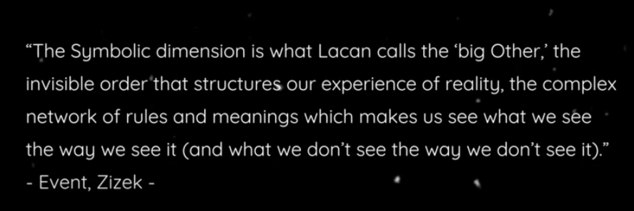
I think in these kinds of debates, we're coming up against that 'invisible order' and that this influences what you're saying about what does and what doesn't constitute valid philosophical insight. The examples you gave of what you call 'direct observation' all refer to sense-able phenomena, things that can be objectively seen and measured, and then maths and logic. You're appealing to those as rules - that's the 'network of rules and meanings'. But there's also an insight, which is neither strictly empirical nor mathematical, which you first acknowledge but then appear to deny. As I said, I get it. Hard questions. Schopenhauer himself spent considerably time and energy grappling with them.
If it is only grounded in intuition, it may or may not be true, but how would you go about determining that, or demonstrating its truth or falsity? That is what you need to show. — Janus
I think a leap of faith is required. There is no external guarantee - I can't show it.* There are many risks, and there is plenty of potential for self-delusion. Comes with the territory. Krishnamurti's 'pathless land' is often quoted but few mention the final sentence of the leading paragraph - 'If you would attain to the mountain-top you must pass through the valley, climb the steeps, unafraid of the dangerous precipices.'
--------
* There's another unspoken factor here. The term for the Hindu philosophical systems is 'darshana', meaning 'a seeing'. An audience with a sage/teacher/guru is a darshan. A meeting with a great teacher may convey an understanding impossible to put into words. That would be a 'showing' or 'seeing' which might convey the gist. A canonical example from Buddhism would be the Flower Sermon. Of course, all of this is in the domain of revealed religion, so properly speaking taboo on this forum. -
Thing-in-itself, Referent, Kant...SchopenhauerAs I see it "a blissful escape" can be attained via several means: activities that might lead to flow states, to present centered awareness… — Janus
It is, perhaps, an infelicitous term. I don’t think the goal of either Buddhism or Schopenhauer is being ‘blissed out’ or attaining a ‘meditative high’. What is at issue is not just subjective, even if it is something that can only be known first-person. But you willl say, sure, you can have great feelings, you can ‘alter your consciousness’ - but it can’t amount to knowledge, as it doesn’t meet empirical standards. Is that right? -
Donald Trump (All General Trump Conversations Here)Why won’t Trump join the initial presidential debate? Answer is very, very simple: Trump shares the stage with no-one. The mere suggestion that anyone other than he might be considered a candidate is, in his eyes, a major insult.
-
Thing-in-itself, Referent, Kant...SchopenhauerI'm rapidly losing interest in trying to engage with those who are intellectually dishonest and can't see past their own agendas. — Janus
More ad hominems, then.
How shall we test the claim that the Buddha was enlightened; just outline the methodology. I believe you know you can't and you just don't want to admit it. — Janus
I’ll put that aside, to venture an answer: learning by doing. But I don’t think the question ‘was the Buddha enlightened?’ is really at issue in the debate. The question is epistemological, what are valid means of knowledge, and my claim was simply that the Buddhist tradition, as an example, does provide a means of testing, finding out, exploring the validity of its methods and claims, which shouldn’t be dismissed simply as ‘mystical and spiritual’. Why not? Well, I know that Stephen Bachelor, a well-known proponent of secular Buddhism, denies that the Buddha was a mystic at all, and I also know that the term ‘spiritual’ is alien to the Buddhist tradition. I’m attempting to establish the theoretically factual basis for there being ‘a blissful escape’, which is the point at issue. -
Thing-in-itself, Referent, Kant...SchopenhauerThe dispute about intersubjective validation started when I made the claim that what Buddhists call 'higher states' can be validated inter-subjectively, i.e. if you're part of a community of discourse in which such states are understood, then there will be others who know what you mean, and also spiritual elders who understand the stages and so on - as @Leontiskos eloquently re-stated in a later post.
I was intending to point out that such forms of understanding are not just to be dismissed as 'mystical or spiritual', a categorisation which I claim is a cultural bias. It's due to the way we as a culture 'divide up' or understand experience.
Janus' response was:
The way I look at there is direct observation which can be personally inter-experentially and publicly intersubjectevly confirmed. such as there is a tree next to the end of the shed, water boils at 100 degrees C, it is raining here and now and countless other examples of observation of the phenomenal world which yield all our discursive or propositional knowledge.
Then there is mathematics and logic.
Then there are beliefs about what cannot be confirmed by observation, mathematics or logic; that is those things we take just on faith. — Janus
Then I said, this is basically empiricism (or scientific empiricism):
You're appealing to sense-experience, empirical observation, or whatever you want to call it. At least be clear about that.
— Wayfarer
I am not appealing to anything, rather I'm just saying that what is usually counted as knowable in the intersubjective sense is what is confirmable by publicly available observations, mathematics or logic. — Janus
So, Janus denies appealing to empiricist principles while at the same time insisting on empiricist principles. That's where the confusion lies. -
Thing-in-itself, Referent, Kant...SchopenhauerDon’t play stupid. — schopenhauer1
Well, ask a stupid question....
Anyway, what was it that prompted that question? You said:
I get the way Buddhist concepts are about the idea that this is an "illusion" etc. It's doublespeak. — schopenhauer1
What does that refer to? If you explain that, I might understand what you were asking. -
Thing-in-itself, Referent, Kant...SchopenhauerWhat if there were no living things in the world, and evolution never created any new form of consciousness? — schopenhauer1
'What if you weren't here to ask me a question, and I weren't here to answer it?' :roll:
It's not even a hypothetical. -
Thing-in-itself, Referent, Kant...SchopenhauerThis is textbook nihilism:
Because of this, Mainländer can claim that once an "individual will" is silenced and dies, it achieves absolute nothingness and not the relative nothingness we find in Schopenhauer. By recognizing death as salvation and by giving nothingness an absolute quality, Mainländer's system manages to offer "wider" means for redemption. — Mainlander Wiki
And also conflates 'nothing' and 'no-thing-ness' as I said in this post. -
What is Logic?Why thanks. Put it down to a sudden rush of blood to the head. Kept the icon though.
-
Thing-in-itself, Referent, Kant...SchopenhauerBut I think it is a fair description of anti-natalism.
-
Thing-in-itself, Referent, Kant...Schopenhauerisn't that convenient... — schopenhauer1
Or not - it might amount to a very 'inconvenient truth' indeed.
Saying something is "nihilistic" doesn't impute anything other than it's a term you use for X. — schopenhauer1
Nihilism is the description of various schools of philosophy which hold that nothing is real, or that nothing has any ultimate moral or ethical principle or implication. It is often associated (per Nietszche) with the 'death of God' signifiying the collapse of belief in religious ethical systems. -
Thing-in-itself, Referent, Kant...SchopenhauerI think it is telling in Buddhism that you have to be born so you can escape the burden. — schopenhauer1
I was responding to the point you made about Schopenhauer being 'overly optimistic'. What you see as his 'optimism', I see as the whole point of his philosophy (as I think he did too.) Also I think you've really got the wrong end of the shtick. The 'clear and decisive path' you speak of would not constitute a release from the cycle of re-birth. I think the Buddhist view would be that even if you don't procreate, you will be re-born in a future existence in accordance with your karma. I suppose in the absence of a belief in re-birth, it seems like escaping the cycle - but again, that is a nihilistic view. (Important distinction: there's a world of difference in religious philosophies between 'nothing' and 'no-thing-ness'. The former is mere absence, or the negation of the existence of some particular; the latter is the absence of specificity of the unmanifest/unborn/uncreated. It is not 'a thing' - neither this nor that ('neti, neti') but is also not mere absence or non-existence. This is at the basis of apophatic mysticism and 'the negative way' which occurs in all religious cultures. The inability to make this distinction is one of the root causes of nihilism. See The Cult of Nothingness, Roger Pol-Droit.) -
What is Logic?@Gnomon - I moved your comments about Law of Form to the new thread on that topic https://thephilosophyforum.com/discussion/14599/reading-the-laws-of-form-by-george-spencer-brown
-
Donald Trump (All General Trump Conversations Here)Good on you, I didn't, of course, as I'm not a US elector, but as you know, deeply interested (and concerned).
Wayfarer

Start FollowingSend a Message
- Other sites we like
- Social media
- Terms of Service
- Sign In
- Created with PlushForums
- © 2026 The Philosophy Forum