
Comments
-
Is there a limit to human knowledge?Well, for what it's worth, I think there's no end to things that can be discovered. We're more aware of that now than ever before, I would have thought, since we now have a realistic grasp of the immense scope of the Universe and the teeming complexity of organic life and the environment. It seems pretty clear will always be more to discover.
But perhaps there's distinction to be made between the limits of knowledge, and the limitations of knowledge, considered as the mastery of facts or as scientific expertise. There are cognitive modes or skillful actions, like those that might characterise artistic or athletic or aesthetic pursuits. Such proclitivities - consider for an example the uncanny abilities of musical prodigies - rely on something other than knowledge in the sense usually understood.They often rely very much on what Mihaly Csikszentmihalyi described as 'flow'. His work focused on the state of intense focus and immersion in activities, which he described as being so absorbed in an activity that nothing else seems to exist. The state of flow, according to Csikszentmihalyi, is highly conducive to creativity and personal fulfilment. I suppose they involve a kind of knowledge, but more like know-how than symbolic or propositional knowledge (although obviously concert pianists often have extraordinary knowledge of the classical piano repertoire as well.)
There are several other themes and memes the OP brings to mind, but I'll leave it at that for now. -
The Mind-Created WorldI don't know. The fact you think it's a religious argument says something. I've gotten hold of the ebook and will peruse it.
Sounds like Donald Trump to me — Gnomon
:rage: -
Information and RandomnessAnd has been pointed out, ‘information’ is the logical master metaphor for our day, as ‘mechanism’ was previously.
-
Information and RandomnessI gather this had been exposited by 3Blue1Brown Youtube channel, — fishfry
It's from a channel now called Verisatium, although under an earlier name. The original video wasn't cited until the top of page 2, you can review it here https://www.youtube.com/watch?v=sMb00lz-IfE . (I've viewed quite a few Verasatium presentations and overall found them pretty good, but I'm very dubious about some of the claims in this one.) I can definitely see the relevance of the Kolmogorov complexity idea, the video would have been better if it had been informed by it. -
What is the true nature of the self?Many people believe that humans have immortal souls which leave when the body dies and is either resurrected by God or reincarnated according to karma. I am not convinced that souls exist but I am open to examining any new evidence for the existence of souls. — Truth Seeker
Regrettably I can't vote for any of the options.
From the jacket copy of the attached book:
Rather than a single entity, the self is really a constellation of mechanisms and experiences that create the illusion of the internal you.
I don't much like the use of 'mechanism' as it's a hangover from mechanistic materialism. But otherwise, there's nothing too objectionable about it from a Buddhist perspective, although Buddhism sets this is in the context of continued existence (saṃsāra) rather than a single life. But it's important to understand that Buddhism generally rejects the idea of a soul that migrates from life to life and of a single unified self that continues to exist unchanged while all else changes (see for example the text Sati, the Fisherman's Son.)
One of the schools of Mahāyāna Buddhism ('Northern Buddhism' which developed historically later than the Theravada Buddhism of Sri Lanka and Thailand) developed ideas of the 'storehouse consciousness (ālāyavijñāna) in which 'karmic imprints' (vasanas) are imprinted and which then give rise to experiences in future lives. That said, the specific individual in this life is not the same as the individual who generated them in a previous life, but neither are they completely different. When asked if a person in one life is the same as a person in a previous life, the answer will usually be, are you the same person you were when you were a child? The answer being, you're neither the same person, nor a different person.
The store-house consciousness (ālāyavijñāna) receives impressions from all functions of the other consciousnesses (i.e. sensory and rational), and retains them as potential energy, bīja or "seeds", which manifest as, or 'perfume', one's attitudes and actions. Since this consciousness serves as the container for all experiential impressions it is also called the "seed consciousness" or "container consciousness".
According to Yogācāra teachings, the seeds stored in the store consciousness of sentient beings are not pure.
The store consciousness, while being originally immaculate in itself, contains a "mysterious mixture of purity and defilement, good and evil". Because of this mixture the transformation of consciousness from defilement to purity can take place and awakening is possible. — Wikipedia, Eight Consciousnesses
Allied with this, is the concept of the mind-stream, which is not quite the same as a soul (although to understand the distinction takes considerably more explanation):
Citta-santāna (Sanskrit), literally "the stream of mind", is the stream of succeeding moments of mind or awareness. It provides a continuity of the personality in the absence of a permanently abiding self (ātman), which Buddhism denies. The mindstream provides a continuity from one life to another and also moment to moment, akin to the flame of a candle which may be passed from one candle to another: William Waldron writes that "Indian Buddhists see the 'evolution' of mind in terms of the continuity of individual mind-streams from one lifetime to the next, with karma as the basic causal mechanism ( :angry: ) whereby transformations are transmitted from one life to the next." 1
According to Waldron, "[T]he mind stream (santāna) increases gradually by the mental afflictions (kleśa) and by actions (karma), and goes again to the next world. In this way the circle of existence is without beginning."
The vāsanās or "karmic imprints" provide the continuity between lives and between moments of existence. According to Dan Lusthaus, these vāsanās determine how one "actually sees and experiences the world in certain ways, and one actually becomes a certain type of person, embodying certain theories which immediately shape the manner in which we experience."2
1.Waldron, William S. (n.d.). Buddhist Steps to an Ecology of Mind: Thinking about 'Thoughts without a Thinker
2. Lusthaus, Dan (2014) Buddhist Phenomenology: A Philosophical Investigation of Yogacara Buddhism and the Ch'eng Wei-shih Lun. Routledge. — Wikipedia, Mindstream
Something to think about, anyway, as Buddhism neither accepts there is an immortal soul in the usual sense, nor the materialistic idea that humans are only physical beings.
The only other point I'd mention is the idea of 'possessing' a self. Usually a self is what has possessions - I have various property, computers, cars, books and so on. Whether I possess a body is a moot point, as I have no way of knowing whether I could exist in the absence of one. One might believe that there is a self, without believing that it is something one possesses. But I admit that is a pedantic distinction. -
The Mind-Created WorldI'm not sure what 'saved' means however, once you articulate this in more sophisticated spiritual terms. Liberated? Moksha? Any thoughts? Saved seems so binary and one suspects a more nuanced vocabulary is required. — Tom Storm
I don't know for certain, but I'm sure that 'saved' does mean something. (That's what puts me on the religious side of the ledger. I had a kind of anamnesis of my own aged about 13, although such realisations are generally impossible to convey to others.) What does it mean? I still hark back to Alan Watts' title 'the Supreme Identity' even while acknowledging Watts' shortcomings. The idea that the being realises his/her true nature as something beyond death. (There's a Princeton philosopher who wrote a book on this, Surviving Death, Mark Johnston, which I personally couldn't relate to, but it's written in the mode of analytic philosophy to appeal to that audience.)
Here's one point. The Indian traditions have a much more expansive outlook. Hinduism can accomodate Christianity more easily than vice versa, as Jesus is seen as an avatar, without detracting from His divine nature. That is anathema to doctrinal Christianity, but figures such as the Venerable Bede Griffith presented a kind of integral path synthesising Vedanta and his native Christian faith. (I saw Father Bede lecture in Sydney towards the end of his very long life.) I suppose the kind of view I'm advocating is universalist, although I don't want to fall into a kind of one-size-fits-all syncretism. But related to that is the religious cosmology common to both Hinduism and Buddhism, of the eternal caravan of rebirth (saṃsāra) and liberation from it (mokṣa, Nirvāṇa). Once aware of that, the linear cosmology of traditional Christianity seems more difficult to entertain, although the longer I live, the less certain I become. -
The Mind-Created WorldI'm sorry about the quality of my previous reply, it was off the cuff and not well thought out. I'll retrace my steps.
We were talking about Bernardo Kastrup's 'dissociated alters'. Kastrup's analytical idealism suggests that the ground of existence is experiential, rather than material, and that the universe is ultimately a single, universal mind. As discussed previously, there are convergences between that and schools of ancient Greek (nous in neoplatonism) and the Brahman of Vedanta (not to mention more recent schools of idealist philosophy). The model of the self as a "dissociated alter" originates from this. In this understanding, individuals are like "alters" (a term borrowed from dissociative identity disorder in psychology) of this larger consciousness. These alters are local 'dissociated' centers of awareness within a broader field of universal consciousness.
Kastrup uses this framework to account for individual subjectivity, as well as mental disorders, and even paranormal occurrences. He argues that what we consider our individual minds are in reality dissociated segments of a larger consciousness that encompasses all reality. This perspective places individual human experiences within a larger, interconnected framework of consciousness that transcends individual boundaries. It also provides an interpretive model whereby insight into the universal nature of consciousness provides the means of liberation from or transcendence of the limited ego-centred mind, which might be compared to what Richard M. Bucke called 'cosmic consciousness' in his 1901 book of that name.
Unfortunately, my sojourn with Western religious Piety makes it seem to be a case of Self-Deception. Is an attitude of open-minded Creedence necessary to experience "the Unitive Vision"? — Gnomon
The expression 'the unitive vision' is a catch-all for various diverse expressions of divine union or theosis in different cultures. As a matter of interest, the expression of an 'oceanic feeling' which you mention is associated with Freud's attempt to interpret mysticism, which however was vitiated by his overall 'scientism'.
Maybe the reason you associate that with credence and religious faith, is a consequence of the long association (or subordination!) of these ideas with ecclesiastical authority and downtown religion. (I recall a remark by British philosophical theologian Dean Inge, that were Christ to return, there would be some Christians who would be the first to crucify him again.) The case can be made that these ideas were coralled into the confines of religion as a means of social control in the first place (although that would be a massive thesis requiring voluminous argument). But I would venture that the influence of dogmatic religion in your earlier life has prejudiced you against these ideas, so that you tend to view them through those spectacles.
The key point is that popular religion cannot traffic in high-falluting ideas of cosmic consciousness and the unitive vision. 'Believe and be saved' is much nearer the mark. While I'm coming around to the understanding that those who really do practice charity, empathy, self-control and agapē really may be 'saved', I'm in complete agreement that much of what goes on in the name of religion is ignorance personified.
Some Buddhist monks have claimed to be able to control various sub-conscious bodily function via deep meditation. — Gnomon
This is quite well-documented, actually - and not only Buddhist monks, but yogis, generally. But those skills, that level of self-discipline, are practical impossibilities for most of us, they have been developed in seclusion under strict regimens and high levels of discipline. There's a lot of popular mythology about these kinds of yogic skills but its fruits are incredibly hard-won. (Hence the popularity of popular religion!)
Incidentally, here is a rather good presentation from Bernardo Kastrup, about ten years ago, differentiating his analytical idealism from panpsychism, among other matters. Again my understanding of idealist philosophy is very much convergent with what he says.
-
The Mind-Created WorldKastrup argues that the human mind can split into two or more "alters". But I have no personal experience with that kind of "dissociation". So, I just have to take his word for it. I have never meditated to be point of dissolution of self into the cosmos. And never took psychedelic drugs to depress my self-identifying frontal lobes into an oceanic cosmic Self. — Gnomon
These are all pretty subversive ideas from a western cultural viewpoint. Not for nothing was Timothy Leary's first book called The Politics of Ecstacy, which I read around the time of the corresponding psychedelic experiences. But I can assure you the experience of 'the unitive vision' is a real thing (a great Aussie psychedilc rock song from those years was called The Real Thing). Not that I would ever encourage consumption of hallucinogens.)
In any case, Kastrup's dissociated alters theory, despite its eye-rolling reception, has a philosophical basis, rather similar to a popularised version of Advaita Vedanta (and I listened to a dialogue between him and the resident minister at Vedanta Society of New York, Swami Sarvapriyananda.) Recall that Kastrup is obliged to say that if matter is not the fundamental reality, then that role must be assigned to mind - not my mind, or yours, but to what he describes as 'mind-at-large'. And on that note, one of my Medium essays is a friendly critique of that concept. -
The Mind-Created WorldHowever, tables etc can be subject - of pictures, investigations, conversations, etc. They can also, in ordinary language, do things like blocking fire exits, squashing fruit, supporting vases, etc. Equally, a human being can stand in the object-place in a sentence, being looked at, rather than looking, being pushed, rather than pushing and in general being objectified. — Ludwig V
Thanks for the clarification, but still not quite the point I'm seeking to make. Tables, or any objects, can be subjects of a sentence, or subjects of an investigation, or subjects in a catalog. But they are not subjects of experience. So there's there's an equivocation of the word 'subject' at work there. To be a subject of discussion is not necessarily to be a subject of experience.
Humans may indeed be objectified, or treated as objects, and even legitimately so, by, for example, demographers or statisticians or epidemiologists. Or, I suppose, a gunman, if the subject in question is a combatant or an intended victim. But we generally recognise that humans are subjects of experience by use of the honorific 'you' or personal pronouns, 'he or she', rather than 'it' (and leaving aside all of the politically-correct gender neutrality business.) I say that this is because we recognise humans as beings, and we recognise, at least tacitly, a distinction between beings and objects or beings and things.
I don't believe our world-view is unified, except possibly in the world-views of philosophers. — Ludwig V
On the contrary, I take the subjective unity of experience as apodictically certain as Descartes' cogito ergo sum. When I feel a pain, or an emotion, or a sight, I don't learn this at second-hand from organs of perception of sensation. Although I agree with Buddhism that no soveriegn unchangeable self can be identified, nevertheless I accept the basic tenets of Kant's transcendental unity of apperception. Also, I think the argument can be made that something like a 'principle of unity' can be discerned in Aristotle's description of the soul - again, like my criticism of Descartes, not a 'ghost' or 'ethereal spirit' but the organising principle of De Anima (granted I've never done the studies of De Anima to back that up, but it seems to be presented in many of the secondary sources.)
The thing I find with your posts is that you're such a long way down the path of your own syncretic combination of ideas, that I often feel we talk past each other. I see merit in some of what you say, and agree with you in the rejection of mainstream physicalism and in other ways. But then I also see that you interpret many of the things we both read in ways very different from my own. There's nothing I need to 'forgive' on that account, although there are some aspects which I think - how to say - could be refined. (Although doubless that is also true for me, which is what we're doing here, I hope.) -
I’ve never knowingly committed a sinIf God wills that one of his creatures commit a sin, then that creature must do so; if He wills that they refrain from sinning, they have no option but resist temptation. — Vera Mont
I don't identify as Christian, but I don't believe that is a fair characterisation of their principles. There's a diversity of views. Some denominations, especially Calvinism, insist on predestination and the sovereignty of God in a way that impacts the meaning of free will, no doubt. However, they also maintain that this divine sovereignty does not completely negate human accountability. (Don't ask me why that's not contradictory, but they might have an answer.)
But most other denominations emphasize free will. They argue that while God is omniscient and omnipotent, He has granted humans the freedom to choose or reject His grace. If we were simply "puppets on strings," completely controlled by divine will without any agency or choice, then the concept of salvation would be meaningless. So while many a criticism can be made, that's not a fair characterisation. -
Mindset and approach to reading The Republic?So this is how it is: this region contains the colourless, utterly formless, intangible being that actually is, with which the realm of true knowledge 247D is concerned, seen only by reason, the pilot of the soul. Now since the mind of a god is nourished by reason and unmixed knowledge, so too is every soul that cares to receive what is proper to it. Eventually, beholding what is, the soul is delighted, and contemplating the truth, it is nourished and gladdened, until the revolution carries it around in a circle to the same place. In the revolution, soul has sight of justice itself, sound-mindedness and knowledge; not knowledge to which becoming is added, this is knowledge different under different circumstances, 247E concerned with what we normally call ‘things that are’; no, it is the knowledge of that which really is. And once the soul has, in like manner, contemplated and feasted upon the other things that really are, it descends once more into the inner heaven and goes home. And when soul arrives there, its charioteer stations the horses at the feeding stall, sets ambrosia before them and gives them nectar to drink. — Phaedrus 247c
Some exegetical points:
Nature of the Higher Realm: Plato describes a transcendent realm that is "colourless, utterly formless, intangible" and accessible only to true knowledge (epistēmē). This description emphasizes the abstract and non-physical nature of the One beyond being and non-being. In this metaphysical domain, the only faculty capable of perceiving this is reason (nous). Plato often characterises reason as the pilot or charioteer of the soul, guiding it towards true knowledge. This underscores the idea that reason, rather than sensory perception, is what allows the soul to apprehend the true nature of reality.
Soul’s Nourishment and Delight: The passage suggests that a soul that engages with its proper objects of contemplation—true and unchanging knowledge—receives nourishment and delight. This engagement involves a direct encounter with the Forms, such as Justice, Temperance (sound-mindedness), and Knowledge itself. For Plato, this intellectual nourishment is vital for the well-being of the soul, elevating it beyond the transient and imperfect physical world.
The Concept of Revolution: The "revolution" likely refers to the cyclical journey of the soul as it moves through the higher realms and back to the material world. This cyclic motion is a recurring theme in Plato's work, reflecting the soul's eternal quest for knowledge and its periodic engagement with the world of Forms. Also reflects the 'myth of the eternal return' which characterised the archaic Indo-European mythology. (c.f. Mircea Eliade)
Knowledge and Being: Plato makes a distinction between the knowledge of things that "become" (the sensory and changing) and the knowledge of "what is" (the "always so"). The former is seen as inferior because it is subject to change and decay, unlike the latter.
Descent of the Soul: After feasting upon the truths of the higher realm, the soul descends "into the inner heaven" and returns to the mundane world. However, this is not merely a return to ignorance; the soul retains a higher understanding acquired from its communion with the Forms. This journey reflects the dual nature of the Platonic soul, caught between the world of eternal Forms and the physical world. (Hence the logic of anamnesis - the soul recalling what it has learned but forgotten in the descent into birth.)
Ambrosia and Nectar: The reference to ambrosia and nectar, foods of the gods in Greek mythology, symbolizes the divine and immortal nature of the nourishment that the soul receives from its engagement with the Forms. This not only sustains the soul but also prepares it for its continuous cycle of rebirths and intellectual engagements. 'Nectar' is related to the Sanskrit 'amṛta' which means literally un (a-) dying (mṛta, the indo-european root of 'mortal' and also 'murder') and which is often translated as 'the nectar of immortality'. -
I’ve never knowingly committed a sinGod has never revealed his will to me. — Art48
Obviously the Christian response is to say that, well, that is what the Bible is, including the gospel of Jesus Christ. The Bible is the revealed word of God. Of course, you choose not to accept that, and that choice is perfectly within your rights, and I wouldn't try to persuade you. You choose to believe that Catholic Priests are expressing their ideas, arising from their personal conviction, and that religion is all man-made, and not revealed truth at all. Again, perfectly within your rights to believe that, and if you challenged them to prove otherwise, and considering the attitude you bring to the table, they in all likelihood would never succeed. And they would say, well, God's will has indeed been revealed, but you chose not to believe it.
But for some reason I am reminded of an anecdote. A parish church is sorrounded by a once-in-a-lifetime flood, but the priest refuses to leave, saying, "God will save me."
The water keeps rising, and begins to lap at the door. A crew in a rubber dinghy comes by and offers him a ride to safety. The priest declines, repeating, "God will save me."
The water continues to rise, and after some time the priest has been forced into the bell-tower. A rescue helicopter arrives and the crew shout to him through a loud-hailer and offer to lower a rope. Again, the priest waves them off, insisting, "God will save me."
But a short while afterwards, the floodwaters overwhelm him and he drowns.
When he reaches heaven, the priest asks, "Why didn't you save me?" He gets the reply, "We sent a boat! We sent a helicopter! What more did you want?" -
The Mind-Created WorldWhat we tend to forget is that every object can also be a subject, — Ludwig V
How so? Subjects are invariably sentient beings are they not? Tables and chairs and billiard balls are objects, but how are they subjects of experience? Isn’t saying that a version of panpsychism?
now we are facing a "hard problem" that appears to have no solution. The framework that establishes the problem has to go. — Ludwig V
Precisely!
I don't quite understand this — Ludwig V
What I meant was that Descartes, in dividing the two substances, material and mental, placed them side-by-side, as it were. And whilst any of us can see and interact with material substance, the existence of ‘res cogitans’ is conjectural, and the proposed ‘interaction’ between the two ‘substances’ problematic. It sets the stage for the elimination of the mental, which is basically what subsequently developed, most directly expressed by ‘eliminativism’.
This criticism is not novel to me, by the way. As I mentioned in another thread, it’s also related to what Husserl said about Descartes, even while crediting him as the founder of transcendental philosophy.
Not to create a physical world from scratch, but to create a metaphysical model of the world that we sense (feel) and make-sense of (comprehend). — Gnomon
Notice the duality you introduce between model and world.
The realization that prompted this essay is basically that of the primacy of experience - but unlike much empiricist philosophy, without bifurcating the domain of experience into subjective and objective. You and I have both read Charles Pinter’s book Mind and the Cosmic Order which I think supports a similar view. -
Rings & BooksI will add, two of my direct family owe their health and well-being to neuroscience. I’m not at all sceptical about its medical and therapeutic benefits. But I’m profoundly sceptical about its relevance to philosophy per se.
-
Rings & BooksI find it interesting to find out about the insights of philosophers with regard to thinking, when those philosophers didn't have the advantage of modern neuroscience in making sense of what is going on. — wonderer1
Don’t you think that is just a tad ‘scientistic’?
Have you ever read anything about the well-known book The Philosophical Foundations of Neuroscience, Bennett and Hacker? -
Mindset and approach to reading The Republic?It can be seen, but not demonstrated. — Count Timothy von Icarus
What I get from this, is that this is something that can only be known first-person, as it were. Not that it’s personal in any sense, but (as Buddhists say) ‘only knowable by the wise’. The wise are like finely-tuned instruments which can detect what others do not. But then of course to those who don’t know it, it might well sound like ‘moonshine’, as Socrates also says.
it's less clear if man, hoping to "become like what is most divine," can ever reach that goal, which is why Aquinas has to add infused contemplation/grace into the equation in his commentary on the Ethics to allow the human being to actually achieve happiness in the beatific vision. — Count Timothy von Icarus
‘Through a glass, darkly’ is the Biblical expression. In the Christian faith, it is something that is only seen on the other side of death, although in the Christian mystics, death might be understood symbolically as representing the ‘death of self’. All of which belongs to another age of mankind altogether. -
Exploring non-dualism through a series of questions and answersAll I said was, she acknowledges it. The point being, to gesture towards ‘the atom’ as a purported physical fundamental unit fails to recognize the indeterminate nature of so-called sub-atomic particles. Anyway it’s off-topic.
-
Exploring non-dualism through a series of questions and answersYes - at one point Lawson asks her what her interests are, aside from her ‘very successful YouTube career’ to which she demurs. She says she’s interested in a fundamental research program - something is missing or wrong with quantum physics, and the observer problem ought to be eliminated. (I’m not able to re-listen at the moment, but I know she said it.)
//around 16:30 “…which will do away with this measurement problem….” -
Mindset and approach to reading The Republic?Terrific post, thanks Count. I think that covers a lot of points that I have been struggling with, I’m on the road at the moment but will come back to it later.
-
Exploring non-dualism through a series of questions and answersIt's a fact. I listened to Hillary Lawson interview Sabine Hossenfelder yesterday, and she says her main research interest, aside from her very successful youtube channel, is somehow eliminating 'the observer problem'. That, and the ontological status of the wave-function (which which it is intimately connected) are still outstanding issues in philosophy of physics. You are, of course, free to ignore or deny it but it doesn't negate it.
-
Exploring non-dualism through a series of questions and answersendlessly swirling atoms — 180 Proof
atoms which have no definite existence until they're observed, what's more. -
Evidence of Consciousness Surviving the BodyNo, not that. The problem of personal identity across time. — RogueAI
The article I linked to mentions perdurance. That has to do with anything - and it doesn't have to be a being - maintaining identity through time even as some or all of its component parts are changed (per Ship of Theseus).
I was lamenting that there's no way to test what is actually going on- to know if it is reincarnation, or some form of ESP. — Relativist
Stevenson acknowledges that. It's why he says his data doesn't prove that reincarnation has occured.
It's probably worth acknowledging the Buddhist view of rebirth. As a matter of dogma, Buddhism denies that there is an eternally-existing self that migrates life to life. However, and paradoxically, rebirth is still fundamental to the religion. Consider the selection of lamas in Tibetan Buddhism, where children are shown artifacts from a purported previous incarnation, if they recognise them it's taken as evidence of their identity - even though there is no self or soul that migrates! Many would say it's evidence of a contradiction in Buddhism, but they say that a rebirth is more like a recurring pattern of existence - there's actually a rather lovely Sanskrit term for it, 'citta-saṃtāna':
Citta-saṃtāna (Sanskrit), literally "the stream of mind",[3] is the stream of succeeding moments of mind or awareness. It provides a continuity of the personality in the absence of a permanently abiding "self" (ātman), which Buddhism denies. The mindstream provides a continuity from one life to another, akin to the flame of a candle which may be passed from one candle to another:[4][5][a] William Waldron writes that "Indian Buddhists see the 'evolution' of mind i[n] terms of the continuity of individual mind-streams from one lifetime to the next, with karma as the basic causal mechanism whereby transformations are transmitted from one life to the next."[6]
According to Waldron, "[T]he mind stream (santāna) increases gradually by the mental afflictions (kleśa) and by actions (karma), and goes again to the next world. In this way the circle of existence is without beginning."[7] — Wikipedia
So that actually dovetails rather well with 'perdurance' theory, which could be summarised as 'not the same, but also not different'.
(Incidentally, William Waldron is a go-to scholar in this area, when I did Buddhist Studies, I emailed him and got a nice reply, with some unpublished articles attached. His latest book is this one.) -
AGI - the leap from word magic to true reasoningQuestion: Further to this discussion one of the points I would make is that, in order for an AGI system to fully realise human capacities, it would need to be a subject of experience. And no current systems, including ChatGPT, are subjects of experience, as such. They emulate what a subject might say, but they're not actually subjects as such, right?
ChatGPT: That's a very astute point, and you're correct. Current AI systems, including ChatGPT, are not subjects of experience—they do not have subjective experiences, consciousness, or awareness. These systems are designed to process input data and generate responses based on patterns they have learned from large datasets. They can emulate human-like dialogue and even imitate styles of thinking or arguing, but this is fundamentally different from actually experiencing or understanding these processes.
The notion of an AI being a "subject of experience" involves concepts of consciousness and subjective experience that are, at present, beyond the capabilities of AI. The idea of subjective experience, often referred to philosophically as "qualia," is closely tied to consciousness—having personal perceptions, feelings, and experiences that are inherently private and firsthand.
For an AGI to truly realize human capacities as you've mentioned, it would need to not only process information and solve problems efficiently but also possess consciousness or some form of experiential understanding. This leap from a highly advanced computational tool to a being with subjective experiences raises profound questions about what consciousness is and whether it can be artificially created or replicated.
Philosophers, cognitive scientists, and AI researchers debate whether it is possible for artificial systems to ever truly achieve consciousness, or if it is a quality that will remain unique to biological organisms. Some argue that consciousness might emerge from sufficiently complex systems, while others believe it requires a specific kind of biological substrate or that it is fundamentally inexplicable and thus inimitable by machines.
In any case, the development of AI systems that can claim genuine subjectivity and consciousness would represent a monumental shift not only in technology but in our understanding of what it means to be 'alive' or 'aware.' This continues to be a fascinating area of inquiry at the intersection of technology, philosophy, and ethics.
And that sure sounds like a Hard Problem ;-) -
Exploring non-dualism through a series of questions and answersNirvana is the realization of impermanence, no absolutes, and emptiness through and through. — PoeticUniverse
But it's emphatically also not nihilism, that idea that nothing is real, which is always rejected as one of the 'extreme views' (and even though many Hindus accuse Buddhism of nihilism). So it's unwise to declare what Nirvāṇa is. Only a Buddha knows that. -
AGI - the leap from word magic to true reasoningThe only way I can think of is to imbue it with a chronic angst or fear of death or suffering — Benj96
For it to fear death, it would have to be alive. It would have to be a being, not a simulcrum. But then you'd have to consider its rights as a being. And besides, if it were a being, what if it decided it couldn't bear this mode of being? It's more than a can of worms! Now we're in Blade Runner territory. -
Evidence of Consciousness Surviving the BodyIt's frustrating because there seems to be no way to test any theories. — Relativist
But if a child's alleged memories of a previous life can be validated against documentary records and witness testimony, that amounts to some form of verification. (I've discussed Ian Stevenson previously but it usually generates such hostility that I refrain.) However his activities spanned a 30 year period and many thousands of cases. He himself never claimed to have proved that cases of re-incarnation occur, but that the evidence 'suggests it'. My knowledge of it is limited to a book I read about him by a journalist who travelled with him, and one of his publications borrowed from a library. Seems legit to me, but to a lot of people, not only is it not true, but it can't be true. Whereas I'm open to the idea.
Do you think idealism solves it? Did you see the conversation with Kastrup and Koch yet? — RogueAI
I watched about half of it, but I didn't notice anything about this topic. Besides, I don't know if idealism 'solves' the question of re-incarnation. Perhaps Sheldrake's morphic resonance at least provides a candidate for a medium of transmission. He says, as you will recall, that nature forms habits, that memories are not merely encoded in brains but in morphic fields. One question I've got is this: science only discovered electromagnetic fields in the mid-19th century. Until then, we had no idea of such a phenomenon, now they're thought to be more fundamental than sub-atomic particles. So what if there are fields other than electro-magnetic? How would they be detected? Electromagnetic fields are detected using instruments that register electric current. Even if there were morphic fields, presumably they are not detectable by those instruments, so they might exist undetected. There have been ideas like this in esoteric and occult circles for millenia. Maybe they're on to something, but it's a taboo subject as far as the mainstream is concerned. -
Information and RandomnessRight. But the error I think the Verasatium presentation makes is then to equate non-compressibility with information - that a completely random string carries the greatest amount of information, because it can't be compressed. Whereas I think a random string embodies no information whatever.
That said, I frequently watch that Youtube channel, he's a very good popular science commentator. But I think this was not one of his better efforts. -
What is a strong argument against the concievability of philosophical zombies?Oh, sorry, I re-quoted a question originally posed by @180 Proof (but it doesn't change my response, such as it is.)
-
Rings & BooksOh yes, I perfectly agree. I'm a staunch advocate for one or another form of idealism on this forum, see The Mind-Created World which I think I posted before you joined (and most enjoying your contributions, by the way.)
-
What is a strong argument against the concievability of philosophical zombies?The first of the Towards a Science of Consciousness, a bi-annual spielfest held at Uni of Arizona Tucson (next one is this month!). If you zoom in on that ‘album cover’ it comprises photos of many of the main attendees, with David Chalmers in the middle. (His ‘Facing up to the problem of Consciousness’ was one of the main motivators for the conference. To his right is Stuart Hameroff who is known for the OrchOR model co-developed with Roger Penrose. I can identify a few of the others also.) But the thing which grabbed me about that, is how hippies have now become part of the mainstream, hence the salute to Sgt Pepper's. There's another great book along those lines, How the Hippies Saved Physics, David Kaiser, which features this great photo of the Fundamental Fysiks Group
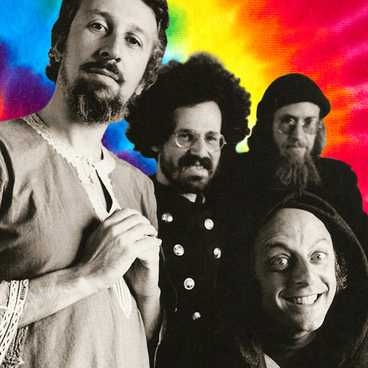
Standing, left to right: Jack Sarfatti, Saul-Paul Sirag, Nick Herbert;
Bottom right: Fred Alan Wolf.
Hence the mainstreaming of the counter-culture in physics and philosophy of mind.
Zombies be damned :flower: -
AGI - the leap from word magic to true reasoningIn the words of Yann LeCun (a leading AI technologist) "researchers need to work on 'objective-driven' AI with the ability to reason and plan about the world, rather than just work on words alone."
So what does it mean to have an "objective", and "reason" towards a resolution instead of just predict one? — Benj96
Does it mean, something has to matter to it? Humans and other creatures are driven by basic needs, but also by desires, plans, intentions and goals. I think the human capacity to reason is also goal-oriented in that way, and so ultimately driven by necessity. How could such attributes be genuinely embedded in an artificial system?
On Pierre-Normand's suggestion, I put it to ChatGPT 4, which responded as follows:
RevealYes, it's a very insightful question, highlighting some of the most significant challenges and philosophical inquiries in the development of artificial intelligence, especially concerning the aspirations toward artificial general intelligence (AGI). Let's explore the concepts mentioned and respond to some of the questions raised.
Objective and Reasoning in AI: In AI, an "objective" typically refers to a specific goal that the system aims to achieve, programmed by humans. For example, the objective of a chess-playing AI is to win the game. This is in contrast to human objectives, which are often multifaceted and can change dynamically based on the situation and internal motivations. "Reasoning" in AI terms means the capability to make inferences or deductions based on data and a set of rules, or more advanced forms of reasoning that involve planning or decision-making based on predicting future states.
However, current large language models (LLMs) like the one you're interacting with now do not genuinely reason in the human sense. They generate responses based on patterns learned from data, aiming to provide the most statistically likely answer, not necessarily to understand or reason through topics as humans do.
Goal Orientation and Data: Humans use a relatively limited dataset (our personal experiences and knowledge) but are incredibly efficient at generalizing from this data, thanks to our biological evolution and cognitive development which grant us the ability to reason abstractly, plan, and adapt. We're not just processing information but also actively learning and applying knowledge creatively and adaptively. For AGI to reach a similar capability, it would need not only access to vast amounts of data but also the ability to abstract, generalize, and reason beyond mere data retrieval or pattern matching.
Reiterative Automaticity: The concept you referred to as "reiterative automaticity" suggests that AGI should be able to autonomously modify its algorithms based on new information or changes in its environment, much like how humans learn from experiences and adjust our behavior. This type of learning and adaptation is a step beyond what current AI systems are capable of, where most adjustments to AI behavior are manually programmed by developers.
Compression of Algorithms and Data Efficiency: The idea that AGI should operate with the same or less data than a typical human to reason effectively is a profound one. It suggests an efficiency of processing and decision-making that AI systems currently lack. Current models require extensive data and computational power, whereas humans can make complex decisions with much less explicit information, often relying on intuition or subconscious processing.
Objective and Free Auto-Self-Augmentation: Giving AI an "objective" while also allowing "free auto-self-augmentation" touches on the core challenge of creating an AI that can set its own goals and adapt its methods autonomously. This raises both technical challenges and ethical questions. How do we ensure that an AI's self-set goals are aligned with human values? How do we manage and govern systems that can operate independently?
Lastly, whether this could be the difference between something that feels/experiences and something lifeless touches on the philosophical debate about consciousness and experience in artificial entities. This is a complex question that straddles technology, philosophy, and ethics.
In conclusion, moving towards AGI involves not just technical advancements in how AI systems process and handle data but also profound insights into the nature of intelligence, consciousness, and the ethical frameworks we construct around autonomous systems. It's a fascinating field with much to explore and discuss! — ChatGPT4
(I noticed the use of the pronoun ‘our’ in relation to human capacities). -
Rings & BooksI've always thought that Kant essentially accepts Berkeley, — Ludwig V
I have read that Kant was infuriated by those critics of his first edition who accused him of basically re-cycling Berkeley's idealism, to which end he included a lengthy section in the second edition, 'A Refutation of Idealism' (see e.g. this reference.) -
What is a strong argument against the concievability of philosophical zombies?mind is a 'mystery' too intractable for science, even in principle, to explain? — bert1
(Apologies for the delay in responding, I only just noticed the question from 15 days ago.)
Science construed as dealing solely with objective phenomena. But the grounds are rapidly shifting. I'm spending a lot of time nowadays perusing various Internet speilfests and panel discussions which are challenging the over-arching physicalist/objectivist paradigm that has dominated science until now. Phenomenology, analytical idealism, post-modernism and non-dualism (to mention a few) are challenging the physicalist paradigm and conception of the nature of science.
Who remembers the poster from the 2014 Tucscon Science of Consciousness conference?
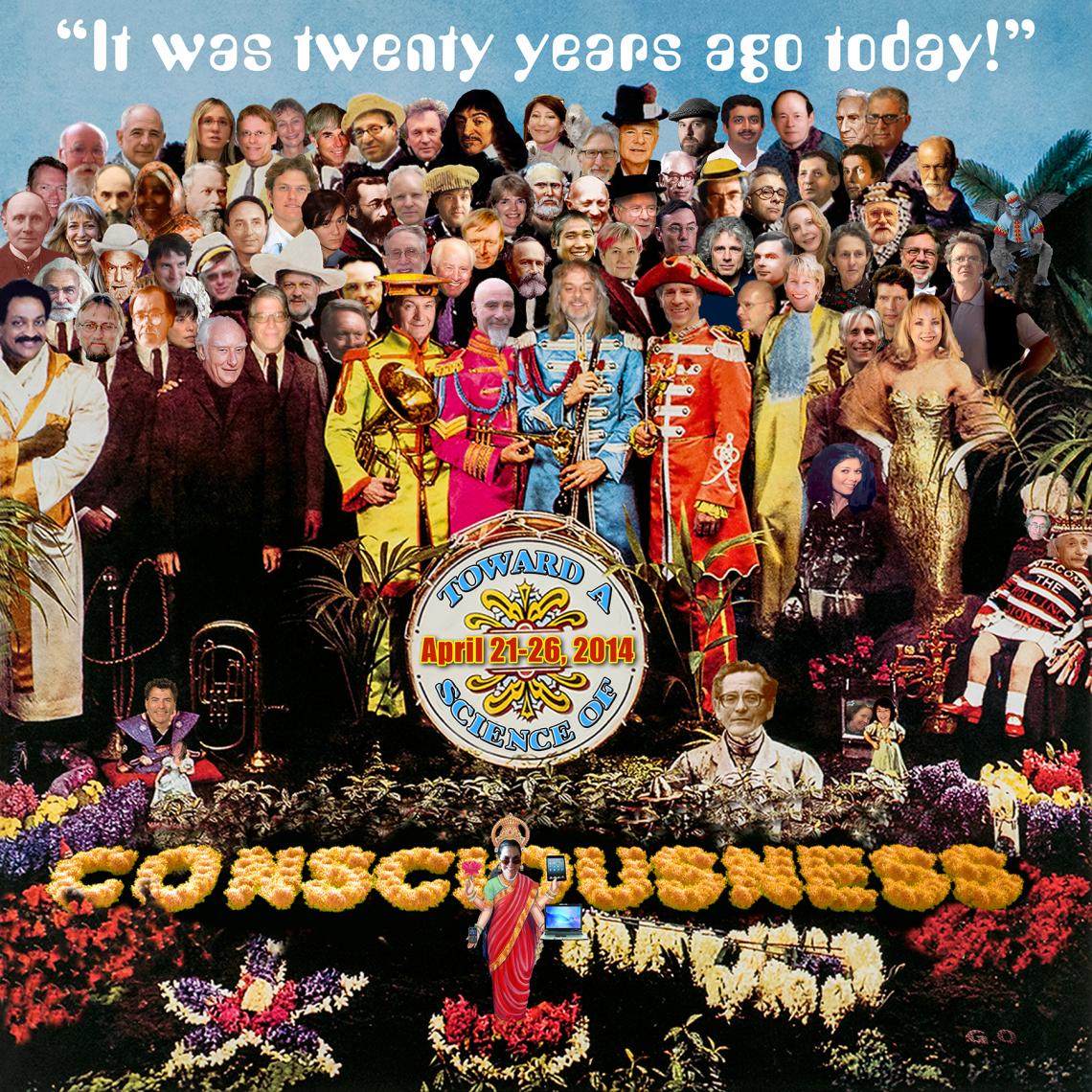
'It was twenty years ago today'. And that was ten years ago! -
Evidence of Consciousness Surviving the BodyStevenson's research on children who remember their past lives might be of interest. Of course it's wildly controversial and a taboo subject but he assembled a large data set. See this article.
-
The Mind-Created WorldA bunch of chalk on a blackboard, not a universe. — Count Timothy von Icarus
True - but that said, it is remarkable that the equations of general relativity can be captured on a single piece of paper. I don't think Thomas Nagel (or myself) wants to deprecate the astonishing reach of mathematical physics, so much as to point to what it assumes, and what it leaves out. Mind you, Wheeler's 'participatory universe' is one of the ways that these kinds of reflections became apparent from within science itself. -
The Mind-Created WorldFrom here. I will try and respond to this here because it is more relevant to this thread than to the one from which it originated.
If the physical is naturally understood to have substantial or substantive existence, and it is upon that idea of substance that the notion of reality is founded, and the idea of a mental substance is untenable, then what justification would we have for saying that anything non-physical is real?
The alternative to eliminative physicalism would be to say that mental phenomena are real functions of some physical existents, and that the only sense in which they are not physical is that they do not (obviously) appear as objects of the senses. — Janus
I think what you mean by 'substantial' and 'substantive' is 'tangible' and/or 'measurable'. Those are the empirical criteria for what is considered to exist.
There are many things that could be said, but as the question originated in a thread about Descartes, it might be noted at the outset that the idea of 'substance' and 'substantial' in philosophy is not an empirical one. Rather it originates with Aristotelian/Platonic metaphysics, wherein 'substance' was 'a thing whose existence is independent of that of all other things, or a thing from which or out of which other things are made or in which other things inhere' (Brittanica. It is, of course, true, that the classical idea of substance has fallen out of favour except for with adherents of Thomism and perhaps other modern forms of hylomorphism, for which see this daunting index.)
That said, I think that the traditional notion of substance became associated with, or displaced by, the objects of physics, as a part of the 'Scientific Revolution'. After all, the hallmark of the 'new science' was (1) the identification of the 'primary attributes' of matter as the principle subject-matter of physics and (2) the supposedly universal scope of the new physics (i.e. Galilean-Newtonian) to all such objects of analysis. This leads to the paradigm that I also quoted in the thread from which this query originated:
The modern mind-body problem arose out of the scientific revolution of the seventeenth century, as a direct result of the concept of objective physical reality that drove that revolution. Galileo and Descartes made the crucial conceptual division by proposing that physical science should provide a mathematically precise quantitative description of an external reality extended in space and time, a description limited to spatiotemporal primary qualities such as shape, size, and motion, and to laws governing the relations among them. Subjective appearances, on the other hand -- how this physical world appears to human perception -- were assigned to the mind, and the secondary qualities like color, sound, and smell were to be analyzed relationally, in terms of the power of physical things, acting on the senses, to produce those appearances in the minds of observers. It was essential to leave out or subtract subjective appearances and the human mind -- as well as human intentions and purposes -- from the physical world in order to permit this powerful but austere spatiotemporal conception of objective physical reality to develop. (Mind and Cosmos, Pp35-36) — Thomas Nagel, Mind and Cosmos, Pp 35-36
I am proposing in this OP, that this amounts to more than just a theoretical paradigm - it's also a worldview, and one which is essentially the default view of secular, scientifically-informed culture. I also claim that an implicit assumption of this worldview is the 'subject-object' relationship - it takes for granted or assumes our status as intelligent subjects existing in a world of objects (and other subjects). Within that paradigm, 'objectivity' is the criterion for what is real or existent; what is 'objectively true' is what 'exists when you stop believing in it', as Philip K. Dick put it.
Here, this point is relevant:
...physics reveals a physical world that is almost completely insubstantial. "Substantial" and "real" have a meaning in the context of physics, but not one that meets the demands of this philosophical wild-goose chase. Berkeley was wrong about many things, but about this, he was right. — Ludwig V
With which I agree. I take his main point to be a reference to the well-known 'observer problem' in quantum physics, which has undermined the whole idea of the 'mind-independent reality' of the objects of quantum physics, although I don't want to go into the whole 'interpretations of physics' tangle.
So what I was arguing in the other thread is that a consequence of Cartesian dualism is to depict mind (res cogitans) as something that exists within this subject-object paradigm, which is the scientific paradigm, and which is the only one we know or are confident of. The question becomes, how do you demonstrate or prove the existence of such a 'thinking thing'? Why, you can't! It's a specious concept. So what are we left with? The other half of Descartes' duality, namely, res extensia, extended matter, which Modern Science has proven so extraordinarily adept at analyzing and manipulating. (This is the sense in which I agree with Ryle's categorisation of Descartes' error as a category mistake, although I don't accept his remedy.)
Mind is not something that exists in this paradigm, except for as a product of the brain, an epiphenomenon, or an emergent attribute of what really does exist - which is the physical. That I see as the common-sense, mainstream view (which eliminativism takes to the most extreme, but also most consistent, position.)
This is why the argument in the OP says that an alternative to this view is a perspectival shift, a different way of seeing, which also turns out to be a different way of being. I'm pretty much in agreement with Bernardo Kastrup's analytical idealism in that regard, but it's really important to understand that this doesn't mean establishing that mind is something objectively existent. -
Exploring non-dualism through a series of questions and answersI'll add, I think these subjects *are* very difficult to fathom, as the Buddha's quote. After all, those who sought to fathom them often gave away everything in order to pursue it.
When I was much younger, I had the foolish idea that Zen enlightenment, satori, was a simple matter - probably from reading too much of Alan Watts. I recently read an essay by an Australian poet and esotericist, Harold Stewart, who emigrated to Kyoto Japan where he spent the last decades of his life. He observes:
But many Western enthusiasts for what they imagine to be Zen have never actually come into contact with this branch of the Buddhist Tradition as it still exists and functions in the Far East. ....Those few who took the trouble to visit Japan and begin the practice of Zen under a recognized Zen master or who joined the monastic Order soon discovered that it was a very different matter from what the popularizing literature had led them to believe. They found that in the traditional Zen monastery zazen is never divorced from the daily routine of accessory disciplines. To attenuate and finally dissolve the illusion of the individual ego, it is always supplemented by manual work to clean the temple, maintain the garden, and grow food in the grounds; by strenuous study with attendance at discourses on the sutras and commentaries; and by periodical interviews with the roshi, to test spiritual progress. Acolytes are expected to develop indifference to the discomforts of heat and cold on a most frugal vegetarian diet and to abstain from self-indulgence in sleep and sex, intoxicating drinks and addictive drugs. Altogether Zen demands an ability to participate in a communal life as regimented and lacking in privacy as the army.
I read a few accounts of Westerners who did spend time in Zen monasteries, like Jan Westerling's 'An Empty Mirror.' And it's extremely taxing. The Japanese are famously strict disciplinarians and the daily routines are exacting - one of those visiting Westerners (can't remember which) became so severely malnourished he almost died because the monks were given only a few minutes to eat.
Not that I've abandoned any effort, I'm still keen to learn and practice, and some things I've learned have sunk in. But it's a hard row to hoe. -
Exploring non-dualism through a series of questions and answersupon its obtainment the conventional truth of phenomena (such as of phenomena-dependent pains and pleasures together the our apprehension of selfhood) will also persist in this state of ultimate being - for the two truths were roughly stated to be one and the same. Yet, as expressed, I can currently only presume this to be wrong, for it is contrary to what Nirvana without remainder is described to be — javra
In the early Buddhist texts, speculation about 'what it must be like' is discouraged. In later Buddhist texts, like the Diamond Sutra, whether Nirvāṇa is something that can really be obtained is an open question.
As far as Advaita is concerned, my reading is limited mainly to the teachings of Ramana Maharishi. At the end of his life, he developed a tumor on his arm which turned out to be the cause of death. When asked if it was painful - it certainly looked pretty gruesome, according to the accounts of those around him - he would reply 'I feel the pain, but it doesn't hurt'.
From a philosophical perspective, which is inevitably quite shallow, his sense of the Self is such that the pain experienced on a physical level no longer seems all-pervading, as it would do to most of us who completely identify with the physical. I suppose you could say that pain is then experienced in a much broader context, as his sense of the Self transcends the physical. But that doesn't mean he's simply numb or unfeeling.
(In all this I'm only reflecting what I've read, I don't claim to have any special insight or realisation.)
Wayfarer

Start FollowingSend a Message
- Other sites we like
- Social media
- Terms of Service
- Sign In
- Created with PlushForums
- © 2026 The Philosophy Forum