
Comments
-
How do we develop our conciousness and self-awareness?I'd like to hear more if you wish, about the effects of this practice in other areas of self-development.
For example, in your writing? — Amity
I'll respond, but it's taking me some time to figure out what I want to say. -
Does quantum physics say nothing is real?I think that means you're wrong. — frank
I'm not surprised at your conclusion. -
Poem meaningThis is a bit of a cheat, but I want to repost something I wrote about a year ago in the "Metaphysics of Poetry" discussion. This is my attempt to give my idea of a description of the experience of reading a poem.
I think that poetry doesn’t mean anything beyond the experience of reading it or listening to it. As an illustration, I’ll provide a description of my experience of a poem I really like. “Dust of Snow,” as always, Robert Frost.
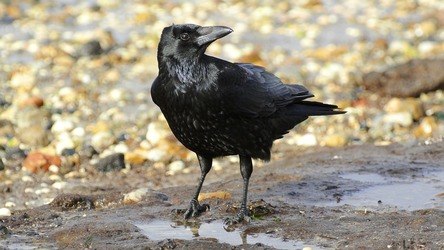
The way a crow
Shook down on me
The dust of snow
From a hemlock tree
Has given my heart
A change of mood
And saved some part
Of a day I had rued.
I really like this poem. First off - it’s really short. It was easy to memorize and when I quote it, people think I’m erudite. I tried to memorize “Two Tramps in Mud Time” once - nine stanzas, 72 lines. That didn’t turn out well. Also, it’s funny and Frost uses one of my favorite animals, no surprise, a crow. Not everyone sees the humor in the poem and I get that. I don’t know how idiosyncratic my reading is.
First stanza. Light, amusing. Very visual. I can see the man walking through the woods after a snow. That’s something that happens regularly in Frost poems. The snow is deep. He’s wearing boots. I can see the tree with the crow sitting at the top. Hemlocks are dark green with short needles ranked on many short branchlets. If that's a word. I’ve seen crows in the tops of trees plenty of times. Sometimes one, sometimes five, sometimes more. They’re usually noisy. Rambunctious. Very social. They’re really smart. It was clear to me the first time I read this poem that the crow shook the snow down on the man on purpose. That image always makes me smile. Having snow fall down on me from a tree branch has happened to me plenty of times. I can feel it going down my neck. Annoying.
Second stanza - More serious. Darker. It also makes me look back at the first stanza and think more about it. It seems like something has happened that the man regrets. So, he feels unhappy, sad, maybe guilty. It’s later in the day. Maybe he’s walking home afterwards or maybe he’s walking in the woods to think things over, brood, head down, not paying attention to where he’s going. And then the crow. He looks up. He sees the crow. He can see the crow looking down at him. He smiles. Maybe he laughs a little.
Why does this change his mood. I can think of a couple of reasons. First, it makes him break out of his introspection and look around at the day, the woods. That’s happened to me plenty of times. You just shake your head and get on with things. There’s another way to think about it that I really like. I like to think that at the moment the crow and the man are looking at each other, there’s a recognition. The crow made a joke. They both know it’s funny. Maybe the crow would cackle a little. I guess not. Frost would have mentioned that. The crow should have cackled. It’s hard to brood when your dignity has been tweaked. When someone has seen you for what you are.
As I said, this is not what the poem means. It is how it makes me feel. What it makes me see, think, feel. I don't expect anyone else to get the same things as I did or see it the same way. -
Does quantum physics say nothing is real?There is no absolute space and time, so no, we don't live there. — frank
You and I see things differently. I doubt there's any middle ground in our views. -
Poem meaningSo I was reading you as restricting poetic meaning to the experience, rather than making a distinction between meaning and experience. — Moliere
You're right. In discussions like this, sometimes I say "art has no meaning" and sometimes I say "art has no meaning beyond the audience's experience." Those are similar but different statements, but I mixed them all up together in my posts here. -
Does quantum physics say nothing is real?But your body and brain depend on being able to harness quantum chemistry. Life and mind start at the quasi-classical nanoscale of molecular machines where proteins can beat the classical odds by employing quantum tricks. — apokrisis
And the success of a cake recipe depends on chemical reactions which take place when you add heat to processed chemical and biological material. But I just want to eat a piece of cake. I know I sound flip, but I'm serious about this. When I'm figuring out how long a train takes to get from Preston MD to Cincinnati OH I don't need to think about relativity. That's a trick example. There is no rail service to Preston.
I think you are just too dismissive of the quantum realm. It is how there could even be the classical realm as its “other”. — apokrisis
I'm not dismissive at all, at least not of the science. I am a bit dismissive about overcomplicating the metaphysics. I think you and I have a different understanding about the value and use of metaphysics. I guess that's metaphysics too, or maybe meta-metaphysics.
It is crazy that nature even exists in one form. It is doubly crazy that a second form hatches emergently from that. It is triply crazy that even the quantum form has to be emergent - or at least that is an implication of the success of quantum field theory.
So stand back and marvel of all that we have discovered - some of it only very recently. — apokrisis
I do. I marvel all the time. -
Poem meaningAnd, if accepted, it would make your distinction between art and reality, as you've acknowledged, ultimately artificial. — Hanover
Maybe I've misunderstood. I wasn't discussing the distinction between art and reality. I was talking about the distinction between fictional, poetic, or artistic communication on the one hand and purely descriptive, technical, or explanatory communication on the other. -
Poem meaningOh... I thought we were disagreeing.
— T Clark
Well, we're not!
So there! — Moliere
Well, good. I guess. But then when I read your ideas it does seem like we're disagreeing.
So you would claim that "poetic meaning" in reference to "meaning" is more or less an equivocation, that these are actually separate things. Do I have you right?
That is fine by me, because I'm also actually interested in the aesthetics of poetry unto itself -- and actually put this in aesthetics with the idea of exploring that more than the usual reductions, with the idea of it generating more shared thoughts to build from.
And, even more than that, while I have this odd suspicion, it is just an odd suspicion. And it's a lot easier to talk about how poems work and how it is they mean or what it is they mean. — Moliere
I'm confused. You keep talking about poetic meaning, but I said poems, art in general, don't mean anything. How can we be agreeing. -
Does quantum physics say nothing is real?Newton worked within a framework of absolute space and time that we now know isn't real. — frank
Except that 99.99999% of the time we do live within a framework of absolute space and time.
QM says some of our assumptions about reality have to be wrong. — frank
QM says that things work differently at small scale than they do up here where we are.
The first ontologists were doing speculative physics. The two have already melded. There is a kind of metaphysics which is just language on holiday. It's fun to follow its convoluted paths, but it's ultimately pointless. Science is almost never pointless, so we might draw a distinction between that pointless kind of metaphysics and science. — frank
As I wrote previously, for me, metaphysics and science are completely different things. -
Poem meaningI agree with this, too. — Moliere
Oh... I thought we were disagreeing.
they necessitate dialogue, an other, a community, a group. The poem comes alive in the collective witnessing of the poem — Moliere
I agree with this. There are worthwhile things to say about poetry, but I don't think meaning is one of them except in the fairly trivial sense of knowing what the poet is referring to. Example - In "Wild Grapes" by Robert Frost, it's good to know that "Leif the Lucky's German" refers to Leif Erickson's German foster father.
I like to talk about what I experience when I read a poem. As I see it, that's different from it's meaning. From my point of view, most of the poem interpretations I've read are baloney. I do also like to talk about technical aspects of the poem - meter, rhyme, metaphor - and how they help me share the poet's experience. I don't think that's the same thing as meaning either. -
Poem meaningMy point is that all is metaphor and poetry. — Hanover
In “Surfaces and Essences: Analogy as the Fuel and Fire of Thinking” Douglas Hofstadter claims that all human thought is analogical. I've read similar views in other places too. -
Does quantum physics say nothing is real?It's just not the case that something odd is happening at the small scale, but this has no bearing on the way we conceptualize the universe as a whole. — frank
One of the points I've beaten till it's black and blue is that metaphysics is not universal. We don't need a one-size-fits-all universal metaphysical foundation. For me, metaphysics should be applied piecemeal. It's a tool to help with thinking and understanding - a tool box. When you're doing reductionist science, maybe pull out the materialism and realism. When it's math, pull out the idealism. When you're trying to see how it all fits together, you might need holism or even mysticism.
This isn't an idealism vs. realism debate. You're right that much of that debate takes place outside the realm of science, but that could very well change in the next century, so let's not imagine that we've reached the pinnacle of understanding. We haven't. We're just somewhere on the trail. — frank
As I understand it, metaphysics and science are different kinds of things. One is the ground, foundation, of the other, especially if we include epistemology in with the metaphysics. Given that view, metaphysics and science will never meld into each other.
I agree we are nowhere near the pinnacle, if there even is one. -
Poem meaningWhat distinguishes an artistic expression from your expression quoted above? What would a non-artistic expression be? If there is no distinction, then all is art. — Hanover
I don't consider myself a very artistic person. I've done a little fiction and poetry writing. I enjoy the process and I like some of the results, but it's not really my thing. I don't draw or paint, but I sometimes think in very vivid imagery. For me, that kind of thinking is exhilarating. I have had the thought that the distinction between art and non-art communication is artificial. All of it is about taking something from my mind and putting it in yours. But that's not a very interesting argument to make and I think there are some important distinctions.
I guess the difference for me is that non-fiction, including the kind of stuff here on the forum, is about sharing knowledge, ideas, or skills. With art, it's about sharing the actual direct non-verbal experience. As I said, the argument can be made that is an artificial distinction. -
Does quantum physics say nothing is real?Thanks. So you, Banno, and others come crowding on to these kinds of threads to show that you don’t take deep and interesting questions seriously. You know better because you haven’t learnt either the physics or the metaphysics. Ignorance of the subject matter becomes your trump card.
C’mon. You can do better than that. — apokrisis
I think I've shown I do take interesting questions seriously and I am very interested in these questions. As I noted, though, I think the gee whiz gets in the way of the science and philosophy. "Gee whizz" is not metaphysics, but in QM, it is treated as if it were.
Also, I didn't mean to include you among the dorks on the forum, although it came out that way. I have always thought of you, Fdrake, and Streetlight as the voices I can trust in math, science, and related philosophy. -
Does quantum physics say nothing is real?It is the flat contradictions in the causality that creates the angst. Sure, you can take the epistemic or modelling perspective that says we simply construct the pragmatic story that captures sufficient truth at each level. So shut up and calculate.
But this invokes an ontology of emergent properties. And so you are just moving the metaphysical questions back to that next grounding level.
For example, you can get into the hierarchy theory debate about whether emergence is all about supervenience - so microstate realism about emergent macrostates - or instead the kind of Peircean holism that I always promote.
So why is quantum reality nonlocal and classical reality local? Why is quantum reality indeterminate or vague, and classical reality definite or crisp? Is it just epistemic accident we arrived at such contrasting causal axioms, or is it instead the big clue that shows there is a directly reciprocal relation in which reality emerges from the manifestation of that causal dialectic. — apokrisis
To the extent I understand what you're talking about, it makes sense. I'm starting to get a feel for your description of how hierarchy's work - the idea of downward constraints and holism. But on the other hand, who cares? Sure, you do and I do and a bunch of other dorks do. Scientists and philosophers seem as confused about this as the low-lifes here on the forum. As I wrote, I think the taint of mystery and weirdness makes it harder for people to figure out what's up.
I don't even disagree with anything you said. I guess I just place the emphasis differently. People should realize the world is the world, not what they think it is or want it to be. They should get used to it. -
Does quantum physics say nothing is real?Have you noticed how folk tend to rely on this distinction as if it were an argument? I don't understand that. Ontology and epistemology are not like ought and is...
What am I missing? — Banno
Geez louise. Don't be such a doink. Answer the ding dong question. -
Does quantum physics say nothing is real?the mooted distinction between epistemology and ontology — Banno
If you're saying the distinction made between epistemology and ontology is arbitrary and unnecessary, I agree. If you're saying something else, I don't know what it is. -
Does quantum physics say nothing is real?There is an argument to be had there. We can build the subjective anthropomorphic view into our metaphysics.
But how is that to be done in a way that simply doesn't serve to contradict all attempts by physics to then take the objective "view from nowhere" as its highly productive metaphysics? And what happens when that unreasonably effective route has to turn around and recover its own subjective point of departure? — apokrisis
I think I'm trying to address a different issue than you are. It bothers me when everybody, even scientists, keep saying that the quantum mechanics is weird. It's not weird. It's just how things work. Why would you expect events at scales of 10 or 15 orders of magnitude smaller than ours to act the same way they do up here?
So, QM doesn't make the world weird. Apples are still apples and they still fall when you drop them and crunch when you chew them. Canada geese still honk and shit on your lawn. Nothing in your daily life get's any less real. There's no reason to get all excited.
On the other hand, I recognize there is a need for a broader context. Once everybody chills out we can work that out. Focusing on the weirdness of the quantum world makes it harder to understand. You can see the effects of that in this discussion.
That is how all the quantum mysticism arises. If the foundation is the human observer making measurements – regardless of whether it is with their wide bum, or a clock and ruler – then how does this "classical" picture account for whatever emergently leads to the collapse of the wavefunction? — apokrisis
I think it arises from people thinking that QM somehow undermines their experience of the world we see every day.
Have you ever tried making sense of action and reaction as a symmetrically opposed pair of force vectors? Or is it only me that saw that as the answer to how rockets worked in a picture book when I was 7 years old and thought, hey, that's a completely bogus metaphysics! — apokrisis
The law of conservation of momentum always made sense to me, although I'm sure I wasn't aware of it when I was 7. Or Newton's laws either. I'm even more sure I didn't know what metaphysics is. You clearly were a prodigy.
So you were on the nose with your earlier remark about scales of observation. But my point here is about taking the ontology seriously once you have indeed sorted out your epistemology. — apokrisis
As I said, I see the human scale standard as a convention. A place to stand while we take our measurements of phenomena much larger or smaller or much more or less energetic then where we grew up. -
Does quantum physics say nothing is real?It is right that reality looks different at different scales of interaction. And so that makes us ask which scale is foundational and which is emergent. — apokrisis
As a matter of convention, I think it makes sense to think of interactions at human scale as foundational, at least for bookkeeping purposes. It was at that level that the whole concept of reality was established. It's at that level that most people experience reality directly. It's at that level where noting weird is going on. -
Does quantum physics say nothing is real?Not anymore, not with the Wigner's friend experiment evidently. Now science and philosophy are becoming one and the same or at least blending. — Darkneos
Massimo Pigliucci and I disagree. -
Does quantum physics say nothing is real?I've said it before. I'll say it again. Questions about our reality are not science.
— T Clark
:fire: — 180 Proof
Thinking about it, I edited my previous post to read "Questions about the nature of our reality are not science." The original seemed a bit ambiguous. -
Poem meaningIn one sense an interpretation of a poem will set out what it means, why it's significant, the feelings that might arise, — Moliere
I've come to see that art, including poetry, doesn't mean anything beyond the audience's experience in seeing, reading, or hearing it. Art is an artists way of expressing an experience which makes it possible for them to share it with others. -
How do we develop our conciousness and self-awareness?No. Learning is about memory, and memories are things one becomes aware of when something reminds one. Learning about learning is doubly so. I could put it this way; "Awareness is the present moment", and one can be aware of the past but not in the past. I remember being aware as I wrote that last sentence, that it would likely be confusing, and I am aware as I write this one that I may not be clarifying things much. — unenlightened
This point is probably not worth arguing about more than we have. -
Does quantum physics say nothing is real?If someone wants to claim that no quantum theories can be tested even in principle, that's a positive claim and requires some support. It's a strong claim, so it needs strong support.
You just misunderstood the quote, that's all. No biggie. — frank
It's clear to me I've made my point no matter how obstinate you are. Nuff said. -
Is it possible to be morally wrong even if one is convinced to do the right thing?when the authors of the Declaration of Independance wrote that "all men are created equal" they were talking about white men, not women nor black people — Matias
What you've written makes sense. I do think many of our country's founders were aware of the ambiguity and hypocrisy. -
Does quantum physics say nothing is real?There's no way yet. It hasn't been established that there's no way in principle. — frank
It's seems clear to me from the quote that Pigliucci means it can't be done. Before I read that, I had thought it was still an open question. Perhaps that's true, but, to me, it's beside the point. You wrote "You're wrong." I showed you a credible opinion by a qualified person that says I'm right. Although I'm willing to acknowledge that the issue may not be resolved, I think I've established that the position I've advocated in this discussion is a reasonable one. -
Does quantum physics say nothing is real?Did you read what he said about the experiment and how it invites questions about our reality. — Darkneos
I've said it before. I'll say it again. Questions about the nature of our reality are not science. -
Does quantum physics say nothing is real?That's not true. — frank
From the August 2022 edition of "Skeptical Inquirer." Thanks to @Gnomon for the quote.
Let that sink in : there is no way to empirically tell apart different interpretations of quantum mechanics. One might even suspect that this isn't really science. It smells more like . . . metaphysics. — Massimo Pigliucci
Pigliucci is a philosopher of science at City College of New York. -
Does quantum physics say nothing is real?So what about the Wigner's friend experiment. — Darkneos
There are many interpretations of quantum mechanics. It is my understanding that there is no empirical way to determine which, if any, are correct, even in principle. Questions which can't be answered empirically are not science. -
Is it possible to be morally wrong even if one is convinced to do the right thing?All decent people today (at least in so-called Western countries) agree that slavery is morally wrong, and that this is not just an opinion, but a moral fact. Most would even argue that slavery has always been wrong, be it 200, 400 or 2000 years ago. — Matias
I think many people knew even 200, 400, and 2,000 years ago that slavery was wrong. America's founders - Jefferson, Washington, Monroe, Madison - knew it was wrong or at least had serious doubts even though they owned slaves themselves. They knew their practice put the lie to their rhetoric in the Declaration of Independence. That doesn't answer your question, but I think it shines some light on it. -
Does quantum physics say nothing is real?The fact they link to experiments and science sites and I just have your word. — Darkneos
You don't just have my word, you have my argument, which I've made over my past posts on this thread. The heart of that argument is that the question of what reality is and whether or not objective reality exists is not a scientific question, it is a metaphysical, i.e. a philosophical, one. The answer to the question is in philosophy, not science. Scientists are not generally very good metaphysicians.
There's not much more I can say. If you don't get it or you disagree, there's no place else for this conversation to go.
Also - note the poster in the second Quora link you provided agrees with my position, although Quora is not generally considered an authoritative source. You'll find all sorts of inconsistencies and disagreements there. -
How do we develop our conciousness and self-awareness?But I don't think it's awareness of awareness as such. — unenlightened
Being aware of the feelings in muscles, balance, and energy when I move in certain ways is awareness. Observing and being aware of patterns in the way I learn to be more aware in different situations is awareness of awareness. -
How do we develop our conciousness and self-awareness?But perhaps I am wrong about this; perhaps someone can describe the experience of awareness. I await with eager anticipation a better explanation. — unenlightened
I'll try to describe how it feels for me to become aware of something. The first time I remember doing that was while learning Tai Chi. I was having trouble with a move, so I kept doing it over and over. I tried to focus not only on the movements, but how the movements felt in my body. I would ask my teacher "what's it supposed to feel like?" Tai Chi for me has to do with the movement of power through my body, so I would ask "What is the power supposed to do?"
While I did the movement, I would try to pay attention to how my body felt as well as I could. A couple of times I thought I felt something that might be important, so I focused on that feeling when I was practicing, but it didn't help. Then I felt something again, I always call it a "tickle." When I paid close attention to that feeling it grew and came into focus. It was a feeling in my body - the muscles, balance, stress - I had not been aware of. After enough practice, it became natural to be aware in that way. That experience and awareness was helpful in working on other moves.
Since than, I've found a similar process takes place in other areas of awareness - intellectual, physical, emotional, social... I guess that's awareness of awareness. -
Is it possible to be morally wrong even if one is convinced to do the right thing?A good question and a good opening post. I can't come up with a good response right now. I'll think about it some more.
-
Does quantum physics say nothing is real?Can you not read something about QM and become enlightened on the topic? — frank
Please explain how I am "talking down." -
Does quantum physics say nothing is real?I get that. And you're wrong. QM is not a matter of "different rules for small things."
Check into any quantum theory. And stop talking down to people. — frank
I disagree. Please explain how I am "talking down." -
Does quantum physics say nothing is real?Because we believe in the uniformity of nature — Srap Tasmaner
But nature clearly isn't uniform. It behaves differently depending on where you choose to look - baseballs or bosons.
the unity of science. — Srap Tasmaner
And science clearly is not unified. We have broken it down into a hierarchical list of different sciences depending on scale and principle of organization. There have been long discussions of that hierarchy here on the forum. I think the important message is that reductionism works - each higher level behaves consistently with the level below - but constructivism doesn't - you can't generally predict behavior at a higher level from principles of the lower level. Example - you can't predict the behavior of biology from chemistry.
And yes of course there are differences between how a crowd of 50,000 behaves and how a group of 5 behaves. Yes, scale matters. But it should be explicable how you crossover from one scale to the next — even if there is no simple, non-fuzzy boundary. — Srap Tasmaner
At some level I think you're right, although I'm not sure it's always possible. I think there has been a lot of work to figure out how the quantum world transitions to the classical one. That seems like a valuable thing to know, but I don't think it changes my position.
Anyhow, that's why at least one person (me) would think that wouldn't be true, based entirely on my assumptions and with hardly any knowledge of quantum theory at all. I've just never understood the "it's just a matter of scale" view — as if Mother Nature checks the size of what she's dealing with and then picks the appropriate rule-book to follow for that size object. That leaves the events at different scales isolated from each other in a way I find incomprehensible. — Srap Tasmaner
I doubt you and I would disagree with each other on a practical level. I think our metaphysical language is just different. When it comes to metaphysics, my rule is to use whatever works. Not everyone agrees with that. -
Does quantum physics say nothing is real?This is squarely false. It is a physics question. There are a number of quantum theories which vary considerably in how they explain quantum experiments, and none of them confirm your folk notions of reality.
You have misrepresented the scientific field in this thread and should by no means be talking down to anyone else. — frank
I disagree. Please explain how I am "talking down." -
Does quantum physics say nothing is real?There are ways of accommodating within a a single metaphysics the situation in physics that the world appears to work differently at different scales. For instance, one can argue, as the followers of Quine do , that facts and value systems ( accounts of the world) are inextricably bound together. Thus, it is not just the human and nano scales of physical description that can’t be fully integrated. It is also the myriad descriptions of reality within the various subsegments of the biological and social sciences. Whatever we study within one approach responds also to other theories and procedures, but with different new precision. Since it responds to various systems, it cannot be how one system renders it. — Joshs
I don't see how this substantively differs from what I wrote. It seems like there's just a language tweak that allows you and Quine to bundle a bunch of different metaphysical approaches into a single mega-metaphysics.
I have no problem with that I guess, I just find it less clear than the way I describe it.
T Clark
Start FollowingSend a Message
- Other sites we like
- Social media
- Terms of Service
- Sign In
- Created with PlushForums
- © 2026 The Philosophy Forum