
Comments
-
How do we develop our conciousness and self-awareness?That isn’t disparaging. It is to say it is is another level of semiotic regulation. And we can aspire to professional standards and evidence backed practice. It isn’t something mystic that can only be acquired in encounter groups or exotic eastern practices. — apokrisis
I didn't take it as disparaging, I just think it's inaccurate. I see self-awareness as a skill, not a technology. I don't see self-awareness as mystical either. As I said, I think it's everyday, bread and butter human behavior, although I admit it can feel magical sometimes.
But is that attaining self awareness or shedding it? I’m talking about finding a better way to integrate with a community of minds rather than just escaping its constraints. Our challenge is how to find a balance in that regard, not particularly about finding a way to disappear into some sublime sense of self. — apokrisis
I agree this has nothing to do with "some sublime sense of self." Oh, good. I get to quote from the Tao Te Ching. From the Ellen Marie Chen translation of Verse 10:
In being enlightened and comprehending all,
Can you do it without knowledge?
This is one of several passages that say something similar - knowledge leads to artificiality - a false sense of self. I've had arguments about this before. Lao Tzu can't possibly mean that knowledge is bad, but I think he means just that. A release from knowledge and surrender to experience is what self-awareness is for me.
Again, holism is the oneness of the many, and the multiplicity that forges its oneness. Parts and wholes are that which are both differentiated and integrated. So it is not an opposition but a synergy in the systems view. — apokrisis
I agree.
Sounds like you think he achieved something nevertheless. But DuPont. How easy would it be to create genuine community values in an industrial corporation? — apokrisis
You're right about big industrial corporations. It was always a struggle for him. I wasn't denigrating his way of doing things, it's just not my way. -
How do we develop our conciousness and self-awareness?Do you mind if I ask you what you mean? I am not clear how your father saw people from your account other than he tired to provide a positive work space based on an eclectic approach. — Tom Storm
I think he saw people in a way similar to my interpretation of the kinds of process @apokrisis described. He was an engineer and he saw labor management processes as an engineering problem. He used to make lists and draw flow diagrams of how worker/management interactions should work. He tried to apply what he had gotten from his sources in what seemed to me to be a rigid, mechanical way.
Sorry, Apokrisis, now you can set me straight for any misrepresentation.
On the other hand, my interactions with other people are almost entirely intuitive based on my personal reactions to the situations and my perceptions of how others are thinking and feeling. I'm not a wonderful manager. It's very possible his style worked better in practice than mine did. I don't know. -
How do we develop our conciousness and self-awareness?Now it is a learnt skill and I can do it without much thought and effort. — apokrisis
I agree it is a learned skill. It's taken me more than 50 years to get even as far as I have.
I disagree. If you have integrated your various forms of experience under the one running sense of self, then that has to be a learnt rationalisation now practiced to the degree it is a fluid habit. — apokrisis
And I disagree. I don't think the experience of everything all at once is artificial or a rationalization. My intellect is not separate from my body, my emotions, my perceptions, all my experiences. On the other hand, it doesn't make sense for us to have dueling awarenesses here. There's no reason to expect that different people would think of it or experience of it in the same way.
And that is why I tout positive psychology. Generally it is a tool to articulate your own unconscious thinking - externalise it in a way that can be rationally critiqued and then reframed in a fashion that feels more pragmatically true to the life you must actually live. — apokrisis
I wasn't familiar with positive psychology, so I looked it up. It made me think of my father. He was an engineer working for Dupont his entire career, starting out as a supervisor on shift work, getting into management, and ultimately working on labor relations. The last years of his career he spent trying to get unions and management to work together. That involved committees of union workers sharing ideas with management and other I guess you would call them "stakeholder engagement" practices. He was definitely a pragmatist and he took principles and practices from all over the place - management theory, eastern philosophies, human potential practices like encounter groups. I wouldn't be surprised if he knew about and used positive psychology. I think he really did see what he was doing as technological - as human engineering I guess you'd say.
I hope the way I described it doesn't sound condescending. He was trying to do what all good managers do - balance the needs of the company with the needs of the people who worked with him and for him. He wanted to make peoples lives better at the same time making them more productive. He always said that workers got his ideas right away and were enthusiastic about them but management resisted every way they could.
But that way, his way, doesn't work for me. That's not how I see people. -
How do we develop our conciousness and self-awareness?Self awareness is a cause of much mental ill health in modern society as people find it isolating and socially crippling. Drink and drugs are needed to blot it out. — apokrisis
This makes me think of something my older brother told me. Welbutrin is an antidepressant that is also sometimes used to help people quit smoking. It was prescribed for him because he had tried to quit many times without success. He told me he stopped taking it because he became much more aware of how badly he had treated some people in his life. It became an overwhelming experience which interfered with his life.
The truth that the Tao captures is that we should aim for flow. What people enjoy is being in a state of “unconscious” habit and skill - engrossed in some useful activity...
...Self awareness is socially constructed technology to get members of a society to filter their actions through a communal lens. It is the way we police our impulses and feelings. It is where we negotiate a social agenda from behind social mask. — apokrisis
I don't see self-awareness as a technology at all. Perhaps you could call the practices that lead to awareness, e.g. meditation, technologies, but I think that's a stretch. For me, the Tao and self-awareness are states where we are released from the communal lens and our social mask. The search for self-awareness is a search for surrender of our wills. I think to achieve that fully is impossible. It certainly is for me. In the meantime, the effort is enjoyable. The effort not to expend effort. -
Does quantum physics say nothing is real?That's a very well put and useful paragraph TC — Tom Storm
Thank you. -
How do we develop our conciousness and self-awareness?But being moved in a physical or emotional sense is not the same as being moved in an intellectual and rational sense. It is not about being “a community of inquirers” in the pragmatic sense I specified. — apokrisis
For me, self-awareness is not an intellectual or rational exercise, at least it's not only that. It feels like most of my interaction with the world is intellectual, so that's where a lot of my awareness focuses. You can see that in a lot of my posts. I tend to be very aware of what I know and how I know it, how I process ideas. That's the engineer in me. It's both a temperamental inclination and a result of many years of effort. But those aren't the only kinds of awareness. Over the years I've become much more aware of my emotional and physical experiences. The way my body feels. Intuition about how other people feel. I'm probably weakest in my perceptual awareness. I tend to overlook a lot. I'm not very observant of the outside world.
But breaking it up like that is artificial. There's really only one awareness, at least for me. It all fits together and it's not rational at all at bottom. It's just a sense of the world and how it fits together and how I fit into it. -
How do we develop our conciousness and self-awareness?I'm glad people like poetry and I wish I did. But I don't. You're probably right about the jazz comparison. Do you consider Tao Te Ching a work of poetic imagination? — Tom Storm
I'll go out on a limb, because I haven't thought this through. Yes, I guess I think poetry aims at the same target Lao Tzu does. That's how it feels to me. -
Does quantum physics say nothing is real?The links seem to say different. — Darkneos
What makes your sources any more authoritative than all the other thousands of voices out there, including mine. As I said, it's not a physics question, it's a metaphysics one. The failure to recognize the difference between everyday or scientific reality and metaphysics is the biggest failure of most posters on the forum.
I've had my say. If you're not convinced, or even interested, I can't think of anything else that might make you think twice. -
How do we develop our conciousness and self-awareness?I've always found poetry tedious. I'll just admit it. And while I loved many high romantic works of art and literature as a teen, well now I find them mostly cringy and over-wrought. So I am very prejudiced against any idea that poetry is more than entertainment. — apokrisis
I hear you and agree. — Tom Storm
I'm here to speak for poetry. I don't get a lot of it, but when I do, it goes somewhere really different than non-fiction or fiction. It can lead to awareness of a whole different part of who I am.
Just because you don't get it doesn't mean there's nothing to get. I feel the same way you do about poetry about jazz. I don't get it. It doesn't move me. On the other hand, I can see there's something there. Even if it doesn't work for me, I can see and hear value while not participating. Also, a lot of people whose judgement I respect are moved by it. -
Does quantum physics say nothing is real?How do you know? I from all the links I've gathered there seems to be something to there being no objective reality based on what that guy on Quora is saying. — Darkneos
There is something to it. I started a whole discussion about it. I think the concept of objective reality can be very misleading. On the other hand, in some situations, it is very useful, e.g. the scientific method. Another example - our everyday life. Trees don't cease to exist when we're not looking. Somebody said something about how reality is what's left when nobody's there.
Whether or not there is or isn't objective reality is a metaphysical question. As R.G. Collingwood wrote in his "Essay on Metaphysics," metaphysical questions don't have yes or no answers. Metaphysical claims are not true or false. They are more or less useful in specific situations. As I noted previously, the idea of objective reality is probably not very useful at quantum scale. -
How do we develop our conciousness and self-awareness?Is your first thought aware of itself? Or is your second thought a reflection on your first thought (as mine is). — unenlightened
This is an interesting way of putting it. Now I'm trying to figure out if the first thought you're talking about is a thought at all. For me, at least, it's not in words. It's a wordless experience. I'm asking myself whether the second thought is where awareness begins. -
How do we develop our conciousness and self-awareness?
This is a different way of thinking about awareness than mine, but it's interesting and well thought out. It made me go back and look closer at how I experience my own awareness. -
Does quantum physics say nothing is real?Does quantum physics say nothing is real? — Darkneos
Start with the easy part - you know that things, at least some things, are real. You wake up in the morning. Get dressed, brush your teeth. Have some coffee, maybe eat breakfast. Go to work. You know that your clothes, your toothbrush, coffee, pop tarts, your car are real. You know that because those are the kinds of things we created the concept of "reality" to apply to. Quantum mechanics doesn't change that.
The danger with QM is that people get the physics and metaphysics all wrapped around each other. Drastically different physical principles apply to sandwiches and surfboards than apply to subatomic particles. The world works differently at different scales. Why would we think that wouldn't be true. Different metaphysical regimes apply at different scales. That's the thing about metaphysics - there's not just one appropriate view of reality. The philosophical lesson of QM is that what works at human scale doesn't work at all at nano-scale.
See. Easy. -
How do we develop our conciousness and self-awareness?How do we develop our conciousness and self-awareness? — Universal Student
I guess the most important part of self-awareness for me is the understanding that it is nothing special, nothing magic. It's something we do every day and something we can get better at. There's one rule, one practice - just pay attention. And then, pay attention to paying attention.
I'm going to punt now, which is cheating. Forgive me. This is the original post from a discussion I started more than five years ago. Still one of my favorites. Lots of smart self-aware people participated.
I’d like to talk about the experience of awareness. What it feels like from the inside. In particular what it feels like to become aware. This is probably the one philosophical/spiritual phenomenon I’ve thought the most about. I think that’s because I was deeply unaware of my feelings and internal experience when I was a teenager and I’ve been struggling for 50 years to come to terms with that.
I’d like to make a distinction here between awareness and consciousness. I’m not sure that distinction is legitimate lexicographically, but in terms of how it feels on the inside, they seem different to me. For the purpose of this discussion, by consciousness I mean the capacity for putting experiences into words. Awareness, on the other hand, is pre-verbal. It’s certainly true for me that consciousness and awareness sometimes happen at the same time. Sometimes I’m not even aware I’m aware of something until I talk about it with myself. On the other hand, I’ve had many experiences of awareness without words or concepts. I don’t want to argue about the distinction I’m making. Again, I want to talk about actual experiences.
In what ways am I aware – intellectually, emotionally, physically, perceptually, spiritually. What else?
I’m probably the most aware intellectually. I think that’s both because of my natural capacity and inclination and the fact I’ve been an engineer for 30 years. I have visual images of how the things I know and understand fit together. I can see the universe – everything, stars and electrons, love, god, macaroni and cheese, my brothers - as a cloud. When I am putting ideas together to describe what I know or make an argument, I am very aware that I am putting together a story and I see a curve, a narrative arc, that shows the sequence of facts, ideas, and conclusions I am using to make my case.
When I was a teenager, I was almost completely unaware of what I felt emotionally. Worse, it didn’t seem like I felt anything. I felt inauthentic in a fundamental way. Numb. Frozen. It made it incredibly difficult to have healthy relationships with others – family, friends, lovers. Now, I spend much of my attention on what is going on inside me. I often find myself stopping what I’m doing or thinking to figure out what I feel about something. Given where I’ve come from, it’s an incredibly freeing experience. It’s so much fun.
I could go on – but I don’t like long original posts. I have more to say, but for now I’d like to hear what others have experienced. — T Clark -
Currently ReadingI promise those are the last books of Japanese literature in my room. I will read other types of literature in the coming months. — javi2541997

-
Currently ReadingAutumn readings
Captain Shigemoto's Mother, Jun'ichirō Tanizaki.
Rivers, Teru Miyamoto.
Beauty and Sadness, Yasunari Kawabata. — javi2541997
I told you, no more Japanese reading. Except for those cool porno comics. -
The hoarding or investment of WealthContrast this to say Gates amongst others who although ultra wealthy do not feel the necessity to pass on this wealth to them. — Deus
He's leaving his children enough that they'll never have to work again if they don't want to. This is much more than I would ever be able to leave to mine. -
Antinatalism ArgumentsIt diminishes us to helpless cogs that can have no real agency. — schopenhauer1
It is your judgement that we are diminished. Many of us don't feel that way. I think you are a pessimist first by temperament. This seems like just a post hoc search for rational justification, which is not hard to find.
See that, post hoc. Latin jargon. I must be a real philosopher. -
Foundational Questions of Physics & MetaphysicsWho wrote the "laws" limiting how far amateur philosophers can speculate, beyond the "revealed Word" of physical Science? — Gnomon
I don't think I have anything more to add in response to your two most recent posts to me. We could go on for days without getting any closer to agreement. I'm not sure if you'll get any satisfaction from this, but discussing these issues with you always helps me reexamine and refine what I really believe. -
Question about Free Will and PredestinationIn your walk from one side to the other, you freely chose the path, now turning left, now right, now making a loop. The path you uncovered is yellow, so you naturally assume the entire lot is yellow. However, when the sand is blown away, you see only the path you uncovered is yellow; the remainder of the lot is black. — Art48
I have a pet peeve about half-assed thought experiments, but this is a pretty good one. Paints an interesting picture. Now the question is if the scenario you describe is a good model of how things actually work. My first thought is that in the real world, the sand never gets blown off the parking lot. We never really have to face convincing evidence that our behavior is strictly constrained. We can only speculate. -
Foundational Questions of Physics & MetaphysicsUnstated assumptions : Speculation Bad! Metaphysics Bad! — Gnomon
If I've misrepresented your argument, tell me which of my statements you don't agree with. Tell me what your conclusion is if not the one I state in the last bullet.
Did you omit a prejudicial step, in your logical calculation of that damning conclusion from an unfavorable reading of the OP? Would you apply such biased reasoning (sophistry) to Massimo Pigliucci, too. In the Skeptical Inquirer article, he implied that he has had accusing fingers pointing at him. — Gnomon
I didn't read Pigliucci's article and I wasn't commenting on what he wrote. I was commenting on your interpretation of what he wrote. Again, tell me which point of my summary don't you agree with. Tell me what your conclusion is.
It's hard to respond to smears without getting sh*t on your hands. — Gnomon
What did I say that was a smear? -
What does this mean?Actually waaaaaayyyy at the bottom he makes it clear that this is NOT solipsism and explains the problems associated with going in that direction. Not that I understood it but just pointing it out. — Darkneos
You're right. I didn't read carefully enough. -
Foundational Questions of Physics & MetaphysicsDoes The Philosophy Forum have minimum requirements for "professional credentials"? Do you have relevant accreditation to verify that your own "opinions are credible" on the subject of Philosophical Diffidence (deferring to Science on philosophical questions), and Foundational Questions of Physics? — Gnomon
This is not an outsider science forum or any kind of science forum at all for that matter. If the world were consistent, wild-eyed trips into pseudo-science would not be allowed. As it is, though, the moderators allow quite a bit, including much of what you write. I don't have any particular desire for them to crack down, but from time to time I find myself wanting to at least note that a chicken is not a fish.
Here is a summary of the argument you have presented in this discussion, as I understand it:
- Various interpretations of quantum mechanics are controversial.
- Qualified scientists can't agree on the proper interpretations or even if any interpretation is needed or possible.
- Based on this, a credible philosopher with adequate knowledge of quantum mechanics says "there is at least one area of science where things appear to be characterized by utter confusion and lack of consensus : interpretations of quantum mechanics."
- Based on that confusion and lack of consensus, Gnomon is justified in any speculation he makes about quantum mechanics or related metaphysics.
-
The hell dome and the heaven domeSo the thought experiment is not far fetched but carefully thought out with exacting parameters — Benj96
Can you think of any realistic or relevant real-world scenario that would be analogous to your thought experiment? I can't. -
Foundational Questions of Physics & MetaphysicsSo it is just science doing its thing of following the evidence. Which is what makes it easy to distinguish from crackpots doing their thing.
— apokrisis
:smirk: :up: — 180 Proof
You are so subtle. So kind. Not. -
Foundational Questions of Physics & MetaphysicsI agree that multiple interpretations seems a sign that nothing has leapt out of the pack in way that has advanced the actual physics. But then again, there has been a story in the way attempts to assimilate QM to classical notions – as with EPR and Bell's inequality – have led to ever more subtle experimental evidence in support of nonlocality and indeterminacy.
So the interpretations have been eating away at their own believability and demanding that greater metaphysical paradigm shift in my view. — apokrisis
Seems then that the various interpretations have been useful, even if only as annoying gnats or mosquitos that have to be swatted away. By the standard I proposed, that would mean that it might be reasonable to consider them metaphysics rather than meaningless. Yes, I know, I know. Who really cares? Well... I do. -
Foundational Questions of Physics & MetaphysicsSo what does it mean that there are a whole bunch of QM interpretations that try to demystify its mathematical success in one way or another?
Well, the thing they all have in common is that they want to assimilate QM to a more familiar everyday metaphysics – the classical view which is founded on determinism, composition and locality.
This simply shows the prevailing metaphysics in scientific circles is out of step with the prevailing physics. Or at least it was in the 1930s or whenever the popular choices were being framed. — apokrisis
Is it firmly established that there is no empirical difference between the interpretations? -
Foundational Questions of Physics & MetaphysicsBut these days it is catching up as folk come to accept that cherished elements of reality such as determinism, compossibility and locality are emergent features of a quantum reality rather than foundational features of a classical reality. — apokrisis
This is a good way of describing the situation, but I can't figure out what you mean by "compossibility." I looked it up but I'm still confused. -
What does this mean?I could only make out virtual world but I don't really know what he means by it or what he's exactly arguing here. — Darkneos
What the author means by virtual world theory seems pretty clear to me. We are, actually I am, the only thing that exists. All of reality is an illusion, my fantasy. There's another name for that - solipsism. I think the consequences of this view of reality are similar to those for the simulation theory of reality, which is the subject of a discussion currently underway on the forum. Here's the original post of that discussion and a link:
How likely do you think this is? What are the major arguments for and against the idea of a simulation? Would you mind personally if it were? And do you think a simulation must be determined (programmed) or could it allow for free will (a sort of self coding open-simulation) ? — Benj96 -
Foundational Questions of Physics & MetaphysicsIn the July/August issue of Skeptical Inquirer magazine, philosopher of science Massimo Pigliucci, asks, "What Does It Mean To 'Interpret' Quantum Mechanics?" In the early days of Quantum Theory, some Hard-line scientists have been known to claim that there's no need to "make sense" of quantum queerness, as long as the mathematical models work reliably. Hence, they denigrated any rational or metaphorical attempts "to attach physical interpretations to the equations : the math is all there is, the rest is a waste of time . Philosophy, if you will".
But, over the years, that professional smugness seems to have been shaken by their inability to reconcile QT with Classical Physics. A 2017 international survey of physicist's attitudes on "foundational issues" *1 revealed that "the shut-up and calculate school is in the minority, at only 23 percent". — Gnomon
Here is a graph summarizing the results of a survey of physicist's opinions of the correct interpretation of quantum mechanics:
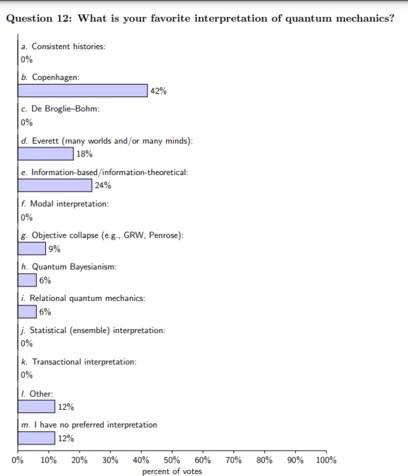
This is from "A Snapshot of Foundational Attitudes Toward Quantum Mechanics" published in 2013. The results are very similar to the article you referenced. Here's a link to the article:
https://phys.org/news/2013-01-survey-physicists-fundamental-quantum-mechanics.html
The graph shows that the Copenhagen interpretation was chosen by 42% of the physicists surveyed. Generally, the Copenhagen interpretation is considered equivalent to the shut-up-and-calculate one, although I guess there is some lack of clarity on that. No other interpretation comes close. That doesn't mean it's the correct interpretation, but I think you misrepresented what physicists think in your post.
Then he says "Let that sink in : there is no way to empirically tell apart different interpretations of quantum mechanics. One might even suspect that this isn't really science. It smells more like . . . metaphysics". — Gnomon
For me, this is the heart of the matter. I have always thought this is a good way of looking QM, with one difference. In my view, if it's true that there is no empirical way of selecting among the interpretations, then the interpretations are either metaphysics or they are meaningless. If an interpretation adds value, if it is useful, then it is metaphysics. If it doesn't, if it isn't, it's meaningless. For me, adding value or being useful means that the interpretation clarifies existing science, gives insight into possible fruitful new science, or raises important questions. If all it does is make us feel good or reduce our anxiety, then it's meaningless.
Maybe, it's good that I have no professional credentials to be sullied when I express personal opinions on an internet forum. — Gnomon
That seems like a pretty facile statement. Having no professional credentials might also mean your opinions are not credible on this subject. -
The hell dome and the heaven domeWhich group if either do you believe are most likely to try to "break free". — Benj96
You don't need a far-fetched thought experiment to get your answer. Just look at the world. People leave places where they are suffering from starvation, oppression and poverty to go to places they think will be better all the time. For examples see the US's southern border, the border between Russia and Kazakhstan, and the Mediterranean Sea between northern Africa and Europe. -
Listening to arguments rather than peopleQuestion: Should we listen to arguments rather than people?
Background information: An “Argument” is where one or more premises (supporting propositions) provide reasons to believe a conclusion (main proposition). A “Proposition” is a truth-bearing statement (that is, a statement that bears truth and falsity). Examples of propositions include: "All men are mortal" or "Socrates is a man." These propositions form the following argument: (premise 1) “All men are mortal.”; (premise 2) “Socrates is a man.”; and (conclusion) “Therefore, Socrates is a mortal.” — Cartesian trigger-puppets
What you've described isn't, and shouldn't be, the typical form that an argument takes on the forum. If I say "I hold this truth to be self-evident - all people are created equal," there is no simple logical road that gets us to a resolution. It's an essay question, not true/false or even multiple choice.
If a person makes the statement “A bachelor is an unmarried man”, the person’s characteristics (e.g., dishonesty, ignorance of marriage, immoral behavior, etc.) bring nothing to bear on whether or not the statement is true or false. The truth or falsity of the statement remains the same nonetheless, despite the characteristics of the person is making it. — Cartesian trigger-puppets
This would be true except that most questions require knowledge and understanding of the relevant facts and conditions. For that reason, the credibility of those in the argument is an important consideration. For example, there are members of the forum who make technical scientific claims that are inconsistent with current science. In such a situation, it doesn't make sense to criticize the details of a long, involved, and unsupported argument. One good solution is to avoid the discussion. On the other hand, criticizing the credibility of the person making the claim is not irrelevant. -
Is "evolutionary humanism" a contradiction in terms ?If by "survivability" what is meant is adaptivity, then, as far as I can tell, this deflation of "truth" is spot on. — 180 Proof
Hey!!! You changed my text.
Anyway - I'm ok with adaptivity for survivability. I'm not sure of the difference in this context. -
Is "evolutionary humanism" a contradiction in terms ?I think the takeaway message is that for many people certainty or truth, even the possibility of intelligibility itself must rest upon a transcendental foundation (idealism/will/theism/deism/Tao). — Tom Storm
Well, it's clear to me that truth, certainty, intelligibility, belief, and all the rest are concepts and reflect values created by our imperfect human minds. That makes it a circular argument. -
Is "evolutionary humanism" a contradiction in terms ?The argument (and there are philosophers like Donald Hoffman who take this view too) is that the process of evolution does not require truth, only survivability. — Tom Storm
Another way of saying that survivability is what matters is to say the truth is what works. That's the battle cry of the pragmatist. As far as we can tell, the theory of evolution by natural selection works. It helps us predict the future. Predicting the future makes it easier for us to survive. -
Is "evolutionary humanism" a contradiction in terms ?The evolutionary argument against naturalism seems to be a nice companion this.
https://en.wikipedia.org/wiki/Evolutionary_argument_against_naturalism#:~:text=The%20evolutionary%20argument%20against%20naturalism,evolution%20and%20philosophical%20naturalism%20simultaneously.
My glib response is there are lots of things people will argue can't be done and yet they are done. — Tom Storm
The argument, to the extent I can understand from the article you linked, seems to be that without outside guidance, evolution could never develop reliable rational intelligence and without reliable rational intelligence no human belief, including in evolution, can be trusted. Seems a lot like the fine tuning argument. -
Is "evolutionary humanism" a contradiction in terms ?Here's a question for those who would deny that such a qualitative gap exists: imagine a herd a migrating wildebeests somewhere in Africa. They cross a river and 50 of them drown. Now image a group a migrating humans, and 50 of them drown while trying to cross the Mediterranean or the Rio Grande. Is there a difference in value between the two accidents? The first incident is just something that happens every day in nature; animals are born, they survive, they die. But the death of 50 human migrants is not something in the category "things happen": is a tragedy. Because of special human dignity.
To sum it up: The evolution theory says: no special role / special position for the H.sapiens . Humanism says: yes, because only the human being, regardless of his abilities, has a special dignity.
Therefore the "evolutionary humanism" is a philosophical impossibility, the attempt of a squaring of the circle. — Matias
But atheist humanists like MSS have great problems to explain what their 'humanum' is supposed to be that makes the human animal so special. They are unable to explain human dignity. That's the basic flaw of their theory — Matias
I have always thought of humanism as a perspective that sees the world from the viewpoint of human values. If that's a valid definition of humanism, and I think it is, then there is no contradiction.
A philosophy that can be summed up by "We are all together on this boat; so let's be nice to each other" does not need a pretentious name like "humanism" — Matias
I do agree with this.
T Clark

Start FollowingSend a Message
- Other sites we like
- Social media
- Terms of Service
- Sign In
- Created with PlushForums
- © 2026 The Philosophy Forum