
Comments
-
Former Theists, how do you avoid nihilism?
Again, with the political correctness! Sorry, but "Drama King" just wouldn't convey the same imagery. :grin:The 'drama queen' line is funny, but note the subtle casting of a female for that role. — jellyfish
I was looking for a modifier that would focus on an extreme version of the broad Romantic worldview. It wasn't intended to be anti-feminist, but merely anti-extremist. The key to the Stoic worldview is Aristotle's "moderation in all things". Or, as Lou Reed says : "some kinds of love, they're mistaken for vision". Romantic "love will conquer all" is a nice sentiment, but not very realistic. That's why most love songs are tinged with the sadness of love-gone-wrong. Stoics are advised to avoid being "blinded by love". -
Former Theists, how do you avoid nihilism?
Not so. Stoicism teaches us to avoid extremes of emotion, not to completely shut-off normal human feelings. Of course, Stoic love might seem like indifference to a drama-queen Romantic. Likewise, to be aware & concerned about Death & Disaster is necessary for the continuation of life. But, anxiety and dread and self-flagellation are counterproductive, and useless, and as Mr. Spock would say "illogical" . :smile:To live without anxiety or dread is, seems to me, to no longer be capable of falling in love or of experiencing spiritual/intellectual revolutions. — jellyfish -
Former Theists, how do you avoid nihilism?
Apparently, my pathetic attempt to rhyme "heroic" and "stoic" struck a nerve. The modern meaning of "hero" has been skewed by all the comic-book Übermensch. See my reply to --jellyfish.I'd say there's nothing heroic about Stoicism, or at least my version of it. — Ciceronianus the White
Since many posters on this forum admit to some degree of depression, anxiety, or existential dread, they seem to find things to "contend/despair over". A Stoic doesn't have to be a super-hero, but merely someone who perseveres in the face of challenges and uncertainties.What is extraordinary or unbelievable about this, what is there to contend/despair over? — Ciceronianus the White -
Former Theists, how do you avoid nihilism?
Since I have no formal training in Philosophy, I tend to speak plainly, and to avoid beating around the bush. I'm aware that we live in "politically correct" times, but a philosophical forum should be more concerned with "factual correctness".Ah, but look at how you can't resist words like 'weakling' and 'wimps.' — jellyfish
One of the "four cardinal virtues" of Stoicism is "andreia", which is translated as "courage" or "manly virtue". So I think "heroic" was not too far off-base. And "weakling" is just a way to illustrate the difference between those who sink and those who swim. I didn't label any person with those general terms, so I hope no one here was offended by the kinds of distinctions made by ancient macho Greeks.
Nor was I.I'm not trying to be rude. — jellyfish -
Former Theists, how do you avoid nihilism?
I wasn't equating "heroic" with "stoic" -- merely rhyming. The intended point was that it takes a strong personal character (virtue) to exercise self-discipline. And that was the message of Stoicism. A heroic character might be ideal, but not necessary, to practice stoicism. We don't have to be super-heroes in order to overcome depression or nihilism or temptation. But moral wimps will give-in to gravity dragging them down, whereas those with a minimum of moral fiber will resist. And even the drowning weakling can reach-out in desperation for help from a stronger swimmer. Stoicism can be communal, so we don't have to go it alone. But ultimately, my psychological survival is my responsibility. :cool:I'm not against your identification of the heroic and the stoic, but I don't take it for granted. — jellyfish -
Because qualia: THIS! What does it mean?
I'm still developing my own position on the controversial concept of Consciousness. It begins by noting that Consciousness is an abstract quality, not a concrete thing. It's what you do, not what you are. Consciousness is a functional attribute of brain quality, not the substance of neurons in any quantity. In a computer metaphor, it is the property of processing Information at a high level of through-put, but in the sense of Quality, not Quantity. Faster is not necessarily better.Why is consciousness conscious? — TheHorselessHeadman
Consciousness seems to be a natural emergent property of integrated holistic systems, not an add-on Soul. So, the point-of-emergence (so to speak) lies on a continuum from space-time Physics to indeterminate Metaphysics. Yet, even Tononi hasn't been able to define the crossover point from non-conscious to Conscious. It defies quantification.
The ultimate answer to your question lies in the inscrutable intention of the Eternal Enformer. Sorry! :joke:
Consciousness : http://bothandblog2.enformationism.info/page32.html -
On beginning a discussion in philosophy of religion
I agree. But, when god is labeled as "a perfect being", it's an Oxymoron. In our experience, no created or mortal beings are perfect. Because, given Life & Time, they have the potential for further development. That's why I try to avoid the confusion by labeling G*D as "BEING" : defined as the eternal-infinite power to exist. Since that includes all possibilities, it means that G*D has the potential for Personality. But only in the world of imperfect created beings is that opportunity actualized into reality. "Person" is a relative term, while "BEING" is an absolute concept.That said, since god as I have defined possesses all abilities that exist (or more), and since persons exist, then god must possess the ability of persons too. But as the perfect being, it is not limited to possessing the abilities of persons only. — Samuel Lacrampe -
An Estimate for no ‘God’
Do you have a link to "The Final Answer"? Was it written by Nobody or by you?You are a genius, for a digest of 'Everything Forever' is next in the poem, completing it, as 'The Final Answer', although it's rather long; Nobody's portion is done, but he referenced Giorbran in a forum post and so must have liked Gevin's idea. Nobody is probably not dead but cannot currently be found anywhere online. — PoeticUniverse -
Former Theists, how do you avoid nihilism?
Maybe "rational" was the wrong term. Perhaps I should have proposed that the "conscious" self (pilot) should retake control from the "subconscious" (autopilot). That's what Cognitive Rational Therapy (or Rational Emotive Behavior Therapy) attempts to do. Most people think their conscious mind is in control of all they do, when in fact most of our behaviors operate on cruise-control, so we don't have to pay attention to what's going on. When the "pilot" is weakened by stress (doubts, depression, drugs, etc), it's easier to "veg-out" and offload your responsibilities to a mindless machine ("let go, and let God"). But, even when he is handicapped, he needs to see the danger signs that "autopilot" is about to get him into trouble, and know when to take-back the controls. After disaster has been averted, he'll be happy to still be alive.You pose the rational self against the old lizard. If only we are rational enough, then surely we'll be happy. — jellyfish
Depression overwhelms the conscious mind with pain & paranoia, causing the pilot to cede control to negative emotions. So, it takes great effort to resist giving-in to the demon on the shoulder, urging you to give-up on life. That's why suicide is often viewed as the easy-way-out. It also takes heroic (or Stoic) Character to take charge of a bad situation. :cool:
"people are rarely emotionally affected by external events but rather by their thinking about such events" https://en.wikipedia.org/wiki/Rational_emotive_behavior_therapy
"for there is nothing either good or bad, but thinking makes it so" ___Shakespeare, Hamlet
[actually, it's automatic thinking that makes in-appropriate knee-jerk responses]
"Precursors of certain fundamental aspects of rational emotive behavior therapy have been identified in ancient philosophical traditions, particularly Stoicism".
The ultimate goal may be eudaimonia, but calm cognitive self-control is the method. -
An Estimate for no ‘God’
I was just reminded, by your physical/metaphysical poetry, of the book by Gevin Giorbran : Everything Forever, Learning to See Timelessness.https://www.amazon.com/Everything-Forever-Learning-See-Timelessness/dp/0979186102/ref=sr_1_1?keywords=everything+forever&link_code=qs&qid=1572222362&sourceid=Mozilla-search&sr=8-1In No Time and No Space
What came first, the matter or the light,
Since it seems that each needs the other to be?
There’s no first, only at the same ‘time’.
Photons, electrons, positrons are all-at-once. — PoeticUniverse
He was a poet-scientist , who wrote a mind-boggling book about the universe as a whole. I say "was", because he committed suicide in 2008, shortly after publishing the book. Apparently, his website has been taken down, but here is an old interview on YouTube : https://youtu.be/-SI5MgGnP1g
It occurred to me that your poet-scientist mind might be better able to understand his far-out concepts than less imaginative prosaic thinkers. For example, the eternal "universe" (what I call G*D) is perfect symmetry, and our temporal-material universe is broken symmetry. I don't know if his hypothesis is true -- he discusses Many Worlds and Multiverse conjectures, along with the "God" concept -- but it presents some visionary ways to interpret the Reality that seems bottomless, the deeper we look into it.
EVERYTHING FOREVER
Time is one enormous moment
Where children play
not knowing of a tomorrow
where people walk along an ocean
and gaze in wet air
This sense of separation and loss
is all illusion
though old men tell of the past
as if it is gone somewhere else
to children who listen
as if it used to be
We all walk here in time
not yet knowing
as we ponder the mystery
and animals listen
that all in this same moment
the world begins
and the world ends
while these waves
crash upon the shore
regardless
And now as I touch your hand
time will stand still
and trap something there forever
for us to view from some heaven
as we are forever born
into an endless moment”
― Gevin Giorbran, Everything Forever: Learning to See Timelessness
https://www.goodreads.com/author/quotes/61155.Gevin_Giorbran -
An Estimate for no ‘God’
:up:Everything connects to everything else
Through overlapping interference patterns,
And so nothing is so separate at all, as it seems,
But is one large all-encompassing whole.
. . . . . .
We are part and parcel of everything—
We are the cosmos; we are life; we are love;
We are all that is; we are the creator
Of the dance as well as the dancer. — PoeticUniverse
My G*D model is defined as ALL, the Whole of which humans are curious particles.This then is the secret of the universe,
Knowing of that which underlies all reality:
Fundamental, absolute, indestructible,
Omnipresent, indeterminate, but all pervasive.
Why absolute and fundamental?
Because it is made of one piece—itself,
And therefore indestructible, and eternal, too,
And makes up all that there is, everywhere. — PoeticUniverse
My personal illusion of Reality is created in my own mind by interpreting those incoming signals (wave patterns) according to some inherent (significant) commonality. Like Morse Code, both sender and receiver must speak the same language. In my thesis, the common language of the universe is Information, which boils down to 1 or 0, on or off, dot or dash, From that cosmic communication, we know "part & parcel", absence & presence, "life & love".Interference patterns of virtual reality. — PoeticUniverse
. -
On beginning a discussion in philosophy of religionI understand the desire to transcend that dichotomy. In some ways it reminds me of German philosophers who wanted to bring God down to this world. — jellyfish
Apparently, I have given you the wrong impression of Enformationism. It is not an attempt "to bring God down to this world". And it is not a Christology in any sense. It is instead an attempt to understand the traditional disputed dichotomies of Science, Philosophy, and Religion. As expressed in the heading of my BothAnd Blog : "Philosophical musings on Quanta & Qualia; Materialism & Spiritualism; Science & Religion; Pragmatism & Idealism, etc."The vision blends Christianity with technological progress. It's optimistic. It doesn't address the mortality of the species (God himself is mortal). Humanism is arguably the best thing we have. — jellyfish
However, in view of my thesis, it might seem that the only reasonable religion for humans would be some form of man-made Humanism. Yet, I can't imagine that it would ever appeal to enough people (non-philosophers) to have any effect on the masses. So, I compromise on Deism as my religious philosophy : although I have no direct experience or knowledge of G*D, I have concluded that the evolving world seems to be organized by a Mind, instead of by random collisions of atoms, or by an infinite regression of materialistic Multiverses. And, since modern science has discovered that both Energy and Matter are forms of metaphysical Information, it follows that everything in the world is a piece of that Cosmic Mind. By that, I don't mean Panpsychism, but PanEnDeism. :cool:
Yes. I was impressed, although at times mystified, by Hofstadter's books. I have quoted him in some of my essays on The Self. But I wouldn't mention that abstruse Strange Loop argument to non-scientists or non-philosophers, because it's so technical and abstract. :nerd:Have you looked into Douglas_Hofstadter? — jellyfish
. -
Former Theists, how do you avoid nihilism?
I suspect that you suffer from the Philosopher's disease : you overthink things. If you focus on the minor details, you'll miss the big picture. If you are insane, with "incoherent random states of mind", then of course the world won't make sense, and you need to be institutionalized. But, you seem to be only slightly insane, in the sense that a depressed brain can cloud your thoughts. You are obviously sane enough to write lucidly, despite the clouds. So you need to allow your rational "self" (ego) to regain control over the emotional reptilian brain (id). That won't be easy, and many people drown, sinking into despair. It will take motivation (your posts indicate that you have enough insight and ambition to seek text therapy), self-discipline, maybe some drugs, and perhaps the discipline of others. Cognitive Behavioral Therapy can help slightly insane people to think more rationally about their negative thoughts. And to take responsibility for their own agency. Look it up.But how do you make sense of the world with ourselves as ultimately incoherent random states of mind? — dazed
Many philosophers also tend to compare their life conditions negatively against an ideal model. But that's not realistic, by definition. Who told you that you are not a freewill agent, and that, not only do you not have a Soul, but not even a mundane Self? Have you been reading Daniel Dennett? His analytical methods dismiss the obvious fact that all of us behave as-if we have a subjective perspective and clearly exercise some agency in the world.How do you navigate social discourse with a loss of the concepts of agency and selfhood that permeate all our human political and social structures? — dazed
Even pathetic You can reach-out and pick up an object by intention, so there is some kind of agency associated with your mortal flesh. So, take credit for it. Dennett thinks that you and he are zombies (in his case a very smart, yet short-sighted, zombie). But, if so, join the club, if you are half the agent that he is, you're doing pretty good for a mindless automaton. His notion that your actions are predestined by your genes is a product of acute reductive thinking, and portrays genes as little zombie demons. But how could an ancient organized social structure of soul-dead mummies build pyramids without any goals or agency? Did their genes make them do it? Did an accidental Big Bang predestine the emergence of monolithic mountains of stone billions of years later? If so, it sounds like good planning. :smile: -
Former Theists, how do you avoid nihilism?
I'm afraid my worldview would not be very comforting for most people. It doesn't "justify" evil, but merely accepts that both Good and Evil are inherent in a dualistic dialectic universe. It's the bible-god who needs some rhetorical help to justify a world that goes off the rails after a perfect beginning. No sooner than the first moral agents exercise their free choice, they discover that knowledge of good vs evil doesn't mean that they have the wisdom to see the long-range consequences of their choices.Your attitude is of course reasonable, but it's also familiar in terms of the emotional comfort it offers. I don't know exactly how far the idea goes back, but justifying evil in terms of a future to come goes back at least to Hegel. — jellyfish
Hegel acknowledged the BothAnd nature of the natural world. Although he saw progress in evolution, his dialectic proceeded, not in a straight line, but in a heuristic zig-zag search pattern for the best compromise in an imperfect world. His interpretation of that struggle between Good & Evil was optimistic for the long-term, and pragmatic in the short-term. Like him, I get no emotional comfort from imagining that my personal interests are being served by a loving Father in Heaven, but a modicum of intellectual satisfaction that the system is not rigged against me, so I have as good a chance of happiness as anyone else.
BothAnd Principle : http://blog-glossary.enformationism.info/page10.html
Sounds like Adam Smith's theory of the "invisible hand" of free-market Capitalism. So, is G*D a capitalist? I don't know, but freewill Agents, serving their own interests, inadvertently serve the general interest. This is an intrinsic principle of the potential order within randomness : that free individual "choices" add-up to a stable pattern when viewed as a whole : The Bell Curve. So, in the game of life, some players are winners and some are losers, but the game goes-on, and the "house" (G*D's plan) always wins in the end. Unfortunately, you and I didn't choose to play the game, but maybe like fatalistic Greeks, we accrue honor by playing nobly. "It's not whether you win or lose, it's how you play the game". So, "live for the moment", nobody has promised us an after-party in heaven.These vast congeries of volitions, interests, and activities constitute the tools and means of the World Spirit for attaining its purpose, . . . on the part of individuals and peoples in which they seek and satisfy their own purposes are, at the same time, the means and tools of a higher and broader purpose of which they know nothing, which they realize unconsciously. — Hegel
Therefore, I have concluded that the game designer is fair-but-indifferent (amoral) regarding individual players, and is serving He/r own ultimate interests -- whatever that might be. G*D treats me fairly in a statistical sense, but doesn't tip the scales in my favor via miraculous intervention. Nobody is G*D's darling. So, judgements of Good or Evil don't apply to the designer outside the game, but only to the players. In our space-time world, all things are relative; but in eternity-infinity, all things are absolute. Hence, unlike the dueling deities of the Bible, in G*D's "world" there can be no Good versus Evil, but in an all-things-are-possible sense, you could say that G*D is BothAnd, i.e GoodEvil .
Rationalism versus Fatalism : http://bothandblog2.enformationism.info/page67.html -
Design, No design. How to tell the difference?
I agree. But I also infer from the constructive order of the universe that the "intrinsic structure" of the system was not a random accident. And, since the structure as a whole is evolving in an apparently positive direction, I can't buy the Genesis account of a "designer" who made a perfect world, and then was chagrined to see it quickly falling into disorder. That's why I prefer the analogy of an Evolutionary Programmer who uses randomness to generate novel options, and selective criteria to guide the process toward an optimum solution.The search method is heuristic : a journey of discovery, not a fait accompli. That's why I think evolution is not just about the destination : "getting there is half the fun." :grin:So, 'design', then isn't really the result of 'designers', it is fundamentally a result of the way the universe is intrinsically structured. So, in this view, there is only ever one ultimate source of order [and disorder] which is nature itself. — aporiap
Intrinsic = essential, inherent
Chaos Theory is based on the fact that there is potential for order in randomness. For example, the random interactions of heat, moisture, and wind produce recognizable weather patterns, that forecasters can analyze to predict short range future arrangements. But the key to such ephemeral capricious phenomena -- which caused the ancients to infer that whimsical gods were responsible -- is only possible because Natural Laws (criteria) combine with Initial Conditions to produce repeatable patterns under similar conditions. But, since those "Laws of Order", and the Energy to enforce them, were in effect at the very beginning of evolution, they must have been established prior to the Big Bang.Anyway I've gone on a limb and did a cursory search for clear examples of order arising from entirely unpredictable, random processes. . . . results entirely from the disorder of the inputs to the system. So here is one case in which order comes out of disorder. — aporiap
So, of course there is order in random behavior. And although those simple patterns seem to arise spontaneously, the "Rules of Order" are intrinsic in the system. Yet, weather patterns are never progressive, but cyclical. The image link below is an example of design by Genetic Algorithms and Evolutionary Programming. Marvelous, but the codes and criteria for the process didn't emerge spontaneously. They were input by human "designers" of the goal-oriented process. :cool:
EVOLVED ANTENNA
https://en.wikipedia.org/wiki/Evolved_antenna -
On beginning a discussion in philosophy of religion
I have asked those same questions about my hypothetical G*D. And my answer is No.Is the universe a person? Some mere parts of it are, such as humans. Can the whole of the universe be a person, or can only mere parts of it? Such a universal person, a god, would have nothing to experience or act upon but itself; can such an isolated being be a person at all? — Pfhorrest
First, my G*D is not Theistic or Pantheistic, but PanEnDeistic. Defined as Eternal-Infinite, hence wholly transcendent (Ideality) and partly immanent (Reality). If G*D is ALL, Omni-existent, then any experiences or actions must be internal. Such a G*D is not a being, but BEING itself : the power to exist. And "person" is an anthropomorphic concept that could not apply to an abstract generality. Example, the United States is an abstract concept, a generalization, not a person. G*D can be personal, only in the sense that You are part of ALL. -
On beginning a discussion in philosophy of religion
As I began to develop my own personal Agnostic worldview, I tried to avoid any religious terminology. But eventually I realized that the Ultimate Source of ubiquitous Information is equivalent in most respects to the ancient concept of an abstract world-sustaining creator God (e.g. Brahman). When I used evasive terms in discussions, I had to provide long round-about definitions. So I gave-up and made-up a neologism that suggests a creator deity, but with a question mark. Since I have no direct evidence of this hypothetical Enformer, the asterisk in "G*D" means "to be determined". Pre-scientific thinkers were not idiots; they were just working with incomplete information about how the world works.Maybe I find the choice of 'G*D' as a name for it sub-optimal. Maybe I think it doesn't really answer the question. (Is there a question?) — jellyfish
Interestingly, the modern understanding of Information/Energy is similar to the archaic notion of Spirit : invisible, intangible, causal agency. So I view Enformationism as a 21st century update of outdated philosophical theories of Materialism and Spiritualism. Information is the essence of both Matter and Mind. Unfortunately, few people have read my thesis, so they don't fully grasp what I mean by Enformation or by "G*D".
Yes, there are many questions that are answered by the G*D concept. But the new answers are not found in conventional Science or Religion. The Enformationism thesis asks those age-old queries, and proposes theoretical answers. But Atheists dismiss them as "gap fillers" or "empty set", because they have an outdated understanding of Physics and Metaphysics. -
Former Theists, how do you avoid nihilism?
Christianity set the bar too high for mortal humans. By their standards, we are all abject sinners.I do seem to still care about making the world a better place. but for me what's missing is the underlying structure and framework that allowed me to make sense of what making the world a better place meant — dazed
The dark cynical attitude that no one really cares about anything except Self-Interest, might brighten-up if you find the right depression drugs, or the right group of caring people. Like AA meetings, just sharing with others in the same boat seems to help. If you care, maybe others do too. You'll just need to look for the meaningful Qualia hidden under the mathematical Quanta.
If you're looking for an alternative to traditional religions, maybe you should delve into Deism. It's not a formal religion, but a general religious philosophy that acknowledges the necessity for a First Cause creator. There's no holy book, no carved-in-stone rules, and no myths of afterlife to entice you to endure the suffering of the present world. Unfortunately, also no religious meetings to offer mutual emotional support. It's a god-helps-those-who-help-themselves attitude. At the risk of sounding elitist, it's an artificial religion substitute for intellectuals : like Voltaire and Ben Franklin. If Deism is not for you, maybe some form of Buddhism, such as Zen.
I have created my own personal worldview in order to provide structure and framework for making sense of a world that is still under development. No faith required, but a long-range rational view of how the world works is necessary to see the sensible order and positive direction of Evolution. It requires looking at the scientific evidence from a different perspective. It only appeals to rational pragmatic people who look for clues at the scene of the crime : of creating an imperfect world that requires motivation to keep putting one foot in front of the other. :smile:
Deism : http://blog-glossary.enformationism.info/page12.html
PanEnDeism : http://blog-glossary.enformationism.info/page16.html
Neo-Deism : http://blog-glossary.enformationism.info/page15.html
Beism : http://blog-glossary.enformationism.info/page10.html
Enformationism : http://enformationism.info/enformationism.info/ -
Design, No design. How to tell the difference?
From what kind of logic could you infer otherwise? Do you have any reason to believe in spontaneous creation of organization, energy, laws? The reason Aristotle postulated a First Cause, was that an eternal regression of causation is an empty gesture that doesn't answer the question of origins. The Prime Mover concept answers the question with a "buck stops here" assertion that does not imply spontaneous emergence from nothing, but intentional creation from everything.Your justification is that every instance of things we conventionally define to be ordered, derives from a ‘designer’. You infer from all instances of design-designer you’ve seen, that order in the natural world must also be from a designer. — aporiap
Logically, in eternity-infinity all things are possible. Once an organic system has been created (by magic, if you like), all subsequent order would be produced by cause & effect Necessity, not magic. But we now know that the space-time universe is not eternal or infinite. So its origin must lie outside the boundaries of space-time, in the infinite "unbounded" -- what I call G*D, as the job-title for Creator, Designer, Programmer, Energizer, World-Maker functions.
Spontaneous Generation : https://en.wikipedia.org/wiki/Spontaneous_generation
"Anaximander, who believed that all things arose from the elemental nature of the universe, the apeiron (ἄπειρον) or the "unbounded" or "infinite," -
Design, No design. How to tell the difference?
Oh no. That's would be far above my pay grade. I'll leave the specifying of an evolutionary program to those who are experts in that field. And I leave the specifics of G*D's fitness function for Natural Evolution to the Creator. But, in general, Darwin has discovered that nature seems to be designed to experiment with a variety of species, in its search for ever "better" forms of Life & Mind. What the ultimate goal might be, I have no idea.Does your theory include an explicit fitness function? Or it more like Darwin generalized? — jellyfish
But, judging from the evidence we've collected so-far, the upward trend of Evolution probably requires physical complexity and mental intelligence, and even some level of FreeWill. Put those traits together and you find that Evolution has already created little creators of its own. That is not what you would expect from an accidental universe. Some even speculate that a future creative species, whether silicon or carbon based, might create something like a god-on-earth. I'm not smart enough to see that far ahead.
Note : what qualifies as "better" depends on the applicable Fitness Function. -
Design, No design. How to tell the difference?
No insult was intended. The Black/White reference was intended to show what the BothAnd philosophy is supposed to provide an alternative to.There's no need to get into this kind of implicit insult. — Coben
No. IMHO, Evolution does indeed progress freely without any specific predetermined path -- only a general direction. But that doesn't mean that Brownian molecules have any choice in their movements. FreeWill is a feature of self-conscious creatures, who can predict the future from past experience, and choose a direction that seems desirable.I don't think it holds at all, but if it did, it would mean that any stochastic process, in your deism, would mean there is free will present. — Coben
Enformationism has some similarities to Panpsychism, but the fact that all things in the world are composed of generic Information, does not imply that they are self-conscious. Again, self-consciousness is an emergent feature of creatures that are freewill agents. Consciousness is necessary for animals to live. But self-consciousness allows some creatures to thrive, by merging their individual creativity into a species Culture. :smile: -
Design, No design. How to tell the difference?
Precisely! Randomness is an integral part of the "design" of Evolution. The program has two major components : a Randomizer to generate multiple options, and a Derandomizer (CPU) to select the "fittest" options to meet the Designer's criteria. Together, these components provide exceptions to Dumb Destiny, and a progressive arrow to the otherwise directionless "unfolding" of Time. But ultimate control was in the mind of the designer working outside the system. Which is why demands for empirical evidence of the Creator are fruitless. The only evidence is in the architecture of the system itself.Random effects are not under anyone's control or choice. — Coben
As an architect, I created Dumb Designs that depended on construction workers to interpret and implement the designer's intentions. And sometimes they got it wrong, so I had to intervene to get the project back on track. Yet the Cosmic Designer created a system that constructs itself from nothing but a metaphorical blueprint (or recipe, or DNA kernel) encoded in the Singularity. The Programmer's Intention was translated into the operating system code. From the Big Bang onward, the system is self-creating and self-directing.
The assertion above about "control" assumes, erroneously, that any postulated designer would have to reach into the system (intervene) to make any course corrections. But if you think of the universe as a Black Box functioning automatically, then the designer had to think "outside the box". In other words, the system was designed to work autonomously. This is not how the bible-god works. But it is how the postulated Enformer is presumed to work. The universe is an Autonomous Self-Directing Evolution System. Once set in motion, it requires no further inputs. It works by inherent (built-in) Teleology, not by ad hoc interventions (miracles). -
Design, No design. How to tell the difference?
Most discussions of this topic are argued from the assumption of a True/False dichotomy : Either/Or. But my worldview and operating philosophy are based on the Both/And assumption : Yin/Yang. That's why my reasoning is hard for Black/White thinkers to grasp.And nowhere in this did you explain how randomness and determinism lead to freedom. — Coben
But, if you have the patience to follow the thread, these excerpts from a Quora Forum topic may explain how I rationalize human Freewill. It uses a mathematical analogy (Bell Curve) to illustrate that neither directionless Randomness nor cause & effect Determinism is absolute. Statistically, the Bell Curve makes the behavior of collective systems predictable, but the actions of individuals remains unpredictable, hence free from determinism. But this is not the kind of FreeWill that most people imagine. Instead, it's restricted conditional freedom. Humans are both free-ish and predetermined.
Freedom Within Determinism : http://enformationism.info/phpBB3/viewtopic.php?f=3&t=12&p=58#p58
Begin at third panel : 08/04/2018
BothAnd Principle : http://blog-glossary.enformationism.info/page10.html -
Design, No design. How to tell the difference?
Yes. Evolving programs, as opposed to calculated programs, are heuristic in that they explore random paths (mutations) and judge their fitness against the programmer's criteria. In my thesis, the Great Programmer set-up the initial conditions and natural laws that determine which options are selected for the next generation. The "unfit" paths are ruthlessly abandoned to extinction. Which could apply to humans if we prove to be unfit for future generations. In that case, we may be replaced by robots. :smile:Are you talking about genetic algorithms? Those are awesome. But we provide the fitness function. — jellyfish -
Design, No design. How to tell the difference?
How about : the foundation of everything is mathematical, therefore everything is made of Information? In my thesis, "Information" is equivalent to Spinoza's "Substance" (Monism). And everything in the world is a "Mode" of that Eternal Mind Stuff.But if everything is math, then nothing is math. This is the fate of all monisms? — jellyfish
"According to Spinoza, everything that exists is either a substance or a mode (E1a1). A substance is something that needs nothing else in order to exist or be conceived." https://www.iep.utm.edu/spinoz-m/ -
Design, No design. How to tell the difference?
That's based on the assumption of Determinism. And Randomness does indeed allow short strings of "apparent" order, that lead to the Gambler's Fallacy. But long and progressive chains of order, such as the evolution of intelligent beings (novelty), supposedly from random collisions of atoms (disorder), cannot be explained by rigid Determinism, except as an act of faith. There is no novelty in randomness without the Direction of Selection, or the Action of Intention.*1Those intentions are not made by the supposed 'designer' intentions appear, determined past causes. — Coben
The Theory of Evolution was based on a> Random Mutations plus b> Natural Selection. But "selection" requires Criteria, which require Intention. So, Evolution is Freedom Within Determinism, Randomness ordered by Selection, which allows Novelty despite Laws. :cool:
"In a godless universe with no design or purpose, the emergence of consciousness is an unexplained anomaly." http://www.bothandblog.enformationism.info/page66.html
Gambler's Fallacy (non-independent events are not completely random) : https://en.wikipedia.org/wiki/Gambler%27s_fallacy
*1 Intention : Darwin's theory was based on the example of humans intentionally selecting canines for certain functions over thousands of years, which resulted in dogs that could hardly survive in the wild without the help of humans.
Human Selection :
Natural Selection :
-
Thoughts of a hopeless misanthrope
Be forewarned that the arctic climate can cause Winter Blues (Seasonal Affective Disorder). So take precautions. Maybe Light Therapy Lamps will help. :smile:before heading up to the arctic in about 14 days — CornwallCletus -
Thoughts of a hopeless misanthrope
Depression does indeed have chemical causes. But in view of the depressed brain-state, a person's sour attitude is reasonable. The same could be said of a schizophrenic, whose perception is distorted by chemical imbalances in the brain : they are acting rationally in order to survive in their warped inner world.I have long suffered from depression and have struggled to find purpose and direction in life, even though I have traveled, moved around a lot, and tested myself in different types of relationships, workplaces, and environments. I have been told that it's chemical, or perhaps seasonal. In reality it is nothing but reasonable. — CornwallCletus
But in both cases, modern medicine has developed other chemicals to block those distortions. Of course, they can have mind-numbing side-effects. But if you are rational enough to write such a lucid post, you can also see that your perception has been blinded toward the good, and focused on the bad aspects of society. Those who are not depressed can deal with disappointments of human frailty, via simple attitude adjustments, without descending into self-pity. But for those with unbalanced brains, it often helps to fight chemicals with chemicals. However, there are also other ways to brighten moods without drugs.
Do you really believe that you are among the minority of sane people? Or could it be your own "cognitive dysfunction" that you project onto others. Don't dwell on the Dark Side. Find someone you can trust to help you find your way back to the Light. As with alcoholics, the hardest part is to take a leap of desperation to ask for help. This post may be your first step. :smile:To be anything other than miserable in this shit stain of a world is to me a sign of severe cognitive dysfunction. — CornwallCletus
Natural Depression Treatments : https://www.webmd.com/depression/features/natural-treatments#1
Former Misanthrope : https://jeffthewriter.com/misanthropy/ -
On beginning a discussion in philosophy of religion
It was a simple dichotomy, for purposes of illustration, not argumentation. However, to complicate the issue further, let's say that, "an atheist thinks of God as 'only' a concept", while a Theist thinks of God as the 'referent' of the concept. So the question boils down to whether there is Content for the Concept.Hi. Perhaps you are oversimplifying atheism here. I'm an 'atheist,' but I also think God is a concept of central importance. I'd say that an atheist thinks of God as 'only' a concept. A theist might instead separate their concept of God from God itself. — jellyfish
In my view, there is no concrete humanoid person out there playing the role of God. No "teapot circling Mars". Instead, since the real material world ultimately consists of immaterial Information (e.g. mathematics), G*D is not just out-there in eternity-infinity, but in every particle of space-time. I have detailed arguments to support that assertion, but I can't claim that it is revealed Truth, merely my personal opinion. For all practical purposes, it makes me an A-Theist. But for philosophical purposes, it makes me a Deist.
This is indeed the abstract philosopher's God. But, as a hypothesis, it explains a lot about "entanglement" and the ubiquitous role of Information in the world. As a popular religion, it would be impractical, since it doesn't "scratch an itch" that most people of the world have always had : someone to give us unconditional love and to defend us from evil. Instead, it merely puts the ointment of theory on "itches" that philosophers have always had : ultimate "why" questions.Fair enough, but this looks like a philosopher's 'God.' It's a piece of sculpture. It scratches an itch that most people don't have. — jellyfish
Russell's Teapot : https://en.wikipedia.org/wiki/Russell%27s_teapot
"Scientists and Philosophers are always on the lookout for significant patterns in Nature from which they can extract specific meanings. Those extracted pieces of meaning are then labeled generically as information. But how that “information” came to be encoded in the material of nature is not often questioned by scientists. That’s not considered to be a practical project, so it’s left to impractical amateur philosophers to speculate on the origins of information: e.g. which came first, the informer or the information---the sculptor or the sculpture?" http://enformationism.info/enformationism.info/page2%20Welcome.html -
Design, No design. How to tell the difference?
For philosophical purposes it's good that you are not prejudiced in favor of either Free Will or Determinism. In my own worldview, I've concluded that humans are both pre-determined by natural laws and free-to-choose due to inherent randomness. Thus, we can have cosmic design and local freedom too. A good example of how that freedom-within-determinism works is illustrated in computer design using Evolutionary Programming and Genetic Programming methods. In these cases, the programmers are seeking solutions that cannot be pre-determined.Personally I am agnostic as far as determinism and free will. But it seems to me if one believes in determinism, design - any design, human, animal - no longer makes sense. Stuff just happens. An architect plans a house, but that plan was determined long before he was born. Atoms bash into atoms, molecules follow their paths. This isn't design, it is just inevitable unfolding. — Coben
For those who cannot see any signs of design in nature, I can only say that even atheists, like Stephen ("know the mind of god") Hawking, are forced to use "design" terminology to describe how the world began and proceeds to evolve, presumably without intention. In my own training as a designer, we once did an exercise called "design by accident". But even though we allowed objects to arrange themselves randomly, the exercise would never get started without the intention of the designer to set-up the system and then allow it to evolve freely. As in Evolutionary Programming the system is "designed" to "unfold inevitably". Since the intention occurs before the exercise begins, it is not obvious from within the experiment.
Evolutionary Programming : http://blog-glossary.enformationism.info/page13.html
The Grand Design by Stephen Hawking and Leonard Mlodinow : https://en.wikipedia.org/wiki/The_Grand_Design_(book)
Order From Randomness : https://www.lesswrong.com/posts/2FZxTKTAtDs2bnfCh/order-from-randomness-ordering-the-universe-of-random
Order Within Chaos : https://www.bbvaopenmind.com/en/science/physics/discover-the-hidden-order-in-chaos/
Freewill Within Determinism : http://bothandblog2.enformationism.info/page67.html -
Design, No design. How to tell the difference?
Yes. My personal philosophical worldview is based on the 21st century understanding of the dual functions of Information : both mental and physical. So, the fact that some physicists have concluded that the material world is ultimately mathematical (abstract information) supports my thesis. Of course, most people would find it inconceivable that immaterial abstract math could become concrete material stuff. But I have been developing my own hypothesis of how that phase transition might work. However, I'm not a scientist, so you don't have to take my word for it. You can research the mathematical and physical literature for yourself.Are you saying that the mathematical nature of the world is a clue? Can I then say that the programmer/architect is god? — TheMadFool
I prefer not to use the traditional term for a creator deity, because of the superfluous religious baggage attached. But I found that more scientific (Multiverse) or philosophical (First Cause) terms don't convey the real world implications as completely (quanta and qualia). So, I compromised on the novel spelling "G*D" to indicate that the Cause of our world's existence is in most ways equivalent to the ancient notion of a Creator. Then, in the glossary I try to define that neologism in such a way as to dispel the anthro-morphic & magical & anti-science meanings attached to the conventional term that don't apply to my thesis. I also use other metaphors, such as "Programmer", to convey the concept of the Enformer of our world. The key difference between "God" and "G*D" is that the latter doesn't have to intervene in the process of natural evolution. The Programmer just runs He/r program, and waits for the final output.
Mathematical Universe Hypothesis : "Tegmark's MUH is: Our external physical reality is a mathematical structure. That is, the physical universe is not merely described by mathematics, but is mathematics" https://en.wikipedia.org/wiki/Mathematical_universe_hypothesis
G*D : http://blog-glossary.enformationism.info/page13.html -
Design, No design. How to tell the difference?
As a retired Architect, I have some understanding of Design and Blueprints. And I do see evidence of design intent in the world, but the nature of the artist can only be inferred from the nature of the artwork. However, most arguments against a designing deity, point-out the imperfections and failures of the so-called design. So I no longer use those terms in my discussions of a philosopher's First Cause.Why does a perfectly normal person infer a designer/occupant from a well-ordered room/space and then contradict him/herself by rejecting a designer for the universe which too is well-ordered? — TheMadFool
Instead of the Genesis concept of magical creation of a perfect Garden of Eden, I view the world as evolving like a computer program from basic codes and criteria toward an answer to the programmer's "what if?" question. This notion is supported by physicists who have concluded that the material world is essentially mathematical in nature.
Of course, arguing that the world is a program won't satisfy Atheists, because they would require hard evidence of a Programmer, and it won't sit well with Theists, who prefer the traditional biblical account of seven day creation. It also won't suit those who think in terms of the Blueprint metaphor as a predestined design. It may not even make sense for those who imagine that the world is evolving toward a Technological Singularity. But, for me, a better metaphor for the Information Age is Evolutionary Programming in which the final answer is unknown until computed via a heuristic process of evolution. Hence, imperfections and failures are to be expected.
Evolutionary Programming : https://en.wikipedia.org/wiki/Evolutionary_programming -
An Estimate for no ‘God’
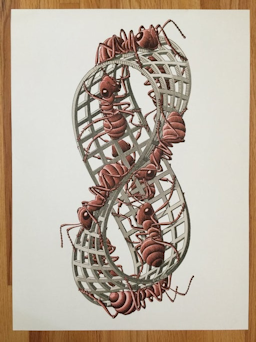
I too, have toyed with the notion of a holographic universe as an extension of the Enformationism thesis. If the uni did indeed begin as a minuscule Singularity, then 4 billion years of expansion has stretched the original information over the 2D surface of a thin membrane. In that case, there is no stuff inside the bubble and there is nothing left at the center. Instead, our 3D reality is an interpretation of the 2D information of our FlatLand. Hence, Real Reality is 2D, and Virtual Reality is 3D.Bohm, too, suggested that the whole universe could be thought of as a kind of giant, flowing hologram, or holomovement, in which a total order is contained, in some implicit sense, in the same finite space. — PoeticUniverse
Not being a mathematician or physicist, I don't find that notion very useful in everyday life. So I still assume that the world is really as it appears to me, in my brain's interpretation of what's out there. :smile:
FlatLand : https://en.wikipedia.org/wiki/Flatland

-
On beginning a discussion in philosophy of religion
Perhaps a different approach to the generic name "God" would be helpful. For Atheists, "god" refers to an empty set. But for Theists, "God" refers to a meaningful, but abstract concept, with associated feelings. For example, "United States" is not a concrete thing, but an abstraction that invokes positive feelings for some, and negative feelings for others.Actually, much closer to the ground, in that for certain words I wonder if any agreement, even provisional, on meaning is possible. On "God" for example, unless I've missed it, no one has pinned anything down. Yours is the empty name, mine the idea, some Anselm, and X. That's it for God. — tim wood
In order to avoid the conflicting theological baggage attached to the "God" designation that means different things to different people, I spell it "G*D", and provide a definition that fits my personal worldview*1. But I cannot give a concrete description, or claim that "G*D" is real and empirical. Instead, my "G*D" is a gap-filler in the same sense that scientists use "Dark Matter" and "Multiverse". They don't know what Dark Matter is, only what it does. Likewise, Multiverse is an explanatory hypothesis, with no possibility for empirical confirmation. It has to be taken on Faith. I don't know what G*D is, only what it has done : enform this non-self-existent universe. And since generic Information is the fundamental substance of the material universe, I must assume that G*D is an Enformer. *2
These knowledge-gap-filler terms are useful in that they convey a meaning that can be communicated, even though the referent is not accessible to objective confirmation. For me, "G*D" refers to the logical "First Cause" and "Logos" hypotheses of Aristotle. Objectively, we can all agree that the world exists. But how it came to be is debatable. So. those with Materialist assumptions imagine an eternal mechanical Multiverse, while those with Spiritualist assumptions imagine an eternal king-like magician (Jehovah), or an infinite abstract power with no human characteristics (Allah). None of us has any direct knowledge of the object referred-to by our gap-filler names. But we can use the agreed-upon definitions of those terms for philosophical discussions. We may not accept that those definitions are factual, but at least we can know what we are talking about.
*1 G*D : " I refer to the logically necessary and philosophically essential First & Final Cause as G*D, rather than merely "X" the Unknown, . . . ."
http://blog-glossary.enformationism.info/page13.html
*2 EnFormAction : http://bothandblog2.enformationism.info/page29.html -
Former Theists, how do you avoid nihilism?
I'm arguing against the typical definition of Nihilism : "the rejection of all religious and moral principles, in the belief that life is meaningless." GoogleI wonder what you’re arguing against here - I’m not advocating Nihilism or Existentialism as core principles at all, but as a useful path for dazed to break this attachment to certainty or infallible authority. — Possibility
I assume you are thinking of extreme skepticism as a way to start all over with no preconceptions . . . a way to reboot your belief system. That's essentially what Descartes tried to do, but it was only a thought experiment, not a way of life. Nihilism is a pretty extreme approach to a new worldview. It seems to imagine that you can purge all former beliefs, and begin anew with a blank slate. But that sounds unlikely, due to the way the human mind works. Nietzsche said a lot of provocative things, but I doubt that even he was that radical in his personal life.
Perhaps you can give me a more positive and reasonable definition of Nihilism. :smile: -
An Estimate for no ‘God’
:smile: :razz: :grin: :blush: :cool:The price of penny candy went up to a nickel; cigarettes now cost $1000 a pack. (I insured all of my packs, but they were eventually consumed by a series of small fires. My insurance company wouldn’t pay, so I took them to court, where I was convicted of arson.) — PoeticUniverse -
Former Theists, how do you avoid nihilism?
Sounds like you might be an Introvert, as I am, and the church was your only arena of social engagement. The suggestion to get involved in "politics" and "causes" is good advice for extroverts, but not so much for innies.An even deeper engagement would involve caring about causes, positive societal change, the greater good. I used to be engaged and care about trying to better things (when I was a theist). Now I have no interest in those things because I can't define what positive or good would really mean on a macro scale. I just stick to the micro where it is usually more easy to define what is good for those I actually interact with. — dazed
Nevertheless, there are ways for introverts to socialize without stress. Internet forums, for example, seem to be a "god-send" for those who tend to avoid clamorous public situations. One philosophical forum I was on for several years, seemed to have an unusually high proportion of people with various psychological and physical disabilities : from depression, to palsy, to schizophrenia. Such psycho-physical issues don't reduce your intelligence, but they do tend to keep you on the fringes of society. The key feature of forums is they let you have a meeting of minds (preferably one at a time) without meeting in person or in crowds. This limits the interpersonal complexities that sometimes overwhelm us turtles. You don't even have to display a photo avatar if you don't want to. :smile:
If you are also feeling depressed, whether clinically or mildly, just the feedback from non-judgmental (except for a few trolls) forum or group members can ease you into feeling comfortable about expressing your beliefs and feelings. If you are also existentially depressed, due to the feeling that the world is going to hell, you might find some non-religious rational solace in an article I just came across [link below]. :cool:
5 Books That Explain Why It Seems the World Is So Fucked : https://markmanson.net/5-books-that-explain-why-it-seems-the-world-is-so-fucked -
An Estimate for no ‘God’IN HONOR OF NOBODY,
Who can under-stand the universe,
Not even needing a place to stand,
That is nowhere and everywhere,
A wizard creating something of nothing,
Whose imagination reaches the edge
Of forever, beyond, and before. — PoeticUniverse
The nobody that is necessary to understand our universe "hung upon nothing" is the wizard that I credit with creating the Cosmos so vast that it is beyond our senses, but not imagination. :smile: -
On beginning a discussion in philosophy of religion
Yes. But I was talking about the physical motivation behind the felt human need for union with Mother, Father, Family, Tribe, and God. That urge to unite is "deathless" as long as it has roots in human nature. And Culture, including Religion, is the offspring of Human Nature, which is an outgrowth of Physical Nature, and so forth.Can't completely agree - while it is of course true that 'tradition' means 'to carry forward', but the idea of 'joining' or 'union', as in 'union with the divine' (or theosis or apotheosis) is not temporally-bound in any way. The tradition is seen in some sense as a vessel for preserving the gist of such teachings, but from their perspective, the subject is 'the deathless'. — Wayfarer
External traditions (e.g memes; ceremonies) are symbolic cultural models of inner natural emotions. When we observe Hindus bathing in the Ganges, and Baptists immersed in rivers or water tanks, we can see the common human urge for purging and purification. Inner Meanings are preserved and propagated in outer traditions. -
Former Theists, how do you avoid nihilism?
A healthy dose of skepticism is necessary for those who want to think for themselves rather than be led by the nose via Faith. But when it becomes the core principle of your life, Skepticism tends to deteriorate into unhealthy sneering Cynicism (in the modern sense of contemptuous, pessimistic, and generally distrustful of people's motives).Nihilism can be rejecting reality, sure - but it can also be rejecting and being sceptical of any particular interpretation of reality as truth. Stoicism doesn’t necessarily allow for the same level of skepticism, but some of their approach may be seen as a helpful path out of nihilism, I suppose. — Possibility
Another alternative to negative Nihilism is Existentialism*1. It is especially appropriate for Dazed's situation, because it is intended to be a rational response to "losing one's faith" -- that, despite the ups & downs of life, the world is in the firm control of a loving God. When they lose that childlike faith in a heavenly father, many people become despondent, because they have been taught to distrust their own reason and emotional resources. So, they have to grow-up and learn to take responsibility for themselves as moral agents.
As a Christian, I didn't understand Existentialism. It seemed to be a pessimistic worldview. But I now know that it is, if not exactly optimistic, positive and realistic. It accepts that God does not really intervene in the world on behalf of the faithful. And that there may be no heavenly hereafter. What we see instead is that bad things happen to good people, and all too often bad people prosper on the backs of the good. But that's no reason to give-up moral behavior. Yes, Nature is red in tooth and claw, and life lives upon life (lions eat little lambs). Yes, the world is not ideal, in the sense that my personal interests are also God's interests. So, those who are "woke" to the fact that God is not caring for us as individuals, then we have to learn to look-out for our own interests -- while respecting the interests of others, of course. It's an independent mature worldview, as opposed to the dependent naive attitude of those who feel lost without God.
My current worldview however, has developed beyond Stoic Existentialism, because I now believe that the world is evolving in a positive direction*2, and that I have personal control over my own character and attitude. So, I can have a reasonably happy life, despite the exigencies of impartial reality*3. Ironically, the theory of Evolution, despised by many religious believers, reveals that natural processes are both Random (Fatalistic) and Orderly (Selection). Which means that moral agents have the power to choose (Will) their own path through the tangled jungle of the amoral world. Some existentialists actually believed in God (Kierkegaard), but only in an abstract sense. And I have replaced the perplexing bible-god with a more scientifically plausible First Cause (G*D)*4. So, that's my path out of Nihilism and Despair.
*1 Existentialism : a philosophical theory or approach which emphasizes the existence of the individual person as a free and responsible agent determining their own development through acts of the will.
*2 Intelligent Evolution : http://gnomon.enformationism.info/Essays/Intelligent%20Evolution%20Essay_Prego_120106.pdf
*3 Impartial Reality : the real world is fair & balanced (Yin/Yang) in the sense that it treats all things randomly, and is "no respecter of persons".
*4 G*D : http://blog-glossary.enformationism.info/page13.html
Gnomon

Start FollowingSend a Message
- Other sites we like
- Social media
- Terms of Service
- Sign In
- Created with PlushForums
- © 2026 The Philosophy Forum