
-
 RussellA
2.6kBy contrast, the premise “the mind is only directly aware of the senses” is not a law of logic; it is a substantive epistemological thesis. — Esse Quam Videri
RussellA
2.6kBy contrast, the premise “the mind is only directly aware of the senses” is not a law of logic; it is a substantive epistemological thesis. — Esse Quam Videri
I agree that my premise was wrong.
I am using perception in the sense of cognition, rather than seeing.
We need premises that the IR and DR can agree on, such as:
There is no absolute definition of a word, such as direct or indirect, but usage should be normative within language.
There is a mind-external object.
An object is perceived by the mind.
We can have many different types of perceptions about a mind-external object, such as sight, sound, touch, taste, feel, smell, but all these perceptions are mediated by our senses.
There is a causal chain from the mind-external object to the object perceived in the mind.
The links in the causal chain are of a different kind, in that the perception of a colour in the mind is of a different kind to the neural activity in the brain, is of a different kind to the electrical signal in the optic nerve and is of a different kind to the wavelength of light between the eye and the mind-external object.
The senses mediate between the object perceived in the mind and the mind-external object.
We are not perceiving the links of the chain, we are perceiving the content of the links as an object.
The perception of the object and the links in the causal chain have been caused by the mind-external object.
The links in the causal chain are temporal, in that each link has been directly caused by the previous link.
I cannot directly perceive the cause of a link, as the cause of each link is temporally prior to the link.
Only the present time exists. Therefore, I can only directly perceive the present time and my memories of the past. Therefore, I can only indirectly perceive the past.
The DR believes that they directly perceive an object, and the object they perceive is the same object as the object in the mind-external world.
The IR believes that they directly perceive an object, but there is no reason to think that the object they perceive is the same object as the object in the mind-external world.
Therefore:
As I can only directly perceive the present, any object I perceive must exist in the present. An object can only exist in the mind in the present as a memory.
Therefore, I cannot directly perceive the mind-external object, as the mind-external object was at the beginning of a temporal causal chain, and I cannot directly perceive something that was in the past.
I can say that I have direct cognition of the object because the object that I am directly cognizing is in the present and in my memory. I have indirect cognition of the mind-external object because I cannot have direct cognition of the past.
When I cognize about a mind-external object in my mind, I am cognizing about something that no longer exists, and because it no longer exists, is now an illusion. -
 NOS4A2
10.2k
NOS4A2
10.2k
You don't need to believe in non-physical mental phenomena to accept that experience is something the brain does. We see and hear things when the visual and auditory cortices are active, regardless of what things caused this to happen (whether internal to the body or external). If the visual cortex is active in the right kind of way we see colours, even if our eyes are closed and we're in a dark room, e.g. if we have chromesthesia and are listening to music. However you choose to "cash out" these colours they are evidently not the "direct presentation" — in the philosophically relevant sense of the phrase — of something like an apple's surface, and are the medium through which we are made aware that something (probably) exists at a distance (either reflecting light or, for those with chromesthesia, vibrating the air).
I’ve never seen a color in my life. This is because colors are adjectives. I have only ever seen colored things, like apples. And the reason a green apple appears different than a red apple is in the apple itself, because of chlorophyll levels, for example. The little patterns that show up when I close my eyes can be explained by biology, as the random firings of an organ that often deals with light, but it’s still a necessary fact that I’m just looking at the back of my eyelids.
So why do I need to say colors are in the brain, and act like the brain paints colors on a thing, and a little viewer is in there peering at the final results? -
 Esse Quam Videri
377
Esse Quam Videri
377
Thanks for the clarification. I think it shows how much ground we may actually agree on. But I don’t think the temporal argument you’re introducing does the work you want it to do.
From the fact that perception is causally mediated and temporally downstream, it does not follow that the object perceived no longer exists, nor that what is perceived is a memory or an illusion. Temporal priority in a causal explanation does not turn perceptual awareness into awareness of the past in the sense relevant to memory or illusion. If it did, then all perception—including the sensory contents the Indirect Realist treats as directly known—would collapse into illusion as well.
When I see a ship, the light reflected from it may have been emitted a fraction of a second earlier, but the ship itself has not thereby ceased to exist, nor has my awareness become memory-like. The causal story explains how perception occurs; it does not determine what perception is of. Conflating causal mediation with indirect awareness is precisely the move the Direct Realist rejects.
So at this point, the disagreement is no longer about logic or semantics, but about whether temporal causation entails that the object of perception must be a present mental item rather than a mind-external object. I don’t think that entailment holds, and if it did, it would undermine perceptual realism of any kind, not just Direct Realism. -
 AmadeusD
4.2kSo why do I need to say colors are in the brain, and act like the brain paints colors on a thing, and a little viewer is in there peering at the final results? — NOS4A2
AmadeusD
4.2kSo why do I need to say colors are in the brain, and act like the brain paints colors on a thing, and a little viewer is in there peering at the final results? — NOS4A2
Because you're not actually talking about the problem. Although, you are (imo trivially) totally correct.
"red" might be in the apple, insofar as certain material (lets say we're talking about a Rose apple to avoid ambiguity) is formed of arranged atoms, in such a way that when light bounces off it, that light travels to the human eye and etc... then we "see" red. That can then be true for paint, blood, packaging, leaves etc.. Same, basic, process (although, it does seem beyond us to determine what, across all those things, causes red to occur, as distinct from what causes the human to experience redness - I haven't worded this well, and on reflection I can't quite word it satisfactorily without being too verbose. Maybe another exchange).
I don't think many IRs would disagree with this. It seems factually true. But this doesn't address the issue of "what is the sensation of redness" or whther it corresponds to anything, as opposed to is caused by anything which seems unavoidable in either theory (there is a very good objection to this, which is essentially that it cuts both ways - happy to confront if its a line you want to take). Given that colourblindness and spectrum inversion exist, I do not think it's quite open to bare claim red is in the apple. If that were the case, any eye/brain complex would experience the same sensation and they do not.
You have to imagine that you can see redness without having a perceptual system to positively claim that we can be sure there's a 1:1 correspondence as opposed to, for instance, seeing a formal representation of the aspects of matter which cause redness (you could analogize this by looking at the data behind a photograph. The right specialist may be able to recreate the image from that data and that 'data' is what I'm positing for this hypothetical, in actual objects in the world "outside" our mind. While I wouldn't put it past you (or anyone), i find it very hard to believe someone actually thinks that with any conviction. And If we can't be sure, then IR is the way to go for now, I think. Its parsimonious, imo - but I presume the convicted DRist thinks the same and that may be why there's such a "basic" disagreement between DR and IR. -
 Banno
30.6kA description close to Davidson's anomalous monism, the view that while thoughts and actions are physically grounded (monism), there are not governed by strict laws.
Banno
30.6kA description close to Davidson's anomalous monism, the view that while thoughts and actions are physically grounded (monism), there are not governed by strict laws. -
 Michael
16.8k
Michael
16.8k
I think you're confusing two different arguments.
The first argument is that a scenario like the below is intelligible, and even plausible. Different people can have difference experiences (i.e. because their visual cortices are behaving differently) even if they use the same words. John and Jim each see different colours but when asked to describe the strawberry say "the flugleberry is foo-coloured" in their language. I then extended this to cover not just colour but also orientation. What John sees when standing upright is what Jim sees when hanging upside down even though they both use the word "up" to describe the direction of the sky and "down" to describe the direction of the ground.
My criticism with your response is that we don't need to be able to determine that John and Jim are having different experiences for them to be having different experiences. They just either are or they aren't as determined by what their brains are doing, regardless of whether or not we have the practical means to compare the two.
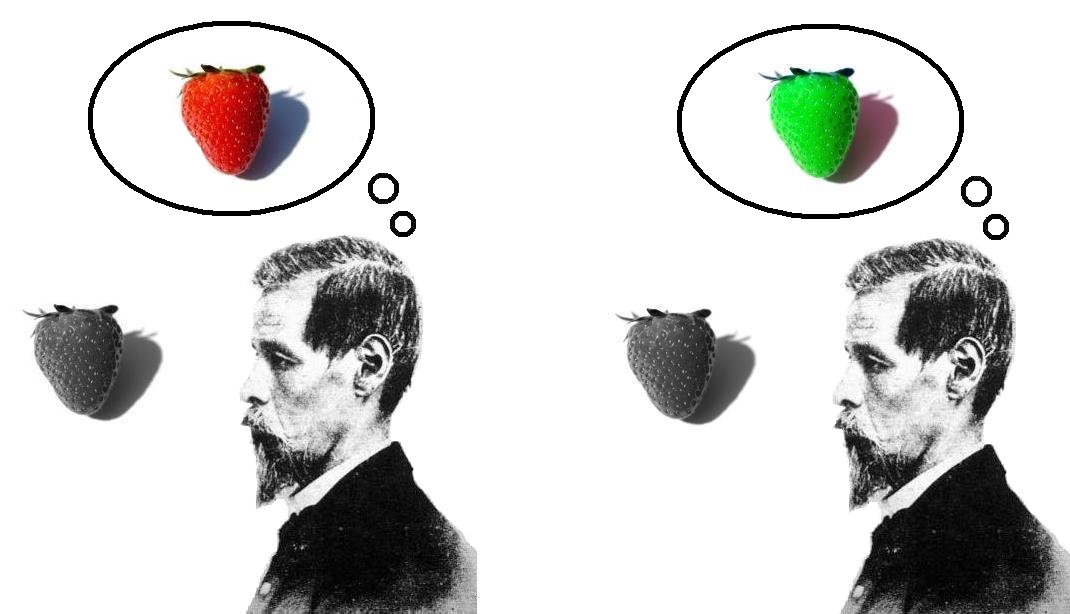
The second argument is that the words do, in fact, (also) refer to our private experiences. As an example of this, consider the people with the visors. The visors have been constructed in such a way that when the sensors on the outside detect 700nm light they output on the screen 500nm light and vice-versa. These people use the word "red" to describe the colour of strawberries and associate the colour red with 700nm light and use the word "green" to describe the colour of grass and associate the colour green with 500nm light.
Then when they're asleep we fix their visors so that the light emitted by the screen matches the light detected by the sensors. When they wake up do they go about their day as if nothing has changed, continuing to use the word "red" to describe the colour of strawberries and associate the colour red with 700nm light and to use the word "green" to describe the colour of grass and associate the colour green with 500nm light? Or do they immediately ask "why are strawberries now green?" and "why is grass now red?" and then be very confused when nothing about strawberries, grass, or the light they each reflect has changed?
I think the latter is obviously what will happen, showing that even though the use of the words "red" and "green" was public the words primarily referred to the colours on their private screen (assuming direct realism for the sake of argument) and not whatever was happening in their shared environment. -
Michael
16.8k
Dreams and hallucinations can be coloured (or "have colour" if you prefer), and people with synaesthesia can see colours when listening to music. This is because seeing colours (or even coloured things) is what happens when the visual cortex is active in the right kind of way, regardless of what the eyes are doing or what objects exist at a distance. This is also why cortical blindness is a thing, where the eyes react to stimuli as normal but the person doesn't see anything.
None of this entails a homunculus. That's a tired and lazy strawman. -
Michael
16.8k
Then let's make it even simpler.
There are two wavelengths of light: 1nm and 2nm. There are two neurons in the brain responsible for colour experience: A and B.
When John's eyes detect 1nm light his A neuron is active and he describes the colour he sees as red and when his eyes detect 2nm light his B neuron is active and he describes the colour he sees as blue.
When Jim's eyes detect 1nm light his B neuron is active and he describes the colour he sees as red and when his eyes detect 2nm light his A neuron is active and he describes the colour he sees as blue.
We then directly stimulate these neurons when their eyes are closed, asking them to describe the colour they see, and their answers will be consistent with the above.
Assuming eliminative materialism (to avoid positing non-physical phenomena), experiencing a particular colour just is a particular neuron being active. Given that when John's eyes detect 1nm light his A neuron is active and when Jim's eyes detect 1nm light his B neuron is active it must be that John and Jim are having different experiences when their eyes detect 1nm light even though they both refer to their experience as "seeing red".
We then rewire Jim's brain so that, like John, his A neuron is active when his eyes detect 1nm light and his B neuron is active when his eyes detect 2nm light, shine a 1nm light into his eyes, and ask him what colour he now sees. He'll say "blue". -
Esse Quam Videri
377
I thought it might be interesting to interject here since I see my position as being wedged between @Banno's and @Richard B's on the one hand, and @Michael's on the other.
I’m broadly sympathetic to the spirit of Banno's and Richard's replies here, but I wouldn’t go quite as far as saying these inversion scenarios are outright incoherent or fail to be truth-apt.
I’m happy to grant that scenarios involving inverted neural realizations or inverted experiential mappings are logically and even physically conceivable. Where I part company with Michael is in what follows from that conceivability. I don’t think the mere possibility of private experiential differences that make no difference to judgment, action, or correction does any epistemic work.
In particular, I don’t think such scenarios motivate skepticism, indirect realism, or the introduction of epistemic intermediaries. Even if two subjects differed in their neural realizations or phenomenal character while making the same world-directed judgments, all that would show is multiple realizability at the causal level, not that perception is mediated by inner surrogates or that perceptual justification is undermined.
So my view sits between the two positions on offer here: I don’t want to deny the coherence of these scenarios altogether, but I do want to deny that they carry the philosophical weight Michael wants them to carry. Once truth and error are located at the level of world-directed judgment, private inversion possibilities become explanatorily idle, even if they remain metaphysically conceivable. -
AmadeusD
4.2kOnce truth and error are located at the level of world-directed judgment, private inversion possibilities become explanatorily idle, even if they remain metaphysically conceivable. — Esse Quam Videri
Forgive me, but I think I need some clarification here. It seems to be saying that once we ascertain that errors can be made in world-directed judgements, the underlying possible explanation of inversion and private aberration is then irrelevant? I think that's jumping to a conclusion.. We need not call a spectrum inverted person erroneous unless we already assume hte premise of colour being a property of objects rather than wavelength reflection. -
Esse Quam Videri
377
Thanks, that’s a fair question — but I think it slightly mislocates the point I was making.
I’m not claiming that the mere fact that world-directed judgments can be true or false rules out inversion hypotheses, or renders them false. I’m happy to grant that spectrum inversion or other private aberrations remain metaphysically conceivable.
The claim is instead about explanatory role. Once truth and error are located at the level of world-directed judgment, inversion hypotheses no longer explain anything further about how perceptual judgments succeed or fail. They don’t add to our account of justification, error, or skepticism.
In particular, we don’t need to assume that colour is a property of objects or deny that assumption in order to make sense of perceptual error. Error arises when a judgment about the world fails to be satisfied by how things are, not when an inner experience mismatches an outer property.
So the point isn’t that inversion is impossible or incoherent, but that it’s explanatorily idle with respect to the epistemic issues under discussion — even if it remains metaphysically possible. -
 Art48
500
Art48
500
That's surprising. I read a book (some years ago) which said most philosophers were idealists. Perhaps, that was true once but is no longer?I think most contemporary philosophers will want to describe themselves as direct realists — Clarendon
I have 5 physical senses. I have no "ship-sensing" sense. All I have is the visual sensation of the (purported, externally-existing) ship. Think "Brain in a Vat". Or there's this.The point they typically make at first is to note that when we have a visual sensation of a ship, it is not the visual sensation that we perceive, but the ship itself by means of it. — Clarendon
82 – Materialism and Some Alternatives https://vimeo.com/1135081275 -
 frank
19kWe need not call a spectrum inverted person erroneous unless we already assume hte premise of colour being a property of objects rather than wavelength reflection. — AmadeusD
frank
19kWe need not call a spectrum inverted person erroneous unless we already assume hte premise of colour being a property of objects rather than wavelength reflection. — AmadeusD
Scientists say humans look purple to cats. So to a cat, it would be true that humans are purple. If a human says that, there might be something wrong. Except Latino babies are actually purple. For real. -
 Richard B
569I thought it might be interesting to interject here since I see my position as being wedged between Banno's and @Richard B's on the one hand, and @Michael's on the other.
Richard B
569I thought it might be interesting to interject here since I see my position as being wedged between Banno's and @Richard B's on the one hand, and @Michael's on the other.
I’m broadly sympathetic to the spirit of Banno's and Richard's replies here, but I wouldn’t go quite as far as saying these inversion scenarios are outright incoherent or fail to be truth-apt. — Esse Quam Videri
The modern camera does a good job of accurately depicting the world. I don't hypothesize metaphysical intermediaries like mental images/sense data for the camera to achieve this success in accuracy. Likewise, I don't need to do it for the human brain, which has about million of years of development behind it, while the camera has about two hundred. When an artist paints a landscape by memory of a visit to a park, the accuracy is judged by comparing it to the actual park, not to some mental picture. If the picture is inaccurate, I don't suppose the camera hallucinated an extra tree when the picture has two when there should have been one. But I will inspect the camera to see if it is working properly. This is not to say the imagination cannot aid in the troubleshooting the problem of the camera, but only if that imagination has some knowledge of its design should we expect a resolution. -
frank
19kAgain, sensory organs are interfaces. They convey electrical discharges to the central nervous system, which is separated from the rest of the body by the blood-brain barrier. The CNS even has its own private immune system as if it's a separate entity. It's not directly in contact with the world the organism lives in. It's indirect realism.
-
 Hanover
15.2kAgain, sensory organs are interfaces. They convey electrical discharges to the central nervous system, which is separated from the rest of the body by the blood-brain barrier. The CNS even has its own private immune system as if it's a separate entity. It's not directly in contact with the world the organism lives in. It's indirect realism. — frank
Hanover
15.2kAgain, sensory organs are interfaces. They convey electrical discharges to the central nervous system, which is separated from the rest of the body by the blood-brain barrier. The CNS even has its own private immune system as if it's a separate entity. It's not directly in contact with the world the organism lives in. It's indirect realism. — frank
If I see a cat, I'm not in direct contact with the cat even before it enters the CNS, and I don't receive the cat on my eye. I just receive photons. Even if I pet the cat, I only receive stimuli. Under this description, everything is indirect.
My point is that your distinction that sometimes we have direct contact with the world and sometimes we don't doesn't exist. All external objects are mediated by other objects, whether they be light waves, airwaves, or the various internal structures in your body, like retinas and your CNS.
Under this model, I don't trip over the cat. I experience falling which is how cats are represented to me when they are under my foot. The cat itself can't be said to actually be a certain color, truly have a distinct meow, nor have a certain trip like quality. I just know some noumenal cat triggered a phenomena of me busting my ass so I could better comprehend the elusive real actuality of cat. -
frank
19kIf I see a cat, I'm not in direct contact with the cat even before it enters the CNS, and I don't receive the cat on my eye. — Hanover
Your eye is directly exposed to light bouncing off the cat. That's the only directness to the situation. Humans don't have any kind of direct perception.
My point is that your distinction that sometimes we have direct contact with the world and sometimes we don't doesn't exist. — Hanover
I didn't say that. -
RussellA
2.6kFrom the fact that perception is causally mediated and temporally downstream, it does not follow that the object perceived no longer exists, nor that what is perceived is a memory or an illusion. — Esse Quam Videri
It depends what you mean by “the object perceived no longer exists”.
Light takes 8 min 20 sec to travel from the Sun to the Earth. The Sun we look at now in the present is not the same Sun as it was in the past 8 min 20 sec ago. The Sun is continually changing.
It depends whether you are referring to the object as a concept, such as the concept of a Sun, in which case we do have the concept of the Sun as it existed in the past, exists in the present and will exist in the future. This is the position of the Indirect Realist, in that the Sun exists as an object as a concept in the mind in the present.
Or are you referring to the object as a particular instantiation, such as a particular temporal instantiation of the Sun, in which case the Sun we are looking at in the present is not the same Sun as the Sun that existed in the past. And if so, it becomes impossible to directly look at any mind-external object, because a mind-external object is something that no longer exists in the present. But this is the position of the Direct Realist.
================
So at this point, the disagreement is no longer about logic or semantics, but about whether temporal causation entails that the object of perception must be a present mental item rather than a mind-external object. — Esse Quam Videri
One aspect is semantics, the normal use of language. When reading about Caesar, it would be misleading to say that we have direct knowledge that Caesar crossed the Rubicon. When looking at evidence of a crime, it would be misleading for the detective to say that he has direct knowledge of the criminal. Similarly, it is misleading to say that we have direct knowledge of a mind-external object, when we only know about the mind-external object because of a temporal causal chain.
Another aspect is logic. How can our perception of something in the present give us direct knowledge of something that happened in the past, when that something that happened in the past no longer exists in the present. How can we have direct knowledge of something that no longer exists. -
Michael
16.8kLight takes 8 min 20 sec to travel from the Sun to the Earth. The Sun we look at now in the present is not the same Sun as it was in the past 8 min 20 sec ago. The Sun is continually changing. — RussellA
I recall an argument from somewhere that argued something to the effect of:
P1. We directly perceive a distal object only if that object exists
P2. Many of the stars we see in the night sky no longer exist
C1. Therefore, many of the stars we see in the night sky are not directly seen
P3. The manner in which we see a star that still exists is the same as the manner in which we see a star that no longer exists
C2. Therefore, none of the stars we see in the night sky are directly seen
P4. The manner in which we see a star is the same as the manner in which we see any distal object that emits or reflects light, regardless of distance
C3. Therefore, no distal object is directly seen
So at best we only directly see light (leaving mental phenomena aside for the moment). -
RussellA
2.6kI recall an argument from somewhere that argued something to the effect of: — Michael
Absolutely.
Linguistically, I could call an animal with a long proboscis, tusks, large ear flaps, pillar-like legs, and tough but sensitive grey skin a “giraffe”, but this is a misuse of language. Similarly, the Direct Realist’s argument that they perceive mind-external objects “directly”.
Yes, and logically, how is it possible to “directly” perceive a mind-external object in the night sky, such as a star, when that star may in fact no longer exist.
It only makes sense that the direct object of our perception and cognition exists in our mind, from which we may reason and indirectly infer its cause as a mind-external object. The Indirect Realist does believe in a mind-external world, hence the name “Realist”. For me, my intellectual rather than instinctive belief in a mind-external world comes from “inference to the best explanation”, gaining understanding about the mind-external world indirectly. -
Esse Quam Videri
377
Thanks — this is a very clear statement of your position, and it helps isolate where we disagree.
I agree that perception is causally mediated and temporally downstream, and that in cases like astronomy our perceptual access depends on events in the past. I also agree that if objects are individuated strictly as momentary temporal instantiations, then the Sun-at-t is not identical to the Sun-at-t–8 minutes, and that no relation can obtain to what does not exist.
Where I disagree is with the inference you draw from this. I do not take the objects of perception to be momentary temporal stages. On my view, mind-external objects are temporally extended continuants that persist through change. The fact that the Sun is continually changing does not entail that it is a numerically different object at each instant in the sense required to break perceptual reference.
I also reject the claim that temporal mediation entails that the object of perception must be a present mental item. The causal chain explains how perception occurs, not what perception is of. That the light emitted earlier makes perception possible does not entail that what is perceived is a memory, an illusion, or an inner surrogate. It shows only that perceptual access is finite and temporally indexed.
This is why I think the Caesar and crime-scene analogies mislead. We deny direct knowledge of Caesar not because he is in the past, but because our access is symbolic, testimonial, and inferential. By contrast, perceptual access to the Sun or a ship is sensory and causal, not mediated by beliefs or descriptions. Temporal distance alone does not make knowledge indirect; mode of access does.
Finally, I think your conclusion overgeneralizes in a way that undermines Indirect Realism itself. If temporal mediation and non-simultaneity were sufficient to make perception indirect, then all perception would be indirect — not only perception of mind-external objects, but even the perception of mental images or sense-data, since those too are causally and temporally mediated. In that case, perception itself could never get off the ground, because every purported object of awareness would require a further epistemic intermediary, generating an infinite regress.
So while I agree that a relation cannot obtain to a non-existent object as such, I deny that this forces the conclusion that the object of perception must be a present mental item. The disagreement now seems to be about ontology — whether objects are momentary temporal stages or persisting continuants — rather than about logic or semantics. -
Michael
16.8kI also reject the claim that temporal mediation entails that the object of perception must be a present mental item. — Esse Quam Videri
I suppose there are two related claims:
1. The direct object of perception is a distal object
2. The direct object of perception is a mental phenomenon
It's possible that both (1) and (2) are false.
Carrying on from the argument here, let's assume a world in which light travels at 1m/s. An apple is placed in front of me at a distance of 10m. After 5 seconds it is disintegrated. After a further 5 seconds I see an intact apple.
Is the apple the direct object of my perception?
If it is then the direct object of my perception is something that doesn't exist, which is somewhat peculiar.
If it's not then what is the direct object of my perception, and at what (non-arbitrary) speed does light have to travel and at what (non-arbitrary) distance does the apple have to be for it to be the direct object of my perception? -
 Ludwig V
2.5k
Ludwig V
2.5k
Yes. It seems to me that the fact that we do not perceive light waves as such is important. Light and sound are the means by which we perceive, not what we perceive.The causal chain explains how perception occurs, not what perception is of. — Esse Quam Videri
Exactly.By contrast, perceptual access to the Sun or a ship is sensory and causal, not mediated by beliefs or descriptions. — Esse Quam Videri
Quite so. But then one has to explain what a hallucination of a dagger is, if not a mental image. That's not easy, because most people are absolutely sure that, like Macbeth, they see a dagger that is not there. Hence, a dagger-like object. Illusions like the bent stick are easy - we can demonstrate that the stick in water should look as if is bent - it's an actual physical phenomenon. At the moment, I'm inclined to just say that Macbeth is behaving as if he can see a dagger, and believes he is seeing a dagger - but there is no dagger and hence no perception of a dagger.So while I agree that a relation cannot obtain to a non-existent object as such, I deny that this forces the conclusion that the object of perception must be a present mental item. — Esse Quam Videri
At the moment, I'm inclined to think that this is just a question of different notations. I need to be shown that something hangs on the distinction.The disagreement now seems to be about ontology — whether objects are momentary temporal stages or persisting continuants — rather than about logic or semantics. — Esse Quam Videri


Welcome to The Philosophy Forum!
Get involved in philosophical discussions about knowledge, truth, language, consciousness, science, politics, religion, logic and mathematics, art, history, and lots more. No ads, no clutter, and very little agreement — just fascinating conversations.
Categories
- Guest category
- Phil. Writing Challenge - June 2025
- The Lounge
- General Philosophy
- Metaphysics & Epistemology
- Philosophy of Mind
- Ethics
- Political Philosophy
- Philosophy of Art
- Logic & Philosophy of Mathematics
- Philosophy of Religion
- Philosophy of Science
- Philosophy of Language
- Interesting Stuff
- Politics and Current Affairs
- Humanities and Social Sciences
- Science and Technology
- Non-English Discussion
- German Discussion
- Spanish Discussion
- Learning Centre
- Resources
- Books and Papers
- Reading groups
- Questions
- Guest Speakers
- David Pearce
- Massimo Pigliucci
- Debates
- Debate Proposals
- Debate Discussion
- Feedback
- Article submissions
- About TPF
- Help
More Discussions
- Other sites we like
- Social media
- Terms of Service
- Sign In
- Created with PlushForums
- © 2026 The Philosophy Forum