
-
 Magnus Anderson
393Nor is your making shit up. — Banno
Magnus Anderson
393Nor is your making shit up. — Banno
"Making shit up" is what people confuse with thinking when they know nothing other than to read books and / or be sycophants.
Reading a maths book isn’t just passive; it’s fuel for precise thinking, especially when you’re debating infinite sets. It shows how folk have thought about these issues in the past, and the solutions they came up with that work. — Banno
In your case, it's obviously passive. That you can't see it is your problem. It's pretty clear that you don't know how to think.
Your responses are now a bit too sad to bother with. Thanks for the chat. — Banno
You get what you ask for. But I'm sure you're innocent in your mind. -
 Ansiktsburk
213
Ansiktsburk
213
I’ve lived with that since 1973The kind of thought that was subject of an excellent 2008 BBC documentary, Dangerous Knowledge — Wayfarer -
Magnus Anderson
393:lol: — Banno
For a grownup man, that's a pretty childish response.
If the word "function" is defined the way mathematicians define it, namely, as a relation between two sets where each element from the first set is paired with exactly one element from the second, then, if a bijective function that maps N onto N0 is a logical possibility, i.e. if it's not a real oxymoron, then it follows that there's a one-to-one correspondence between N and N0.
Notice the requirement that it must be a logical possibility?
f(n) = n - 1 is a bijective function that maps N onto N0. But, understood through the lens of the above definition, is it a logical possibility? How do you know that? What if it's a real oxymoron that is useful?
You don't know that. And that's why you can't use it as a premise. You can't say, "There's a one-to-one correspondence between N and N0 because there's this function f(n) = n - 1 that maps N onto NO in a bijective way." You don't know if that function is a logical possibility. You have no proof of it.
And it kind of stinks of circular reasoning, doesn't it? "There's a one-to-one correspondence between N and N0 because there is f(n) = n - 1, a one-to-one correspondence between N and N0!" -
 Esse Quam Videri
444I think part of what’s driving the disagreement here is that two different notions of “same size as” are in play, and they come apart precisely in the infinite case.
Esse Quam Videri
444I think part of what’s driving the disagreement here is that two different notions of “same size as” are in play, and they come apart precisely in the infinite case.
In everyday contexts, “same size” usually means something like this: if you subtract one collection from another and anything is left over, then they are not the same size. That notion is closely tied to finite counting, monotonicity, and the idea that proper subsets must be smaller than wholes. By that standard, it’s perfectly reasonable to say (for instance) that the natural numbers and the integers are not the same size.
What @Banno is appealing to, though, is a different notion that mathematicians use when working with infinite sets: sameness of size defined in terms of one-to-one correspondence. On that definition, “same size” no longer tracks what’s left over after subtraction, but whether elements can be paired without remainder. This isn’t meant to preserve ordinary quantitative intuitions; it’s meant to give a notion of comparability that still works once subtraction and counting break down.
So I don’t think the disagreement here has to be read as one side being confused or irrational. It looks more like a clash between two legitimate concepts that happen to share the same words. The intuitive notion works well for finite collections but doesn’t generalize cleanly; the mathematical notion is explicitly engineered to handle infinite cases, even at the cost of violating everyday expectations.
Once that distinction is on the table, the question isn’t really “who is right,” but what we want the concept of “same size” to do in this context. Mathematics answers that one way; ordinary language answers it another. -
 ssu
9.8k
ssu
9.8k
Sorry Magnus, but this what you say is wrong::lol:
— Banno
For a grownup man, that's a pretty childish response. — Magnus Anderson
A bijection does mean that sets can be put into a one-to-one correspondence.That a bijective function exists, cretin, does not mean that the two sets can be put into a one-to-one correspondence. — Magnus Anderson
No. There are injections and surjections, which aren't bijections (both injection and a surjection) and they are also called functions.If the word "function" is defined the way mathematicians define it, namely, as a relation between two sets where each element from the first set is paired with exactly one element from the second then, if a bijective function... — Magnus Anderson
Let me just remind you of this. It's looks simply, but actually it is difficult to grasp especially with infinite sets:
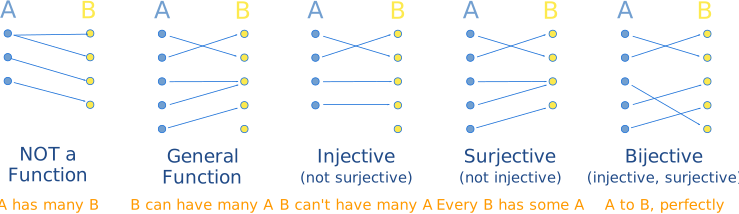
-
 sime
1.2kThe dispute concerns the notion of Dedekind Infinity.
sime
1.2kThe dispute concerns the notion of Dedekind Infinity.
Dedekind Infinity, referring to the "fact" that the set of natural numbers N is equinumerous to a proper subset of itself, is an intensional concept referring only to injections of the type N --> N . This isn't the same asserting that 1,2,3,... is extensionally of the same length as 2,4,6,... since the dots "..." don't have an extensional interpretation.
A sequence S := 1,2,3,.. that is understood to be unfinished rather than complete, refers to the notion of a Dedekind-finite infinite set. This means that
1) There doesn't exist a bijection between S and and a finite set, meaning that S is unfinished.
2) Any injection S --> S is necessarily a bijection, meaning that S isn't Dedekind Infinite.
3) Any function N --> S isn't an injection, meaning that S isn't countably infinite or larger.
Unfortunately, this indispensible common-sense notion of the potentially infinite set, cannot be formulated in ZFC, because it isn't compatible with the axiom of countable choice which insists upon completing every set.
it is right for amateur philosophers to object to Dedekind Infinity being misued as an extensional concept by the media and the general public (including some physicists who ought to know better). This misuse is due to mainstream mathematics being grounded in adhoc 20th century Hilbertian foundations that assumes the existence of a completed "set" of natural numbers, to the detriment of common-sense, as well as to science and engineering.
Recall that Hilbert believed that finitary proof methods could be used to ground the notion of absolute infinity that he considered to be indispensible for mathematics, due to being under the spell of Cantor, and which the incompleteness theorems conclusively debunked - a negative result that should have been obvious from the outset - namely that an infinite amount of information is obviously not finitely compressible into finite axiom schema. -
 Banno
30.6k
Banno
30.6k
Yes, but this far too charitable. There are compelling reasons for rejecting Magnus's account. The notion of "same size" he work with is inadequate to deal with infinities coherently - using it results in inconsistencies.I think part of what’s driving the disagreement here is that two different notions of “same size as” are in play, and they come apart precisely in the infinite case. — Esse Quam Videri
Here's a formalisation of Magnus's account.
- Proper Subset Principle
If and , then is smaller than . - Subtraction Principle
If , then is larger than . - Transitivity of Size
If is smaller than and is smaller than , then is smaller than .
Let's look at a few contradictions that result.
Contradiction 1: ℕ vs Even Numbers
Let
- and
⇒ by (N1), is smaller than .
- is infinite
⇒ by (N2), is larger than .
But define the pairing:
This is a one-to-one correspondence between and .
So:
- and are the same size.
- is strictly smaller than .
Thus:
This violates antisymmetry.
Contradiction 2: ℕ vs ℤ
Let
- , proper subset
⇒ by (N1), .
- is infinite
⇒ by (N2), .
But define a pairing:
So:
- and are the same size.
- is strictly smaller than .
Again:
Contradiction.
Contradiction 3: Self-Subtraction
Let .
Partition into two disjoint infinite subsets:
where
By (N1):
But:
So is the union of two sets each strictly smaller than .
This is impossible under the naïve size rules, which are now mutually inconsistent.
Contradiction 4: Hilbert’s Hotel
Let hotel have rooms , all occupied.
Define:
This moves each guest up one room, freeing room 1.
- No guests are removed.
- A new room becomes available.
- The hotel is both “the same size” and “larger”.
Under subtraction-based size:
- Adding capacity without increasing size is impossible.
- Removing nothing yet gaining space is impossible.
The governing rules of “size” break down.
Conclusion
Once infinite sets are admitted, the principles:
- proper subset ⇒ smaller,
- remainder ⇒ larger,
- antisymmetry and transitivity,
cannot all be maintained. The naïve notion of “same size” does not merely yield counter-intuitive results — it generates outright contradictions.
This is the sense in which the mathematical objection applies: the concept fails to define a coherent ordering on infinite collections.
Thanks to ChatGPT for help with the formatting, but even so the time taken to respond to the sort of nonsense promulgated by maths sceptics is far more than the net benefit.
The question is, "who is right?", and the answer is, the contradictions above show that Magnus' ideas cannot be made consistent. Formal language is nothing more than tight use of natural language - it is not unnatural. What is shown by the contradictions is not a conflict between natural and formal languages, but a lack of adequate tightness in Magnus's argument. Magnus’s argument lacks sufficient precision to handle the case he wants it to handle.Once that distinction is on the table, the question isn’t really “who is right,” but what we want the concept of “same size” to do in this context. Mathematics answers that one way; ordinary language answers it another. — Esse Quam Videri
Notice also that the arguments stand alone, they are not appeals to authority.
The correct diagnosis is not conceptual pluralism, but logical failure. - Proper Subset Principle
-
Banno
30.6kI tried to follow that, but failed. See this response from ChatGPT. And Claude, from the same prompt, concluded
This post articulates real philosophical concerns about actual vs. potential infinity, echoing positions from intuitionism and finitism. However, it:
Makes technical errors about what Dedekind-finite infinite sets would be
Misattributes motivations to Hilbert and misrepresents Gödel
Overstates the practical impact on mathematics and science
Presents a minority foundational view as obvious "common sense"
The core intuition—that treating "1, 2, 3, ..." as a completed totality involves a conceptual leap—is worth taking seriously. But the execution here conflates technical and philosophical issues, and the dismissal of modern foundations as "adhoc" ignores their substantial mathematical and philosophical motivation.
Salience: Relevant to foundations and philosophy of mathematics, but overstated regarding impact on working mathematics. — Claud Sonnet 4.5
I'm not sure how to proceed here. -
 DingoJones
2.9kHave we checked if this guy is…Bartricks I think It was?
DingoJones
2.9kHave we checked if this guy is…Bartricks I think It was?
Sounds awfully familiar and he clearly has a “book reader” ax to grind. -
Esse Quam Videri
444Point taken. I agree that once infinite collections are treated as completed totalities, the intuitive, remainder-based concept of size becomes inconsistent, and your examples make that very clear. I don’t think the intuitive concept is incoherent as such — it’s well-behaved in the finite case — but I agree that Magnus’s attempt to generalize it to infinite collections fails.
-
ssu
9.8k
If someone is willing to learn something, on the contrary.Cheers. Useful stuff. When someone makes such obvious mistakes, it's probably not worth giving detailed responses, because chances are they will not be able to recognise or understand the argument. The result will be interminable. — Banno
I really would hope that if I make a mistake, some fellow PF member will say that I have made a mistake and try to thoroughly explain to me what my mistake was. Not just "Read high school math 1.0".
But yes, usually the response is just an angry outburst. -
Banno
30.6kOk. I'll hold back. We'll see.
Yep, at least the pattern is the same.
Cheers. I'd be interested in your take on my comments regarding formal language. I see it as a refinement of, rather than distinct from, natural language. -
ssu
9.8k
It's not just Dedekind Infinity, it simply is Infinity in general. Galileo Galilei noticed the puzzling aspects of infinity a long time before Dedekind or Cantor (which in my view are best explained by the example of the Hilbert Hotel).The dispute concerns the notion of Dedekind Infinity. — sime
I think the term would be actual infinity that you should refer here to. Absolute Infinity is something totally else, which contradicts the Cantorian hierarchy of larger and larger infinities. Cantor simply preserved Absolute Infinity for God and as he was a deeply religious man, that shouldn't be overlooked. Yet for Absolute Infinity Cantor had no clue how to reason it.Recall that Hilbert believed that finitary proof methods could be used to ground the notion of absolute infinity that he considered to be indispensible for mathematics — sime
The incompleteness theorems didn't debunk actual infinity, what they debunked was Hilbert's aim to formalize mathematics and to prove its consistency and completeness by having a general answer (algorithm) to the Entscheidungsproblem. Mathematicians are usually just happy having infinity as an axiom in ZF and don't worry so much about it.and which the incompleteness theorems conclusively debunked — sime -
Esse Quam Videri
444Cheers. I largely agree with you that formal language is not something alien to natural language, but a tightening of it — making explicit commitments and inferential roles that are often left implicit in ordinary use.
Where I’d add a small nuance is that the act of tightening isn’t always neutral. In refining a concept, we sometimes preserve certain inferential roles while deliberately abandoning others that no longer serve the new domain. In the case of “size”, the move to formal language preserves comparability and transitivity for infinite collections, but it does so by dropping the remainder-based role that functions perfectly well in the finite case.
So I don’t see formal language as distinct from natural language so much as selectively continuous with it: a refinement that’s purpose-driven rather than a mere sharpening of everything we already mean. -
Banno
30.6kOk. Nuanced stuff. Noice.
I have to disagree a bit with this:
The "remainder-based role" is not dropped; the use of bijection keeps everything that the alternative has to offer, and adds the ability to deal with infinities. The shift doesn't sacrifice the old inferential roles, it enriches them....dropping the remainder-based role that functions perfectly well in the finite case. — Esse Quam Videri -
Esse Quam Videri
444
I see what you’re getting at, and I agree that bijection strictly extends our ability to reason about size — especially once infinities are in play. In that sense it’s an enrichment, not a rival notion.
The small point I was gesturing at is that, while the bijection criterion agrees with the remainder-based notion on all finite cases, it does so by no longer treating “having a proper remainder” as decisive for size comparison. That inferential role is preserved extensionally for finite sets, but it no longer has the same explanatory force once we move to the infinite case.
So I’m not suggesting that anything correct is lost in the finite domain — only that some intuitive cues we rely on there stop doing the work we expect of them when the concept is refined for a broader domain. -
Magnus Anderson
393A bijection does mean that sets can be put into a one-to-one correspondence. — ssu
You're missing the point. What has to be shown is that the fact that one can think of f(n) = n - 1 means that there exists one-to-one correspondence, or bijection, between N and N0. To do that, you have to show that f(n) = n - 1 is not a contradiction in terms.
I can think of the concept of square-circle but that does not mean square-circles exist. You have to show the concept is not a contradiction in terms. And in the case of the concept of square-circle, it very much is ( Taxicab geometry is not a valid counter-argument, it's merely a fashionable response, peddled by people who are not particularly good at logic. )
If you're a superficial thinker -- and most people are -- you will miss the subtleties.
I can very easily show that there is NO bijection between N and N0. But of course, it's not written in the books, so sycophantic ego-driven non-thinkers dismiss it.
No. There are injections and surjections, which aren't bijections (both injection and a surjection) and they are also called functions. — ssu
How exactly does that contradict anything I said? -
Magnus Anderson
393↪Magnus Anderson I think part of what’s driving the disagreement here is that two different notions of “same size as” are in play, and they come apart precisely in the infinite case. — Esse Quam Videri
I appreciate your response but I disagree with your conclusion, namely, that we're using two different definitions of the term "same size". I am quite confident that we're using the same definition.
When speaking of sets, the word "size" simply means "the number of elements". The word is defined the same way for both finite and infinite sets. That's how the word has been used for ages and it's the way it is used today.
With that in mind, the term "same size" simply means "equal number of elements". That's it.
The terms "bijection" and "one-to-one correspondence" refer to a relation between two sets A and B where every element from A is paired with exactly one element from B, and vice versa.
The observation is that, for every two sets A and B, if they are equal in size, they can be put into one-to-one correspondence with each other. And if they aren't, then they can't.
This means that, if we know that there's a bijection between A and B, it follows that A nd B are equal in size.
The problem they faced is that, with finite sets, one can determine whether or not they are equal in size simply by counting the elements and then comparing the resulting numbers; but with infinite sets, this isn't the case.
So they came up with the idea that, if we can show that infinite sets can be put in one-to-one correspondence with each other, we can conclude that they are equal in size.
So far so good. That is all true.
The problem lies in HOW they go about establishing whether or not any two sets can be put in one-to-one correspondence.
Their method is based on a hidden, and an erroneous, premise that, if we can think of a function that is defined as a bijection between A and B, it follows that there exists a bijection between A and B.
That's akin to saying that, if there exists a symbol that is defined as a shape that is both a square and a circle, then we can safely conclude that such shapes exist.
You've probably heard of Hilbert's Paradox. Hilbert's Paradox exposes a very serious contradiction in the way infinites are normally dealt with. Unfortunately, most pretend it's not a real contradiction, justifying themselves will sorts of silly rationalizations.
Suppose we have a hotel with a number of rooms equal to the number of natural numbers.
Suppose each room is occupied by a single guest.
That gives us a nice bijection between the set of guests and the set of hotel rooms.
R1 R2 R3 ...
G1 G2 G3 ...
Guest #1 ( G1 ) is in room #1 ( R1 ), guest #2 ( G2 ) in room #2 ( R2 ) and so on.
If there exists a bijection between N and N0, then it follows that we have a spare room for another guest. Let's call that guest G0.
---- R1 R2 R3 ...
G0 G1 G2 G3 ...
There is no longer a bijection between the two sets. G0 is not in any room. And if you try to add it to any room, you will either end up having two guests in a room ( not bijection ) or you will have to kick out one of the guests ( still not bijection. )
There's no way out of this conundrum . . . other than to pretend.
And that's what they do. They pretend. -
Esse Quam Videri
444I think this helps clarify where we diverge. You’re treating “number of elements” as a notion whose inferential rules must be fixed by finite counting, and on that assumption the infinite case does look contradictory. Mathematics takes a different route: it treats counting as the finite implementation of a more general notion of size, and allows the implementation to change when counting no longer applies. I think has done a fine job of showing the inconsistencies that arise if we don't.
That’s why defining a bijection counts as establishing existence in this context, and why reindexing in Hilbert’s Hotel isn’t seen as pretence. At that point the disagreement isn’t about technique, but about whether such revisions are legitimate at all. -
Magnus Anderson
393You’re treating “number of elements” as a notion whose inferential rules must be fixed by finite counting, and on that assumption the infinite case does look contradictory. Mathematics takes a different route — Esse Quam Videri
They don't. It's called ad hoc rationalization. -
Magnus Anderson
393I think ↪Banno has done a fine job of showing the inconsistencies that arise if we don't. — Esse Quam Videri
Not really. Banno's argument is flawed because it is based on the erroneous premise that I already covered:
"If we can think of a function that is defined as a bijection between A and B, it follows that there exists a bijection between A and B."
Because he can think of a function that is defined as a bijection between N and E, namely, f(n) = 2n, he concludes that N and E are the same in size. He never actually proves that such a function is not a contradiction in terms. And I can easily show that it is.
The inconsistencies that he speaks of do not come from "my" use of the term "same size" ( as if anyone else is using it any differently ) but from his own logical mistakes ( which aren't really his own, he merely copied them from a textbook. ) -
Magnus Anderson
393they are not appeals to authority — Banno
Bullshit. You're literally copy-pasting textbook arguments. Zero thinking on your part. -
 Metaphysician Undercover
14.9kI can't think instead of you, Banno. If you can't do it, that's fine. But don't make it look like it's the other person's problem. — Magnus Anderson
Metaphysician Undercover
14.9kI can't think instead of you, Banno. If you can't do it, that's fine. But don't make it look like it's the other person's problem. — Magnus Anderson
Classic Banno!
You should get on well with Meta. — Banno
Well, Magnus was very quick to pick up on your nasty habit of straw manning the other person's claims to make it appear like your own errors are the errors of the other person. I wonder why both of us come to the same very peculiar conclusion. -
ssu
9.8k
With finite set there's a contradiction.You're missing the point. What has to be shown is that the fact that one can think of f(n) = n - 1 means that there exists one-to-one correspondence, or bijection, between N and N0. To do that, you have to show that f(n) = n - 1 is not a contradiction in terms. — Magnus Anderson
With infinite set there isn't.
(In fact just look up the axiom of infinity in Zermelo-Fraenkel set theory. Or the definition of Dedekind infinity).
Sorry, but I don't think you grasp the example of Hilbert's Hotel, which above @Banno gave you. So you write:
Suppose we have a hotel with a number of rooms equal to the number of natural numbers.
Suppose each room is occupied by a single guest.
That gives us a nice bijection between the set of guests and the set of hotel rooms.
R1 R2 R3 ...
G1 G2 G3 ...
Guest #1 ( G1 ) is in room #1 ( R1 ), guest #2 ( G2 ) in room #2 ( R2 ) and so on.
If there exists a bijection between N and N0, then it follows that we have a spare room for another guest. Let's call that guest G0.
---- R1 R2 R3 ...
G0 G1 G2 G3 ...
There is no longer a bijection between the two sets. G0 is not in any room. And if you try to add it to any room, you will either end up having two guests in a room ( not bijection ) or you will have to kick out one of the guests ( still not bijection. )
There's no way out of this conundrum . . . other than to pretend. — Magnus Anderson
OK, you really don't understand the Hilbert Hotel.
How Hilbert hotel works, at first:
R1 R2 R3...
G1 G2 G3...
And then when one gest, let's say G1, leaves, it's still full (meaning there's a bijection) because:
R1 R2 R3 ...
G2 G3 G4 ...
And if another guest comes, that G0, then the hotel fills up:
R1 R2 R3 ...
G0 G1 G2 ....
Please understand when many people are saying the same thing to you. Perhaps this video would help, because it's talking exactly about the same thing, although it really shows in what circumstance there isn't any bijection:
And if you are interested in finitism, I have a great professor to listen to or watch his lectures... -
 SophistiCat
2.4kI see what you’re getting at, and I agree that bijection strictly extends our ability to reason about size — especially once infinities are in play. In that sense it’s an enrichment, not a rival notion. — Esse Quam Videri
SophistiCat
2.4kI see what you’re getting at, and I agree that bijection strictly extends our ability to reason about size — especially once infinities are in play. In that sense it’s an enrichment, not a rival notion. — Esse Quam Videri
This is not even an extension or enrichment of finite counting: all counting is based on bijection. In the finite case, whether you use your fingers, notches on a stick or a number system, it all boils down to the same procedure:
- There is a physical or mental counting device that can represent various sets of known size (fingers, notches, numbers)
- In order to find the size of any other set, you put it into a one-to-one correspondence with one of those reference sets.
(Physical measurements of size and weight are also based on the same principle.)
So, to count sheep in the pen you can bend your fingers left to right, one for every sheep. Once you run out of sheep (or fingers), you can hold up your hands and say: I have that many (or at least that many). Works even if you have no notion of numbers.
Using numbers, you follow the same procedure, only you use counting numbers 1 through N instead of fingers, plus the convenient fact that the last member of your reference set is equal to its size. The size of a set is then the last member of a set of counting numbers that are in a one-to-one correspondence with that set.
Counting infinite sets works the same way, except that you have to set aside certain other assumptions that hold for finite sets but not for infinite sets. For example, you can no longer use finite subsets of natural numbers as described above. But you can use other reference sets. You can use the entire set of natural numbers as your measuring stick, or its power set if that that's not enough, or the power set of the power set, and so on. -
Metaphysician Undercover
14.9kThe OP is correct, yet incomplete. — LuckyR
You wouldn't expect completion from a thread titled "Infinity" would you?
You can use the entire set of natural numbers as your measuring stick, or its power set if that that's not enough, or the power set of the power set, and so on. — SophistiCat
The problem though, is that you really cannot use the entire set of natural numbers as your measuring stick. No one can do this, because by definition, no one can get all those numbers into one's grasp, to use them that way. This renders that statement as false.
Counting infinite sets works the same way, except that you have to set aside certain other assumptions that hold for finite sets but not for infinite sets. — SophistiCat
The "other assumptions" which one must "set aside" are the assumptions that truth is required of a premise, to produce a sound conclusion. Once we dismiss the necessity of truth, then we might assume the premise that the entire set of natural numbers could be utilized in the prescribed way. -
Esse Quam Videri
444
Yes — that’s a good way of putting it, and I agree. I didn’t mean to suggest bijection is foreign to finite counting, only that when we move to infinity the remainder-based cues we rely on in finite cases stop being reliable, even though the underlying correspondence idea remains. -
Magnus Anderson
393With finite set there's a contradiction.
With infinite set there isn't. — ssu
You're not responding to what's in the quote. You did not prove the following: that just because you can think of a function that is defined as bijection between N and N0, e.g. f(n) = n - 1, that it follows that a bijection exists between N and N0. You conveniently ignore that. And so does Banno. It's very convenient.
The problem is not with the definition of the word "same size", the problem is with the wrong conclusion that N is the same size as E or that N is the same size as Z. They aren't equal. And once you plug that in, the contradictions are gone. But neither you nor Banno nor mathematicians want to admit that you made a mistake that you've been stubbornly preserving for decades, so instead, you blame it on the definition, as if definitions can be logically proven to be wrong ( they can't, they are prior. ) The redefinition of the term "same size" merely covers up the fact that you screwed up.
OK, you really don't understand the Hilbert Hotel. — ssu
And you really don't have the ability to determine whether or not other people understand something.
And then when one gest, let's say G1, leaves, it's still full (meaning there's a bijection) because: — ssu
It's not full. There's no longer one-to-one correspondence between the two sets.
R1 R2 R3 ...
---- G2 G3 ...
R1 is unpaired. And it cannot be paired with any other guest because they are all already paired.
And if another guest comes, that G0, then the hotel fills up:
R1 R2 R3 ...
G0 G1 G2 .... — ssu
Nah, that's not what you get when G0 comes.
What you get is this:
R1 R2 R3 ...
G0 G2 G3 ...
G1 left. He's not in the hotel.
Their argument is that you can create an empty room for G0 by moving all the guests one place to the right. But of course, that's impossible. They employ sleight of hand to MAKE IT LOOK like it's possible. The trick is to hide the unpaired guest in the ellipsis and to never reveal it.
And understand that I went over this many times in the past.


Welcome to The Philosophy Forum!
Get involved in philosophical discussions about knowledge, truth, language, consciousness, science, politics, religion, logic and mathematics, art, history, and lots more. No ads, no clutter, and very little agreement — just fascinating conversations.
Categories
- Guest category
- Phil. Writing Challenge - June 2025
- The Lounge
- General Philosophy
- Metaphysics & Epistemology
- Philosophy of Mind
- Ethics
- Political Philosophy
- Philosophy of Art
- Logic & Philosophy of Mathematics
- Philosophy of Religion
- Philosophy of Science
- Philosophy of Language
- Interesting Stuff
- Politics and Current Affairs
- Humanities and Social Sciences
- Science and Technology
- Non-English Discussion
- German Discussion
- Spanish Discussion
- Learning Centre
- Resources
- Books and Papers
- Reading groups
- Questions
- Guest Speakers
- David Pearce
- Massimo Pigliucci
- Debates
- Debate Proposals
- Debate Discussion
- Feedback
- Article submissions
- About TPF
- Help
More Discussions
- Other sites we like
- Social media
- Terms of Service
- Sign In
- Created with PlushForums
- © 2026 The Philosophy Forum