
-
 Michael
16.9k
Michael
16.9k
I'm not saying any of that. In fact I explicitly said several times that at 10:00:25 I see an intact red apple 10m in front of me.
The issue is that you seem to think that this suffices as direct realism and as a refutation of indirect realism. It is neither. -
 Hanover
15.3kI have no idea. Science primarily relies on falsification, not verification. If direct realism claims that ordinary objects are "constituents" of experience (see here), and if science has falsified this claim — as I believe it has — then science has refuted direct realism. — Michael
Hanover
15.3kI have no idea. Science primarily relies on falsification, not verification. If direct realism claims that ordinary objects are "constituents" of experience (see here), and if science has falsified this claim — as I believe it has — then science has refuted direct realism. — Michael
Very well, then how do we falsify indirect realism as you've defined it?
If direct realism (as it is absurdly defined here) requires a part of the apple perceived actually be in your head, even if we found that constituent part in your head, indirect realism wouldn't be falsified because you'd have to say the constituent part you found may not be the apple itself because it is but a mediated perception.
As in, if all you see are shadows, you can't ever know if you have the real thing.
If your position is unfalsifiable, it is not scientific. -
Michael
16.9kIndirect realism says that what we see is not the apple. — Banno
No, it says that seeing an apple is not the "direct presentation" of an apple, where "direct presentation" is understood in the naive realist sense:
On [the naive realist] conception of experience, when one is veridically perceiving the objects of perception are constituents of the experiential episode. The given event could not have occurred without these entities existing and being constituents of it in turn, one could not have had such a kind of event without there being relevant candidate objects of perception to be apprehended. So, even if those objects are implicated in the causes of the experience, they also figure non-causally as essential constituents of it... Mere presence of a candidate object will not be sufficient for the perceiving of it, that is true, but its absence is sufficient for the non-occurrence of such an event. The connection here is [one] of a constitutive or essential condition of a kind of event. — Martin 2004
We do see apples; just not directly. You always conflate "I see an apple" and "I directly see an apple". The addition of the adjective "directly" involves additional conditions that the naive realist (wrongly) claims are satisfied and the indirect realist (rightly) claims aren't satisfied. -
Michael
16.9kIf direct realism (as it is absurdly defined here) requires a part of the apple perceived actually be in your head — Hanover
That's not how it's defined.
This is the naive realist view that indirect realism disputes:
On [the naive realist] conception of experience, when one is veridically perceiving the objects of perception are constituents of the experiential episode. The given event could not have occurred without these entities existing and being constituents of it in turn, one could not have had such a kind of event without there being relevant candidate objects of perception to be apprehended. So, even if those objects are implicated in the causes of the experience, they also figure non-causally as essential constituents of it... Mere presence of a candidate object will not be sufficient for the perceiving of it, that is true, but its absence is sufficient for the non-occurrence of such an event. The connection here is [one] of a constitutive or essential condition of a kind of event. — Martin 2004
Represented as a picture, it would be this:
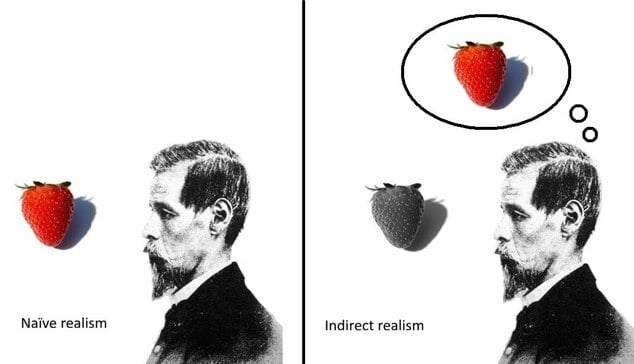
Naive realists aren't saying that apples are "in the head"; they say that experience isn't "in the head" but an "openness to the world", i.e. there are no "mental representations" or anything of the sort; there's just the strawberry being presented to me. -
 Banno
30.6k
Banno
30.6k
Hokum. You conflate "I see an apple" and "I indirectly see an apple".You always conflate "I see an apple" and "I directly see an apple". — Michael
Again, that "naive realist" is no more than a foil against which to draw the supposed "indirect" account. That indirect account is misleading. What one sees is the apple, not a mental image or whatever. -
Banno
30.6kSo the strawberry is actually grey?
Notice how you here work with the merely philosophical construct "the-strawberry-as-it-is-in-itself"? We never get to taste or see "the-strawberry-as-it-is-in-itself" not becasue of any limitation on our senses, but becasue it's not a thing. "the-strawberry-as-it-is-in-itself" is already interpreted.
As being grey, apparently. -
Michael
16.9kYou conflate "I see an apple" and "I indirectly see an apple". — Banno
No I don't. "I see X" is true if we directly see X or if we indirectly see X.
Again, that "naive realist" is no more than a foil against which to draw the supposed "indirect" account. — Banno
It's not a "foil". It's a very real philosophical position, and is the intended target of indirect realism. Naive realists say that apples are "constituents" of first-person phenomenal experience, and indirect realist say that they're not; that the "constituents" of first-person phenomenal experience are only sense-data/qualia/mental representations. -
Banno
30.6k
Good. then the two collapse into one. And you have now agreed that "I see the apple" is true, and "I see a mental image of the apple" misleading. "first-person phenomenal experience" is philosophical fluff.No I don't. "I see X" is true if we directly see X or if we indirectly see X. — Michael
So indirect realists say that apples are not "constituents" of our seeing apples? How's that?Naive realists say that apples are "constituents" of first-person phenomenal experience... — Michael -
Michael
16.9kGood. then the two collapse into one. — Banno
No they don't.
And you have now agreed that "I see the apple" is true — Banno
I always did. Why is it so difficult for you to just read what I write?
So indirect realists say that apples are not "constituents" of our seeing apples? How's that? — Banno
As per the thought experiment, both of these are true:
1. At 10:00:25 I see an intact red apple 10m in front of me
2. At 10:00:25 there is not an intact red apple 10m in front of me because it was disintegrated at 10:00:20
So, given that no apple exists at 10:00:25 no apple is a "constituent" of my experience at 10:00:25. -
Banno
30.6k
So "I see X" is true if we directly see X or if we indirectly see X and yet they do not collapse into one? Not following that at all.No they don't. — Michael
So you say "I see the apple" is true, and so is "I see the mental representation of the apple", and you want to claim these are the same? But it is clear that an apple is different to a mental representation of an apple. You can't make a pie with a mental representation.
Going over the already dispelled though experiment doesn't help you here. -
Michael
16.9kSo "I see X" is true if we directly see X or if we indirectly see X and yet they do not collapse into one? Not following that at all. — Banno
Given that "I see X" is true if "I indirectly see X" is true, it is a non sequitur to argue that if "I see X" is true then "I directly see X" is true.
So you say "I see the apple" is true, and so is "I see the mental representation of the apple", and you want to claim these are the same? But it is clear that an apple is different to a mental representation of an apple. You can't make a pie with a mental representation. — Banno
I could say "I saw Alcaraz defeat Djokovic in tennis" or I could say "I saw images on my computer screen".
Going over the already dispelled though experiment doesn't help you here. — Banno
It's an example of seeing an apple without an apple being a constituent of the experience. You asked how it was possible, I provided. I don't understand who you're trying to gaslight here. -
Banno
30.6k
But the argument is not that I directly see X, because that is little more than a rhetorical ploy on the part of the indirect realist. At issue is whether one sees the apple or a representation of the apple.Given that "I see X" is true if "I indirectly see X" is true, it is a non sequitur to argue that if "I see X" is true then "I directly see X" is true. — Michael
And the answer is that one sees the apple by constructing a representation of the apple.
Yep. Different placements of the Markov Blanket.I could say "I saw Alcaraz defeat Djokovic in tennis" or I could say "I saw images on my computer screen". — Michael
What we should not say is that we never saw Alcaraz defeat Djokovic, only ever images of Alcaraz defeating Djokovic.
:meh: This gaslights itself.It's an example of seeing an apple without an apple being a constituent of the experience. — Michael
In your example, the apple causes the pattern of light that is seen ten seconds later. Hence the apple is a constituent of the experience. -
 AmadeusD
4.3kOysters and Sunlight Banno... Compare them if you must. I shall refrain.
AmadeusD
4.3kOysters and Sunlight Banno... Compare them if you must. I shall refrain.
But, if all perception is by introspection, how do we ever know that it is wrong? — Ludwig V
That's not quite what's being suggested here. All i was doing was putitng paid to a patent stupidity in this discussion - not suggesting there's an out-and-out solution. But i do note that the objections still just fall back on "well that's weird" or "I have a hard time talking that way". In any case, this is one of hte uncomfortable realities of, at least leaning, IR. How can we explain actual error in perception? You can't. You can discuss agreement, and statistical likelihood one has accurately reported the world around them. We can approximate to an extremely close degree, when this has occurred. We do not need direct access to objects for that system to work. It just means that one event which violates expectation in a certain way could up-end whatever we think is the underlying reason for thinking this (i.e, if it turns out objects we interpret as curved are actually angled in some odd way which human perpcetion interprets weirdly, or some other speculative fabulation).
Why can't I just say that I see the sun as it was eight minutes ago? — Ludwig V
You probably could. But that would be admitted that you're essentially looking at a pale imitation (although, pale seems entirely inapt here lmao). If that's the case, and there's a significant difference between seeing the Sun let's say from 200 miles away (impossible physically, but i'm sure you see where I'm going...) and from the Earth, then we need to get a grip on what that is. At any rate, we're having to admit (rather, we should, if being honest, admit) that there is an unavoidable chasm (in this case, physically as well as epistemically) between our object and the experience which presents it to us. Its awkward, but that's no reason to retreat into simplicity for comfort sake, imo.
I expect you mean that what we see is an image of the sun. — Ludwig V
More-or-less.So I can only know that I'm seeing an image of the sun if I know what the sun looks like. — Ludwig V
What's the problem with that? Labels don't operate as apodictic reportage. "the Sun" can only possibly refer to that which humans, under normal circumstances, agree to call "the Sun". Whether this is eight-minute-old light or an "Actual" star so many millions of miles away isn't determinative. If humans are, as this seems to make clear, restricted to an experience of light reflected from the sun eight minutes ago, we can never be sure and that's fine.
Scrutinizing images will never tell me that. — Ludwig V
You're right. Which is why, to me, it seems an attempt to claim DRism is bound to fail, and everyone needs to just get comfortable with the fact that we don't experience an object, but light which is highly relevant to it. -
Banno
30.6k
There's a need to be clear here that representation is Michael's word. Neural nets of course do not function by representing one thing as another. they function by modifying weightings. It’s just a pattern of activations and weights, with no intrinsic “aboutness” or semantic content.And the answer is that one sees the apple by constructing a representation of the apple. — Banno
Better to say they model, in a statistical, functional sense. -
Hanover
15.3kThe philosophical question is not of the physical, but of the metaphysical. How the light bends and the mind processes is whatever it is, and I'm sure a neuro-opthamologist could dazzle us with the details.
If indirect realism is a scientific theory, then it must be falsifiable. It"s obviously not. You can't describe which part of your perception is not modified by the processes you claim modifies all your perceptions. That is, if indirect realism is meta (an underlying axiom) to physical explanation, why am I being educated in neurobiology as an attempt to prove your meta theory?
That is to say, none of this discussion is responsive to the metaphysical question of what the fundamental constitution of reality is. As in, what is the apple in the noumena?
Since that question is fundamentally unanswerable (in fact, the noumena describes the limits of what we can know), we turn to the question of what is an apple, and we realize (1) we have no idea what an apple is via metaphysical analysis, yet (2) we amazingly are capable of speaking fully coherently about apples.
This ought lead us to the conclusion that it must not be metaphysics that underwrites what we mean by "apple." -
AmadeusD
4.3kThat is to say, none of this discussion is responsive to the metaphysical question of what the fundamental constitution of reality is. As in, what is the apple in the noumena? — Hanover
Because it doesn't need or want to. However, the DRist must have a way to do this. IRists reject it. The noumena is as it is - not as we see it. And that is not because they don't match. It's because they are fundamentally different things. We just have words for one and not the others.
All I see are IR descriptions being given as DR descriptions. That's why I started just replying to discreet issues. I can't make heads or tails of saying what Banno does and then saying "Direct". Baffling. I hope that's where it ends, personally. -
 frank
19kThat is to say, none of this discussion is responsive to the metaphysical question of what the fundamental constitution of reality is. As in, what is the apple in the noumena? — Hanover
frank
19kThat is to say, none of this discussion is responsive to the metaphysical question of what the fundamental constitution of reality is. As in, what is the apple in the noumena? — Hanover
That is correct. Both sides of this argument start with irrational confidence in our ability to discern what is true and real. Neither side proposes to build a bridge to that confidence. As you noted, there is no bridge to it. You just have it.
Starting with that confidence, we observe by way of anatomy and physiology that perception of the world appears to be constructed by the brain out of discreet electrical impulses. As you note, this is not a metaphysical argument, it's a scientific fact. -
AmadeusD
4.3kStarting with that confidence — frank
Wait, what?
Both sides of this argument start with irrational confidence in our ability to discern what is true and real. Neither side proposes to build a bridge to that confidence. — frank
So yeah, rejecting that because its absurd (in the technical sense).
we observe by way of anatomy and physiology that perception of the world appears to be constructed by the brain out of discreet electrical impulses. As you note, this is not a metaphysical argument, it's a scientific fact. — frank
Which is why IR is so attractive to those not bent to fall away into impractical discussion of how things feel. -
Hanover
15.3kSo, three distinct questions when asking what is an apple: (1) metaphysical, (2) physical, and (3) linguistic.
As to each:
(1) Kant convincingly tells us we can't know.
(2) scientists offer us all sorts of explanations
(3) philosophers tell us how meaning is assigned to terms.
We seem stuck on discussing #2, which is non-responsive to 1 or 3. We remain in a category slide. -
AmadeusD
4.3kI understand what you mean.
1 - yep, I agree there
2 - I don't think that's accurate. They offer descriptions. and based on the 1 and 2
3 - we think we might have a grasp on this in a way that avoids certainty often gleaned from 2, which is betrayed by 1.
But as noted earlier, using a public system of checks and balances we can get on with it. And science to me, appears to be the art of getting this done - and likely explains why its so successful: You could think whatever you want, in terms of 3, and 2 would roughly speaking remain the same. Its helpful. But not something we could, on metaphysical levels, call veridical, I don't think (because 1). Maybe i'm just easier with discomfort.. indeed...
You don't have confidence that you can tell what's true and real? — frank
Not really. I tend not to think about it. But I also have ways of using those words that don't result in madness when I do fall into that. But admittedly, maybe once of twice I year I have a really tense hour or two. -
 NOS4A2
10.2k
NOS4A2
10.2k
Obviously you disagree with all the talk about "mental re-creations" and "images" and "percepts", but there's nothing objectionable about the use of "distal object" to refer to the object that reflects the light and "proximal stimulus" to refer to the light absorbed by the photoreceptors in the eye.
According to the definition you provided, light is a distal object, an “object in the real world”.
If the “proximal stimulus” is the “stimulation”, you’ve begun to talk about the perceiver, in this case what he does when he contacts light with his retina. There appears to be no other referent for these terms once we’re able to scratch through the cloak of neologisms. It’s clear to me, at least, that we’re no longer talking about the object of perception, which is the light bouncing off an apple. -
 Ludwig V
2.5k
Ludwig V
2.5k
Are you saying that the apple is a constituent of the episode during the first 10 seconds? I would then point out that the relationship of the apple to the light signal during the first 10 seconds and the second 10 seconds is identical. You have no ground for distinguishing between the two.Using this account, the naive realist must accept that the apple is not a "constituent" of the experiential episode during the second 10 seconds — because no such apple exists — and so is not the direct object of perception. — Michael
Interesting. There is the introspective perception, in which whatever seems to be so, is so. But truth and falsity don't apply in the usual ways. Perception of actual objects is different, of course, in that our experiences can be corrected. But our perceptions of colours etc. can also be corrected. "That grass isn't really brown - it just looks that way."I'd say I directly perceive pain, colours, smells, tastes, etc. — Michael
Speaking even more strictlly, the undisintegrated apple stands in exactly the same relationship to the light during the first interval and in the second interval.Strictly speaking, insofar as the apple has disintegrated, there is no direct object of perception during the second interval. So while the intentional content persists, the perceptual act goes unfulfilled. — Esse Quam Videri
But surely "I see X" is also true if "I directly see X" is true.Given that "I see X" is true if "I indirectly see X" is true, it is a non sequitur to argue that if "I see X" is true then "I directly see X" is true. — Michael
I thought the selling point of IR is that it can explain error in perception where DR cannot.In any case, this is one of hte uncomfortable realities of, at least leaning, IR. How can we explain actual error in perception? — AmadeusD
Well, we need to assess whether given indirect perceptions are veridical by some means that is independent of them. What do you suggest?We do not need direct access to objects for that system to work. — AmadeusD
I certainly am not. Ex hypothesi, the light waves are derived from the sun and demonstrate to us exactly what the state of the sun was eight minutes ago. There's no better way of knowing what's going there.But that would be admitted that you're essentially looking at a pale imitation — AmadeusD
I don't think there's any reasonable ground for doubt - and we can be sure that if we are wrong, we will know all about it in the next eight minutes.If humans are, as this seems to make clear, restricted to an experience of light reflected from the sun eight minutes ago, we can never be sure and that's fine. — AmadeusD
Yes, we can attend to either. But I don't understand the second sentence.We are able to flexibly attend to phenomenology, or to object. But our attentional stance does not speak to the epistemological relationship between phenomenology and object. — hypericin
That's why scrutinizing brain waves is not likely to tell us much about how perception works. The computer analogy does not help with this.Neural nets of course do not function by representing one thing as another. they function by modifying weightings. It’s just a pattern of activations and weights, with no intrinsic “aboutness” or semantic content. — Banno
On my understanding, it is unknowable and therefore not perceivable. That's why I think that Kant may have had a point here, but went wrong in suggesting that the noumena is a class of objects. Almost everything that we know about is only partially known. Very few things are either completely known or not known at all.As in, what is the apple in the noumena? — Hanover -
 Esse Quam Videri
444Indirect realism means that (a) is false and (b) is true. The sense datum and representational theories say that (c) is true. — Michael
Esse Quam Videri
444Indirect realism means that (a) is false and (b) is true. The sense datum and representational theories say that (c) is true. — Michael
You are free to stipulate indirect realism in this purely negative way if you wish, but it’s unreasonable to expect others to adopt this stipulation given that indirect realism was traditionally a substantive, positive thesis about perception, rather than merely the rejection of one particular type of direct realism.
Moreover, this move overlooks the fact that there are other ways of cashing out what “direct” means that are neither dependent on the reification of consciousness nor reducible to deflationary semantics.
Finally, redefining indirect realism in this way leaves all of the substantive explanatory questions untouched—about perception, error, objecthood, and normativity. In that respect, the view begins to look less like indirect realism as traditionally understood and more like a form of quietism or eliminativism about perceptual explanation. -
Esse Quam Videri
444Speaking even more strictlly, the undisintegrated apple stands in exactly the same relationship to the light during the first interval and in the second interval. — Ludwig V
This doesn't sound quite right to me. While the distal causal history of the light may be the same across both intervals, the fulfillment conditions of the perceptual act are not. In the first interval, the act is fulfilled by the apple; in the second, it is not. That asymmetry is not captured by describing the light alone, and it’s precisely what distinguishes veridical perception from residual or empty intentionality. Treating the two intervals as standing in “exactly the same relationship” to the object abstracts away from the normative dimension that makes perception what it is, rather than mere stimulation.


Welcome to The Philosophy Forum!
Get involved in philosophical discussions about knowledge, truth, language, consciousness, science, politics, religion, logic and mathematics, art, history, and lots more. No ads, no clutter, and very little agreement — just fascinating conversations.
Categories
- Guest category
- Phil. Writing Challenge - June 2025
- The Lounge
- General Philosophy
- Metaphysics & Epistemology
- Philosophy of Mind
- Ethics
- Political Philosophy
- Philosophy of Art
- Logic & Philosophy of Mathematics
- Philosophy of Religion
- Philosophy of Science
- Philosophy of Language
- Interesting Stuff
- Politics and Current Affairs
- Humanities and Social Sciences
- Science and Technology
- Non-English Discussion
- German Discussion
- Spanish Discussion
- Learning Centre
- Resources
- Books and Papers
- Reading groups
- Questions
- Guest Speakers
- David Pearce
- Massimo Pigliucci
- Debates
- Debate Proposals
- Debate Discussion
- Feedback
- Article submissions
- About TPF
- Help
More Discussions
- Other sites we like
- Social media
- Terms of Service
- Sign In
- Created with PlushForums
- © 2026 The Philosophy Forum