
-
Can humans get outside their conceptual schemas?If, as Kant says, our experiences are structured by features of our minds, such as time, space, cause, effect ... and our expectation that the past is a reliable guide to the future is an evolved feature of our minds, then the fact that we are not able to construct rational support for such a belief is irrelevant. — Brainglitch
Yep. If even causality is in the end merely another reasonable (from observation) hypothesis for us, then that just strengthens an epistemology that is based openly on that kind of pragmatic reasoning. Causality can be an idea we test for. -
Can humans get outside their conceptual schemas?'m a little baffled that you don't seem to know what the problem of induction is. — Mongrel
I'm explaining why a pragmatist might not be bothered. And that's because induction doesn't have to be true right now, just true in the long run. The "undisclosed" or uncertain is what gets constrained or minimised over time.
Hume may have argued the past counts for nothing. Pragmatism argues the opposite. The weight of history is the only thing that could rationally account for the inevitability of some expectable future. -
Can humans get outside their conceptual schemas?I didn't present an argument. — Mongrel
Maybe you have a short memory?
The problem of induction zeroes in on our faith in contiguity past to future. Even if we knew that X has always been true until now, that knowledge would not logically support the conclusion that X will be true five minutes from now.
Logic is not the basis of this faith. Obviously it isn't observation. So what is the basis of it?
So again, why should we believe induction has a "logical problem" (when it is viewed as the accumulation of a constraining history)? -
Can humans get outside their conceptual schemas?The problem of induction zeroes in on our faith in contiguity past to future. Even if we knew that X has always been true until now, that knowledge would not logically support the conclusion that X will be true five minutes from now. — Mongrel
But is there some "logical" reason to doubt that the past acts as a constraint on future events such that repetition becomes so likely that it approaches the status we grant "a causal law"?
There is a suppressed premise in you argument - that causation is a matter of direct control rather than indirect limitation. But a pragmatist need only presume that the past weighs heavy on the freedoms of the present and so future outcomes can become reasonably assured. -
Can humans get outside their conceptual schemas?Its natural to consciousness that it is the attempt to see through to the stability of the world - a mental picture of some panorama of predictable objects. Change is then the confusing bit where we feel instead momentarily puzzled or unfocused.
So the spatial location of a world of real things is what the naive realist presumes they ought to be able to see because that is "what's there". But if you check our visual system, it in fact relies on constant change to construct its impressions of visual stability. If an image is actually stabilised on the retina, it rapidly fades from awareness as the neurons are tuned to signalling only changes in luminance.
So if we fixate on something in the world that is not moving or changing, then our eyes have to compensate by dancing about in microsaccades - keep up a constant jitter to maintain some kind of excited surprise in the retinal cells.
The naive realist reasons the world is some located collection of objects, so the brain just has to look and can see that directly. It is a shifting and unstable world that would instead require an extra effort to decode and represent.
But the temporal nature of consciousness means the opposite. We are always projecting the future and anticipating change. If the world lacks sufficient change to keep us interested, then we start prodding it and disturbing it. We have to force it to change. Consciousness can't exist if it stays in the spatial location. It has to keep riding the edge of change - the temporal location that marks the transition between past and future.
Understood that way, the conceptual basis of awareness becomes an obvious necessity. We must start with some idea of the next moment like a scientific hypothesis to be falsified. We are projecting ourselves into the world as a set of putative actions rather than passively receiving the world as belated news of some existing set of fossilised facts. -
Can humans get outside their conceptual schemas?Yep. The usual question is how can we know what we perceive is real and not imagined. But turning it around - internalising it all - it becomes a matter of imagining the world so we can discover how we failed. The surprising becomes the sign of something we missed. The phenomenology is dualise into the expected and unexpected. The noumenal is then the third thing of that which is implied by this state of affairs.
It is thus a temporal process of reasoning. But that becomes hard to see if consciousness is being understood as a spatialised thing that exists at a location, like stuck inside the head looking out through the windows of the eyes to the world beyond. -
Can humans get outside their conceptual schemas?If "we" are trapped inside anything, it is the present moment in time. We are poised between the two kinds of world that are the past (some accumulation of definite constraints on possibility) and the future (the space of unspent but now constrained possibility). So really the experiencing of the world is the view of an observer at the point of transition in which possibility gets fixed as actuality.
As observers, we could be spatially located anywhere in the universe and it wouldn't make a difference (except in terms of our comfort). But the only place we could be in time is on the cusp of the present.
So when it comes to schemas vs naive realism, the idea of being stuck inside with our ideas, and wondering about what it would be like to jump the fence to see what is really outside, is itself a limiting schema. Conceptualisation is instead about open ended predictions. We have good reason to expect a lot of what will happen based on past experience. Yet then at the point of possibilities becoming actualised, it is the contradictions of our expectations - the differences that make a difference - that stand out in attention as what "really just happened".
The temporal view anchors consciousness. The spatial view leaves it untethered. The temporal view makes it clearer that the goal of conceptualisation is not to "give us reality" in a way that makes the world's own process of possibility-actualisation redundant. Instead, concepts are necessary to us even being sensitised to what is really happening - in terms of being that which we didn't quite manage to predict.
And that is what we can't get outside of. If we have no prior expectations, then nothing can meaningfully count as "an event". We can't construct a view of the noumenal except in terms of how there was some phenomenological surprise, some failure of a conceptual schema that we then need to correct - by a reconception that leads to better future prediction.
So a spatial metaphor of the realism~idealism issue fails because it is essentially dualistic. Minds have no real attachment to a location in space. It makes no essential difference seeing the same world from somewhere else.
But the temporal metaphor is inherently triadic and semiotic. We are located now at the one particular point which marks a transition from the possible to the actual. Until the future becomes the past, nothing is real in the naive realist sense of being some concrete state of affairs. Propositions can only be referring to probabilities and other kinds of conditional fictions.
And that fits with the natural logic of the psychological process. To be aware of the realities of the present, we must be informed by the expectations of our past. And keeping it all "internal", it is our failures of prediction which constitute our signs of what "really just happened". We know we were surprised and so by logical implication (rather than direct knowledge) it is right to suppose that there is the noumenal out there as the apophatic source of our uncertainty. -
Doubting personal experienceWhat about mental arithmetic? or mental operations of any kind? — Wayfarer
That's why you need networks of neurons. To mark a state. When you had to learn your times tables, a whole lot of neural connections grew to fix the patterns in your head.
And even if symbols are physical, the physical material they're made out of, is different to their meaning. — Wayfarer
Of course. That is how symbols get their power. They are as little physical (in an entropic sense) as it is possible for them to be.
You could chisel your thoughts on stone. But soft and erasable wax is easier. Then pen and parchment. Then word processor.
So symbols have to be material marks. But the more immaterial they can be, the more useful they actually are.
But I do see anything like 'signification' in the inorganic domain. — Wayfarer
A river tells the water which way to go as a mark on the landscape. No need to over-think it. -
Doubting personal experienceBut for me it really isn't about being faithful to anything. I'm not a Peircean historian.
So I do see him making a foundational contribution to what I would generally call the organic, or systems, or holistic vein of metaphysical thought in the Western tradition. But I don't apologise for sticking to a naturalistic reading of Peirce. -
Doubting personal experienceWhat is the 'materiality of symbols'? — Wayfarer
Symbols have to be physical marks. So they have materiality in that sense. Something needs to be scratched on a surface for it to endure as a sign.
And then the flipside is that semiosis - as acts of interpretance - must always be engaged in some world. There has to be an interaction going on - a modelling relation which is doing something physical in the end (like entropy production principally).
'Sign relations' generally only operate in the the context of life and mind, don't they? — Wayfarer
Well they definitely apply there. And the speculative metaphysical project that most interests me is pan-semiosis, where semiosis is generalised to the non-living or physico-chemical sphere. So even the Universe is explained in terms of a sign relation.
And that's not particularly mystical because it is all about regular self-organising condensed matter stuff - symmetry and symmetry breaking. Every symmetry breaking creates local information. Some kind of gradient or asymmetry is left to mark a direction in the world.
But it does mean that we can talk about everything from the mind to the cosmos in terms of a single unifying metaphysics.
This is a bit misleading. As you are no doubt well aware, although you have adopted and adapted many of Peirce's ideas in developing your version of physicalism, he explicitly rejected metaphysical materialism and characterized his own position as objective idealism. — aletheist
And you claim as your Peirce the non-scientist.
So I'm not that bothered about a notion of "the consistent Peirce" as clearly he was pulled in several directions quite powerfully as a thinker prepared to just go for it. And I can't imagine Peirce in the end making much of an impact on theism with his particular version of it (maybe you can see something different?), while with biosemiotics in particular, a lot of scientists are getting that aspect of his work. -
Doubting personal experienceAs I've read all the advanced, super-scientific, amazing scientific explanations - the ones people pay hundreds of thousands of dollars to learn, and all it is is a sleight of hand. — Rich
Cool. They couldn't fool you, eh? -
Doubting personal experienceI know all about habituation — Rich
Great. So tell me what you find so anthropomorphic about the neuronal machinery of habituation. The more usual criticism is that it is a tad mechanistic. But I'm really excited by this prospect of you pouncing. Here's the diagram you want.
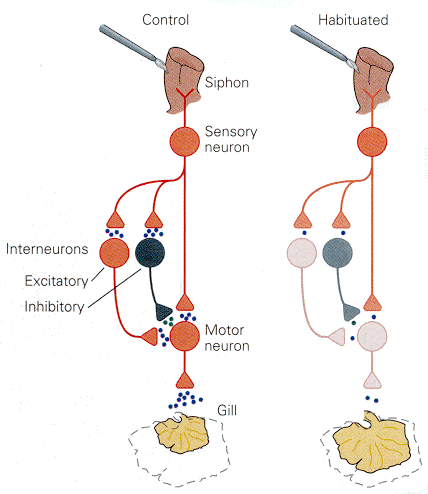
-
Doubting personal experienceNope. Not in my class. Are we talking university or primary school?
-
Doubting personal experienceWhy? Do you have a reason to think that there is no brain doing something inside your skull?
-
Doubting personal experienceDid I mention neurons?
But yes. If we were talking of mindfulness down at the level of simple creatures like sea slugs, then the habituation of neurons does become a relevant and unmystical framing of the discussion - https://en.m.wikipedia.org/wiki/Habituation -
Doubting personal experienceThe hand waving happens when science turns neurons into little humans. — Rich
What could that even mean? -
Doubting personal experienceSee what I mean by hand-wavy? You didn't mention the basal ganglia once. Instead you capitalised consciousness to show that all that messy neuroscience that fills hundreds of textbooks is stuff "you don't need to know". You can go right on talking confidently about this Consciousness as some mystic substance or plane of a creative being that all those dumb scientists have no freaking clue about.
-
Doubting personal experienceWell, yes, but you also have to acknowledge that there is a self-reinforcing tendency even amongst the intelligentsia. — Wayfarer
Sure. Scientists are human too. They have investments in belief systems. They have social boundaries to mark. They like fame and fortune as much as the next guy.
So what makes a difference is the institution of science. If that is strong, that is what shines through in the long run.
If psi exists and evidence for it is being suppressed, that would be bad news. But why shouldn't science as an institution suppress psuedo-science?
There was, or is, a group called PSICOPS (I think the name was changed) — Wayfarer
Yep. Committee for the Scientific Investigation of Claims of the Paranormal. Now called CSI - Committee for Skeptical Inquiry. http://www.csicop.org/
So we're dealing with a consensus model of reality, of the kinds of things that respectable scientists ought to study, and the kinds of things they ought not to. — Wayfarer
And what's wrong with a consensus view? Isn't that the whole bleeding point of rational inquiry into nature?
And when it comes to the careers of "respectable scientists", they don't have research careers unless they are at the fringe pushing for something new. The difference is that the existence of a consensus is what defines that fringe mostly. Scientists know where the next profitable place to dig is located.
So what we see 'scepticism' nowadays doing, is the exact opposite of what scepticism set out to do, namely, it nowadays defends the consensus reality of scientific realism, which determines the bounds of what reasonable people are supposed to think in the way religion used to do. And that is precisely the point where it morphs into scientism. — Wayfarer
So what you are describing is first the scientific mindset being born and now it being able to look back in satisfaction with all that it has achieved. Yah, boo, sucks to all the mystics out there.
Sure there is scientism - that excessive confidence in materialistic explanation. And yet it is within science that you find the best resources for also criticising that overly-reductionist viewpoint.
Sheldrake had zero impact on the state of consensus within theoretical biology. Yet holism and semiosis are alive and well in those same circles, building up their mathematical muscle. -
Doubting personal experienceHow are you defining habits exactly? Is that an actual theory with some mathematical structure or simply vague hand waving on your part?
(A Peircean definition for example does focus on triadic or hierarchical organisation - the maths of thermodynamic complexity. And it is a physicalist metaphysics in that it extends causation to formal and final cause by embracing the materiality of symbols, or sign relations. So the notion of universal habits means something specific in natural philosophy.) -
Doubting personal experienceAlthough my view is that from the perspective of philosophy, the question ought to be treated hypothetically - i.e. if there is such a form of causation, then it is something not acknowledged by current science. — Wayfarer
But to talk about causes, first you have to be able to demonstrate the reliable existence of an effect (so something more than coincidences, accidents, randomness, etc).
That hasn't been the case in parapsychology labs (or at least, only believing researchers are able to report significant results). And in the real world, casinos can set the odds on their slot machines with decimal precision.
Though I guess morphic resonance is the kind of non-theory that could explain the non-existence of negative casino profits. The psychic memory of failed gambling must hang over these places in a way that ensures a steady statistical level of loss on their games of chance. The casino owners think they win because of the mechanical design of their pokies and roulette wheels. But in fact it is this alternative psychic force.
You can see why science as an institution does roll its eyes when you have jokers that can't show there is some effect in want of a theory, then invent theories anyway that apply no matter how the world behaves. It might sound like science to the uninitiated, but it breaks the philosophy of science on at least those two basic counts. -
Concepts in classical physicsYou have to consider all three laws of dynamics as a system to see how the second law scales local symmetry breaking.
So the first law establishes energy conservation/symmetry at the local scale - the inertia of bodies. Then the third law does the same at the global scale - zeroing the baseline in terms of action and reaction so that all the causes of change are defined as being internal to the system. Then the second law describes the symmetry breakings which are the dynamical changes that can now be seen to take place against a generally unchanged, energy conserving, local~global backdrop.
The impulse becomes the cause of change. The momentum becomes the resistance to change. We get that useful distinction between kinetic and potential energy. We can track the conserved quantity of change being moved back and forth across this line on the presumption that as observers we are also fixed by a common frame of reference.
So the definition is not circular but embedded in a hierarchical relation. Change is being confined by the establishment of fixed coordinates both above and below. It takes three laws to describe a system.
(Which is why at the next level, you had to have classical physics bookended by quantum mechanics and relativity. One to fix the local grain of action. The other to make spacetime now fully closed for the conservation of action. That is, both QM and GR open up the conservation issue, but then give you the tools by which to define a closure that makes the Universe safe for a broadly classical description.) -
Doubting personal experiencef PSI were shown to be true, it would 'overturn the basic facts of physics and chemistry'. — Wayfarer
Not to mention the profitability of the casino industry. -
Doubting personal experienceSo do you believe Sheldrake's theory has been experimentally validated?
-
Doubting personal experienceI dunno. I in fact had a close interest in parapsychology research in the early 1990s as an example of science in real world action. Even did a ganzfeld psi test (as a sceptic, of course it didn't work for me - the "experimenter effect" I guess. :) ).
Same with research into meditation, OOBs, homeopathy and anything fringey. I talked with a lot of those researchers.
So I agree that scientism is alive and well and not willing to listen. But on the ground, there are a lot of believers who actually hold down research positions and who get to publish what the heck they like in journals or at conferences.
Frankly cranks abound in science. I've met a heap of them. And science - as a social institution - can afford to be pretty tolerant of "heresy" because it can trust in the overall rationality of its process. It is self-correcting in the long run and doesn't need to impose its authority on every idea.
Of course when it comes to public funding, attitudes tighten up. But really I never saw any general attempt at suppressing way out ideas so long as they were in some way "science" in being in at least some sense prospectively testable. -
Doubting personal experienceAnd, you see, the reference to 'folk metaphysics' really does put you more towards the reductionist end of the spectrum, I'm afraid; after all, it is the elminativists that speak of the mind in terms of 'folk psychology'. — Wayfarer
But I would be a weak eliminativist in that I am only arguing that there are models that are better or worse in the light of some purpose.
So folk models are those that may be actually good for what they are meant to do - produce a conformity of thought targeted at the creation of an enduring social system. While scientific models are meant to serve a different purpose - talk about the world at the level of abstract, globally invariant, "objective" formalisms.
So my epistemology recognises the part that purposes play in the production of models or paradigms. A basic "subjectivity" in this regard is built into the pragmatic position. Whereas you are talking as if this is a competition between rival objective truths. That is why - in attacking scientism the way you do - you come off as championing the alternative objectivity of the occult.
No, it's deeper than that. It's no coincidence that Dennett in addition to describing humans as 'moist robots', is also an evangalising atheist who sees himself locked in a battle of (rational) science vs (superstitious) religion. — Wayfarer
Or is he a blowhard that likes the thrill of public controversy and big publishing deals?
I find it hard to think he actually takes himself that seriously. He actually seems smarter than that. But also his ego shines through. So its his way of having fun.
And yes, it is also legitimate for rationality to be in a fight with religion. Immanent naturalism is up against transcendental discourses that want to leave the window open to creators, miracles, dualism and other kinds of supernatural goings-on. Naturalism's point of view is that it has gone around closing all those windows and so is creating a picture of nature which is self-organising or closed for causality. The idea of a unified Cosmos makes sense. So to now make a case for transcendent causes, you can't just talk about "the essential mystery of it all". To be playing the rational game, you have to come up with rather more concrete evidence of something that naturalism seems to have missed.
So it is not that there isn't a subject matter. However where I personally part ways with the reductionists is in taking a systems or holistic point of view. And that in turn brings me back towards some fairly "religious" sounding metaphysics.
It's complex. :) -
Doubting personal experienceThat's similar to my response to Apokrisis (the paragraph about 'where science is in the hierarchy of understanding), although perhaps not so clearly stated. — Wayfarer
Are life and mind any more "mysterious" than matter? The problem with the idea of 'mystery', is that it suggests something hidden, something occult, that might be somehow uncovered, rather than just the simple fact that matter, life and mind are thinkable in their temporal, finite senses, but as ultimate, absolute, infinite and/or eternal, cannot be fully grasped by a finite mind. — John
As John points out, there is a difference between expecting the mystery to be cleared up in some radically different way (revelation? poetry?) and accepting that science - as the refined form of rational inquiry - is a finite exercise. (Or even, as I always argue, pragmatically myopic in that it seeks control over reality much more than it seeks any "truth" of reality.)
Dennett, in particular, is desperate to 'de-mystify' the nature of mind and life - to say 'at last, science has unravelled the mystery'. You see, I think that is in some sense pathological - I think it's driven by the actual fear of the mysterious nature of life and mind. It is instructive that Dennett, Dawkins, and the like, are always obliged to deny or obfuscate the mysterious nature of life and mind. Robert Rosen, I suspect, would never do that. — Wayfarer
This was the bit where you had a go at scientific inquiry as refusing to acknowledge its epistemic limits when really, even these arch-reductionists would see themselves as being anti-occult explainers. So they don't pathologically fear "a mystery" - your suggestion of some personal foible. They quite sensibly oppose "unnecessary mystification" - and so express a communal standard that rationality seeks to apply to the scope of speculative hypothesis.
If it ain't testable, it ain't in the game. And that is a deliberate choice that arises from accepting practical limits to making models of the world.
Of course I then agree that Dennett, Dawkins, the usual candidates, play a part in the great dichotomising cultural war of Enlightenment monadic materialism against Romanticism's dualising transcendence. So outside of the formal boundaries of science, you have this other big show going on as a folk metaphysical battle.
But I like to keep the two things separate. -
What do you care about?To get outside of your faculties doesn't mean to be left with none; it means to have changed. And my claim is that this is perfectly commonplace. — The Great Whatever
I don't believe Kant would disagree that we get outside of our capacities in this sense that they are changed by something greater. — John
I think Kant can be credited with creating a ground zero for epistemology. Ultimately we can't know the noumenal in any direct fashion, we can merely suppose. But then for pragmatism, that's fine. We can build up quite reasonably from that.
So Kant leaves us in the position where our only certainty is of some change or development in our state of conception. And then we can either attribute this change to "the world", or the alternative would be strict solipsistic idealism. And that doesn't seem a hard choice given that believing in the world results in a greater predictable regularity of our state of conception. It minimises the change, the confusing flux, that we experience (as in for example the contrast between dreaming and being awake).
So we get down to ground zero - in the end, all our impressions of a world could be a big dream. Yet the way to minimise the flux or uncertainty of our impressions is to believe in the fact that there is the noumenal out there acting as a some external set of constraints.
We can't transcend our capacities or faculties to sneak a direct peek. But it is completely reasonable to think that if we have worked to minimise the flux of our impressions in any way possible - such as principally by believing in "a world" - then by definition, that puts us in the best position to notice further "facts" about the world. With our created backdrop of stability, we are now in a position also to recognise what is a surprise or some new change "out there".
I wouldn't go overboard defending Kant (as my position is essentially Peircean here), but it might rather flip perspective on his great "failure" over non-euclidean geometry. Could we have imagined bendy space without having already fixed an idea of flat space? It took the Newtonian certainty about the one to fully sensitise us to the other as a now measureable "objective" surprise. -
"The truth is always in the middle"?To say that the truth is always in the middle seems to be contradictory, doesnt it? — rickyk95
This is a tricky issue because it depends whether you are reasoning about the particular, or about the general.
When you are making claims about the particular, you can expect it to be the case that either something is true, or it is not. The thing in question is either present, or absent. Possible or impossible. It is a black and white bivalent choice with no grey.
But when you are making claims about the metaphysically general, you wind up with a dialectical argument or, formally, a dichotomy. You get two opposed extremes - both of which are "true" in being the limits of the conceivable. A dichotomy is that which is mutually exclusive and jointly exhaustive. So it is a system of thought for reducing vague possibility to two complementary alternatives - with the result that all actual possibilities will be found in the gray area in-between the book-ending extremes.
So we have all the classic categorical dichotomies that drive metaphysical level thinking. Is X discrete or continuous, substance or form, accident or necessity, plastic or static, determined or random, atom or void, etc.
We find that if anything is definitely the case, then it must fall within two bounding and apparently contradictory extremes of being. It might of course approach either bound with arbitrary closeness. Yet it still needs the "other" to secure its identity. You can only know you are close to one of the bounds because you know you are far from the other bound. So that leaves actual being always somewhere in "the middle" - the middle being the spectrum of all the states intermediate between to anchoring boundaries.
And this is why arguments play out the way they do. At first people are uncertain about the right answer, but they have some intuitions. They push the argument strongly in some direction, and that naturally exposes the dichotomous "other" that they are hoping to move away from and indeed leave completely behind. But then other folk can seize on the alternative and start to see its essential rightness.
The space of the possible get sharply dichotomised by a dialectical debate - and eventually it becomes obvious the sensible answer is "somewhere in the middle", the middle now being itself sharply defined in some measurable fashion as a result of the argument. An argument for black vs white results in 50 (or an unlimited number) of shades of grey.
You can actually make a still stronger argument than this.
Saying the truth is in the middle feels a little limp and compromisy. As if we are just happy with a gray muddle. But take an argument like whether intelligence is the product of nature or nurture. Or whether individuals should be free or constrained.
In the end, it feels dumb to say IQ is something like 60% genes and 40% upbringing, or whatever. You want to assign 100% value to them both. And this is because the sum of the two is more than the parts. It is like yes, both are completely true. Both of them contribute fully - and can do so because they are coming from complementary directions and are not treading on each other's toes. Their mixing "in the middle" is not subtractive - a dimming of each other's light. Instead it is multiplicative. By being sharply divided, they make any mixing a much more definite kind of mix.
It is like cooking. The best food combines strong and antagonistic flavours - salty and sweet, crunchy and smooth. You don't want to cook with bland muddled ingredients. It is contrast which produces rich complexity.
So the middle itself now needs to be understood as not just some bland state of greyness but itself a potential dichotomy. It's own "truth" could indeed be bland grey - a simplest possible outcome. Or it could be a zingy, zesty, complex mix of extreme contrasts.
But now we are clearly into territory that ordinary models of logic don't venture. As I say, most people's idea of logic goes no further that reasoning about particulars - the bivalent approach which wants to reduce a claim about a thing to the counterfactually definite options of true or false, yes or no. It is quite exotic even to suggest some kind of trivalent logic which uses the options of yes, no and maybe. Or 1, 0 and -1.
Then metaphysics is built on dialectical or dichotomistic reasoning. Yet for some reason, even this is not a widely understood fact.
Beyond that, I guess it is only over the past 40 years that people have really started to develop a mathematical-level appreciation of complexity - the rich mixture that characterises highly dichotomised middles. And here you would have to turn to hierarchy theory, and fractal or scalefree models of reality, if you want to see a proper "logic of middles".
Hierarchy theory is all about the middles that emerge between complementary bounds. It is a formal way of making the argument I outlined. It is the meta way of escaping the apparent circularity you identified in the OP. -
Doubting personal experienceBut you want to preserve the mystery because you believe in the mystical already. Your epistemic arguments are soaked in self-interest. You must reject naturalism in any form if it threatens to weaken your case for the supernatural.
That is why you constantly seek out the worst examples of scientism you can find. You need its blatant folly to spare your blushes.
But quite plainly the semiotic approach to epistemology takes the observer seriously. The whole point is that the "observables" of any theory are not objective facts but only "reasonable signs" that mediate a relation with "the world".
You have to keep forgetting that semiosis builds in the observer so you can keep strawmanning me as just another bloody materialist. It gets tiresome. -
Doubting personal experienceDennett's new book is basically a re-hashing of this idea. — Wayfarer
I discount Dennett as a serious voice. Frankly I find him all over the shop. Early on he was saying good things about intentionality and even the socially constructed nature of "self". But then he seemed to lose it with the popular success of Consciousness Explained. I couldn't extract a coherent position from that and haven't bothered reading his stuff since.
So whatever account is given of the neurological and evolutionary processes that apparently give rise to consciousness, also rely on judgements which are themselves imposed on those accounts. (I think that is the meaning of the 'transcendental nature of judgements'.) — Wayfarer
Yep. The semiotic view of life and mind says it is "judgments" all the way down. Nature is perfused in sign. Even the receptors studding a cell wall are making semantic interpretations in deciding what gets in.
Sure, there is something syntactical or mechanical about being a biological switch. But the switch is always acting with lived meaning. It matters to "someone" - the organism - what it does.
And that sure ain't the case with hardware and software ... unless there is a human just off to the side making sense of all its hurried electronic switching activity.
So when eliminativism says that the 'socially-constructed notions' have to be 'stripped away', then why should the neurological and so-called scientific accounts of consciousness have any more weight that what has been stripped away? Don't you think that is the essence of 'scientism' - that it privileges the scientific account of the nature of mind, over the first-person appraisal or insight into the nature of mind? — Wayfarer
But the whole notion of "first-person appraisal" is a linguist social construction. The first mistake about being a mind is to think we "just need to look to see what is really there".
As I say, even an animal might be phenomenal - there would be something it is like to be a bat - yet that is a still a biological construction. This is why pioneering semiologist Jacob Von Uexkull tried to imagine the 'Umwelt' of a bee - the world as it would appear as a pattern of signs serving a bee's purpose. See pix at http://www.massey.ac.nz/~alock/175316new/lecture_notes/lecture_16/lecture_16.html
So we see "red" or smell "sweet". But to think of those as "mental qualities in themselves" is a very particular way of parsing experience. It is a habit of thought that every philosophy of mind student sure learns to pick up as a social necessity. However psychological science would like to talk about how its not really an ecologically-valid construct.
Our awareness of red is always the awareness of something red. There is an embeddedness that gives the experience a meaning and purpose. It is then a philosophical version of scientism - let's call it idealism :0 - to suppress the always interpreted nature of experience and just try to talk about the uninterpreted "bare particulars".
Qualia talk gives unjustified realism to "sensory impressions" just as much as scientific materialism wants to talk too substantially about "the material world". It is all part of the strong causal dualism at the heart of Western thinking. And that is what Peircian semiotics in particular tries to get away from.
Why do you think that the elimination of mystery is a requirement? Humans are after all subject of experience, and you may never know what it is that makes another subject 'tick'. You can't write a specification for a person. I think the impulse or desire to scientifically explain the nature of the mind really is a form of scientism, whether you want to call it biosemiotic or whatever. — Wayfarer
Maybe I am just more curious than the average dude. I like to know how everything works.
But scientism is different in that it is a self-satisfied reductionism. You know that my semiotic approach talks only of minimising vagueness or uncertainty. So it builds in a notion of its own proper epistemic limitations. It accepts that it might in the end only be a sophisticated form of instrumentalism. And that more closely fits any philosophy of science definition of scientific inquiry.
Plus why should we think the mind is so beyond explanation given the vast number of things we now understand very well and are no longer a mystery? -
Doubting personal experienceI'm not following because eliminative materialism doesn't seek to say the mind doesn't exist. Rather the point is that folk psychology conceptions of it - conceptions we have to use to introspect - are quite clunky and culturally scripted.
So with freewill, society promotes the notion of a self that is in complete control, whereas science would say the "self" doesn't describe any particular functional unit, it is the name we give to the functional unity that can be observed over time. The self is an illusion in that sense.
Likewise having a conscience seems to be a big deal for some societies. But that is a very socially constructed thing as you can tell by cross culture comparisons.
So perhaps calling things illusions sounds too strong. We do construct actual habits and patterns of thought that answer to their folk psychology conceptions. If you push me on the existence of freewill, I will demonstrate it by lifting my hand without a problem when "I" decide.
But we also know from science that all phenomenology is a kind of illusion. Roses look red and smell sweet, yet the material reality is that there is some balance of reflected radiation and floating molecules whose bonding shape excites a particular interpretation in the nose.
So in a sense, eliminativism seems to want to talk about "real illusions". And the objection then is the degree this becomes a rather negative and paradoxical framing of the situation. It has a dismissive and scientistic ring - as if science can already explain things through its computational analogies in particular.
I of course say that computationalism - the mainstream paradigm - is itself just more folk psychology. The brain is not a machine like that. Which is why I instead take the neuro-semiotic view as the way to eliminate the general air of mystery. The idea of the mind as a modelling or sign relation is a more accurate theory in not seeking to reduce all reality just to material causes.
However as a general project, eliminativism makes sense. We have to strip away the socially constructed notions of what a mind should be to start to understand the mind from a more objectively and empirically founded point of view. -
Why the is-ought gap is not a big dealBut who believes in this fiction of either "the happy man" or "the unhappy man"? What's wrong with "the man with a normal emotional range".
-
Doubting personal experienceIn other words, if we deny the veracity of things like free will, or the Self, or the mind in general, etc by appealing to things like scientific data, we immediately end up pulling the sheet out from under us. — darthbarracuda
But this is only a problem if perception and conception are conflated.
You have an idea that you have freewill. But that is a folk psychology concept - a theory you use to account for the observable phenomenology, like when you suddenly decide to clap your hands together in demonstration.
Then science might offer a different conceptual framework. And that may in fact address the phenomenologically observable rather better by stressing how much we don't have to consciously plan for useful motor actions. Most of the detailed timing and execution can be (in fact must be) left to learnt subconscious habit.
So what you really have are competing explanations for your experience.
There is the familiar cultural script where we are all meant to be "observant selves", personally responsible for our impulse control and our individual actions. The fact that we are largely always acting through established habits is not treated as much of an excuse. Society operates on the principle that we are in ceaseless charge of our thoughts and actions.
Then there is the more neuroscientifically realistic account where "consciousness" is attentional priming of a state of mind - a setting up of expectancies. Then subconscious mechanisms pull it all together in a fluid and integrated fashion. The role of attention in the moment of action is not to will anything in self-conscious fashion. That is just an extra load on the mind sure to fuck things up. At best, attention is there at the last split instant as "free won't" - ready to put the brakes on if a motor response is coming out wrong for some wider reason.
So neuroscience gets under the covers of the motor act and can explain the phenomenology in much greater detail. If you try to attend to the exact moment you decided to push some experimenter's button, neuroscience says the first time "you" concretely knew about it was when a reafference message was broadcast across the brain in a fashion that would allow your self-caused motion to be subtracted from the resulting lurch in your general perceptual state. If you turn your head to look at something, you want to know that was you turning and not the world. And even then, only so you could in fact ignore the very fact that you acted and so actually continue to experience "a stable world" as you bumble about doing stuff.
So the neuroscience view explains in fact why you have such a sense of a stable world in which you can then freely act. Conception and perception are the complementary possibilities that arise by this neural trick of distancing "a self" and "a world".
If you wave a videorecorder about (as kids untrained in camera work do), then the resulting images are like a mad crazy collage that makes no sense. Yet that is what our eyes do all the time. But "we" don't notice because all the motion is cancelled out at a preconscious level.
And in the same way, we have this social fiction of being individual observers acting out of freewill or conscious voluntary control. And the fiction works because the brain really does learn to divide our impressions of the world in a way where there is just an "us" that has an intention, and a world that then co-operates with any wishes in fairly predictable fashion. The less we have to think about, the more in control we feel.
But that then creates this clash of theories when it comes to folk psychology vs neuroscience. The folk psychology - as pursued by Descartes for example - wants to argue for some actual dualistic split between a perceiving soul stuff and a perceived world. Consciousness can't be this neuroscientific account of benignly pragmatic neglect - a refusal to sweat the detail. No. Consciousness must be in charge the whole time, all the way through, start to end ... otherwise there is no self, only automaton!
But as I say, freewill, the self, the mind, consciousness, experience, whatever ... these are all social constructs - conceptions used to organise our understanding of who "we" are. And society doesn't need us to have a deep theory about that. The aim from society's point of view is only to inculate the general habit of being attentive to what we do and self-regulate in a socially productive fashion.
However once we start to philosophise about mind, that is when a folk psychology level of conception can really screw us over. We are chasing a social fiction essentially.
This is another advantage of Peirce as a philosopher of mind. He had students like Jastrow as well colleagues like James. He was right in the thick of early psychology where the role of habits in the "machinery" of consciousness was a hot topic. So his semiotics incorporates that basic insight. -
Humans are preventing natural Evolution.It is interesting that SETI, forensics, and certain other fields that are widely acknowledged to be properly scientific rely on the presupposition that the outcomes of intentional processes are objectively distinguishable from the byproducts of natural processes; yet the same principle is somehow ruled out of bounds in biology. — aletheist
I like Charlie Lineweaver's take on the issue....the counter to the argument that we will be able to detect aliens by their wasteful radiation.
Hawking also said that to understand the lights of Earth, you must know about life and minds. What are these lights that shine from planet Earth and what do they mean? I think those lights mean that someone left the lights on.
All of those lights are inadvertent waste. For the past 100 years the Earth has been wastefully beaming radio and TV signals into the universe, not because we wanted to share I Love Lucy with the universe, but because our broadcasting strategies were primitive.
This “shining of the Earth” that Stephen suggests is a sign that the universe has become aware, is maybe more correctly interpreted as a sign that something on Earth has become wasteful.
As we become more knowledgeable and efficient, signals that were once broadcast into space are squeezed into fibres. Earth will soon stop broadcasting its millions of mobile phone conversations. Routers and cell towers will migrate into the wall paper of every living room. The Earth will stop shining.
The conspicuous consumption of resources and the inadvertent beaming of info-waste into space will end.
Arthur C Clarke wrote that “any sufficiently advanced technology is indistinguishable from magic”, but I think Karl Schroeder’s modified version may be more relevant for SETI searches:
Any sufficiently advanced technology is indistinguishable from Nature […] either advanced alien civilizations don’t exist, or we can’t see them because they are indistinguishable from natural systems.
http://theconversation.com/what-is-the-search-for-extraterrestrial-intelligence-actually-looking-for-44977 -
Why the is-ought gap is not a big dealThe key word here is BALANCE. — schopenhauer1
True that.
I also do not consider the pain involved in exercise or learning something new a "harm" so you don't have to include that red herring, which you are prone to do. — schopenhauer1
Is that because the pain/effort of exercise/learning are somehow naturally part of a greater balance? So we can enjoy the short term signal pointing towards the long term gain?
It is hardly a red herring that in an ecologically valid setting - life as it is lived - your monotonic moan about "bad feelings" becomes exposed as childishly simplfied "philosophy".
Are you suggesting that I take some ethical stance that whatever someone believes is the right action must be the right action? — schopenhauer1
I realise that you are happy to derail another thread to promote your pessimism, but I thought the topic was ethics. So yes, getting back to the subject, I see a lot of loose talk about "good" and "bad". You want to reduce all analysis to how things make you feel. Yet clearly there is a reason for folk also taking a more hierarchical and abstracted "right and wrong" based view of ethics. The general good can outweigh the individual benefit in most folk's view.
But hey, you might be solipsistic enough to think paedophiles and crack addicts have a right to their phenomenological well-being.
Likewise, you might say that virtue and self-sacrifice are socially-imposed burdens/forms of self-delusion because your "feelings" are always paramount in the ethical sphere.
I mean this shows why pessimism is such a shallow subject once you've got the point. Yes, living involves always a measure of pain and struggle. And yes, existence probably does have no transcendent meaning.
But living is also fun and interesting. Nature is full of immanent meaning - human minds, being the products of nature, can't help but find meaning everywhere.
You can stay on the ride to see where it goes, or hop off the bus and get it all over. But sitting in your seat and moaning the whole trip seems the dumbest choice. -
Why the is-ought gap is not a big dealI don't know what letting "the perfect become the enemy of the good" could even mean. — John
It's a common saying - https://en.m.wikipedia.org/wiki/Perfect_is_the_enemy_of_good -
Why the is-ought gap is not a big dealWhat are you talking about? Are you denying that my phenomenological experience is in fact a balance of the positive and the negative?
Does personal, first-person experience with complex variety not occur for you?
Anyway, you were addressing my question about paedophiles and crack addicts. Do you think their "is" should be our "ought"? No matter how good they think something is, would you not wish to draw a moral line on behalf of society? -
Why the is-ought gap is not a big dealAccordingly, mind it is nowadays assumed that mind is a product of nature. I think the biosemiotic approach does offer an alternative to that - that is the direction it's heading. But I think, culturally, we're not there yet. There is another scientific revolution in the making, and I think biosemiosis is one element in that. — Wayfarer
It all boils down to the organisation of power. And power is organised through systems of signs. In nature, that is all mind is - the organising and directing of material flows in pursuit of purposes.
Religion and tradition used to control individual minds. Only social-level thoughts were thinkable. The duty of the individual was to police even their own feelings. Now that was power!
Then came the Enlightenment (the resumption of the Greek philosophical project). A new understanding of power - control over material flows - was created. It needed a new scientific language - a new level of semiosis. But the social stranglehold was broken. The abstractions of mechanism rapidly eroded the mental hold of the church.
But then the Enlightement led to Romanticism. The individual wanted a complete rupture and the right to claim authorship over their own symbols. Every person could - and thus should - craft their own private realm of semiosis. Interpretation of reality became solipsistic as a social right.
But as I say, this Nietzschean inversion was really about a pragmatic power grab - at least for those not too muddled in their thinking to appreciate the development of this new secular game. What more fun is there in the modern world than to be a priest of high culture?
Dress up in black, learn a few Nietzsche quotes, display your messed up tatts and your gender confusion as the stigmata of the blessed, get invited to the right openings, and you are good to go. Yep. It is all about organising power with systems of sign. -
Why the is-ought gap is not a big dealThat goes without saying. If you are promoting the idea that the only important knowledge is the knowledge that can be determinately modeled, then you are promoting scientism and you are devaluing the humanities, the arts and religion. — John
How many more times must I say that my semiotic approach is founded not on determinism but indeterminism. Constraints and freedoms co-arise in mutually synergistic fashion.
And note how in progressive society, art is on the rise, religion on the demise. There are a lot of things you don't want to talk about in creating your "unified front" against Scientism.
The church once controlled social iconography and acted pretty viciously against the pagan alternatives. Modern art can still create a slight frisson with its "Piss Christs". But generally - in the secular civil society that now dominates the power discourse - the battle has been long won. Transgressive freedom is the new norm - the social marker for being a member of the true elite. Look at me. I can shove outrage in your face. I win.
So "art and religion"? Hah. Whether it is telling me that your big daddy in the sky is going to come and get me, or yours is the exclusive back-slapping club to which I can't belong, it always comes back to the pragmatics of social power.
Of course a balance is desirable, but I don't believe the kind of balance you are extolling here can ever be precisely struck, and nor should it ever be attempted. — John
If a balance is desirable, then why shouldn't a balance be attempted? Why would you let the perfect become the enemy of the good? (Or is this one of those non-commonsense examples of religious/artistic wisdom that I was asking for.)
That would amount to social engineering. — John
You mean like ... politics?
apokrisis

Start FollowingSend a Message
- Other sites we like
- Social media
- Terms of Service
- Sign In
- Created with PlushForums
- © 2026 The Philosophy Forum