
-
Consciousness is a Precondition of BeingPhysicalists and such people reduce the difference between sentient individuals (e.g., humans) and non-sentient individuals (e.g., trees) to a difference in degree, rejecting the idea that they are different in kind. — Jamal
That is an oversimplification. It is an axiom of materialism that there is only one substance, in the philosophical sense, which is matter (nowadays matter-energy). It is assumed by many whether they consciously articulate it or not. Accordingly, there can be no ontological distinction between things and beings, as an ontological distinction would mean a different kind of being, which materialism can't allow. (For further elaboration I'll refer back to the article linked in this post.)
traditionally in philosophy, anything that can be said to be is a being. — Jamal
That is one I will need a citation for.
Notice in the Brittannica snippet you cited:
"For Aristotle, “being” is whatever is anything whatever. Whenever Aristotle explains the meaning of being, he does so by explaining the sense of the Greek verb to be. Being contains whatever items can be the subjects of true propositions containing the word is, whether…"
The reference here is not to *a* being, but to being. Is there a citation where Aristotle refers to anything inanimate as 'a being'?
The Brittanica article that contains the quote from Aristotle, https://www.britannica.com/topic/Being
is quite a good jumping-off point for the history of the idea in philosophy. -
Consciousness is a Precondition of Beingyou have said to people, for example, that inanimate things are not beings, in conversations about metaphysics, where "beings" standardly refers to anything which can be said to be. — Jamal
I will henceforth agree that anything that exists can be called an existent or an existing thing and that of anything that exists that it can be said to be. I'll add that as a caveat in all such discussions. Would that help? -
Consciousness is a Precondition of BeingDon't know about that. See this.
I've already agreed that being and existence are different concepts. — Jamal
That is only what I tried to argue in the first place!
What is your reason for telling [Aristotle] he is wrong? (As you have told people here many times) — Jamal
I don't think I've done that, anywhere. That snippet you provided about Aristotle claims that his books of the Metaphysics are 'among the most difficult' in the Western corpus, but then, the belief is now that all this is superseded, Aristotelian metaphysics is the preserve of churchmen and academics. It is in that context that I made the point about the difference between the classical and modern understanding of the question of the nature of being. The modern understanding is that this is largely a scientific matter, as some contributors here have already asserted.
I don't recall telling anyone that they're wrong, but I will continue to argue that eliding the distinction between beings and things results in treating humans (and other sentient beings) as objects, and that this is deeply embedded in our way of thinking. (So saying that trees are beings might be a step in the right direction, although it would have major ramifications for the forestry industry!) This is very much one of the themes in The Hidden Self. There is a lot of critical commentary on the 'objectification' of humans by science, which brackets out the fundamentally subjective dimension of existence. -
Consciousness is a Precondition of BeingI don't think I've been aggressive — Jamal
I agree. It's simply a robust exchange of views. And I acknowledge that my philosophical approach rubs a lot of people up the wrong way.
only sentient individuals are beings. — Jamal
What I said was that 'beings are subjects of experience'. That, of course, is not the only meaning of 'being' or 'to be', which is not and has never been at issue. You and I and the cat on the mat and the tree and the rock are all existents - we all exist. But the cat and you and I are also subjects of experience, and it's a difference that makes a difference.
The starting point of this whole debate was years ago, when I opined that the noun 'ontology' ought not to be understood simply as 'the classification of what exists'. That, I said, was properly the domain of the natural sciences, whereas ontology was originally conceived strictly as 'the meaning of "being"', while noting in passing that a source I had found (no longer extant) said that the etymology of the term 'ontology' was derived from the first-person participle of the verb 'to be' - which is 'I am'. I took that to mean that it refers to an exploration of the meaning of being, in terms different to those accepted by the natural sciences, which naturally pursues science along objective criteria. This is what provoked an (one could only say) hysterical denunciation from a former member here. I was then sent the Charles Kahn article The Greek Verb To Be and the Problem of Being, which, as I already showed, clearly demonstrates that 'ontology' as classically understood embraced a wider range of meanings than the modern notion of 'to exist'. And the fact that this is no longer understood by analytical philosophers is no credit to them, simply a reflection of the zeitgeist.
You could have correctly said 'the differentiation of existence and existents is also explicit in Heidegger". — Janus
Sure. I accept that. I've never claimed any expertise in Heidegger, but 180 brought it up. I know that he placed humans in a priviledged position regarding Dasein and I think he would differentiate sentient beings from things. (I'm reading up on What Is a Thing but I must admit hesitancy about Heidegger due to his nazism.) -
Consciousness is a Precondition of Being
-
Consciousness is a Precondition of BeingAs a naturalist I find that B is most consistent internally as well as with all that we know scientifically – publicly – about narure so far. — 180 Proof
Of course. But what I keep trying, and failing, to explain to you, is basically summarised by this point that I've already posted, from Jung, in the essay we're discussing:
What is more, most of the natural sciences try to represent the results of their investigations as though these had come into existence without man’s intervention, in such a way that the collaboration of the psyche – an indispensable factor – remains invisible. (An exception to this is modern physics, which recognizes that the observed is not independent of the observer.) So in this respect, too, science conveys a picture of the world from which a real human psyche appears to be excluded – the very antithesis of the “humanities.” — Carl Jung
Most naturalism falls into this trap - it thinks that 'the universe' would exist just as it is, were there no subject to experience it. But it doesn't see the way in which 'the subject' actually brings the Universe into being through providing the perspective within which the very ideas of 'existence' and 'non-existence' are meaningful in the first place. 'Materialism is the philosophy of the subject who forgets himself', said Schopenhauer. This is why I keep saying that the naturalist view depends on the framework of conscious experience within which it is formulated and which precedes it, but then it pretends that it is seeing reality as it is, as if it has entirely cut off the subjective, rather than just bracketing it out. This is 'the blind spot of science'.
RevealBehind the Blind Spot sits the belief that physical reality has absolute primacy in human knowledge, a view that can be called scientific materialism. In philosophical terms, it combines scientific objectivism (science tells us about the real, mind-independent world) and physicalism (science tells us that physical reality is all there is). Elementary particles, moments in time, genes, the brain – all these things are assumed to be fundamentally real. By contrast, experience, awareness and consciousness are taken to be secondary. The scientific task becomes about figuring out how to reduce them to something physical, such as the behaviour of neural networks, the architecture of computational systems, or some measure of information.
This framework faces two intractable problems. The first concerns scientific objectivism. We never encounter physical reality outside of our observations of it. Elementary particles, time, genes and the brain are manifest to us only through our measurements, models and manipulations. Their presence is always based on scientific investigations, which occur only in the field of our experience.
This doesn’t mean that scientific knowledge is arbitrary, or a mere projection of our own minds. On the contrary, some models and methods of investigation work much better than others, and we can test this. But these tests never give us nature as it is in itself, outside our ways of seeing and acting on things. Experience is just as fundamental to scientific knowledge as the physical reality it reveals.
The second problem concerns physicalism. According to the most reductive version of physicalism, science tells us that everything, including life, the mind and consciousness, can be reduced to the behaviour of the smallest material constituents. You’re nothing but your neurons, and your neurons are nothing but little bits of matter. Here, life and the mind are gone, and only lifeless matter exists.
To put it bluntly, the claim that there’s nothing but physical reality is either false or empty. If ‘physical reality’ means reality as physics describes it, then the assertion that only physical phenomena exist is false. Why? Because physical science – including biology and computational neuroscience – doesn’t include an account of consciousness. This is not to say that consciousness is something unnatural or supernatural. The point is that physical science doesn’t include an account of experience; but we know that experience exists, so the claim that the only things that exist are what physical science tells us is false. On the other hand, if ‘physical reality’ means reality according to some future and complete physics, then the claim that there is nothing else but physical reality is empty, because we have no idea what such a future physics will look like, especially in relation to consciousness. — The Blind Spot of Science
What is needed is a change of perspective, something like a gestalt shift, which is more than a matter of propositional knowledge.
Using "being" in reference to a sentient or conscious entity, e.g. human being, is perfectly reasonable in philosophy or everyday speech. — T Clark
Of course. That's what I've said. 'A being' is a subject of experience. The verb 'to be' has many other meanings, including 'whatever exists'. That is the sense in which Mikie and Jamal believe it should be used, but I'm saying it is not adequate to interpret the meaning of the word 'being' as is used in the quotation from Carl Jung. -
Consciousness is a Precondition of BeingAt the very least, would you accept the idea is completely foreign to Kant? — Paine
It's certainly not articulated by Kant, I would agree with that. But then, if you adapt the idea of the collective unconscious, it's not difficult to see, for example, mythologies as being an expression of it. -
Consciousness is a Precondition of BeingHow far removed would the conception of a collective unconscious be from Schopenhauer's conception of 'the Will'? I doesn't strike me as much of an incongruity.
-
Consciousness is a Precondition of Beingyour idiosyncratic usage of "being" — 180 Proof
I say that beings are subjects of experience, which is a simple fact. As for the various meanings of the verb 'to be', it's a different matter, but it's not relevant to the question implied in the OP. -
Consciousness is a Precondition of BeingThe main problem I see with this schema is that there is a strong tendency to describe the objective world in terms of what it would "look like" for a subjective observer that, contradictorily, lacks objective being. This is the "view from nowhere," "view from everywhere," or "God's eye view." — Count Timothy von Icarus
:up: This point is also made in The Hidden Self:
What is more, most of the natural sciences try to represent the results of their investigations as though these had come into existence without man’s intervention, in such a way that the collaboration of the psyche – an indispensable factor – remains invisible. (An exception to this is modern physics, which recognizes that the observed is not independent of the observer.) So in this respect, too, science conveys a picture of the world from which a real human psyche appears to be excluded – the very antithesis of the “humanities.” — Carl Jung
This is why a lot of what is paraded around by the media prophets of scientism as secular humanism is anything but humanistic. (It's also why books about 'quantum consciousness' have come into existence.)
The victory of Hegel over Kant dealt the gravest blow to reason and to the further development of the German and, ultimately, of the European mind, all the more dangerous as Hegel was a psychologist in disguise who projected great truths out of the subjective sphere into a cosmos he himself had created - Jung, On the Nature of the Psyche, 358 — "
I have read some articles suggesting that Kant and Schopenhauer anticipate Freud's discovery of the unconscious - which seems fairly obvious when you think about it. For Kant, much of what we think we know is determined by categorial structures that lie beneath the threshold of conscious awareness. For Schopenhauer, transcendence can be sought through art as a symbolic form of the Sublime. Whereas Hegel attempts to explain everything, to make it all explicit, but in so doing, 'projected great truths out of the subjective sphere into a cosmos he himself had created.' It seems a sound analysis to me.
The differentiation of Being and things is also explicit in Heidegger:
The formidable task that Heidegger sets himself in Being and Time is to respond to the question ‘What is Being’? This ‘Question of Being’ has a long heritage in the Western philosophical tradition, but for Heidegger, to merely ask what is Being? is problematic, as that emphasis tends to objectify Being as a ‘thing' – that is to say, it separates off ‘Being’ (whatever it is) from the questioner of Being. ” — Heidegger's Ways of Being
Bolds added. I see the effort to equate being with the simply existent as an attempt to short-circuit the whole question of 'the meaning of being'.
One motivation for suggesting that mind or consciousness precedes being is the view that it seems impossible that consciousness emerges from systems the components of which are severally non-conscious. However it seems to me there is a similar problem with putting consciousness as primary, namely his hard to see how extension, locality, differentiation and so on can emerge from consciousness alone — bert1
There is a theme in the perennial philosophies, 'nature knows herself in the human' - the 'human as microcosm' of the Hermetics, the 'primordial human' of the Rg Veda. I think this is much nearer Jung's point. The various creation mythologies can then be read as a symbolic representation of the emergence of intentionality ('breathes life into clay'). The mistake of materialism is to assume that this is consequential rather than causal. -
Consciousness is a Precondition of BeingIn other words, Kahn is not supporting you on the specific issue of the use of "being". — Jamal
How so? I had argued that the meaning of being as understood in ontology (derived from the Greek 'to be') is different to our usage of the verb 'to exist', and that is what Kahn says. (Although if rocks could talk, maybe they'd say something different.)
And again, anything that exists can be said to be, but that does not exhaust the meaning of being.
Over and definitely out :wink: -
Consciousness is a Precondition of BeingYou might also recall the many heated arguments I got into with a former mod over this topic. He sent me a copy of an apparently classic academic paper on it, The Greek Verb to Be and the Problem of Being, Charles Kahn. He never acknowledged it, but this paper supports my argument that the Greek verb 'to be' has a far greater range of meanings than our verb 'to exist', for example:
These remarks are intended to render plausible my claim that, for the philosophical usage of the verb, the most fundamental value of 'einai' when used alone
(without predicates) is not 'to exist' but 'to be so' or 'to be the case'....
.... This intrinsically stable and lasting character of Being in Greek - which makes it so appropriate as the object of knowing and the correlative of truth - distinguishes it in a radical way from our modern notion of existence...The connotations of enduring stability which are inseparable from the meaning of 'einai' thus serve to distinguish the Greek concept of being from certain features of our modern notion of existence. — Charles Kahn -
Consciousness is a Precondition of BeingWell, sure, but it's well known that one of the bases of Aristotle's metaphysics was precisely the elaboration of the different meanings of the verb 'to be'. And that Franz Brentano's doctoral thesis was on the different meanings of 'to be' in Aristotle, which was a seminal influence on Heidegger who devoted his philosophical career to 'the meaning of being' and 'forgetfulness of being'.
I'm only claiming that beings are subjects of experience, whereas things are not. I don't even know how this is contestable or why there's an argument about it. Even the chatbots get it.
Q: What is the difference between things and beings?
A: Things refer to inanimate objects, physical entities, or concepts that lack life or consciousness. They can include tangible objects such as rocks, buildings, and machines, as well as intangible concepts such as ideas, theories, and laws.
On the other hand, beings refer to living entities, whether they are animals, humans, or other organisms, that possess consciousness and the ability to think, feel, and act. Beings can experience emotions, make choices, and interact with the world around them.
In summary, the main difference between things and beings is that things are inanimate and lack life and consciousness, while beings are living entities that possess consciousness and the ability to think, feel, and act. — ChatGPT -
Consciousness is a Precondition of Beingthat’s how it’s always been used in philosophy. — Jamal
Can you point to a specific example? -
Consciousness is a Precondition of BeingOr are you saying that only consciousnesses are, whereas inanimate objects merely exist? I doubt you want to go down that route. I think you probably agree that inanimate things are, even though this is plainly, linguistically, in contradiction to your wish to restrict being to animate individuals. — Jamal
I think it's a fair analysis. It's not that I find it annoying, but I'm at a loss that the distinction accorded to beings as distinct from things seems to me Ontology 101, and conversely, the denial of that distinction seems Materialism 101, as to me, treating humans (and sentient beings generally) as objects is one of the symptoms of the dehumanising effects of materialism (as Jung might also say).
'To be' has various meanings - it can mean 'anything that is' or 'anything that has existence'. But in this case, and considering the context of the quote, I was referring to what is designated as 'a being'. That is a different case of the use of the word 'being' to the general sense of 'anything that exists'. When we talk of 'a being' as a noun then we're designating the subject of that sentence as 'a being'. And of course, beings and things both exist, but that is not the point at issue.
And no, I don't think that inanimate objects are individuals - unless you're including artefacts, which are, of course, manufactured by individuals. I suppose you could refer to an individual tree, or mountain, or river, but I don't know what special significance that has. I don't think you would refer to trees, mountains or rivers as beings, would you? Perhaps if you held to some form of folk religion you might.
But then, also consider the origin of the original post. The preceding sentence is
Without consciousness there would, practically speaking, be no world, for the world exists as such only in so far as it is consciously reflected and consciously expressed by a psyche. Consciousness is a precondition of being. — Carl Jung
So in this sense 'being' does have a meaning which is not conveyed by 'the sum of everything that exists', as Jung is more or less arguing for an idealist philosophy. (Furthermore, I think this is deeply connected to why humans are called 'beings'.) I've read quite a bit of that text in the intervening hours, and he has a bit more to say on it, but overall it's about the dangers to individuation posed by mass culture and mass political and religious movements - rather similar in tone to Erich Fromm's 'Escape from Freedom' which must have been published around the same time. -
Consciousness is a Precondition of BeingThe OP plainly doesn't want to go down this road so I'll leave it at that.
-
Consciousness is a Precondition of BeingTo provide a bit more context, here is the sentence you quote with the preceding sentence:
Without consciousness there would, practically speaking, be no world, for the world exists as such only in so far as it is consciously reflected and consciously expressed by a psyche. Consciousness is a precondition of being. — Jung
(Emphasis in original). I don't know if he's expressing a 'standard metaphysical view'. -
Reality, Appearance, and the Soccer Game Metaphor (non-locality and quantum entanglement)It's worth noting that the OP refers to one part of one video, which is part of a series of video presentations comprising an entire course on 'analytic idealism', which can be accessed freely here. To get a fair idea of what Kastrup is talking about, it's probably better to be aware of the context, rather than 'kicking the ball around' on the basis of a brief excerpt.
-
Consciousness is a Precondition of BeingI guess I don't see the difference between "beings" and "things”. — T Clark
Beings have the capacity for experience - often the adjective 'sentient' is also added. Inanimate objects do not. In fact it suggests what I think is a pretty succinct definition for consciousness, i.e. 'the capacity for experience'.
I think making the distinction between beings and things is part of a different discussion — T Clark
Customarily, the subject matter of ontology, which is suggested by the thread title. -
The role of observers in MWIVery clever experiments but I did notice
As to how the day-to-day reality of objects that we observe, such as furniture and fruit, emerges from such a different and exotic quantum world, that remains a mystery. — Macro-Weirdness: Quantum Microphone Puts Naked-Eye Object in 2 Places at Once
Until I get there I do not know. She resides in that mystical state of superposition, being both there and not there. But I have calculated the probability and it has come out .7 in favor of her standing there and .3 her not. — jgill
It's not a valid analogy, though. The strangeness of the observer problem in physics is that the act of observation itself is instrumental in determination of the outcome. The proper analogy would be that, prior to you seeing your wife, she didn't exist in any specific location at all, she's not simply in an unknown location.
The answer to the question as to where the particle is, prior to measuring its whereabouts, just IS the probability equation, it has no particular existence but only the probability of existence. That's the point. -
The role of observers in MWIThat shouldn't suggest an "extraspatiotemporal" limbo world where tree potentialities exist and evolve until they are actualized as trees in our "spatiotemporal" world. — Andrew M
As I thought had been established, the interference pattern in the double-slit experiments is independent of time and space (shown by its rate independence), thus indicating an extraspatiotemporal cause. It might be the same principle as an acorn becoming an oak, but on a far more pervasive and subtle level of existence. Put another way, the possibility equation really does describe 'degrees of reality' which are not actualised until a measurement is made. Hence the 'nothing exists until it is measured', of Neils Bohr. -
Consciousness is a Precondition of BeingI think I might have introduced a red herring, but I was objecting to:
We may want to include the idea that existence and being point to the same concept — Joshs
by trying to point out a philosophical distinction between 'being' and 'existence'.
But, getting back to the OP, on reflection, I agree with what Jung is trying to say. Elsewhere in the title he says 'without consciousness there would, practically speaking, be no world, for the world exists for us only insofar as it is consciously reflected by a psyche' - a point I have been arguing for in another thread.
I think that The Undiscovered Self is a Jung essay I must get hold of. From the Introduction:
The plight of our civilization, accurately diagnosed by Jung in Modern Man in Search of a Soul, is here presented as a specifically individual struggle for moral and spiritual integrity against the ‘mass psychology’ generated by political fanaticism, scientific materialism and technological triumphalism on a global scale. Ultimately, this is a religious as much as a psychological problem, which is not solved by passive adoption of some established creed, but by opening oneself up to the ‘religious instinctive attitude’ and inner symbolic vitality possessed by each and everyone of us by virtue of our humanity. One of Jung’s most profound, yet accessible, texts. — The Undiscovered Self
:pray:
What is more, most of the natural sciences try to represent the results of their investigations as though these had come into existence without man’s intervention, in such a way that the collaboration of the psyche – an indispensable factor – remains invisible. (An exception to this is modern physics, which recognizes that the observed is not independent of the observer.) So in this respect, too, science conveys a picture of the world from which a real human psyche appears to be excluded – the very antithesis of the “humanities.” — Carl Jung
:100: :clap: -
Aristotle's MetaphysicsIsn't there always a presumed link between virtue and ethical behaviour throughout the Platonic-Aristotelian corpus?
The same man [cannot] have practical wisdom and be incontinent; for it has been shown that a man is at the same time practically wise, and good in respect of character. Further, a man has practical wisdom not by knowing only but by being able to act; but the incontinent man is unable to act - there is, however, nothing to prevent a clever man from being incontinent; this is why it is sometimes actually thought that some people have practical wisdom but are incontinent, viz. because cleverness and practical wisdom differ in the way we have described in our first discussions, and are near together in respect of their reasoning, but differ in respect of their purpose - nor yet is the incontinent man like the man who knows and is contemplating a truth, but like the man who is asleep or drunk. — Nichomachean Ethics
Put another way, practical wisdom is manifested in virtuous action, not simply in verbal description. The old saw, 'actions speak louder than words'. (Incidentally, I am presuming the reference to 'incontinence' is actually to celibacy or lack thereof.) -
Consciousness is a Precondition of BeingYes - Lantana is a South American climbing vine that forms large patches sprawling over hundreds of square meters displacing native species and is extremely resistant to weedicides, nowadays endemic to large parts of Australia.
More to the point, CS Peirce differentiated existence and reality. He said that existence is a binary property that can be ascribed to any concept or entity, depending on whether or not it satisfies certain logical criteria. For example, we might say that unicorns do not exist, because they fail to meet certain logical criteria for existence, such as being observable or verifiable in some way.
On the other hand, Peirce argued that reality is a far more complex and multifaceted concept that encompasses both the logical properties of existence as well as the broader metaphysical properties of being. Reality includes not only the things that exist, but also their relations, connections, and interactions with one another, and such things as probablities and possibilities. There is, for example, a real realm of possibility, but none of its inventory actually exists. But there are other things outside the realm of possibility.
Finally there are things like numbers, logical principles, scientific laws, and the like. In what sense do they exist? They can only be grasped by a rational intellect, but they're nevertheless real. So that's another kind of distinction that could be made. -
Consciousness is a Precondition of Beingwhich doubtless will carry this thread through quite a few more pages without benefit. — Banno
Yes! Another omnibus consciousness thread. They're like lantana. -
Consciousness is a Precondition of BeingA non-conscious being is not actually 'a being' but an object or a thing
— Wayfarer
So while sleeping or comatose, a person is just a "thing", and not a "being", like a sofa or toilet? — 180 Proof
It would be prudent to avoid that presumption.
Does it count that I once dreamt I was a toilet? — Joshs
I hope you awoke flush with happiness. -
Consciousness is a Precondition of BeingEver wonder about why humans are, in fact, designated as 'beings'? What significance does that term have? And to what category does the word 'being' apply? I would think, apart from human beings, that there would be agreement that some of the higher animals - apes, elephants, whales, dogs - might be considered 'beings'. Obviously the religious believe in spiritual beings - whether deities or celestial bodhisattvas in Buddhism, for example - but it's not essential to the point.
So - is not consciousness invariably associated with beings? Isn't consciousness a fundamental attribute of beings, generally? (as jgill suggests) A non-conscious being is not actually 'a being' but an object or a thing. So consciousness is intrinsic to being, isn't it? I'm tempted to say that to be, is to be conscious. -
The role of observers in MWIThanks for taking the time to look. I had the idea that the wave function literally is ‘the degrees of probability’. The reason that seems daft to many people is that there is no concept of ‘degrees of reality’ - usually it is assumed that nothing can be more or less real. But that is the point of this article.
This new ontological picture requires that we expand our concept of ‘what is real’ to include an extraspatiotemporal domain of quantum possibility,” write Ruth Kastner, Stuart Kauffman and Michael Epperson.
Considering potential things to be real is not exactly a new idea, as it was a central aspect of the philosophy of Aristotle, 24 centuries ago. An acorn has the potential to become a tree; a tree has the potential to become a wooden table. Even applying this idea to quantum physics isn’t new. Werner Heisenberg, the quantum pioneer famous for his uncertainty principle, considered his quantum math to describe potential outcomes of measurements of which one would become the actual result. The quantum concept of a “probability wave,” describing the likelihood of different possible outcomes of a measurement, was a quantitative version of Aristotle’s potential, Heisenberg wrote in his well-known 1958 book Physics and Philosophy. “It introduced something standing in the middle between the idea of an event and the actual event, a strange kind of physical reality just in the middle between possibility and reality.” -
The Hard Problem of Consciousness & the Fundamental AbstractionSure, picked that up too, and often paired with metaphysics.
-
The Hard Problem of Consciousness & the Fundamental AbstractionProbably I did mean that. What I was trying to differentiate was the philosophical sense of ontology as distinct from its modern conception of ‘study of what there is’ (not to mention its use in information technology). I thought that in its modern form, it simply becomes absorbed into the natural sciences thereby loosing its original meaning.
-
External world: skepticism, non-skeptical realism, or idealism? PollI just think the attempt to frame that mystery in terms of mind or matter, or any of our categories of understanding, or their absence, is a fool's errand — Janus
Whereas I see it in terms of the quest. (Take a look at the poem currently pinned to my profile page.)
Might be easier to explain them to dinosaurs, although I’m finding it tough going. ;-)So now we need Kant and Quantum and relativistics and Husserl to explain dinosaurs. — Banno -
External world: skepticism, non-skeptical realism, or idealism? PollSo, the above doesn't answer the question as to how there could be time prior to humans if time is observer-dependent and there were no suitable observers back then? We can't even say there was a "back then" because that presupposes time. — Janus
I know! That's the point! The objection to idealism will frequently be raised 'how can you claim that "mind creates world" when we know the world is far more ancient than the emergence of h. sapiens?' Which from a realist point of view is a slam dunk.
So I'm appealing to the Kantian distinction which enables him to say that he is an empirical realist - yes, this is empirically the case - but also a transcendental idealist - nevertheless, it is still in some sense mind-dependent - but not in a simplistic or obvious way. As Bryan Magee notes in his Schopenhauer's Philosophy:
This, incidentally, illustrates a difficulty in the way of understanding which transcendental idealism has permanently to contend with: the assumptions of 'the inborn realism which arises from the original disposition of the intellect' enter unawares into the way in which the statements of transcendental idealism are understood, so that these statements appear faulty in ways in which, properly understood, they are not. Such realistic assumptions so pervade our normal use of concepts that the claims of transcendental idealism disclose their own non-absurdity only after difficult consideration, whereas criticisms of them at first appear cogent which on examination are seen to rest on confusion. We have to raise almost impossibly deep levels of presupposition in our own thinking and imagination to the level of self-consciousness before we are able to achieve a critical awareness of all our realistic assumptions, and thus achieve an understanding of transcendental idealism which is untainted by them. This, of course, is one of the explanations for the almost unfathomably deep counter-intuitiveness of transcendental idealism, and also for the general notion of 'depth' with which people associate Kantian and post-Kantian philosophy. Something akin to it is the reason for much of the prolonged, self-disciplined meditation involved in a number of Eastern religious practices. — Bryan Magee
And the reason I mention Andrei Linde is because I think he articulates a version of 'the observer problem'. The observer problem raises questions about the role of the observer in determining the reality of the quantum world. And I think the 'Kantian' resolution to the problem is the most elegant. -
The Hard Problem of Consciousness & the Fundamental AbstractionWhich "etymological dictionary" are you referring to? — Paine
There used to be an explicit statement that 'ontology' was derived from the first-person participle of 'to be' (i.e. 'I am') on one of the online dictionaries, but it's gone now.
Isn't Kahn's point that existence is not an adequate translation of einia because to "step out" is to step out from something? — Fooloso4
I'm trying to grasp the distinctions that appear in pre-modern philosophy between existence, being, and reality. The verb 'to exist' is derived from 'ex-' (apart from, e.g. exile, external) and '-ist', 'to stand' or 'to be'. So to exist is to be separate, to be this as distinct from that.
I think it is generally assumed in the modern lexicon that 'existence' and 'being' are practically synonyms, that there's no significant distinction between them, but that in pre-modern thought it is a distinction that was recognised. See for instance from the Internet Encyclopedia of Philosophy:
Degrees of Reality
In contrast to contemporary philosophers, most 17th century philosophers held that reality comes in degrees—that some things that exist are more or less real than other things that exist. At least part of what dictates a being’s reality, according to these philosophers, is the extent to which its existence is dependent on other things: the less dependent a thing is on other things for its existence, the more real it is. Given that there are only substances and modes, and that modes depend on substances for their existence, it follows that substances are the most real constituents of reality.
God Exists and is a Substance
Furthermore, each of the philosophers we will discuss maintains (and offer arguments on behalf of the claim) that God exists, and that God’s existence is absolutely independent. It is not surprising then, given the above, that each of these philosophers holds that God is a substance par excellence. — 17th C Theories of Substance
But even that is misleading in saying that they believed that God exists. God is transcendent, and 'existence' is what He is transcendent in respect of - beyond the vicissitudes of coming-to-be and passing-away.
I think, generally, in ancient Greek philosophy, there was scepticism that we know 'what truly is' by sense-perception. That is the subject of the 'knowledge of the equal' in the Phaedo. -
The Hard Problem of Consciousness & the Fundamental AbstractionHow would your respond to the suggestion that to return to Aristotle from the vantage of the 21st century is to filter his ideas through the entire lineage of Western philosophy that came after him and transformed his concepts? The implication is that for someone who has assimilated the insights of Descartes and those philosophers who followed and critiques him, to prefer Aristotle over Descartes is to re-interpret Aristotle from a post-Cartesian perspective — Joshs
My knowledge of Aristotle is slight but I've been impressed by the way that Aristotelian-Thomist philosophy preserves metaphysics. Accordingly, I don't agree with the wholesale rejection of classical metaphysics that pervades modern philosophy, although I agree it has to be constantly re-interpreted. It's not a matter of return to any kind of golden age.
That is also the origin of my interest in the nature of the reality of intelligible objects and Platonism in mathematics. My intuition about it - and it is only that - is that there was in pre-modern philosophy a conception of there being greater or lesser degrees of reality, whereas the empirical tendency in modern philosophy understands reality solely in terms of what can be determined to exist by science (within which something is either existent or not). In doing so, it looses contact with the category of 'the unconditioned'.
Like Macbeth, Western man made an evil decision, which has become the efficient and final cause of other evil decisions. Have we forgotten our encounter with the witches on the heath? It occurred in the late fourteenth century, and what the witches said to the protagonist of this drama was that man could realize himself more fully if he would only abandon his belief in the existence of transcendentals. The powers of darkness were working subtly, as always, and they couched this proposition in the seemingly innocent form of an attack upon universals. The defeat of logical realism in the great medieval debate was the crucial event in the history of Western culture; from this flowed those acts which issue now in modern decadence. — Ideas have Consequences, Weaver
I don't think Descartes plays a significant role in the work being done in cognitive science, but he does play a role in historical accounts. — Fooloso4
You misunderstand. What I'm saying is that Descartes' conception of 'res cogitans' as a literal 'thinking thing' - 'res' means thing or object - is the source of the self-contradictory notion of the 'thinking substance' and of Ryle's depiction of it as 'the ghost in the machine'. Whereas the scholastic depiction of reason, based on elements of Aristotle, was much more subtle. In the Aristotelian scheme, nous is the basic understanding or awareness that allows human beings to think rationally. For Aristotle, this was distinct from the processing of sensory perception, including the use of imagination and memory, which other animals can do. For him then, discussion of nous is connected to discussion of how the human mind sets definitions in a consistent and communicable way, and whether people must be born with some innate potential to understand the same universal categories in the same logical ways. This is predicated on realism concerning universals, which is nowadays generally rejected (hence 'modern decadence'.) -
The Hard Problem of Consciousness & the Fundamental AbstractionNow a few more words about @Dfpolis' essay. I generally agree with his diagnosis of the malady of the 'post-Cartesian conceptual space'. I don't exactly agree with the specifics of his critique of it, but that this problem exists, and that its consequences are pernicious, I generally agree with. In my analysis, it basically stems from Descartes' designation of mind or consciousness as 'res cogitans' which means 'thinking thing' ('res' being Latin for 'thing or object')*. This leads to the disastrously oxymoronic conception of 'a thinking substance' which is the single biggest contributor to modern physicalist philosophy. So this, I entirely agree with:
Similarly, metaphysical naturalists project nature onto an a priori model defined over a restricted conceptual space. With historical myopia, they tend to see dualism as the sole alternative to physicalism. — DfPolis
:100: :clap:
I also agree with the gist of the 'fundamental abstraction', although again, I differ somewhat in my analysis of it. I trace the 'fundamental abstraction' to early modern science - a consequence of Cartesian dualism, and equally, the division of the world into primary and secondary qualities or attributes, with the primary qualities being the objects of physics and the secondary being assigned to 'mind' and thereby subjectivised and relativised**. I agree that Aristotle's hylomorphic model is vastly superior to the Cartesian, and also note that Aristotelian metaphysics is enjoying a comeback in the biological sciences.
There are other points that I agree with, and disagree with, but that will have to do for now.
-----
* I also have the sense that, had Descartes lived longer, or had had better successors, he could have answered many of the critics of his philosophy and elaborated it in the face of many of the objections. I have respect for Descartes' genius and his seminal contributions to the establishment of modern culture.
** Leading to the 'Cartesian Anxiety': "Cartesian anxiety refers to the notion that, since René Descartes posited his influential form of body-mind dualism, Western civilization has suffered from a longing for ontological certainty, or feeling that scientific methods, and especially the study of the world as a thing separate from ourselves, should be able to lead us to a firm and unchanging knowledge of ourselves and the world around us. The term is named after Descartes because of his well-known emphasis on "mind" as different from "body", "self" as different from "other".
Richard J. Bernstein coined the term in his 1983 book Beyond Objectivism and Relativism: Science, Hermeneutics, and Praxis. -
The Hard Problem of Consciousness & the Fundamental AbstractionKahn's essay mentions Aristotle in a few places. I've gone back and looked at the passages I highlighted. My original contention is that there is a distinction to be made between 'being' and 'existence' that is not generally made in the modern philosophical lexicon. Naturalism presumes that what exists, and what is, are co-extensive or coterminious. Whereas, I argued, the original meaning of ontology was not simply an exhaustive catalogue of everything that exists, but is nearer to 'the meaning of being'. In support of this, I quoted an etymological dictionary which pointed out that the term 'ontology' is derived from the first-person participle of the verb 'to be' - which is, of course, 'I am'. (This is the point which the ex-moderator used to hysterically denounce.) Note also the resonance with the Biblical definition of God, viz, 'I am that I am'.
One passage which I refer to in support of my contention is:
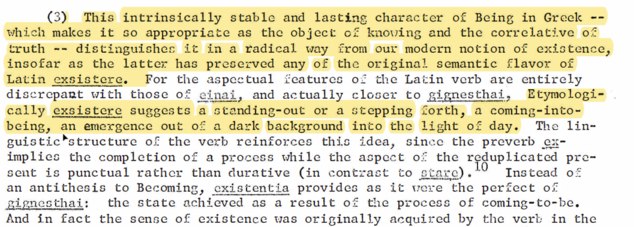
This makes almost exactly the point I am seeing to make: that 'what exists' is only ever an aspect or facet of 'what is', which has to be grasped through the 'unitive vision' which I believe the fragmentary poem of Parmenides is testimony to. Of course, this is grounded in my interpretation of the mystical basis of Parmenides vision of 'to be' - Parmenides and the other early Greek sages are much nearer in spirit to the Buddhist and Hindu sages than modern philosophers generally (cf. Peter Kingsley, Thomas McEvilly). Of course, there is always a resistance on this forum to such ideas on the basis of their affinity to religion, this being a resolutely secular (not to say misotheist) ensemble of individuals (which incidentally I respectfully differ with on the whole).
In any case, 'knowing' in this sense is much nearer to a form of gnosticism - not in the sense specific to the gnostic sects, but in the sense that the kind of knowledge or insight being sought was itself transformative and not simply propositional or formulaic. -
The role of observers in MWII'd be interested if you could see what I was driving at in this OP on Physics forum particularly #11 and #14. I was trying to argue that the probability wave is outside of space and time, although (probably predictably) the physicist who responded thought this 'gobbledegook' and preferred the (I think inane) dogma that 'particles interfere with themselves'. I don't know enough physics to really articulate the intuition I have about it.
Wayfarer

Start FollowingSend a Message
- Other sites we like
- Social media
- Terms of Service
- Sign In
- Created with PlushForums
- © 2026 The Philosophy Forum