
-
Nice little roundup of the state of consciousness studiesUnanswereable questions, I think, although useful grist for the mill for sci-fi stories. (Did you by any chance see Devs?)
So is the argument that consciousness is off-limits because it's first-person, or that one of the things psychology needs to account for is that it is first-person? — Srap Tasmaner
David Chalmer's doesn't say that consciousness is off-limits. He says it is intractable from the third-person perspective, due to its first-person character. He has written extensively on that, e.g. his book 'Conscious Mind: in search of a fundamental theory'. This whole debate between Dennett and Chalmers practically kicked off the modern 'consciousness studies' field, with their conferences in Arizona, featuring a cast of colorful characters and some truly mind-bending ideas.
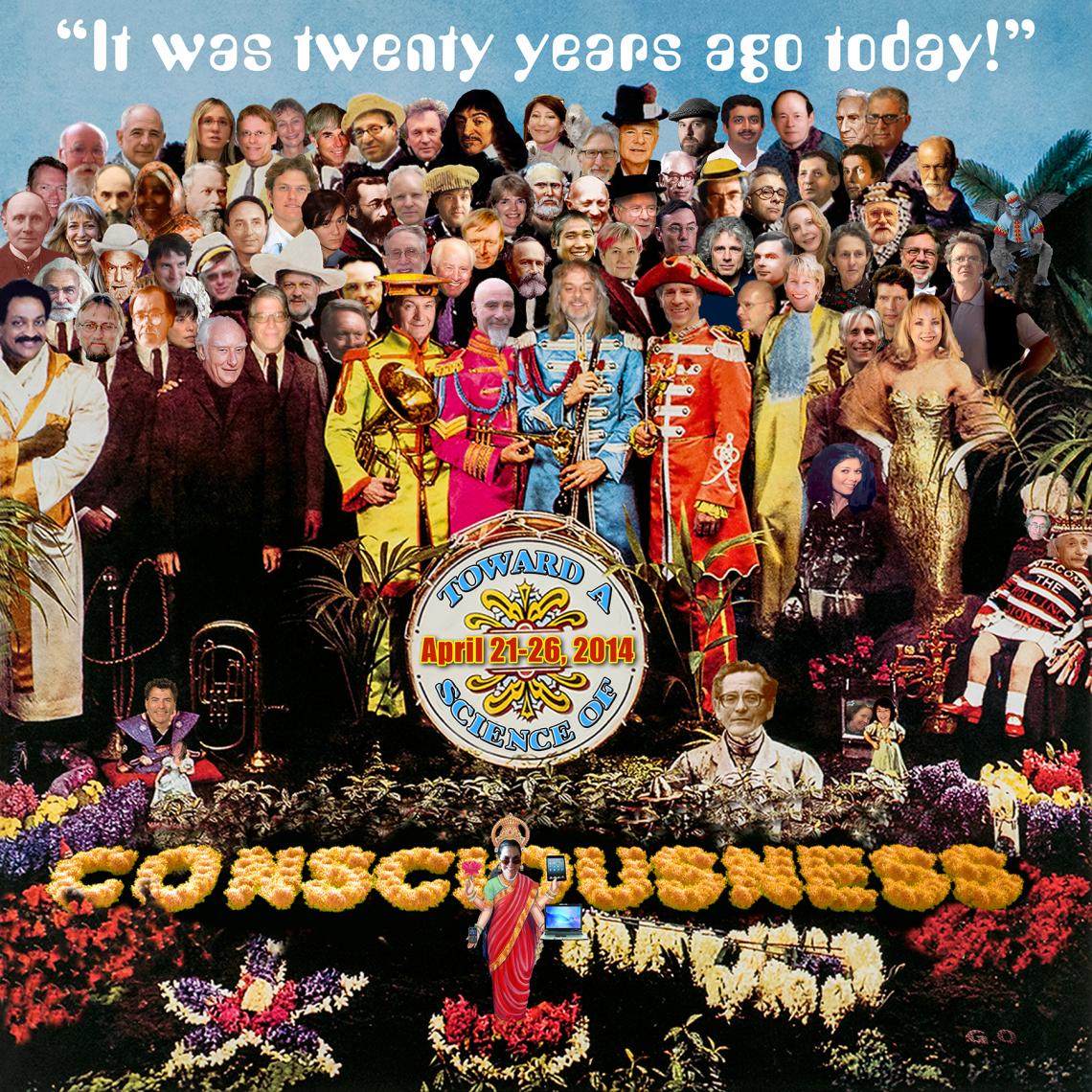
I think the more interesting approach is the phenomenological/hermeneutic/existential approach in continental philosophy. Also the intersection of phenomenology and Buddhist philosophy of mind in the embodied cognition approach (e.g. The Embodied Mind, Varela Thompson et al.) -
Nice little roundup of the state of consciousness studiesI think you're aware of this discussion in exactly the same sense that I'm aware of this discussion. — Srap Tasmaner
But that takes for granted that you and I are both subjects of experience, so that you can safely assume that I will understand what you mean. And for the purposes of describing or acounting for objective phenomena, the fact that we're both subjects can be ignored. But in the philosophical question of the nature of consciousness, insofar as that is a first-person experience, it can't be ignored, nor can be accounted for in those terms.
As John Searle put it:
in his book, Consciousness Explained, Dennett denies the existence of consciousness. He continues to use the word, but he means something different by it. For him, it refers only to third-person phenomena, not to the first-person conscious feelings and experiences we all have. For Dennett there is no difference between us humans and complex zombies who lack any inner feelings, because we are all just complex zombies. ...I regard his view as self-refuting because it denies the existence of the data which a theory of consciousness is supposed to explain...Here is the paradox of this exchange: I am a conscious reviewer consciously answering the objections of an author who gives every indication of being consciously and puzzlingly angry. I do this for a readership that I assume is conscious. How then can I take seriously his claim that consciousness does not really exist?
Does ChatGPT have a first person perspective? — RogueAI
No, ChatGPT does not have a first-person perspective. It is an artificial intelligence language model that generates text based on patterns it has learned from a large dataset. It does not possess personal experiences or consciousness. Instead, it provides responses based on the information it has been trained on. Its purpose is to assist users in generating human-like text based on the prompts and questions it receives. — ChatGPT
ChatGPT knows something that Dennett doesn't. -
Nice little roundup of the state of consciousness studiesBut if you define a phenomenon so that its first-person-ness is part of the phenomenon, we're in "Hand me the book on the shelf" territory. — Srap Tasmaner
Right - that is the issue. The key paragraph in David Chalmer's original paper was:
The really hard problem of consciousness is the problem of experience. When we think and perceive, there is a whir of information-processing, but there is also a subjective aspect. As Nagel (1974) has put it, there is something it is like to be a conscious organism. This subjective aspect is experience. When we see, for example, we experience visual sensations: the felt quality of redness, the experience of dark and light, the quality of depth in a visual field. Other experiences go along with perception in different modalities: the sound of a clarinet, the smell of mothballs. Then there are bodily sensations, from pains to orgasms; mental images that are conjured up internally; the felt quality of emotion, and the experience of a stream of conscious thought. What unites all of these states is that there is something it is like to be in them. All of them are states of experience. — David Chalmers, Facing Up to the Problem of Consciousness
Compare Chalmer's antagonist, Daniel Dennett, who claims:
In Consciousness Explained, I described a method, heterophenomenology, which was explicitly designed to be 'the neutral path leading from objective physical science and its insistence on the third-person point of view, to a method of phenomenological description that can (in principle) do justice to the most private and ineffable subjective experiences, while never abandoning the methodological principles of science. — Daniel Dennett, The Fantasy of First-Person Science
I agree with Chalmers, on the grounds that objective physical sciences exclude the first person as a matter of principle. Many other scholars and academics, including John Searle and Thomas Nagel, agree that Dennett's attempt to account for the first person perspective in objective terms, is conceptually flawed from the outset. Hence the satirical depiction of Dennett's book by Searle et al as 'Consciousness Ignored'. -
Nice little roundup of the state of consciousness studiesENOUGH SNARK ALREADY. I deleted the last post as it was blatantly abusive. Unless there are more constructive contributions to be made this thread will be locked.
suddenly you all seem to be reading papers on biosemiosis — apokrisis
This is mainly because of your contributions to the forum so as to provide some background to the subject for those lacking it, to better understand what you are talking about, which goes over the heads of many contributors here. -
Welcome to The Philosophy Forum - an introduction threadWelcome Leontiskos. I too am interested in the Platonist tradition and Christian philosophy. I'm inclined towards idealism with an interest in the classical traditions of philosophy. By the way, don't overlook the Help articles which provide useful tips and pointers to use of the Forum software.
-
Nice little roundup of the state of consciousness studiesBarbieri wanted to be the big cheese — apokrisis
I don’t have a professional interest in the subject, but I’ve found a couple of his articles useful, and the subject is generally interesting. Glad it’s something I’ve learned about. -
Kant's Notions of Space and TimeAs I see it, you are trying to do justice to the entanglement of subject and substance. — plaque flag
I was hoping it was pretty well in line with the OP. Even including Linde. -
Kant's Notions of Space and Timetalking about a world without an embodied cultural subject is also a mere abstraction (a useful fiction.) — plaque flag
You're getting closer to what I understand the issue to be. What I think the issue to be is the apparently commonsense notion that the world exists just as it is, without any observer.
Remember that the passage from Schop that you reacted against was an argument against materialism. He is arguing against the mind-independent reality of the objects of perception. That mind-independence of objects is sine qua non for scientific realism (SEP: 'Metaphysically, realism is committed to the mind-independent existence of the world investigated by the sciences.') The common-sense view is that the world exists, just so, even if nobody is around to observe it. After all, it is common knowledge that h. sapiens has only been around for the metaphorical wink of an eye whilst the Universe is 13-odd bilion years old. But what the realist doesn't appreciate it is that for the word 'to exist' to be meaningful, the subject of the proposition 'it exists' has to be distinguished or singled out - that is part of the meaning of 'exist' ('ex' - outside of, apart from, -ist', to be or to stand.) So the idea of the world with no h. sapiens in it, whilst an empirically valid observation, overlooks the role of the subject in any meaningful notion of 'what exists'. It interprets an heuristic - an interpretive stance regarding mind-independence - as a metaphysical truth, which it is not. The truth is that the mind actually 'brings the world into being' in some fundamental sense - not that things literally go into and pass out of existence depending on the observer.
So it's actually not legitimate to suppose that the world exists in the absence of any observer - there's always an implicit perspective in that supposition, and without that perspective, there is not even an abstraction. This has become apparent even in science (and I've quoted the following umpteen times):
The problem of including the observer in our description of physical reality arises most insistently when it comes to the subject of quantum cosmology - the application of quantum mechanics to the universe as a whole - because, by definition, 'the universe' must include any observers. Andrei Linde has given a deep reason for why observers enter into quantum cosmology in a fundamental way. It has to do with the nature of time. The passage of time is not absolute; it always involves a change of one physical system relative to another, for example, how many times the hands of the clock go around relative to the rotation of the Earth. When it comes to the Universe as a whole, time looses its meaning, for there is nothing else relative to which the universe may be said to change. This 'vanishing' of time for the entire universe becomes very explicit in quantum cosmology, where the time variable simply drops out of the quantum description. It may readily be restored by considering the Universe to be separated into two subsystems: an observer with a clock, and the rest of the Universe. So the observer plays an absolutely crucial role in this respect. Linde expresses it graphically: 'thus we see that without introducing an observer, we have a dead universe, which does not evolve in time', and, 'we are together, the Universe and us. The moment you say the Universe exists without any observers, I cannot make any sense out of that. I cannot imagine a consistent theory of everything that ignores consciousness...in the absence of observers, our universe is dead'. — Paul Davies, The Goldilocks Enigma: Why is the Universe Just Right for Life, p 271
There's a great youtube video of Linde discussing 'the role of consciousness' with Robert Lawrence Kuhn on Closer to Truth. He's a serious figure in modern cosmollogy, although I'm sure many scientists look askance at this idea of his, as he himself acknowledges in this rather amusing interview. -
What is the Nature of Intuition? How reliable is it?Oh yeah sorry at first I posted the wrong link.
-
What is the Nature of Intuition? How reliable is it?Can you post an excerpt of what in particular you see as pertinent? — wonderer1
It's the book Plato at the Googleplex, Rebecca Goldstein. It's a reflection on the role of Plato both historically and culturally up until the present (hence the title!) It combines analysis of some of Plato's teachings with reflections on what relevance they have for the present day, including rather whimsical imaginary modern dialogues where Plato encounters computers (a google chromebook in particular) among other things. Of course Goldstein is not starry-eyed, she recognises Plato as the beginning, not the end, of philosophy, and the significance of all that has been discovered since. I see it as relevant, because I think it dispells the idea that, because Plato lived 2,500 years ago, his ideas are archaic or superseded. Of course in some ways they are, but some of them are of perennial interest.
For instance there's also a good Goldstein piece on Kurt Gödel on Mathematical Truth. She says
Gödel was a mathematical realist, a Platonist. He believed that what makes mathematics true is that it's descriptive—not of empirical reality, of course, but of an abstract reality. Mathematical intuition is something analogous to a kind of sense perception. In his essay "What Is Cantor's Continuum Hypothesis?", Gödel wrote that we're not seeing things that just happen to be true, we're seeing things that must be true. The world of abstract entities is a necessary world—that's why we can deduce our descriptions of it through pure reason.
As I mentioned to @Srap Tasmaner, I find platonic realism interesting - the fact that there are real abstractions. They're not just 'in the mind' but also //not// 'out there somewhere'. That, I find extremely interesting.
But it is the entire nature of intuition that it extends if not transcends the current limits of what can be discursively extracted from the context. — Pantagruel
Kant differentiation between 'transcendent' and 'transcendental' - 'transcendent' refers to objects or beings that lie beyond the realm of possible experience or knowledge, cannot be known through sensory experience or empirical investigation. Examples include God, the soul, and the ultimate nature of the universe. Kant says that attempting to understand or make claims about transcendent beings is beyond the scope of reason.
'Transcendental' refers to the conditions and knowledge - what must be the case for knowledge to be possible. Transcendental inquiry seeks to examine the necessary structures and principles that make knowledge and experience possible. Kant believed that our minds possess a priori cognitive faculties that shape and structure our experience of the world including space, time, and the categories of understanding (e.g., causality, substance, and quantity), which provide the necessary framework for us to perceive, understand, and make sense of experience.
It's a distinction worth reflecting on, because the latter is more in keeping with naturalism, but also illustrates the sense in which what we know exceeds the bounds (=transcends) what we can empirically validate. -
What is the Nature of Intuition? How reliable is it?Sometimes philosophy looks a bit like ancestor worship. — wonderer1
You might find this title of interest. -
Kant's Notions of Space and Timewe largely construct our knowledge of the world. — plaque flag
That was what I thought you were taking issue with. -
Nice little roundup of the state of consciousness studiesThat is quite a well-researched article. If you look at the footnotes, Dennett is really the outlier, there's hardly any one of the others mentioned who agrees with him. But I say that Dennett performs a useful function, because his writing puts all the cards on the table, so that if you criticize Dennett as representative of materialist theory of mind, you can't be accussed of a straw man argument - he really does say this stuff.
The article you mention is by Marcello Barbieri - in my reading of biosemiotics, solely due to Apokrisis (to give credit where it's due) I've learned that Barbieri resigned as editor of the journal Biosemiotics, because he felt that it had become too philosophical and influenced by Peirce. He has initiated what he considers a new approach which he calls 'code biology', that, he says, is more concentrated on the science, less on the philosophy (I think Apokrisis would probably disagree but I'll leave that to him). There's a useful intro to his approach here What is information? (different from your own use of the term). He also wrote a history of the subject that I found useful - like, who's who in the zoo. -
Nice little roundup of the state of consciousness studiesThat's because Western culture demolished any sober way of thinking about it, mainly due to the authoritarianism of ecclesiastical religion. Don't loose sight of the fact that to express wrong views on the subject would get you a death sentence for many centuries of Christian history. Then Descartes tried to thread the needle with his simplistic depiction of mind and matter as separate substances, and the whole question became deeply confused. But the times, they are a changin'.
-
Kant's Notions of Space and TimeThe truth is you see there is no truth. Or maybe there really isn't such a thing as the truth of the matter. Sounds profound and openminded but it's silly upon examination. — plaque flag
Of course I accept that there is a truth, but I conceive of it in Buddhist terms - to apprehend it requires going beyond the ego oriented worldview that we are naturally disposed to. Hence the convergence I mentioned between Kant, Schopenhauer and Buddhism (subject of an appendix in Magee's book on Schopenhauer).
Are you familiar with Kant's expression of his 'Copernican revolution in philosophy'? (Here's a crib.) -
Nice little roundup of the state of consciousness studiesConsciousness was already explained years ago.
https://en.wikipedia.org/wiki/Consciousness_Explained — RogueAI
:lol: From the article:
Critics of Dennett's approach argue that Dennett fails to engage with the problem of consciousness by equivocating subjective experience with behaviour or cognition. In his 1996 book The Conscious Mind, philosopher David Chalmers argues that Dennett's position is "a denial" of consciousness, and jokingly wonders if Dennett is a philosophical zombie. Critics believe that the book's title is misleading as it fails to actually explain consciousness. Detractors have provided the alternative titles of Consciousness Ignored and Consciousness Explained Away. According to Galen Strawson, the book violates the Trades Description Act and Dennett should be prosecuted.
But none of it matters to Dennett and his readers. They are so motivated by the fear of spooky woo stuff that they'd prefer to accept it. -
Kant's Notions of Space and Timeillusions and delusions depend upon an actual world.... — plaque flag
...the nature of which is the point at issue. -
What is the Nature of Intuition? How reliable is it?Well, I'm flattered to have posted something which provoked such a coherent and lucid response.
There is a broad sense in which you seem to believe there is a world of concrete particularity, accessible to the senses, and a world of abstract generality, accessible to reason. — Srap Tasmaner
That is Platonism 101, isn't it? The 'argument from equals' is one among many of the arguments for the Forms. I've never really gotten across all of the material, which is voluminous and subject to millenia of commentary. But I sense a deep issue which I've been exploring throughout my engagement with philosophy forums.
Very briefly I see the whole issue as being bound up with the nature of the reality of intelligible objects -
what kind of existence they have. Consider for example the nature of number and of universals. When I first signed up to forums I had the intuitive view that numbers are real but not material, i.e. they are the same for all, but can only be grasped by a rational mind. * My reasoning was simply that numbers, unlike sense objects, are not composed of parts, and do not come into and go out of existence. It seemed obvious to me that they possessed a kind of higher truth, but I learned that it is mainly rejected nowadays because it is at odds with empiricism - that what is real is grounded in, and must always refer back to, sensory experience. See the essay, What is Math, Smithsonian Institute:
“I believe that the only way to make sense of mathematics is to believe that there are objective mathematical facts, and that they are discovered by mathematicians,” says James Robert Brown, a (Platonist) philosopher of science recently retired from the University of Toronto. ...
Platonism, as mathematician Brian Davies has put it, “has more in common with mystical religions than it does with modern science.” The fear is that if mathematicians give Plato an inch, he’ll take a mile. If the truth of mathematical statements can be confirmed just by thinking about them, then why not ethical problems, or even religious questions? Why bother with empiricism at all?
Speaks volumes, as far as I'm concerned.
This issue goes back to medieval times and the debate between scholastic realism and nominalism. Nominalism won the day, and 'history was written by the victors.' Nowadays our culture is so steeped in nominalism and empiricism that we literally can't understand realism (in the traditional sense. The modern outpost of scholastic realism is of course neo-thomism).
It seems to us we see the entire environment before us, like a high-definition movie on a screen, our visual field. This is false. There is no such rendering of our environment present anywhere in our brains, and could not be. The truth is that we move our eyes frequently, much more than we are aware of, and we see a section of about a degree or two of our visual field clearly each time; the complete visual field is patched together without our awareness, giving the impression of a seamless whole. — Srap Tasmaner
But the impression is the reality! We experience ourselves and the environment as a unified whole - that is almost as undeniable as cogito ergo sum. This a specific subject in philosophy, namely the subjective unity of perception. That was subject to commentary by Kant, but it's also an aspect of the hard problem of consciousness. See Jerome Feldman, The Subjective Unity of Perception.
-----
* I found an excellent early essay, Frege on Knowing the Third Realm, Tyler Burge. -
Kant's Notions of Space and TimeKant himself invokes the sense organs. — plaque flag
Of course eyes are objects, but it is not as objects that they are significant. The significant factor is sense perception and its interpretation. Plainly we are subject to illusions, for instance optical illusions. More subtly, we are subject to delusion - misinterpreting what the senses tell us - and even more subtle errors, such as errors of judgement. -
Kant's Notions of Space and TimeEyes, olfactory bulbs, the machinery of the ear -- in situ ( 'in the original position') are not objects of the world ? — plaque flag
No, they're not. Your eyes are organs of sight, but your eyes are not what you look at, unless you have some cause to do so. Yes, you can see the eyes of others, and in some metaphorical sense see 'with the eyes of others' (like 'standing in another's shoes'), but they're not objects, unless you're wanting to examine the eye or other sense organs objectively.
the sense organs are treated as both illusions and the source of illusions — plaque flag
What is that an objection to? Who is treating the sense organs as illusions? -
Kant's Notions of Space and TimeYou’re both right. There is a priori knowledge derived from extant experience, but in Kant, the stipulation is made that when he talks of a priori knowledge, he means absent any and all experience. — Mww
Only one of us said that :-) -
Kant's Notions of Space and TimeI don't mean anything fancy by spatial reasoning. I mean the most barbarically obvious common sense of brains being inside skulls, connected to the spinal cord. — plaque flag
Here, though, ‘the brain’ could easily have been replaced with ‘the mind’ which is not so amenable to that kind of description.
Sense organs in situ are not objects in the world, unless you’re studying them as an optometrist, for example. They are fundamentally elements of experience - they’re referred to in Buddhism as ‘sense-gates’. They’re provide the perceptions which are constitutive of experience and perception.
It says something about us humans that we so easily tell ourselves such confused stories. — plaque flag
What ‘confused story’ are you referring to? Kant’s Critique of Pure Reason? -
The Biden "bribery scandal"The ‘star witness’ that James Comer was counting on to dish the dirt on Biden has instead been made subject of an arrest warrant for various acts of international skullduggery including trying to sell Iranian oil to Chinese business interests as well as dodgy arms deals.
A dual U.S.-Israeli citizen who has accused President Joe Biden and his son, Hunter, of corruption has been charged by federal prosecutors in New York with failing to register as a foreign agent while working to advance the interests of China.
Gal Luft, 57, has also been charged with violating U.S. sanctions on Iran. He remains a fugitive.
https://abcnews.go.com/US/biden-critic-gal-luft-charged-failing-register-foreign/story?id=101093820 -
Nice little roundup of the state of consciousness studiesAnd folk like Robert Ulanowicz were openly Catholic and god-fearing, but also shrugged their shoulders and said science is science. — apokrisis
He still wrote a book on Making Room for Creation which seems open to divine agency. From which:
For 300 years, the reigning consensus in the West has been that nature is monist and functions according to a single metaphysics. Furthermore, it has been assumed (and still is by most) that continued research will demonstrate that the same laws and metaphysics will eventually fully describe matters in the chasm that living systems inhabit. To doubt that belief is to exhibit what Haught (2000) calls ‘metaphysical impatience.'
Fair amount of that on display in this thread.
What did nature insert to get evolution going? — apokrisis
I'm saying that organisms are the appearance of intentional agency, even if in rudimentary form. That they are able to act for reasons other than those dictated by physical law. Robert Ulanowiczw seems to support that view:
Accepting process ecology as a legitimate way to describe natural systems would provide significant philosophical and theological opportunities. Starting with the question of free will—it becomes a given in a narrative that posits indeterminacy as an axiomatic attribute of nature. The burden of proof would shift to the determinists, who would then need to demonstrate how neuronal firings make their way through some five hierarchical layers of mind, each with its compliment of indeterminacy, to determine higher-level thought and choice.
Not when you are immediately collapsing the Peircean triadic relation back to the good old dyadic one of Descartes. — apokrisis
There's a cardinal difference between what I mean and Cartesian dualism. I'm not invoking a model of there being material and mental substances. I say that the subject of experience cannot be understood as a 'thinking substance' or objectified in the way that Cartesian dualism suggests. Organisms act for reasons that are not solely determined by lower-level laws. The two perspectives implied are the third-person perspective - which is descriptive - and the first-person perspective - which is 'what it is like to be', or put more simply, being.
The Hard Problem of how mind and matter can interact causally is solved by that. — apokrisis
So do you reckon if you'd been the other party in that wager with David Chalmers you'd have won the bet? -
Buddha's Nirvana, Plato's Forms, Schopenhauer's QuietudeDon't assume I don't know these things and also make me out to be a boogie-man. — schopenhauer1
Not trying to. Sorry if I did. Amended post accordingly. -
Kant's Notions of Space and TimeAccording to Kant, a priori knowledge refers to knowledge that is independent of experience, meaning it is derived from reason and logic alone. This type of knowledge is not derived from sensory perception or empirical observations. A priori knowledge is considered to be universal and necessary, applying to all possible instances.
a posteriori knowledge, also known as empirical knowledge, is acquired through experience and observation of the external world. It is contingent on particular sensory perceptions and is derived from specific instances or examples.
Kant argued that both a priori and a posteriori knowledge are necessary for a comprehensive understanding of the world. He believed that while a posteriori knowledge provides us with factual information about the empirical world, a priori knowledge enables us to have synthetic judgments, which go beyond mere analysis of concepts and provide us with genuine knowledge of the world. -
What is the Nature of Intuition? How reliable is it?All of which require rational ability, don’t they? I have no doubt you could train animals to recognise difference and similarity in objects through rewards, but I doubt you could train them to understand the concept. That requires the ability to abstract, which I’m reasonably confident is part of the rational-linguistic capacity of h. Sapiens.
The reason I mentioned the argument from equals, was in relation to the earlier question of the nature of mathematical intuition and the ability to grasp abstractions. The argument from equals is one of the canonical arguments for universals. I just think it is a fairly simple and direct way of pointing that out. -
What is the Nature of Intuition? How reliable is it?I think you have it exactly backwards. — Janus
You mean, Socrates, or 'the argument from reason', has it backwards. (I am quoting him.)
We don't need to have a prior idea of perfect equality in order to notice that there are always differences, however minor they might be, between actual things. — Janus
But you do need to have the ability to grasp what 'exactly equals' means. -
Kant's Notions of Space and TimeAs far as I can make out, the vision at the base of this reasoning is of a brain, locked in the cave of the skull, constructing the world from inputs to the sense organs and concepts. But this is of course (at least) spatial reasoning. Where could ideas of the brain and its sense organs come from in the first place if not from their untrustworthy 'mere appearance' in (merely apparent) space and time? — plaque flag
I think there's an error in your reasoning here. Recognising that the brain synthesises sensory inputs with pre-existing knowledge is not 'spatial reasoning', but comes from direct analysis of how cognitive processes and reason operate together. That analysis doesn't comprise, for instance, literally looking at how areas of the brain react to various types of stimuli, as neuroscience does, which would clearly take place in the objective domain.
A priori knowledge - things that are known by reason alone - doesn't arise from experience, as a matter of definition for Kant. (I understand that Quine and other current philosophers have called this into question but I'll leave that aside for now.) Instead, that faculty is required for us to make sense of experiences, to understand the relations between the different data of experience, and to sequence them as existing in time and space. The mind (or the brain) does all of this, as is nowadays well-attested in cognitive science. The key point is, contra empiricist philosophy, the mind is not a passive recipient, a tabula rasa, receiving impressions from the pre-existing world, but an active agent who synthesises impressions with existing knowledge to generate a unified world-picture (this is the topic of the 'subjective unity of experience').
'There is a no world' is a presented as a fact about the world. — plaque flag
That is not what Kant is saying. Distinguishing between the world as it appears to us, and the world as it is in itself, doesn't say that the former is merely illusory or non-existent or dream-like. It's simply a statement about an inherent limitation of what we know as embodied rational creatures. Kant recognises that you can be at once an empirical realist and a transcendental idealist.
The two key paragraphs are these:
I understand by the transcendental idealism of all appearances the doctrine that they are all together to be regarded as mere representations and not things in themselves, and accordingly that space and time are only sensible forms of our intuition, but not determinations given for themselves or conditions of objects as things in themselves. To this idealism is opposed transcendental realism, which regards space and time as something given in themselves (independent of our sensiblity). The transcendental realist therefore represents outer appearances (if their reality is conceded) as things in themselves, which would exist independently of us and our sensibility and thus would also be outside us according to pure concepts of the understanding. (CPR, A369)
Having carefully distinguished between transcendental idealism and transcendental realism, Kant then goes on to introduce the concept of empirical realism:
The transcendental idealist, on the contrary, can be an empirical realist, hence, as he is called, a dualist, i.e., he can concede the existence of matter without going beyond mere self-consciousness and assuming something more than the certainty of representations in me, hence the cogito ergo sum. For because he allows this matter and even its inner possibility to be valid only for appearance– which, separated from our sensibility, is nothing – matter for him is only a species of representations (intuition), which are called external, not as if they related to objects that are external in themselves but because they relate perceptions to space, where all things are external to one another, but that space itself is in us. (A370) -
What is the Nature of Intuition? How reliable is it?To paraphrase Bertrand Russell, we model the world mathematically not because we know so much about it, but because we know so little.
— Wayfarer
That's very nice, but there's a lot more to say. We only can know a little because of the creatures we are. Bandwidth is small and reality is big. — Srap Tasmaner
I think you're downplaying the faculty of reason here. 'Bandwidth', obviously a technological analogy, refers to the rate at which information can be transferred. But that may not have much to do with the question of why 'the unreasonable effectiveness of mathematics'.
One passage from Plato's dialogues that I have recently re-discovered is the 'argument from equals' in the Phaedo. To paraphrase: At 74b, Socrates asks, "do not equal stones and sticks sometimes, while remaining the same, appear to one person to be equal and to another to be unequal"? The point being that sticks of equal length appear both equal and unequal, i.e., they appear to be and to not be equal.
Sticks that appear to be equal and unequal are imperfectly equal. However, the recognition of the sticks as imperfectly equal requires knowledge of perfect equality - otherwise, in virtue of what are they being recognized as imperfect? "Whenever someone, on seeing something, realizes that that which he now sees wants to be like some other reality but falls short and cannot be like that other since it is inferior, do we agree that the one who thinks this must have prior knowledge of that to which he says it is like, but deficiently so?" (74d)
This knowledge must be acquired before the recognition of the sticks as imperfectly equal, i.e., before sense perception; therefore, acquired before birth.
It is traditionally said from this and numerous other passages that Socrates (and Plato) hold that this faculty is acquired before birth, in line with belief in the pre-existence of the soul. In today's terms, however, I don't think it would be too outlandish to say that the faculty is innate. But even that is controversial: the empiricist dogma of 'tabula rasa' still has a very strong hold on naturalism. (This is why, I think, there is such controversy about platonism in mathematics.) The empiricist account will generally be 'well, we see many things that are equal or near equal, so we acquire the idea of equality from experience'. But the rationalist rejoiner might be that, were we not able to perceive the abstract 'equals' by reason, then no amount of experience will convey that insight. Furthermore that this is simply one example of the innummerable kinds of cases where we are able to derive conclusions based on foundational notions of 'equals', 'not equals' 'same as', 'different to', foundational to logic and mathematics. -
Nice little roundup of the state of consciousness studiesYour explanation makes more sense to me than the "epistemic cut" notion. — Gnomon
The epistemic cut is simply that between knower and known, organism and environment and symbol v what is symbolised. It was coined by Howard Pattee, who has been influential in biosemiotics. Seems to me an interesting philosophical question would be, ‘does it introduce a duality’? However, the paper answers:
The Physics of Symbols: Bridging the Epistemic Cut :
This epistemic irreducibility does not imply any ontological dualism. It arises whenever a distinction must be made between a subject and an object, or in semiotic terms, when a distinction must be made between a symbol and its referent or between syntax and pragmatics.
Although it then goes on to acknowledge that the origin of the subject-object distinction - that is, the origin of life - is still a mystery. He also says that 'it is not possible to distinguish the living from the lifeless by the most detailed "motion of inorganic corpuscles" alone. The logic of this answer is that life entails an epistemic cut that is not distinguishable by microscopic (corpuscular) laws.' So again the subject-object distinction is not something that can be neatly reduced to physical laws. The concluding sentence is a question: 'Is it not plausible that life was first distinguished from non-living matter, not by some modification of physics, some intricate nonlinear dynamics, or some universal laws of complexity, but by local and unique heteropolymer constraints that exhibit detailed behavior unlike the behavior of any other known forms of matter in the universe?' - thereby providing a glimmer of hope that physical reductionism may not, in fact, provide the answer.
I'll go out on a limb here, and suggest that the aspect or element of the process that will never be amenable to an objective account just is the subjective experience of any organism whatever - of what it is like to be a microbe or amoeba, all the way up to mammals and self-aware beings. In that sense, the origin of the epistemic division of knower and known is the outer manifestation of an internal state, namely, that of being a subject:
We ourselves, as physical organisms, are part of that universe (i.e. described by science), composed of the same basic elements as everything else, and recent advances in molecular biology have greatly increased our understanding of the physical and chemical basis of life. Since our mental lives evidently depend on our existence as physical organisms, especially on the functioning of our central nervous systems, it seems natural to think that the physical sciences can in principle provide the basis for an explanation of the mental aspects of reality as well — that physics can aspire finally to be a theory of everything.
However, I believe this possibility is ruled out by the conditions that have defined the physical sciences from the beginning. The physical sciences can describe organisms like ourselves as parts of the objective spatio-temporal order – our structure and behavior in space and time – but they cannot describe the subjective experiences of such organisms or how the world appears to their different particular points of view. There can be a purely physical description of the neurophysiological processes that give rise to an experience, and also of the physical behavior that is typically associated with it, but such a description, however complete, will leave out the subjective essence of the experience – how it is from the point of view of its subject — without which it would not be a conscious experience at all.
So the physical sciences, in spite of their extraordinary success in their own domain, necessarily leave an important aspect of nature unexplained. — Thomas Nagel, The Core of Mind and Cosmos
So I think there is an ontological dualism here - but not one of two cartesian 'substances' like mind and matter, but of two complementary but separate perspectives. -
Buddha's Nirvana, Plato's Forms, Schopenhauer's QuietudeSleep I would see is the ultimate ideal in this philosophy. It is the easiest route to escape. — schopenhauer1
Again, nirvāṇa is not non-existence or non-being or a dreamless sleep, or anything of the kind. The difficulty is that it cannot be defined, specified or described, and attempts to do so invariably result in misconceptions and further clinging and craving - in this case, clinging and craving for what is presumed to be a goal, the 'highest state', and so on. Which is why in many of the discourses, Nirvāṇa is spoken of in negative terms - what it is not, rather than what it is. That includes the discourses about emptiness (śūnyatā) which is often described as 'nothingness' (see introductory article here). But even that leads to fallacious interpretations. There are books about how the early Western discoveries of Buddhist literature were interpreted in nihilistic terms - Neitszche's description of it as the 'sigh of an exhausted civilisation' is an example. There is a vital distinction between beyond existence and non-existence but it's an impossible distinction to make in a one-dimensional culture such as this, where there is no conceptual space for anything other than sensory (or what Schopenhauer calls 'empirical') consciouness. From Urs App:

-
Buddha's Nirvana, Plato's Forms, Schopenhauer's QuietudeI will try and backtrack and at least summarize the points we have discussed. I really don't want to insult or offend, but I found this hard to swallow:
Every philosopher fails. But the pieces are picked up and a new arrangement is tried. — plaque flag
I think that the philosophical tradition as a whole does convey a coherent understanding and vision. It's not as if every generation of philosophy has to begin creating the entire discipline de novo.
I think the convergence of Kant and Schopenhauer, on the one side, with Indian philosophy and praxis on the other - the topic of this thread - is, I think, very important but generally neglected or overlooked, as it is almost entirely at odds with current academic standards. There is a coherent and philosophical attitude embodied in all these sources (which is not to overlook the important differences and divergences also.)
There's a scholar called Andrew Brooks, who's written extensively on Kant as being the godfather of cognitive science (some of the Stanford entries on Kant are written by him.) Many of Kant's ideas are still seminal in that discipline.
As for the idea of the mind-created world - I know that you and many others will say that it sounds absurd or preposterous, but it is an idea which comes up again and again in contemporary neuroscience and philosophy (for fun, just google it). The TED talk I linked to provides a good introduction - it is by an author who has written and published an open access book on the subject, who is a physicist with a degree in complexity science. I don't see him as fringe or eccentric.
To try and put it in philosophical terms, my considered view is that there is a subjective pole to even the most apparently objective and detached scientific understanding of reality. This subjective pole is the faculty which integrates knowledge, perception, judgement and cognition - very close in meaning to the ancient Greek idea of 'nous'. But it is not 'out there somewhere', it is not itself amongst the objects of cognition or part of the objective world, so it is something barely considered in 'modern' culture with it's extroverted and objectively-focussed attitude. Due to the exclusive emphasis on objective knowledge, the presence and significance of that faculty has been overlooked - precisely the point of that Schopenhauer passage quoted. -
What is the Nature of Intuition? How reliable is it?The former allows for complete precision as a matter of definition, of which the reality is always an approximation. — Wayfarer
Both of you describe reality as approximating the mathematical ideal.
Isn't it the other way around? Isn't the mathematics a simplification of reality? — Srap Tasmaner
I see your point. I suppose what I meant to say is that mathematics allows for utter precision, whereas, in reality, things are generally not mathematically precise. To paraphrase Bertrand Russell, we model the world mathematically not because we know so much about it, but because we know so little. It's only those aspects which can be quantified that provide mathematical certainty. Although obviously since Galileo, this approach has provided an absolutely astonishing amount of progress. (the subject of Eugene Wigner's often-quoted essay on the Unreasonable Effectiveness of Mathematics in the Natural Sciences.)
This also resonated with me:
Discursive or conceptual cognition operates by casting concrete particulars in symbolic terms, which relies on general concepts or universals. But there is always a gap between the ideal rational cognition made possible by symbolic thought and the concrete totality. — Pantagruel
This is reminiscent of platonic or Aristotelian realism, where the concept or idea or universal - these are not synonyms but that's not important at this point - is what can be grasped with rational certainty but the actual object is an imperfect realisation of the idea or form. That is the basis of Aristotle's hylomorphic dualism which is having something of a comeback. -
Buddha's Nirvana, Plato's Forms, Schopenhauer's QuietudeEvery philosopher fails. But the pieces are picked up and a new arrangement is tried. — plaque flag
I think it's more likely that it is the understanding that is fragmentary. -
Nice little roundup of the state of consciousness studiesTo apply biosemiotics to a former cosmos devoid of life from which life emerged will either necessitate a panpsychistic cosmos by default or, else, again, it will make no sense: the semiotics of life, i.e. biosemiotics, applied to processes of non-life in attempts to explain life’s emergence and all aspects of life, thereby explaining the semiotics of life. — javra
My question also.
Simply put, semiotics resolves the antique dilemma of realism vs idealism by inserting the epistemic cut of the “sign” between the world and its interpretation. — apokrisis
But this 'epistemic cut' is that between a subject of experience, and the world in which it exists, even if in very primitive form. On the Information Philosopher's page on Pattee, he quotes him as saying:
Self-replication requires a distinction between the self that is replicated and the non-self that is not replicated. The self is an individual subject that lives in an environment that is often called objective, but which is more accurately viewed biosemiotically as the subject’s Umwelt or world image. This epistemic cut is also required by the semiotic distinction between the interpreter and what is interpreted, like a sign or a symbol. In physics this is the distinction between the result of a measurement – a symbol – and what is being measured – a material object.
I call this the symbol-matter problem, but this is just a narrower case of the classic 2500-year-old epistemic problem of what our world image actually tells us about what we call the real world.
What he's calling 'an epistemic problem' is actually the metaphysical problem of appearance ('world image') and reality ('what we call the real world'). So I don't see that as 'resolving' the idealist-realist distinction.
there is somehow an “observer” baked into the physics — apokrisis
Somehow. There is a lot of argument about whether 'the observer' can be an instrument, if that instrument is itself not observed, or what if anything would happen in the absence of any observer, as by stipulation, that is not something we could ever know. -
Buddha's Nirvana, Plato's Forms, Schopenhauer's QuietudeBut where and when is this observer ? Kant is justly famous, but this is one of his clunkers. It just doesn't make sense. — plaque flag
In the very first sentence, you're wanting to objectify the observer, locate the observer in time and space. There is no such thing, in an objective sense. And there's a reason that the transcendental aesthetic is at the very start of the critique, because the remainder rests on it. If it is a 'clunker' then the whole project fails.
I'm not suggesting a 'subjectivist' view - the subject in question is not your mind or mine, but the mind, of which yours and mine are instances.
But here you are talking to me, apparently assuming that I exist outside your mind — plaque flag
I'm not addressing you as an object, but as a subject like myself.
To me, this is the central point of philosophy - a mind-independent world is assumed for the purposes of naturalism, but then taken as a metaphysical truth, which it isn't. -
How Does Language Map onto the World?leveled by the realist-materialist crowd — Joshs
...for whom any suggestion that objectivity can be less than absolute is a surrender to anarchy... -
How Does Language Map onto the World?I need a nervous system to see a tree, but I also need eyes and a tree in an encompassing world. Or are we to claim that the eyes create themselves? — plaque flag
See my reply in the Schopenhauer thread. -
Buddha's Nirvana, Plato's Forms, Schopenhauer's QuietudeIf one was to put a teleological bent on it, perhaps it is the Will "needing" its playground, but then this is akin to some sort of theism. — schopenhauer1
You can see Schopenhauer struggling mightily to avoid the necessity for God. He says at one point that if God has symbolic meaning, then that's OK. I have the sneaking suspicion that the God he is at pains to reject is actually one very like Jupiter. It's a very odd blend of peity and atheism in Schopenhauer - one of his main inspirations, after all, was Jacob Boehme, a Christian mystic.
I need to read more on his doctrine of ideas.
The idea that the brain imposes the forms of time and space is absurd, for the brain is understood in terms of time and space from the beginning. — plaque flag
Schopenhauer is echoing Kant's Transcendental Aesthetic - his analysis of time and space as 'primary intuitions'. The way that I interpret that is that time is inextricably connected to measurement and to the perception of duration. In other words, there is no absolute time or space, existing independently of any observer - the observer furnishes the perspective which makes time a meaningful concept. But the observer is herself always unobserved. There's the rub.
I'd wager that most scientists would reject the ideality of space and time (they idea that they aren't real but somehow products of a nervous system which is situated where after all ?) — plaque flag
Au contraire, there’s a distinct kind of neuroscientific idealism visible in modern discourse. What we perceive as objective reality is indeed the workings of mind. Here’s an article that came up in my news feed recently, You Don’t See Objective Reality Objectively. There are many other articles and TED talks circulating about this insight.
When you assert that ‘the brain is situated in time and space’, you’re tacitly assuming a viewpoint from outside your own perception of the world. You’re speaking from the ‘God’s eye view’ which presumes that the world you perceive is real independently of your mind. That is what Bryan Magee in his book on Schopenhauer describes as 'the assumptions of the inborn realism which arise from the original disposition of the intellect.' He goes on:
Such realistic assumptions so pervade our normal use of concepts that the claims of transcendental idealism disclose their own non-absurdity only after difficult consideration, whereas criticisms of them at first appear cogent which on examination are seen to rest on confusion. We have to raise almost impossibly deep levels of presupposition in our own thinking and imagination to the level of self-consciousness before we are able to achieve a critical awareness of all our realistic assumptions, and thus achieve an understanding of transcendental idealism which is untainted by them. This, of course, is one of the explanations for the almost unfathomably deep counterintuitiveness of transcendental idealism, and also for the general notion of 'depth' with which people associate Kantian and post-Kantian philosophy. Something akin to it is the reason for much of the prolonged, self-disciplined meditation involved in a number of Eastern religious practices.
(There is actually a convergence between Kant and Buddhism which has been subject of considerable literature, not least T R V Murti, The Central Philosophy of Buddhism.)
Wayfarer

Start FollowingSend a Message
- Other sites we like
- Social media
- Terms of Service
- Sign In
- Created with PlushForums
- © 2026 The Philosophy Forum