
-
Do science and religion contradictI will add that, as many people have pointed out, usually in vain, the new atheist depiction of God is remote from the conception of deity maintained by philosophy of religion. Dawkins often states that a 'creator' must be 'more complex' than what it creates, so if God created the Universe, he must be fantastically complex (not to mention BIG!) It's a thoroughly anthropomorphic image, much more characteristic of folk beliefs in sky-fathers than anything held by actual theologians. It is really a kind of 'straw God' argument - attacking a kind of deity that few but the most stubborn fundamentalists hold to. Maverick Philosopher has written many blog posts on this, for instance:
If someone asserts that there there is a celestial teapot orbiting the Sun, or an angry unicorn on the far side of the Moon, or that 9/11 was an 'inside job,' one will justifiably demand evidence. "It's possible, but what's your evidence for so outlandish a claim?" It is the same with God, say many atheists. The antecedent probability of God's existence, they think, is on a par with the extremely low antecedent probability of there being a celestial teapot or an irate lunar unicorn, a 'lunicorn,' if you will.
But this is to assume something that a sophisticated theist such as Thomas Aquinas would never grant, namely, that God, if he exists, is just another being among the totality of beings. For Aquinas, God is not an ens (a being) but esse ipsum subsistens (self-subsistent Being). God is not a being among beings, but Being itself. Admittedly, this is not an easy notion; but if the atheist is not willing to grapple with it, then his animadversions are just so many grapplings with a straw man.
Why can't God be just another being among beings in the way an orbiting teapot would be just another being among beings were it to exist? I hope it is clear that my point is not that while a teapot is a material object, God is not. That's true, of course, but my point cuts much deeper: if God exists, he exists in a way different from the way contingent beings exist. — Maverick Philosopher -
The Mind-Created Worldre Medium - I signed up almost 3 years ago but I’ve only published three articles on it, including this one. I like the publishing features and the look and feel of the output. But on the other hand, there’s an absolute torrent of content pouring out of it every day. The quality is mixed - a lot of it pretty ordinary, but there are some good writers (one philosophical favourite is https://medium.com/@castalianstream). It’s very hard to get anything noticed, especially if you have my kind of esoteric philosophical interests. I’ll also add, I made use of ChatGPT Premium in writing, it was very useful for providing critique, suggestions, and structure. I intend to finish a few more pieces but I’m not expecting much traffic from them ;)
-
The Mind-Created WorldWhat I was hoping for, but the above comment seems to deny me, is an inversion of that, such that the constructed sensed world is the real, of which the 'objective world is a mere abstraction:— that just because we are participants in the unfolding of the world, we have direct access to it, and the objective world is an impoverished world that 'works' but does not 'care'. — unenlightened
Excellent point, I'll take that on board.
Building upon what you have written, how would you compare (or integrate?) the Buddhist doctrine of the Two Truths? (whichever version of the doctrine you may prefer) — 0 thru 9
Thanks for positive feedback! I've always found the 'two truths' doctrine compelling, since I first encountered it in T R V Murti The Central Philosophy of Buddhism. One of the footnotes to the Medium essay can be found in the Wikipedia link you provided:
By and large, Kaccayana, this world is supported by a polarity, that of existence and non-existence. But when one sees the origination of the world as it actually is with right discernment, “non-existence” with reference to the world does not occur to one. When one sees the cessation of the world as it actually is with right discernment, “existence” with reference to the world does not occur to one.’ — The Buddha, Kaccāyanagotta Sutta
That is what I'm drawing on for much of the essay, as you've correctly intuited.
:pray: -
Is maths embedded in the universe ?This is how we end up fooling ourselves into believing that mathematical structures are embedded in the world. What is embedded in the world is human discursive interactions, not the abstract forms that we fabricate out of these relationships. — Joshs
What a happy coincidence how well the products of mathematical science work! We should all thank our lucky stars. -
The Mind-Created Worldthe very concept of “perspective” has to be considered completely unreliable — Angelo Cannata
I don’t know if perspective is a concept at all; it’s more that perspective provides a necessary ground for any concept. Certainly in non-dualism there is awareness of states of ‘contentless consciousness’ (nirvikalpa samadhi) but not having realized such states then yes, I am still a dualist. It’s the human condition, I’m afraid. And as such I have to use reasoned argument to point to that which is beyond it. That is all philosophy is good for, as far as I’m concerned.
There’s an understanding in non-dualism, that any form of teaching is like the stick used to get a fire going. When it’s going, the stick is thrown in with it. I think that’s what you’re driving at and thank you for it :pray:
Thanks. I would hope my view is compatible with what is starting to manifest as ‘extended’ or ‘transcendent’ naturalism - a style of naturalism that acknowledges the irreducibility of the first-person perspective. In that sense naturalism itself is evolving. -
Joe Biden (+General Biden/Harris Administration)Highlights from Day One of the Sham Impeachment Hearing. Worth the listen!
Jasmine Crockett knocks it out of the park. And hey, look which network. -
Is maths embedded in the universe ?You are saying you can't imagine any sort of alternate world in which the logic we enjoy would not exist — jgill
I’m saying it’s an idle thought. It has no meaning. -
Is maths embedded in the universe ?Why can you assume in some universe beyond our imagination our brand of logic must hold? — jgill
Logic is in the mind, but not of it. It’s not our invention but what we are able to discover through reason. I really don’t think that the idea of a world where there are no necessary facts is even an hypothesis. -
Metaphysics as an Illegitimate Source of KnowledgeHume's talk of the self, or Locke's talk about personhood, or Leibniz discussing innate ideas, these things pertain more to the way we think about the world, than the world itself. — Manuel
Notice that these are the early modern philosophers and that, for them, the relation of self and world has become a vexed issue. I’m considering the idea that this is associated with the advent of the modern conception of individuality, and that in pre-modern culture this sense of ‘otherness’ was not so accentuated. Evidence for that is the presence in Aristotelian-Thomism of the principle of ‘the union of knower and known’. There was less of a sense of the divide between self and world in that phase of philosophy.
Cudworth, the most elaborate and fierce innatist of the 17th century, even more than Descartes and Leibniz is correct on the role of the senses:
They provide the occasion of experience within which innate ideas are able to arise. If we don't get experience, ideas won't develop. — Manuel
:ok: That is very similar to the theme that I’m developing in my work. I might post some of it later. -
Joe Biden (+General Biden/Harris Administration)The incompetent wing of the GOP is trying to shut down the government and run an 'investigation' on impeaching Biden that will go nowhere — GRWelsh
It’s all being run by Trump’s stooges in Congress, in the mistaken hope that the shutdown will stop the legal system pursuing its cases against him, and also just for retribution, as he said he would do. -
Is maths embedded in the universe ?It does. Shannon’s theory is often mentioned in this context.
-
Is maths embedded in the universe ?How do you reckon a world would work out, if 2 did not, in fact, equal 2, of if 9 was less than 7? The law of identity, A=A, is an example of something that is true in all possible worlds. That is an element of modal logic referring to what are otherwise known as 'necessary truths'.
If a statement is necessarily true, it means that there is no possible world in which the statement is false. It holds true in every conceivable scenario or possible world. An example of a necessary truth might be a tautological statement like "All bachelors are unmarried".
Conversely, if a statement is possibly true, it means that there is at least one possible world in which the statement is true. However, there might be other possible worlds where the statement is false. An example might be "There is a planet entirely covered in water." It's possible, but it's not necessarily true across all possible worlds. It's contigent as distinct from necessary.
Lastly, if a statement is necessarily false, it means that there is no possible world in which the statement is true. For instance, "A square has five sides" would be considered necessarily false.
I think there's a relationship between this and basic arithmetical logic - I can't see any other way for it to be. That's why I'm generally of the 'maths discovered not invented' school - I think it rests on a foundation of the discovery of necessary truths (although with mathematical ability, also comes the ability to create imaginary number systems and so on, which muddies the waters somewhat.) -
Is maths embedded in the universe ?He discovers there is a minimum. And he shows how to calculate it. — Patterner
That's why Shannon's work is fundamental to data compression on digital devices. It lead directly to the ability to greatly reduce the number of bits required to encode data.
His formula is based on the probabilities in the message. It has a very intriguing form. It’s almost identical to a fundamental quantity in physics called entropy.
Shannon, the pioneer of information theory, was only persuaded to introduce the word 'entropy' into his discussion by the mathematician John von Neumann.
The theory was in excellent shape, except that he needed a good name for ‘missing information’. ‘Why don’t you call it entropy’, von Neumann suggested. ‘In the first place, a mathematical development very much like yours already exists in Boltzmann’s statistical mechanics, and in the second place, no one understands entropy very well, so in any discussion you will be in a position of advantage’. — Source -
Metaphysics as an Illegitimate Source of KnowledgeAbsolutely sense-data or sensations or however you want to call it, is fundamental to any metaphysics. — Manuel
There's a nagging thought that I've always had about this. Going back to my undergraduate studies, it was said at the outset that there was a clear distinction between empirical facts (a posteriori, discovered by experience) and truths of reason (true as a matter of definition, the textbook example being that bachelors are unmarried.) This was presented in the context of the tension between empiricism and rationalism in Phil 101.
I always found this definition rather peremptory and dismissive. It seems to reduce the scope of what could be considered 'innate ideas' simply to mathematical statements and logical postulates. It seems to me that even in Kant's Critique of Pure Reason, that this is assumed to be exhaustive of the possibilities of knowledge.There are things we know by experience, and facts we can deduce by reason.
But it's always seemed to me that metaphysics proper is concerned with a much greater issue. Thomas Nagel says of Plato's metaphysics, in his essay Secular Philosophy and the Religous Temperament, that:
Plato was clearly concerned not only with the state of his soul, but also with his relation to the universe at the deepest level. Plato’s metaphysics was not intended to produce merely a detached understanding of reality. His motivation in philosophy was in part to achieve a kind of understanding that would connect him (and therefore every human being) to the whole of reality – intelligibly and if possible satisfyingly. He even seems to have suffered from a version of the more characteristically Judaeo-Christian conviction that we are all miserable sinners, and to have hoped for some form of redemption from philosophy. — Secular Philosophy and the Religious Temperament
I think (@Mww might confirm) that such concerns were more part of what Kant dealt with under the heading of 'practical reason' - that it was a pragmatic moral necessity to assume a transcendent moral order, even if it could not be proven by reason alone.
In any case, I see the origin of metaphysics with being in some sense also 'meta-cognitive' - a deep questioning of how it is that we know what we know, or even whether we really do know what we think we know. I think that Parmenides and the other Eleactic philosophers attained a kind of 'unitive vision' or cosmic awareness, of which we now only have fragmentary pieces. This entails also some pretty deep questions about the nature of being, which I think have tended to drop out of modern philosophy. (This is what the maverick classics scholar Peter Kingsley is on about.) -
Is maths embedded in the universe ?I feel that your question is similar to saying that the periodic table of elements has always been embedded in the universe waiting to be discovered. — L'éléphant
"Discover" - Middle English (in the sense ‘make known’): from Old French descovrir, from late Latin discooperire, from Latin dis- (expressing reversal) + cooperire ‘cover completely’. So, to uncover or make clear something previously unknown. A great deal of scientific discovery concerns things that are 'embedded in the Universe waiting to be discovered', the Periodic Table of Elements being one.
But even simpler than that take for example 1+1 = 2 this can correspond to reality. Though in itself a simple mathematical calculation one apple and another apple means you have effectively applied the math to the real world. — simplyG
Of course. Numbers are fundamental artifacts of reason, they are basic to the means by which rational thought is able to analyse and predict events and establish causal relationships. Further, mathematical statements are true in all possible worlds, not just in the world we've happened to experience.This universality and necessity cannot be accounted for if mathematics is merely a generalization from experience. Indeed there is a sense that they possess a kind of logical order which is assumed by empiricism.
there is no reason to believe that this language applies to those proportions independently of the process we go through to think in terms of that language. — Julian August
One of the most interested popular articles on philosophy of maths is Eugene Wigner's essay The Unreasonable Effectiveness of Mathematics in the Natural Sciences. Wigner emphasizes how mathematical concepts and equations often prove extraordinarly apt in describing and predicting physical phenomena. He marvels at how mathematical structure can correspond so closely to the behavior of the real world and points out that mathematical concepts have often been developed before they find any application in the physical sciences, where they turn out to be very powerful. There is the famous case of the discovery of anti-matter. In 1928, Paul Dirac formulated a relativistic quantum mechanical equation (now known as the Dirac equation) to describe the behavior of electrons. This equation incorporated both the principles of quantum mechanics and the theory of special relativity, describing electron behavior at relativistic speeds.
However, the equation had solutions that implied the existence of an electron with positive energy (which was expected) and another set of solutions that implied an electron with negative energy (which had never even been considered). Initially, this negative energy solution was a conundrum. Instead of discarding it or considering it a mere mathematical artifact, Dirac proposed that it could correspond to a particle that had the same mass as an electron but with a positive charge - purely on the basis of the mathematics. In 1932, just a few years later, Carl Anderson discovered the positron (or positive electron) in cosmic ray collisions, which was the exact particle Dirac's equation had predicted. The discovery of the positron, the antiparticle of the electron, marked the first evidence of antimatter and validated Dirac's groundbreaking prediction. Many analogous discoveries came out of Einstein's discovery of relativity theory, which often made mathematical predictions well in advance of the means to empirically validate them (hence the oft-repeated headline, Einstein Proved Right Again.)
Wigner concludes by suggesting that the deep connection between the mathematical and physical worlds is something of a miracle. While there might be no definitive explanation for this connection, the fact remains that mathematics serves as an invaluable tool for understanding and describing the universe. (In fact, the word 'miracle' occurs a dozen times in the essay.)
Does this 'point to God', as the OP asks? That's a moot point. But Wigner points to the relationship between mathematical insight and empirical discovery as compelling evidence of the deep ties between the mathematics and the workings of the physical universe. And I think it's safe to say that this relationship transcends naturalist accounts of mathematics - it truly is a metaphysical, not a scientific, question. (See this great CTT interview with Roger Penrose, Mathematics - Invented or Discovered?) -
Do science and religion contradictSome claim that Dawkins and crew believe that science disproves God but when you try to find them saying some such it’s not easy to find — praxis
The God Delusion (Dawkins) and Breaking the Spell (Dennett) are mainly about that, predicated on the claim that the theory of evolution undercuts the rationale for divine creation. -
Metaphysics as an Illegitimate Source of KnowledgeIf anyone thinks of metaphysics (in the sense of gaining knowledge of that which is beyond the possibility of all experience) as a legitimate practice, then, I would ask, how can one distinguish it from the human imagination (irregardless of how plausible it may sound)? — Bob Ross
This sounds very Kantian. My interpretation of metaphysics is that we should always begin with the derivation of the term 'metaphysics' by one of the redactors of Aristotle's writing. To recall that the term originally meant 'after the physics', meaning, the texts that came in sequence after the physics, but that it originates with Aristotle's texts and has meaning in relation to them. What is after, and possibly implied by, the physics, but not necessarily shown by the physics. What must be the case in order for the physics to be as it is. And as such, it is very much alive in many of the current debates about the implications of physics. 'Philosophy', Etienne Gilson remarked 'generally buries its undertakers'. Also applies to metaphysics.
The second point is to recall the origin of metaphysics - with Parmenides. He is known for a fragmentary 'proem' (prose/poem) which is arguably the source of all metaphysics proper. Then there's Plato's dialogue, The Parmenides, which recounts the apocryphal meeting of a young Socrates with an old Parmenides - one of the most difficult of the dialogues. In it the nature of 'the knowledge of what is' that is the major subject. The nature of what truly is, which is not subject to change and decay, the imperishable. Set against the conviction that the experience of the senses was not necessarily a reliable source of knowledge. The basic drift of Parmenides was that that which truly is must necessarily be:
Two paths are open to investigation.
The first says: being is and nonbeing is not.
It is the path of certainty, because it follows the truth.
The other says: being is not, therefore nonbeing is.
This misdirected path, I tell you, cannot lead to a sound conviction.
That was the background to Aristotle's metaphysics. It is often dismissed nowadays without the vaguest idea of what it was actually about.
As for what is beyond the possible forms of experience - who knows what types of experience are possible? The human psyche is still a vast uncharted ocean, with realms of possibility that we might never dream of. I think it's a mistake to deprecate the imagination, after all, Einstein himself said imagination was more important than knowledge. He discovered the theory of relativity mainly through thought-experiments.
Overall I think it's a mistake to dismiss metaphysics. -
Donald Trump (All General Trump Conversations Here)What bothers me about the property fraud case is that none of the banks lost any money. Sure it's inflated property values but if the banks took the claims at face value without their own due diligence, and still made money on them, then aren't they co-conspirators? I hope and believe that Trump will be convicted in the election fraud and insurrection cases, and be jailed for them, but dunno about this one. Could easily get tossed on appeal, and it's not as if the DoJ can afford misfires. Too much at stake.
Gotta say, though, Jamie Raskin and others are just knocking it out of the park at the sham hearings. It's beyond ridiculous. -
Art Created by Artificial IntelligenceYou wait until AI and VR hook up, allowing you to virtually visit any mind- or machine-created realityscape that can be dreamed of. (Why am I inclined to doubt that the 'no pornography' firewall will break down pretty quickly. Glad I'm old. :wink: )
Incidentally, I paid 10 bucks for a bunch of computer-enhanced avatars of yours truly, at least some of which came out looking a lot better than, ahem, I actually do, I'm even using some of them:
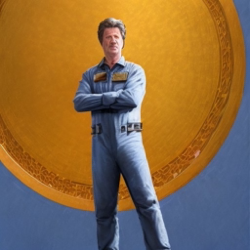
I've been using ChatGPT daily since it came out. It's been amazingly helpful with drafting and research. It really is like interacting with a knowledgeable academic tutor. The actual prose suggestions it offers are often a bit lame, but it's really good at critique, suggestions, structure, etc. -
What creates suffering if god created the world ?I believe Schopenhauer drew inspiration from Boheme. — schopenhauer1
I like the orthodox reading (of Eckhardt et al) in part though because it shows the vast space of conceptual possibilities that exist within orthodoxy, even if they are rarely explored. We tend to think, "if most x state y, then x is what is consistent with y," but I find it neat how Eckhart, Rumi, etc. can show us, "hey look, there is this whole set of other spaces that don't conflict with the boundaries of Christian/Muslim orthodoxy, and yet are conceptually very different." — Count Timothy von Icarus
I think what might be missing in this discussion is the ethical or moral dimension of religious philosophy and its ultimately existential nature. One of the Schopenhauer quotes that is relevant:
In order to always have a secure compass in hand so as to find one's way in life, and to see life always in the correct light without going astray, nothing is more suitable than getting used to seeing the world as something like a penal colony. This view finds its...justification not only in my philosophy, but also in the wisdom of all times, namely, in Brahmanism, Buddhism, Empedocles, Pythagoras [...] Even in genuine and correctly understood Christianity, our existence is regarded as the result of a liability or a misstep. ... We will thus always keep our position in mind and regard every human, first and foremost, as a being that exists only on account of sinfulness, and who is life is an expiation of the offence committed through birth. Exactly this constitutes what Christianity calls the sinful nature of man. — quoted in Schopenhauer's Compass, Urs App, p1
The Eastern religions designate this state or condition as 'avidya' or ignorance, rather than 'original sin', which has a more cognitive connotation (i.e. corruption of the intellect) than sin (corruption of the will).
In either case, I think the essential implication is that existence as we understand it is inherently prone to suffering. The human condition is characterised in the early Buddhist texts as being one of inherent suffering due to being separated from what one loves, united with what one doesn't love, and subject to old age, illness and death, the implication being that the only real escape from suffering it to escape altogether from re-birth in saṃsāra (although this became modified in Mahāyāna Buddhism with the idea that the Bodhisattva can take voluntary birth 'for the welfare of all sentient beings', which actually dovetails rather well with Christian theology.)
Whereas in today's culture, physical satisfaction, safety, health, enjoyment, and so on, are regarded as the only real goods, so it is unnacceptable to this outlook that God doesn't just facilitate that. He doesn't conform to our ideas of what constitutes 'the good life'. (This is what I describe as the 'hotel manager theodicy' - 'who's responsible for all this!?!' I believe C S Lewis has an essay on that, God in the Dock (although I haven't read it) - but the gist is, in previous times, man was the accused, standing in the dock and being judged by God. However, in the modern era, this has reversed, and God is the one being judged by human standards.)
So the upshot is, according at least to ol' time religion, there is no permanent peace and security to be found 'in this vale of tears', all we can do is improve physical well-being and political security and maximize comfort. Against that background, 'religion' generally makes no sense. As we see. -
Do science and religion contradictAs already noted, it depends a great deal on what you have in mind by the two terms. Dogmatic religion and materialist science are mutually repulsive, but there are many other varieties of both.
Heisenberg was essentially Christian Platonist in his views, he used to carry a copy of the Timeaus around in his University days and remained Lutheran (unlike Neils Bohr who was atheist although not evangelically so). Newton devoted enormous amounts of time in later life to his rather eccentric commentaries on matters biblical and alchemical, although those writings are not regarded as much more than historical curiosities nowadays. James Clerk Maxwell and Michael Faraday were both groundbreaking scientsts and devoutly religious, as this interesting New Atlantis essay shows.
There's a great deal of pseudo-scientific nonsense spouted by the 'new atheists' such as Dawkins, Dennett and Sam Harris who all mistakenly believe that 'science disproves God' or some such, leading none other than Peter Higgs (of Higgs Boson fame), no believer himself, to describe Richard Dawkins as a 'secular fundamentalist'.
I think the most important and difficult aspect of the question is to recognise the symbolic nature of most religious texts and also their existential implications, what they mean in terms of the living of life. Science itself is pretty removed from that dimension of existence. -
Kant on synthetic a prior knowledge... and experience?Maybe one practical source of anecdotal evidence for this point can be drawn from the writings of neurologist Oliver Sacks. He documented many cases where patients, due to various neurological disorders, underwent bizarre cognitive dislocation, as evidenced in his famous book title, The Man who Mistook his Wife for a Hat. In the titular story of that book, Dr. Sacks described the case of Dr. P., a music teacher and former singer who had a neurological disorder called Visual Agnosia that caused him to misperceive the world in a highly unusual way. Dr. P. had difficulty recognizing common objects and even people's faces, to the point where he once mistook his wife for a hat: when he and his wife rose to leave Dr Sacks' office, he reached for his wife's head, mistaking it for the hat on the hat-stand.
I've always rather wondered whether this kind of disorder illustrates the way in which, if the mind is affected by a neurological disorder, it disrupts the cognitive framework within which we identify and interact with objects and people, thereby showing up the sense in which that framework is 'mentally constructed' by us, rather than that the world is something simply being presented to us. -
"Beware of unearned wisdom."The only way for that to happen is through manipulation - tabulation, statistics, visualization, modeling, fiddling, analyzing, running sensitivity analyses. Doing it once, doing twice, and then doing it again. — T Clark
I seem to recall reading a biological snippet about C S Peirce who was very much a working scientist - spent years doing hydrological measurement. He said something similar. Very disdainful of armchair experts. -
US Election 2024 (All general discussion)Mahathir held it together in Malaysia into his nineties. Biden doesn’t project well but I think he’s sound. It’d be great if the Dems had a younger alternative, but….
-
US Election 2024 (All general discussion)Very likely. I mentioned previously that I witnessed something exactly the same at a relative's 90th birthday celebration. He got up to say a few words but suddenly fell silent mid-sentence and had to sit down. He was very embarrased about it and had his son contact us later to say he had suffered a 'mini-stroke'. He died not long after. But McConnell seems so enfeebled and so clearly unfit for such a strenuous position, he really should have more sense. (Although there's a bit of unease as to who will replace him, what with some of the nutjobs in the the current GOP - although John Thune doesn't look too obviously terrible, aside from the fact that he's a Republican. ;-) But at least he's been critical of the Orange Emperor.)
-
Is touching possible?Touching is by many considered an object coming into contact with another, which perhaps requires the objects occupying the same space. — elucid
It's doesn't mean occupying the same space, but sharing a point of contact. Problem solved. -
US Election 2024 (All general discussion)McConnell is clearly past it. Looks like a befuddled old man when this happens. He plainly needs to retire straight away but then common sense is in very short supply in US politics nowadays.
-
"Beware of unearned wisdom."I think you make some good points, but it might be worth recalling the link between 'wisdom' and that little-used term, 'sapience' (little-used, but actually a part of our species designation!) I think, nowadays, the distinction between knowledge and sapience is quite difficult to discern, as modern thought tends to deprecate what was hitherto known as 'the sapiential dimension'. And that was understood to refer to a dimension or aspect of knowledge related to deep insight into fundamental truths or principles. It often pertains to philosophical or spiritual knowledge that goes beyond mere factual or intellectual understanding.
if happiness (eudomonia) consists in activity in accordance with virtue, it is reasonable that it should be activity in accordance with the highest virtue; and this will be the virtue of the best part of us. Whether then this be the Intellect (nous), or whatever else it be that is thought to rule and lead us by nature, and to have cognizance of what is noble and divine, either as being itself also actually divine, or as being relatively the divinest part of us, it is the activity of this part of us in accordance with the virtue proper to it that will constitute perfect happiness; and it has been stated already* that this activity is the activity of contemplation — Aristotle, Nichomachean Ethics,1.1177a11
The idea being that true 'wisdom' discerns the commensurate objects of the understanding, such as the first principles of metaphysics. As to whether there are short-cuts to attainment of that understanding, I think a great deal would depend on the aptitude of the enquirer - some might grasp it straight away, others never. -
The irreducibility of phenomenal experiences does not refute physicalism.I can produce the same image on different paper or have it on a digital screen and identify the contents of the image; those contents are not directly related to the physical composition of a photograph you can hold in your hand and cannot be reduced to it, which is the main point...it is still information of the image which is independent of the physical medium — Apustimelogist
These are good arguments against physicalism, apparently being deployed in support of physicalism. :roll: -
Donald Trump (All General Trump Conversations Here)our politics have become particularly depraved lately — Ciceronianus
A very simple point which I often make, is to ask how can someone who denies the electoral process and claims not to have lost the last election in the face of all evidence, be allowed to participate in the next one? Surely a pledge to abide by the rules of the contest ought to be a basic minimum entry requirement. Plain common sense, I would have thought.
//Imagine if DJT were challenged that in order to continue with his bid for the Presidency, all he need do is sign a publlc document acknowledging that he lost to Biden in 2020, and that his previous denials of this were falsehoods, and that he promised to abide by the rules in the next round. If he couldn't bring himself to do it, it would be over.// -
Donald Trump (All General Trump Conversations Here)@Ciceronianus You may recall I raised the question of how Trump's potential disqualification under the 14th Amendment might be enacted. Now it appears that State Attorneys General are starting to express their unease at the possibility that elections might be challenged on this basis, should Trump be found to be ineligible - that it might invalidate the ballot paper or the vote itself. Arizona Secretary of State, Adrian Fontes, said:
"We have to have a final certification of eligible candidates [for the primary ballot] by Dec. 14 for Arizona’s presidential preference election,” Fontes, a Democrat elected last year, told NBC News. “And because this will ultimately end up in court, we are taking this very seriously.” ...
“We need to run an election,” Fontes said. “We need to know who is eligible, and this is of incredible national interest. We aren’t taking a position one way or the other.
“If there are people who want to fight this out, they need to start swinging, because I have an election to run,” Fontes added.
The same question is being asked in New Hampshire. It seems the recently-published opinion piece by Luttig and Tribe might be starting to ripple through the landscape. -
Donald Trump (All General Trump Conversations Here)So i don't know if the govenment is behind this, because if so, they surely have done a very good job. — Hailey
I'm sure they do! :wink: -
Donald Trump (All General Trump Conversations Here)The popularity of Trump in China is definitely something to think about. — Hailey
I honestly do think there's an element of propaganda in it. Even though Trump was hostile to China, his foreign policy was inept (for instance, he believes to this day that if he imposes a tarriff on Chinese goods, that China has to pay it). But I think the Party will put up with that hostility in exchange for the fact that Trump will overall greatly weaken America, through a combination of ineptitude and isolationism and creating havoc in the American political scene, which is the only thing he has demonstrated any real aptitude for. And the Chinese Government fears Biden - the CHIPS act is inflicting real pain on their tech sector. They understand that he is a much more fearsome opponent on the world stage, as he actually knows what he's doing.
It's the same reason the Russian Government wants to see Trump elected, and constantly commiserate with his trials in their media. They think if Trump wins that he would immediately drop support for Ukraine and basically support Russia, which, given his long record of adulating Vladimir Putin, is not an unreasonable expectation.
That was the question asked at the beginning of the American Civil War. — Paine
And the stakes are almost that high, except for the Proud Boys and their associated crews are nowhere near as big nor as well-supported as the Confederate Army. But if you watch Rachel Maddow this week, she draws some pretty chilling connections between what Trump is doing, and the upsurge of reactionary right-wing violence. Where it's a lot, or a little, blood will be shed over this conflict.
:100: -
Donald Trump (All General Trump Conversations Here)There are a couple of news items about the mooted 14th Amendment invocation to declare Trump ineligible for public office. In The Atlantic, David Frum argues against it, saying that Trump needs to be beaten at the ballot box (requires subscription). In Politico, the New Hampshire Attorney General is said to be carefully considering the issue (open access).
But leaving this particular Constitutional mechanism aside, the question that nobody seems to be asking is: how can someone who flouts the rules of a contest be allowed to participate in it? Even without a conviction (as yet!) there is an enormous compendium of evidence indicating that Trump sought to overturn the last election by improper means, and it's beyond dispute that he's never acknowledged loosing the last ballot, even despite he and his associates bringing more than 60 lawsuits. He persists in lying about it whenever he speaks about it (which he does on a daily basis).
You couldn't even get into a chess tournament or a tennis match with that kind of attitude. So if he won't play by the rules, why should be allowed to participate? It doesn't seem a very difficult question to me. -
The irreducibility of phenomenal experiences does not refute physicalism.I don't think it is unreasonable for someone to defend a physicalist view, depending on how they conceptualize it, given the success of the natural sciences and what they seem to say. — Apustimelogist
What you're saying is that you have faith in science, given its results, and science generally presumes a physicalist stance. So that even while you recognise something like the 'explanatory gap' or 'the hard problem of consciousness', you think physicalism is a pretty safe bet regardless. I don't know if that really amounts to much of an argument for physicalism. And it says nothing about alternatives explanatory frameworks. If there were a satisfactory non-physicalist account, such as those of analytical idealism, then that ought to be considered.
subjective meaning (Qualia) cannot be reduced to the properties of the object (Quanta). Experiences are meaningful (significant) to the Subject, but meanings are metaphysical/immaterial, not physical/material. There's definitely a correlation between physics & metaphysics, but the creative causation (translation) by the brain produces novelty (a system, instead of merely reproducing the original. The brain is a machine for making meanings, but meaning is not the ding an sich. :smile: — Gnomon
:clap:
Also, notice the heading in Pinter's book, Symbols in Nature, towards the end:
Symbolic systems are among the oldest inventions of nature. Evolution could never have gotten off the ground without the molecular genetic system, which is a paradigm example of a symbolic scheme. The double helix is a symbolic structure, essentially an extended proposition, which contains the description of an organism’s entire body plan. — Pinter, Charles. Mind and the Cosmic Order (p. 150). Springer International Publishing. Kindle Edition.
He doesn't really develop the idea, but it converges well with biosemiotics. -
The irreducibility of phenomenal experiences does not refute physicalism.How do you do itallics here? — Apustimelogist
Notice when you're in Edit mode, the I symbol in the Edit bar - select required text and click it, or enclose expression in (i) (/i) tags
Have a look in the help section https://thephilosophyforum.com/categories/44/help for tips and tricks. -
List of Definitions (An Exercise)
Being
Many would say the cardinal attribute of whatever can be said to exist, but as I have argued in many a thread, 'being' carries the connotation of sentient existence, i.e. existence as a being (e.g. 'human being'). Accordingly I hold that 'being' 'existence' and 'reality' are not strictly synonymous.
Awareness
The most basic form of consciousness, also the aspect of consciousness that is prior to apperception, integration and rationalisation.
Consciousness
Best thought of in the Eastern sense of 'citta', a Sansrit word that means both 'mind' and 'heart'; that which is aware or conscious; but never in itself an object, always as the subject
Thinking
Conscious deliberation and also the spontaneous activity of consciousness
Time
Awareness of the duration between events or occurences
Sensation
That which the nervous and cognitive systems transmit
Perception
Cognition and re-cognition of the contents of sensation
Mind
Consciousness
Body
Like a VR headset used to navigate terrestrial environments
Good
One half of a pair
Happiness
Absence of pain, absence of conflict, absence of fear, awareness of harmony.
Justice
Ideally, the resolution of conflict and the establishment of:
Truth
That which is; satya; veritas.
Wayfarer

Start FollowingSend a Message
- Other sites we like
- Social media
- Terms of Service
- Sign In
- Created with PlushForums
- © 2026 The Philosophy Forum