
-
Is there a term for this type of fallacious argument?Everything in the ‘futility bias’ article you linked really just amounts to cynicism - ‘don’t even try, you know it’s never going to work’. Might also be called defeatism, pessimism, or fatalism. In any case, it’s an attitudinal issue, not a logical fallacy per se.
-
Is there a term for this type of fallacious argument?The Nirvāṇa Fallacy is a new one to me, must admit. :-)
-
Absolute nothingness is only impossible from the perspective of somethingDo you have the quotes from Hume's works? — Corvus
What I meant was that if you read the quoted passage “If we take in our hand any volume; of divinity or school metaphysics, for instance; let us ask....", it actually applies to Hume's treatise itself! In other words, according to his own criterion, his book should also be 'committed to the flames'.
I studied a unit in David Hume as an undergraduate. The lecturer used to compare Hume's philosophy to the fabled uroboros, the snake that eats itself.

'The hardest part', he would say, 'is the last bite'. -
Dualism and InteractionismYou begin where you hope to convince others to end, that is, with your belief in God — Fooloso4
I myself can't help but see a connection between necessary truths, the domain of a priori, and an implicit order in the Cosmos (although I remain agnostic in some basic sense). But the likely response to such sentiments will be that because this sounds like natural theology or religious apologetics, then it ought to be rejected on those grounds. Just the admission of belief in God is sufficient to call an argument into question, as it is said to automatically consign it to the realm of faith, which is definitionally subjective and not amenable to empirical proof. It is flourished as a kind of rhetorical trump card. (See! A believer!)
I think this is all a manifestation of what (atheist philosopher) Thomas Nagel describes in his essay Evolutionary Naturalism and the Fear of Religion. He begins by quoting a paragraph by C S Peirce:
The only end of science, as such, is to learn the lesson that the universe has to teach it. In Induction it simply surrenders itself to the force of facts. But it finds . . . that this is not enough. It is driven in desperation to call upon its inward sympathy with nature, its instinct for aid, just as we find Galileo at the dawn of modern science making his appeal to il lume naturale. . . . The value of Facts to it, lies only in this, that they belong to Nature; and nature is something great, and beautiful, and sacred, and eternal, and real --the object of its worship and its aspiration.
...
The soul's deeper parts can only be reached through its surface. In this way the eternal forms, that mathematics and philosophy and the other sciences make us acquainted with will by slow percolation gradually reach the very core of one's being, and will come to influence our lives; and this they will do, not because they involve truths of merely vital importance, but because they [are] ideal and eternal verities.
Nagel then comments that Peirce's comments
have a radically antireductionist and realist (scholastic not scientific ~ wf) tendency quite out of keeping with present fashion. And they are alarmingly Platonist in that they maintain that the project of pure inquiry is sustained by our “inward sympathy” with nature, on which we draw in forming hypotheses that can then be tested against the facts. Something similar must be true of reason itself, which according to Peirce has nothing to do with “how we think.” If we can reason, it is because our thoughts can obey the order of the logical relations among propositions — so here again we depend on a Platonic harmony.
The reason I call this view alarming is that it is hard to know what world picture to associate it with, and difficult to avoid the suspicion that the picture will be religious, or quasi-religious.
This is the point where Nagel confesses to the 'fear of religion', which, he says, he and many others suffer from, and which, he says,
is responsible for much of the scientism and reductionism of our time. One of the tendencies it supports is the ludicrous overuse of evolutionary biology to explain everything about life, including everything about the human mind. Darwin enabled modern secular culture to heave a great collective sigh of relief, by apparently providing a way to eliminate purpose, meaning, and design as fundamental features of the world. Instead they become epiphenomena, generated incidentally by a process that can be entirely explained by the operation of the non-teleological laws of physics on the material of which we and our environments are all composed.
I see this writ large in many a debate on this forum, which is why I frequently hark back to this essay of Nagel's. Science itself throws up many metaphysical questions which it is not equipped to deal with; but then, because it's not so equipped, it relegates them to the domains of personal faith or unverifiable speculation. Consequently, in the end, the only kinds of causes that today's naturalism will countenance, are those which science itself can replicate and have control over. As one Cardinal Ratzinger, a well-known Catholic philosopher, put it:
(Renaissance philosopher Giambattista) Vico....following formally in Aristotle’s footsteps ... asserts that real knowledge is the knowledge of causes. "I am familiar with a thing if I know the cause of it; I understand something that has been proved if I know the proof". But from this old thought something completely new is deduced: If part of real knowledge is the knowledge of causes, then we can truly know only what we have made ourselves, for it is only ourselves that we are familiar with. This means that the old equation of truth and being is replaced by the new one of truth and factuality; all that can be known is the factum, that which we have made ourselves. It is not the task of the human mind—nor is it within its capacity—to think about being; rather, it is to think about the factum, what has been made, man’s own particular world, for this is all we can truly understand. — Cardinal Joseph Ratzinger, Introduction to Christianity
Hence the transformation (or devolution) of man from h. sapiens, 'wise man', to h. faber, 'man the maker', for whom the technologically-buffered ego is the sole arbiter of truth. It is that kind of thinking that nowadays rules culture. -
Absolute nothingness is only impossible from the perspective of somethingHume wrote in his Treatise... — Corvus
Interesting to note that the criticism also applies to his book. Not for nothing is Hume sometimes called 'the godfather of positivism'. -
Israel killing civilians in Gaza and the West Bank:up: Helped me make sense of it.
What I'm reading is that the biggest inhibitor to Hezbollah's involvement is that Lebanon is already totally economically f***ed. What with the aftermath of the Beirut port explosion, the collapse of the currency and banking system, sky-rocketing inflation and huge unemployment - much of which Hezbollah's blatant corruption and nepotism are responsible for! - there is absolutely zero appetite amongst the actual Lebanese citizenry for war with Israel. It's the very last thing anyone wants, even if the mullahs and jihadis are all chomping at the bit. (Although it's also true that the constraints of reason often mean nothing to fanatics.) -
Israel killing civilians in Gaza and the West BankBenjamin Netanyahu has been the most successful Israeli Prime Minister ever and is the longest serving one
Yuval Noah Harari has something to say about that in a Washington Post OpEd. Addressing why the country was caught so utterly unprepared for the Hamas onslaught, he says
The real explanation for Israel’s dysfunction is populism rather than any alleged immorality. For many years, Israel has been governed by a populist strongman, Benjamin Netanyahu, who is a public-relations genius but an incompetent prime minister. He has repeatedly preferred his personal interests over the national interest and has built his career on dividing the nation against itself. He has appointed people to key positions based on loyalty more than qualifications, took credit for every success while never taking responsibility for failures, and seemed to give little importance to either telling or hearing the truth.
The coalition Netanyahu established in December 2022 has been by far the worst. It is an alliance of messianic zealots and shameless opportunists, who ignored Israel’s many problems — including the deteriorating security situation — and focused instead on grabbing unlimited power for themselves. In pursuit of this goal, they adopted extremely divisive policies, spread outrageous conspiracy theories about state institutions that oppose their policies, and labeled the country’s serving elites as “deep state” traitors.
The government was repeatedly warned by its own security forces and by numerous experts that its policies were endangering Israel and eroding Israeli deterrence at a time of mounting external threats. Yet when the IDF’s chief of staff asked for a meeting with Netanyahu to warn him about the security implications of the government’s policies, Netanyahu refused to meet him. When Defense Minister Yoav Gallant nevertheless raised the alarm, Netanyahu fired him. He was then forced to reinstate Gallant only because of an outbreak of popular outrage. Such behavior over many years enabled a calamity to strike Israel.
As an outsider to Israeli politics, albeit aware of the huge controversy sorrounding Netanyahu's attempt to castrate the judiciary, this OpEd was helpful in understanding his weaknesses. -
Are you against the formation of a techno-optimistic religion?It's fantasy. That robot meditation image is grotesque. Here's an anecdote - Siddhartha Gautama, the Buddha, pursued an arduous form of ascetic meditation for six years in the wilderness. During this time, he nearly starved to death =- there's a class of Buddhist iconography which depicts him in this form, practically skeletal.
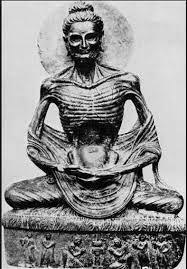
According to legend, he was at death's door on the bank of a river when a milk-maiden noticed his emaciated condition and provided him with curdled milk (yoghurt) which, to all intents, prevented him dying. It was after that episode that he realised the futility of extreme asceticism and went on to realise Nirvāṇa to free to himself from continual re-birth in saṃsāra, which is what he went on to teach for 45 years.
Gnosticism was also a severly ascetic movement in the early Christian period. The Gnostics saw the world as a prison, created by an evil demiurge, which they identified with the God of the Old Testament. They believed that through severing all desires and renouncing all human relationships, they could escape the prison of worldly existence and return to the Pleroma.
Neither would be of much interest to the technofuturist, I imagine. But what that kind of tech will provide is endless variety of imagery, synthetic experiences, and sensual pleasure, including incredible sexual adventures. Just don't confuse it with anything spiritual. -
Is there a term for this type of fallacious argument?Basically, you're describing what is generally called ‘cynicism’. It’s not a fallacious argument as such, more a negative attitude towards human nature. (The term “cynicism” originates from the teachings and practices of the Cynic philosophers in ancient Greece. Unlike its modern usage which generally denotes a distrustful or pessimistic attitude, the original Cynic philosophy was more about leading a life in accordance with nature, rejecting conventional desires for wealth, power, and fame, and valuing self-sufficiency and freedom. The original cynics were really more like Hindu ascetics.)
-
The Mind-Created WorldA little further down from that chapter: ‘at the very moment when radical anthropomorphism set in and man could know only his own work, he had to learn to accept himself as merely a chance occurrence, just another “fact”’. Yet it is within that very context that the ‘primacy of the objective’ is clung to with such determination. That is what the OP seeks to address.
-
Dualism and Interactionism...physics is based on what I call the Fundamental Abstraction of natural science, which attends to the objects observed rather than the subject observing. Yet, these are inseparable, for all knowledge requires a knowing subject and known objects. By fixing on the object and prescinding from the subject, natural science is left bereft of the concepts and data required to explain subjective operations, including consciousness and willing. Thus, the experiential footprint from which the laws of physics are derived is mindless matter. — Dfpolis
:up: I think the motivation for questioning the existence of 'natural law' is because even though science assumes the regularities of nature designated as lawful, it can't explain them. -
Why is the Hard Problem of Consciousness so hard?I read it. I’m making a philosophical observation, not offering a scientific theory.
-
Why is the Hard Problem of Consciousness so hard?The criterion of objectivity would presume that, would it not?
-
Why is the Hard Problem of Consciousness so hard?Speaking of the hard problem, a letter was published in Sept 2023, signed by 100 notable scientific researchers, to the effect that the currently-popular ‘theory of consciousness’, IIT (Integrated Information Theory) is pseudoscience. It’s caused a furore,
Earlier this week, a letter signed by over 100 researchers, including several philosophers, was published online, calling a popular theory of consciousness, integrated information theory (IIT), “pseudoscience.”
Others, including some who themselves have criticized IIT, have called the letter “so bad” and “unsupported by good reasoning.
On both sides of the dispute are concerns about the reception of ideas beyond those researching them. The authors of the letter are concerned about the damaging effects that taking IIT seriously might have on certain clinical and ethical issues, while the critics of the letter are concerned about the damaging effects that accusations of pseudoscience might have on the whole field of consciousness studies.
The letter, published at PsyArXiv, is a response to publicity about IIT following the recent resolution of a bet made in 1998 between David Chalmers and Christof Koch. The bet was over whether, within the next 25 years, someone would discover a specific signature of consciousness in the brain, with Koch betting yes and Chalmers betting no. Chalmers was recently declared the winner of the bet, based on recent testing of two theories of consciousness, global network workspace theory (GNWT) and IIT.
The letter’s primary authors are a group of scientists, but the signatories include several philosophers, including Peter Carruthers, Patricia Churchland, Sam Cumming, Felipe De Brigard, Daniel Dennett, Keith Frankish, Adina Roskies, Barry Smith, and others.
The letter writers take issue with the reported status of IIT as a leading theory of consciousness:
The experiments seem very skillfully executed by a large group of trainees across different labs. However, by design the studies only tested some idiosyncratic predictions made by certain theorists, which are not really logically related to the core ideas of IIT, as one of the authors himself also acknowledges. The findings therefore do not support the claims that the theory itself was actually meaningfully tested, or that it holds a ‘dominant’, ‘well-established’, or ‘leading’ status.
More here.
My take: ‘theories of consciousness’ can’t conform with modern scientific practice, which begins with the assumption of the separation of knower and known. Phenomenology, of course, sees through this, but then, it was never the target of the ‘hard problem of consciousness’ argument. -
The Mind-Created Worldnow you seem to be flirting with full-fledged Idealism — Leontiskos
It was intended as a defense of idealism from the outset.
Splendid Hegel quote. Just the kind of thing that Marx inverted. -
Vervaeke-Henriques 'Transcendent Naturalism'Another installment from the never-ending Vervaeke content stream. Listened to this one at my gym workout this morning, has a few egregious clangers (Australia drifting towards authoritarianism because of the lack of values of secular culture? :yikes: ) but still, some great ideas and themes.
-
The Mind-Created Worldeven in this scenario things are human-mind independent. — Janus
In classical philosophy and scholasticism, particularly within the Thomistic and Neo-Platonic traditions, there is indeed a view that the human intellect (nous) is a reflection or an image of the Divine Intellect. That shows up in the doctrine of the rational soul and also in the role of intellect in hylomorphic dualism. I don't know if they ever entertained the idea of other solar systems (actually wasn't that somerthing that Giordano Bruno was burned at the stake for? Unlike Mahāyāna Buddhism, which acknowledges 'a myriad of life-bearing orbs'.)
Catholics accept the current cosmological paradigm, according to which the cosmos existed for far, far longer without humans than it has with them. — Janus
Indeed. The inventor of big bang cosmology was Georges LeMaitre, a Catholic priest. I've often told that anecdote that Pope Pius wished to use LeMaitre's argument to press the case for 'creation ex nihilo', but that LeMaitre was embarrased by this conflation of the scientific accounts with religious cosmology and asked the Pope's science advisor to intervene, which he did. I loved that story on a couple of grounds - first, LeMaitre's utter commitment to scientific impartiality, while still maintaining his faith, and seeing no conflict between them; second, that he got the Pope to agree not to do something.
Granted, it's also fun to try to eat the whole meal in one bite. :grin: — Leontiskos
I understand your concern. But my philosophical quest started with an eclectic approach - very much in the spirit of the 1960's. I read, for example, quite a few of Alan Watts books, also Thomas Merton, and other eclectics. Heck, I first learned the name 'Jacques Maritain' through a book I bought at Adyar Bookshop (one of many!) God, Zen and the Intuition of Being. All of those kinds of sources quote Aquinas and Plotinus and pseudo-dionysius, and others of that ilk. Later in life, I came to recognise the lack in my own education, never having been schooled in 'the Classics' but some elements of classical philosophy have really come alive for me. Yes, it's syncretist, and definitely unorthodox but there is a thread. -
The Mind-Created WorldI think you are working above your pay-grade at this point. — Leontiskos
Almost certainly, but then I am trying to follow a thread through a labyrinth. And thank you. :pray: -
The Mind-Created WorldTranscendental Thomism is more conciliatory towards modern thought — Leontiskos
On further reflection, it occurs to me that an Aquinas would not endorse the notion of a 'mind-independent object'. Why? Because in his philosophical theology, particulars derive their being from God - that they are created and maintained in existence by the divine intellect. Not only does God grant existence initially (through creation), but He also continuously sustains all things in existence. Without the continuous causal activity of God, things would cease to exist. In this way, God is not just a distant first cause; He is intimately involved in maintaining the existence of all particulars (cf Jean Gebser, 'The Ever-Present Origin'.) And whilst the 'divine intellect' might be an unfathomable mystery to us mortals, it is still a mind, rather than an impersonal physical force such as energy.
This is what I clumsily referred to with the earlier reference to Eckhardt, that being the gist of his aphorism, 'creatures [i.e. created things] are mere nothings'. They have no intrinsic reality outside the Divine Intellect which sustains us and all things in existence. -
Aquinas on existence and essence
-
Aquinas on existence and essence
-
The Mind-Created WorldQuestions I might ask: is color real ? is sound real ? are feelings of love real ? To say that the world is 'really' numbers doesn't make much sense. — plaque flag
As you know, since Day 1 on the forum, I've been pursuing the question of the question of the reality of number (and abstract objects generally). My view is that they're real, but they're not phenomenally existent; they're inherent in the way the mind categorises, predicts and organises its cognitions. And as 'the world' and 'experience' are not ultimately divided (per non-dualism) then this is why mathematics is uncannily predictictive. That, I think, is the thrust of McDonnell's book.
I've tried to read up on Tegmark but have been dismayed to learn that despite his commitment to what he calls 'pythagoreanism', he still remains wedded to a scientifically materialist philosophy. 'It’s fair to say that Tegmark, a physicist by training, is not a biological sentimentalist. He is a materialist who views the world and the universe beyond as being made up of varying arrangements of particles that enable differing levels of activity. He draws no meaningful or moral distinction between a biological, mortal intelligence and that of an intelligent, self-perpetuating machine' ~ The Guardian.
As always, 'the philosophy of a subject who forgets himself'. -
The Mind-Created WorldI would prefer resisting scientism by way of an alternative realism. — Leontiskos
As I noted, briefly, I think there's a lot in Aristotlelian-Thomist philosophy - which surprises me, as I'm not Catholic, and it's usually associated with the Catholic faith. I have learned there's a school of thought called Transcendental Thomism, associated with Rahner and other mainly European Catholic philosophers. I'm interested in that. -
The Mind-Created Worldthink Tegmark is like this, but such thinking has left the empirical scientific spirit behind. It's bad metaphysics drunk on its close association with good physics. — plaque flag
Courtesy a link provided by @Janus, I've just acquired Jane McDonnell, The Pythagorean
World: Why Mathematics Is Unreasonably Effective In Physics - a very recent title, McDonnell being a recent grad of Monash Uni in Melbourne. This is her PhD thesis in book form. Seems to present a kind of Pythagorean idealism, although I've barely started reading it yet. -
The Mind-Created WorldFor the classical realist the extramental world can be known in itself precisely through the rational, perspective-grounded mind. — Leontiskos
BECAUSE the rational intellect knows the forms of things. Google 'the union of knower and known'. Most of the top results are either Islamic or Thomist. Why? Because they preserve Aristotle's 'active intellect', with the remnant of the Plato's forms (modified by Aristotle), which in turn were inherited from the dialogue with Parmenides. THAT is what becomes lost in the transition to modernity, where instead 'the object' is endowed with 'mind-independent' status as the criterion of what is real. That is what I'm arguing against. -
The Mind-Created WorldBut I won't elaborate so as to avoid raining on Wayfarer's parade. — Leontiskos
You'd need to be in the same street to do that ;-) -
The Mind-Created WorldIt's not a contradiction. Time itself is one of the primary intuitions, the condition of our experience of the object. There is no time from the perspective of the object, as the object has no perspectives, plainly. We ourselves can arrive at an empirical estimate of the age of the object, its material, etc, but again, that is all reliant on our conscious ability. Time is not inherent in the Universe itself, it is not real independently of the observer. It is something brought to the picture by the observing mind. That is the point of the quote from the cosmologist that I mentioned:
The problem of including the observer in our description of physical reality arises most insistently when it comes to the subject of quantum cosmology - the application of quantum mechanics to the universe as a whole - because, by definition, 'the universe' must include any observers.
Andrei Linde has given a deep reason for why observers enter into quantum cosmology in a fundamental way. It has to do with the nature of time. The passage of time is not absolute; it always involves a change of one physical system relative to another, for example, how many times the hands of the clock go around relative to the rotation of the Earth. When it comes to the Universe as a whole, time looses its meaning, for there is nothing else relative to which the universe may be said to change. This 'vanishing' of time for the entire universe becomes very explicit in quantum cosmology, where the time variable simply drops out of the quantum description. It may readily be restored by considering the Universe to be separated into two subsystems: an observer with a clock, and the rest of the Universe.
So the observer plays an absolutely crucial role in this respect. Linde expresses it graphically: 'thus we see that without introducing an observer, we have a dead universe, which does not evolve in time', and, 'we are together, the Universe and us. The moment you say the Universe exists without any observers, I cannot make any sense out of that. I cannot imagine a consistent theory of everything that ignores consciousness...in the absence of observers, our universe is dead'. — Paul Davies, The Goldilocks Enigma: Why is the Universe Just Right for Life, p 271
There's a long interview with Linde in the Closer to Truth series, where he explains this in more detail, in his rather charmingly Russian-accented English. (Linde is one of the main authors of the inflationary universe theory, as well as the theory of eternal inflation and inflationary multiverse. ) -
The Mind-Created WorldThus you seem to simultaneously admit and deny the empirical fact that the boulder has shape in itself. — Leontiskos
When we find any object, we will generally find that it has qualities and attributes such as shape, which pre-date our discovery of it. But at the same time, shape is an attribute of our sensory apprehension of the object. Whether it has shape outside that, or whether it has inherent attributes outside our sensory apprehension of it, is unknowable as a matter of principle, as we have to bring it to mind or present it to the senses, to discuss it. Shapes, spatial relationships, duration, position, and all of the manifold which makes such judgements possible, are brought to the picture by the observing mind. -
The Mind-Created WorldYour first paragraph contradicts your second, — Leontiskos
But it doesn't. It simply states that empiricism is not the sole arbiter of what it true. There's no contradiction.
the question, again, is what it means to see; what is the nature of the glass. — Leontiskos
Remember that in this analogy, 'glass' represents 'the act of knowing'. The nature of knowledge is what is at issue. -
The Mind-Created WorldIt seems that you have a stark premise that empirical facts exist. — Leontiskos
I've said a number of times, I'm not questioning empirical facts. This is also Kant's attitude, as he was at the same time an empirical realist and a transcendental idealist. Kant acknowledges that in our everyday experience, we interact with a world of objects that apparently exist independently of our perceptions. This is what he refers to as empirical realism. In other words, Kant recognizes that we can reasonably assume the existence of a mind-independent external world. We perceive objects, interact with them, and make empirical claims about their properties. (Shouldn't forget Kant also lectured in scientific subjects and his theory of nebular formation, modified by LaPlace, is still considered mainstream.)
At the same time, the principles of transcendental idealism concerns the nature of empirical knowledge itself (which is why it's called 'critical'). Empirical knowledge is shaped and structured by the inherent categories and concepts of the human mind. These mental structures, including space, time, causality, and the categories like substance and quantity, are not inherent properties of the external world but rather conditions for the possibility of experience. (This is where Kant's philosophy dovetails with the cognitive science approach. There's a scholar named Andrew Brook who has written extensively about Kant and cognitive science, including contributing some of the SEP articles on Kant. Wiki entry.)
Kant argues that while the external world exists independently of our perceptions, we can never know it as it is in itself. Instead, we can only know the world as it appears to us - as phenomena mediated through our mental categories and senses. This is the much-debated distinction of phenomenal and noumena, appearance and reality, as depicted in Kant.
Contrasted with that, the common sense view, and maybe even the view of scientific realism, is what Kant would have designated transcendental realism. Transcendental realism is a term used to describe a philosophical perspective that asserts the existence of a reality independent of the mind, which appears to be the testimony of common sense, as the world plainly precedes our own existence. But in so doing it over-values our sensory and intellectual faculties - it's at once hubristic and naive.
The question, to put it bluntly, is whether the glass distorts. — Leontiskos
Again the analogy is misleading. It's not as if you have one party, that sees with eyes, and another, that sees without them, so you can compare the two. The question would be better put 'do the eyes distort?' - to which the response is, in their absence there is no capacity to see. It's not as if there is a choice. -
Aquinas on existence and essenceThere is plenty of scope to explore philosophical topics on the forum, and you’re welcome to do so, but this particular thread was about a very specific topic in the history of philosophy, that’s all.
-
Aquinas on existence and essenceAnd thanks to the threadstarter for the topic! — Julian August
However, your two above entries show no discernible relevance to the topic, which specifically mentions Aquinas. The digression into Cartesian dualism compared with Aquinas’ dualism at least carried a reference to the OP. -
The Mind-Created WorldIt just exactly the world's being. — plaque flag
Why ‘the world’s’ being? Could you elaborate on that? -
The Mind-Created WorldThe key representatives of objective idealism I can think of are Hegel and Plato. — Count Timothy von Icarus
Quite right, although as often pointed out, the term ‘idealism’ was not current in Plato’s time and would not be coined until the 1700’s. But there’s another contemporary defender of absolute idealism, Sebastian Rodl, professor of philosophy at Leipzig University. From the jacket copy of Self-Consciousness and Objectivity: an Introduction to Absolute Idealism ‘ Self-Consciousness and Objectivity undermines a foundational dogma of contemporary philosophy: that knowledge, in order to be objective, must be knowledge of something that is as it is, independent of being known to be so. Sebastian Rodl revives the thought--as ancient as philosophy but largely forgotten today--that knowledge, precisely on account of being objective, is self-knowledge: knowledge knowing itself.’ -
The Mind-Created WorldThe question of solipsism has come up several times in this thread. ‘If “the world” is experience alone, then how is solipsism avoided?’
From an excellent blog post on idealism and non-duality, the following solution is given:
Influenced by the Zen experience of Enlightenment (“satori”), the Japanese philosopher Kitarō Nishida writes in his classic work An Inquiry into the Good: “Over time I came to realize that it is not that experience exists because there is an individual, but that an individual exists because there is experience. I thus arrived at the idea that experience is more fundamental than individual differences, and in this way I was able to avoid solipsism… The individual’s experience is simply a small, distinctive sphere of limited experience within true experience. (Nishida, Kitarō (1990 [1922]), An Inquiry into the Good.)
With his statement that the Zen experience of Enlightenment enabled him to “avoid solipsism”, Nisihida indicates the insight that consciousness is not ‘locked up’ inside the individual’s head or brain: “it is not that consciousness is within the body, but that the body is within consciousness”. (Idem: 43.) If consciousness resided in the brain, it would indeed be cut off from the world outside one’s skull, which would invite the solipsistic conclusion that all I can know is the phenomenal world appearing in my subjective consciousness, but not the real, objective world outside of it. The Zen realization that consciousness is radically different, that it is rather the non-dual openness in which both individual and world appear, thus takes away the threat of solipsism. Nishida, of course, does not deny that brain activity is closely connected to individual mind activity, but for him this only means that one group of phenomena appearing in consciousness (mental processes) correlates with another such group (neural processes): “To say that phenomena of consciousness accompany stimulation to nerve centers means that one sort of phenomena of consciousness necessarily occurs together with another.” (Ibidem.) This already gives a glimpse of how Western Idealism can benefit from Eastern spirituality.
(I think this is the same point I try to make with the argument that ‘the mind’ is not simply the individual mind, your mind or mind, but the mind, which however is never an object of consciousness.) -
Currently ReadingTotally get that. Author is a young Australian researcher, this is her PhD thesis, published as a book. I found it via another really interesting article I’ll share soon. BTW - you might check out this blog, Critique of Pure Interest, by a Dutchman with a lot of reading under his belt and a keen insight into non-dualism.
-
Aquinas on existence and essenceThe passage you’ve linked to clearly says in many places that Descartes conceives the soul and body as separate substances, with the soul acting on the body through the pineal gland, for example:
In the Treatise of man, Descartes did not describe man, but a kind of conceptual models of man, namely creatures, created by God, which consist of two ingredients, a body and a soul. “These men will be composed, as we are, of a soul and a body.’
….. Descartes’ criterion for determining whether a function belongs to the body or soul was as follows: “anything we experience as being in us, and which we see can also exist in wholly inanimate bodies, must be attributed only to our body. On the other hand, anything in us which we cannot conceive in any way as capable of belonging to a body must be attributed to our soul.
While it’s true that the description of his position in terms of other schools of though might be a matter of debate, Descartes’ dualism is a fact of his philosophy.
Not a point you will find support for in any of the sources you’ve quoted, as far as I can discern.My point was that for Descartes held the soul and body to be held by one ego — Gregory
‘Cogito’ is purely the functionality of the ‘res cogitans’, whereas all the motions of the body, he describes in ‘mechanical’ terms with reference to ‘animal spirits’, although as the article notes, he made important errors even in terms of what was known in his day, all of which is of course completely superseded in our say. -
Currently Readingmate you’re a champion. Averse as I am to IP violations, here my curiosity outweighs such scruples. Thanks a ton.
Wayfarer

Start FollowingSend a Message
- Other sites we like
- Social media
- Terms of Service
- Sign In
- Created with PlushForums
- © 2026 The Philosophy Forum