
-
Culture is criticalI get this unsettling feeling that many people (10 thousand? 100 thousand?) in the USA are actively chomping at the bit to start another US civil war… or some bloody battles anyway. — 0 thru 9
There's a lot of commentary on the idea that much of the insurrectionist and white-supremacy rage is driven by the shrinking demographic of white males as a proportion of the electorate. The nation is becoming visibly more diverse ethnographically, culturally and socially and there are those who see this as a mortal threat to their identity and way of life. That's one of the drivers of the Republican efforts at vote suppression and electoral gerrymandering as a desparate way to hang on to the seats of power. Plus there's that streak of anti-authority violence in that milieu, and of course diehard commitment to the right to carry assault weapons - ironic considering they are the nearest to authoritarian on the political spectrum. The only silver lining is that the MAGA movement seems to have thoroughly alienated the FBI and the Military, all of whom view Trump with contempt.
The Trump anomaly is a symptom, not the disease or the cause. — Vera Mont
I agree that the rot in the Republican establishment allowed this demagogue to take over, but he's more than a symptom. He's now a driver of a great deal of it, having been elected President it allowed the rot to set in at the highest levels, which might never have happened without a central figure who was able to capitalise on the politics of grievance so successfully (if accidentally - there remain many credible accounts that Trump never seriously set out to win the White House but had treated his bid as a publicity stunt until he won. You can see the surprise on his face in that first fateful post-election CNN broadcast, where he kept repeating 'I won' with this kind of child-like wonder. The irony being in 2016 he never thought he would win, and did, and in 2020, he never thought he would loose, and did. One of the many, many things that DJT has been wrong about.) -
Donald Trump (All General Trump Conversations Here)anyone heard anything about Steve Bannon's appeal against the Contempt of Congress sentence? According to prior reports 'Bannon appealed his conviction and sentence; he remained free pending appeal, with his sentence being put on hold, and the date for his appeal hearing was set for October 12, 2023' - but I can't find any reference in the media to a hearing on that date or its result. (Sooner he's in prison, the better, he's one of the principle back-office agitators behind the current crisis in Congress.)
//update - On October 3, 2023, Bannon's appeal hearing was delayed to November 9 at the request of the DOJ due to the unexpected death of the son of one of the government's lawyers.// -
Existential Dependency and Elemental ConstituencyThe outline proves itself very useful for evolutionarily amenable discussions about complex things; things that are comprised of a set of more basic irrevocable elemental constituents(simpler things). Water, for instance, or civilization, government, stories, language, meaning, thought, belief, logic, truth. concepts, linguistic frameworks, conceptual schemes, etc. — creativesoul
Certainly if viewed in terms of physical causation, then simple elements are constituents of more complex objects. I think cosmology establishes that the singularity at the origin of the Universe was simple, or at any rate, the very early cosmos comprised only plasma and then mainly hydrogen (which it still is). It wasn't until the formation and then collapse of stars (as supernovae) that complex elements (those elements comprising the remainder of the table of elements) were able to form.
But the question I would raise is one of logical as distinct from temporal priority. Is the order that emerges from the chaos of the very early universe causal or consequential? Logic would seem to indicate the former, as it would be perfectly conceivable that the Universe might simply have remained chaotic (not that there would have been anyone to conceive of it, had it remained so). The emergence of order from chaos is one of an underlying themes in ancient philosophy and cosmology, and obviously a very difficult thing to pronounce on, but the intuition of there being an implicit order which itself has a causal role, from the very instant of the 'big bang', seems at least to suggest a pre-existent or transcendent causal order.
A second question is, exactly what do the purported simple elements comprise? You may recall that the argument of the ancient atomists was that 'the atom' - indivisible and indestructible - provided the solution to this dilemma. Atoms themselves were eternal, the absolute elements of existence, forever being re-arranged to produce the panorama of the cosmos we see today. It has powerful intuitive appeal and is doubtless one of the main philosophical attractions of materialism. But I don't know if it stacks up against the insights of quantum physics, within which sub-atomic particles are seen as excitations of fields. And what 'fields' are, is quite impossible to fathom. All that is known for certain is that they produce and account for specific effects on the arrangements of matter. Their strengths and physical effects can be measured with exquisite precision, but what they really are is another matter.
One of the sleights-of-hand of physical reductionism is to present the purportedly basic constituents of physics as grounding higher-level complex phenomena, through emergence or supervenience or what have you. But the problem with that view is that these simple constituents are themselves defined mathematically, as is the whole super-structure of mathematical physics itself, and are themselves devoid of many of the qualities (qualia!) of the perceived phenomena of existence. So the question of how such mathematical simples actually do comprise complex particulars that we experience is still far from resolved. And then the question may arise, in what sense are the mathematical structures or relationships comprising the objects of physics ontologically fundamental, insofar as they're mathematical in nature? That has been the question of a great many difficult arguments and books, and whilst I don't propose any solution there are still cases being made for a Platonic or Pythagorean attitude which declares number (as distinct from material objects) as ontologically fundamental.
So I'm afraid the 'sheer simplicity' of your outine might only be because it's simplistic. It's a very appealing intuitive image, that of simple elements giving rise to more complex phenomena through the evolutionary process, and arguably one of the reigning metaphors suggested by evolution. But there are a great many philosophical and scientific conundrums thrown up by it. (I own a copy of The Anthropic Cosmological Principle by Barrow and Tipler, a massive tome of 700 dense pages, including a great many equations which are well beyond my level of comprehension, and it is solely concerned with such questions!) -
Dualism and InteractionismBut you are back to this question of public demonstration, are you not? I don't see why people are so obsessed with this question — Leontiskos
You have to see that something is either publicly demonstrable or it’s subjective. Intellectual honesty demands it. -
Dualism and InteractionismSo how can the information be physical?
— Wayfarer
By being encoded in the structure of physical stuff.
Why think there is information available to us, other than that which can come to us via configurations of physical stuff? — wonderer1
All kinds of things. A lot of what we nowadays take for granted, or at least, see around us all the time, not long ago only existed in the domain of the possible, penetrated by the insights of geniuses who navigated a course from the possible, the potential, to the actual, by peering into that domain, which at the time did not yet exist, and then realising it, in the sense of 'making it real'. One parameter of that is physical, and it's an important parameter, but not the only one.
Superb piano music on that site. (That's as far as I've gotten.) -
Dualism and InteractionismTrying to dismiss what I say by associating it with a philosophical position I don't hold is both a red herring, and a strawman — Janus
The statement quoted already was right out of the positivist playbook.
Positivism: a philosophical system recognizing only that which can be scientifically verified or which is capable of logical or mathematical proof, and therefore rejecting metaphysics and theism.
More about Hadot:
Hadot’s founding meta-philosophical claim is that since the time of Socrates, in ancient philosophy “the choice of a way of life [was] not . . . located at the end of the process of philosophical activity, like a kind of accessory or appendix. On the contrary, its stands at the beginning, in a complex interrelationship with critical reaction to other existential attitudes . . .” (WAP 3). All the schools agreed that philosophy involves the individual’s love of and search for wisdom. All also agreed, although in different terms, that this wisdom involved “first and foremost . . . a state of perfect peace of mind,” as well as a comprehensive view of the nature of the whole and humanity’s place within it. They concurred that attaining to such Sophia, or wisdom, was the highest Good for human beings. — Philosophy as a Way of Life
Also, in response to your frequent argument that 'as all religions differ, and all make exclusive claims to truth, then how can you say that any of them might have a hold of it?', see this paper by John Hick, well-known philosopher of religion and defender of pluralism, Who or What is God?
What does this mean for the different, and often conflicting, belief-systems of the religions? It means that they are descriptions of different manifestations of the Ultimate; and as such they do not conflict with one another. They each arise from some immensely powerful moment or period of religious experience, notably the Buddha’s experience of enlightenment under the Bo tree at Bodh Gaya, Jesus’ sense of the presence of the heavenly Father, Muhammad’s experience of hearing the words that became the Qur’an, and also the experiences of Vedic sages, of Hebrew prophets, of Taoist sages. But these experiences are always formed in the terms available to that individual or community at that time and are then further elaborated within the resulting new religious movements. This process of elaboration is one of philosophical or theological construction -
Dualism and InteractionismWhy must we argue about "higher things" when it is not rationally, logically or empirically demonstrable that there are in fact any higher things? — Janus
Here is where I say that you echo positivism. You tend to set the limitations of your own personal worldview as the yardstick for what others might or should think is reasonable. -
Donald Trump (All General Trump Conversations Here)Biden campaign has a user account on Trump's platform. — creativesoul
Not only that, but Biden's campaign on Truth Social has more followers than Trump's campaign! (Can't you just see the ketchup hit the wall when the Orange Emperor reads that.) :lol: -
Dualism and InteractionismWhat do you mean by 'exactly'? — wonderer1
As you've made a claim that 'Meaning depends on a physical interpretive context' so I'm asking, what do you mean by that? If it's a 'vague notion' then presumably it doesn't mean anything in particular.
So how can the information be physical?
— Wayfarer
By being encoded in the structure of physical stuff.
Why think there is information available to us, other than that which can come to us via configurations of physical stuff? — wonderer1
But how does it come to be so encoded, what is it that does the encoding and what interprets the code? I think you will find that they are very big questions, so I'm not trying to elicit an answer - like Feynmann says! - so much as a recognition that the answer is not obvious, and also not something that can be understood in terms of physics. As far as I can discern, the only instances of codes are the biological code - DNA - and in languages. In other words, part of the attributes of life and mind, and also part of what makes living things and minds not reducible to physical laws. -
Dualism and InteractionismIf we pressure people to stop talking about gold because of the danger of fool's gold, then we deprive many people of the search and possession of real gold. — Leontiskos
I see what you mean. -
Dualism and InteractionismThe important aspects of life are precisely those which cannot be publicly demonstrated. — Janus
But can they be subject to philosophical discourse? The whole point of the remainder of your post is to uphold a taboo - these things ought not to be discussed, they're subjective, they're transient and basically inconsequential. Hadot himself doesn't say that. He says that philosophy as understood in the contemporary academy has lost sight of its original motivation, to its detriment. By writing his books, he was seeking to re-instate that original purpose. Not declare it out-of-bounds.
I read a little of Kierkegaard's 'Concluding Non-Scientific Postscript' recently. A major thrust of that book is that philosophical insight does have an intrinsically subjective nature, but that doesn't imply that this is not something that can be understood or conveyed. Rather, that it can't be reduced to the procrustean bed of the objective sciences. -
Dualism and InteractionismOriginally, Philosophy studied both aspects of reality (mind & matter), but since the Renaissance secular split, philosophers have been forced to distinguish their observations from religious dogma, by providing empirical evidence. — Gnomon
I read once an excerpt from the Charter of the Royal Society in the late 1600's, the first scientific foundation, that a boundary was to be set demarcating their subjects of enquiry from anything metaphysical, which was the province of priests. This is understandable, considering the extraordinary violence and conflict that marked religious wars in the Europe of that period. Then you have Descartes, also around this period, himself very interested in science, positing his mysterious 'thinking thing' that somehow interacts with the body through the pineal gland. You can see how this, allied with the astonishing subsequent development of science, leads to the deprecation of anything deemed spiritual. Which leads conveniently back to the main idea of the OP. -
Dualism and InteractionismThe point is, theology and religion do not have exclusive rights to the "domain of values". — Fooloso4
Agree. My reading is, though, that historically, much of what was valuable about the pre-existing (so-called 'pagan' philosophers) was absorbed into (some would say 'appropriated by') theologians in the early Christian era. I'm thinking in particular of the Greek-speaking theologians such as Origen, Clement of Alexandria, Augustine, and others of that milieu. Much of the 'intellectual superstructure' of Christian theology was developed this way, with particular reliance on Plotinus and the late neoplatonists. That is still visible in Aquinas and the medieval mystics, and to some degree in scholasticism. With the abandonment of metaphysics, the advent of nominalism and the ascendancy of empiricism, the philosophical content was discarded along with its theological trappings. So it's not a co-incidence that David Hume's 'is/ought' distinction comes along with the Enlightenment rejection of religious philosophy, with the ascendancy of science and positivism. -
Dualism and InteractionismAs soon as discussion turns to the qualitative dimension, the domain of values, then the response is 'Ah! You're talking religion.'
— Wayfarer
That may be true in some cases but certainly not all. — Fooloso4
Agree it might be a generalisation, but it is an observable tendency.
Meaning depends on a physical interpretive context. T — wonderer1
'Physical' meaning what, exactly? I can encode information - a recipe, a formula, a set of instructions - in all manner of physical forms, even in different media, binary, analog, engraved on brass. In each case, the physical medium and the symbolic form may be completely different, while the information content remains the same. So how can the information be physical? -
Dualism and InteractionismThe last two comments illustrate what I've been saying. As soon as discussion turns to the qualitative dimension, the domain of values, then the response is 'Ah! You're talking religion.' Next stop: Televangalism! Fake gurus! It's highly stereotyped. Not saying anyone is at fault - it's more fault lines. This is what I mean by the cultural dynamics.
-
Dualism and InteractionismOkay, so the idea is that secularism denies this vertical dimension? — Leontiskos
Well, the issue is, as I keep saying, the 'vertical dimension', which is the domain of values, the qualitative dimension. In traditional philosophy, like the Aristotelian, this was assumed - eudomonia, virtue ethics, and so on. As these became absorbed into or incorporated with the Christian ethos, so correspondingly the decline of the Christian ethos often entails the decline of those kinds of principles. Do you know McIntyre's book After Virtue? Said to be one of the cardinal texts in modern ethical theory. McIntyre started out as a Marxist but ultimately converted to Catholicism mainly as a consequence of this analysis. That massive doorstop of a book, A Secular Age, Charles Taylor, also a valuable reference. But I don't want to over-egg the pudding. I definitely value living in a secular culture, as distinct from a proscriptively religious culture. But secular philosophy, as a kind of self-conscious philosophical outlook, is lacking in that 'dimension of value' in my opinion. -
Dualism and InteractionismYes, but is secularization inherently tied up with strong notions of egalitarianism? If not, then where does the strong egalitarianism come from? — Leontiskos
I am egalitarian in believing that every individual should be treated equally by the law. The issue I was getting at was the denial of what I described as the 'vertical dimension', the axis of value (as distinct from the horizontal axis of quantitative measurement). That is required to make the sense of the idea of there being a higher truth, as without such a dimension, there could be no higher or lower.
Case in point - an excerpt from an article on the Catholic philosopher, Joseph Pieper, apparently very well-known (although not to me):
Our minds do not—contrary to many views currently popular—create truth. Rather, they must be conformed to the truth of things given in creation. And such conformity is possible only as the moral virtues become deeply embedded in our character, a slow and halting process. We have, Pieper writes, “lost the awareness of the close bond that links the knowing of truth to the condition of purity.” That is, in order to know the truth we must become persons of a certain sort. The full transformation of character that we need will, in fact, finally require the virtues of faith, hope, and love. And this transformation will not necessarily—perhaps not often—be experienced by us as easy or painless. Hence the transformation of self that we must undergo “perhaps resembles passing through something akin to dying.”
I'm not mentioning that as an exhortation to a specifically Catholic philosophy, but as preserving what I think of as a kind of universalist insight. Firstly the idea that there's a kind of understanding which also requires a transformation in order for it to be meaningful. Secondly that this is not easy or painless. I don't see an equivalent of that in much of secular philosophy. -
Dualism and InteractionismSpeaking of world wisdom literature, I was reading a introductory text on Proclus the other week
and was surprised to come across this remark, without there being any further elaboration or comment by the author:
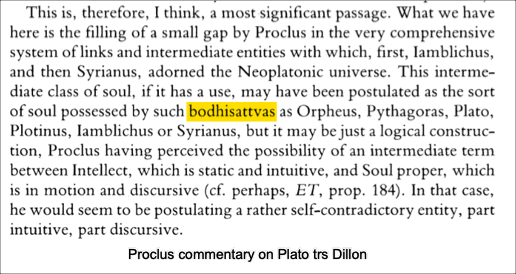
I think this is the serious danger in censoring that sort of language for fear of abuse. — Leontiskos
It's not so much about censoring it - there's no prohibition on discussions of it, it's more that there's a kind of tacit disapproval because of its association with religion and or with cultic ideas.
I notice in the IEP article on Pierre Hadot, whom I've already brought up, says that 'Hadot acknowledges his use of the term “spiritual exercises” (in relation to traditional philosophy) may create anxieties, by associating philosophical practices more closely with religious devotion.' That's why I made a point of mentioning Nagel's essay on the fear of religion.
My view is that the process of secularisation in the West is a major factor in many of these debates. But it's like a tectonic plate movement - hard to detect on the surface but still capable of producing violent effects. I'm still working through it, and will probably never succeed in coming to a conclusion, all the more so as I'm very much a product of the very forces that I'm critiquing. :yikes: -
Israel killing civilians in Gaza and the West BankI am going to assume it was an attack by Israel — FreeEmotion
Without wanting to get involved in a big argument over it, I think that an unsafe assumption. The emerging story of a failed missile launch from the cemetery behind the hospital, by a group called Islamic Jihad (not Hamas, but allied with them) was the likely cause. As others have pointed out above, if it had been a bomb dropped from an aircraft, there would have been far greater structural damage and a crater. What the pictures show is consistent with a firestorm caused by an exploding missile. -
Israel killing civilians in Gaza and the West BankJust looking at the BBC report from the scene, I'm not seeing a big crater, and I'm not seeing lots of demolished buildings and damaged buildings. Rather it looks like a lot of people camped in the hospital courtyard, and a rather modest explosion in a crowded place. So it does rather look to me as if it was more likely a palestinian missile gone horribly wrong. — unenlightened
The twitter thread posted earlier on with the sub-titled comments from Hamas operatives, says that it was a missile that had launched from the cemetery immediately behind the hospital, and that it malfunctioned and hit the hospital immediately after firing. The implication being that, apart from whatever explosive charge it carried, it also would have been full of rocket fuel, which would explain the massive fireburst that was captured on video. Here it is again:
Whoever was responsible, whatever the cause, the suffering on the ground is absolutely heart-breaking. (It should be noted that Islamic Jihad denies this account. The authenticity of the recording will also be questioned.) -
Dualism and InteractionismBy the same token, unless someone is wise they may be wrong when attributing wisdom to Aristotle or anyone else. Is there anyone here able to make that determination? — Fooloso4
I don't think one has to claim to be enlightened (as I certainly am not) in order to see evidence of what it comprises in the literature. -
Dualism and InteractionismI do think when people reach for the term 'higher truth' we should question this as it can be used in a range of ways. And it can be used to shut down discussions. As in, 'There are higher truths you don't understand, Son.' — Tom Storm
Well, true, it's a magnet for abusers of all kinds, as we seen amply and tragically demonstrated many times over. But as Rumi said 'there would be no fool's gold if there were no actual gold'. The subtle principle at work in any real philosophical spirituality is in the transformative value of insight. Seeing how things (your life, what you hold dear, the world) really are. The kind of understanding Carl Jung was always concerned with. Spinoza was mentioned earlier in the thread: he said '“After experience had taught me the hollowness and futility of everything that is ordinarily encountered in daily life […], I resolved at length to enquire whether there existed a true good […] whose discovery and acquisition would afford me a continuous and supreme joy to all eternity.” (Treatise on the Emendation of the Intellect, para.1) He's referring to knowledge of higher truth. -
Dualism and InteractionismI have never understood what "modernism" means — Dfpolis
I understand modernity as the period between the publication of Newton's Principia and Einstein's Special Theory of Relativity (or more precisely, the legendary 1927 Solvay Conference where quantum theory was introduced). That marks the beginning of post-modernism. As for liberalism, I mean 'liberal democracy' as practiced in Western Europe, UK, Australia, Canada, etc (not 'liberalism' as distinct from 'conservatism' in the US sense.)
My observation was that there is often a tension between liberal democracies and modernism and classical/traditional philosophies. Hardly a novel observation. More on that below.
If I remember correctly, (Hadot) had an early interest in mysticism but later moved away from Plotinus’ Neoplatonism. — Fooloso4
He immersed himself in Plotinus' philosophy when writing his first book on that subject, but afterwards came to see it as overly other-worldly and ascetic. But his emphasis on 'philosophy as a way of life' and the principle of the transformation of the understanding remained constant throughout the remainder of his (and his wife, Iseltraut's) career. He has found a new fanbase amongst modern-day enthusiasts of stoicism. 'According to Hadot, twentieth- and twenty-first-century academic philosophy has largely lost sight of its ancient origin in a set of spiritual practices that range from forms of dialogue, via species of meditative reflection, to theoretical contemplation.' :clap:
If it were a matter of reasoning then, as is the case with mathematics, Aristotle could reach clear, definitive, undisputed, and necessary conclusions. But he does not, and neither has anyone else. — Fooloso4
Says you! There are many quite unambiguous declarations of the signficance of wisdom and the contemplation of the first principles in the Nichomachean Ethics:
Hence it is clear that Wisdom must be the most perfect of the modes of knowledge. The wise man therefore must not only know the conclusions that follow from his first principles, but also have a true conception of those principles themselves. Hence Wisdom must be a combination of Intelligence and Scientific Knowledge: it must be a consummated knowledge of the most exalted objects — Nichomachean Ethics
Which, according to you, neither Aristotle nor anyone else has ever had!
I specifically said that I didn't think it was Wayfarer's intention to be patronising, but this kind of argument can easily been understood that way. — Tom Storm
I didn't take your comment pejoratively - but at the same time, there's a cultural dynamic at work in this topic. This goes back to one essential plank of liberal democracy, namely, that everyone is equal. In practice, this is often taken to extend to value judgement as well. Secular culture tends to level everyone in that sense - it questions any form of charismatic authority or any sense of there being a higher truth. Even the expression 'higher truth' is generally a red flag on this site, it invariably provokes not just criticism but often overt hostility. And it's because, in our culture, the individual is the arbiter of values, and science the arbiter of truth. (As I said, 'nihil ultra ego' - 'nothing beyond self' ;-) ) Ethical truths are subjective (decided by the individual) and relative (pertaining to cultural context. See Does Reason Know what it is Missing?, Stanley Fish, NY Times.) -
Israel killing civilians in Gaza and the West BankWasn't Hamas and Islamic Jihad fighters killing every Israeli they could find and reach already highly inflammatory? — ssu
Of course it is. Do you think my recommendation to 'avoid inflammatory language' amounts to propaganda? Considering the amount of vitriol already sorrounding this issue, I'm simply advising moderation in speech. -
Israel killing civilians in Gaza and the West BankLet's be careful what we say in this thread. The whole issue is highly inflammatory, and there's not a lot of point in fanning the flames, as if there's not enough people doing that already. What I'm interested in is factual claims about the source of this atrocity. The Israel Foreign Ministry video is in Arabic, so it tells me nothing. Let's see if anything more definite comes to light.
-
Absolute nothingness is only impossible from the perspective of somethingWolf must have affected greatly the Kant's system, but probably in opposition way? — Corvus
My knowledge of him is extremely scanty, but I know Kant depicted him as a dogmatist, and I get the sense of what he means by that. That article I linked to said he started his career wanting to demonstrate theology with mathematical precision, which doesn't seem promising. My knowledge of Kant isn't that great either, but I think at least I get the point of his 'Copernican revolution in philosophy'. Anyway this isn't a Kant thread so let's not pursue that line of conversation. -
Absolute nothingness is only impossible from the perspective of somethingHe was torpedoed by Kant, although that article doesn’t really seem to capture that.
-
Israel killing civilians in Gaza and the West BankSomehow the single most powerful rocket fired from Gaza ever, that could destroy whole buildings, misfired and hit one of the few hospitals in Gaza. — ssu
Has this been documented? I read that Israel showed then deleted a video showing an apparent missile strike when it was found to have been timestamped after the strike.
I mean it’s the most thoroughly dreadful crime whoever is responsible but the ramifications of it being an Israeli strike are truly horrendous. -
Absolute nothingness is only impossible from the perspective of somethingSpeaking of ‘committing texts to the flames’:
(The philosopher Christian) Wolff became known throughout Europe as a martyr of reason and the Enlightenment, thereby only increasing his fame. The Crown Prince of Prussia, Friedrich II (later Frederick the Great), commissioned a French translation of Wolff’s so-called ‘German Metaphysics’ in 1736, and rumour has it that he read it so often that his pet monkey Mimi threw it into the fire out of jealousy. — The Great, Forgotten Wolff
Perhaps she was a kindred spirit of Hume’s :-) -
Dualism and InteractionismI should add, I'm not of the view that the kind of values I'm seeking ought to be imposed on others, or that they necessarily form the basis for a political philosophy (although there will be some connection.) It's more a matter of seeing that the traditional virtues associated with philosophy are at odds with today's materialistic culture in many respects. But at the same time, I also acknowledge that this culture provides the freedom to explore and pursue these kinds of aims, even if, at the same time, it conditions you against it, by encouraging a hedonistic attitude. It's a kind of inconvenient truth.
Oh, and speaking of Hadot, just acquired this splendid volume. -
Dualism and InteractionismThe question is how can we tell if someone has the right virtues or attributes? — Tom Storm
It’s a shame you see it like that but I don’t want to derail the thread any further. I suppose I could say that I’m a moral realist, I believe there is a vertical dimension, the dimension of value, and not just as a matter of subjective opinion. -
Dualism and InteractionismNot your intention, but that does sound like elitist, status seeking dogma. — Tom Storm
It's incompatible with //some aspects of// democratic liberalism. That's why most of the exponents of the various forms of the perennial philosophy are hostile to modernism. In modern culture, the only arbiter of truth is what is objectively measurable and subject to social consensus, but that's also the source of the 'meaning crisis' that Vervaeke is constantly webcasting about. This shows up in the fact/value dichotomy first elaborated by David Hume (not coincidentally.) The motto of modern culture is 'nihil ultra ego'. -
Dualism and InteractionismAn insight that requires virtue and reason to obtain; not commonly found amongst the uneducated or untrained; the aim of the philosophic life.
See e.g. these excerpts from the Nichomachean Ethics on 'contemplation as the highest form of happiness'. Also the entry under Hadot on 'the askesis of desire'. -
Dualism and InteractionismI think we also agree that is not something we should argue about since neither of us knows — Fooloso4
I’m not putting myself up as an exemplar. Like you, I’m citing sources - for instance, Pierre Hadot's, whose interpretation varies considerably from yours, I think. Exclusive emphasis on negation, that nobody can know anything like a higher truth, neglects the sapiential dimension of ancient philosophy. -
Dualism and Interactionismwhat suspicions or conclusions follow from an awareness of the limitations of knowledge in exploring fundamental questions? I think the answer is: human beings are not wise. — Fooloso4
But wisdom is the aspiration, surely. Otherwise, what’s the point? I would put it in more traditional terms - that there is really such a thing as the philosophical ascent, that there is a way of knowing that requires a way of being, but that this is something that has to be done (praxis) not simply spoken (theoria.) So the philosopher (better still ‘the sage’) points the way but the aspirant has to walk it, and won’t really see what it is, until that is done. That’s why it can’t be explained in plain language and also why a lot of Plato’s teaching was said to be verbal only. (Compare with the meaning of ‘Upaniṣad’, Hindu philosophical discourses - the etymology of the word is from ‘sitting up close’, i.e. the chela (student) attending closely to the instruction of the guru (teacher)).
One more point - I don’t know Aristotle’s view, but in respect of knowledge, Plato and Socrates both seemed to strongly endorse ‘innate knowledge’ possessed by the soul prior to birth, which could be recovered by anamnesis. They certainly weren’t empiricist in the modern sense of attributing all knowledge to sensory experience. Plato and Parmenides were the originators of rationalist philosophy. -
Freedom and Processif we accept that physical regularities occur because of "what the universe is," then it would seem like it is self-determining... — Count Timothy von Icarus
…for argument’s sake. -
Dualism and InteractionismThe wise man according to Socrates is the man who knows when he does not know. — Fooloso4
There is a distinction between mere ignorance - not knowing specific facts - and learned ignorance, an awareness of the limitations of knowledge in exploring fundamental questions such as the nature of justice or the idea of the good. The latter approach is apophatic - which ties in with your ‘philosophy between the lines’ thesis, as apophaticism gestures towards what can’t be simply stated in plain speech, knowing that any propositional formulation will miss the mark.
There is no being a subject without having an intentional relation to an object known — Dfpolis
Schopenhauer also affirms this.
the collapse of the wave function has nothing to do with consciousness. — Dfpolis
But it definitely has something to do with the act of measurement, does it not? “No phenomena is a phenomena until it is observed”, said Bohr. -
Freedom and ProcessThis seems to be the case to me if we also allow that the "laws of nature" are not external forces that cause the universe to evolve in such and such a way, but are rather merely descriptions of the intrinsic properties of the universe. — Count Timothy von Icarus
However the fundamental constraints and ratios, per Martin Rees’ ‘Just Six Numbers’, seem very like prior conditions required for anything to evolve. In the book, Rees discusses six dimensionless constants (often referred to as the six numbers) that are fundamental to the structure and behavior of our universe. These constants determine the properties of the universe and its destiny, and slight alterations in their values would lead to a radically different universe.Rees argues that small alterations in any of these numbers would result in a universe where life as we know it would be impossible. His book is closely related to the ‘naturalness problem’ in cosmology and physics. Meaning that the Universe, at least as far as can be discerned, is dependent on these specific ratios and values which appear to be causal rather than consequential, throwing into question the extent to which the universe can really be said to be ‘self-determining’.
Wayfarer

Start FollowingSend a Message
- Other sites we like
- Social media
- Terms of Service
- Sign In
- Created with PlushForums
- © 2026 The Philosophy Forum