
-
Exploring non-dualism through a series of questions and answersIncidentally I read an Aeon essay some time back from a philosopher who is interested in dialetheism, Graham Priest, on Buddhist logical paradoxes, you can find it here https://aeon.co/essays/the-logic-of-buddhist-philosophy-goes-beyond-simple-truth . (I couldn't really understand it but others might find it helpful.)
-
Exploring non-dualism through a series of questions and answersNāgārjuna's philosophy posits that the ultimate truth is not a separate, higher realm of reality but is instead the real nature of the conventional world when it is seen without the distortions of conceptual thought. In other words, ultimate reality is not an alternative to conventional reality; it is the insight into the emptiness (śūnyatā) of inherent existence in all phenomena. This realization leads to the understanding that what we consider to be fixed and separate entities are actually interdependent and devoid of intrinsic nature (svabhava).
Thus, the distinction between conventional and ultimate truths is a skillful means (upāya) to guide beings towards enlightenment. For unenlightened beings, the world appears in dualities and distinctions. For those who have realized enlightenment, however, these dualities are seen as expressions of a single, indistinguishable reality that is empty of inherent existence. The "two truths" are therefore not ultimately separate; they are two ways of perceiving the same reality, contingent upon one's level of insight.
Like I said (somewhat tongue-in-cheek) 'burn after reading' ;-) -
Exploring non-dualism through a series of questions and answerswhat I was fishing for here is any rational criticism of the presented necessity that non-dualism, this regarding the world as it’s known, entails a duality between a) a real (or ultimately real) and non-dual fundamental essence and b) a contingent fundamental essence of phenomena (etc.) which brings about duality in the world and which is ultimately illusory in full. — javra
I haven't read Loy's book in full, either, but I would be surprised if he doesn't cover this.
But the epistemology of non-dualism is a very subtle and difficult thing to understand. That's because at its core, it arises out of dhyana, meditative stillness, which is the practical negation or transcendence of self-and-other. The early Buddhist texts constantly repeat a fundamental theme, which is that of dependent origination, the causal chain which leads to suffering, and the seeing through of it by insight. But the insight is always inseperable from praxis - the three legs of the tripod are sila, prajna, samadhi, meaning right action, right wisdom, and meditative absorbtion. But that is not presented or understood as being something easy to attain or understand, it requires constant application and deep commitment. So it's a form of practice.
Actually if you read Pierre Hadot, ancient philosophy in the West was also like this:
For Hadot...the means for the philosophical student to achieve the “complete reversal of our usual ways of looking at things” epitomized by the Sage were a series of spiritual exercises. These exercises encompassed all of those practices still associated with philosophical teaching and study: reading, listening, dialogue, inquiry, and research. However, they also included practices deliberately aimed at addressing the student’s larger way of life, and demanding daily or continuous repetition: practices of attention (prosoche), meditations (meletai), memorizations of dogmata, self-mastery (enkrateia), the therapy of the passions, the remembrance of good things, the accomplishment of duties, and the cultivation of indifference towards indifferent things. Hadot acknowledges his use of the term “spiritual exercises” may create anxieties, by associating philosophical practices more closely with religious devotion than typically done. Hadot’s use of the adjective “spiritual” (or sometimes “existential”) indeed aims to capture how these practices, like devotional practices in the religious traditions, are aimed at generating and reactivating a constant way of living and perceiving in prokopta (=preceptors, students), despite the distractions, temptations, and difficulties of life. — IEP
Secondly, the relationship between reality and illusion is also very subtle. In the Madhyamaka of Nāgārjuna, there is 'the doctrine of two truths', the domain of conventional reality, Saṃvṛtisatya, in which all sentient beings are situated, but then the domain of ultimate reality, Paramārthasatya which is the higher truth perceived by the Buddhas. But part of this doctrine is that (1) these are not ultimately two and also that (2) the principle of emptiness (śūnyatā) is also empty.
There's a saying in both Advaita and Buddhism, that wisdom-teachings are like the stick you use to stoke the fire. Once the fire is burning, then the stick can be thrown into it. Like, 'burn after reading'. All of that goes back to the Buddha's 'parable of the raft', which compares the teaching to a raft, used to cross the river of suffering, but not to be clung to. See the Zen calligraphy, Hui Neng tearing up the Sutras:
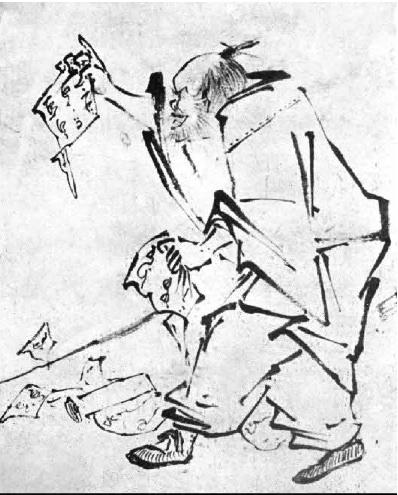
I think the way to see all this, is that awakening is something like a deep gestalt-shift, a complete shift or reversal of perspective, so that from the 'conventional' perspective, there are 'two truths', conventional and ultimate, but from the 'higher' perspective, the distinction vanishes. The world appears as multiplicity to the conventional mind, but is seen as being ultimately one in the unitive consciousness. Of course that is a very hard thing to grasp also, as the Buddha says to one of his philosophical interlocutors, 'Deep, Vaccha, is this dharma, hard to see, hard to realize, tranquil, refined, beyond the scope of conjecture, subtle, to-be-experienced by the wise.' -
US Election 2024 (All general discussion)Meanwhile Trump is holding a press conference on Election Integrity on Friday, some he’s said to ‘care deeply about’ :vomit:
-
Rings & BooksI recommend Pierre Hadot's "Philosophy as a Way of Life" — Fooloso4
From which:
Philosophy in antiquity was an exercise practiced in each instant. It invites us to concentrate on each instant of life, to become aware of the infinite value of each present moment, once we have replaced it with the perspective of the cosmos. The exercise of wisdom entails a cosmic dimension. Whereas the average person has lost touched with the world, and does not see the world qua world, but rather treats the world as a means of satisfying his desires, the sage never ceases to have the whole constantly present to mind. He thinks and acts within a cosmic perspective. He has the feeling of belonging to a whole which goes beyond the limits of his individuality. In antiquity, this cosmic consciousness was situated in a different perspective from that of scientific knowledge of the universe... . Scientific knowledge was objective and mathematical, whereas cosmic consciousness was the result of spiritual exercise. — Pierre Hadot, PWL, pa 273
(Incidentally just prior to this passage, Hadot says Descartes and Spinoza remained faithful to philosophy as 'the practice of wisdom'. Spinoza, in particular, despite being claimed as the harbinger of secular naturalism, was still within the current of Judaic mysticism, and his 'intellectual love of God' very much in keeping with Hadot's depiction of cosmic consciousness.)
Compare also Thomas Nagel:
Plato was clearly concerned not only with the state of his soul, but also with his relation to the universe at the deepest level. Plato’s metaphysics was not intended to produce merely a detached understanding of reality. His motivation in philosophy was in part to achieve a kind of understanding that would connect him (and therefore every human being) to the whole of reality – intelligibly and if possible satisfyingly. — Secular Philosophy and the Religious Temperament -
Rings & Booksthere is no problem conceiving something immaterial that exists by itself unless you are a close-minded physicalist. — Lionino
What kind of 'something'? That's the rub. I'm sure the majority view is expressed by Janus here:
If the physical is naturally understood to have substantial or substantive existence, and it is upon that idea of substance that the notion of reality is founded, and the idea of a mental substance is untenable, then what justification would we have for saying that anything non-physical is real? — Janus
The notion is - mind is the product of the brain, which in turn is the product of evolutionary biology over many aeons of time. Rational sentient beings such as ourselves are therefore a very late arrival in the grand scheme, which is otherwise mindless. Isn't that what practically any sound person believes? -
Exploring non-dualism through a series of questions and answers
You might find this a useful resource: Nonduality, David Loy, a .pdf copy of his book by that name, based on his PhD. You can find more about him on davidloy.org.(FYI, this correlates with parts of something I'm currently working on.) — javra -
Rings & BooksWhat is your claim? — Banno
Again - my claim is that due to the form that Cartesian dualism assumed, that there is a kind of widespread, implicit dualism of mind and body or spirit and matter that is endemic in culture. And that the untenability of the idea of a 'thinking substance' or 'thinking thing' has had huge influence of philosophy of mind ever since, it is one of the principal causes of the dominance of physicalism in mainstream philosohpy (remember your surveys in which only 1% of respondents hold to alternatives to physicalism?) Which is implicit in the question you asked. -
Rings & BooksYou do understand that in your quote, Ryle is setting out his target, not defending a doctrine. — Banno
His target is, explicitly, Cartesian dualism of mind and body. That's the starting point of his book Concept of Mind. Ryle's solution to it is basically beaviourism - that categorisation of mind and body as two separate entities is a category mistake (which is the origination of that term), but then, the philosophy of mind that comes from that is essentially behaviourist. -
Rings & BooksExplaining how the ghost interacts with the machine is your problem. — Banno
Descartes' dualism is the origin of Ryle's 'ghost in the machine', surely. 'Analytic philosophy' is not a school of thought, but the English-language philosophers that I mentioned are operating within the overall paradigm which Nagel spells out.
There is a doctrine about the nature and place of the mind which is prevalent among theorists, to which most philosophers, psychologists and religious teachers subscribe with minor reservations. Although they admit certain theoretical difficulties in it, they tend to assume that these can be overcome without serious modifications being made to the architecture of the theory.... [The doctrine states that] with the doubtful exceptions of the mentally-incompetent and infants-in-arms, every human being has both a body and a mind.... The body and the mind are ordinarily harnessed together, but after the death of the body the mind may continue to exist and function. — Gilbert Ryle -
Rings & BooksWell, I gather you more or less agree with substance dualism, a notion that I cannot see as coherent. I decide to move my hand, the damn thing moves; I take the drugs, the pain goes away. I can't see how such facts can be made to fit Descartes without folly. — Banno
Consider this passage from Thomas Nagel "Mind and Cosmos":
The modern mind-body problem arose out of the scientific revolution of the seventeenth century, as a direct result of the concept of objective physical reality that drove that revolution. Galileo and Descartes made the crucial conceptual division by proposing that physical science should provide a mathematically precise quantitative description of an external reality extended in space and time, a description limited to spatiotemporal primary qualities such as shape, size, and motion, and to laws governing the relations among them. Subjective appearances, on the other hand -- how this physical world appears to human perception -- were assigned to the mind, and the secondary qualities like color, sound, and smell were to be analyzed relationally, in terms of the power of physical things, acting on the senses, to produce those appearances in the minds of observers. It was essential to leave out or subtract subjective appearances and the human mind -- as well as human intentions and purposes -- from the physical world in order to permit this powerful but austere spatiotemporal conception of objective physical reality to develop. — Pp35-36
Notice the implicit division between the objective and measurable, and the subjective and internal. There's the origin of the problem, in the Cartesian 'bifurcation of nature'. There are ways of mending the split, but I feel you won't find them in your usual sources of Quine, Austin, Davidson, and so on, as they still operate within those basic parameters and assumptions (Although it might be noted that Nagel is also an analytic philosopher, although dissident from the mainstream.) -
Rings & BooksThose are the kinds of questions that Princess Elisabeth of Bohemia put to Descartes (here.) It seems Descartes didn't really have very good answers. But then, Descartes was a pioneer, he was attempting to explore a very difficult subject from a truly novel perspective. Even though Husserl critiques Descartes, he still recognised him as the founder of transcendental philosophy.
-
Information and RandomnessPerhaps "the randomness and information are essentially the same thing" simply means that you cannot compress something that is random or you will lose information (about the random sequence). At least that is the way I understand it. — ssu
You can't compress a random sequence of characters or a random collection of objects, you can only describe it, and that description will be 1:1. Whereas as soon as it is ordered, that order can be leveraged to create meta-data about the object.
I don't know if I agree with Verisatium's reasoning in this regard (that's the video that is referred to above which was the source for this thread) - chaos doesn't contain or convey information of any kind. It can't be compressed but how is that a criterion for 'information-bearing'? At 3:17 where he says that a completely compressed file is completely random - not sure about that, either. Otherwise, how could it be de-compressed, or intrepreted, at the receiving end? If it were totally random, then there'd be nothing to interpret. So I'm still not sold on the 'information=entropy' equation.
But I like that he recognises that quantum physics undermines LaPlace's daemon. Kudos for that. -
Rings & BooksThen there's "exist". Wikipedia tells us that "The word "existence" entered the English language in the late 14th century from old French and has its roots in the medieval Latin term ex(s)istere, which means to stand forth, to appear, and to arise." (Note that our use of the word has absolutely no basis in ancient Rome.) — Ludwig V
There's an article on the IEP, 17th Century Theories of Substance, which says:
In contrast to contemporary philosophers, most 17th century philosophers held that reality comes in degrees—that some things that exist are more or less real than other things that exist. At least part of what dictates a being’s reality, according to these philosophers, is the extent to which its existence is dependent on other things: the less dependent a thing is on other things for its existence, the more real it is.
I think the background to this 'degrees of reality' was the 'scala naturae', the great chain of being, which provided a vertical dimension, with matter at the lowest level and the Divine Intellect at the top (and transcendant to existence). It is virtually extinct in subsequent Western thought, although I believe references to it are still found in some of the modern Thomists, for example in Jacques Maritain's rather daunting book The Degrees of Knowledge.
Lionino is right, however that it arrived in English from Old French. — Ludwig V
Descartes' Principia Philosophia was published in Latin, in which I presume the word 'substantia' would have been used (although I'm open to correction).
As for the meaning of ousia in Greek, there's an entry in IEP on its use in Plato and Aristotle here. Joe Sachs makes the observation:
And so a word (i.e. 'substantia') designed by the anti-Aristotelian Augustine to mean a low and empty sort of being turns up in our translations of the word whose meaning Aristotle took to be the highest and fullest sense of being. Descartes, in his Meditations, uses the word substance only with his tongue in his cheek; Locke explicitly analyzes it as an empty notion of an I-don’t-know-what; and soon after the word is laughed out of the vocabulary of serious philosophic endeavor. It is no wonder that the Metaphysics ceased to have any influence on living thinking: its heart had been cut out of it by its friends.
(My personal heuristic is that classical metaphysics allows for a distinction between what exists and what is real which are generally assumed to be coterminous. I've had many lengthy and often vexed debates about this topic here over the years, centered around my claim that the term 'ontology' is concerned with 'the meaning of being', and not with 'the nature of what exists', which is the proper concern of the natural sciences. During the course of this debate, I was sent a reference to an apparently classic paper on this subject, The Greek Verb "To Be" and the Problem of Being, by Charles Kahn, which I feel actually rather supported my argument.)
Is it possible to be too preoccupied with defending Descartes to see Midgley's point? — Banno
I think Midgley makes a good point, and I generally enjoy reading her work, but I'm always interested in discussions of Descartes. -
Rings & BooksSo his position is a bit more complicated than the simplified version that is usually considered in the literature. (And I do not know how to represent it more accurately.) — Ludwig V
Point taken, and an important distinction. Nevertheless the depiction of the 'thinking thing' is very much the residue of his philosophy in popular culture. And it should be added, the fact that he found it necessary to try and account for the interaction between mind and body through the pineal gland, is also indicative of the sense in which he treats the mind as something objectively existent.
Here is my reference for this derivation. If you have an alternative derivation, do tell. -
Are there primitive, unanalyzable concepts?You could, but I don’t think that’s what the op is interested in. (In fact on further reflection it’s pretty hard to work out what it is asking.)
-
Are there primitive, unanalyzable concepts?Is there a philosophical perspective on language/meaning/truth/metaphysics that acknowledges this weak inter-definability and balance of dependence/independence of our core concepts? — substantivalism
No, I hadn't heard of him, although looked up his Wikipedia entry now you've mentioned him. But in some ways, what you're point to is the way dialectic was conceived in the classical tradition isn't it? You mention Heraclitus and Parmenides - wasn't Plato very much engaged in the dialectic between those two apparent contraries? All very deep and difficult questions. -
What is a strong argument against the concievability of philosophical zombies?No reason it can't do those things about itself. No reason it can't be the object of its own examination. — Patterner
There's a very good reason, which is that a considerable proportion of its activities are sub- and unconscious. -
Are there primitive, unanalyzable concepts?Frege refers to real numbers as 'primitive concepts' i.e. cannot be reduced to, or explained in terms of, another concept. I wonder if basic concepts in logic are similar, such as the law of the excluded middle. We call upon such principles to explain higher-level or contingent facts.
This pecularity indicates, by my lights, that ‘being’ is a primitive concept and, as such, is absolutely simple, unanalyzable, and (yet) still perfectly valid. — Bob Ross
I recall that Aristotle considers the different meanings of the verb 'to be' in the Metaphysics. From the SEP essay on same:
But ‘being’, as Aristotle tells us in Γ.2, is “said in many ways”. That is, the verb ‘to be’ (einai) has different senses, as do its cognates ‘being’ (on) and ‘entities’ (onta). So the universal science of being qua being appears to founder on an equivocation: how can there be a single science of being when the very term ‘being’ is ambiguous? .... — Aristotle's Metaphysics
Here you can see the beginnings of what was to become a long history of debate over substance metaphysics, and the meaning of being is central to it.
do these so-called, alleged, primitive concepts need to be either (1) capable of non-circular definition or (2) thrown out? — Bob Ross
Every philosophy, even everyday language, must include some primitive concepts or else it would collapse into relativism and circularity.
Are there pure and unanalyzable concepts? Put me in the affirmative/similar view column, re: the categories of transcendental philosophy. — Mww
Would you include the so-called 'primary intuitions' of time and space? (It might be their very 'primitiveness' that makes them so hard to explain!)
A couple of refs: Frege on Knowing the Third Realm, Tyler Burge
The Greek Verb 'To Be' and the Problem of Being, Charles Kahn -
Rings & BooksThanks! Interesting, although I had to call on Google Translate as I'm not fluent in French
You obliged me to warn me of the passage from Saint Augustine, to which my "I think, therefore I am" [has] some connection; I read it today in the Library of this City, and I truly find that he uses it to prove the certainty of our being, and subsequently to show that there is some image in us of the Trinity, in what we are, we know that we are, and we love this being and this knowledge which is in us; instead I use it to make it known that this self, which thinks, is an immaterial substance*, and which has nothing corporeal; which are two very different things. And it is something which in itself is so simple and so natural to infer, that we are, from what we doubt, whether it could have fallen under the pen of anyone; but I am still very happy to have met with Saint Augustine, even if it was only to shut the mouths of the little minds who have tried to rethink this principle.
*As noted previously, I think 'immaterial subject' conveys the gist better than 'immaterial substance' or 'immaterial thing' which I feel is oxymoronic. This anomaly comes from the translation of the Greek 'ouisia' into the Latin 'substantia' and then the English 'substance'.
Many years ago I read the Teachings of Ramana Maharishi, who was an Advaita sage (died 1960). Throughout his teachings, he makes a connection between the Self (ātman) of Vedanta and the 'I AM THAT I AM' of the Bible. According to Vedanta, this 'I AM' is the 'cosmic self', from which individual beings become alienated through attachment to the physical senses and body. (His website is here.) -
Rings & BooksMy take is that Descartes, qua 'the first modern', introduces the individual as the arbiter of reality. It's not co-incidental that he is categorised with Newton and Galileo as one of the harbingers of modernity. It's the introduction of our modern subject-object consciousness and 'the reign of quantity' which is fundamental to liberal individualism.
-
Rings & BooksI've been meaning to look at Parfit but, you know, too many books.... :fear:
-
Rings & BooksI see what you're getting at, and have entertained much of the same kind of idea. But recall in the original Latin, the phrase is 'cogito ergo sum', where 'Cogito' is in the first person, i.e. 'I think' but as Latin is an inflected language, the 'I' is implied rather than articulated.
Ironically, perhaps, I'm aware of a book on the interface between Buddhism and psychoanalysis called 'Thoughts without a Thinker', Mark Epstein (though haven't read it). Buddhist philosophy is known for its 'no-self' doctrine, i.e. there is no permanent or separate self which exists apart from the flow of experiences. That seems congruent with this claim:
Because we ascribe thoughts to thinkers, we can truly claim that thinkers exist. But we cannot deduce, from the content of our experiences, that a thinker is a separately existing entity. — Parfit, Reasons and Persons Sec. III
(However, the denial that there is an agent or subject is also rejected by Buddhism, see this reference.)
I think the issue all revolves around objectification. To say what something is, is to identify it, which requires that it exists as an object to a subject. (It's an apple! a tree! a chair!) But the subject who thinks is never an object as such. Which is why I say that Descartes' error is not in the basic intuition of being, but in the 'objectification' of the thinking subject as 'res cogitans', a thinking thing. (I think this kind of analysis is made much more explicit in Buddhism. As it happens, I did an MA thesis on the subject in Buddhist Studies. ) -
Rings & Books"We could give what I call an impersonal description" ~ Parfit, Reasons and Persons Sec. III;894990" — AmadeusD
Wouldn't that be 'a view from nowhere'? An idealised objectivity? -
Mindset and approach to reading The Republic?The carpenter knows that his personal 'form of bed', the formula which he follows in building a bed, is not the most perfect, ideal bed possible, it is not the divine form of bed. — Metaphysician Undercover
Quite right.
It is not, as you say, the "attainment of this insight" or an "innate capacity for enlightenment". It is the capacity to know. — Fooloso4
But there are different kinds of knowing, as spelled out in the Analogy of the Divided Line. And the specific kind of knowledge that characterises the Philosopher is spelled out in Book 6:
We must accept as agreed this trait of the philosophical nature, [485b] that it is ever enamored of the kind of knowledge which reveals to them something of that essence which is eternal, and is not wandering between the two poles of generation and decay. — Plato, Republic, Book 6
The 'two poles of generation and decay' are contrasted against 'something of that essence which is eternal'. Again it bears comparison to Indian philosophy (with which it was in fact contemporaneous). I understand all of this sounds too 'spiritual' in today's terms. It is felt to be superseded, a sentiment belonging to a vanished past. But as I see it, the spiritual orientation of Plato's philosophy has been deprecated in modern culture, because it is, as Lloyd Gerson says, antagonistic to naturalism, which is the prevailing orthodoxy.
I know you will probably not agree, but I'm used to being in the minority in these matters. -
I am deeply spiritual, but I struggle with religious faithGod could appear in actuality — Astrophel
Christians believe that this happened already, with the Incarnation. -
Rings & BooksIt's sometimes mentioned that Augustine anticipated Descartes by centuries:
But who will doubt that he lives, remembers, understands, wills, thinks, knows, and judges? For even if he doubts, he lives. If he doubts where his doubs come from, he remembers. If he doubts, he understands that he doubts. If he doubts, he wants to be certain. If he doubts, he thinks. If he doubts, he knows that he does not know. If he doubts, he judges that he ougth not rashly to give assent. So whoever acquires a doubt from any source ought not to doubt any of these things whose non-existence would mean that he could not entertain doubt about anything. — Augustine, On the Trinity 10.10.14 quoted in Richard Sorabji Self, 2006, p.219
I think the commonly-held view, that this entails solipsism, is unnecessary: I don't think that by it, either Augustine or Descartes believed that only one's own existence is apodictic, although that is the way it often seems to have been taken, including by Midgley. The point was, by doubting everything that he had hitherto taken for granted (the suspension of judgement, epochē) to arrive at an indubitable fact - which is that he must exist, in order to doubt (or affirm) anything (as Augustine also says). There is thought, therefore a thinking subject.
I see the major flaw with Descartes' reasoning as positing 'a thinking thing' (res cogitans) thereby objectifying or reifying the thinker or subject (to reify is exactly 'to make a thing of'). Husserl says in Crisis of the European Sciences that
Descartes does not make clear to himself that the ego, his ego deprived of its worldly characteristics through the epochē, in whose functioning cogitationes the world has all the ontic meaning it can ever have for him, cannot possibly turn up as a subject matter in the world, since everything that is of the world derives its meanings precisely from these functions - including, then, ...the ego in the usual sense. — Crisis of the European Sciences, p82
This is what I believe leads to the 'ghost in the machine' criticism of Ryle and others - the 'thinking thing' conceived literally as a kind of ectoplasmic substance. This is the problem of 'objectification' which becomes a major theme in modern philosophy and the criticism of it by phenomenologists such as Husserl. -
Information and RandomnessDo you think Deacon's "constitutive absence"*3 is the missing link between Logical truth and Empirical fact*4 regarding Abiogenesis? — Gnomon
The relationship of logical necessity and physical causation is a deep topic and one of interest to me. It is fundamental to Hume’s ‘Treatise’ where he argues that deductive proofs are true as a matter of definition, whilst facts derived from observation have no such necessity. It’s the distinction between observed facts (a posteriori, known by experience) and deductions (a priori, matters of definition), pretty much in line with your point 2 above.
But then, Kant believed that his ‘answer to Hume’ dealt with the issue with the concept of facts that are 'synthetic a priori' (definition).
I suppose It comes down to the definitional difference between Ideal (what ought to be) and Real (what is) causation. — Gnomon
I think where it shows up is in Wigner's unreasonable effectiveness of mathematics in the natural sciences. Look at the way that physics applies mathematical logic to physical objects and forces. It is fundamental to modern scientific method. This is, of course, a dense metaphysical question, and generally speaking modern philosophy is averse to metaphysics.
See my earler thread Logical Necessity and Physical Causation for a discussion.
My point regarding Terrence Deacon in particular is that it appears to me that he's attempting to bridge this gap by explaining how it is that symbolic logic can arise as both a consequence and cause in the physical order of things. -
Information and RandomnessHey, I've quoted your response to me in the Abiogenesis thread to here, as it's more relevant to this topic, and as we're discussing Terrence Deacon in both threads.
It occurs to me that maybe you could say that Deacon is trying to establish the linkage between physical and logical causation. Ran it by ChatGPT, it says that it's feasible.
— Wayfarer
I had to Google "logical causation". What I found was not very enlightening*1.
Apparently, Logical Causation is what Hume said was "unprovable"*2, perhaps in the sense that a logical relationship (this ergo that) is not as objectively true as an empirical (this always follows that) demonstration. Logic can imply causation in an ideal (subjective) sense, but only physics can prove it in a real (objective) sense.
Of course, even physical "proof" is derived from limited examples. So any generalization of the proven "fact" is a logical extrapolation (subjective) from Few to All, that may or may not be true in ultimate reality. I suppose It comes down to the definitional difference between Ideal (what ought to be) and Real (what is) causation. How is linking the two realms (subjective logic and objective science) "feasible"? Isn't that where skeptics confidently challenge presumably rational conclusions with "show me the evidence"?
Do you think Deacon's "constitutive absence"*3 is the missing link between Logical truth and Empirical fact*4 regarding Abiogenesis? I'm afraid that proving a definite connection is above my pay grade, as an untrained amateur philosopher. What is ChatGPT's philosophical qualification? :grin:
*1. What is the difference between logical implication and physical causality? :
Logical implication refers to the relationship between two statements where the truth of one statement guarantees the truth of the other. Physical causality, on the other hand, refers to the relationship between events where one event is the direct cause of another event.
https://www.physicsforums.com/threads/logical-implication-vs-physical-causality.1015629/
*2. Hume Causation :
Hume saw causation as a relationship between two impressions or ideas in the mind. He argued that because causation is defined by experience, any cause-and-effect relationship could be incorrect because thoughts are subjective and therefore causality cannot be proven.
https://study.com/academy/lesson/the-metaphysics-of-causation-humes-theory.html
*3. Causation by Constitutive Absence :
According to Deacon, the defining property of every living or psychic system is that its causes are conspicuously absent from the system
https://footnotes2plato.com/2012/05/23/reading-incomplete-nature-by-terrence-deacon/
*4. Causal and Constitutive explanation :
It is quite natural to explain differences or changes in causal capacities by referring to an absence of certain components or to their malfunction. . . . .
most philosophers of explanation recognize that there is an important class of non-causal explanations, although it has received much less attention. These explanations are conventionally called constitutive explanations
file:///C:/Users/johne/Downloads/Causal_and_constitutive_explanation_comp.pdf — Gnomon -
Abiogenesis.It occurs to me that maybe you could say that Deacon is trying to establish the linkage between physical and logical causation. Ran it by ChatGPT, it says that it's feasible.
-
The Meta-management Theory of ConsciousnessSelves are a very interesting and vivid and robust element of conscious experience in some animals. This is a conscious experience of selfhood, something philosophers call a phenomenal self, and is entirely determined by local processes in the brain at every instant. Ultimately, it’s a physical process. — Thomas Metzinger
-
I am deeply spiritual, but I struggle with religious faithDon't worry about it! It's turning out to be a very interesting discussion.
-
Mindset and approach to reading The Republic?You could start a reading group here — Fooloso4
Might as well be this one.
A passage from Book 7, 517b ff. This comes directly after the Allegory of the Cave, when Socrates and Glaucon are discussing the 'ascent of the soul' which is allegorised in the allegory.
Compare the realm revealed by sight to the prison house, and the firelight within it to the power of our sun. And if you suggest that the upward journey, and seeing the objects of the upper world, is the ascent of the soul to the realm known by reason, you will not be misreading my intention, since that is what you wanted to hear. God knows whether it happens to be true, but in any case this is how it all seems to me. When it comes to knowledge, the form of the good is seen last, and is seen only through effort. Once seen, it is reckoned to be the actual cause of all 517C that is beautiful and right in everything, bringing to birth light, and the lord of light, in the visible realm, and providing truth and reason in the realm known by reason, where it is lord. Anyone who is to act intelligently, either in private or in public, must have had sight of this. — Republic Book 7 517b
I've often read in discussions of Plato on this forum that he never claims that Socrates or anyone has ever seen 'the form of the good'. Yet in this passage, and even though Socrates has said 'God knows whether it happens to be true', he nevertheless says 'anyone who is to act intelligently....must have had sight of this.' That seems an unequivocal confirmation that the form of the Good is something that 'must be seen'.
Further along, attainment of this insight is linked with a particular faculty:
“Yes,” I said, “but the argument is now indicating that this capacity, present in the soul of each person, the instrument by which each learns, is like an eye which cannot turn to the light from the darkness unless the whole body turns. So this instrument must be turned, along with the entire soul, away from becoming, until it becomes capable of enduring the contemplation 518D of what is, and the very brightest of what is, which we call the good. Is this so?”
Notice 'present in the soul of each person'. A cross-cultural comparison might be ventured with the 'buddha nature' of Mahāyāna Buddhism, which represents the innate capacity for enlightenment that is present in every rational sentient being, albeit obscured by 'adventitious defilements.'
The metaphor of the "whole body" turning towards the light symbolizes a comprehensive transformation that's required for the soul to achieve enlightenment. In the context of Platonic philosophy, this isn't just about shifting one's gaze or changing a single belief but involves a profound and total realignment of one's entire being — encompassing ethical, spiritual, and intellectual dimensions, something akin to conversion (albeit without the fideist overtones imposed on it by later Christianity). This turning (a.k.a. 'metanoia') is necessary for the 'eye of reason', to noetically grasp the forms, which alone are real. The principle is that understanding the forms (especially the form of the good) is not just an intellectual exercise but requires a holistic transformation of the individual's character and perspective. Hence the curriculum of the Academy required education in all the arts and sciences and also in sport and athletic achievement.
The 'realm of becoming' refers to the sensible, material world around us — a world of change, impermanence, and appearance. In contrast, the realm of "being" is the world of forms, which is unchanging, eternal, and true. Thus, turning "away from becoming" means shifting one's focus from the sensory world - current affairs, you might say - to the realm of forms. This turning reflects Plato's epistemological and metaphysical views that true knowledge and understanding come not from the sensory experience but from noetic insight into the forms, with the form of the good being the apex. The movement away from becoming, then, is a metaphorical journey from ignorance to knowledge, from shadows to reality, mirroring the ascent described in the Allegory of the Cave.
One way I've come to think of the forms as being more like principles, whereas I think they're often confused with shapes (in the same way that 'ousia' is often confused with what we think of as 'substance'.) -
I am deeply spiritual, but I struggle with religious faithI can't imagine Dennett arguing the way Henry does. — Astrophel
Of course he doesn't! What I'm saying is, Henry's description of 'barbarism' applies to, is exemplified by, Daniel Dennett's 'eliminative materialism'. In other words, in those terms, Daniel Dennett is indeed an exponent of a barbarous philosophy. Dennett, and the other materialist philosophers, are what Henry has in mind with his criticism. They're barbarians!
It is said that the Buddha was the quintessential phenomenologist — Astrophel
That is the point I was labouring a couple of pages back, which you seemed not to notice. I even included a passage from Husserl to this very point.
Is there something the matter with my prose style? Am I being obscure? -
I am deeply spiritual, but I struggle with religious faithYou might not agree, but I argue, once one sees that any of the varieties physicalism or materialism and their counterpart, idealism, is simply the worst and most inhibiting metaphysics that we all carry around with us, and it is carried with an implicit unbreakable faith. It is a reduction to dust, as Michel Henry says. — Astrophel
Agree that physicalism is the presiding and destructive myth of modernity, but not in the least that idealism is merely a 'counterpart' to, or dialectical projection of, physicalism. I've been introduced to Michel Henri on this forum and read part of his essay Barbarism, which is an an exact diagnosis of eliminative materialism.
The inversion of culture in “barbarism” means that within a particular socio-historical context the need for subjective self-growth is no longer adequately met, and the tendency toward an occultation (i.e. concealment) of the bond between the living and absolute life is reinforced. According to Henry, who echoes Husserl’s analysis in Crisis, such an inversion takes place in contemporary culture, the dominating feature of which is the triumph of Galilean science and its technological developments.
Insofar as it relies on objectification, the “Galilean principle” is directly opposed to Henry’s philosophy of immanent affectivity. For Henry, science, including modern Galilean science, nonetheless remains a highly elaborated form of culture. Although “the joy of knowing is not always as innocent as it seems”, the line separating culture from “barbarism” is crossed when science is transformed into scientist ideology, i.e., when the Galilean principle is made into an ontological claim according to which ultimate reality is given only through the objectively measurable and quantifiable. — SEP, Michel Henry
The clearest statement of this form of barbarism is Daniel Dennett. But I've been arguing against philosophical or scientific materialism here since day one so it's not news to me.
Wayfarer

Start FollowingSend a Message
- Other sites we like
- Social media
- Terms of Service
- Sign In
- Created with PlushForums
- © 2026 The Philosophy Forum