
-
The Mind-Created WorldSo, each of us cause the world to exist? — Ciceronianus
If you read the OP you will see it says no such thing.
‘Let me address an obvious objection. ‘Surely “the world” is what is there all along, what is there anyway, regardless of whether you perceive it or not! Science has shown that h. sapiens only evolved in the last hundred thousand years or so, and we know Planet Earth is billions of years older than that! So how can you say that the mind ‘‘creates the world”’?’ -
The Mind-Created WorldThe original post provides ample justification for basic argument, as does a related On Purpose.
Although I will grant that 'create' carries connotations that are perhaps a bit too strong. 'Mind constructed world' would be nearer the real intent, but it doesn't have the same ring to it. -
Cosmos Created MindThere is no point here unless you can give an example of where these things are not being realized by physical systems. — Apustimelogist
Well, I could say pure mathematics. That’s the obvious case where what is grasped is not “realised” by a physical system in the way you mean. Nevertheless, we can be wrong about a mathematical result, so there is something to be wrong about. But the reason you don’t see the force of such examples is that materialism doesn’t allow you to see it. If you begin with the axiom that only what is physically instantiated can be real, then of course logical necessity will appear to you as just another contingent pattern — “the way things work,” nothing more.
So when you say the examples I’m giving are “not interesting,” that simply means you’re not seeing the point — and you’re not seeing it because the philosophical framework you’re committed to screens the distinction out in advance. A view that cannot recognise the difference between physical causation and logical necessity will always brush the issue aside, because it has no conceptual space for reason as anything other than physical. So of course anything that doesn’t fit into that particular Procrustean bed is dismissed as “not interesting" (speaking of "patterns"....)
This isn’t my invention. The distinction has deep roots in the history of philosophy. And speaking of pure maths, see for example this Aeon essay: The Patterns of Reality. It makes exactly the point I’m pressing: logical necessity isn’t a physical process. Physical causation is contingent; logical relations hold by necessity. The two belong to different orders — and treating one as the other is precisely the category mistake that materialism cannot see.
Philosophy is in large part learning to look at your spectacles rather than just through them. You’re reasoning about this right now, and reasoning is more than, or other than, a physical process. Of course you need a healthy brain to think logically, but the law of the excluded middle didn’t come into existence when brains evolved, and it doesn’t disappear when a brain dies. Logical necessity doesn’t depend on neural tissue — neural tissue depends on logic to be intelligible. -
The term "metaphysics" still confuses me
According to 'Clarendon'.
Thanks, but I choose my sources carefully.
What I mean is - 'what is a "thing?" What does "exist" mean? Does "exist" and "real" have the same meaning? - and so on. These are metaphysical questions, that sound straightforward, but they need a framework in which to be discussed. That is provided by the literature. -
An Autopsy of the Enlightenment.1. If <Truth claims are always context dependent> then <Every truth claim, in every context, is context dependent> — Leontiskos
Thomas Nagel's 'The Last Word' is devoted to this topic. -
The term "metaphysics" still confuses meNo. If I said the meaning of metaphysics was restricted to the meaning in Aristotle's texts, and that it had no other meaning, then it would be. I'm just saying Aristotle is an important starting-point for getting your head around the question, as it's a difficult question. If you look at the way the question it posed in the OP, it is clear that the poster really has no idea what the word means. So, reading at least something about Aristotle's Metaphysics is a good start.
-
The term "metaphysics" still confuses meWords change their meaning over time. — Clarendon
It's not 'the etymological fallacy'. Certainly the word 'metaphysics' has acquired many meanings over time but, especially in this case, it's important to have a clear grasp of what it originally meant, as it's a highly complex subject. Which means that a very large percentage of what is written in popular sources about metaphysics is mush.
There's another way into the subject also, which is that certain philosophica and scientific issues raise metaphysical questions. Classics include the interpretation of the wave-function in quantum physics, and whether abstract entities like numbers are real and if so in what sense. But those questions provide a specific focus, which poorly formed 'what is metaphysic?' questions do not. -
Can a Thought Cause Another Thought?When you play with little kittens who have never seen a mouse, have never hunted for anything, and never been threatened because they were born in your closet a couple months ago, they have the instincts. — Patterner
When I did a unit in cog sci we were told of an experiment where kittens were brought up in an environment where all the obstacles were vertical. They became adept at navigating them, but when after some period of time horizontal obstacles were introduced they would run into them, until they were able to assimilate the new information. I'm hazy on the details (it was a long time ago) but googling it, it was the Blakemore and Cooper experiments. -
The term "metaphysics" still confuses meAgree. I believe the Joe Sachs edition is highly regarded. (I had a look - the Joe Sachs edition is not the Penguin Classics edition, which is less expensive, and still probably worthwhile.) https://amzn.asia/d/9c4U6ok https://www.penguin.com.au/books/the-metaphysics-9780140446197
-
The term "metaphysics" still confuses meThe key thing to understand is that it starts with Aristotle. One of the later editors of Aristotle's texts applied the term 'metaphysics' meaning 'after' of 'over and above' the Physics, which he had edited previously (although in Aristotle's works there are considerable common threads that appear in each of his separate topics.)
But it's really important to grasp the Aristotelian origin - which is not easy to do as Aristotle is a very big subject. But the reason it's necessary, is because metaphysics is not just anyone's 'theory about what is real' or 'anything which isn't explainable in terms of physics'. It starts out with Aristotle's efforts to define terms and basic concepts rigorously. These were then laid out in a number of books (14 volumes in all!) Not that we can be expected to plough through all this content. But it's important to get some idea of where it started, otherwise talk of metaphysics easily degenates into vacuous phrases.
Maybe check out this lecture or the entries on Aristotle: Metaphysics at the Internet and Stanford Encyclopedias of Philosophy. -
The Mind-Created Worldisn't talk of our "creating" the world just hyperbole or metaphor? — Ciceronianus

It could also be noted that the derivation of 'world' is from the old Dutch 'werold' meaning 'age or time of man.' -
The Mind-Created WorldDo the minds of other other organisms "create" the world as well? Is there a human world, and also a cat world and bunny world, and on and on? — Ciceronianus
They create their world - meaning, they enact or bring forth a meaningful environment through their embodied activity. That is a fundamental point of enactivism, 'a theory of cognition that emphasizes the dynamic interaction between an organism and its environment, positing that cognition arises from the organism's actions, not just from internal brain processes. It posits that the mind is not separate from the body but is fundamentally constituted by the brain, body, and environment interacting in dynamic ways, a concept known as the "embodied mind". Instead of passively representing the world, enactivism argues that organisms actively "enact" their world through their sensorimotor activity and that their subjective experience is shaped by these embodied actions.' (definition.)
The linked version of the essay on which the OP is based also mentions the 'lebenswelt' concept derived from phenomenology. Lebenswelt means life-world: the world as it is lived, experienced, and made meaningful by embodied, language-using beings like ourselves. Meaning is not a layer added on top of a neutral, value-free physical world, nor do words function by “corresponding” piece-by-piece to ready-made objects. Rather, meaning arises within the whole fabric of practices, situations, skills, expectations, and shared forms of life that constitute our lived world.
A word has meaning not because it mirrors a thing, but because it plays a role in this life-world — in the ways we perceive, act, communicate, and make sense of what matters to us. That’s why Husserl, and later Wittgenstein and Merleau-Ponty, insist that understanding is rooted in our participation in the life-world, not in some point-for-point mapping between language and “objects out there.”
So, surely there are cat worlds and bunny worlds. This does not mean there are multiple separate physical universes, but that each kind of organism inhabits a differently structured field of significance (also known as a 'salience landscape'), determined by its embodied capacities. But 'if a lion could speak, we wouldn't understand him' (Wittgenstein) and we'll never know what it's like to be a bat (Nagel.) -
The Mind-Created WorldThe point is, the OP wasn't generated by AI, on account of it having been published before AI went live (Nov 19th 2022) - but I felt that the AI review was positive. But, you're right, I'll move it offsite.
-
The Mind-Created WorldThe original essay and OP were written prior to the advent of large language models - publication date was 4th November 2022, 15 days prior to the launch of ChatGPT. Just now, I copied it into Google Gemini for feedback, to wit.
-
Cosmos Created MindTruths are statements that correspond to reality, These "defined rules for how we reason" consist of applying precise definitions to certain words. ....The concept of "true" seems perfectly straightforward - a recognition that a statement corresponds to (say) what is perceived, vs a statement that does not. — Relativist
Please notice what you are glossing over or assuming in saying this. Philosophers have spent millenia puzzling about the relationships between mind, world and meaning, here you present it as if it is all straightforward, that all of this can simply be assumed. Which is naive realism in a nutshell.
"Truth, it is said, consists in the agreement of cognition with its object. In consequence of this mere nominal definition, my cognition, to count as true, is supposed to agree with its object. Now I can compare the object with my cognition, however, only by cognizing it. Hence my cognition is supposed to confirm itself, which is far short of being sufficient for truth. For since the object is outside me, the cognition in me, all I can ever pass judgement on is whether my cognition of the object agrees with my cognition of the object."
Kant, 1801. The Jasche Logic, in Lectures on Logic
"Although it seems ... obvious to say, "Truth is correspondence of thought (belief, proposition) to what is actually the case", such an assertion nevertheless involves a metaphysical assumption - that there is a fact, object, or state of affairs, independent of our knowledge to which our knowledge corresponds. "How, on your principles, could you know you have a true proposition?" ... or ... "How can you use your definition of truth, it being the correspondence between a judgment and its object, as a criterion of truth? How can you know when such correspondence actually holds?" I cannot step outside my mind to compare a thought in it with something outside it."
Hospers, J.; An Introduction to Philosophical Analysis, p116.
Mostly, your objections reflect either: a misunderstanding of physicalism (e.g. conflating with science), a lack of imagination (failing to figure out a physicalist account might address your issue), or an attempt to judge it from an incompatible framework (e.g.the way you treat abstractions). When I've addressed these, you do not respond directly, — Relativist
My argument is that physicalist philosophy of mind conflates physical causation with logical necessity. If you don't grasp that argument, you can't pose a counter.
A brain state does not have meaning. I never claimed it did. — Relativist
You said:
That language mirrors the mental processes involved with defining/learning the concept — Relativist
Are these 'mental processes' physical in nature? If they are, they can be described in terms of brain states. If they're not, then they're not physical, and you're no longer defending physicalism.
As for your 'pain' example:
You and I both feel pain when we grab a hot pan. We cognitively relate the word "pain" to this sensation, so it's irrelevant that our respective neural connections aren't physically identical (i.e. the "meaning" is multiply realizeable). — Relativist
It is an extremely basic account which attempts to equate intentional language with physical stimulus and response. A dog will yelp if it stands on a hot coal, but a dog yelp is not a word. And regardless, it fails to come to grips with the point about 'multiple realisability', against which it was made.
Hillary Putnam’s original point about multiple realisability is that a mental state like pain can be realised in many different physical ways. Different types of creatures could all feel pain, even though their nervous systems might be nothing alike; and even within one person, the neural pattern associated with “pain” can vary enormously depending on context, learning, or injury (including even psychosomatic pain). So there is no single physical configuration that corresponds with pain. And because the same mental state can be realised by indefinitely many different physical structures, the mental state cannot be identical with a physical state. (Hilary Putnam, “Psychological Predicates” (1967))
This allegory can be extended. The fact that a single meaning can be encoded in any number of radically different physical forms shows that meaning is not identical with those forms. You can express the same thought as spoken sound waves, as ink marks on paper, as binary code, as Braille dots, or as neural activity — and despite the heterogeniety of the media and symbolic form, the meaning is preserved. If meaning were nothing but its physical instantiation, then changing the physical medium would change the meaning.
'Pain' is also utterly inadequate as an example, because it completely fails to come to terms with the intentional and semantic structure of language. -
Cosmos Created MindAll you've done is to to reify an abstraction ("logic") and assert that this reification cannot be reduced to "physical forces" — Relativist
The position you are attacking doesn't recognize the distinction you're making. — Apustimelogist
It is based on your not recognising a fundamental distinction going back to David Hume. There is a fundamental philosophical distinction between physical causation and logical necessity. Physical causation is that in which every sequence in a causal chain can be described in physical terms - gravity, energy, combustion, reaction, and so on.
Logical necessity, on the other hand, describes the relationship between statements or propositions, not events in time. It is that in which the conclusion is guaranteed or required to be true if the premises are true, based solely on the rules of logic and the definitions of the terms used. It operates in the realm of thought and abstract structures, not physical interaction. The connection is necessary (non-contingent): it holds true in all possible worlds where the definitions and laws of logic remain consistent.
The philosophical implication is that while physical causes explain physical events and processes, logical necessity defines the rules for how we can reason and establishes unavoidable truths (like 2+2=4 or geometric axioms) that hold regardless of any physical event.
This is not a reification. To reify is to make a concrete thing out of an abstraction. It is not reifying logic to correctly identify it.
That language mirrors the mental processes involved with defining/learning the concept. — Relativist
1. If language mirrors only the contingent physical process rather than the necessary logical content (the final, valid definition), the statement equates the psychological fact of concept acquisition with the logical structure of the concept itself.
2. To treat a brain state as having meaning (as representing a proposition) or logical order (as representing a valid step in an argument) is to already inject a non-physical, intentional, or normative element into the physical description to assign semantic content to to a physical state.
Brain processes, like ink marks, sound waves, the motion of water molecules, electrical current, and any other physical phenomenon you can think of, seem clearly devoid of any inherent meaning. By themselves they are simply meaningless patterns of electrochemical activity. Yet our thoughts do have inherent meaning – that’s how they are able to impart it to otherwise meaningless ink marks, sound waves, etc. In that case, though, it seems that our thoughts cannot possibly be identified with any physical processes in the brain. In short: Thoughts and the like possess inherent meaning or intentionality; brain processes, like ink marks, sound waves, and the like, are utterly devoid of any inherent meaning or intentionality; so thoughts and the like cannot possibly be identified with brain processes. — Edward Feser, Some Brief Arguments for Dualism 1
It's notable that I countered 100% of your claims — Relativist
Only in your own mind. -
Cosmos Created MindOf course I accept science, you'd have to be a fool not to. What I don't accept is the attempt to subject philosophical questions to scientific criteria. Of course, that doesn't imply that one's philosphical principles can contravene those criteria, but that science can't be called on to provide the criteria by which philosophical principles should be assessed.
Here's an example of what I regard as an innappropriate appeal to science.
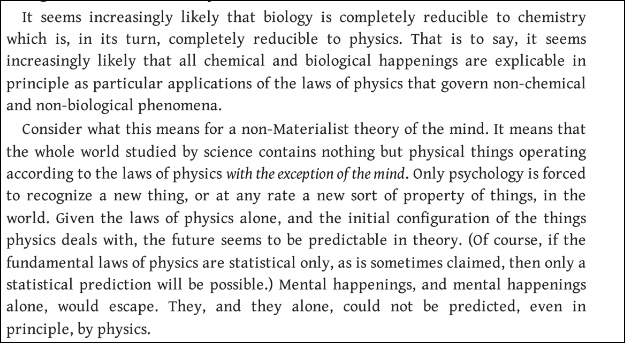
I think this is plainly wrong, as a matter of principle. Not because there is some mysterious thing called 'mind' which somehow always escapes scientific analysis, but because the mind is never an object of analysis in the same way that the objects of science are. It is, to paraphrase Wittgenstein, not something - but also not nothing. How this eludes so many people continues to surprise me. -
Cosmos Created MindI agree that in practice you can’t do neuroscience without maths, models of inference, and all the conceptual tools scientists rely upon. But that’s a point about method, not about ontology (i.e. what are the constituents of the neural systems).
The distinction I’m making is simply this:
Causal processes refer to neural and biochemical reactions
Normative relations refer to what makes causal inferences valid.
They belong to different explanatory levels.
A neuroscientist can model the brain as performing Bayesian updating, but the validity of Bayesian reasoning isn’t something you find by examining neural tissue. The neural story explains how we are able to reason (at least to some extent, although the detail is elusive); the logical story explains whether the reasoning is correct. These are not competing explanations — they are explanations of different kinds.
It’s the same with physics and mathematics. Physics relies on mathematics completely, but the maths isn’t identical to the objects being described. A differential equation can describe a falling apple, but the apple isn’t made of equations. Using inferential models to study the brain doesn’t make inference itself a neural process any more than aircraft wings “do calculus” because their behaviour can be simulated mathematically on a computer. The model and the actual mechanism aren’t the same kind of thing.
So my point isn’t that neuroscience is “unsuccessful,” nor that anyone is trying to derive axiom-systems from fMRI scans. It’s just that the norms scientists rely on to build their models — validity, consistency, justification — don’t themselves show up as physical properties. They’re the standards that are used to interpret the physical data in the first place.
That’s all I mean by saying the two can be separated conceptually. “Irreducible” doesn’t mean “supernatural” — it just means that different kinds of explanation are in play. And it's not a 'caricature', rather, a valid distinction between two kinds or levels of discourse.
On further thought, as you often say that I'm engaging in speculation or unthethered philosophizing uninformed by science, could you point exactly to where I'm doing that? -
Cosmos Created MindThis distinction doesn't make sense because people use formal models of reasoning to understand what the brain does and then map aspects of that to physical architectur — Apustimelogist
The point is that norms of reasoning and causal processes belong to different explanatory orders. Physical processes unfold according to causes; reasoning unfolds according to grounds—the logical relations that make an inference valid or invalid.
A neuroscientist can (and must) use modus ponens, reductio, probabilistic inference, and mathematical formalism to interpret data. But the validity of those inferences isn’t something that can be read off an fMRI scan. You can’t derive logical necessity from neural activation patterns.
So yes, of course cognitive scientists model reasoning, and of course they look for neural implementation of various inferential capacities. But that research presupposes the very norms it’s trying to naturalise. You can’t turn around and say the norms just are the neural activity that was used to investigate them. This is the vicious circularity that haunts neurological reductionism.
We're going in circles here. Bottom line: logic is not physical nor can be reduced to physical forces and categories, but I'm not going to press the point further. We've been arguing since Nov 5th 2024 - I remember the date, because it was the eve of the US Presidential Election, I see no purpose being served by continuing. -
An Autopsy of the Enlightenment.It is in Heraclitus that the theory of the Logos appears for the first time, and it is doubtless for this reason that, first among the Greek philosophers, Heraclitus was regarded by St. Justin (Apol. I, 46) as a Christian before Christ. For him the Logos, which he seems to identify with fire, is that universal principle which animates and rules the world. This conception could only find place in a materialistic monism. The philosophers of the fifth and fourth centuries before Christ were dualists, and conceived of God as transcendent, so that neither in Plato (whatever may have been said on the subject) nor in Aristotle do we find the theory of the Logos.
It reappears in the writings of the Stoics, and it is especially by them that this theory is developed. God, according to them, "did not make the world as an artisan does his work, but it is by wholly penetrating all matter that He is the demiurge of the universe" (Galen, "De qual. incorp." in "Fr. Stoic.", ed. von Arnim, II, 6); He penetrates the world "as honey does the honeycomb" (Tertullian, "Adv. Hermogenem", 44), this God so intimately mingled with the world is fire or ignited air; inasmuch as He is the principle controlling the universe, He is called Logos; and inasmuch as He is the germ from which all else develops, He is called the seminal Logos (logos spermatikos). This Logos is at the same time a force and a law, an irresistible force which bears along the entire world and all creatures to a common end, an inevitable and holy law from which nothing can withdraw itself, and which every reasonable man should follow willingly (Cleanthus, "Hymn to Zeus" in "Fr. Stoic." I, 527-cf. 537). Conformably to their exegetical habits, the Stoics made of the different gods personifications of the Logos, e.g. of Zeus and above all of Hermes. — New Advent Encylopedia
I've always liked that passage and its metaphors. -
Cosmos Created MindI think you're trying to argue that there's something magical about the fact that our minds can do what they do (where "magical"= not even possibly a consequence of material processes.) — Relativist
Not magical—just not the same kind of thing. My point is that the capacity to grasp reasons, recognise valid versus invalid inferences, and understand causal relations as relations is categorically different from the physical processes described by neuroscience. Physical causation can explain correlations and mechanisms, but it cannot be the normativity involved in reasoning.
That’s why I say neural states aren’t the “basis” of mental causation in the way you’re implying: whatever neural states enable reasoning, the content and validity of inferences aren’t reducible to their physical description. They belong to a different explanatory order.
Physicalism, naturalism, and materialism generally seek to naturalise cognition in terms of evolutionary theory and neuroscience. Which is OK as far as the science is concerned, but there's an implicit conviction, again. that science provides the court of adjutication for philosophy. What it actually does is change the terms in which philosophical questions should be asked and answered, so that they conform to what can be defended as scientifically respectable.
Furthermore even if human reason is not magical, it is extraordinarily uncanny. To think these 'featherless bipeds' descended from homonim species that evolved capturing prey on the savanahs over thousands of millenia are now able to weigh and measure the Universe.
Consider a concept that can be described verbally: this act of description could be parallel to the mental processes involved when we formulate or utilize the concept. You don't seem to have considered this. — Relativist
I have indeed considered it, and this is precisely where the argument from multiple realisability bites. Even if you can verbally describe a concept, the physical or neural realisation of that concept can vary enormously. This isn’t an incidental feature — it’s structurally unavoidable.
A single sentence can be expressed in English, Mandarin, Braille, Morse code, binary, or handwritten symbols, and the meaning is preserved across all of these radically different physical forms. That shows that meaning is not identical with any one physical instantiation.
Neuroscience faces the same issue. During the “Decade of the Brain,” researchers tried to identify specific, repeatable neural signatures for learning new concepts or words. What they found were broad regional activations but no consistent, fine-grained neural pattern that maps onto a specific meaning. That’s exactly what multiple realisability predicts: the same semantic content can be realised in indefinitely many different neural configurations.
So the fact that we can describe a concept verbally doesn’t help your claim — it actually illustrates why semantics and reasoning can’t be reduced to any one class of physical patterns. The level of explanation is simply different.
And this is precisely where the significance of universals shows up. Feser says 'A mental image is something private and subjective, while the concept of triangularity is objective and grasped by many minds at once.' Russell: 'if whiteness were the thought as opposed to its object, no two different men could think of it, and no one man could think of it twice. That which many different thoughts of whiteness have in common is their object, and this object is different from all of them.'
The whole basis of language and abstraction is clearly reliant on these cognitive processes which are unique (at least in the way that humans are able to use them). So I'm arguing that trying to account for them in physical terms is categorically mistaken.
In short, physical processes are governed by causal relationships; reasoning is governed by norms of validity. The latter can't be reduced to the former. -
An Autopsy of the Enlightenment.I stand corrected but the basic point remains - the re-interpretation of the Greek 'logos' in theological terminology.
-
An Autopsy of the Enlightenment.There's a through-line, so to speak. I've acquired a textbook on Husserl (David Bell) but haven't made a lot of headway with it. But Husserl's noesis and noema surely has Platonist roots. Kant adopted and modified both Plato and Aristotle, and Husserl adopted and modified Kant.
If order is posited as basic, it suggests a universal intelligence or God. — Janus
I suppose it's inevitable to see it in those terms. But bear in mind, there is another Axial-age term which has very similar functions, namely 'dharma'. Both logos and dharma refer to:
- the intrinsic order of reality
- the principle that makes the cosmos intelligible
- the way things ought to unfold, not merely how they do
Logos (Heraclitus, the Stoics, Middle Platonism) is the rational structure, the measure, the reason, the intelligible order pervading nature.
Dharma is the law, the ordering principle, the truth of things — ranging from cosmic law to ethical duty to the basic structure of experience itself.
Both serve as the intelligible pattern through which beings have their roles and right relations.
But dharma is associated with non-theistic religions (Buddhism and Jaina). A big cultural factor is the absorption of Greek philosophy into Biblical theology and the subsequent identification of 'logos' with 'the word of God' or simply 'the Bible'. So it all tends to be rejected together with religion. -
An Autopsy of the Enlightenment.Is there one overarching foundation for nature itself? — Janus
That would have been what the ancients designate 'logos'. -
An Autopsy of the Enlightenment.One conundrum I have been puzzling over, is the distinction between mind-independent objects, and mind-independent principles.
Let me explain. The principle of objectivity revolves around the idea that things exist in a particular way irrespective of whatever you or I might do or not do. The objective sciences endeavour to discern 'the way things are' outside of or apart from any subjective biases or pre-suppositions that we bring to the study of them. This also extends into subjects other than science, insofar as disciplines like history and jurisprudence strive for objectivity.
But it's interesting to reflect that in earlier philosophy, it was not things or objects that were considered to be independently existing in this way. The Platonic ideals of goodness and beauty were by no means objects in the sense of being 'objects of scientific analysis'. in the classical philosophical tradition, what was regarded as independent of the individual mind were not objects but principles: the good, the beautiful, the just, the true. They were intelligible measures, realities that could be participated in but not possessed. Access to them was understood to require a transformation of the knower — metanoia, the philosophical “ascent,” the cultivation of detachment (the original meaning of 'apatheia').
This is the part that, I think, becomes almost invisible within the post-Enlightenment frame. Once the Enlightenment redefines mind-independence in exclusively objective terms, normative principles lose their perceived standing. They are no longer something we discover through moral-intellectual formation but something we construct, negotiate, or inherit. And so the communities of practice that once embodied those principles inevitably begin to weaken.
When principles cease to be experienced as realities that make a claim on us, they can no longer act as shared horizons. What remains is a plurality of individual perspectives, each valid “for me” or “for us,” but without a binding force that earlier cultures assumed. This is not moral collapse — it’s simply the logical outcome of shifting the locus of reality from intelligible principles to empiricism.
Seen this way, the Enlightenment tended to undermine the forms of life and communities of practice in which normative principles were embedded. It gave extraordinary intellectual freedoms, but it also left us without the structures of meaning that were grounded in a very different understanding of what “mind-independence” really means.
(This is very much the ballpark of Alisdair McIntyre ('After Virtue'), Charles Taylor ('A Secular Age'). And also Pierre Hadot ('Philosophy as a Way of Life')) -
Cosmos Created MindThank you for that careful analysis. The comment about 'being ignored' was in response to posts by several contributors who predicted that I would ignore one entry challenging one of my responses, which I did not, and which was repeated even after I had responded. (I try and respond to challenges although it's inevitable there's going to be some 'talking past one another' going on considering the subject matter.)
Given that the world represents the manifold of all possible material things, those material things are necessarily presupposed if consciousness is claimed to be inseparable from them. One cannot deny that which he has already presupposed as necessary. From which follows denial of materialism as such, is self-contradictory given from its being the ground for the composition of the world of material things consciousness is said to be inseparable from. — Mww
The 'inseperability of self and world' is an underlying theme that I have been exploring through various perspectives. The original intuition behind it was the sense that reality itself is not something we're outside of or apart from. This insight was a consequence of having been immersed in the study of the perennial philosophies and the 'unitive vision' that they refer to in their different ways. At the time I was reading the American Transcendentalists ("The act of seeing and the thing seen, the seer and the spectacle, the subject and the object, are one" ~ Ralph Waldo Emerson). This gave me an awareness that the sense we usually have of being separate egos in a material world is actually a culturally-conditioned state of being. (This will be generally stereotyped as being 'religious'.)
….if materialism were true with respect to linguistic communication, — Mww
Lloyd Gerson's point was made in respect of Aristotle. The section quoted was about Aristotle's hylomorphic (matter-form) dualism. According to Aristotelian philosophy, the form (idea, principle) of a particular thing is what the intellect knows, which makes it possible to say 'this particular is X'. The senses receive the material impression while the intellect receives the form. It is precisely that ability that underwrites reason, the faculty that differentiates humans from other animals. This is what Gerson was glossing when he said 'you could not think if materialism were true' - because rational thought relies on the abiility to grasp universal concepts and thereby understand what things are. (Aristotelianism has generally fallen out of favour in modern philosophy, although it still has plenty of defenders.)
:up: -
Cosmos Created MindI'm not sure what you mean by "empirical additions" but the capacities you refer to are, I'd suggest, the result of evolution--as you seemed to acknowledge in an earlier thread--and so are as much a result of our interaction with the rest of the world as are our thumbs (the evolution of which it seems played a role in the development of our intelligence). — Ciceronianus
Sure. I would never deny the facts of evolutionary theory, although I often question the significance that is attributed to it. I think if Plato had known what we now know he might have attributed his innate ideas to evolution instead of the soul having been re-born (and in fact Empedocles anticipated the idea of evolution, and even a form of natural selection.) But then, how different are the evolutionary and mythical accouts, really? H.sapiens evolved to the point of being language- and tool-using primates, capable of speech, philosophy, science and much more. As such, members of the species are born with innate capacities which other creatures lack, foremost among them language. To what extent can that be ascribed solely to evolution? Biologically, it can, but at some point, we escape the bonds, and bounds, of biological determination - we realise horizons of being that are not perceptible to other species. Hence the designation of humans as 'the rational animal' (a distinction which the current generation seems to have neglected.) By it, and through it, we are able to 'see' things which other animals cannot. Hence it was referred to in antiquity as 'the eye of reason'.
So I'd say our capacities, like our thumbs, are the products of experience. — Ciceronianus
It's the customary empiricist argument: look, we learn to count by being exposed to groups of things, and we pick up the idea.
Two points about that. Apes have thumbs, if not opposable thumbs, but no matter how much experience they have, they will not be able to master mathematical concepts (I'm not talking of shape recognition). Second, without the capacity to count, we couldn't recognise numbers in the first place, no matter what kind of experience we have. So I don't think Plato's belief in the innate capacity to reason is invalidated by the facts of evolution.
But I know that the customary sanguine acceptance of the facts of evolution will generally mitigate against mere philosophy. -
Cosmos Created MindIt was, "what justified beliefs does it lead to?" — Relativist
The justified belief that knowledge cannot be solely objective.
If an insight leads to a dead-end, — Relativist
Then it's not an insight. But the fact that someone doesn't recognise an insight doesn't mean it's a dead end.
My view is that they exist immanently within objects- such as the 90 degree angle that exists between the walls of a room. This 90 degree relation between walls is a universal with no dependency on minds. — Relativist
That is what the Russell passage above I posted is about - the relationship 'north of'. It doesn't exist in the same sense that Edinburgh and London exist, even though Edinburgh is north of London. ' There is no place or time where we can find the relation 'north of'. It does not exist in Edinburgh any more than in London, for it relates the two and is neutral as between them. Nor can we say that it exists at any particular time. Now everything that can be apprehended by the senses or by introspection exists at some particular time. Hence the relation 'north of' is radically different from such things. It is neither in space nor in time, neither material nor mental; yet it is something. ...'
This is important, don't brush it aside.The reason it's not noticed is because we rely on the mind's ability to discern these relationships, without which we wouldn't be able to form an idea of the world. So that's the sense in which the world is 'mind-dependent' - not going in or out of existence, depending on whether you yourself see it, but because the whole idea of existence depends on the mind's ability to grasp these intelligible relations (which is elaborated in The Mind Created World op). Which we don't see because (as Russell says) they don't exist, they're not 'out there somewhere'. If there's a single insight that empiricism cannot grasp, it is this one and dare I say the apparent inability to grasp it, is an illustrative example.
This is becoming repetitive. If I fail to respond further, it won't be because I'm ignoring anyone's posts, but because they may not be presenting anything that hasn't alreafy been addressed. -
Cosmos Created MindHe (Feser) is making a case for the reality of universals - justifying believing these exist. That's reasonable. It's also consistent with physicalism. — Relativist
Not according to Edward Feser, it isn't. The universals that he has in mind —geometricity, equality, necessity, logical relations—are not physical, and cannot be described in physical terms. For A-T (Aristotelian-Thomism):
- Universals are forms (ideas, principles), and are real but not material
- They are instantiated by particulars, but cannot be reduced to them.
- Their mode of being is intelligible, not physical
- They are grasped by the intellect, not the senses
- They are the basis for the intelligibility of physical things (by conferring identity)
You may be referring to “universals” in Armstrong’s naturalistic sense, but they are not universals in the Aristotelian (or real!) sense. According to Armstrong:
- Universals are physical properties instantiated in the world
- (colour, mass, charge, spin, fragility, etc.)
- They are wholly located in spacetime
- (not abstract, not non-physical)
- They are identical with physical properties that recur in multiple places
- They are “universals” only in the sense of being repeatable physical features
Armstrong rejects:
- Platonic universals (too abstract)
- Aristotelian forms (too metaphysical)
- Fregean abstracta (non naturalistic)
Armstrong is not a realist about universals in the classical sense at all. He is a nominalist who has scaled up the notion of “repeatable physical properties” (not too far distant from Galileo's primary attributes) and called the result a universal. In effect, he is trying to universalise nominalism.
At issue, is the sense or mode of existence that universals (and other intelligibles) possess, as Betrand Russell also explains:
RevealConsider such a proposition as 'Edinburgh is north of London'. Here we have a relation between two places, and it seems plain that the relation subsists independently of our knowledge of it. When we come to know that Edinburgh is north of London, we come to know something which has to do only with Edinburgh and London: we do not cause the truth of the proposition by coming to know it, on the contrary we merely apprehend a fact which was there before we knew it. The part of the earth's surface where Edinburgh stands would be north of the part where London stands, even if there were no human being to know about north and south, and even if there were no minds at all in the universe. This is, of course, denied by many philosophers, either for Berkeley's reasons or for Kant's. But we have already considered these reasons, and decided that they are inadequate. We may therefore now assume it to be true that nothing mental is presupposed in the fact that Edinburgh is north of London. But this fact involves the relation 'north of', which is a universal; and it would be impossible for the whole fact to involve nothing mental if the relation 'north of', which is a constituent part of the fact, did involve anything mental. Hence we must admit that the relation, like the terms it relates, is not dependent upon thought, but belongs to the independent world which thought apprehends but does not create.
This conclusion, however, is met by the difficulty that the relation 'north of' does not seem to exist in the same sense in which Edinburgh and London exist. If we ask 'Where and when does this relation exist?' the answer must be 'Nowhere and nowhen'. There is no place or time where we can find the relation 'north of'. It does not exist in Edinburgh any more than in London, for it relates the two and is neutral as between them. Nor can we say that it exists at any particular time. Now everything that can be apprehended by the senses or by introspection exists at some particular time. Hence the relation 'north of' is radically different from such things. It is neither in space nor in time, neither material nor mental; yet it is something. ...
We shall find it convenient only to speak of things existing when they are in time, that is to say, when we can point to some time at which they exist (not excluding the possibility of their existing at all times). Thus thoughts and feelings, minds and physical objects exist. But universals do not exist in this sense; we shall say that they subsist or have being, where 'being' is opposed to 'existence' as being timeless. The world of universals, therefore, may also be described as the world of being. — Bertrand Russell, The World of Universals
Note well his distinction 'subsists in' and 'exists'. It is of utmost importance.
Thank you. But I don't see how the fact we possess intelligence indicates that our minds "bring" the form or concept of a triangle, or anything else for that matter, to experience. — Ciceronianus
You're welcome. But, my dear sir, those elements which the mind brings to experience are precisely what Kant called the a priori conditions of cognition. They are not empirical additions; they are the very capacities that allow us to recognise and classify something as a triangle (or as a cause, an object, a quantity, and so on).
In other words, the mind does not 'inject' triangles into experience — it contributes the conceptual structure that makes “this thing” recognisable as a triangle in the first place, and thus communicable, definable, and held in common with others. It is essential to the mechanisms of meaning.
I also think it would be a slight on Maritain to dismiss him as a mere apologist. Not many on this forum seem to mention him, but his was a towering intellect, also notable for his commitment to Christian humanism, and generally identified with the religious left, in political terms. (And no, I'm not Catholic.) -
Cosmos Created MindYou haven't suggested making any alteration, nor specific addition, to the set of (science based) beliefs about the world as a consequence of this insight. Instead, you just restate the same thing, about the role of our sensory/cognitive framework in developing these true, physical facts about the world. Other than being an interesting factoid that is folly to ignore, you haven't inferred any additional insights from it - not insights that can constitute justified beliefs — Relativist
Yes, I distinguish between factual knowledge and beliefs (justified or otherwise). No, I am not “opposed to science,” nor do I neglect the findings of science. What I am critical of is the appeal to science as the authoritative basis for philosophical justification.
My point about universals is simply that they are real but not physical; as Russell put it, they are not thoughts, but “when known they appear as thoughts.” Their reality is intelligible rather than phenomenal — they can be grasped by a rational mind, but they do not exist as physical particulars or states of affairs.
And recognising the role of the observing mind in the construction of knowledge is not a “factoid.” It is a philosophical insight. It does not produce new empirical claims — it clarifies the conditions that make empirical knowledge possible in the first place. It this seems a commonplace now, it is only because of the contributions of philosophers, such as Thomas Kuhn and Michael Polanyi (and of course Immanuel Kant.) The whole subject of the relation of mind and world, is itself not a scientific one, as it cannot be sufficiently defined so as to constitute a scientific question. -
Cosmos Created MindPositivism is a philosophical approach that argues all genuine knowledge is based on scientific observation and sensory experience. It rejects metaphysical speculation, religious faith, and other forms of "knowing", asserting that truth is found only
in verifiable, empirical facts.
A lot of people hold to a basically positivist attitude although they’ll generally deny it if it’s called. out -
Cosmos Created MindIdentify something you believe about "the preconditions that make observation, measurement, and intelligibility possible", and provide your justification for believing it.
— Relativist
I wouldn't expect a response to this. — wonderer1
And the response was - in case it went past you - that the precondition is the capacity to grasp rational concepts, which is not something that needs to be explained in scientific terms, but without which there could be no scientific understanding.
Curious that it was said that I would likely ignore relativist's challenges, but then when I answer them, the response is ignored. Who is ignoring what, exactly? -
Cosmos Created Mindit will be ignored — Janus
It was, in fact, addressed, point by point - but there's no use explaining that to someone who is not prepared to reckon with it. Hence Twain's adage, very suitable in the context. -
An Autopsy of the Enlightenment.Thompson sees reason as emerging from our everyday experience and the ways we engage with the world, not from a detached, universal viewpoint. We develop our thinking through action, conversation, and the practices we inherit. He rejects the notion that this makes him a relativist: being aware that reasoning is 'situated' doesn’t mean all ideas are equally valid or that anything goes. On the contrary, some ways of thinking are better than others, and we can test, refine, and improve our ideas through experience, dialogue, and careful reflection. Thompson would probably acknowledge that reasoning is grounded in context but this doesn’t weaken it, it makes it more honest, responsible, and connected to how we actually understand and navigate the world. — Tom Storm
Spot on. I had the idea of writing an OP on disembodied cognition. Why? To bring out what was important about embodied cognition in the first place - what it was critiquing. I think that was largely focussed on intellectual abstraction, functionalism, physicalism, and many of the other popular 'isms' of the academic philosophy. So, I agree with you, I don't think Thompson's project is relativist, but it's also //not// hanging off philosophical absolutes. It's threading the needle between those kinds of dilemmas which gave rise to the whole project. Which is why it is not co-incidental that the whole of The Embodied Mind is pervaded with references to the Buddhist 'middle way'. -
Cosmos Created MindI confess I don't understand the point of the exegesis on triangulation. I'm uncertain just what an imperfect triangle might be. My guess, however, is that it isn't a triangle. In which case a "perfect" triangle is, simply, a triangle. It should be unsurprising that when we think about a triangle, we think about a triangle. It's difficult to ascribe much significance to this fact. But it seems some do and I wonder why? — Ciceronianus
You’re able to grasp the concept of a triangle — “a flat plane bounded by three intersecting straight lines” — because you possess a rational intelligence capable of understanding what the word means. That capacity is fundamental to language and to rational thought itself.
It’s easy to take this for granted because you and I both possess it: the ability to apprehend abstract, intelligible forms. The triangle is merely a simple example. The same point applies to any number of concepts, principles, and relations that H. sapiens can grasp thanks to its fantastically elaborated forebrain.
Why does this matter? Because without universals, you can’t explain how any rule-governed thought is possible. You can’t explain how different people can understand the same concept, or why a mathematical truth holds regardless of who considers it, or how we recognise something as falling under a shared description. And, crucially, you can’t explain how we move from particular things to general claims — which is what every argument requires.
(And if that sounds like neural reductionism, it isn’t. You won’t find any of these forms or principles in neural data. The brain enables the grasp of concepts, but the concepts themselves aren’t hiding in the folds of the cortex. The way I think of it is that h.sapiens evolved to the point of being able to grasp universals, which affords them – us – with a capacity to grasp universal truths. I think this capacity is usually either assumed, explained away, or ignored. See Jacques Maritain, The Cultural Impact of Empiricism, Parts II - III.)
:ok: -
Cosmos Created MindSaying they are “immanent” does not reduce them to material particulars. Aristotle’s forms are not products of material processes; they are the preconditions for there being any particular thing at all. They are real as structures of intelligibility, not as material objects. The reality of triangles is not dependent on there being physical triangles — just as the reality of numbers, ratios, limits, and functions is not conditional on physical instantiation. Almost the entirety of pure mathematics would otherwise collapse into “idle fiction,” which is a reductio of your position, not mine.
And I think you already knew what I would say. — Mww
I still don't quite get it. My thoughts on it are that time and space are meaningless without there being a perspective. And perspective can only be provided by an observer. I think that goes back to the Transcendental Aesthetic.
Wayfarer

Start FollowingSend a Message
- Other sites we like
- Social media
- Terms of Service
- Sign In
- Created with PlushForums
- © 2026 The Philosophy Forum