
-
Dialectical materialismIt is therefore incorrect to say dia-mat is a political doctrine, it is more of a view of the world. It is a theory, actually, a certain model of the way the world could work. — Tobias
which is why, I think, 20th Century communism was more than simply a political movement, it was akin to a kind of religion or secular religion or at the very least an ideologically-constructed view of the world.
'Marx’s theory of ideology is presented in The German Ideology (Marx and Engels [1845-49] 1970). Marx uses the term “ideology” to refer to a system of ideas through which people understand their world. A central theoretical assertion in Marx’s writings is the view that “ideology” and thought are dependent on the material circumstances in which the person lives. Material circumstances determine consciousness, rather than consciousness determining material reality: “The hand-mill gives you society with the feudal lord; the steam-mill society with the industrial capitalist” (Marx 1971). A system of ideology plays the role of supporting the class advantage of the dominant class, according to Marxist theory. The concept of commodity fetishism is discussed in Capital (Marx 1977). Marx uses this concept to refer to the pervasive and defining illusion that exists in a commodity society. A commodity is perceived solely in terms of its money equivalent (its price), rather than being understood as standing within a set of social relations of production. The labor of the operator of the shoe-sewing machine disappears and we see only the money value of the shoes. Marx believes that this is a socially important form of mystification; the market society erases the relations of domination and exploitation on which it depends.'
This in turn is linked to the later development in Marxist theory of 'false consciousness' which (I think) becomes central in (for example) critical theory. -
Intelligent Design - A Valid Scientific Theory?What I meant to say is that if we require science to require all theories to be empirically testable, then philosophical naturalism is not a scientific view, — Paulm12
That’s a very interesting point. What ‘naturalism’ has come to mean is ‘can be accommodated within the epistemic framework of science’. And science, or at any rate modern science, operates from certain assumptions about what is real, what counts as evidence, and so on. It’s implicitly physicalist in outlook - ‘implicitly’ because physicalism may not be explicitly stated or defended as a philosophical tenet, but simply assumed.
I was going to write some more, but @javra more or less beat me to it! ;-) -
Logical Necessity and Physical CausationWe’ve been here before, and honestly, I can’t find anything to substantiate Kant’s acknowledgement as you’ve posited it. I’d understand if you’ve no wish to pursue this line of disagreement; to each his own, etc, etc..... — Mww
Folks are generally empiricist and realist by upbringing and cultural inclination. As Bryan Magee comments:
We have to raise almost impossibly deep levels of presupposition in our own thinking and imagination to the level of self-consciousness before we are able to achieve a critical awareness of all our realistic assumptions, and thus achieve an understanding of transcendental idealism which is untainted by them. This, of course, is one of the explanations for the almost unfathomably deep counterintuitiveness of transcendental idealism, and also for the general notion of 'depth' with which people associate Kantian and post-Kantian philosophy. Something akin to it is the reason for much of the prolonged, self-disciplined meditation involved in a number of Eastern religious practices.
Indeed. No coincidence that my initiation into Kant was via T R V Murti's exposition of Madhyamika in his book The Central Philosophy of Buddhism. I'm still exploring that connection. -
Intelligent Design - A Valid Scientific Theory?But arguing that science and biblical literalism are in conflict does not mean (mainstream) religious views are irreconcilable with science. — Paulm12
Agree. And also that dogmatic materialism and religious fundamentalism are kind of mirror images - not in terms of content but attitude.
If we relegate only empirically verifiable things to science, then we also need to acknowledge that any attempts to extrapolate these studies to what happened in the past involves (by this definition, non-scientific) justification. And as a result, we further must admit that the best explanation for data may indeed be a non-scientific, non-testable one. — Paulm12
I don't go along with that. As far as fossil evidence is concerned, there is abundant fossil evidence to validate in broad outlines evolutionary history. Sure there are big gaps and unknowns but there's also a lot of solid data. But the facts of evolutionary history are one thing, but the meaning of it is another. I think there's a lot of misuse of evolutionary biology as a kind of catch-all explanation for everything about human life, beyond what the theory actually says.
If science only concerns itself with making testable hypothesis, then plenty of theories put forth by scientists are not “science.” — Paulm12
There's a lot of argument in the scientific community about speculative physics and cosmology and whether or not it really amounts to science. There's a powerful school of thought that at least some of this speculative physics is not science at all - I've got a book called Farewell to Reality by Jim Baggott, who's a science writer. There's been plenty of criticism of those tendencies. But human nature being what it is, it's inevitable that questions will get thrown up for which there can't be any answers. -
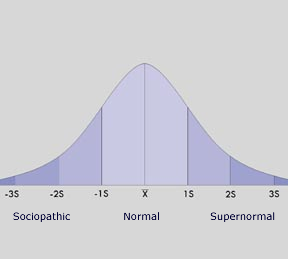
Mysticism and MadnessMy only thought was that normality is a narrow band of behaviour. It's bell curve.
I wrote a blog post on it some time ago:
It is natural to assume that normality is an end in itself, or that the 'normal' mode of life is all that can be aspired to. People generally hold great stock in normality as a mode of being. But just because normality is our modus vivendi (way of life) does not make it our summum bonum (ultimate end.) Anyone spiritual must realise that normality is simply a transitional state and not the end of life. You don't want to be subnormal, but spirit calls you to be more than normal. It calls you to a state beyond the 'normal' concerns of the 'normal' life.
The way normal people worship fame and riches betrays the notion that, for them, 'normality' defines all our notions of reality and they can conceive of nothing beyond it. For being rich and famous - being a Star - is conceived of by the normal person as being the best thing that normality has to offer. Being A Star is the excellent version of normality, that to which all of us ordinary bourgeois individuals can only aspire. Stardom, or being rich and famous, is the Ultimate in Normality - it represents all of the things which normal people have and enjoy, but in more or less infinite supply and variety. Getting everything you want, in a world where getting what you want is the most important thing. Hence the paparazzi, and a large part of the 'normal' media. People are transfixed by it. They will kill for it. And because most people are normal, then naturally this is an enormous audience.
But I also see a different dimension to the human condition, that of the 'Self-Realised Individual' in the sense defined by the non-dualist schools of Indian culture. Now without going into the profound meaning of this term, let us just say that 'Self Realisation' is definitely not part of the normal condition of humanity. In other words, 'Self Realised Persons' are not 'normal persons'. The normal person is not self-realised, and the self-realised individual is not a normal person.
But self-realised individuals are not sub-normal. They are actually super-normal, they are outside the scope or realm of what we call 'normality'. Yet they are not mad, or psychotic, or degenerate. My thesis is, that if degrees of normality can be represented on the Bell Curve, then the self- realised individual is on the extreme right side of the curve.
So at the far left of the Bell Curve of normality are the sub-normal: psychotics, sociopaths, those who for one reason or another cannot live in 'normal' society (defined by Freud as 'the ability to love and to work').
Then you have the vast bell of the curve, 'normal people', moving, from the left, from those who are barely integrated, through the middle, where almost everyone you will ever know is, to the right of the bell curve, where superbly integrated people are - commensurately few in number, of course.
Then, probably fewer in number than the psychopaths and sociopaths, are the highly integrated humans, those who are as far above 'normality' as your psychopath is below it, on the extreme right of the bell curve.
I had in mind Abraham Maslow and the other transpersonal psychologists when I wrote that.
I suppose another point that can be mentioned is the idea of 'holy madness'. There is a recognised category, cross-cultural, of the 'holy madman (or woman)' who is 'possessed by God' but also completely fails to observe normal standards of behaviour. Such people might really be clinically insane, but they're said to be not only that, to also have a real 'charism'. You have to dig pretty deep in anthropological literature to find the accounts, but they're both interesting and a bit disturbing. There's closely-related accounts of holy (usually wandering) vagabonds and vagrants who are great spiritual beings in disguise, that are the subject of (usually edifying) tales, often both enlightening and humorous (like the classic Mullah Nasruddin stories from the Islamic culture). -
Scotty from MarketingOne more delicious morsel - it looks highly likely that the repulsive Hanson will be defeated by the Greens. And all of the wannabee QAnon-antivax loony rightists have been thoroughly trounced (including the equally repulsive Christenson).
https://www.crikey.com.au/2022/05/22/clive-palmer-pauline-hanson-one-nation-uap-freedom-movement/ -
Intelligent Design - A Valid Scientific Theory?The most common objection to ID seems to be that it does not produce any testable hypothesis, and thus is “outside” of science (thus perhaps it would better be argued in a philosophy class). However, what bothers me about this is if science must be testable, then much of cosmology would also be considered inappropriate for a science classroom (no multiverses, no accounts for natural laws-all those would similarly be outside of science and therefore not belong in a science classroom either). — Paulm12
Much speculative physics and cosmology would indeed fall under that heading, as you say.
I've read a bit about Intelligent Design theorists. The problem is that it is a highly culturally and politically charged debate, due to the antagonism between aggressive fundamentalism and equally aggressive secular philosophers. I'm thinking on the one side of mainly Protestant, mainly American, fundamentalists, who cling to a literalistic view of the Bible. On the other side, you have the aggressive neo-darwinian attitude (typified by Daniel Dennett, Richard Dawkins and Sam Harris) which is implacably hostile to any form of religion and tries to enlist science as a weapon in that battle.
My view is that fundamentalists obviously have a pre-committment to their particular beliefs, and will try and dispute indisputable evidence on the basis of tendentious interpretations. In it crudest form, it will even deny that, for instance, radio-carbon dating is accurate. Of course, many of the more "sophisticated" ID theorists won't attempt that, and will try to accomodate all of the evidence. But the question then becomes, what are they trying to prove? What actually is at issue? What does 'created by God' actually mean, or look like?
I think it's the case that none of the major Christian denominations (Orthodox, Anglican and Catholic) have ever seriously questioned the theory of evolution on doctrinal grounds. For instance, there are forms of Biblical religion that are compatible with acceptance of evolutionary theory, such as theistic evolution theory. This accepts the scientific account, but says that natural processes are ultimately set in motion by God (or a higher intelligence). Francis Collins, and the Biologos Foundation, advocates this approach (see here for instance. This article is from a Christian philosopher and scientist taking issue with the best-known advocate of 'scientific' intelligent design.)
I don't personally accept the standard 'neo-darwinian' account and it's associated materialism, or any form of Biblical creationism, but I think there's huge scope for alternatives that don't fall into either camp. See for instance https://www.thethirdwayofevolution.com/ -
Logical Necessity and Physical CausationIt's one-way. If it were 'both', then Kant would not have said anything. If you want to show otherwise, you'll need to back it with some references.
-
Logical Necessity and Physical CausationIt's on the cut itself where physical causation meets logical necessity. — Hillary
:up: Now that's better. And very close to something I said somewhere earlier in this thread - that scientific principles are a place where logical necessity and physical causation meet.
The outside of the physical world is projected continuously into a mental counterpart on the other side. It's on the cut itself where physical causation meets logical necessity. — Hillary
But the distinction between inner and outer is itself a constructive activity of the mind. That is why I am always working on trying to understand Kant's 'copernican revolution in philosophy' - that things conform to thoughts, not thoughts to things. -
Logical Necessity and Physical CausationWell, what to some of the texts say about the relation of logical necessity and physical causation? I'm sure you will find it's not nearly the slam-dunk you're saying it is.
-
Logical Necessity and Physical CausationSays I — Hillary
Have you ever studied philosophy in any formal sense? Read anything about it? I only ask, because your comments appear on almost every thread on this forum, but they seem almost totally devoid of any real philosophical acumen. -
Logical Necessity and Physical CausationKant acknowledged that a priori judgements come after experience. — Janus
Kant’s ‘discovery’ of the a priori grounds of empirical cognition was praised because it showed how a spiritualist metaphysics could be confined to the limits of empirical experience. It was acclaimed much more, though, for showing that beyond these limits in which Locke and Newton threatened to immure reason, the mind encountered ‘objects that cannot be conceived but can only be thought through reason’. These transcendental objects or ideas made it possible to defend the presence of a self-acting moral being within the empirical world and a supreme intelligence as
the ground of its intelligibility.
...
These are concepts – the transcendental ideas – that necessarily arise from rational reflection. According to Kant, these ideas of reason, like the categories of the understanding, form an a priori system. Kant does not attempt to derive the transcendental ideas in questionable ways from the forms of rational inferences or the possible relations between subject, object, and representation (even though the text suggests this), but rather considers them, much more plausibly, as concepts we arrive at through rational inferences about specific (psychological, cosmological, and theological) subject matters. The central philosophical point here is that concepts can be the result of what Kant calls ‘necessary inferences of reason.’ A first instance of this is Kant’s derivation of the concept of the unconditioned; the chapter then turns to the three classes of transcendental ideas (psychological, cosmological, theological).
(Cribbed from various sources.) -
Logical Necessity and Physical CausationAll logical necessities are based on physical causes and effects. — Hillary
Says who? Provide one citation for that. -
Logical Necessity and Physical CausationDon't think this is the case, in my humble opinion — Hillary
No offense, but your opinion has no bearing, and the examples you cite are not relevant. If you go back and read the first post in the thread you might see why. -
Scotty from Marketingvotes for One Nation and UAP. — Banno
speaking of which, how did they go? I saw not one reference toJabba the HutClive Palmer in the coverage. Last I heard the unvaxed Hanson had a pretty bad case of COVID. I'll have to look into it. (I did hear that nitwit Kelly got a well-deserved drubbing.)
SO the next question is, might the Liberal Party see Dutton as a liability? — Banno
I'm sure Dutton would be an electoral disaster. I can't understand how anyone in their right mind could see him as viable candidate for PM. Let's see what happens. -
Logical Necessity and Physical CausationI would say the rules of valid inference are abstracted from our experience — Janus
Logical rules (such as the law of the excluded middle) are known a priori. That's what a priori actually means. The mind is capable of understanding such principles without any reference to experience - that's the point. Actually if you look at the OP again, this very point is the subject of the first post so I'm not going to go into it again.
On a related note, I've found an excellent academic paper, which I've pinned to my profile page, 'Philosophy and Spirituality in Kant's Critique of Pure Reason'. It's a difficult and lengthy read but it's a really important paper. It demolishes the depiction of Kant as the sensible, prudent empiricist philosopher. I might do an OP on it to summarise the details. -
Scotty from MarketingI'll also add, although this thread should probably be put out to pasture now, that the greatest act of political bastardry in Australian history was the Conservative's abolition of a functional and efficient Emissions Trading Scheme in 2014, which had been legislated by the previous Labor government. This program was working exactly as intended and would have put Australia a long way towards meeting environmental goals, and it was torpedoed out of pure political malice and pig-headed ignorance. The main offender met his electoral demise in the 2019 elections at the hands of one of the 'Climate Independents' and has since left politics altogether, but this single act wrought damage that may never be reversed, and ultimately was one of the major factors in the Conservative's wipeout last night.
-
Scotty from MarketingHere's an analysis of Morrison's performance by one of the better-known journos. (I don't think it's paywalled, it's from the Sydney Morning Herald's website which allows visitors a small number of articles.) I think it's plausible that Morrison's political career is over, although I don't know if anyone's saying that. The likely candidate to replace him is an obnoxious ex-policeman with the endearing nickname of Potato Head, whom I'm sure will lead the remnant of the conservatives ever deeper into the wilderness.
-
Metaphysics ToolsTertullian is the first Church Father to single-out epicureanism (as representative of "Greek wisdom") as heresy which was foundational in early apologetics and later Christian theology. — 180 Proof
Now that is an interesting fact. -
Scotty from MarketingI am having company over, and have splashed out on a bottle of French Champagne, which we’ll either open, or not. (I won’t mention I have it unless it’s certain. Otherwise, it’ll have to keep.)
In my electorate the ALP incumbent, for whom I voted, scraped in by <400 votes last time. But there will be many interesting contests tonight; I think I’m more aware of all the seats and personalities than I used to be, probably because of the internet coverage. -
Are values dominant behaviours of a society, or are they personal?"Values are the dominant behaviours and beliefs of a society or a group" and that values have nothing to do with individuals. — carlacalvert9
I think 'nothing to do with' is too strong. Perhaps s/he meant that individuals by themselves are not able to exert much change on social values. Furthermore, individuals need to deal with social values, like it or not, unless they're sociopathic, because those around them will reflect those values in their judgements and behaviour.
Short answer: ask lecturer to clarify. -
Donald Trump (All General Trump Conversations Here)Trump is a symptom! — Agent Smith
You wouldn't say that if you were victim of a terminal cancer. The symptoms would be debilitating illness and a painful death. Trump is more like the cancer than a symptom.
In any case, where I came back into this thread was the actual threat of fascism emerging in the US, through the agency of one of the two major political parties, namely, a debased and corrupted Republican Party and it's various media and business boosters. And I made that comment, because of the role of the likes of Tucker Carslon, who is obviously fascist, in boosting the kind of hatred-filled conspiracy-theory garbage that led to the slaughter of ten innocent people in Buffalo, NY, last week. No doubt the next Replacement-Theory, White Supremacist terrorist is already prepping for the next engagement, and Carslon and his ilk will be egging them on. -
The ChurchlandsDoesn't that mean we can gain insight into the subjective/first-person aspects of conscious using science? — Agent Smith
You mean, you didn't read what I reported Penfield to have said? -
The ChurchlandsI would be able to objectively analyze the subjective aspects of my own consciousness. — Agent Smith
Well, you couldn't do it yourself, but as the brain has no nerve endings, it is impervious to the pain caused by surgical incision, so patients can experience having their brain operated on while fully conscious. There was a pioneering Canadian neurosurgeon by the name of Wilder Penfield who conducted thousands of these procedures over decades. And, whilst only peripheral to his main body of work, his discoveries caused him to form a rather dualist view of the brain. He noted that he could, by stimulating areas of a subject's brain while conscious, cause them to have vivid recollections of past experiences, experience sensations, and even to move parts of their body. But, intriguingly, all of those subjects reported that they knew when what they were experiencing was being triggered by the stimulus - they would invariably be able to report that 'you (the surgeon) are doing that', could distinguish those effects from voluntary actions and recollections of their own volition. He published a book on it, called Mystery of the Mind (which regrettably, but probably predictably, has become canon-fodder in the psi wars.) -
The ChurchlandsTo me this is the best and most logical response. — GLEN willows
And hey, it ain't brain surgery :wink: -
Donald Trump (All General Trump Conversations Here)I wouldn't give a toss if Trump merely held irrational beliefs. It's the fact that he disseminates them throughout American society and enlists others in their defense that is obnoxious, and also corrosive to democracy and civil discourse.
liberals have tended to exacerbate the sources of populist hostility.
Sure they have. Nobody in the current American political establishment is blameless - well, nobody who makes any news - but some are surely more culpable than others. -
Metaphysics ToolsAgain, Kant erred on space; he made it perceptual. If you read my post on the origin of the universe, it eludes Kant's antinomies. — val p miranda
Sorry but you don't get to dismiss the philosophy of Kant, nor establish the origin of the Universe, on the basis of one single short paragraph. -
Donald Trump (All General Trump Conversations Here)Until the all the parties guilty of seditious conspiracy against The United States of America are charged and punished to the fullest extent of the law, that threat has no reason to diminish. — creativesoul
I agree with you. I can't understand why all of the many legal proceedings against Trump, and the findings of the January 6 Commission, haven't yet lead to serious charges against him and his cronies. I can't accept that this is because he has not committed crimes, only that he has mobilised the power of the mass media as an effective weapon against due process.
But of all the crimes Trump has committed, his continued refusal to acknowledge the falsehood of his claims about the last election has to be the greatest. In fact, I can't see how anyone who does that, could be allowed to run for an elected office. It would be like letting a player compete in a chess or tennis tournament, when they repeatedly insist that the rules don't apply to them and the umpire has no authority. Accepting his loss in the last election ought to be an ironclad requirement for any possibility of participation in the next (not that I think he'll actually run in 2024). -
Donald Trump (All General Trump Conversations Here)Here is a google search of Republican Fascism USA. The articles it returns make for sobering reading.
What is fascism, on its most fundamental level? An assault on reality, time, facts and truth. — Salon
All amply illustrated by Trump and his coterie.
I believe that a descent into fascism, the suspension of the Constitution and the democratic process by the lunatic right of the Trump party is a possibility. It's not a certainty, but the fact that it has so many supporters, and the enthusiastic support of the Murdoch press, certainly make it a threat. -
Logical Necessity and Physical Causation“The understanding itself is the lawgiver of Nature; save through it, Nature would not exist at all.” Critique of Pure Reason, A126.
"Quantum mechanics is a law of thought."
— Chris Fuchs -
Metaphysics ToolsWith these tools and imagination, one should be able to arrive at the first existent, and consequently, the origin of the universe. — val p miranda
Kant argued that the antinomies of reason follow necessarily from attempts to cognize the nature of transcendent reality by means of reason. The fourth of the antinomies is the subject of the thesis
'there belongs to the world, either as its part or as its cause, a being that is absolutely necessary' for which the anti-thesis is that 'an absolutely necessary being nowhere exists in the world, nor does it exist outside the world as its cause.' According to Kant, this antinomy, like the others, cannot be resolved by reason. I suppose you could then fall back to Kant's saying that he had to 'declare a limit to knowledge to make room for faith' but if you do, then you're back at faith - not logic. -
Ukraine CrisisProbably, Putin would regard these kinds of consequences as leverage. The fact that he can cause world starvation will be, to him, only a sign of how powerful he is. He will have absolutely zero concern from a humanitarian perspective.
-
The ChurchlandsNo offense taken (although the whole point of a forum like this is debating ideas.)
-
The ChurchlandsConsciousness is an emergent property of the brain but then is separate….where? Floating above the head like a halo? — GLEN willows
This can only conjure up some sort of mystical "mist" floating around somewhere. Unless someone can illuminate that aspect to me. — GLEN willows
Can anyone help Glen out? -
The Churchlandswho said quantum mechanics and consciousness were the same. Deepak Chopra? Not me. — GLEN willows
Oh. I thought you were trying to say something along those lines here:
isn't there something called "quantum mechanics" that requires a different approach to particle physics? (not to mention reality itself) — GLEN willows
---
Ironically I find the arguments against materialism similar to those for intelligent design — GLEN willows
That's not the argument that I used. I'll try it one more time. At issue is the fact that consciousness is not an objective phenomenon for science. You can study cognitive function through science - cognitive science, evolutionary and regular psychology. But the scientific study of consciousness is based on observation of objective and measurable data, whereas the key attribute of consciousness is feeling, it is a first person phenomenon, it is only cognizable in the first person, not as an object. So it's not that it's too complex to study, but it's not a satisfactory object of scientific analysis. And that's nothing like an intelligent design argument.
I've just been reading (actually, listening to) a book called Silicon: From the Invention of the Microprocessor to the New Science of Consciousness by Federico Faggin. Note the title: - 'a new science of consciousness'. So he says there is such a thing.
Federico Faggin was the inventor of the world's first microprocessor, the Intel 4004, and later the Zilog Z8000 microprocesser, which is still in production after 40 years. So he's one of the principals of the Information Revolution. The first part of the book is all about chip design, and rather hard to follow unless you have some knowledge of microelectronics. But from there, he started a start-up to commercialise AI software. By this stage he was already immensely wealthy and never had to work again. But it was during this phase that he realised that consciousness is something that can't be realised in a computer. In fact he refers to David Chalmers by name, and basically recapitulates what I said above. This is followed by a completely unexpected spiritual awakening, which transformed his life's direction. He went on to form the Faggin Foundation about which he says 'The Foundation is interested in the scientific investigation of consciousness under the assumption that it is an irreducible property of nature.' Read on for more. Far more fruitful line of enquiry than Churchlands, in my opinion. -
The Churchlandsyou realize that Dennett is saying that science contains the explanation for consciousness right? — GLEN willows
That’s what i’ve said that he says, with a quote from him showing him saying that exact thing.
I’m not ‘straw-manning’, I think it’s more the case that you don’t understand anything I’ve said.

Wayfarer

Start FollowingSend a Message
- Other sites we like
- Social media
- Terms of Service
- Sign In
- Created with PlushForums
- © 2026 The Philosophy Forum