
-
To What Extent Can Metaphysics Be Eliminated From Philosophy?My answer is that this reasonableness is mostly a trick of language. We say the plane will stay up in the air and the train will arrive regardless of the shifting grounds of the sciences that makes these devices possible. — Joshs
I'm sympathetic to this line of analysis. But planes overwhelmingly do stay up in the air, and the many other devices and technologies that technological culture relies on are generally extremely reliable and stable, validating the faith we have in them. And as philosophers have often observed, scientific activity requires faith that the principles discovered by science are repeatable, dependable, that they will continue to operate in just the same way regardless of contingent factors, whence the very idea of there being scientific laws (or principles). Knowledge of these has expanded considerably since the advent of modernity, knowledge which we previously didn't have, and again is validated on a daily basis by the effectiveness of the technology, medicine, and so on, that it has enabled.
Faith, on the other hand, is an excuse for believing something when there is no good reason. — Tom Storm
That's a kind of fundamentalist view of the nature of religious faith. Many here will agree here that religious faith is belief without evidence, but that doesn't take into consideration the fact that, for a community of faith, the Universe itself is evidence of divine creation (in the theistic traditions at least, i.e. not including Buddhism.) I'm not wanting to open that particular can of worms other than to observe that those who say that faith is belief without evidence, will do so generally on the basis of having already consigned the entire tradition and history of the religion, with its sacred texts and communities of the faithful, to the dustbin of history. (This amounts to a kind of 'negative faith', a conviction in the unreliability of religious faith.) Whereas for those living within such a tradition, evidence abounds - just not in the form of peer-reviewed studies and popular culture. But bear in mind, the kinds of truth which religions deal in are on a very different level to those explored through the empirical sciences. And I also agree at least some of these communities will be characterised by delusion or denial, such as young-earth creationism or many abhorrent religious cults and movements, but by no means all of them are, there are still very many able scientists who profess Christianity, and who don't see any fundamental conflict or division between science and faith.
:clap:
"Personally I would never use the word faith to describe reasonable actions taken in the world." — universeness
Have a read of Metaphysical Mistake, Karen Armstrong. -
Shouldn't we speak of the reasonable effectiveness of math?Metaphors are commonly used in science — RussellA
Not all of those are metaphorical. I can't see how Newton's equations of motion are metaphorical, although I agree that many of the other examples are. There are also such things as 'rogue metaphors' that have become deeply embedded in cultural discourse but have assumed many meanings that they may not have originally carried. I think evolutionary biology is rife with 'em. -
Shouldn't we speak of the reasonable effectiveness of math?. He had no use for organized religion, but was something of a disciple of Tielhard de Chardin, an intellectual and Catholic priest who advanced the idea of an Omega Point, toward which the world moves and reaches in its final days. — jgill
that is indeed interesting. I think overall that what has happened is that religion has 'burst its banks', i.e. overflowed the boundaries that had been set up for it by the Church. All of the Biblical symbolism of tares and wheat and flocks and blood sacrifice which are natural to an early agrarian culture make no sense in the post-industrial landscape, but there's a deeper level of meaning which flows on regardless.
Kurt Godel apparently developed a rationalist 'proof of God' argument towards the end of his life (ref). He too was religiously unaffiliated, but also a mathematical Platonist, as many physicists are.
Ever since I began to think about it, I've held that numbers and basic geometrical principles and the like are real, in that they're the same for anyone who can grasp them. So they're not dependent on your or my mind, but can only be grasped by a rational mind. Secondly, that because reason uses these to interpret and organise experience, then they are fundamental elements of lived reality, not in the way that objects and energy are, but as fundamental constituents of the human 'life-world'. -
Shouldn't we speak of the reasonable effectiveness of math?The language he uses is deeply religious throughout — Moliere
It's funny you say that - his Wikipedia page says he was a convinced atheist. Maybe the fact that it reads as 'religious' is because the kind of mathematical Platonism he seems to be suggesting goes against the grain of philosophical naturalism. There's a remark in another essay about philosophy of maths that I've read, saying 'Scientists tend to be empiricists; they imagine the universe to be made up of things we can touch and taste and so on; things we can learn about through observation and experiment. The idea of something existing “outside of space and time” (i.e. like numbers) makes empiricists nervous: It sounds embarrassingly like the way religious believers talk about God, and God was banished from respectable scientific discourse a long time ago.' -
To What Extent Can Metaphysics Be Eliminated From Philosophy?Ought to be remembered that ‘supernatural’ is the Latin equivalent of the Greek ‘Metaphysical’. (There’s also a Buddhist equivalent, ‘lokuttara’ usually translated as ‘world-transcending’ or ‘transmundane’.)
-
To What Extent Can Metaphysics Be Eliminated From Philosophy?Smart observations. Meta-physics is to physics as meta-data is to data. Take for example a letter. The contents of the letter is the data. The facts about the letter - who it is from, who to, date sent, etc - are meta-data. So physics refers to the behaviour of the observable universe and the physically measurable and observeable entities which comprise it. Meta-physics is reflection on what it means, or what must be the case for it to have the meaning it does, and so on. So for example in current physics, the metaphysical debates revolve around the meaning of quantum physics - what the quanitifiable observations and predictive theories mean about the larger reality, what is implied by the theory. So too many of the debates about evolutionary biology. I for one would never debate the empirical facts of evolution disclosed by research and exploration - but what does evolution mean? Is it directional, or is it the consequence of chance? and so on. They're also metaphysical questions. You can't escape them. So the attempt to declare metaphysics unknowable or out-of-bounds on account of definitional inconsistencies, and so on, always end up failing, because they too are metaphysical ideas, positivism being the classic example.
Something I could add is the notion of meta-cognition. That too has various connotations depending on context, but as the term implies, it is 'knowing about knowing'. As soon as you begin to reflect deeply on the nature of knowing - something which I think philosophy uniquely does - then you are in some sense engaged in a meta-cognitive exercise. And that also rears its head in contemporary science and philosophy debates, in the form of the argument about hard problem of consciousness, which is precisely an argument about the nature of first-person knowledge.
But I would add that metaphysics requires metacognition - that you can't really have one without entertaining the other.
And I end up being able to agree with all those snippets you quoted to greater or lesser extent. :grin: -
To What Extent Can Metaphysics Be Eliminated From Philosophy?Tegmark is not a "physicalist" — 180 Proof
He says consciousness is a state of matter - how could he not be? Anyway, whatever you say, not a point I can be bothered going into bat for.
I know very little about Sheldrake but I did see common ground between his 'morphic resonance' label and Dawkins's' memes' label, both in functionality and proposed final result. Do you see any connection between the two? — universeness
The two characters are worlds apart. Sheldrake’s original book on morphic resonance was considered so ‘heretical’ by the then-editor of Nature, that he said that, even though he knows book-burning is a bad thing, Sheldrake’s book should be burned for heresy. Why? Because he’s arguing for an a-causal connecting principle. He’s saying that once some new process in nature has happened in a particular way, there’s more likelihood of it adopting a similar form in future - but without any specific connection, other than that ‘nature forms habits’. John Lennox said it amounted to magic as well as being a scientific heresy. But one thing to know about Sheldrake is that at the time he was a plant biologist, who claimed to have evidential support for this theory based on science. Not just an armchair philosopher. It’s important to understand that he claims to support his arguments with evidence. You may not believe the evidence, but that’s different from believing there could be no evidence, as a matter of principle.
Dawkins ‘memes’ is rather a good metaphor, I use it myself for describing things like ‘the new atheist meme’. But it’s strictly pop culture. -
To What Extent Can Metaphysics Be Eliminated From Philosophy?I've read a little of Max Tegmark, after an OP of his about his neo-Pythagorean philosophy. But as I understand it, he nevertheless remains committed to a physicalist (or a kind of physicalist-panpsychist) account of consciousness (e.g. here) where matter still remains fundamental (opposite of Pierce’s ‘matter as effete mind’). Alain Badiou I've encountered mainly via this forum but haven't read anything about him, he wasn't on the radar at the time I did undergraduate studies.
-
To What Extent Can Metaphysics Be Eliminated From Philosophy?Are you saying it's hard to find robust Plato scholars who can write from a perspective located somewhere between recherché and accessible pap? — Tom Storm
I guess that's what I am saying. Despite my enthusiasm for Buddhism, I seem to have a kind of culturally-instilled Platonism - I sometimes think it might be a past-life memory. (Hey, both Buddhists and Platonists can say that, but Christians can't ;-) )
This may also be too breezy, but there's a Neo-Platonist Catholic philosopher on Youtube who who often recommends books on Plato. Check out Pat Flynn and Jim Madden (Benedictine College) - they love Gerson and various others.
:up: For some reason, I find neo-Thomism and Thomism appealing, even though I have little affinity for the Catholic religion. I guess it's because it's practically the last iteration of the perennial philosophy in the Western tradition. But then, that appeals to a lot of ultra-conservatives, and I don't want to identify with that. Perplexing. -
To What Extent Can Metaphysics Be Eliminated From Philosophy?I'll add that I've noticed a book by Lloyd Gerson, Platonism and Naturalism: The Possibility of Philosophy.
Gerson contends that Platonism identifies philosophy with a distinct subject matter, namely, the intelligible world, and seeks to show that the Naturalist rejection of Platonism entails the elimination of a distinct subject matter for philosophy. Thus, the possibility of philosophy depends on the truth of Platonism. From Aristotle to Plotinus to Proclus, Gerson clearly links the construction of the Platonic system well beyond simply Plato's dialogues, providing strong evidence of the vast impact of Platonism on philosophy throughout history. Platonism and Naturalism concludes that attempts to seek a rapprochement between Platonism and Naturalism are unstable and likely indefensible.
But then, reading Lloyd Gerson is often wading through the molasses of 2,000 years of Plato scholarship, dense with footnotes and discussions of arguments from centuries ago and liberally sprinkled with ancient Greek sentences and phrases. And Plato himself requires huge erudition to read and interpret. So all in all, it means the philistines are winning, and philosophy, according to Lloyd Gerson, is heading for extinction, outside the antiquities. :groan:
What would be great would be a contemporary scholar who is learned enough to carry Gerson's style of argument forward, without all the scholastic minutiea. I've tried Peter Kingsley, but am about to return my last hardback purchase to Amazon as it's too breezily written. So, still looking, probably for something that doesn't exist. -
To What Extent Can Metaphysics Be Eliminated From Philosophy?Murdoch does initially speak of the void in British politics. I do see her as describing what is happening rather than advocating for the elimination of metaphysics. — Jack Cummins
There is an Iris Murdoch book called Metaphysics as a Guide to Morals which was recommended to me by a lecturer. I bought a copy for a relative for Christmas but have never read more than a few snippets, it seems a rather discursive if not rambling text. But she is, broadly speaking, situated within the Platonist tradition of Western philosophy, as is evidenced by another book of hers, The Sovereignity of the Good, taken from lectures, in which
Murdoch describes a "progressive education in the virtues" which involves engaging in practices that turn our attention away from ourselves toward valuable objects in the real world. Citing Plato's Phaedrus, she identifies the experience of beauty as the most accessible and the easiest to understand. She attributes the "unselfing" power of beauty both to nature and to art. Also following Plato, she locates the next and more difficult practice in intellectual disciplines. She uses the example of learning a foreign language as the occasion to practice virtues such as honesty and humility while increasing one's knowledge of "an authoritative structure which commands my respect". She says that the same quality of outward objective attention to the particular is needed for developing and practicing virtues in ordinary human relations.
Murdoch argues that Plato's concept of the Good applies to and unifies all these ways of learning and practicing the virtues. In her discussion of the concept, she refers to three sections from Plato's Republic: the Analogy of the Sun, the Analogy of the Divided Line, and the Allegory of the Cave. The concept of Good, Murdoch says, involves perfection, hierarchy, and transcendence, and is both unifying and indefinable. She suggests that "a sort of contemplation of the Good" in the sense of "a turning away from the particular" is possible and "may be the thing that helps most when difficulties seem insoluble". However, this practice is difficult and carries with it the danger that the object of attention might revert to the self. — Wiki
The problem, Jack, is that modern culture generally cannot accomodateanythis kind of metaphysic, because it is always associated with the idea of there being a qualitative dimension to existence, an actual good. In liberal culture, individual judgement and social consensus are the only arbiters of what is good, and all opinions on the matter are treated as being more or less equal, given that those voicing them don't stray too far from social norms. So traditional metaphysics can't be accomodated within that framework, as it's like trying to fit a three-dimensional form into a two-dimensional plane.
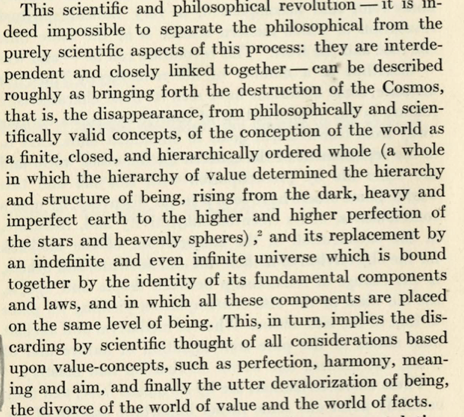
Alexander Koyré -
To What Extent Can Metaphysics Be Eliminated From Philosophy?I was comparing Rupert Sheldrake's 'morphic resonance' with Richard Dawkings coining and use of the term meme from his book 'The Selfish Gene.' — universeness
Dawkins and Sheldrake are poles apart. Read about this encounter between them. (I'm a Sheldrake admirer, actually had the good fortune to meet him and hear him speak in the early 90's. Of course he's regarded by establishment science as a maverick and crank, as many of those who argue against scientific materialism are.) -
Shouldn't we speak of the reasonable effectiveness of math?The mind is of a different kind to the mind-independent world
Realism is the belief that the world comprises the mind and a mind-independent world. — RussellA
I question the coherence of the idea of a 'mind-independent world', but I don't think I'll pursue it. (I have some familiarity with F. H. Bradley whom as I understand it was one of the last of the British Idealists, in other words, he did not subscribe to the doctrine that reality comprises a plurality of really existing mind-independent objects, as can be seen here.) -
Shouldn't we speak of the reasonable effectiveness of math?If universals don't exist in a mind-independent world, yet we can perceive them in our minds, then they must have been created in the mind. — RussellA
I think before going further, you should explain further what you mean by your term 'ontologically exist'. -
Action at a distance is realized. Quantum computer.I’m no authority on physics but I’m interested in the philosophical implications.
-
Action at a distance is realized. Quantum computer.That’s a question fir physics forum (although I’ve looked it up there before and the answer was ‘no’ for reasons I couldn’t follow).
-
Shouldn't we speak of the reasonable effectiveness of math?Conceptually distinguishable (rationalism) but perceptually not (empiricism). — Agent Smith
Correct. One of your sporadically insightful observations. :wink: -
To What Extent Can Metaphysics Be Eliminated From Philosophy?I wonder how we would we describe the position of mysterianism in relation to the venerable mind body question? It maintians the issue can't be resolved (perhaps even in principle) which may be an overreach, but does it imply that the question or any proposed answers are nonsense too? — Tom Storm
This is going to be a digression but it can't be helped. I've read some brief articles and reviews by Colin McGinn who is the current mysterian-in-chief. He says that 'consciousness is a mystery that human intelligence will never unravel'. I don't necessarily accept that, or rather, I think that that it is a question which requires a radical shift in perspective.
We have previously discussed articles by Michel Bitbol and others that about the role of the subject as 'unknown knower'. These discussions often refer to a well-known passage in one of the Upaniṣads along the lines of 'the hand cannot grasp itself, the eye cannot see itself' (thereby bringing in Indian philosophy.) I've always found that principle to be what is called in philosophy 'apodictic' - it cannot plausibly be denied - although in my experience, many others don't.
The bearing this has on metaphysics is going to be very hard to articulate, but there are some pointers. Phenomenology became aware of the objectively-unknowable nature of mind and the unstatable presence of the subject, for example. Husserl said 'Consciousness is not a thing among things, it is the horizon that contains everything.'
But to appreciate that takes a perspective-shift, from the objective attitude to the self-reflective attitude. That attitude is much more pronounced in Continental than analytic (i.e. English-speaking) philosophy. It is also found in some of the post-modern theorists that @Joshs refers to, specifically Evan Thompson, and also to Michel Bitbol (mentioned above). Their perspectives come from a from a blending of phenomenology with Buddhist abhidharma (so once again bringing in a perspective from Indian philosophy.)
But notice that this shift is away from what I call 'the objective stance'. The objective stance is instinctively one of scientific realism. (I suggest that is the perspective from which Colin McGinn declares consciousness is insoluble mystery.) It is the naturalist perspective of the intelligent subject-in-the-world, close to what I understand Husserl to be saying is 'the natural attitude', which is inborn in us and also reinforced by the culture we're in. And from within that perspective, metaphysics is most often dismissed or 'bracketed out', as what is 'really there' is assumed to be the objects amenable to scientific analysis (because if they're not amenable to that, then how can we know them? Which is basically 'the hard problem' again, and it's not a pseudo-problem!) But it is precisely the 'objective stance' which has been called into question by the discovery of the 'observer problem' or 'measurement problem' in early 20th C physics, hence opening the door to contemplation of the role of the subject. And also generally by 'the rediscovery of the subject' which has also happened in more recent philosophy. And that is a momentous change in perspective, and also a cultural change, that we're actually living through, albeit in fits and starts, in today's culture. -
To What Extent Can Metaphysics Be Eliminated From Philosophy?The purpose of metaphysics is to bring those unacknowledged, unrecognized assumptions out in the open — Clarky
:up: -
To What Extent Can Metaphysics Be Eliminated From Philosophy?That quoted passage means something different from saying that 'metaphysical positions have no truth value'. That is very much the line of the 'vienna circle positivists' for whom metaphysics are nonsense. Collingwood's concern is more with interpretation: how are we to interpret metaphysical statements, so as to better understand those who made them? It's not dismissive of metaphysics in the way the positivists were.
You are as much a philosopher as 95% of us here. You certainly are more well-read than I am, in spite of your aw shucks, I'm just a jumbuck playing my didgeridoo next to the billabong in the outback way of talking about yourself. — Clarky
:lol: -
Shouldn't we speak of the reasonable effectiveness of math?A group of people may agree to share a common language. It may be agreed within the group that white objects are linked with the word "white". In the world being observed by the group, not only do white objects physically exist, but also and the word "white" physically exists as an object. — RussellA
You're defending the empiricist view that all concepts are derived from experience. (Some of the following is cribbed from Edward Feser)
Your initial example of a wheel was poorly chosen, the universal concept that is nearest is actually the circle. A circle is 'a round plane figure whose boundary (the circumference) consists of points equidistant from a fixed point (the centre)' as a matter of definition. As such, that is a concept which is discoverable by any mind capable of understanding such concepts. Something similar can be said of other geometrical primitives (squares, triangles and so on.) And these are concepts, not mental images - any mental image you can form of a triangle will be an image of an isosceles , scalene, or equilateral triangle, of a black, blue, or green triangle, etc, whereas the abstract concept "triangularity" applies to all triangles without exception. The concepts that are the objects of intellectual activity are universal, while mental images and sensations are essentially particular. Any mental image you can form of a man is always going to be of a particular man - tall, short, fat, thin, blonde, redheaded, bald, or whatever. But the concept "man" applies to every man.
Second, mental images are always to some extent vague or indeterminate, while concepts are at least often precise and determinate. To use Descartes’ famous example, a mental image of a chiliagon (a 1,000-sided figure) cannot be clearly distinguished from a mental image of a 1,002-sided figure, or even from a mental image of a circle. But the concept of a chiliagon is clearly distinct from the concept of a 1,002-sided figure or the concept of a circle.
Third, we have many concepts that are so abstract that they do not have even the loose sort of connection with mental imagery that concepts like man, triangle, and crowd have. You cannot visualize triangularity or humanness per se, but you can at least visualize a particular triangle or a particular human being. But we also have concepts -- such as the concepts law, square root, logical consistency, collapse of the wave function, and innumerably many others -- that can strictly be associated with no mental image at all. You might form a visual or auditory image of the English word “law” when you think about law, but the concept "law" obviously has no essential connection whatsoever with that word, since ancient Greeks, Chinese, and Indians had the concept without using that specific word to name it.
If concepts existed in a mind-independent world then they would be "out there somewhere" and discoverable. However, if that were the case, two people independently observing an object, for example a rock, should be able to write down all concepts discoverable within the object, in which case, when compared, their lists should be the same. Concepts in objects cannot be discovered by observation alone, but require the inventive power of reasoning using the intellect. — RussellA
Quite right! That is the point at issue, which here you appear to be conceding.
If universals don't exist in a mind-independent world, yet we can perceive them in our minds, then they must have been created in the mind. As universals have been created by thoughts in the mind, they must be dependent for their existence on thoughts in the mind. — RussellA
The 'law of the excluded middle' didn't come into existence when it was discovered by h. sapiens; it would be true in all possible worlds, and would remain so, even if h. sapiens were to become extinct. This is the point of the a priori nature of the pure concepts of reason in Kant. So universal concepts are not created by thought, but can only be discerned by a rational intellect. And that is quite in keeping with the mainstream of Western philosophical thought, even if not with today's empiricism - so much the worse for it! -
To What Extent Can Metaphysics Be Eliminated From Philosophy?No probs, just wanting to clear up that possibly ambiguous reading of @Clarky's statement.
-
To What Extent Can Metaphysics Be Eliminated From Philosophy?A bit simplistic. That belongs more to Carnap than Collingwood, of whom SEP says:
In An Essay on Metaphysics (1940) (Collingwood) attacked the neo-empiricist assumptions prevalent in early analytic philosophy and advocated a logical transformation of metaphysics from a study of being or ontology to a study of the absolute presuppositions or heuristic principles which govern different forms of enquiry. Collingwood thus occupies a distinctive position in the history of British philosophy in the first half of the twentieth century. He rejects equally the neo-empiricist assumptions that prevailed in early analytic philosophy and the kind of metaphysics that the analytical school sought to overthrow. His logical reform of metaphysics also ensures a distinctive role and subject matter for philosophical enquiry and is thus far from advocating a merely therapeutic conception of philosophy or the dissolution of philosophical into linguistic analysis in the manner of ordinary language philosophy.
Collingwood is critical of those philosophers who, like Bradley (1874), bring the presuppositions of natural science to bear upon the study of the historical past. It is not the role of historians to dismiss as false the testimony of historical agents who attest to the occurrence of miracles on the grounds that since nature is uniform and its laws do not change, the miracles past agents attested to could not have happened because their occurrence contravenes the laws of nature. This “positivistic spirit” encourages a judgmental attitude towards the historical sources rather than an attempt to understand their meaning. This is not to say that historians need to believe that miracles happened in order to understand the sources, but rather that understanding the role that belief in the supernatural had for the agents who witnessed to them is more important for the historian than assessing whether belief in the supernatural is true or false.
So Collingwood was not dismissing metaphysics in the way that the positivists were. -
To What Extent Can Metaphysics Be Eliminated From Philosophy?Of course! Wasn't suggesting anything of the kind. Sleep well.
-
To What Extent Can Metaphysics Be Eliminated From Philosophy?You want metaphysics, there's some ;-)
-
To What Extent Can Metaphysics Be Eliminated From Philosophy?the main point which Murdoch is making is making is the emphasis on empiricism — Jack Cummins
You might find Jaques Maritain's essay The Cultural Impact of Empiricism food for thought. (Maritain, d.1973, was a leading French neo-Thomist philosopher and cultural critic.) -
A few strong words about Belief or BelievingExample: "Belgiums are baby killers and should be punished". Once, long ago, those words were believed my millions. Evil words, sinful words. Death words. — Ken Edwards
Still trying to work out who those millions were, and why "Belgiums", especially considering that Belgium is actually a country. :chin: -
The American Gun Control DebateCanadian Prime Minister Justin Trudeau on Monday announced the introduction of a bill that would place a national freeze on handgun ownership across Canada.
"What this means is that it will no longer be possible to buy, sell, transfer or import handguns anywhere in Canada," Trudeau said in a news conference.
"In other words we're capping the market," he added.
If passed, the new anti-gun legislation will fine gun smuggling and trafficking "by increasing maximum criminal penalties and providing more tools for law enforcement to investigate firearm crimes," Trudeau said.
The new legislation would also require that long gun magazines "can never" hold more than five rounds.
"Gun violence is a complex problem, but at the end of the day the math is really quite simple: The fewer the guns in our communities, the safer everyone will be," the Prime Minister said. — CNN -
To What Extent Can Metaphysics Be Eliminated From Philosophy?It does seem that Kant has become rather unpopular, — Jack Cummins
A lot of that is because he's very hard to understand, and it's a lot easier to dismiss him than to understand him. After all, he's a dead white male, there are plenty willing to write him off on that basis alone.
Positivism was built on the attempt to eliminate metaphysical discourse from philosophy. Unfortunately for them, the very criteria which they used to eliminate metaphysics was found to apply to positivism also. 'No metaphysics' turned out to be just bad metaphysics. -
Shouldn't we speak of the reasonable effectiveness of math?That's how you interpret it. — Landoma1
No, that's what you've said. You say in your OP, you can't imagine it being any different. That's because you live in a society that has made these discoveries. If you lived a hundred years ago you couldn't even imagine such a discovery. But, yeah, so what. -
Shouldn't we speak of the reasonable effectiveness of math?As with all inventions they were invented in the mind, and then made into a physical thing of perhaps wood and steel, a circular rim supported by spokes revolving around an axle. — RussellA
But you don't know that. It's quite feasible that the wheel was invented because some Cro-Magnon discovered that you could roll a big rock on logs. Basic empiricism.
I am persuaded by FH Bradley's Regress Argument that relations don't ontologically exist in the external world, meaning that wheels don't ontologically exist in the external world. — RussellA
I'm not familiar with Bradley's Regress Argument, nor with the meaning of 'ontologically exist'. But at least you're prepared to discuss universals, which few here are, so I will persist.
It could mean that if we turn over the whole universe item by item we will find at least one thing that is to the west of another thing.
There is a case - at least one case - of something being to the west of something else.
From which if finally follows that relations exist...........we can see that relations have ontological existence. — RussellA
I think that you're saying that statements about what exists can only be validated against instances that might be encountered in the sensable universe. That for something to exist, it has to be 'out there somewhere' - you have to find an instance of it in order for it to 'ontologically exist'. I'm guessing that's what you mean by that rather awkward phrase.
Bertrand Russell provides an example in Problems of Philosophy, which I'm guessing you're familiar with, given the particular example that you've cited involving Glasgow. The way he puts it is like this (and please forgive the lengthy quotation):
Consider such a proposition as 'Edinburgh is north of London'. Here we have a relation between two places, and it seems plain that the relation subsists independently of our knowledge of it. When we come to know that Edinburgh is north of London, we come to know something which has to do only with Edinburgh and London: we do not cause the truth of the proposition by coming to know it, on the contrary we merely apprehend a fact which was there before we knew it. The part of the earth's surface where Edinburgh stands would be north of the part where London stands, even if there were no human being to know about north and south, and even if there were no minds at all in the universe. ...We may therefore now assume it to be true that nothing mental is presupposed in the fact that Edinburgh is north of London. But this fact involves the relation 'north of', which is a universal; and it would be impossible for the whole fact to involve nothing mental if the relation 'north of', which is a constituent part of the fact, did involve anything mental. Hence we must admit that the relation, like the terms it relates, is not dependent upon thought, but belongs to the independent world which thought apprehends but does not create.
This conclusion, however, is met by the difficulty that the relation 'north of' does not seem to exist in the same sense in which Edinburgh and London exist. If we ask 'Where and when does this relation exist?' the answer must be 'Nowhere and nowhen'. There is no place or time where we can find the relation 'north of'. It does not exist in Edinburgh any more than in London, for it relates the two and is neutral as between them. Nor can we say that it exists at any particular time. Now everything that can be apprehended by the senses or by introspection exists at some particular time. Hence the relation 'north of' is radically different from such things. It is neither in space nor in time, neither material nor mental; yet it is something. ...
It is largely the very peculiar kind of being that belongs to universals which has led many people to suppose that they are really mental. We can think of a universal, and our thinking then exists in a perfectly ordinary sense, like any other mental act. Suppose, for example, that we are thinking of whiteness. Then in one sense it may be said that whiteness is 'in our mind'. ... In the strict sense, it is not "whiteness" that is in our mind, but "the act of thinking of whiteness". The connected ambiguity in the word 'idea', which we noted at the same time, also causes confusion here. In one sense of this word, namely the sense in which it denotes the object of an act of thought, whiteness is an 'idea'. Hence, if the ambiguity is not guarded against, we may come to think that whiteness is an 'idea' in the other sense, i.e. an act of thought; and thus we come to think that whiteness is mental. But in so thinking, we rob it of its essential quality of universality. One man's act of thought is necessarily a different thing from another man's; one man's act of thought at one time is necessarily a different thing from the same man's act of thought at another time. Hence, if whiteness were the thought as opposed to its object, no two different men could think of it, and no one man could think of it twice. That which many different thoughts of whiteness have in common is their object, and this object is different from all of them. Thus universals are not thoughts, though when known they are the objects of thoughts.
We shall find it convenient only to speak of things existing when they are in time, that is to say, when we can point to some time at which they exist (not excluding the possibility of their existing at all times). Thus thoughts and feelings, minds and physical objects exist. But universals do not exist in this sense; we shall say that they subsist or have being, where 'being' is opposed to 'existence' as being timeless. — Bertrand Russell, The World of Universals
There are very many crucial points made in this passage, of which I'll point to a few. One is the distinction between the existence of universals and of sensable objects. As Russell says, neither 'north of' nor 'whiteness' exist - rather they subsist or 'have being' - rather an awkward expression, but it's rather a difficult point. The second, and crucial, point, is that such qualities or relations or whatever they are, are not dependent on thought, but they can only be perceived by thought. Both of which point to what I regard as an absence or lack in the current philosophical lexicon, with respect to the distinction between 'being' and 'existence'. It's the tip of a very large iceberg. -
Shouldn't we speak of the reasonable effectiveness of math?But you’re assuming just the thing that is in question. You know, ‘the task of philosophers is to wonder at what men think ordinary’. Philosophy asks questions about many things that you ordinarily take for granted. That mathematics can predict things that not only are not known, but of a kind of which was never even previously imagined, like anti-matter. So a philosophical response to that is not, I suggest, ‘so what?’
-
To what extent is the universe infinite?I was told by a professor of philosophy that the Universe is finite but unbounded. (I believe that is also Einstein's understanding.) It means, you can't reach an end or edge, in a way analogous to not being able to find the edge of a spherical shape. Wherever you are in the Universe, it extends for billions of light years in all directions, but it's still not infinite. And if you travel far enough in a straight line, you will end up where you started. And no, I can't figure that out, either.
-
Action at a distance is realized. Quantum computer.That Alice measures her entangled particle doesn't imply that a measurement has been made or ever will be made on Bob's entangled particle. — Andrew M
I was referring to this thread on physics forum. I felt I had spotted an error that the first response set straight but this is obviously not the place to discuss Physics Forum threads. I only went there because @noAxioms mentioned there was a sub-forum on interpretations, and that was the first thread I looked at.
"Quantum Computation and Quantum Information - Nielsen and Chuang"]For physicists, the most important lesson is that their deeply held commonsense intuitions about how the world works are wrong.
Add 'and naturalists' :wink:
Here at human scale, we can live our lives as we always have. — Clarky
People do say that often when encountering the paradoxical quality of quantum mechanics. But don't forget that the subject concerns what has always been thought of as the 'fundamental constituents of reality'. -
Action at a distance is realized. Quantum computer.The world is not locally realistic. — Andrew M
What does 'locally realistic' mean? It doesn't make a lot of sense as plain English.
Incidentally, I've been reading an article on QBism. As far as I understand it, it makes sense to me.
Schrödinger thought that the Greeks had a kind of hold over us — they saw that the only way to make progress in thinking about the world was to talk about it without the “knowing subject” in it. QBism goes against that strain by saying that quantum mechanics is not about how the world is without us; instead it’s precisely about us in the world. The subject matter of the theory is not the world or us but us-within-the-world, the interface between the two. — Chris Fuchs
That really nails it for me, because, if you think about it, it actually lines up with Kant. -
Ape, Man and Superman (and Superduperman)Never mind, I was being sarcastic, which I ought not to do.
-
Ape, Man and Superman (and Superduperman)I have the impression from previous reading that Nietzsche aligns himself with Aristotle's notion of eudamonia, "good spirit" or "flourishing", — Janus
Yes, and he provided such a stellar example of that.
Wayfarer

Start FollowingSend a Message
- Other sites we like
- Social media
- Terms of Service
- Sign In
- Created with PlushForums
- © 2026 The Philosophy Forum