
-
Ukraine Crisis
Exactly.It makes no sense. The obvious strategic move is to decapitate Ukraine and install a puppet. — RogueAI
What you say was the most obvious objective. But some have this need to prove this is a "myth", that the real cause of Russia's attack was only a defensive move because of NATO enlargement. And once you've taken that stance that everything was because of the American military-industrial complex and the foreign policy blob, then this "critical" stance leaves you determined that Ukraine shouldn't be assisted and Trump should push Ukraine to surr... make peace with Russia.
Well, let's see how long there is a NATO, thanks to Trump. -
Ukraine Crisis@Mikie has stated that:
I told you what I believe the goals were— to create chaos in Ukraine and make a mess of things. So attacking Kiev makes sense— even if it wasn’t a success. — Mikie
So you make sense of that. I think that Putin's actual warplan was something else. Because obviously this isn't the outcome that Putin had in mind. -
Ukraine Crisis
Ok, here you have to really prove your point, because "creating chaos in Ukraine" doesn't sound at all as something any intelligent entity would make. That simply is nonsensical.I told you what I believe the goals were— to create chaos in Ukraine and make a mess of things. — Mikie
There has to be an defined outcome beneficial to Russia. No sane military commander would accept an objective: "Oh, let's just go there and create chaos and mess things up." I mean WTF?
The simple question is "and then what?" could be ask. So the objective could be to A) install a Pro-Russian friendly regime in place of the Zelensky administration and, what has already happened, that B) annex the territories you want from Ukraine. As I've stated over and over, both end Ukrainian independence and both option A) or B) are worthy things to defend from happening for the Ukrainians.
That Pro-Russian leader could have been Victor Medvedchuk, who is a close friend of Vladimir Putin. How close can be seen from the fact that after the Ukrainian SBU arrested him, he was handed over to Russia in a prisoner-of-war exchange.
(In an alternative history, he might have been the replacement to Zelenskyi)
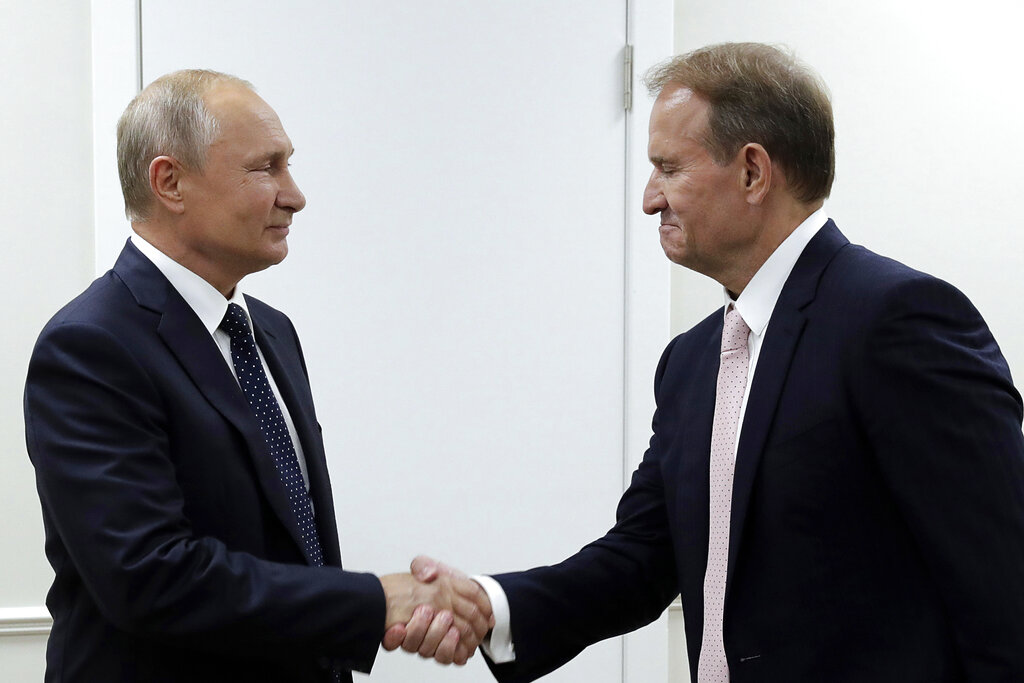
(But not so, and now this guy lives in Russia)
:quality(80)/cloudfront-us-east-1.images.arcpublishing.com/semana/B2JCNCJK6FCOXEHUW5QTGENQQA.jpg)
Mikie, Ukraine was part of Russia. What on earth are you blabbering about?Because Ukraine isn’t a monolith. The areas Putin wants are culturally and politically different from the others — and conquering Ukraine world entail ALL of them being under Russian control. That isn’t the case now, and wasn’t the case then. — Mikie
Your just living in your own estranged echo-chamber. Putin has annexed parts of Ukraine. He wants more territory that isn't in his control. And he has broken peace agreements earlier, remember the Minsk agreements?What you meant was: I take what Putin says seriously if it corresponds to what I want to believe. That’s not interesting to me. — Mikie
But for you those all events that have taken place are "myths". -
Donald Trump (All Trump Conversations Here)
Well, Trump was amazed to find out that Lincoln was a Republican. Who knew?As if to correct that mistake, Trump posted the Obamas as monkeys, just to make it plain where they now stand — Questioner
The MAGA-cult has nothing to do with conservatism or the values of the Republican party. It is a revolutionary movement. -
Donald Trump (All Trump Conversations Here)
I think that's one way of dealing with a scandal: make it so absolutely bizarre and outlandish and give the room to the most eccentric conspiracies, you make it simply too crackpot for people to hold interest. Just remember what happened to the 9/11 truthers.I'm sure many of you are aware that there have been testimonies about Epstein and the elite that frequented his company that are so grotesque they defy belief. These testimonies go well beyond the abuse of adolescents and young women. — Tzeentch -
Ukraine Crisis
If Putin attacked, it simply means that he was confident to achieve his goals. That should be obvious even to you. If Ukraine hadn't been able to recover the territory from the Kremlin-backed insurgents in the Donbas, so to Putin likely Ukraine looked like a push over. The US had retreated from Afghanistan in a humiliating way, so no worry of them responding angrily. And Putin had bragged on a phone to a German leader that he would have his tanks in hours in Kyiv. Evidently he had bad intel, which can be seen from the fact that he fired many of the FSB personnel responsible of Ukraine after the attack had gone awry.Look at the number of troops used in February of 2022— do you think that was enough to conquer Ukraine? — Mikie
Besides, look at the number of the "little green men" used in seizing Crimea? How many troops did Russia loose then? None. And you are simply likely bothering to read to the end what I say: if the objective was to put up a puppet regime that would control rump state, that is simply trivial.
Yes. Putin wants far more than it's troops have capture. Ukrainians are still willing to defend their country. What is wrong with that?Given that reality, Russia will not accept anything less than what they’ve demanded for years. Much like Crimea, those eastern territories are now gone. — Mikie
And please just answer this simple question: If Putin wants territory of Ukraine, why are you repeatedly insisting about Putin not wanting Ukraine? It's like if someone is assaulting someone and beating the crap out the person, you claim that the assaulter isn't going to kill the person and never wants to kill the person, becuase why would the assaulter want that.
This shows your utter lack of the actual events in Ukraine and the Russian-Ukrainian relations. Period.If the US didn’t continually attempt to turn Ukraine into a western “bulwark,” this wouldn’t have happened. That’s just the fact of the case. — Mikie
You really think that taking Crimea was about "the US attempting to turn Ukraine into a western bulwark"?
@Mikie, you quote Putin's speech when he attacked Ukraine. So he didn't say directly there in that that Russia will conquer Ukraine, that's your argument for Russia not wanting to have Ukraine if Ukraine defenses would have collapsed.So you can’t answer that question, got it. — Mikie
Seriously? Is that your logic?
That's the poorest counterargument that I've heard of. I mean seriously, not all politicians are so perfectly transparent as Trump is who really utters totally, without any filter, just what is in his mind.
I think that this debate is totally not worth wile. But you go to believe the MAGA cult on this one... -
Ukraine Crisis
And how much do you know of the history of the Donetsk and Lugansk People's Republic's?Do these words count, or should they be ignored? — Mikie
How they were created by the Russian Intelligence Services in the way to instill instability after the Crimean invasion?
It's an old trick, that the Soviet Union used even on us Finns too in 1939. They created "the rightful government" of Finland called Finnish Democratic Republic and Stalin stated that would negotiate on with this government. And when the Red Army would have conquered Finland, likely this Democratic Republic would have woved to join the Soviet Union, just like Donetsk and Lugansk joined Russia. In modern times Georgia (South Ossetia and Abkhazia) and Moldavia (Transnistria) have gotten the same treatment.
When one country wants to annex even parts of another that it has earlier recognize the independence of, it should be obvious who the attacker and the perpetrator is.
This is absolute nonsense. And Putin's idea that Ukraine should be part of Russia is in his famous text that you can find following this link: Article by Vladimir Putin ”On the Historical Unity of Russians and Ukrainians“Annexing parts of Ukraine and conquering Ukraine are different things. The latter makes no sense and hasn’t been attempted. Which is why you can give no evidence for it, verbally or militarily. — Mikie
Seems you have no understanding what you are saying or what it means actually when your country is invaded by another country that is willing to annex your land. The Russian stop if they cannot advance anymore. If the rule is either a puppet regime backed by Russian troops or part of Russia is totally trivial, because the end outcome is the same.
Only the demented Trump says totally what is on his mind when he says he wants Greenland. Putin follows the procedures that Russian Intelligence Services have used for over 100 years. -
Ukraine Crisis
No, you disregard it. They annexed Crimea, they have annexed regions that in their entirety they don't even control. You disregard that - not fine. Putin has made quite clear his intentions, it started to be obvious four years ago before the attack happened. I then in my first post well before the attack happened stated that Putin had made very sinister remarks by questioning the sovereignty of Ukraine.The Russians have been clear about what they’ve wanted. You disregard that— fine. — Mikie
What move? What Putin and the Kremlin said before the attack was that Ukraine was an artificial state and it should naturally be part of Russia. That's what they have stated, which you either are ignorant about or willingly put aside. Because what Putin himself says and writes obviously seems not to matter to you. Well, what the leader of a state publicly declares does matter for me.Russia has likewise been telegraphing this move in Ukraine for years. — Mikie
@Mikie, read actually what Putin has said to be the reasons that Ukraine should be part of Russia prior to the attack. And for crying out loud, they attempting to conquer Ukraine. They thought they would have the power, because they thought that Ukraine wouldn't fight back as hard as it has. You simply cannot deny this reality.It doesn’t make sense to conquer Ukraine. First, they don’t have the military power to do so. — Mikie
It's not a matter of making sense. For you and me it doesn't make sense, but for Putin it makes perfect sense. And this isn't something debatable anymore as Russia has already fought the war for several years and already has annexed parts of Ukraine. So this talking about "it doesn't make sense" is totally irrelevant.
First of all, NATO enlarged because and only because of the Russian conventional attack on Ukraine February 2022. Would this Russian attack not have happened, Finland and Sweden would have never joined NATO.NATO expansion is now off the table. — Mikie
Secondly, Ukraine's NATO membership was de facto off the table far earlier, just like EU membership of Turkey is way off. But NATO obviously wouldn't say it aloud.
Just the show of force on the Ukrainian border - the actual troop building for the conventional invasion - was enough to make Germany to promise that Ukraine would not become a member of NATO. Already Hungary and some other countries oppose Ukrainian membership, so it was off the table still before. NATO is an organization with rules for membership. Hence it's irrelevant if some President Bush makes promises to Ukraine, because president Bush or any president cannot decide that. And that's why Trump hates so much NATO (and many other US presidents have been disappointed in the organization).
To assume that Russia did this attack because it wanted to prevent NATO expansion is simply incorrect as it didn't have to attack Ukraine to stop this. And the real threat of NATO? Now there over 1000 kilometers of new NATO border that Russia has, hence the actual threat from NATO hasn't been the driving issue for the attack on Ukraine.
Again, you seem not to understand at all how Russia works and what is it's agenda.The myth of an evil Putin bent on conquering Eastern Europe and reestablishing the USSR is justification to absolve the US of their hand in this, and to continue the enormous amount of cash being thrown at this proxy war. — Mikie
Ukraine it might attempt to conquer, but for Eastern Europe, the Baltics and Northern Europe, it want's it's sphere of influence enlarged. That's why it's primary strategic objectives are 1) the dissolution of the Trans-Atlantic alliance and 2) the dissulotion of the European Union. Without a strong NATO and EU, every European country is in great disadvantage towards Russia. But being part of NATO and EU, tiny states like Estonia, Latvia and Lithuania, basically having populations equvailent of Maine to Nebraska, can stand up against Russia.
So hopefully you can understand that Russians really mean it, when they say that Trump's policies are aligning with theirs when Trump is hostile towards the EU.
Sorry, but your living in your own delusional bubble. Perhaps start by looking what annexation means.That’s exactly what matters. Notice that they’ve never said they wanted to conquer Ukraine and, unsurprisingly, never tried to. — Mikie
Here is Putin formally taking parts of Ukraine to Russia. Cause and effect should be clear.
-
Donald Trump (All Trump Conversations Here)
Yep, you seem to hit the nerve. :up:Ooh ooh, I must have hit a nerve. — Punshhh
Of course it was first the war against Georgia, the Russian army hadn't been yet reformed, but it managed because the Georgians were even more unprepared to fight the Russian 58th army. That the US didn't respond, but let Georgia on it's own just like Europe did basically emboldened Putin (who actually then was prime minister and Medvedev the President). There had been these interventions earlier in the disguise of "Russian peacekeepers" (even South Ossetia had them to defend the Pro-Kremlin insurgents), but this was the first conventional war with a neighbor state. After the war the West tried several times to "reset" the ties. This was basically what every US President has done since Clinton.
So you can call it sleeping on the wheel, but in reality it's simply hoping that Putin and Russia would be something that the US hoped it to be. -
Ukraine CrisisMyth?
You should make the case just why "Russians didn't want to conquer Ukraine", because you don't give any evidence of this, just state that it's a myth. And this is the unfortunate state of the discourse even in a philosophy forum. It's basically ludicrous argument when Russia has already declared that it has annexed parts of Ukraine and demands parts that it doesn't even control. But the actual words and actions of the Russian seem not to matter here.
On the case that Putin wanted a 10 day special military operation to take control of Ukraine:
- The easy success of the military seizure of Crimea and that Ukraine didn't fight at all back then.
- Actual speeches of Putin and all the speech of Ukraine being an "artificial" country.
- That there were Pro-Kremlin Ukrainian politicians then ready to be set up as leaders of the "denazified" Ukraine.
- The attempt on taking Hostomel airport, the follow in troops that were diverted because the airport weren't secured. Along with the other troop movements, it was obvious the Capital was the objective.
- Actual plans and ordered that were taken from killed or surrendered Russian troops and how to treat the Ukrainian.
- The Russification of the people in the occupied Ukrainian lands.
And when it didn't go to plan, then:
- The large firing of those FSB officers responsible for the Ukraine operation prior to the conventional attack. They were the people that were telling Putin that Ukraine would fold easily.
Just like in 2014. Back then the commander of the Ukrainian navy happily took a position of being a Russian admiral, which tells a lot of the situation. If it was so easy then, why would it now be difficult? Above all, the US just had betrayed another of it's allies like in Vietnam, so why not?
Nobody has to know Putin's soul. What he has said and what he has done is far enough. And the above were just examples why this should be totally obvious. It should be you who would be a consistent argument of just why everything is a myth. The annexations, the Russification of the Ukrainians, everything should be an obvious proof of what the intent is, starting from the fact the Putin see's the collapse of the Soviet Union as the biggest catastrophe of the 20th Century, something obviously he tries to get back.
What I'm only aware is the lurid story especially told by Mersheimer and Sachs that doesn't focus at all in the relationship that Russia has with Ukraine, but see everything just as an outcome of US policy and NATO enlargement. This is basically where the extreme navel-gazing that Americans do ends up in, where everything, absolutely everything, evolves around them without any other actors having objectives and agendas of their own. It's worrisome, because it creates a very delusional, fictional understanding of the world. -
Mechanism of hidden authoritarianism in Western countries. Almost all of the reasons for that (which are quite numerous and varied), actually have nothing to do with the actual healthcare itself, rather in systems that surround it. Insurance company financial motivations, drug and equipment company profiteering, high malpractice concerns, cultural style, high self abuse rates, heroic attempts to address problems that go untreated elsewhere, an unhealthier population to treat are just a small list of reasons for high costs in the US. — LuckyR
The problem is that the system is designed for the insurance companies and in general for companies with financial motivations around the health care sector, not for the citizens themselves. This is the real fault here. Basically those that benefit from the current system hold dearly on it. Here comes to play the power of lobbying in the US Congress. Why? Isn't the Congress elected by the people? Wouldn't lowering health care costs be something that all Americans would agree on?
One thing can be that the Americans simply don't trust any improvements happening and just assume anything new promised will be worse than now. But I think that is a minor cause. I think here the fault is the entrenched party system, all that gerimandering and a polarized political discourse. The brazen way how Americans who support either party will overlook any criticism of their own party and focus on the errors and faults in the other party creates this tribalism. In my view two parties simply cannot represent the vast different opinions found in any country. It's just little shy from a single-party system. All this creates a fertile breeding ground for corruption, which basically is made legal.
The real problem is that Americans think this system would be changed by electing a President. Thanks to that, the world has gotten now Trump again. -
Ukraine Crisis
Wrong. It isn't.If one believes Russia wanted to conquer Ukraine— which it never did. That’s a stupid myth perpetuated by the West, of course. — Mikie
Putin attempted to take Kyiv and failed. The claim that Ukraine was to be "denazified" shows totally and very clearly the sinister objectives of Putin. If the Western part of Ukraine would have been a satellite state or annexed is quite irrelevant: the Ukrainians would have lost their freedom. Besides, if there's nothing to stop them, why not take everything then? The talk of Novorossiya was already there very public when Crimea was annexed. Imperialism never died in Russia.
A map from 2014:
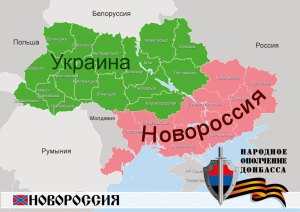
Nope Mikie, this is the lie fed by the Kremlin extremely well to especially Americans. It is swallowed so well because it puts the US at center stage (everything happened because of the US actions). For people who think wars are fought as forever wars just to keep up the military expenditure, it surely might be confusing that Ukrainians do defend their country and are willing to die for it. -
Mechanism of hidden authoritarianism in Western countries
Broken, but working. Usually the Presidents became multimillionaires through writing books and giving speeches. They didn't become billionaires...when acting as president. Your argument is obviously that "this isn't anything new under the sun". But it actually is. When the corruption is in the hundreds of millions, when it's open and when nothing happens, that's the worrying issue.The US system has been irreconcilably broken for decades. The idea that Trump meaningfully changed anything is laughable. — Tzeentch
Or you think it's ordinary, that the President of the US sues the IRS for 10 billion dollars for leaked tax information? You really think that it is totally ordinary, the typical thing? It's laughable if you think it is. -
Mechanism of hidden authoritarianism in Western countries
Would be interesting to know just why and how it has come to that.Ironically, the American problem with obesity is caused by low quality, ultra-processed crap. — frank
Better to have a single buyer. And why is there advertising for prescription medication?since COVID, American healthcare providers have been coalescing into mega-entities. The advantage to that is that huge operations (spanning across half the country in some cases) can take control of drug costs. — frank -
Donald Trump (All Trump Conversations Here)As Trump was financially saved by his Russian connections and how close Trump and Epstein had been, it's no wonder that these guys were mingling with the Russians.
-
Mechanism of hidden authoritarianism in Western countries
Nope, it's actually the actions that the leaders do. Do the leaders stay in their described role in the system or start taking power which they shouldn't have? Is the judiciary independent? Is political plurality accepted or not?Hungary nor the US is authoritarian. That's just a pure cope from people who are mad that the democratic process didn't produce the outcome they wanted. — Tzeentch
Well, Trump's DOJ and it's actions are a case point. Just to give one example. -
Mechanism of hidden authoritarianism in Western countries
Well, it isn't yet equivalent to a Third World country's health care system. One hypothesis is that there simply isn't so much preventive health care treatment. Or how about food safety?Outcomes are worse. That doesn't equate to "mediocre.". Why exactly outcomes are worse is an unanswered question. One hypothesis is that the American population is sicker for some reason. — frank
I think it just starts compiling up in a spectacular fashion. One huge reason is simply that any system that is created to make a profit will make it expensive. Health care of the population shouldn't be viewed as an opportunity to get profits, but a service that the government should provide for it's people. -
Ukraine Crisis
If it would be losing badly, I guess Kharkov ought to have fallen and the battles should be fought on the streets of Kyiv and Odessa.1) Ukraine is losing and losing badly. — Mikie
This is the crazy talk kept up by the Trumpsters. Putin isn't negotiating. He feels he can win it all.3) Better to negotiate a settlement than continue. — Mikie
When it's the Ukrainians who are doing the fighting, it's up to them to decide when to surrender. The US has already twice in it's history just left the side that it helped totally on it's own. We Europeans shouldn't do that to Ukraine. -
Mechanism of hidden authoritarianism in Western countries
Everything is complicated, yet the simple fact is that US health care costs are the highest in the World whereas the healthcare system is mediocre and the US doesn't have universal health care, the only developed and industrialized country without it.US healthcare cost is a poor example to illustrate any simple concept since the reasons for it's outlier status are multiple and complicated. — LuckyR
That in itself tells a lot. -
Mechanism of hidden authoritarianism in Western countries
Democracies can turn also authoritarian. Case point is what is happening (or attempted) in the US, but Hungary is another example.Western countries are not authoritarian, they are democratic. — Tzeentch
Rule of the rich is called Plutocracy.The 'hidden authoritarianism' the OP is talking about is the corruption of the democratic system and not actual authoritarianism. — Tzeentch
Best example of plutocracy is when how many votes you have is dependent on how much taxes you pay (and hence how much income you get). Then basically it's an integral part of the system.
Calling it 'authoritarianism' is a misdirection, shifting the blame to people like Trump (who was democratically elected), and an attempt at perpetuating the myth that democracies would somehow be immune to corruption if it weren't for figures such as him. — Tzeentch
Corruption is a complex issue. And indeed it doesn't need authoritarianism, but my point is authoritarianism goes many times hand in hand with corruption. Corruption can been indeed very institutionalized and it's origins are interesting. Do people in general obey the laws and pay their taxes? What is the attitude towards paying bribes? How common is it? If the police stops you, do you give him a bribe?
Terminal stage? Well, many times everything seems to feel like this is the end.The truth is of course that western democracies have arrived at the terminal end stage of corruption — Tzeentch -
Donald Trump (All Trump Conversations Here)
In general because of lower standard of living modelling (prostitution) in the West seems a lucrative career for many. Some of Epstein's American victims have said that they were told that they were rare.Why would Epstein be trafficking Russian escorts to royal palaces in the U.K. if it was a U.S. state operation? — Punshhh
Do notice that Epstein wasn't government employee. Intelligence services usually have very dubious connections. -
Mechanism of hidden authoritarianism in Western countries
One thing is sure, I wouldn't start from the wages of the health care employees, but simply to take out the insurance companies from the racket. Have universal health care, have the government act as a single, bulk purchaser, leveraging high-volume demand in order for negotiating lower costs from manufacturers. Anyway, start with the profit taking and rent seeking. If you lower the wages of health care professionals, likely you won't get in the future as good people into the sector.Now wait a minute. If nurses and hospital staff were as willing to work for low wages as they were not so long ago, medical care would be more affordable, if teachers also did so for less as they did when my grandmother was a teacher, we would have more affordable schools. — Athena
Do understand that the American health care system is a racket. It's a racket where some people don't have health care which leaves them to have their first appointment with health care system when they are carried from the ambulance to ER. That's insane and extremely costly. No other way could you spend so much money on health care with so mediocre results. Norway has lot's of oil revenue and it simply pours this into it's health care system (with the effect the Finnish nurses flock to Northern Norway thanks to the high salaries). Still it's spending isn't anywhere close to the US system.
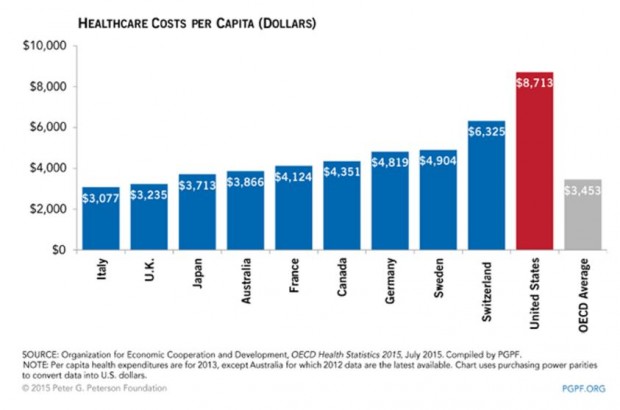
Authoritarianism creates an opening for rampant corruption.I think authoritarianism is the wrong word. I think the right one is corruption - and yes, it is rampant. — Tzeentch
Authoritarianism basically means that the extremely important institutions that keeps corruption in check is replaced by favoritism and cronyism.
These two go hand in hand. -
Donald Trump (All Trump Conversations Here)
I think the Epstein pedo sex-ring was more subtle than blackmail. When you have the Mossad ties, the basic issue is that people are basically pro-Israel. And that's it. As that's the most natural thing for any politician or billionaire to be in the US, pro-Israel that is, this stance isn't at all dubious or threatening. It would be totally different if Epstein would have been working for let's say the Chinese. Hence sexual predators like Bill Clinton or Donald Trump (or "former" Prince Andrew) just would love to be in such "safe" pedophile ring.If this is the case, then some state must have provided them with the funding, to operate, and in return that state would receive benefit from the extortion and blackmailing.
Have you seriously looked into which state was providing this funding, and benefitting from the operation? — Metaphysician Undercover
Now Epstein seems to have wanted to have connections to Russia, but these were more like attempts to have business connections etc.
Of course the horribly sad state where Trump has put the Department of Justice and the FBI has made the US system a real banana republic court totally dependent on the whims of the local dictator. It is just laughable.
Now it seems that the Trump-lovers are eager trying to say that all Western countries are as corrupt as the US is now.
There's actually tons of this kind of stuff as many countries and their hosts have taken care of the needs of one British prince.There seem to be a lot of Russian escort women moving around the place including one being trafficked into the U.K. for the use of Prince Andrew. Which the police are looking into. — Punshhh
Lol. The whole Trump administration is looking like a Russian operation.It is beginning to look as though it became a Russian operation. — Punshhh -
Mechanism of hidden authoritarianism in Western countries
Yes. Just look at history. Just look at what Marxist-Leninists actually wrote. Here's some Soviet propaganda:Very strange - from the Left? For me, the ruling elites are in full collaboration with the Left in Europe (before Trump, in USA too). — Linkey

(Capitalists of the World, unite!)
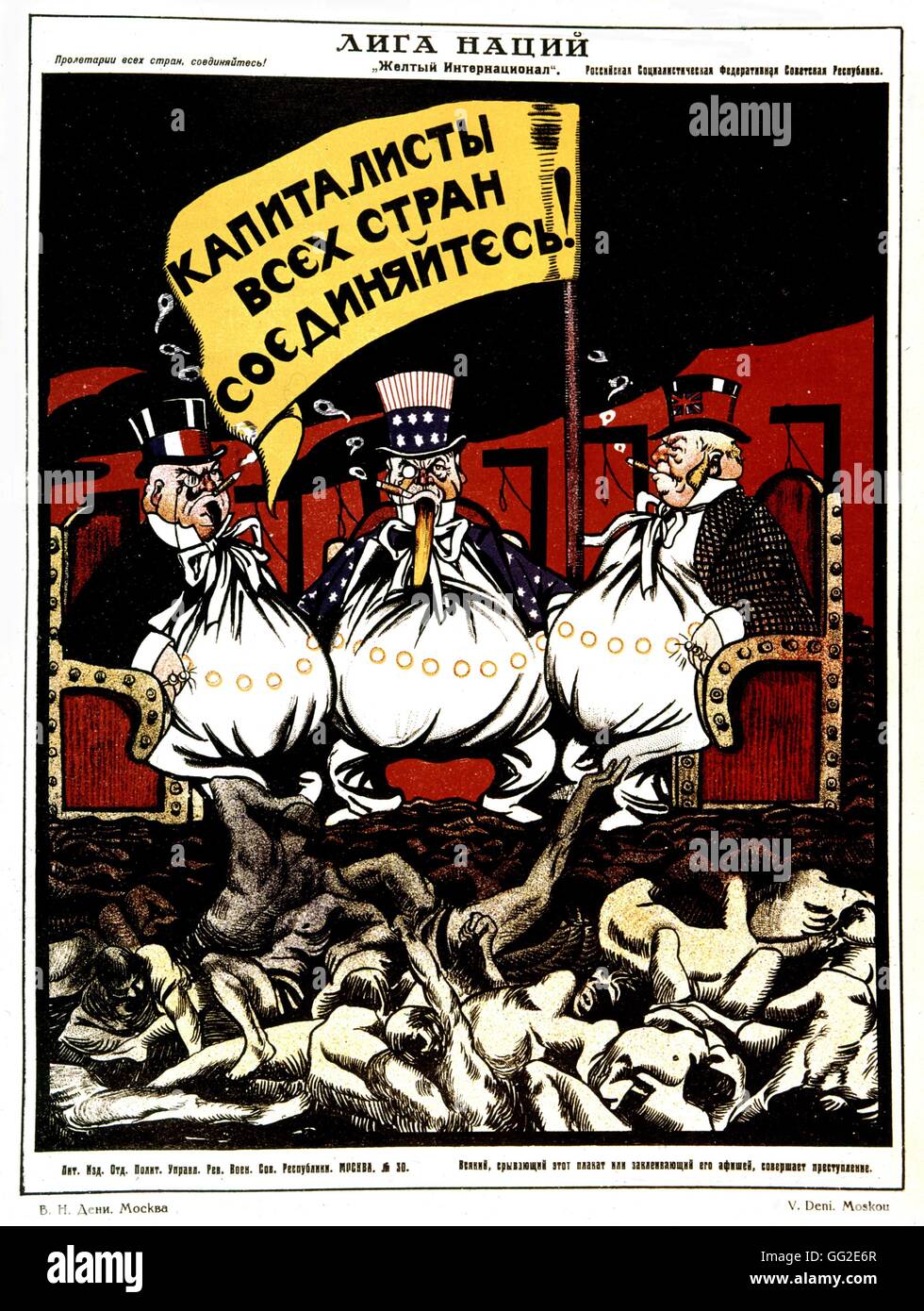
Then we can look back just how many millions of it's own citizens the Communist system killed in Soviet Union or in China.
To see the wrongs is easy, yet what radicals purpose to solve those wrongs is the crucial part that people don't notice. Or with Trump, he just says he'll do it, and the Maga-crowd believed him.
I'm not so sure about that. Many see how disgusting the politics is, think of what there family would be through if they would become politicians. They take other professions. Do perhaps some voluntary work etc.The real rulers of the USA and the Western world in general (financial elite) do not allow smart and honest people to start a serious political career, because a smart politician can become a threat/competitor for these rulers. So only bad candidates can participate in elections, and so the voters do not have a good choice. — Linkey
No, the problem starts from the ground roots. Ask yourself, how many of your friends and those who you work with or share a hobby are politically active, are in for example in communal politics? When's the last time when you have talked with a political representative of your country (Parliament member / member of Congress)?
If ordinary people don't participate in politics, what is the chance really for democracy to work? -
Donald Trump (All Trump Conversations Here)Well, basically the reference was "to the first shots". But you are correct.
-
Donald Trump (All Trump Conversations Here)
The positive sign here is that Minneapolis isn't literally exploding. The injustices aren't an excuse for burning up stuff and for looting. That is really positive. Also, earlier a think tank/study group made a study just how civil war would break up in the US and the scenario was just as what has happened in Minneapolis. The city was just wrong. In that scenario two government agencies, on controlled by the executive and one controlled by the state start shooting at each other. I think that this "Fort Sumter"-moment has passed for now. Even if ICE is still roaming the streets in the city, some kind of dialoge, even if weak, is done. Above all, the White House has backed down and now the Trump people are blaming each other. Stephen Miller, the father behind the immigration strategy, is now backpedaling and saying he got wrongful information and Noem is telling that she was only following orders.In the US, we're about to explode because 2 people were murdered by ICE. That's actually a good sign about the health of rule of law. — frank
That should immediately tell every ICE agent just on how thin ice the whole organization is on now, when looking at the future. It's quite likely that there's going to be quite a reform and organizational restructuring as now ICE has turned into Trump's own Sturm Abteilung. -
Ideological Crisis on the American RightDevelopments in the US and in the world in just the two weeks makes in my view the OP even more important.
Where are the libertarians, the neoconservatives and the old republicans? Seems to be that not many are with Trump MAGA crowd. It might be just the algorithm that US policy commentaries that I read from conservatives are highly critical of Trump. -
Donald Trump (All Trump Conversations Here)
Earlier Presidents didn't have badly trained agents actively roaming the streets for possible illegal immigrants and stopping people who look to be foreigners.Hey bud - can you say what you mean here? — AmadeusD
And when the police fucked up, they didn't go with such blatant lies of the killed people being domestic terrorists.
It's totally different when you come into the airport from an international connection or come to the border crossing and have to represent your passport (visa in some times) and have to tell just what you are doing in the country to you walking on the street or driving home and your stopped by the border guard.
These simple differences, like abiding with laws, having the law enforcement working together. Or things like not locking up 8 year olds for six weeks and then let them back to their family. -
Donald Trump (All Trump Conversations Here)
Because both Biden and Obama did not go with it as Trump has done.Why was there few if any protests over Biden and Obama's deportation numbers (~5 million each) yet mass protests for Trump (~2 million)? — BitconnectCarlos
And the first thing to understand is that WHEN there's democrats in power, it is percieved by immigrants, legal or illegal, that the US is more open to immigration while people understand that Trump is hostile towards immigration. Now tourists from Europe are afraid to come into the US. Then during Obama and Biden the border control performed it's ordinary duties at the border, not patrolling through US cities.
And what has specifically Trump done wrong, I earlierly commented on this, but here it's again.
(This is literally true: @Punshhh made an apt comment about this here: )It's really a concept of how to really fuck everything up:
1) Rapidly enlarge one particular force disregarding a vetting process and training.
2) Take literally the political rhetoric of "tough on illegal immigration" by disregarding formal standard police procedure, perhaps as "pinko-liberal weak" obstacle for the process. — ssu
3) Have totally ludicrous "quotas" ordered by the White House that simply cannot be achieved as the country's tough stance on immigration has already diminished the actual size of illegal immigration.
4) Have no cooperation with local law enforcement and basically treat the local authorities as part of the problem. Have the actions of this government force heavily politicized.
5) When all the above points 1) to 4) create popular resentment and accidents of total ineptness occur, like where one ICE team member taking away an holstered gun leads to someone yelling "GUN" and several agents discharge there weapons several times on a victim that was already on the ground and wasn't a threat, THEN LIE ABOUT IT even if there is multiple video evidence from different angles of the incident. — ssu
In fact, by interviewing ICE and border patrol agents, Ken Klippenstein wrote a good article ICE Unloads about how badly the agents themselves see the situation. Worth reading. For those that don't read it all, here's a quote. Klippenstein writes:
Overall, as someone who has been covering this for months, I am struck by how angry homeland security officers are with their own agencies, and their blunt dismissal of the Washington leadership. All of the immigration officers I interviewed for this story spoke on the condition of anonymity.
Sagging morale and declining standards are a constant theme I picked up, problems that these sources say have been festering long before the deaths of Pretti and Renee Good (and ones that very much contributed to these outcomes).
More than one ICE agent in particular complained about how Washington’s focus on labeling protestors as “impeding” federal functions (and thus breaking the law), and the vilification of “Antifa” and others labeled paid agitators, leftists, radicals, extremists, and terrorists is confusing the ranks while also distracting everyone from the immigration enforcement mission.
“I can go on and on but overall it’s been a ridiculous experience,” one ICE agent told me. He says that many agents on the ground are just going along with the expanded mission because they are more interested in their away-from-home per diem pay and collecting overtime than whatever the mission is.
Others express the cynicism typical of everyone who toils at the bottom of any bureaucratic food chain, pooh-poohing rapid expansion of the ICE army and shaking their heads over the ridiculous budget increases being fought for in Washington that will have no impact where they work.
“The brand new agents are idiots,” an experienced ICE agent assigned to homeland security investigations told me. This same sentiment was echoed by virtually everyone I talked to, with several conveying the view that Pretti’s death was the fault of some skittish young recruit who panicked when he heard the word “gun” (if that’s what happened).
Hopefully this answered just why Trump's actions are different from the past presidents and just why there is so much criticism. -
Donald Trump (All Trump Conversations Here)
Yet that action can be still done by the rules of the republic, just as the people of Minneapolis have done. Is Minneapolis burning? Is there looting? No. Minnesotans are showing how to deal with Trump.Action is required. We've seen that the action of committed people in Minnesota has resulted in Trump backing off somewhat. — Questioner
Why? Because Trump is no Putin. With a guy like Vlad, the US would have already lost totally it's republic and likely a majority would be pleased with the way things are going. Not with Trump as Trump's worst enemy is Donald himself.
And we can already see that the Trump regime is panicking...and blame each other. Democrats are demanding Noem to be fired or face impeachment. And Noem seems to be whisked away "to oversee issues on the Mexican border". Of course the real head that should roll here (because it won't be Trump) is Stephen Miller. His deranged quotas and enlisting of untrained agents with against the law tactics has backfired as it evidently would be. The worst thing of course that the White House went with ludicrous lies of domestic terrorists attempting to assaulting law officers, when everyone can see the trigger happy executions that these goons do.
And of course the second murder really did spoil what should have been Melania's week: her film is coming out, so I guess that she got upset the events in Minnesota and made a rare public announcement. That might actually have made Trump to think that the straightforward lying won't bring him success.
And on the international front, I think the response to Trump has been shown with the actions and the stance that Canadian prime minister Mark Carney has adopted. Trump himself saved the Liberal Party from a humiliating defeat and destroyed the pro-Trump candidates chances by his condescending attacks on Canadians. And people are getting the message: if you accept what Trump wants, he will see it as weakness and will come form more later. Mark Carney gave a great speech in Davos, which likely will be one of the important speeches in this system. Anyway, the damage towards that allies have already been done: even if the US ousts Trump and US leaders will want to strengthen their alliances, people will always remember that Americans voted twice for Trump, and thus can vote populist fascists again to power. -
Donald Trump (All Trump Conversations Here)
So what do you make of the many people that are disgusted about the politics, but just live on with their lives? Besides, in a democracy you can elect other people after those with fascist tendencies and you don't go after those that did vote for the authoritarian candidate. There are countries that have been capable of this.There can be no middle road on this issue. You either support fascism, or you do not. — Questioner
I don't think there were no riots after Maduro was taken out. In fact even Caracas was quite silent as people were afraid if a war would come. And if there was a protest, pretty small one compared to the response to the execution style murders done by incompetent goons that ICE unfortunately now represents. Anyway, if Rubio tried to make it a case of bringing Maduro to justice, Trump made it quite clear just what it was all about oil by declaring the he would now manage the oil of Venezuela. That's the criticism. What I've noticed is that usually people refer to the fact that Maduro stole the elections and that basically his regime (naturally without him) is still running Venezuela.You’re supporting crime. If Trump took out Hitler there would be riots. There was people out there protesting when he took out Maduro. This is what anti-Trumpism leads people to do. — NOS4A2
Don't live in your own echo chamber, but listen to what actually the critique is about.
So what's your take on the WSJ that Trump has benefitted 1,5 billion dollars in one year of his second term? What do you think about Trump asking 1 billion for a permanent seat on "Board of Peace", where he is chairman for life? Is that Presidential behavior? This from the guy that promised to "drain the swamp". -
Mechanism of hidden authoritarianism in Western countriesAs far as I can see, the Western democracy is mostly an illusion; the Western countries are ruled by the financial aristocracy. This works as follows: if a problem arises in society, the financial elite, represented by parliamentarians, passes laws to solve it; but these laws simultaneously serve one more purpose—increasing the wealth and power of the elite. In particular, these laws are always aimed at suppressing small businesses, because small businessmen are less dependent on the power and can overthrow it. — Linkey
Democracy doesn't create a paradise, but it still works in some countries. Many people just look at their own "democracy" and assume others are similar. Especially now when the United States is at a political crisis with rampant and unchecked corruption going on, this is a very normal attitude that people will have.
Yet remember that it's the authoritarians themselves who push exactly this rhetoric that you say: that Western democracy is an illusion, that it is totally ruled by the financial aristocracy. This is the classic argument from the left, from the past Marxist-Leninists with the Nazis just adding to the line that the financial aristocracy is controlled by Jews.
But let's look at this from a different viewpoint and just ask yourself: If the above what you say is true, then how on Earth do a lot of countries have a welfare state? How do we enjoy universal health care? Free education including university level education? Having a home being a right of the individual? First a six-day working week and then a five day working week? Labour laws, work safety requirement and trade unions where the vast majority belong to these unions, including military officers?
Subsidies are usually paid for production and there obviously isn't a case of the laws having limitations like "If you produce well over this huge amount, no subsidies will be given to you". That would be extremely counterproductive.1) I have seen an interview on Euronews, where it was said that agricultural subsidies in the European Union always help large agricultural holdings more than small farmers; — Linkey
And let's remember just how agriculture has changed in the long run and is still changing.
Earlier in the West (just as now in the poorest countries still) peasants were subsistence farmers, land owners or renters, but basically dirt poor against our standards with only a few of the landowners being immensely wealthy. This has transformed into commercial farming, which is far more like modern manufacturing where the economics of scale bring in the real money. When farming is fully automated, the costs of having that modern tractor or the robots that milk the cows and the huge cowpen where the cows wander freely are far higher than the standard farmer working on the farm inherited from his/her parents can afford. So one option is simply to rent the fields and get another job, which is happening in many countries.
(Cows waiting in line for the milking robot. In a modern cowhouse the cows go freely to the milking and wander around freely. You can imagine what an investment this is.)
This leads to simply to the fact that largest producers get the largest subsidies, even if the subsidies originally were to provide for a large number of smaller producers. The loss in the number of smaller farmers is happening because of this transformation basically in every Western country. -
The Strange case of US annexation of Greenland and the Post US security structureISIS won't create it's Caliphate, but at least they did have a serious attempt.
And people actually did take in the end the franchise very seriously... and are taking it. The situation in Sahel is still extremely volatile. Remember Trump's cruise missile attack in Nigeria. Not so long ago. -
Donald Trump (All Trump Conversations Here)There is no dirty trick that is beneath him to ensure he maintains power. We've seen that with what transpired after the 2020 election. — Questioner
After the 2020 election Trump's total ineptness and lack of leadership qualities was shown. The self-coup, which basically it would have been if Trump would have overturned the elections, didn't happen. It was Trump encouraging his voter to go to Capitol Hill (which the did and stormed the place), yet Trump simply went to the White House to watch his supporters invade the Capital. It was simply a mess.
To me the really scary part was when general Mike Flynn advise him to use the military to confiscate the voting machines. That was a direct plan and someone like Flynn would have known that either power or then prison. Only later it seems that Trump has thought that this would have been a great thing to do.
Yet the issue is that on Jan 6th 2020 Trump would have had total strategic surprise. The political system and the Democrats were totally like a deer in the headlights, totally unable to understand what was happening. It would have been unfathomable. And Trump had his followers making it seem to be as a popular revolt. A self-coup would then have been actually possible, but Trump just created a huge mess.
Now it's totally different.
Now everybody is ready for the dirty tricks. Trump seizing power is not unfathomable. And now the limits of Trump's outrageous actions are seen. Just like with Greenland, Trump has to withdraw from the most insane denials of Pretti having attacked the ICE agents. Bovino, the nazi-like commander who has lost all credibility, seems to have been sidelined.
Yet now Trump does have his yes-men (and yes-women) in prominent positions who know that they likely won't last even if the next president would be a Republican. Such people can have the determination to go with Trump's dirty tricks, unlike people in the Trump's first administration. -
Donald Trump (All Trump Conversations Here)Let's hope that the US crawls back from this pit it has fallen into.
An electoral commission would naturally be the first thing an autocrat wants to control. But there are many other entities, simply called the separation of powers. When people don't think that this separation of powers are needed and assume that actually nothing works because of the separation of powers, then you get these populist autocrats. Strong men that promise to correct everything and make things better... and end up making things better only for themselves and their cronies. -
Donald Trump (All Trump Conversations Here)Quite a lot of my predictions have come true.
Like how it was laughable to think that someone like Trump "would end the forever wars" and "focus on America itself", and obviously that this guy "would drain the swamp". And he did move on Greenland, obviously got only scared when the stock market took a hit.
And Kash Patel btw. seems to be exactly the kind of guy I thought he would be.
Exactly. First of all, ICE or any government agency wouldn't make an operation without approval of the state in normal times. And then it would be low key, simply marketed as totally normal police stuff. Just ask yourself: was it really in the news when the highest number of illegal immigrants were sent away during the years when we had Democrat Presidents? You have to have a serious political crisis when for example the Military is put into a state without the acceptance of the state leaders. It's not something that hasn't happened, for example President Eisenhower put the military escort black children to school:That's true, but there's always going to be a question: If local law enforcement co-operated, the way they did under Obama, there wouldn't be the need for ICE to be carrying out these raids and there would be no media-driven (and, as much as you might think this is fine) a concerted, semi-violent effort to impede, harm and hamper not just the enforcement, but agents themselves, the temperature wouldn't be so goddamn high. — AmadeusD
And this tells what really is here the issue.Trump's offer to remove the ICE army if Minnesota hands over the voter rolls shows that. — Questioner
The whole immigrant issue is just the smoke and mirrors here, just like "Chinese or Russian warships off Greenland" or "Canada sending Fentanol to the US" or whatever bullshit Trump says. But it's something that the MAGA crowd likes and keeps them fantasizing that Trump is actually doing what he promised to do. In reality this is all about a power play.
Seriously, if a Presidents gets over one billion in wealth in one year with even the Swiss bribing him, does anyone think seriously that this guy will just give away power and face the consequences? Trump does control the Justice Department and people like Pete Hegseth, Kash Patel, Pam Bondi and Kristi Noem do know that they are on thin ice without Trump/Vance team in power.
The insurrection act cannot change the timeline for federal elections. That is down to your congress. The 20th Amendment sets an absolute end to a presidential term on January 20th, with no exceptions for emergencies or ongoing challenges. — Banno
You assume Trump will uphold the Constitution — Questioner
I think Trump just declaring himself a President for life won't happen. But I think that Trump will try to fake an election win so that at least the Senate is in GOP hold. Trump isn't worried about the next presidential elections, he is worried about impeachment after the Midterms. And what better for him to do this, when all of his stellar political career it's been about the democrats having large scale election fraud. After that, if he would be shrewd, he'd do the Yeltsin thing: pick a Putin, who will let him be safe from investigations and possible jail time. Is JD up to it? Well, he surely is on the Trump boat.
Election fraud is a real possibility, because then people can say that everything is normal and we have seen already this dumpster fire. Not holding elections and oh boy, Trump is for a real ride. It's a move that even US "former?" allies won't accept. And hopefully the American people.
The real issue is of course is that Trump is a simply a disaster. The Greenland deal ended in disaster. As some put it aptly, NATO secretary general had to tap Trump on his back to get Trump from the whole he had dug himself with Greenland and gave him a fictional win. Trump is his worst enemy.
In the end Trump will have his supporters. These people will think that everything is just a lie and badmouthing of Trump. And if Trump will break the rules, he's breaking them because his opponents will do the same thing. Hopefully many will see that this man is really not well and not for the job that he holds now. -
Donald Trump (All Trump Conversations Here)
The way things are going look very sinister to me. Even now when the GOP is enjoying a narrow margin in Congress, Trump isn't going the actual way of having laws pushed through the Congress, but just goes on with more whacky executive orders even if those. Just messages in his Truthsocial! Declaring that he is in charge of Venezuela and then the income from oil from the seized tankers ends up on a bank account in Qatar. And (was it WP) it's been reported that he has made now over a billion dollars in his first year of his second term. He bloody well knows what he will be facing if (when) the democrats are in control.Because Trump is 80, and he’s deeply unpopular. They’ll get wiped out in the midterms, beyond a doubt, and then Trump is out of office forever. — Mikie
You really think that after the peculiar attempt on Jan 6th, now with having total control of the Justice Department, FBI and with those ICE goons around, that Trump will respect democratic elections that would be devastating for him?
So what do you do when he just postpones the elections? Trump has said publicly that "we shouldn’t even have an election". What if he does what he has said? Or when they aren't free and fair? Alzheimer kicking in or another Trump having another stroke might take time. Just look at what he's done or attempted to do in one year. -
Donald Trump (All Trump Conversations Here)
It's really a concept of how to really fuck everything up:Guess just carrying a gun legally is enough to get you shot 10 times. Look forward to applying those standards in the future. What goes around comes around. — Mikie
1) Rapidly enlarge one particular force disregarding a vetting process and training.
2) Take literally the political rhetoric of "tough on illegal immigration" by disregarding formal standard police procedure, perhaps as "pinko-liberal weak" obstacle for the process.

3) Have totally ludicrous "quotas" ordered by the White House that simply cannot be achieved as the country's tough stance on immigration has already diminished the actual size of illegal immigration.
4) Have no cooperation with local law enforcement and basically treat the local authorities as part of the problem. Have the actions of this government force heavily politicized.
5) When all the above points 1) to 4) create popular resentment and accidents of total ineptness occur, like where one ICE team member taking away an holstered gun leads to someone yelling "GUN" and several agents discharge there weapons several times on a victim that was already on the ground and wasn't a threat, THEN LIE ABOUT IT even if there is multiple video evidence from different angles of the incident.
What's the worse that can come from this? First steps have already been taken on a very dark path, if this path will be followed. Look at this picture:
Above are Minnesotan National Guard giving donuts and warm coffee to people. They have yellow vests on deliberately to make them visually separate from roaming ICE teams in Minneapolis. It looks like an innocent picture, but it tells very unsettling things of how downhill things are going in the US. First, there are basically now two government armed groups following orders from separate leadership that are totally at odds with each other. States might really start to think just what is their relation to Trump's regime now. Just like NATO countries are thinking now what the future holds for them as the US is what Trump has made of it.
Yes, now it might really be a stretch that you would have these two entities, Donald Trump's ICE versus local law enforcement and National Guard shooting each other. Perhaps it is as remote as Greenland being invaded by the US. Yet this is extremely alarming just what is happening with the US. -
Trump's war in Venezuela? Or something?
If Trump would be just an ordinary president, it would be after all 5% (or well, with an ordinary prez I guess the percentage would be 0,05%), but he's not. Greenland, Minneapolis, mocking the NATO members in Afghanistan... it's not going to end there.I admire, and envy, your optimism. IMO, the liklihood of Trump being impeached, and removed, is maybe 5%. — Relativist
I think in reality Trump getting impeached or being sidelined is about 11%. Him dying (of natural causes) is more like 20%. Alzheimers runs in the family. All those tests he brags of doing tells something real.
In reality, there may also be the "Biden moment", when he is just put aside when he is totally incapable of ruling. If the Dems did it to Biden, it can indeed happen to Trump. He just needs to be in a worse condition.
In fact,
My little country which thinks it's a good democracy had an experience of this. A President that had basically destroyed the opposition and had the backing of the Soviet Union, simply got too old and demented. And then it wasn't great political drama, but a small announcement that he has retired for health reason. Not with a bang, but with a whimper.
(Last moments of Urho Kekkonen as the President of Finland, here assisted by the Iceland's President, Vigdis Finbogadóttir and his Finnish army adjutant in August 1981 in Iceland, next month the president "took" sick leave and then died in 1986.)

Trump's health simply going down is a real possibility. If Alzheimer takes hold, then the "ouster" is quick and easy.
ssu

Start FollowingSend a Message
- Other sites we like
- Social media
- Terms of Service
- Sign In
- Created with PlushForums
- © 2026 The Philosophy Forum