
Comments
-
Architectonics: systemic philosophical principlesThe ultimate ontology I have is one of a network of interactions which are simultaneously phenomenal experiences of and also physical behaviors of objects that are also all subjects (as covered more in the essay On the Mind) that only exist as nodes in that network, defined entirely by the interactions/experiences/behaviors they take part in. — Pfhorrest
I did jump around a bit to try to get some sense of where you arrived. Again - as with your panpsychic discussion in the mind section - my criticism would be that you are trying to talk around the obvious problems of conventional folk metaphysics rather than simply recasting everything from the unifying perspective that is offered by a true systems metaphysics.
So - as is often the case - you may be leaning towards an organicist metaphysics. But you are using the language and concepts that were constructed so as to oppose that very tendency.
Nodes in a network is both a useful mathematical conception - one that lends itself to systems modelling - and yet also further entrenches that fundamentally atomistic notion of objects and properties. It portrays a concrete realm of located entities, the nodes, and their linearised connections in "a space" - an a-causal void.
Nothing is said in that metaphysics about why the stable locales could just exist, or how a space of uncertainties is being constrained to such a stark nothingness. And as I say, quantum theory should sensitise anyone to the cartoon nature of such thinking.
My own approach to "mind" is based on modelling relations theory - another way of talking about Peircean pragmatics or enactive psychology.
In some general sense, a system of constraints can be understood as a "pansemiotic" model of the reality it is shaping into being. The constraints are the mould that give shape to the raw material plasticity of the apeiron. So this would be the level at which a form of panpsychism or objective idealism (or even Whiteheadian process theology) has some bite.
Mind = constraints. And it works in the sense that the systems view is about permitting rather psychological terms into the discussion. It is fine to talk about memory, information, finality, etc.
But at the level of ultimate simplicity - the realm of particle physics and fundamental forces - there is no actual semiosis in the sense of a subject-forming, located, point of view. That only begins to happen with the development of organisms that actually have the memory mechanisms to own their own "models of the world" - a model that has them in it as the purpose-representing point of view.
So sentience in any sense is a property only of life itself. It is a useful corrective to a "mindless" physics - a non-systems physics - to introduce psychological terminology as powerful metaphor. But it is then bad to get carried away by the success of such a move.
Panpsychism stays stuck in Cartesian dualism because it accepts mind and matter as categories of substantial being ... with no actual necessary connection, just a pair of modes.
The systems approach demands that any pair of things stand in the strict logical relation of a dichotomy. And so this is what is made explicit by replacing the categories of mind and matter with the systems's alternative of global constraints and local uncertainty. You can see how constraints on uncertainty must produce a stabilised persistence. They are two opposites that must act on each other so as to produce the third thing of an emergent actuality.
So a network of nodes is a pre-existing reality, a brute existence, that can then be a basis for emergent complexity - in that the necessary dichotomy of "parts in relation" already itself has formed into being.
But the systems thinker has to drill down into that "better description" of base reality to tell the story of how a network of connections could itself have evolved. Which is where you have to switch over to a Peircean tale of constraints on uncertainty as the larger picture - the quantum reality that precedes the classical reality, so to speak.
The interactions/experiences/behaviors are the most concrete things in existence, and the objects/subjects they are of are abstract constructions whose existence is like that of numbers and other abstract entities (as covered more in the essay on Logic and Mathematics). — Pfhorrest
But isn't this conflating experience and interaction - the world that is its own model, and the self that is a model produced by an organism? And also treating localised objects rather than globalised or contextual constraints as the "abstract" and some pattern of connectivity, those very constraints, as the "concrete".
This is still essentially trying to make dualism work.
The systems view is triadic. You have a dichotomous separation that forms the complementary limits of being, and then the middle ground that emerges inbetween.
The limits - being exactly the place where actual reality can never reach - become the abstract. Constraints and uncertainty - as global and local extremes - are by nature abstract. That is why we place natural laws, as constraints, beyond the world itself. And likewise, why chance or uncertainty is also placed outside the concrete determinism of reality.
And then, sandwiched between these "abstract" bounds - absolute law (or Peircean synechism) to one side, absolute (quantum?) chance (or Peircean tychism) to the other - we find the third thing which is the "somethingness" that is the emergently actual, or emergently concrete.
Can you elaborate on this? Because on my understanding of Whitehead, his view is quite similar both to mine and to what I gather is yours. — Pfhorrest
Whitehead is like Kant for me. I can't be arsed sifting the wheat from the chaff. They both have promising moments then go off track as they don't question the kind of object-oriented metaphysics I describe. They don't make a clean break with dualism to embrace a triadic systems logic. -
Architectonics: systemic philosophical principlesI would really love to hear you take on my whole book — Pfhorrest
...that there are not so much different kinds of properties, much less different kinds of stuff, as there are what could crudely be called mental and material ways of looking at the same properties and the same objects, that are essentially both mind-like and matter-like in different ways, that distinction no longer really properly applying when we really get down to the details.
http://www.geekofalltrades.org/codex/ontology.php
I looked through to see what our sharpest point of divergence might be. I generally agree with what you say you stand against, but I don’t think you have arrived at the same thing that I would say I stand for.
Not that that matters. But you might be interested.
The way you express yourself In that cite feels a little confused as it accepts an object oriented ontology where the mental and material would be two ways of a subject interacting with some thing and its properties.
That may not be what you were thinking, but it is what you wrote.
The systems theory approach I take stands against object metaphysics. As Peirce in particular made clear, reality is not a collection of objects but a process of manifestation. It boils down to an interaction where global constraints (or information/memory/sign/context/law/habit) reduce fundamental uncertainty (or entropy/vagueness/degrees of freedom).
The outcome of this process of constraint on uncertainty is an emergent world that is full of object-like structure with property-like interactions. So you recover an object oriented reality as the emergent fact. Concrete stuff exists as abstracta suppress variety and leave behind a state of relatively definite facts.
But at a deeper level, there is only a “materiality” in the sense of an Apeiron - a formless ocean of fluctuation or possibility. And there is then the “mind” that arises by imposing an order or regularity on this shapeless energetic potential.
This was the ontology proposed by the first mathematically minded metaphysician, Anaximander. Peirce nailed it as a general logic of being. Quantum theory confirms it as scientific fact. And so does the more recent convergence of statistical thermodynamics and information theory.
But as an organising idea, it remains pretty much completely outside the tradition of philosophy. I think that is why you might have a problem if your own project is to formulate an over-arching view by responding to the vast range of object oriented confusions baked into traditional philosophy. Even Whitehead is part of the problem, not part of the solution.
Where we connect seems to be in our structuralism - structure being process crystallised or stabilised into a functional and self-reconstructing flow. Structure is where things develop to a point that a system does have an explicit divide between its constraints - its channels, switches, barriers and other informational order - and the surging uncertainty or plastic growth it directs into extending its own realm of stabilised order.
I come from the science side of things - hierarchy theory, complexity theory, thermodynamics, etc - where this kind of organic structuralism is exactly what is being modelled. But most of this is new science made concrete only in the past 50 years. And even within science, this systems thinking is counter to a long standing object oriented metaphysical tradition. That’s why it’s not much heard about as a new deeper ontology. -
Architectonics: systemic philosophical principlesIt's not world on the left, mind on the right, but mind-to-world on the left and world-to-mind on the right. — Pfhorrest
My approach to dichotomies treats them as the mutual limits on possibility so you are always talking about relative states of affairs. So "world" and "mind" are just complementary bounds on being. As humans, we have to develop a habit of reality modelling where our consciousness feels sharply divided into "a world" that then has an "us" in it - the "experiencing ego".
So the world becomes defined as that part of being which has the least of that us-ness. And the us is the part which has the least degree of the world. The fact of that construction is shown by something as simple as finding your arm is dead after you slept on it.
My reading of your diagram followed this pragmatic logic. We have to construct "the world" to construct our "selves". And vice versa. It is a two way psychic street. This contrast with Cartesian dualism where both world and mind are granted substantive reality. It is instead the basis of what Peirce called his objective idealism. Or Kant, his transcendentalism. (If you ignore the lingering religious leanings of both of those two.)
So I see your whole map as a map of the pragmatic effort to construct the reality of being. It is not about the Cartesian project of a mind-soul that knows the world in a passive but directly perceiving way. It is a pragmatic Peircean consciousness where we are refining the intellectual tools to work on both sides of this act of co-construction. One side of the knowledge map is focused on technical control over the appearance of the world. The other is focused on the technology for the making of a complex modern selfhood.
It may or may not be what you had in mind explicitly. But it is what jumps out for me. And I've rarely seen something that makes as much sense. Is this diagram something you have published or planned to?
I could quibble over details.
For example, one of the striking things about geometry and algebra is they are themselves an exact seeming dichotomy. Every description in one language maps to a complementary description in the other. Michael Atiyah writes nicely about that. Algebra models relations as points in time and geometry as connections in space - https://people.math.umass.edu/~hacking/461F19/handouts/atiyah.pdf
So maybe those two segments should be same sized - mirror images.
And maybe you are saying that dynamics/calculus are geometry plus time, while harmonics/trigonometry are algebra plus space? So rather than four quadrants, you have two halves with their subset extensions.
And does arts chop up the same way?
On logic vs rhetoric, what I think the diagram gets right is that language is conventionally divided up into the three things of syntax, semantics and pragmatics. So it is neat that logic is syntax/semantics - the technology of argumentation with the least possible constraint in terms of pragmatic embeddedness, while rhetoric can be defined in contrary fashion as the technology of argumentation with the least possible constraint in terms of syntactical correctness.
Was that a lucky accident or your conscious intention there?
Another random point is that Maslow's psychological hierarchy of needs could be a useful way to structure the human side of the equation - the hierarchy that goes from basic survival needs to self-actualisation. Securing the physics of life - energy and integrity - and then continuing towards the sociology of free individual action.
That might reorder the trades hexagon, for example. Or the ethical sciences. It seems to match the sciences hierarchy already. -
Architectonics: systemic philosophical principlesHah. That is a pretty neat diagram. I hadn't seen it. And it makes a lot of sense to me in that it can be read from a modern systems-thinking perspective.
The systems view is a triadic logic in which you have a dichotomy or symmetry-breaking, and then the hierarchy or triadic state of organisation that fixes a stable relation between those two complementary poles of being.
So very simplistically, a rabble of warriors make a fighting mob. Then the organised thing of an army can develop as the mob starts to divide into leaders and followers. You get the emergence of the dichotomy of infantry and general. Each complements the other in that the infantry acts in the immediacy of the now - the best choices in the heat of battle. The general then acts with the long term view.
This local~global hierarchical division brings stability and coherence. We can speak of the army as an organism, and even an organ system as it develops specialised branches like a reconnaissance force, logistics, artillery.
You even get a thermodynamic divide. The soldiers are the entropy - the grunt energy. The general is the information - the abstract information.
So check your diagram. Language stands opposed to trades as these kinds of complementary partners. To the one side is an exploration of the concrete particularity of the informational machinery that organises the human system. To the other is the entropy harnessing side of human life, the trades that sustain our physical growth and action.
Then in the middle - between the particularity of human language and particularity of human trades - you have the rising abstraction which would be a "philosophical" account of semiotics and dissipative structure in general.
That is, the edges bleed out into local concrete particulars. The middle swells towards a generality of view where language vs trades can be seen as a metaphysically abstract distinction.
Arts vs physical sciences is another natural divide. The difference there seems to be about control over nature vs control over our social selves. Which again is an entropy vs information distinction. Nature is the energetic resource. Culture is the ideational resource.
But mathematics rather than art is how we actually gain semiotic power over nature. That is the language employed. While art is the language for regulating cultural organisation - at least art in the broad sense of the communication of values.
That would be why you have maths next to physical science as its language kin, and art next to ethical science as its language kin.
Of course, that raises the whole issue of whether the humanities have got it right in focusing on value-driven thinking. It seems subjective and lacking mathematical rigour.
But on the other hand, if part of the whole job of being an organism is to construct a purposeful identity, then the ability to regulate subjectivity - the informational dimension to being a human sociocultural organism - is as crucial as being able to regulate our supporting material conditions. The entropy dissipation.
So again, the arts and ethical sciences would exist as domains giving concrete and particular expression to the construction of subjectivity (as opposed to the mathematical/physical science focus on the construction of objectivity). And then moving back towards philosophy in the centre, it would supply the generalisation of those modes of production. What does it mean for anything to be an organism or have a subjectivity, a point of view, a purpose to be?
So your hexagon has two axis. There is the north/south of informational constraint at the top and entropic dissipation at the bottom - to use the general systems way of describing a reality organised by semiosis.
And then east/west is the flip between the objective and the subjective - the world and the mind. In the systems view, these are two mutually emergent parts of the whole. Mind arises as the informational model - the set of habits - shaping material reality into being. (That is "mind" in the non-mystical sense of an organismic nature evolving a regulating general purpose.)
The hexagon has maths and physical science both sitting on the right side of this axis - the objective. Or as I emphasise, the construction of the objective. Which is why you need two boxes as this construction has both an informational and an entropic element. It needs a language and it needs a physics. With those, humans no longer just live in nature, we can refashion nature as a matter of choice.
And arts and ethical sciences sit on the side of subjectivity. Or as I emphasise the construction of subjectivity. And this again reflects the need for a language and a social machinery that can refashion the "mind" as a matter of choice.
I've got to admit that this last step breaks down to the degree that art has become entertainment rather than group instruction. And to the degree that social organisation might be achieved through the communication of feelings rather than reasons.
This side of the hexagon suffers soft development compared to how far humans have moved in gaining semiotic control over nature. But on the other hand, we are good as a practical fact at manufacturing human minds via socialisation.
So maybe "art" is about the language-like technology we have for deeply engaging in that production of subjectivity. And that is matched by the language-like technology - maths - that we have been perfecting for deeply engaging in the production of objectivity, the ability to fashion physical reality to our desires.
You do squeeze in logic and rhetoric as the two hinge points. So maybe "arts" could be relabelled "propaganda"? :wink:
Anyway, your diagram immediately makes more sense to me than anything else so far.
It splits into metaphysically general halves - the general dichotomy of global informational constraints and local entropic degrees of freedom (the Peircean division of firstness and thirdness). And also into the metaphysically specific halves of how humans can harness this technology of semiotics to fashion the world vs fashioning the mind.
And the connections between the four quadrants is achieved by the maths~physical sciences and arts~ethical sciences linkages. While in the centre, all paths cross through philosophy so that the concreteness of specific detail achieved at the periphery of this cognitive empire is matched by the further axis that is the contrast of a uniting metaphysical generality of mechanism. -
Architectonics: systemic philosophical principlesReading of both the IEP article and the Architecture of Theories paper I referenced show that Peirce's game was trying to impose a uniting classificatory scheme on knowledge creation that might reveal his pragmatism/semiotic to be the natural source of such unity.
So the distinctive thing about the Peircean system of thought is its hierarchical triadicity - the semiotic of firstness, secondness and thirdness. And generally speaking, it is an organic conception as it is developmental - the hierarchical accumulation of constraints on uncertainty.
It is this organicism - as opposed to the nominalism or mechanicalism of the usual approaches to hierarchical organisation - that could be the uniting glue, the functional pulse bringing knowledge creation to life as a living pragmatic exercise.
So in the Architecture of Theories, Peirce says that too much of the history of philosophy seems like a haphazard bunch of cottage industries. They are not architecturally designed, starting from an understanding of epistemic basics - ie: pragmatism. His survey of the sciences then shows that - despite science supposedly being the application of a mechanical turn of mind - actually his own organic and developmental conception of existence is the deeper view being revealed. And so this is the architectural lesson that philosophy should be learning too if it wants to become properly systematic in its endeavours.
The IEP article then talks about Peirce's efforts to impose just such an organic hierarchy on philosophy and science. The exercise goes awry partly because of a deep confusion between the two general kinds of hierarchical organisation - the compositional and the subsumptive. That was a confusion in Peirce's own work in my view. Stan Salthe has done the best clarification for my money.
IEP notes this difficulty....
The first thing to clarify is that the sub-ordinacy of philosophy to mathematics, or metaphysics to phenomenology, is not sub-ordinacy in the sense of embeddedness, i.e., philosophy is not a sub-branch of mathematics. Of course, embedded sub-ordinacy does occur in Peirce’s classification where, for instance, aesthetics is a sub-branch of Normative Science, just as ethics and logic are. However, ethics and logic are not sub-branches of aesthetics, even though they are sub-ordinate to it. So, what is the nature of the non-embedded sub-ordinacy of, say, philosophy to mathematics?
Things get screwy because the relation could be that of the general to the particular, or the vague to the constrained.
But a sense can be made of the hierarchy IEP describes where maths is the most general discipline in terms of being the most abstract level of rationalisation and philosophy is a concrete expression of that rationalising habit. We are in the realm of Platonic forms, but moving towards engagement with the world. Then science is the habit of rationalisation properly engaged with the world as empirical knowledge creation.
Then philosophy itself would be divided into a bunch of threes. Philosophy is composed of the triad of phenomenology, normative science and metaphysics. Normative science then subdivides into the triad of aesthetics, ethics and logic. And logic divides into the triad of philosophical grammar, critical logic and methodeutic.
Philosophy is divided into three orders: phenomenology, or the science of how things appear to us; the normative sciences, which study how we ought to act; and metaphysics, the study of what is real.
So sure a familiar template is being hinted at - firstness, secondness and thirdness. The universal growth of reasonableness as the basis of all existence.
But does the abstract reasonableness of maths really emerge before the concrete reasonableness of philosophy? Mmmm.
And does the concrete reasonableness of philosophy start in its most general form with phenomenology - reasoning about the brute firstness of appearances - then develop via reasoning about the secondness of mediating interactions, and thirdness of rational habits as they must be expressed in nature itself?
It can sort of work. But it is not especially convincing as it tends to mix up the two views of hierarchical order - the compositional and the subsumptive.
However the point is that Peirce was looking for an architectonic unity in thought through the lens of a triadic organicism. That is the classificatory hierarchy he wanted to apply.
The unity lies in that the fact that reasonableness has just a single functional form. Within that, there are the three natural divisions of firstness, secondness and thirdness. But which is then the ground - the firstness of raw possibility or the thirdness of established regulative habit?
If maths is ground to philosophy, or phenomenology ground to metaphysics, in which of these senses exactly?
And is aesthetics ground to logic, or philosophical grammar ground to methodeutic, in either sense really?
That is why I say his architectonic works best for showing there is a unity of method that spans all reasonable human inquiry. And thus for diagnosing problems like scientific nominalism or philosophical monism where the full triadicity of a systematic approach is not being applied, leaving the discourse - the community of inquiry - stunted. -
Architectonics: systemic philosophical principlesThe rest of what you've described of Peirce's sounds like an epistemology. — Pfhorrest
How is an OP on the architectonic structure of theories not an epistemological question?
The surprise might be that there is a single general answer here rather than a bunch of unrelated methods, each perhaps applicable only to their own domain. But there you go.
people here have called my approach "architectonic", a word I wasn't previously very familiar with, — Pfhorrest
Your approach is more a classification scheme - an Aristotelian exercise in categorisation.
Architectonic is about a general functional structure to the act of inquiry, not describing the way the flow of human inquiry then breaks up into reasonably distinct domains.
Though the two are of course connected as the various constraints might be loosened or tightened to cause the uniting flow to fragment.
For example, some can say subjective feelings are a reasonable form of inductive evidence. If I believe it simply feels morally right to be vegan, then that is what goes. Others demand objective evidence.
The larger view then says all evidence is subjective - the nature of measurement is a choice we make in constructing out theories, But then inquiry can aspire to objective evidence in that it meets the constraint of being the most generally shareable. It is a little hard to calibrate my sense of right against yours. But we can both read the same numbers off an instrument dial.
So the unitary structure can produce local variety. Do you want to talk about the general principles of inquiry - which are as deep as nature itself - or the cultural variation that organises itself into academic domains?
It would still be an interesting exercise to capture that variety with the fewest number of categorical distinctions. Science - being well organised - does have its familiar reductionist hierarchy. Philosophy instead tends to organise itself by its human applications and its dialectical oppositions, as you note. -
Architectonics: systemic philosophical principlesLists don’t really cut it if what you are reaching for is an account of a functional architecture. You need to understand the structure of the flow. And it is a flow that caps out in a enfolding hierarchical organisation
All systems philosophy - Aristotle, Hegel, Peirce - is triadically structured. So it is irreducibly complex or holistic. That is, its bootstrapping. The whole is shaping the parts even as the parts are constructing the whole.
But to start somewhere simple, you could consider Peirce’s division of natural reasoning into the three steps of abduction, deduction and inductive confirmation.
So you start the loop by sporting some fruitful guess - a hypothesis. You have some vague sense of what the purpose for framing a question might be, and a vague idea about what could be the right type of answer.
Every philosophical or scientific inquiry is going to start like that, right? A question that seems worth answering, even if the question itself is still hazy in its exactness. And likewise a sense that it is answerable as it has the right shape for an answer to fit.
Next comes the fleshing out of some exact model or theory that makes the hypothesis precise. Deductive reason can draw out a variety of logical consequences - how things should be if the core idea is correct.
Then third comes induction - the empirical bit. The formal model spells out the measurements that are sufficiently binary to give a thumbs up or thumbs down. Evidence gathers as you compare the predictions of the theory against the apparent facts of the world.
So you do all that and find the model works or the model fails. And keep going back around the loop until the model is refined in a way that feels satisfactory.
This threshold is thus defined by your purpose. What is the ultimate goal? And how private and subjective is that versus how publicly shared and objective?
That in a nutshell is a modelling relationship which is both prescriptive enougH, and flexible enough, to cover reasoned inquiry in all its possible variety. -
Entropy, diversity and order - a confusing relationship in a universe that "makes""Topics to make one gag or snide, right? Spewed by none other than Peirce. — javra
But isn't evolution a balancing of the competitive and the co-operative? That's what ecology says.
Peirce's religious excesses are what they are. To be taken in context.
More pertinently, the question concerning the disparity between IT’s model of entropy and the thermodynamic model of entropy has not been answered clearly, if at all. — javra
What disparity? They are formally complementary modes of description.
See Wiki - https://en.wikipedia.org/wiki/Entropy_in_thermodynamics_and_information_theory -
Entropy, diversity and order - a confusing relationship in a universe that "makes""Because of this, until I stand corrected, I’ll be addressing entropy as the terrain which we do our best to model. — javra
But it is only the differences that we would experience or measure. And "entropy" talk is about imputing the mechanism.
Time has a thermodynamic arrow. Entropy - measured as disorder - has tendency to increase. The terrain seems to have this constant slope downwards.
So are we being propelled down this slope by the hand of some global force? Or are we stumbling down this slope due to the local vagaries of chance? Entropy thinking is a claim about the imagined mechanism.
When considering the metaphysical issue of identity: It can be argued that the universe’s identity as a whole is currently not maximally ordered, being instead fragmented into multiple, often competing, identities – residing within the universe, and from which the universe is constituted – whose often enough conflicting interactions results in a relative disorder, or unpredictability, and, hence, uncertainty. — javra
Yes. The universe at the age and temperature we live in right now is in the process of transiting from one extreme to the other. So you have this fragmentation that ranges from simple identities to complex ones.
A mountain is an entropy dissipating structure. A monkey is too. Different grades of complexity can evolve as bits of the universe are hotter than other bits and provide the energy that allow the localised accumulation of information in the form of entropy-producing superstructure.
But at the beginning of time, such variations from place to place were minimal - quantum level fluctuations around the maximal possible heat density. And at the end of time, they will again become minimal. But now as quantum level fluctuations around the minimal possible heat density.
So complexity of entropic identity is just a passing stage we are having to live through at the moment.
On the other hand, when considering the cosmos’s identity as a whole: increased entropy will simultaneously result in an increased order of the cosmos’s being as a whole - this till maximal entropy is obtained, wherein the identity of all parts of the cosmos vanish so as to result in a maximally ordered, maximally harmonious or cohesive, and maximally homogeneous identity of the universe. From this vantage, increased entropy leads to increased order (namely, relative to the universe as whole). — javra
It is a kind of exchanging of one form of order for another. Or one kind of disorder for another. And that is why talk about order vs disorder tends to drop out of the conversation. As concepts, they become too simplistic.
At the beginning, the Universe is all potential, all becoming. At the end, it is all spent, all become. So something has been wasted to get there. Or has something been achieved?
We humans can project our value systems on to the scientific facts either way. The accepted scientistic view is see it as a journey arriving at meaningless waste. You prefer to read it as achieving some ultimate good state - call it Nirvana.
I say it is what it is. And the remarkable fact looks to be that we count as a high point of that fragmented identity which is the universe in the middle of its grand transition from universalised everythingness to universalised nothingness. We exist at the time of maximal somethingness. This is the time when local complexity - informational densities - can be its own thing. -
Architectonics: systemic philosophical principlesOne of the amazing things about ideas though, especially philosophical systems, is that they are perspectival; every well thought out idea is a perspective on the world and generates a view on other ideas connected to it. — fdrake
What distinguishes architectonics is that it is speaking to the unity of this view taking. And it is an anti-nominalist, and hence systematic, meta-theoretic position. Perspectives are connected to their consequences by some optimising relation. So you can't just have philosophy as just a bunch of disconnected views.
And if philosophy does develop into a network of neighbourhoods as you say (which is a fact), then there would be two principal sources of variety I would say. One would be a community agreement about the optimisation value in play - beauty, truth and good would be three of the familiar choices. A notion of least action or information reduction would be the more scientific pick.
The other thing that happens is that every "well-formed" perspective has to contain the possibility of its dialectical "other". You say idealism, I say realism. You say system, I say atomism. So rather than a loose network connection - a flat many to many relation - you have opposed schools of thought adopting complementary perspectives (that, architectonically, ought really be fused into the unity of a single hierarchical systems account).
So a "perspective" is a pragmatic modelling relation. You start with the thing-in-itself. Some messy set of impressions about "reality" - the explanandum - you want to get your nut around. To get beyond this immediate subjective response - to transcend it - you have to create some kind of perspective. You have to step outside reality and form a model, an explanatory account, some generalised framework of such phenomena.
But in doing that, the perspective then allows you to generate predictions about concrete particulars. Now to the other side of the messy phenomenology, so to speak, you construct a detailed image of a bunch of answering measurables. You no longer experience the mess as the mess but as an atomised collection of known particulars.
A warm furry ball becomes understood as a "cat" because it has all the right details, like "those pointy ears" and those "retractable claws". The perspective is tied to empirical consequences. And it is tied to them by some optimising rule. The perspective works in some sense that meets the goal of reducing confusion about what might be the case concerning "the world".
So.... MODEL >>> "messy world" <<< MEASURABLE FACTS
If the messy world had no unity or systematic regularity itself, we would never be able to extract such a relation. And - architectonically - progress in philosophy would be about moving towards the system of model and measurement that does the best universalising job of clarifying all messy impressions.
For that reason, being truthful, honest, precocious, exploratory and recognising limitation and fallibility is much more important than doctrine; care how you generate your perspective and the rest will take care of itself. — fdrake
Yes, the problem is that because every theory is defined in terms of the type of facts it imagines, then it is easy enough to get trapped into a self-satisfying loop. If I think all cats have pointy ears, then I might identify a Tasmanian devil as a cat.
But rather than stressing a set of "ideal human inquirer" values, discussing modelling (or perspective taking) at a meta-theoretic would produce its own philosophically general cautions.
For instance, a "good" model achieves the maximum possible information reduction. It gets things so right that it needs the least effort when it comes to measuring the facts. Our brains do this when they learn to recognise "cat-like" configurations of features. The answering act of measurement is itself a gestalt reaction rather than a laborious listing of atomised details. You could boil down the conformity to a single number between 0 and 1, as recognition technology might do.
And the reason for wanting to move away from human-centric criteria is that - for Peircean architectonics at least - the ultimate revelation is that epistemology is ontology. The modelling relation not only is the "mental" algorithm that discovers the underlying unity of nature, it is the very way that nature produces "material" unity in itself.
To stress the qualities of the philosophical mind when confronted with the mysteries of the brute world is to stay stuck in the Cartesian framing that both Kant and Peirce were intent on transcending. It is halting that progress towards a fully unified "view of everything". And as I say, with Peirce, the epistemic modelling relation becomes itself the best model of cosmic evolution. The reason anything definite could come to exist, such that it would be amenable to our attempts to decode its grand patterns.
It was that ultimate flip in viewpoint that he was getting at here....
The Architecture of Theories By Charles S. Peirce
https://arisbe.sitehost.iu.edu/menu/library/bycsp/arch/arch.htm -
Architectonics: systemic philosophical principlesIn this thread I'm interested to hear if other people have their own core principles that they think entail all of their positions on all of the different philosophical sub-questions, and if they think that there are common errors underlying all of the positions that they think are wrong. — Pfhorrest
The point of architectonics would be to get to the root of what "knowing" could even be. What would be its natural, and hence inescapable, organisation? It is the meta-philosophic question.
And Peirce, with his pragmatism and semiotics, nailed it. To know is to be in a modelling relation. It is about forming a world predicting machinery - a rational engine with a useful goal - that is cashed out by the answering measurements it expects to find. And in being able to form such definite expectancies, the model can also be confounded by its mistakes or surprises. It can be wrong. So it is driven by the feedback of its own mispredictions to improve its modelling.
So the argument is nothing else could properly constitute knowledge. There is the one general architecture - even if then there might be a variety of actual models of that architecture, such as Peircean semiotics, Bayesian reasoning, Rosen's modelling relation, Grossberg's adaptive resonance networks, etc.
It doesn't matter what the philosophical sub-question is pretty much. Knowing is a modelling relationship. It is how nature designs our own minds. it is how we would have to build a knowing machine.
That being so, it would be almost impossible not to be using it. The errors would arise more from thoughts about what are the right ultimate goals of some act of trying to know. And then also from a failure to understand the natural limitations of pragmatic inquiry as a system of model construction.
For example, the realist minded might believe that modelling delivers truth. The measurements that arise from predictions count as cold hard undeniable facts. But Kantian architectonics already showed that, as modellers, we can't transcend the model. We can predict X - X being some judgement of the senses. I can easily tell you that leaf is green, not red, because I'm not colourblind. But we know from science now that wavelengths don't have colour. Or at least we know how to point a light meter at a source and read off numbers that relate to some theoretical model.
So if the goal is to know 'the truth", that simply misunderstands the nature of modelling relation. It is an error. But on the other hand, most people just want "truth" of a pragmatic kind - enough to serve some purpose they have in mind. They can be satisfied they have "the facts" as responding to the world in that fashion doesn't result in unwanted surprises.
There are many other aspects of this pragmatic machine. You could discuss the different kinds of modelling forms - the logics - it might employ. Some would be too simple for some purposes, others too complex. It would be an error in some sense to use one when the other is better suited.
But if we have a common goal in mind, then it does become a competition of what works best to model in such a way that we can demonstrate minimum surprisal.
(Of course you have to then agree to make definite predictions in a form that is comparable. Much bad philosophy avoids naming observable consequences and instead predicts vague feelings or frank unobservables. Yet it still apes the architectonic form which claims: I have a model, and this counts as evidence ... to me.) -
Entropy, diversity and order - a confusing relationship in a universe that "makes""But to rephrase things in as simpleton a fashion as I can currently produce: The entropy of given X within the universe leads to disorder relative to given X (its permanency, or identity, or determinacy steadily ceasing to be), but simultaneously leads to greater order in respect to the universe itself as a whole. Entropy thereby simultaneously increases disorder and order relative to parts and to everything, respectively. Is that about right? — javra
Sorry, I don’t think I follow. Entropy is a measure of where some system X might be on a spectrum between maximal order and maximal disorder - if we are speaking very simply.
So a pack of cards might be completely ordered in terms of suit value - ranked in sequence that has zero uncertainty from that point of view. Or it might be completely disordered in being so well shuffled you couldn’t guess what came next at a level better than chance. Or it might be somewhere in between in its shuffle so that you could still guess one card would follow the next in sequence to a degree.
Reductionism likes to emphasise that random local action will always arrive at a perfectly shuffled deck. An arrangement that offers the least predictability. Mindless nature can have an entropic arrow simply because of unmotivated statistics.
But I was countering this kind of happy metaphysics by saying it builds in presumptions - like that nature just comes with brute degrees of freedom in the way our imagination supplies us with these handy decks of cards and bags of balls that constitute a reality already pre-atomised.
So what is determinate - the concealed presumption in the OP - is that a bag of identical balls can just exist. The balls don’t fluctuate through all kinds of possible identities, just as the deck,of cards doesn’t muck about in any fashion and just passively let’s you shuffle them.
But we know from fundamental physics that any notion of countable particles disappears as you reach the energy densities of the Big Bang. Standard notions of entropy counting cannot apply in any simple fashion. And the same applies at the Heat Death in a different way.
So entropy is a modelling construct - and all the better for the fact that is not disguised. The mistake was to talk about energy as if it were something substantial and material - a push or impulse. And now people talk about entropy as a similar quantity of some localised stuff that gets spread about and forces things to happen.
This seems to be what you have in mind here, but I’m not sure. My point was about how the entropic/informational approach to physics can free you from one sided materialistic conceptions. A fuller systems metaphysics is implicit in the maths once you get past the usual introductory examples. -
Entropy, diversity and order - a confusing relationship in a universe that "makes""Just popped back to check an old post. Nice to see a few metaphysics threads going. :)
-
Entropy, diversity and order - a confusing relationship in a universe that "makes""You’ve made use of both notions. How do you make sense of them in manners devoid of equivocation? Hopefully I’m missing out on something here. — javra
Hi Javra. As Shannon made clear, these would be physically complementary perspectives. The information and the dynamics. But also, that fact gets confused because reductionist science wants to still strip its metaphysics down to a world devoid of meaning. So we have the paradox that information theory winds up counting noise rather than signal. A bit might well have significance, but information theory just locates it as an atomistic position - a bare material absence or presence.
So again, reductionism gives a useful first order model of reality. But begs the question as soon as you want to do real philosophical work. Almost anyone trying to be scientific about metaphysical questions find the whole discussion going off the road as standard science is designed for modelling a world that already has its global constraints (its laws) and local constants (its atomistic grain) baked in as unexamined presumptions.
A systems view is based on all four Aristotelean causes. Reductionist science wants to account for the world only in terms of material/efficient causes as its atomistic variables. So that is what still frames the discussion whether we are counting entropy in terms of informational bits or dynamical degrees of freedom. The Holism is collapsed and hidden in the fact that information and dynamics are united by “the Planck scale” where it is bit, and vice versa.
You would have to crack open the machinery of the Planckscale - the triad of constants that are the speed of light, the strength of gravity, and the uncertainty of the quantum - to find where the deeper holism has got stuffed. (Clue: G and h are in a reciprocal relation to define fundamental location vs fundamental action, and c then scales the interaction to give you an emergent direction for temporal evolution.)
So the informational bit and the dynamical degree of freedom are not an equivocation but the same thing seen from its two possible directions. The informational angle stresses the formal/final half of the systems view - that which speaks to a capacity to constrain action to a location such as to make definite some atomistic degree of freedom. And then the dynamical angle speaks from a material/efficient perspective where such a degree of freedom simply exists ... in some brute fashion as a given. The constraints acting to make this so are extra to the model.
And then equivocation of a kind does arise when the constraints-based production of a bit is taken for granted as likewise a brute material fact with no systematic history. This is what happens when physics seems to say reality is made of bits as it it WERE a material rather than a meaningful limitation that has created a “material” possibility.
Yet even as an equivocation it is a useful one for founding models of semiotic complexity. It is a huge fact - one that legitimated the whole exercise - to be able to show that there is an irreducible physics of symbols. The old Platonic division between matter and idea does actually reduce to a Planckscale commonality. There is a baseline size to counterfactual definiteness. A bit of noise or entropy is the same size as a bit of signal or negentropy when you drill down to the simplest possible level of material description. And then having a fundamental basis for the measurement of cosmic simplicity, you can do what reductionist science is so good at doing - add levels of more complex systems modelling on top. Like chemistry, biology and sociology.
Discovery the equivalence of Boltzmann entropy - dynamical degrees of freedom - and Shannon information entropy was an epochal move. And what united them was Planck scale physics.
Physics can now recover a full systems perspective from that. As it is doing with its information theoretic turn and attempts to recast quantum theory in the language of contextual constraint (decoherence, etc).
A simpler way to put it might be that information theory is seeking its least meaningful quantity - the bit that could be countably present because it could be countably absent. Dynamical degrees of freedom are likewise the least form of material action that is countable present vs countably absent. And because reality is a system, based on an interaction between laws and actions, constraints and possibilities, regulation and dynamics, the search for the smallest scale of definite existence - a grain of being - arrives in the same place when you take either route.
The further complication - the third rung issue I cite - is that the actual Universe only arrives at this physical limit of counterfactual definiteness at the end of time. It is the great fact that evolves.
Or equivalently, if you unpack the machinery of the Planckscale maths, the end of time is also the biggest and flattest possible state of things. A cold and even void very definitely exists in a way that was not the case at the beginning, when all you could say was there was a state of indeterminate potential.
So it takes three steps back to see the wholeness.
Step one creates the reductionist view of an atomised ground. Reality is composed of bits. And both the informational and the dynamical perspective arrive at a counting system to handle that.
Then step two is to see that information and dynamics are the two complementary halves of the one deal. The maths of the Planckscale encode the fundamental largeness of reality as much as its fundamental smallness. A reciprocal relation is what is baked in, but rarely highlighted.
Then step three is to see that this very distinction - of maximal largeness and smallness, or order and disorder, spatiotemporal extent and local energy density, and other ways of describing it - themselves are a feature that has to emerge via a process of development. Crisp counterfactuality is where things arrive as they cease to change at the end of time. It is only when things get very cold in a very big world that even quantum fluctuation arrives at its residual level.
An observer of the Heat Death could look around and be sure that there is just nothing happening in the most extreme possible fashion. The cosmos still expands at lightspeed. And that creates event horizons that must radiate. So material dynamics is in full play. But it is equally as devoid of informational difference. It is so homogenous that it just an eternalised nothing,
The glass is both completely full and completely empty, and so it’s counterfactually is expressed not just locally but globally. If a heat Death photon represents some hope of an energetic disturbance, a local perturbation, well it has now been stretched so that a single wave beat spans the visible universe and thus can do no work inside that event horizon.
Thankfuly we exist because the universe had to cross over from one kind of simplicity to the other. At the Big Bang, there was no stable counterfactuality in terms of global informational constraint or local dynamical degrees of freedom. At the Heat Death, the two are united by a local~global homogeneity. Halfway through the story, there is an abundance of stars and chill vacuum. There are many localised gradients where energy densities can bleed into heat sinks. The grand equilibration process is in complex unfolding still. Reductionist science has eons before its celestial accountancy is redundant. -
Entropy, diversity and order - a confusing relationship in a universe that "makes""How do we approach order in a world whereby everything is both qualitatively the same (energy) but also qualitatively different (mass, time, space etc)? — Benj96
What you are drawing attention to is that “disorder” is a relative claim. The question becomes “disordered in relation to what kind of expectation, meaning, purpose or constraint?”
So a more general definition of entropy would be grounded in an information theoretic perspective. What about this world counts as a degree of uncertainty or surprise in relation to my simplest model of it as a system?
You can see that your first system - 20 identical balls - is already a highly constrained or ordered one as you have somehow managed to reduce all possible surprise as to the colour of the balls. Surprise is minimised. Your world is completely predictable on that score.
A truely entropic situation would be if the balls could randomly take on any colour at any time. Even as you grouped them, they could switch colour on you. Or split, merge, be in multiple places at once, etc.
So note how the standard mental image of an entropic system already smuggles in an atomising assumption - some stably countable degree of freedom like a particle that itself is already in a highly negentropic state of constraint. The particle and its qualities are made as homogenous as possible so that - by contrast - a chosen variable like location becomes maximally surprising. The thing you have the least information about, the least control over ... until you get grouping and impose order over that too.
Of course, treating physical systems as if they were systems of particles - an ideal gas confined in a container and sat in a heat sink - is a useful model. If you are doing practical thermodynamics here on the warm surface of a planet floating in a cosmic heat sink with a temperature of 2.7 degrees K, then the statistics of bags of marbles pitches things at a suitable level.
But once you want to apply the concept of entropy to the Universe itself as a system, then you have to recognise this habit of including negentropic assumptions in your metaphysical accounts.
Take the Big Bang to Heat Death story of a Universe that starts off hot and constrained and becomes cold and spread out. In a broad sense, nothing changes as the positive contribution to entropification in terms of a disordering of position is matched by a negative contribution in terms of an increase of resulting gravitational potential. If the universe was just a bunch of balls spilling out, then a gravitational gradient wanting to clump them all back becomes an ever swelling constraint on their apparently unconstrained kinetics.
Of course, that in itself is way too simplistic a model of the actual universe as it is presuming that the BIg Bang and Heat Death can be modeled in terms of countable degrees of freedom - definite material particles with a defined location and energetic state, so therefore a matchingly undefined degree of surprise as to the locations or energies they might have.
In the Big Bang, any such degree of freedom is maximally indeterminate. The quantum uncertainty of any claim for identity is as high as it could be. So - relative to that accountancy point of view - the Big Bang was a chaos that became increasingly ordered by a process of spatiotemporal expansion. What got constructed was a developing heat sink that started to make particles - as localised energy densities - countable elements. After a while, the chaos got sorted into collections of quarks and electrons with their identities constrained by fundamental symmetry breakings.
Then at the other end of the story, you have the Heat Death which - to our best knowledge - will be a state of immense order and uniformity ... measured from a relative point of view.
At the Heat Death, you will left with an empty vacuum that continues to radiate with only a zero point quantum energy. All particles will have been swallowed up by black holes that then themselves eventually evaporate. The contents of this world are black body photons with a wavelength of the width of the visible universe - the de Sitter horizon. Or an uncountable number of photons with a temperature within a Planck’s hairsbreath of absolute zero K.
So again, like the Big Bang, essentially a nothingness without a point of view. But still some kind of transition from a hot everythingness of an ur-potential to the chill emptiness of a generalised spatially structured void.
Thus using entropy models to describe the evolutionary trajectory of systems such as the universe is tricky and fraught. But for quite understandable reasons. We have to make three shifts in our point of view to arrive at a point of view that is actually “objectively” outside the totality of the thing we want to describe.
The first rung of the modelling is the standard entropy story. We have a bag of balls, a die with a fixed number of faces, an ideal gas with a defined number of identical particles. We are creating a world that is completely ordered or constrained in a way that, by contrast, leaves other aspects completely free or random. A world of degrees ... of freedoms. So this is an internalist dichotomy. We stand inside a world where this contrast is between what we are certain of - some number of balls - and what we are matchingly uncertain about - their possible location.
A second rung of modelling would be to recognise that this state of affairs is only relative to that constructed point of view. It could be otherwise. We could be certain about the location of the balls - clumped in this group - but uncertain as to their identity, So now your counting of entropy/surprise/disorder is relative to what you decide to fix vs what you leave to swing free. If you are imagining a system as a bag of balls spilling out freely, well what about the gravitational pull that is a countering quantity of negentropy?
Like cosmologists do, you would have to step up to a viewpoint where the creation of spacetime - as the great heat sink being manufactured to absorb what now looks to be so be some initiating Big Bang quantity of located energy - is also a thing to be counted in the final balance.
Then from there, you need to step up to a third rung that achieves a viewpoint completely outside the system in question. If the Universe isn’t just a messy dispersion of degrees of freedom, nor even the orderly construction of a vast heat sink void, then you have to have an evolutionary tale that combines the local and global scales of what is going on in holistic fashion.
Now you arrive at a picture where the very distinction you seek - order vs disorder - has to emerge into being. At the beginning of time - the Big Bang - order and disorder are radically indistinguishable as there is just an absolute (quantum/Planckian) potential. And at the end of time, you have the opposite of that. The Heat Death is final maximal dispersion of that potential into the ever lasting and unchanging definiteness that is an infinite void with a single temperature and undifferentiated holographic glow of de Sitter radiation. Both locally and globally, there is maximal uniformity across all possible locations along with a maximal number of those possible locations where something could have been different.
So at the beginning of time, nothing could be counted as distinctive variety - individual bits of information or degrees of freedom. Everything was a hot quantum blur of potential. A quantified account can only be imputed retrospectively by the countable variety - in terms of a quantity of energy/a quantity of space - that we observe around us now.
And at the end of time, the number of energy bits (Heat Death photons) and number of spatial bits (Planck scaled distances) will be matchingly infinite in number. So uncountable for the opposite reason of being in unlimited abundance and hence offering zero distinctiveness once more. A chill blandness of differences (radiation) that can’t make a difference (to the cosmically prevailing temperature).
Standing on the third rung right outside the system that is the universe, we now see a transition from unlimited potential to unlimited difference (that also, matchingly, makes no meaningful difference).
Each view of the situation can be correct. So the standard bag of marbles modelling works fine within its own limits. But also each enfolds the other as a succession of larger views. And the largest view is radically unlike the standard, or even the second tier relativistic models used mostly in cosmology.
It is only when you get to quantum holographic type models of the universe - de Sitter horizons, etc - that you start tracking everything that is emerging. Marbles with some countable identity (surprising or otherwise) to have, along with countable locations that give them some place (surprising or otherwise) to be. -
MonismYou don't leave monism for a monistic-y anti-monism. You leave the very idea of a rational fixed-point. — csalisbury
The other ontic choice is to motor past dualism to arrive at the irreducible triadic complexity of a developmental or process view of "existence". You arrive at a better rational fix-point that either monism or dualism.
The problems with dualities - like mind vs matter - is they don't meet the formal criteria of a dichotomy. Therefore they never really convince.
But a full metaphysical strength dichotomy meets the definition of being "mutually exclusive/jointly exhaustive". You end up with two poles of being that are formally complementary. They are in fact mathematically reciprocal and thus mutually justified.
Take a classic like discrete~continuous. And understand them as complementary limits of what could be the case - so processes which are about heading in directions rather than states of existence.
To be discrete would be rationally defined as 1/continuous. And to be continuous would be similarly defined as 1/discrete. Each is the measure of the other. The more definitely you have the one, the more definitely you don't have the other. But you always still have to have both to have anything!
So this is the trick which gets you past mere duality. You have a triadic story of a separation into two extremes that is the third thing of an interactively self-defining process.
To be discrete is to measurably lack any evidence of continuity. And so a state of discreteness can only be as definite as that pragmatic metric. You might claim discreteness "for all practical purposes". And that rational position then harbours within it the "other" that is the continuous - rendered now as vague or indeterminate possibility.
So - as CS Peirce said - the full logic of existence is developmental. And it starts with a "monism" of the completely vague or indeterminate. It then breaks rationally towards matched and reciprocal poles of being. Then step back from that and you can see how the whole forms a system, an interacting structure of being, a sign relation.
The familiar duality of matter and mind just doesn't cut it. It compares apples and oranges. Matter is supposed to be talking about the fundamentally simple. But so is mind. And we know that mind is better understood as a complex embodied semiotic process - a modelling relation. It ain't another species of substance - a psychic stuff to rival the material stuff, setting up a disconnected duality of monisms.
However if we want to get at some basic duality that works as a formal dichotomy, we can find it in the modern contrast between entropy and information. One stands for uncertainty or indifference. The other stands for certainty and meaning. And physics finds them to be reciprocal in a way that can be measured. The more you have of one, the less you have of the other. And at the Planck scale, they become fused. Order and disorder look like the same thing. It is indeterminate which you have.
So monism equals ontological reductionism. And dualism arises by recognising that any ontic distinction - no matter how universal - has to arise as a dialectical contrast to its "other". If you individuate in some ontic direction, you also - reciprocally, measurably - have to be just as definitely leaving some other place behind.
Is everything stasis? Well, can't see any flux right now. Is everything chance? Well, can't see any necessity right now. Etc, etc.
So symmetry breaking involves moving towards a metaphysical limit by demonstrably leaving behind its metaphysical other. Limits can only exist if they are opposed. And being opposed, they have to be the third thing of holistically related. That gives reality a perfectly rational irreducible complexity. You have to have a triadic, or hierarchical, story to give an intelligible account of existence.
This is a very fixed point. :)
But it includes your own epistemic distinction of the one vs the many. Pluralism is just another complementary extreme. If the whole is defined by achieving the limits of cohesion or integration, then the parts are defined by achieving the counter limit of being incoherent or differentiated.
This again will seem a problem. The instinct remains to protests it has to be either all about the integration or the differentiation.
But instead, a triadic worldview says what we should hope for is a functional balance. States of affairs can only exist if they persist. And they can only persist if they find a complementary balance. The global cohesion and the local differentiation must be in some sense forming a feedback loop. The more of one results in the more of the other. You have a system that essentially freely grows to become both more unified, and more diverse, at the same time, due to the very relation causing their existence.
And again, maths and science now give us robust formal models of exactly this - which match what we observe in nature. We have all the maths of fractals, dissipative structures, scalefree networks, constructal theory, etc, that tell us this triadic/developmental ontology maps to the world as we know it.
Triadicism has won. Structuralism is in again. The news is just taking a while to filter out. -
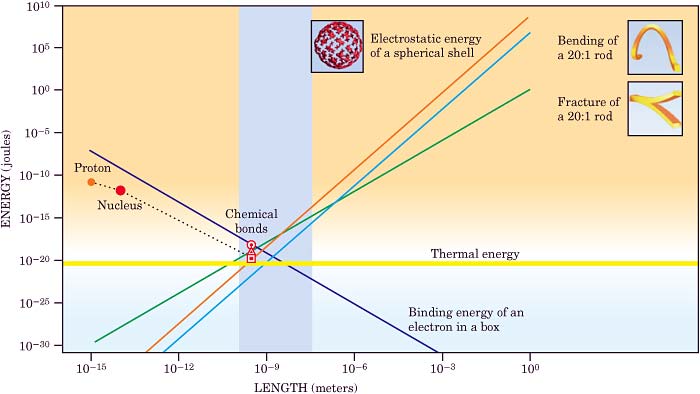
Intentional vs. Material Reality and the Hard ProblemTry http://rpdata.caltech.edu/publications/Phillips2006.pdf
Phillips, R., & Quake, S. (2006). The Biological Frontier of Physics Physics Today 59
-
Intentional vs. Material Reality and the Hard ProblemDenigrating what I say because I am a theist is an instance of the genetic fallacy, verging on ad hominem. — Dfpolis
But you called naturalism vague and irrational without good justification. And as a theist, you have yet to show that you are willing to deal with the metaphysical problems of theism rather than just cherry-pick naturalistic science that you can bend towards the support of a theistic conclusion.
I simply do not see the abstract and limited consideration of data on which natural science is (rightly) based as rational grounds for the a priori of logical possibilities -- which is what metaphysical naturalists do. Their blindness with respect to their to the fundamental assumptions, their preference for the a priori over the a posteriori, and their unwillingness to consider fully what is logically possible run counter to the entire scientific mindset. — Dfpolis
That may be true of some naturalists perhaps - the scientistic and reductionist type who are monists or eliminativists. But I am arguing for the systems science/holist/process metaphysics/philosophical naturalism tradition - the one that follows on from Aristotle and Peirce in particular.
So maybe you are just unfamiliar with that distinction? Systems thinkers are holistic naturalists and not reductionist naturalists. Hence the semiotic twist which recognises that things like finality and meaning are part of nature too. The goal becomes to give a fully scientific account of that.
You have your project. I can have mine. My claim is that a systems naturalism is what modern science now clearly supports. Whereas religious belief still makes bad metaphysics.
While I agree that the mind does a great deal of modelling, I think it is an error to think of mind primarily as a modelling process. — Dfpolis
If you have thought about it so deeply, you could then quickly explain why.
The Peircean position would be that mindfulness does reduce to the absolute generality of a sign relation. Even the Cosmos is built of regulative habit. So the active interaction is the primary one. A contemplative or self-reflecting consciousness would be a secondary "luxury" that emerges with systems complexity. And psychological science says the self-aware human mind, with its inner world of thoughts and plans, is still primarily an active rather than a passive modelling relation.
Psychological science did go through its Cartesian era - cogsci back in the 1970s in particular. But now it has moved on to an embodied, enactive, ecological paradigm. The mind is understood as a semiotic relation rather than a computational representation. The world has moved on, thankfully.
There are integral human beings which have material and intentional operations -- operations describable by physics and operations that are not. I have given my reasons for holding that there are human operations not describable by physics. You have chosen not to rebut any of them. Instead, you are making dogmatic and unsupported claims as though I had not made my case. — Dfpolis
I haven't rebutted that point as it is the point I explained. As my approach to naturalism is semiotic, it fits my metaphysics that our abstract accounts of reality must arrive at this essential duality of matter and information. Or as I would prefer to say, local degrees of freedom and global constraints. And in fact, as I keep saying, physics now supports that duality. Indeed, it has discovered the basis for it.
It all starts with the complementarity of information and entropy built in at the Planck scale. Context and event become indistinguishable at the microlevel. So the basis of a semiotic division - one that can develop thermally with Cosmic cooling and expansion - is a modern empirical discovery. You can't now do metaphysics and ignore that fundamental finding.
Information is context - the downward causation that bears down with a degree of certainty to shape material events. And entropy is local disorder or the degrees of uncertainty that then, in mirror fashion, are the creative grain of spontaneity which give something undirected to be shaped and woven into a developing history.
A similar empirical revolution is now unfolding in the biophysics of life and mind. In just the past 10 years, we have learnt how the quasi-classical nanoscale is a special convergence zone - analogous to the Planck scale - where the kind of semiotics that underpins biology can get its foothold. Molecular machines can exert their regulative stability on the thermal storm of chemical entropy. An informational context - as provided by DNA - can actually switch the wild energies of that scale and keep it directed towards the building of larger scale structures.
So my metaphysics arises out the scientific revolutions that continue to roll. I've come round to Peircean semiotics because that is how the science has panned out. I didn't start with a view and then choose my evidence to fit.
No, meaning need not result in action. Meaning is found in theoretical reflection as well as in practical reasoning. What action results from being able to distinguish essence and existence, or knowing that we cannot prove the consistency of arithmetic? — Dfpolis
You are talking about minds at the top of the food chain. As a philosophical naturalist, my argument is developmental and evolutionary.
So I am saying, sure, we have a modern cultural tradition - an attitude that arose in the philosophy of Ancient Greece - where the human mind is understood as essentially contemplative. As Plato said, look inwards and the enlightened mind will simply remember the realm of ideas. We celebrate this rather mystic and passive notion of mindfulness, putting it above the pragmatic kind of thought that is in fact the basis for our everyday, rather habitual and uncontemplative, being in the world.
But that is easy to see as a traditional cultural prejudice, not a view of mindfulness that psychological science would support.
So meaning remains founded in the ideas or theories that we would be willing to act on - stake our lives on if necessary.
Sure, philosophy, maths, poetry, and all other kinds of "contemplative" thought are good habits to cultivate. They are socially supported because historically they generate pragmatic social value. We pay folk to reflect in theoretical fashion ... because we get stuff like new technology and better ways of organising society as a practical outcome.
So the meaningfulness of theoretical reflection is ultimately pragmatic. It comes back eventually to its social utility, even if it can be a very long return journey with any number of sidetracks and dead-ends.
The angle of your argument is always to take the complex extreme of mindfulness and present it as the monistically simple starting point. As with Socrates, the philosopher becomes then top of the tree. The end of a journey is made the beginning.
I - as a naturalist - prefer to travel back to the root. And biosemiotically, that would be the nano-scale machinery that regulates the thermal blizzard we call the chemical basis of life. I can see the "mind" at work there - the active downward causation of organismic purpose and plan.
And thus there is both a basic duality - of information vs matter - plus its integration, as a living sign relation. We never get into the Platonic or Cartesian binds that are fuel for transcendent theistic arguments. That bad metaphysics gets cut off at the pass. Just as much as this triadic systems view also cuts off the bad metaphysics of monistic scientism at the pass. -
Intentional vs. Material Reality and the Hard ProblemIt seems to me that the meaning of a sign is information it evokes in the mind of the recipient. — Dfpolis
This is a passive/substantive notion of "mind". And it might fit a dyadic Saussurian notion of semiotics. But I prefer a triadic Peircean approach that fits the modern neurocognitive understanding of "mind" as an active process - an embodied modelling relation.
So the emphasis shifts to how intentionality actually engages with materiality. There is nothing much going on unless an idea is acting causally with material effect. There has to be that connection - that aspect of reality covered by finality or downward causation where purposes constrain the free play of material events.
Semiotics only makes physicalist sense if the ultimate goal - of information being used to regulate physical flows - is kept firmly in the foreground of the metaphysics. So there is no passive "recipient" - the Cartesian ghost in the machine. Semiotics is just about habits of interpretance. A sign is informational in that it acts like a logic switch to release a developed pattern of regulative behavior. Meaning is not evoked. It is meaningful action which is evoked.
To talk about meaning in and of itself in this kind of passive/substantive way would be an example of the fallacy of misplaced concreteness. Meaning is just a willingness to act in response to a sign. And the fact that some habit of interpretance is meaningful remains forever open to emprical correction. The consequences of acting in a habitual way either reinforce or weaken the habit in question.
So again, a triadic or enactive semiotics closes the supposed explanatory gap. It divides the world cleanly into the two parts of the information and the matter, the constraints and the degrees of freedom, the downward acting formal/final causes and the upwards constructing material/efficient causes. Then it also does the other thing of showing how what gets separated then becomes connected by an actual relation, a functional process.
It is the hylomorphic story. But updated by a clearer modern understanding of the science of semiosis. We now get the trick of how codes - like genes, neurons, words and numbers - can anchor the self-organising complexity of semiotic systems like life and mind. -
Intentional vs. Material Reality and the Hard ProblemNaturalism is a vaguely defined and, in my considered and elaborated view, irrational movement motivated by an a priori prejudice against what its proponents call "spooky" realities. — Dfpolis
A theist would say that. But scientific naturalism accepts the empirical evidence that life and mind evolved and so there are good grounds to expect nothing spooky or transcendent going on. That then leads to an appreciation of a systems approach anchored in the immanence of Aristotelian four cause thinking.
Call that vague and irrational if you like. Sounds more like classical metaphysical thought ... before the church got hold of it ... to me. -
Intentional vs. Material Reality and the Hard ProblemFor instance, the intelligible aspect of the voice as opposed to its arbitrary sound. — sign
That is why the semiotic approach would be that of a triadic relation. The marks serve to mediate between the meanings and the world.
So the word “chair” is merely a syntactic token. It is information in the sense that it is a mark that can be crisply distinguished from other marks, like “cheer” or “hair”. There are simple objective and physical differences in the sign. But what the sign then mediates is an understanding of a constraint on material possibility. It stands for a habit of interpretation with a physical reality in that only something that serves a chair-like purpose with its chair-like form can be accepted as a proper instance of a chair.
So the essence is that there are two worlds in interaction. The meanings or intentionality exist only because there is a material world that would give them a role to play. And what makes this possible is the sign, the mark, that can act rather unphysically as a logical switch. Information can be stored because marks can be unambiguously distinguished.
From a material point of view, this is a complete accident. As scratches on paper, it is meaningless whether the word is chair or cheer. And by that being maximally a material accident, it can conversely be the least accidental distinction underpinning a system of interpretance. It is the lack of meaning in one sense that opens the door to absolute meaningfulness in another.
This aspect of language use or semiotic codes is both obvious and yet not much appreciated. It shows why mind and world are in fact connected by a radical kind of disconnection. The accidents of the one can be the necessities of the other.
So this thread makes the usual fuss about an explanatory gap. But it is how nature arrives at a strong disconnect between the accidental and the necessary that explains the fact that life and mind are even possible. The degree of the disconnection is how minds, as models of reality, can stand apart so as to regulate the accidents of that reality, applying their own intentionality to that world.
Again, dualities only speak to the easily appreciated fact of a strong disconnect. The next step is to understand how the disconnect is the basis of the resulting more complex modelling connection. It is the triadic modelling relation which returns us to a physical naturalism. -
Intentional vs. Material Reality and the Hard ProblemSo, we have to look beyond physicality to understand information, and so the intentional realities that are essentially dependent on information. — Dfpolis
As a result, we can maintain a two-subsystem theory of mind without resort to ontological dualism. — Dfpolis
Alternatively, information and matter make a pretty sound modern naturalism. What can be dubbed the pan-semiotic approach.
Where we make a huge ontological mistake is to abstract the "mental" as a simple. A basic kind of substance or stuff. Mindfulness is instead a complex process. It arises as an elaboration of a semiotic modelling relation - the capacity for information to act as an enduring constraint on material instability. A system is mindful when it is regulating its material world - the world of fluxes and entropic flows. Intentionality is just this in spades. It is the evolution of a nervous system that can accumulate the memory, the habits, the plans, the information, to channel materiality towards the maintenance of living and knowing form.
So while it is commonplace to set up physicalism in strawman fashion as a brute materialism, in fact science has moved on to a systems understanding of materiality in which information plays the role of developmental constraints. History accumulates to regulate material instability. And this is just as true of the thermal cooling of the Cosmos that produces the current material reality of atoms and particles as the way the dirt of a landscape is the memory channeling the flow of a pattern of waterways, or a nervous system comes to encode a "selfish" set of regulatory habits and intentions.
Ontology does have to wind up with the ultimate simplicity of a dualism. A substantial monism (like everything is matter, or everything is mind, or even everything is information) can't work. It is the sound of one hand clapping. We always have to have a pair of ontic abstractions that reduce reality to some kind of orthogonal pairing. A dichotomy or opposition of parts.
But then that sets up an explanatory gap unless the two parts make a unity of opposites. The two abstract simplicities we extract from our experience of the world must make a properly matched duo - connected by being in a reciprocal or inverse relation. They must each be each others logical extreme in a formal sense. And that way, they then can be both ultimately simple and also in the kind of interaction that produces the more complex world we experience. There can be the actuality of the system - the triadicy of a hierarchical organisation.
Information and matter produce this kind of composite ontology if materiality is understood as a radical instability. Just action or fluctuation without shape or form. And then that gives information its physicality. It becomes the part of the equation which is the accumulation of events, the forming of a history or memory which then impinges on the material energies of the present as a constraining context.
It doesn't take much. If you have wax, you also have the possibility of the mark, the imprint, the sign. A little bit of material stability brings with it a little bit of informational memory. A history can start to build. The organisation of a world can begin. A past can start to constrain the present in ways that limit material possibilities and so anticipate a particular structured future.
Again, this is true of Cosmos that is locked into an entropic dissipative gradient - cooling and expanding its way to a Heat Death - as of a river snaking its way across a plain, as of a nervous system building up a rich modelling relation with its world.
So it is time to dump the theistic metaphysics. It is just substance dualism-lite to talk about information in contrast to matter ... if matter is not also re-imagined in its modern form of radical instability. Action without direction, or flux and fluctuation.
To still speak of the material aspect of being as a stuff with inherent properties is the strawman. It fails to keep up with modern physics. We now take a structural approach to particle physics where particles are stabilities only to the degree that instabilities have been contextually suppressed or thermally decohered.
Materiality has a new (pan-semiotic) ontology. And that makes a rehashed substance dualism old hat. -
Idealism vs. Materialism...a general difference to what? — Harry Hindu
To the emergent macroproperties. -
Idealism vs. MaterialismIn other words, it ceases to exist. — Harry Hindu
No. It reaches an equilibrium state where the continuing dynamic change ceases to make a general difference.
You would still call yourself actually you each morning even though, for instance, all your microtubules creating the cytoskeleton of your cells will have fallen apart and rebuilt a few times during the night. -
Idealism vs. MaterialismOne person's regulation is another person's freedom, and so it is with bullshit. — Janus
Hence the wisdom of collective rationality as epistemic best practice. If we agree how to measure something, then we can lift ourselves out of our individual ignorance.
No such unambivalent definition of what constitutes doing philosophy is universally accepted; — Janus
Sure. Philosophy would appear more tolerant. And having been pushed to the sidelines by the overwhelming success of scientific/pragmatic rationalism, it may indeed have turned to celebrating whatever social kudos it can cling on to. Flirting with irrationality and romanticism is a traditionally approved alternative. Academics can wander off and play that game too.
But when it comes to metaphysics, anything else but a pragmatic systems approach is going to be a waste of time.
the minimum requirement is that you provide argument or explanation for what you want to assert or even what you merely want to allow as a possibility, and that your argument or explanation not be self-contradictory. — Janus
But this is just aping the form of reasoned thought. By failing to agree on acts of measurement, you are just going to risk producing theories that are "not even wrong".
You seem happy with dualism and so you won't be too troubled that you are arguing for an epistemology that holds up a lack of interaction between the self and the world as an acceptable thing. It seems fine that a mind would invent a few syntactical rules and spin out the resulting logical patterns in "non self-contradicting" fashion. That's all minds do. Noodle away without a worldly purpose.
But consistent with my own meta-metaphysics, I insist on the primacy of there being some damn global point to the exercise. And acts of measurement - the ability to read the truths of the world in terms of a rational language of signs - is that bridge of interaction that connects our minds to reality.
The specificity of the measurement is what anchors the generality of the conception. Anything else is mindless free-wheeling.
Of course, metaphysics has its sacred spot at the centre of knowledge as it is focused on rational generalisation. It is always seeking to broaden the space of our conceptions. And thus metaphysics is still valuable to the degree it can be applied to the current frontiers of scientific thought. Especially in terms of mathematical explorations, we can hope to free-form our way beyond what we currently can conceive to measure.
Scientific advance is sold as working the other way round. First the troubling data, then the sweeping theoretical insight. But philosophy of science has exposed how much it is the other way around. A lot of practical difficulties with current theory has to accumulate. Then we notice that the facts never did exactly fit. And we are able to notice this having some even more general conception ... together with the even more highly specified measurements that the conception entails.
These days physics has boiled down to the measurement of entropy. And even information.
What we think we are measuring says everything about how we are conceiving reality. And this rolling revolution of thought is being advanced by scientists. When it comes to free-wheeling metaphysics, they are the least constrained by traditional thinking.
Lovers of the poetic can moan all they like, but metaphysics just ain't their strength. That kind of creativity is about the social and cultural sphere. And to the degree it can express concrete theories of how to live, then it gets tested by folk who try to live that way.
Does thinking like hippy, for instance, work as a social formula, a self-organising and self-perpetuating form of life? Does thinking like an existentialist, a romantic, a punk, or whatever? It does all come back to pragmatics even there. -
Idealism vs. Materialism"Must be regulated" for what or whose purpose? — Janus
So as to close the loop of reason and stop the endless torrent of bullshit that otherwise tends to flow. -
Idealism vs. MaterialismPeople may be divided into two primary groups; those who have (or allow themselves to have) such feelings, imaginations and intuitions and those who don't. ... It's all pretty subjective really! — Janus
What about those of us who believe that it being so subjective is the reason why the freedoms of the imagination must be regulated by the discipline of acts of measurement?
Peirce, after all, was the founder of Pragmatism. We conjecture and then we test. It works out pretty well as history has shown.
I think mind or spirit is usually imagined (to reverse Peirce's metaphor) as a kind of effete matter, an attenuated ineffectual matter that, because it is not governed by physical laws, cannot have physical effects. — Janus
That's exactly what you want to avoid. You must arrive at a duality that retains an interaction - which is indeed being generated from the start by that interaction.
So if you employ any form of words that arrives at a conclusion of two disconnected realms, you already know you took a wrong turn. You have managed to trip yourself up along the way.
The right approach is always a reciprocal relation, and hence dialectical or dichotomistic. The weakening of the one aspect is by definition the strengthening of the other.
You could argue that the discrete is "maximally effete continuity". But then also that continuity is "maximally attentuated discreteness". Thus each pole is linked to the other by the third thing of a spectrum. You can have strong continuity to the degree you can have weak discreteness, and vice versa.
This makes perfect sense for robust metaphysical dichotomies, like discrete~continuous, flux~stasis, chance~necessity, matter~form, and so on.
But it fails for mind~matter. And that is telling. It means a wrong turn got made and we should simply give up a dichotomy that doesn't actually work as a dichotomy should.
Now self~world can work as a dichotomy - one describing the epistemology of neurocognition, for example. We experience the world as "other" to precisely the degree that we also experience "being a self". All day long, we can be so engrossed in the flow of the habitual that the distinction is highly situated an enactive. We can chew our food, not bite off our tongue, and never see any big deal. While at other times we can step back and think about ourselves as "conscious beings" in a "material world", or some similar culturally-useful, socially-pragmatic, dichotomy.
But standard issue dualism - the theistic kind - has just failed as metaphysics because it made a very wrong step and wound up with a disconnected pair of parallel realms.
This doesn't say there is some actual hard problem that must confound science and everyone else. It just says you guys did some bad metaphysical modelling. For social reasons, you pushed a line that broke the sound rules of systems thinking. Go back and start again. Look for the triadic complexity which allows two poles to be each others' "other" in transparent and obvious fashion. -
Idealism vs. MaterialismIf it doesn't matter what we call the primary substance, then why the debate for the past 1000 years? — Harry Hindu
The debate here is really whether substance is primary or emergent. I am saying monism doesn't work, and neither does dualism. The simplest possible workable metaphysics is triadic - the kind in which substantial being, or actuality, is emergent from a developmental process of becoming.
And this kind of self-organising systems approach is what we find as our best current scientific answer. Aristotle got it early on. Peirce picked up the threads in a modern way. And science makes sense of both mind and matter in terms of self-organising systems these days.
It seems to me that the debate stems from our preliminary assumption of dualism and is solved through the realization of monism. — Harry Hindu
You are trying hard to make monism work. And it kind of does work if the "one thing" is the idea of a developmental process in which a fundamental instability becomes emergently self-regulating so as to produce comparatively stable being.
So there is one basic thing. Nature. The cosmos. Physical existence. But it is a systemic process. A logic of development and emergent order. And it thus has an irreducible complexity that can be most simply described in terms of three moving parts. In other words, the form of a hierarchy.
Jumping ahead to the physics, this is exactly how the science has panned out. You can see it everywhere. The Planck scale is defined by just three constants - c, G and h - bound in reciprocal relations to breath measurable existence into space, time and energy. The cosmos is described in terms of its triadic hierarchical structure - a quantum microscale, a relativistic macroscale, and then the good old solid and substantial classical scale that emerges between these two systematic limits.
The very shape of physics expresses a triadic metaphysics.
So the big mistake is to look for a monism without internal complexity. The simplest possible metaphysics that makes sense in actual descriptions of the world is a monism - a presumption of a closed system with all its causality bound up within itself - in which there are enough internal parts in play to explain the emergence of complex stable structure. And hierarchical organisation is the simplest model of a complex system.
Once you can count to three in metaphysical terms, then dualism or twoness becomes a lot less psychologically threatening to your worldview. You get to have your monism - a monism of one world - but a monism with the necessary complexity to describe a world with internal systematic order and a history of growth and development. Ie: The story modern science again tells since the discovery of the Big Bang~Heat Death developmental arc of our own universe.
So as Peirce laid it out so nicely, existence is a tale of three developmental stages.
You have the primacy of a Firstness or Vagueness - the chaotic initial conditions that is a realm of fluctuations without order or dimension, and thus a state of maximum possible symmetry (or sameness, or indifference - the two being synonymous).
Then if you have a symmetry which is a state of maximal disorder, then you can have the symmetry-breaking which is the phase transition to some new state of regulating order. You have Secondness or duality in which an asymmetry breaks out, allowing the new thing of relationships. You have the emergence of a globally regular difference between parts and wholes, figures and grounds, events and contexts.
Or in terms of Big Bang physics, you get the symmetry-breaking in which local microscopic particles are reacting energetically with each other within the background of a relatively thermally empty spacetime vacuum. You get that vital distinction between events and contexts which yield the further thing of some actual possibility of a history. The past becomes a thing as an accumulation of all the little accidents that define the present. The future also becomes a thing as all the little accidents or degrees of freedom that remain unconstrained and so living possibilities - actions to be dissipated.
In short, from the total disorder of a vagueness, we get the emergence of a dualistic difference between the many aspects of being. There is the concrete difference between the past and the future, the void and its events, the laws of physics and the accidents provided by degrees of freedom.
And because all these "dualities" are actually asymmetries - the product of taking possibilities to their opposing or reciprocal limits - they are really nascent hierarchical structure. As the universe expands and cools, it becomes ever more cleanly separated into its local play of hot events against an empty and inactive void. The bland radiation bath of the Big Bang clears to become a structure of moving particles in a spacetime vacuum.
The classical realm that we then see as substantial is the bit that emerges right in the middle - where enough crud gets lumped together in a shared inertial frame to lose its quantum indeterminacy and behave how we expect canonical substance to behave. Gas clouds can gravitationally clump to form fusion stars. Stars become factories of heavy atoms. Crud at a higher level of self-stable organisation, which eventually gets clumped into planets and spawns further developmental possibilities like symbolically structured life and mind.
So monism - if it is understood in the usual reductionist fashion of finding something primary, a material root to existence - is always going to fail. It didn't ever work as metaphysics. And science has proved it fails as an approach to modelling nature.
The first step out of monism was always dualistic in being some kind of ur-story of reciprocality or symmetry breaking. You need two to tango. And that is why metaphysics was born out of the logic of dialectical reasoning. The modern scientific understanding of existence got going once metaphysics had nutted out all the useful dialectical distinctions - the unities of opposites - like atom~void, discrete~continuous, matter~form, flux~stasis, chance~necessity, one~many, mind~world, and so on.
The mistake then is get stuck with this oppositional stage of metaphysical thought - to do what these kinds of threads always do and obsess about "fixing things" by getting back to some kind of monism. Or worse yet, to enshrine a dualism of substances.
So if the metaphysics winds up in an opposition of the ideal and the material, then the choices are a) argue for materialism, b) argue for idealism, c) argue for the separate and disjoint reality of both of these realms of being.
But all this is standard issue "theology". A legacy of the scientific revolution colliding with the Church. Folk took sides on something 600 years ago and have not escaped the confines of that debate ever since.
There was always another alternative - the one that the Ancient Greeks already expressed and which modern science has again arrived at. And this is the triadic or hierarchical systems view. Existence is a process. Systematic order is what naturally develops from unbound chaos. We now have testable mathematical models of this kind of reality creating organisation. The emergence of substantial being via phase transitions or symmetry-breaking is just a routine thing for scientific theory these days.
So maybe we have the odd thing of modern science - as a systems view - clashing culturally with the received "classical materialist" physics that has become the new folk orthodoxy. Materialism has become the secular theology. Everyone then wants to show they are on the right side by "eliminating" anything that questions their ardent monism. It becomes impossible to understand the scientific revolution that took place in the 20th century because they are still locked in mental combat with 16th century theological doctrine. -
Idealism vs. MaterialismYes. Dualism arises out of materialism by treating the mind as another kind of substance or stuff. Consciousness would be a property of that substantial being. So the hardening of opinion around the one led to a matching hardening of opinion about the other.
As you know, I would take a process view of both the mind and the matter. So some kind of duality is inevitable. But a hylomorphic one gets so many things right in in fact being triadic. It is about the interaction in which the substantial emerges from formal constraints on material freedoms.
That rather nicely confounds modern folk metaphysics in making the material aspect of things as immaterial as possible - a naked freedom - and the formal aspect of things is then the most substantial in being the structure that puts a limit, and thus gives concrete shape, to those material freedoms. -
Idealism vs. MaterialismI'm surprised you're responding without answering questions you've been asked. — Terrapin Station
But I told you. Until we get to the bottom of how little you have learnt on the issue over these past 45 years, where could one even start? -
Idealism vs. MaterialismWhy not type something about "constraints" now? — Terrapin Station
Lets not run before we can walk, eh. -
Idealism vs. MaterialismHow about answering the question instead of posturing? (And will you believe me when I say I'm surprised if you never answer the question?) — Terrapin Station
Did you want me to move your fingers for you as you type "hylomorphism" into Google? :razz:
You are the one posturing with your claims of 45 years of "formal" philosophical training. And I have been explaining as we have been going along. So your problem if none of this rings a bell. -
Idealism vs. MaterialismFirst I'm not even using the term "substantial being" am I? And I wouldn't. What in the world is that term saying that "matter" doesn't say? — Terrapin Station
I've been studying philosophy for 45 years now, and I have a "formal" background in it. — Terrapin Station
So in those 45 years, did you ever actually bone up on basic Aristotelian metaphysics? Seems not. -
Idealism vs. MaterialismWhat I posted.
Substantial being can't be just matter, or just form. And yet the folk position is that matter just IS substance and form ISN'T substantial. -
Idealism vs. MaterialismSo then my view isn't "the folk position. — Terrapin Station
Yep. Your position is that you back two contradictory positions without apparently realising it. -
Idealism vs. MaterialismIn other words you cannot. Saying a concrete thing was a bottle is just as aspectual as saying it is glass. — Heiko
Hence hylomorphism. Sure.
The thing is - the bit that actually interests me - is that we can talk very clearly about the formal aspect of substantial being, but it all goes very shifty as we try to drill down into the material aspect of substantial being.
Glass is just informed substance. Bottles are one of those possible forms. The silca molecules composing the glass are just another deeper level of informed substance. Silicon and oxygen can compose other possible forms. Particle physics tells us that the electrons and quarks composing the silicon and oxygen atoms are yet again just informed substance - localised excitations in a quantum field or frustrations in a vacuum condensate.
So for the materialist, it is turtles all the way down. Yet materialists don't seem to think they have a problem. -
Idealism vs. MaterialismIf It's "the usual folk metaphysics" and there's supposedly a problem with it, there would need to be a good argument for whatever the problem is supposed to be. — Terrapin Station
Correct.
Why would you be trying to contrast them or say that one is more fundamental? They're inseparable and incoherent without the other. — Terrapin Station
Again correct.
So the problem remains that you don't see the contradiction between the two statements.
Substantial being can't be just matter, or just form. And yet the folk position is that matter just IS substance and form ISN'T substantial. :chin: -
Idealism vs. MaterialismMatter may not actually be as it appears to us. — Harry Hindu
Sure. If we redefine matter as idea, I guess problem solved?
What are you talking about? -
Idealism vs. MaterialismEasy. You show that "bottle" is an idea that can be imposed on other materials, like plastic or metal. And you can show that "glass" is what you are left with once you melt your bottle to a liquid puddle.
apokrisis

Start FollowingSend a Message
- Other sites we like
- Social media
- Terms of Service
- Sign In
- Created with PlushForums
- © 2026 The Philosophy Forum