
Comments
-
Definition of naturalismI think spirit-salamander has come up with a workable definition based on the scope of causal effect that entities are capable of and subject to, which seems to cover all the bases. — Janus
The title of the thread is "Definition of Naturalism." At the time I wrote my post, no one had provided a definition of what naturism means in common usage. I gave four definitions from four different sources. Whether or not you like them, I think they represent pretty well what the word "naturalism" means in everyday philosophical speech. There is nothing stopping people from defining a word any way they want. If you want "naturalism" to mean two dogs fighting over a hotdog, ok. At least be clear about that from the beginning.
I like @spirit-salamander's summary also. -
My favorite verses in the Tao Te ChingAs you know, our view differs here. I think the commentary that it doesn’t belong says more about the translator’s perspective than the text, their inability to reconcile it with the flow at this point. It warrants a closer look. — Possibility
The file I attached to my original post has Stefan Stenudd's full commentary, which discusses this in more detail.
I think it’s more about recognising our limitations with regards to knowledge or learning, embracing uncertainty to eliminate worry, fear, concern, sorrow, care, anxiety, etc. — Possibility
As you note, you and I disagree on this. The statement in the first line seems stronger to me than similar lines in other verses. More definitive. As mystical philosopher Tommy has noted, "You ain't gonna follow me any of those ways, although you think you must."
The first line says that we cannot accurately quantify the relation between positive and negative; the second that we cannot qualify the relation between good and evil. It’s like asking ‘how long is a piece of string?’ This uncertainty is what we fear. Such desolation, such scarcity of information has no centre, no end, nothing to beg for. — Possibility
The second and third lines of the first stanza seem to me to be pointing out that our value judgements are conditional and somewhat arbitrary. The important distinction isn't between good and bad, but between making judgements and not making judgements.
The rest of the verse describes the difference between the sage who faces this uncertainty, and everyone else who appear to have full and busy lives, so in control and certain of their usefulness, their dominant and joyful ‘springtime’ stance, their vision of who they are and where they’re going. — Possibility
As I noted in my comments, I think the point of the verse is that people who follow the Tao look odd, disreputable, stupid, or crazy to many other people because they don't care about the goals most people do - acclaim, wealth, status, attention.
the Taoist starts from the limitations of knowledge, recognising that we can be certain of nothing - that all knowledge is quantitatively and/or qualitatively relative (to the flow of chi). This is not to say that we cannot know anything - only that we cannot claim beyond ourselves to know anything with certainty, — Possibility
I don't see it this way at all. The TTC is not about knowledge, it's about the rejection of knowledge. Lao Tzu could not be more explicit about it. He's a plain-spoken guy. He says what he means.
In my view, Lao Tzu gets around this only by extricating chi from the TTC - recognising that when it is read, when we interact with the language, we inevitably bring our own. — Possibility
I don't see where this comes from. Lao Tzu doesn't mention "chi," or any other term I recognize as similar, at all.
Have you been following the discussion on Buddhist epistemology? Also there's a discussion about why people turned away from Buddhism in the Lounge. I'm curious about your thoughts. I plan to follow up with @FrancisRay on some of the comments he made on the logic of Taoism and Buddhism previously in this thread. -
Hard And Easy Is All RelativeWhether something is hard or easy is relative — HardWorker
Sorry, I have the Tao Te Ching on the brain these days. This is from Derek Lin's translation of Verse 2.
When the world knows beauty as beauty, ugliness arises
When it knows good as good, evil arises
Thus being and non-being produce each other
Difficult and easy bring about each other
Long and short reveal each other
High and low support each other
Music and voice harmonize each other
Front and back follow each other -
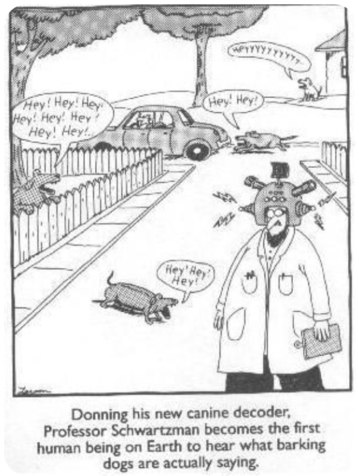
Cartoon of the dayI believe this to be the best cartoon of all time...
Gary Larson - The Far Side - Cows — synthesis
Half right. This is.
-
For those who have distanced themselves from Buddhism -- How come?If Buddhism is unpopular because it is a religion,then this just goes to show how poorly it is understood. But its an odd comment seeing that Buddhism is the most popular religion on the planet at this time. — FrancisRay
As I noted, there are 0.5 billion Buddhists. There are 2.4 billion Christians. -
For those who have distanced themselves from Buddhism -- How come?Buddhism is so unpopular. — praxis
There are 500,000,000 Buddhists in the world. -
For those who have distanced themselves from Buddhism -- How come?It's not nearly as much fun as listening to Miles Davis, — FrancisRay
And then again, some of your responses come across as incredibly condescending. -
For those who have distanced themselves from Buddhism -- How come?No. I replied because you asked for 'anything else of interest', and so I tried to suggest your reasons for having problems with Buddhism were poor. . . — FrancisRay
Some of your responses come across as really condescending. -
Definition of naturalism
Makes sense to me. Very clear and specific. One of the things that bothers me most on the forum is how discussions go off in 20 directions because terms are not defined at the beginning of the thread. That's why I got involved.
Thank you. -
Definition of naturalismYes. Do you know what a circular definition is? — Herg
Yes. Your criticism of my statement was accurate. Your turn. -
Definition of naturalismWell, it wasn't me that introduced this red herring, was it? — Herg
Do you even know what the phrase "red herring" means? -
Definition of naturalismNo, I'm suggesting that since the word 'natural' pre-dates the scientific method, it must then have had a meaning which did not depend on the scientific method, and may well still have the same meaning. — Herg
The word "natural" is not the subject of this thread. The subject is "naturalism." I gave several definitions of the word as it is currently used from various web sources. If you want to argue that those definitions are wrong, go ahead. You should provide some evidence for that claim. -
Dollars or death?if you're to keen for thought experiments let's just throw relativity out the window while we're at it. — Lif3r
I have nothing against thought experiments, as I noted, my beef is with "pointless, unrealistic thought experiments." Also, Einstein was a physicist, not a philosopher.
Also - Einstein's thought experiment isn't what made the theory of special relativity true. It was just an explanation of an actual aspect of the world. -
Dollars or death?you can certainly apply this principle to common life problems, and in fact we all do on a daily basis in deciding what products and services we use and what paths we take. — Lif3r
Then why not use one of those "common life problems" instead of something that has never happened and won't ever happen to anyone in the history and future of the universe. It makes philosophy look like a joke, which is ok if that's what you're trying to do. If you think it makes it look wise or insightful, it doesn't. And what is it with trains? Why do philosophers like trains so much? And what if it was Adolf Hitler tied to the tracks? Or what if it was 100 million pictures of Adolf Hitler instead of dollars? -
Definition of naturalismThat would imply that there was nothing natural until the scientific method came along. That doesn't seem right. — Herg
Do you think the world didn't operate in accordance with scientific principles before there was science? Was there a different set of rules that operated before there were sentient beings? -
Dollars or death?Perhaps one of the most impactful social questions one could ask, one that we've all already answered, that dictates the path of society: — Lif3r
Little known fact - The word "philosophy" comes from ancient Minoan combining "pilos," meaning "love of" and "physos," meaning "silly thought experiments."
Why do philosophers think that pointless, unrealistic thought experiments can shed any light on moral questions? See the trolley problem. Can't you come up with something that might actually happen in an actual person's actual life? -
Definition of naturalismThis is a good starting point. Because you can see from these definitions that they do not give a criterion for how I can distinguish the natural from the supernatural or unnatural. But that is what matters. One needs a precise criterion. — spirit-salamander
The definitions are pretty specific - the natural is what is allowable under natural laws established using the scientific method. -
Definition of naturalismTo clarify things, here are several definitions of "naturalism."
- The philosophical belief that everything arises from natural properties and causes, and supernatural or spiritual explanations are excluded or discounted.
- The belief that reality is exhausted by nature, containing nothing “supernatural”, and that the scientific method should be used to investigate all areas of reality
- The belief that natural laws are the only rules that govern the structure and behavior of the natural world, and that the changing universe is at every stage a product of these laws
- A comprehensive, science-based worldview, premised on the idea that existence in all its dimensions and complexity is a single, natural realm, not split between the natural and the supernatural
- The philosophical belief that everything arises from natural properties and causes, and supernatural or spiritual explanations are excluded or discounted.
-
My favorite verses in the Tao Te ChingThe lack of clarity in there verses is most likely the result of a incorrect perspective of the translator out reader. When viewed as a set of fables or hymns of an ancient people, them one can see that it is but much different from the kinds of spiritual writings and thoughts that have always been present in all cultures. It is good marketing to try to make it more than that, but more understandable if one doesn't. — MondoR
Again - I see Lao Tzu telling us a story, laying out a path. It doesn't seem like a random hodgepodge or marketing at all. -
My favorite verses in the Tao Te ChingVerse 20
Ellen Marie Chen
Eliminate (chüeh) learning so as to have no worries,
Yes and no, how far apart are they?
Good and evil, how far apart are they?
What the sages (jen) fear,
I must not not fear.
I am the wilderness (huang) before the dawn (wei yang).
The multitude (chung jen) are busy and active,
Like partaking of the sacrificial feast,
Like ascending the platform in spring;
I alone (tu) am bland (p'o),
As if I have not yet emerged (chao) into form.
Like an infant who has not yet smiled (hai),
Lost, like one who has nowhere to return (wu so kuei).
The multitudes (chung jen) all have too much (yu yü);
I alone (tu) am deficient (i).
My mind (hsin) is that of a fool (yü),
Nebulous.
Worldly people (su jen) are luminous (chao);
I alone (tu) am dark (hun).
Worldly people are clear-sighted (ch'a);
I alone (tu) am dull (men),
I am calm like the sea,
Like the high winds I never stop (chih).
The multitudes (chung jen) all have their use (i);
I alone (tu) am untamable like lowly material.
I alone (tu) am different from others.
For I treasure feeding on the Mother (mu).
Addiss and Lombardo
Banish learning, no more grief. Between Yes and No How much difference? Between good and evil How much difference??
What others fear I must fear - How pointless!
People are wreathed in smiles as if at a carnival banquet. I alone am passive, giving no sign, Like an infant who has not yet smiled. Forlorn as if I had no home.
Others have enough and more, I alone am left out. I have the mind of a fool, Confused, confused.
Others are bright and intelligent, I alone and dull, dull, Drifting on the ocean, Blown about endlessly.
Others have plans, I alone am wayward and stubborn, I alone am different from others, Like a baby in the womb.
My thoughts
The theme of Verse 20 is, if you follow the Tao, you will look odd to other people. In the attached PDF file, I’ve included two commentaries. I included Ellen Marie Chen’s because I think she summarizes the verse well, by which I mean her understanding is close to mine. I included Stefan Stenudd’s because he had some interesting things to say about language and history. For example, he says many scholars think the first line doesn’t really belong in this verse.
The attached file also includes several other translations of the verse.
Ellen Marie Chen Verse 20 – stanza by stanza
Eliminate (chüeh) learning so as to have no worries,
Yes and no, how far apart are they?
Good and evil, how far apart are they?
Again, Stenudd says the first line doesn’t belong. Too bad. I like it. As you should know, I’m a fan of the knowledge = bad interpretation. I think this line states it more strongly than some of the others. “Eliminate learning.” “Banish learning.”
The next two lines remind me of several others. This is Chen from Verse 2:
When all under heaven know beauty (mei) as beauty,
There is then ugliness (o);
When all know the good (shan) good,
There is then the not good (pu shan).
This is Mitchell from Verse 13.
Success is as dangerous as failure.
Hope is as hollow as fear.
I think of American football – I root for the Patriots. I don’t like the Giants. But they’re the same. They both play the same game. If I don’t care about football, there’s no difference. Same with American Republicans and Democrats. If I’m from Bangladesh, I don’t see any difference. Lao Tzu wants us to recognize that all the value judgements we make are games which we can choose not to play.
What the sages (jen) fear,
I must not not fear.
I am the wilderness (huang) before the dawn (wei yang).
This is confusing. Gia-Fu Feng and Jane English translate this as “Must I fear what others fear? What nonsense!” That reading is consistent with other translations.
The multitude (chung jen) are busy and active,
Like partaking of the sacrificial feast,
Like ascending the platform in spring;
I alone (tu) am bland (p'o),
As if I have not yet emerged (chao) into form.
Like an infant who has not yet smiled (hai),
Lost, like one who has nowhere to return (wu so kuei).
I can’t remember where I saw it, whether it was here in the forum or somewhere else, but recently I read a discussion of why modern people are so afraid of monotony. The discussion said lions lie around most of the day doing nothing and that some hunter gatherer tribes work only four or five hours a day and spend the rest sitting around. Whether or not that’s true, I can picture a pride of Taoist lions sitting in the shade.

In her commentary, Chen has a discussion of the Chinese tradition of not naming a child until they are three months old. The idea is that it is not until she has smiled that she truly becomes a person. Smiling is a sign of the beginning of self-awareness.
The multitudes (chung jen) all have too much (yu yü);
I alone (tu) am deficient (i).
My mind (hsin) is that of a fool (yü),
Nebulous.
“Being There” with Peter Sellars comes to mind. In that comedy, Chance, played by Sellars, is a simple-minded gardener. Everyone hears his bland, pointless words and assumes they are wise. What Lao Tzu is describing is the opposite of that.
Worldly people (su jen) are luminous (chao);
I alone (tu) am dark (hun).
Worldly people are clear-sighted (ch'a);
I alone (tu) am dull (men),
I am calm like the sea,
Like the high winds I never stop (chih).
Why would sophisticated, successful men and women assume that a quiet, calm person is dull?
The multitudes (chung jen) all have their use (i);
I alone (tu) am untamable like lowly material.
I alone (tu) am different from others.
For I treasure feeding on the Mother (mu).
People think I am stubborn and odd. -
My favorite verses in the Tao Te ChingIt is possible trust there was not one author of the Dao De Jing (I hold this view), but rather it is a conglomeration of sayings, thoughts, and stories, that were gathered over time. One can bring that the Bible is the revealed Word, or a collection from many authors over a period of time. Ditto for Shakespeare. For me, the Dao De Jing seems to be a collection chants, stories, and fables, all provoking different insights, and possibly deeper wisdom. — MondoR
I have read that some think the TTC has more than one author or that some verses were added later. I don't know enough to argue, but it doesn't seem like "a collection chants, stories, and fables." For me, there is a strong feeling of continuity and unity among all the verses. I see the TTC as all one story told in pieces like a collage. That's one way of getting around the fact that the Tao is unspeakable. -
The “loony Left” and the psychology of Socialism/LeftismWhy is “the Left” called “loony”? Why is “left” considered as somehow “not right”? — Apollodorus
I'll speak for the US. Different political parties have always insulted each other. It's bad rhetoric, although I guess it works sometimes. There has always been political conflict, but the parties and branches of government generally kept things moving. Passed legislation, kept the government open, avoided impeachment if possible. In the last 30 years I've watched things change dramatically. You've heard about it - polarization. Fox News, MSNBC. Everything is a fight to the death now. Why, I'll talk about that more below.
In that kind of a situation, things move toward the extremes - conflicts and parties. Every argument, dollar spent, and bill is a matter of life or death, not because the contents are particularly important, but because the goal has become winning, hurting the other party, as opposed to governing. When I was young, there were liberal Republicans and conservative Democrats. Both parties had the so called "big tent," although the Democrat's tent was always bigger. As Will Rogers said, "I'm not a member of any organized political party, I'm a Democrat." In the early 70s, the Republican vice president, Nelson Rockefeller, was a liberal Republican.
I think you might find pretty wide agreement with what I've laid out before. I wanted to get that out of the way before I got to the controversial part. Why did it happen - it's the Republican's fault. I won't go into my reasons for saying that. I'll let this article from 2012 speak for me. It was taken from a well-known book by Norman Ornstein and Thomas Mann.
https://www.washingtonpost.com/opinions/lets-just-say-it-the-republicans-are-the-problem/2012/04/27/gIQAxCVUlT_story.html -
My favorite verses in the Tao Te ChingI am not giving my opinions. I can demionstrate everything I state. — FrancisRay
We'll have to leave it there for now. -
Being a Mansome perfect ideal state where everybody is altruistic — TheMadFool
This has nothing to do with "altruism." It has to do with fellow-feeling, community, common values. We're human. We more or less, most of the time like each other. We wish each other well. We share a sense of common purpose with other people.
Also, looking for a specific evolutionary purpose for every detail of every aspect of human behavior is silly and pointless. That's sociobiology and it's wrong-headed.
hospitals in general are for-profit organizations. — TheMadFool
According to the web, In the US, about 20% of hospitals are for-profit. -
Belief vs. FactI suppose the process would include the agents changing also themselves by consensus / dissensus. Something like the "Titanomachy" in Hesiod's Theogony ... or Tolkien's Quenta Silmarillion ... or a very very glitchy Matrix populated only by "Agents" & programs like the "Merovingian", the "Oracle", the "Key-maker", etc. — 180 Proof
Maybe a bit off-subject, but this brought to mind "The Lathe of Heaven" by LeGuin. In that book, one person has the power to change past and present reality for everyone. Good book. Ok movie. -
Consciousness and The Holographic Model of RealityWell, the 'scientific attitude' is not to accept what you don't understand until you understand it iff what you have come to understand is (probably, provisionally) correct. — 180 Proof
Worth discussing, but this is the wrong thread. -
Consciousness and The Holographic Model of RealityThat's accepting, not understanding. — 180 Proof
I think most of the goofiness I've seen around the subject of quantum mechanics comes from failure to accept it, not failure to understand it. I'm not quite as smart as Feynman, but I can hold two seemingly contradictory ideas in my head at the same time without whining or exploding. -
Consciousness and The Holographic Model of Reality
If you think you understand quantum mechanics then you don't understand quantum mechanics. — Richard Feynman
I don't understand the how of quantum mechanics, but I completely understand the why. It's just because. -
Consciousness and The Holographic Model of RealityI am wondering is what bothers you is the possible idea of hidden reality, or realities, beyond the manifest world? — Jack Cummins
Forgot this in my last post.
I don't believe there is anything hidden. It's all out there for us to experience. Alan Watts wrote that the only mysteries are things we have hidden from ourselves. Here's my favorite quote. I haven't used it here in the forum in almost a week. Franz Kafka:
There is no need for you to leave the house. Stay at your table and listen. Don’t even listen, just wait. Don’t even wait, be completely quiet and alone. The world will offer itself to you to be unmasked; it can’t do otherwise; in raptures it will writhe before you. -
My favorite verses in the Tao Te ChingI don't understand your view and feel it underestimates both Lao Tsu and metaphysics — FrancisRay
I think very highly of both Lao Tzu and metaphysics. You and I just have different ideas of what metaphysics is. Are you familiar with R.G. Collingwood ("Essay on Metaphysics")? His position was that metaphysics is the study of the "absolute presuppositions" that are the foundation of how we understand and talk about the world. He is explicit. Absolute presuppositions are not true or false. They have no truth value. It is meaningless to talk about the truth of a metaphysical statement. That's metaphysics to me.
If I was defending him — FrancisRay
I don't think he needs to be defended from me. He's been doing pretty well for 2,500 years.
Please note I'm, trying to be useful, not trying to force an opinion on you. I try not to do opinions. — FrancisRay
As I've noted, I'm really happy you showed up here.
You write "I try not to do opinions," while you propound your opinions, Just about everything I write here is opinion. I make no claim to truth. -
Consciousness and The Holographic Model of RealityI am not sure why it bothers you that Fritjof Capra combines quantum physics, metaphysics and Taoism. — Jack Cummins
Taoism and physics are two different kinds of things. Apples and oranges. Electrons and summer squash. Galaxies and love. Taoism is metaphysics. It says nothing about the world, it only describes how we talk about the world. It's not right or wrong. It has no truth value. Physics is... physics. It describes the behavior of the universe and it's parts. It can be right or wrong.
Taoism and physics can be similar metaphorically, which is interesting. Unfortunately, it makes it tempting to mistake a figure of speech for reality.
I have so many books which I am reading at the same time. — Jack Cummins
I currently have three books in my kindle queue that I bought based on recommendations of people here on the forum in the past few weeks. That doesn't count all the others further down the list. -
Consciousness and The Holographic Model of Realityrandomly summoned — Noble Dust
Yes. I am the sorcerer, you are the demon.
Actually, I just wanted to say hi. -
Being a ManStephen J. Gould had a great influence on me — 180 Proof
A lot of my understanding of how science, epistemology, and truth work I got from Gould. I learned that bottom up science is what works - put in your efforts getting specifics, then you can generalize. Details, variation within populations, avoiding misleading data and statistics. Respect for solid, competent science even if the results are not consistent with our current understanding. Chocolate bars that weigh nothing and cost $0.85.
I also learned a lot about good writing.
Also - he was on the Simpsons. -
Consciousness and The Holographic Model of RealityIt was a rhetorical question. — Banno
But if I answer it, it isn't rhetorical anymore. Isn't that right? -
Being a ManI don't ignore biology, I just don't deflate the role of culture and socialization in Human cognition & behavior on that account as, for instance, as sociobiologists or evolutionary psychologists have a tendancy to do. — 180 Proof
I am a big fan of Stephen J. Gould, who was a strong critic of sociobiology, so I agree with you. Perhaps I was being overeager to push biological influences since so many people want to dismiss them to promote political positions these days. -
Consciousness and The Holographic Model of RealityBut can you explain the horror of Guernica purely in terms of the equations of physics? — Banno
We seem to be missing each other. I specifically said that you can not derive the laws of biology, cognitive science, or psychology from physics. I guess we should leave it at that. -
Consciousness and The Holographic Model of Realitya thriller window-dressing as science fiction. — 180 Proof
One of the main characters is a police officer trying to solve the murders, so yes, there is some of that. But it is real science fiction. What I really liked was how the philosophy was right out in the open on the page in a really convincing way. Very Cartesian.
But I can see from your list that you like depressing science fiction. Never liked PKD. Don't let @Noble Dust hear that. I haven't read anything by Egan or Banks. I'll take a look. Like Stross, but even he can be pretty bleak. I've been trying to decide whether to spend the money to get the newest "Laundry Files" book or wait for it to come to the library in kindle format. Never got into the "Merchant Prince" stuff. I saw two movie versions of "Solaris" and may have read the book back in my youth. As I said, depressing. -
Consciousness and The Holographic Model of RealityPhysicalism is the view that every puzzle can be explained in the terms used by physicist. — Banno
And I said that this isn't true, but I guess it depends on your definition of "explain." Cells, viruses, organs, tissues, organisms can not behave in any way that is inconsistent with physical laws. On the other hand, physics principles can not be used to predict how living organisms will be created, evolve, or behave. Although I don't have evidence, my intuition tells me that it is not possible, even in principle. If I'm right, your definition of what physicalism means is wrong. The correct definitions are in my previous post. -
Consciousness and The Holographic Model of RealityThink of it as a Universal Mind (an ocean) with Individual Minds (waves in the ocean). Of course, A Hologram with everything existing everywhere is another equivalent way of imaging it. — MondoR
It is my understanding that, in a hologram, each piece contains the whole. That certainly isn't true of the ocean.
T Clark
Start FollowingSend a Message
- Other sites we like
- Social media
- Terms of Service
- Sign In
- Created with PlushForums
- © 2026 The Philosophy Forum