
Comments
-
The importance of psychology.I won't object to that. Different strokes for different folks. — TheMadFool
I went back and changed what I wrote after I first posted it to this:
You often have interesting and useful things to say on the subjects we talk about on this forum. On the other hand, it makes no sense for you and me to continue discussing this issue.
The way I originally wrote it, the way you quoted it in your post, was unnecessarily snotty.
I do think it's more than different strokes for different folks. I think you and I have a fundamentally different idea of what it takes to justify an argument. -
The importance of psychology.Here's my personal take on psychology for your consideration. — TheMadFool
You often have interesting and useful things to say on the subjects we talk about on this forum. On the other hand, it makes no sense for you and me to continue discussing this issue. -
The importance of psychology.
-
A new model of empathy: The ratIt's not designed for cities of people who don't know one another, can't possibly help everyone who needs it, and have no reason to assume reciprocity. That seems to me where social biology fails and moral philosophy enters. — Kenosha Kid
I'm not sure if that's true, but it seems plausible. -
A new model of empathy: The ratOne of us hasn't got your post right. — Kenosha Kid
Are you saying you don't think our social instincts are a source of morality? -
Logic of Omnipotence and SuicideThis is just a misguided question, giving too much significance to a word. It is said that there is a being, God, which created the universe and has the power to shape it as he wills. Some might say that he can kill himself and others might say that he can't. Whether you want the term "omnipotence" to include being able to kill oneself or to include being unkillable (even by oneself) or to contradictorily include both is irrelevant. — Michael
This "paradox" and all similar ones are knots we like to tie in our language when we have too much time on our hands. As you say - it's words. It has nothing to do with any non-verbal thing. God, if it exists, is not constrained by the limits of our language. -
A new model of empathy: The ratWhatever had the rats in the experiment free their fellow rat (even save a bit of food for them), I wouldn't be surprised is also an aspect of human moral behavior, or perhaps proto-morals of sorts. — jorndoe
I think our social instincts are a major source for our moral attitudes, but thinking of empathy as a sort of proto-morality is putting the cart before the horse. Morality is the icing on the cake, the rationalization, for our emotional and social behavior. -
The importance of psychology.But if you insist, then your burden is to demonstrate against what seems obvious, that areas of psychology are not science, and show them science. If psych. is to be all science, then all of it must be science. — tim wood
@Isaac - It's a lost cause. Tim will just go on redefining the question, moving the goal posts as they say. Now we don't have to show that psychology is a science in general. We have to show that every psychological study ever done is legitimate science.
This from Wikipedia:
No true Scotsman, or appeal to purity - One attempts to protect their universal generalization from a falsifying counterexample by excluding the counterexample improperly. Rather than abandoning the falsified universal generalization or providing evidence that would disqualify the falsifying counterexample, a slightly modified generalization is constructed ad-hoc to definitionally exclude the undesirable specific case and counterexamples like it by appeal to rhetoric. This rhetoric takes the form of emotionally charged but nonsubstantive purity platitudes such as "true, pure, genuine, authentic, real", etc.
Sometimes it just makes sense to give up. -
The importance of psychology.In English, Science means those subjects which use hypotheses, — Corvus
Thank you for this. Your post has made a better case for psychology being a science than my last 10 posts in this discussion have. I've downloaded Haack's essay. -
The importance of psychology.
What you've written may provide a case that some psychology is bad science, but provides no evidence at all that psychology as a discipline is not a science. -
The importance of psychology.Truth be told, my criticism is particular in being directed against Freud but I'm using military tactics - liquidate high value targets. Attacking Freud successfully as I think I've done leaves psychology leaderless. Psychology should collapse unless psychology is the mythical Hydra. — TheMadFool
You aren't "using military tactics - liquidate high value targets." As Ying noted:
you're just ignorant about psychology as a discipline. — Ying -
The importance of psychology.You're beating around the bush. I'll make it easy for you: name one psychological theory that matches up to a scientific theory and we can begin to discuss it. — TheMadFool
Name one geological, or ecological, or paleontological, or evolutionary biology theory that matches up to what you call a "scientific theory." -
The importance of psychology.The reality is that psychologists themselves act as if psychology _is_ a hard science like physics or chemistry. That's how much credit is given to psychology, that's how much credit they believe they deserve. — baker
Maybe some do, but most don't. Most recognize that much of psychology is an observational science like geology or evolutionary biology, i.e. primarily descriptive as opposed to analytic. -
The importance of psychology.However, unlike patterns in physics which are inviolable (laws), those in psychology are statistical i.e. all we might be able to say is most people think a certain way. — TheMadFool
Again, this shows your ignorance of science, even "hard" science like physics. Many, most, of the important properties in physics are statistical. Once you get above particle physics, physical laws are based on statistical laws of mass behavior. They call it "statistical mechanics." Entropy is a purely statistical property. Pressure is a purely statistical property. -
The importance of psychology.That's exactly the point! Psychology isn't/can't be a science. For it to come anywhere close to being a science, it needs people to be honest when reporting their thoughts, feelings, intuitions, whathaveyou and as we all know, honesty is (not) the best policy. — TheMadFool
This is complete bullwinkle. So, you say that if a subject is difficult to study, it can't be science. That just shows your lack of understanding of science, psychology, and human nature. -
The importance of psychology.Paint the wall both yellow and blue in stripes. The wall's not blue (scientific) - genius. It's not fucking yellow either is it? Moron. — Isaac
Now, now. You're getting all excited again. -
The importance of psychology.Brother Wood will, like as not, doubt the worth of psychology (and sociology as well, most likely) no matter how solid your defense. People who think psychology should be a hard science like physics or chemistry need their heads examined, as well as their lives. — Bitter Crank
Yes, it is blind prejudice. On thing I've noticed - when people criticize the softness of psychology, I point out that what was called cognitive psychology has grown to include a very hard branch called "cognitive science." They then claim that cognitive science isn't psychology. So, soft psychology isn't science, we harden it up, and then it's not psychology any more. So, clearly it has nothing to do with the hardness of the science. It has to do with the intrusion of touchy-feely girly-man stuff into the bastion of maleness.
Despite all that, there are many (not sure its more than a billion) people who seem to be healthy, well grounded, clear headed, honest, open, and cooperative. They, of course, do not end up on the psychotherapeutic couch. Psychology would probably learn more if it spent more time analyzing all the happy people who are alike, and less on the unhappy people who are all different and totally screwed up. — Bitter Crank
Long, long ago, in that golden age when you and I were what is now known as "young," I was a psych major. I took abnormal psych, social psych, be-mean-to-rats psych, psych testing. I found them all pretty unsatisfying. Then, in my sophomore year, I took cognitive psychology followed by the psychology of language. Those focused on exactly the people you describe - the more-or-less happy, functional people in the world. Even unhappy, less functional people still have minds that work pretty well most of the time. In those classes, this math and science guy found what he was looking for. -
The importance of psychology.I thought an engineer might know better. In all of these "hard" science is done, with close observation and various kinds of laboratory analysis. How, for example, do we know that what is now Australia long ago was a short walk from Spokane, WA? Not by casual speculation or idle observation, but by chemical analysis of bits of sand from the two regions. Turns out to be the same sand! Paleontology? How about carbon and other ways of dating. Evolutionary biology? By the presence and juxtaposition of similarities and differences in animals separated by millennia. Ecology? how about chemistry. Astronomy? Mathematics, physics, and close and careful observation. Oceanography? Chemistry and physics. — tim wood
This is really pitiful. -
The importance of psychology.Don't know what that is. I observe. Do I observe scientifically? What would that be? And how, exactly, scientific? And what then? I theorize. Is that scientific? And so forth. — tim wood
You're responding to a post I made to Yohan. Did you read my previous post to you where I discussed that?
https://thephilosophyforum.com/discussion/comment/568425
I didn't see any response from you on that. I'll take one more shot at this and then I'm done.
- You said "science is about replicable results from experiments."
- I asked "Do you consider geology, paleontology, evolutionary biology, ecology, astronomy, and oceanography to be sciences?"
- You responded "Yep."
- I noted that the sciences listed are observational sciences, i.e. they are primarily descriptive and do not usually provide "replicable results from experiments."
There is a contradiction here.
As I said, I'm done with this discussion for now. I've laid out my definitions and arguments and you've waved your arms and repeated your claims without addressing what I've written. - You said "science is about replicable results from experiments."
-
The importance of psychology.
-
The importance of psychology.Yep. But what of it? The question is to psychology. — tim wood
You wrote previously.
My view, in brief from above, is that science is about replicable results from experiments. — tim wood
The sciences I listed do not generally have "replicable results from experiments" any more than psychology does. These are called "observational sciences." Here is some text from an article in American Scientist. I don't offer this as proof, but rather as a description of what I'm talking about.
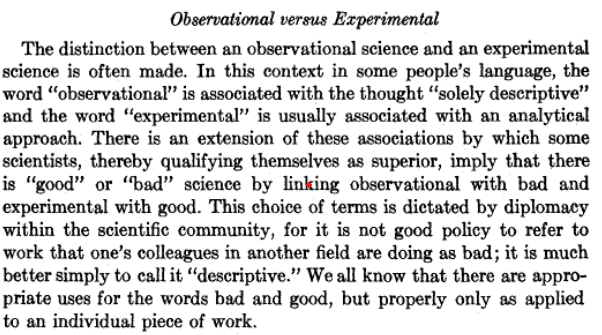
I think we both agree that there is some work in psychology which matches the description of experimental science, but much doesn't. -
The importance of psychology.My view, in brief from above, is that science is about replicable results from experiments. — tim wood
Do you consider geology, paleontology, evolutionary biology, ecology, astronomy, and oceanography to be sciences? -
The importance of psychology.Clinical psychologists will be interested in that. I wonder what their degrees say. — tim wood
Now we're doodling around with language. It doesn't matter what the diploma says. It matters what people actually do. To be fair, I think the confusion you and I are having is something psychologists of all kinds are not very aware of. Maybe that's Freud's fault.
Nor this a carpenter, but what, or among the things that, carpenters do. — tim wood
Now you've just gone out and ruined my brilliant metaphor or aphorism or whatever it is.
You said you'd like to demonstrate (not your word) that psychology is a science. What sort of a start might you make? Having your plane shot-up before it gets off the ground is better all-'round than it's being shot down after it gets up. But that's only if your start is no good. If instead it's good, then maybe we all learn. — tim wood
You're just itching for a scrap and you're impatient waiting for me to decide whether I want to get into it. -
The importance of psychology.What a strange thing to say. Science is science. If something is indeed a science, then it should be science all the way down. — baker
Applied science is another phrase meaning "engineering." Engineering is in no way science.
Pick up any introductory book on the theme of scientific methodology, and you'll see the first chapters are devoted to errors in measurement and how to minimize them. — baker
Again, that's science. Engineering is not science. Hitting a nail with a hammer is not a hammer. Applied psychology is not psychology. -
Where is the Left Wing Uprising in the USA?There is no left wing in the US. Just a bunch of effete liberals - all of whom are centre right - who confuse politeness and table manners for politics. — StreetlightX
Oh, SLX, you're just so cute. I want to pinch your cheek. -
The importance of psychology.The issue is applied psychology, as it is applied by people in positions of power, whether they have a degree in psychology or not, and the legal power that these people have. — baker
The problems with applied psychology have nothing to do with whether or not psychology is a science. There are problems with applied physics that have the potential to destroy humanity, but that doesn't change physic's status as a science. -
Is Society Collapsing?And at a more radical (reductio?) level, R. Scott Bakker refers to this as the (coming?) "semantic apocalypse" wherein we are eliminating with discursive reasoning (technoscience, FN's "will to knowledge") the very basis for our discursive reasoning – human meaning (e.g. intentionality, free will ... are just "user illusions") — 180 Proof
I haven't read the article yet, but I will. I worry less about metaphorical catastrophes than I do about real ones. -
The importance of psychology.It's the sort of circularity a five year old could spot. — Isaac
@tim wood and I get along pretty well, philosophically, except when we don't. He has some pretty strong... opinions that always get me started - his antipathy towards religion and psychology are prime examples.
I'm always happy to get to use "antipathy" in a post. Antipathy, antipathy, antipathy.
Say it loud and there's music playing,
Say it soft and it's almost like praying -
Arguments for livable minimum wage.Sure, why not. — tim wood
I don't know if that would work or not. One thing I like about the universal basic income approach is it cuts out all the frim fram - just write a bunch of checks. Get rid of bureaucrats, complex formulas, multiple overlapping programs, red tape. -
Does anyone have any absolute, objective understanding of reality?How does an absolute truth differ from a plain ordinary truth? — Banno
I think an absolute truth is a proposition that is true in all possible circumstances, for all possible observers, in all possible times and locations, really, truly, we really really mean it. -
The importance of psychology.Great, and when or where was that ever done scientifically? — tim wood
I've been trying to decide whether I should try to make a comprehensive case for psychology as a scientific discipline. I'd considered doing that in the past but never got around to it. That would be the only potentially effective way for me to respond to your skepticism, but it will take some effort. Let me think about whether I've got the energy to do it right now. -
The importance of psychology.How much of this does it differ from other aspects of psychology? Seems interesting to point out that psychology or psychotherapy aren't that distinct from another since one can be more theory based, with the other much more hands on and active. — Shawn
I'm not sure if I understand the question. When I was a psych major many (many, many, many) years ago, the classes I liked the best were in cognitive psychology and the psychology of language and for the exact reasons we're discussing. They were the most "scientific" of the types of psychology. Even better, they dealt mainly with healthy human minds and healthy human behavior. In the intervening 50 years, cognitive psychology has expanded and been joined by cognitive science to provide a very powerful way of looking human cognitive function.
Although when I was in college in the 1970s I had thoughts of being a therapist, I was never satisfied by those classes in that aspect for the reason we are discussing. They had trouble separating out the facts of human behavior and the methods for intervening in human mental problems. I think that's where a lot of the criticism about psychology comes from.
That's actually funny to talk about, since that's by definition behaviorism. I don't think behaviorism is the same as psychology, as is cognitive science the same as the study of thinking. — Shawn
No. The definition of "behaviorism" is "The theory that human and animal behavior can be explained in terms of conditioning, without appeal to thoughts or feelings"
It would be interesting to note, that what types do not involve this form of analysis? — Shawn
Much of psychotherapy these days uses drugs with or without talk therapy. Even the talk therapies vary in the amount of self-awareness involved. Some of them focus directly on problem behaviors and how to improve them directly without necessarily using self-awareness. I am not a psychotherapist, so I we've come to the end of my specific knowledge. -
The importance of psychology.Psychology hasn’t had a Newton or Einstein yet, — khaled
There are those who would say that Freud was that person, including Freud. A lot of people would laugh at that. I think there's a case to be made though. Before Freud and some others at the beginning of the 20th century, it was widely believed that people acted for motives and by methods that are mostly conscious and self-conscious. Freud showed that people are not aware of much of what goes on in their minds. That's a profound idea and one that's at the bottom of any understanding of the human mind and human behavior. -
The importance of psychology.Nothing about deontological or consequentialist ethical theories really incorporate the psyche into their analysis. The trolley dilemma neither does incorporate the analysis of the biases of the lever switcher into the conceptual landscape. — Shawn
And that's one of the reasons so much of the philosophy of ethics is baloney.
Yet, when a patient enters the office of a psychologist, they would sit there and recollect questions they have to the psychologist about their life. — Shawn
I've said this before - psychology is not psychotherapy. Psychology is the scientific study of behavior. But you're right, some, but not all, forms of psychotherapy do involve self-examination. -
The importance of psychology.Well then I should put in a call to Edinburgh University immediately, they'll be dismayed to learn of the imposters they have as the emeritus professor of their department of psychology. — Isaac
I think Tim has fallen victim to the No True Scottish Psychologist fallacy. -
Does anyone have any absolute, objective understanding of reality?Does anyone have any absolute, objective understanding of reality? — Cidat
Not to be too cute, but if I refute the existence of an absolute, objective reality, does that mean my understanding is absolute and objective?
T Clark

Start FollowingSend a Message
- Other sites we like
- Social media
- Terms of Service
- Sign In
- Created with PlushForums
- © 2026 The Philosophy Forum