
Comments
-
Climate change denialI remember in 1976 (my first year at university, doing Chemistry Honours, Physics, and Biology) when the news of a possible pending Ice Age came out. — Agree to Disagree
:lol:
I think that’s climate denial bingo. -
Climate change denialI am interested in looking at the possible solutions and working out which ones are likely to be effective and which ones are likely to be ineffective. — Agree to Disagree
Suddenly we’ve changed our stance, I see…
Please tell me some of the "plenty of solutions", and I will tell you why they won't work. — Agree to Disagree
Good to know you’re now miraculously “looking at which solutions are effective.”
Tell me some, and I’ll tell you how they’re complete crap, then support my claim with solid “evidence” like this: “Good luck with that.” -
Climate change denialAs in most cases where those with nothing left to say and no knowledge — or real wisdom — to impart, the latest climate denier has been reduced to platitudes about “both sides listening to each other” and other such sanctimonious vapidity. How pathetic.
-
Climate change denialHave you taken the time to think carefully about what I have said? I try to provide evidence to back up what I say. Have you looked at the evidence? — Agree to Disagree
Your “evidence” like “all these countries have many cows, so good luck with that’s methane problem” (your first example).
Don’t try to blame everyone else for your climate denial, ignorant stamens and weak “evidence” — which was refuted systematically by those who actually know something about the topic. -
Climate change denialJust a little review of this latest round of climate denial from the person who’s only recently joined the forum and is singularly interested in spreading nonsense about this one issue:
Many people seem to be paranoid about the use of crude oil. Crude oil is very useful for a lot of reasons. — Agree to Disagree
Yeah, that’s it — everyone is just paranoid.
But [climate scientists] have chosen to "hide" the actual temperatures from the public. — Agree to Disagree
Conspiracy.
It is almost like I was questioning your religion. — Agree to Disagree
(Common climate denial accusation— “the church of climate change,” etc)
Do you mean the climate scientists who go on all expenses paid holidays each year (COP) to the worlds top tourist spots to discuss how everyone else should stop flying, etc. — Agree to Disagree
(Common denialist accusation.)
Are the people who live in Moscow “suffering” from global-warming? Or are they having street parties to welcome global-warming? — Agree to Disagree
I believe that there are no solutions that aren't doomed from the start. And many of the proposed solutions will actually make things worse. — Agree to Disagree
(Never talks about why other than it’s cold in sone places and that India and China have a lot of cows so, you know, “good luck with that”. Solid argument.)
Currently sea level is rising by about 3 mm per year. I don't need to worry for about 333 years. — Agree to Disagree
(Wrong— It’s closer to 4mm a year.)
There is not much political will to do things that people don't want (if you live in a democracy). — Agree to Disagree
Wrong — poll after poll show people want their governments to do something.
I believe that it is incorrect to hold those companies responsible for 71% of global emissions. The companies are only supplying what people demand. — Agree to Disagree
Wrong— another myth in defense of industry (no surprise there).
Can you provide links to dispute the claim that cold kills more than heat? — Agree to Disagree
I did — and then no further response about that; subject changed to how because we all evolved from Africa, we can handle the coming heat. :roll:
-----
All the makings of a varsity athlete.
(To those following along, notice how we've already strayed from anything to do with science, where some work actually needs to be done to follow along, into the subjective, flimsy world of "you're mean to me; I'm misunderstood; you call me names; you're not addressing my red herrings") — Mikie
This was just worth repeating. -
Climate change denialHumans evolved in Africa, near Kenya. So humans should be able to tolerate temperatures which are close to the temperatures found in Kenya. — Agree to Disagree
This is why humans can tolerate heat better than they can tolerate cold. — Agree to Disagree
I’m not going to simply refute stupid claim after stupid claim. You’re changing the subject — again. If you want to continue, respond to what’s been said so far and stay on topic. Otherwise, I’m not interested in your particular brand of climate denial. -
Donald Trump (All General Trump Conversations Here)You'd have to be an idiot to think he believed the election was stolen. This is a recurring strategy he uses: "If I win I'm great, if I lose it was rigged against me." It's the sore loser strategy and we all remember it from childhood -- but Trump never outgrew it. — GRWelsh
Yes.
But on the other hand, he’s such a deeply pathological liar that he may have convinced himself somewhere along the way that what he was saying was true.
So if the charges rely on him being something other than a pathological, sociopathic, narcissistic liar— I think it’s doomed to fail. -
Climate change denialFor me there are no "facts" that are beyond dispute.
— Agree to Disagree
'Everyone has a right to their own opinions, but not to their own facts' ~ Daniel Patrick Moynihan. — Quixodian
Yes indeed. But, again, pretty standard (ie, average) for a climate denier.
I posted about this a while back under “selective skepticism.” It’s motivated by something else— in this case, propaganda-driven denial; but not always. Sometimes by money or the feeling of superiority/specialness.
In any case, it usually presents as “ah shucks I’m just asking questions and showing a healthy bit of skepticism” and then fairly quickly reduces to “scientists were wrong about the earth being flat” and, eventually, “there are no facts.”
Yes, maybe when I walk out the door I’ll fly away. Maybe. Who knows? Prove it can’t happen— and cite your source! -
Climate change denialSo how do we know that they are not wrong again? — Agree to Disagree
Creationists say the same thing about evolution— especially when it’s shown that scientists were off about some hypothesis— like ideas about what killed the dinosaurs.
Yours is a god-of-the-gaps approach to climate denial, even going so far as using the fact that it’s WORSE than some scientists anticipated as proof that they may be wrong about all of it. Truly pathetic. But also average. -
Climate change denialIt’s worth pointing out that @ChatteringMonkey provided substantive responses to @Agree to Disagree, all of which was ignored in favor of other posts— posts that can be brought into the realm of subjectivity, where anyone can have an opinion.
-
Climate change denialPlease state clearly which you think kills more, heat or cold? — Agree to Disagree
Heat.
Can you provide links to dispute the claim that cold kills more than heat? — Agree to Disagree
Yep:
https://www.wunderground.com/cat6/Which-Kills-More-People-Extreme-Heat-or-Extreme-Cold
Extreme heat and extreme cold both kill hundreds of people each year in the U.S., but determining a death toll for each is a process subject to large errors. In fact, two major U.S. government agencies that track heat and cold deaths--NOAA and the CDC--differ sharply in their answer to the question of which is the bigger killer.
It goes on from there. But it does involve reading, and a bit of nuance when assessing studies— so feel free to ignore it so you can go on happily with your denial.
Some changes (such as droughts, wildfires, and extreme rainfall) are happening faster than scientists previously assessed.
Mikie, are you saying that sometimes (climate) scientists get it wrong? That their assessment of the speed of change was not correct.
How do we know that they are not wrong about other things? — Agree to Disagree
I’m sure they are. Other scientists will figure out where and how. But I’m not delusional enough to believe I know where they’re wrong or why.
They underestimated the speed of change. No one claimed to have the level of certainty that they do that climate change is happening, and rapidly.
This means climate change is actually worse than expected, btw. You know, that phenomenon that “maybe” is a good thing, as you absurdly and ignorantly suggested?
What gives you the right to deny them the benefits that they have gained. — Agree to Disagree
Next time someone’s house is on fire, we should treat it as a balancing act. Clearly there’s benefits. Who are we to deprive them of heat in winter? The smoldering ashes are a great source of warmth. Maybe they can re-sell the charcoal. -
The Death of Roe v Wade? The birth of a new Liberalism?Ohio Voters Reject Constitutional Change Intended to Thwart Abortion Amendment
Republicans sure know how to grind onwards despite all logic and evidence to the contrary.
I guess you can get away with deluding yourself — about what majorities of Americans want (fake news polling), about climate change, about guns, about voter fraud and “stolen” elections — only to a point. Eventually the facts of reality are going to prove you wrong.
In short, the Republicans are this guy:
-
Climate change denialSince this thread has devolved into stupidity, let me try to bring it back to reality:
Global climate change is not a future problem. Changes to Earth’s climate driven by increased human emissions of heat-trapping greenhouse gases are already having widespread effects on the environment: glaciers and ice sheets are shrinking, river and lake ice is breaking up earlier, plant and animal geographic ranges are shifting, and plants and trees are blooming sooner.
Effects that scientists had long predicted would result from global climate change are now occurring, such as sea ice loss, accelerated sea level rise, and longer, more intense heat waves.
"The magnitude and rate of climate change and associated risks depend strongly on near-term mitigation and adaptation actions, and projected adverse impacts and related losses and damages escalate with every increment of global warming."
- Intergovernmental Panel on Climate Change
Some changes (such as droughts, wildfires, and extreme rainfall) are happening faster than scientists previously assessed. In fact, according to the Intergovernmental Panel on Climate Change (IPCC) — the United Nations body established to assess the science related to climate change — modern humans have never before seen the observed changes in our global climate, and some of these changes are irreversible over the next hundreds to thousands of years.
Scientists have high confidence that global temperatures will continue to rise for many decades, mainly due to greenhouse gases produced by human activities.
The IPCC’s Sixth Assessment report, published in 2021, found that human emissions of heat-trapping gases have already warmed the climate by nearly 2 degrees Fahrenheit (1.1 degrees Celsius) since pre-Industrial times (starting in 1750).1 The global average temperature is expected to reach or exceed 1.5 degrees C (about 3 degrees F) within the next few decades. These changes will affect all regions of Earth.
The severity of effects caused by climate change will depend on the path of future human activities. More greenhouse gas emissions will lead to more climate extremes and widespread damaging effects across our planet. However, those future effects depend on the total amount of carbon dioxide we emit. So, if we can reduce emissions, we may avoid some of the worst effects.
— from the “alarmists” and “scaremongers” of NASA, who definitely don’t know as much as the climate deniers (oops, I mean “skeptics”) on this thread.
https://climate.nasa.gov/effects/ -
Climate change denialFor the last 40 years we have been told that the world will end in 10 years. — Agree to Disagree
scaremongering — Agree to Disagree
But which kills more, heat or cold? — Agree to Disagree
And the climate denial just keeps on coming.
shellacking next year — Quixodian
Let’s hope. -
Climate change denialUnderstanding climate denial used to seem easy: It was all about greed. Delve into the background of a researcher challenging the scientific consensus, a think tank trying to block climate action or a politician pronouncing climate change a hoax and you would almost always find major financial backing from the fossil fuel industry.
Those were simpler, more innocent times, and I miss them.
True, greed is still a major factor in anti-environmentalism. But climate denial has also become a front in the culture wars, with right-wingers rejecting the science in part because they dislike science in general and opposing action against emissions out of visceral opposition to anything liberals support.
And this cultural dimension of climate arguments has emerged at the worst possible moment — a moment when both the extreme danger from unchecked emissions and the path toward slashing those emissions are clearer than ever.
[…]
Back in 2009, when Democrats tried but failed to take significant climate action, their policy proposals consisted mainly of sticks — limits on emissions in the form of permits that businesses could buy and sell. In 2022, when the Biden administration finally succeeded in passing a major climate bill, it consisted almost entirely of carrots — tax credits and subsidies for green energy. Yet thanks to the revolution in renewable technology, energy experts believe that this all-gain-no-pain approach will have major effects in reducing greenhouse gas emissions.
But not if Republicans can help it. The Heritage Foundation is spearheading an effort called Project 2025 that will probably define the agenda if a Republican wins the White House next year. As The Times reports, it calls for “dismantling almost every clean energy program in the federal government and boosting the production of fossil fuels.”
What’s behind this destructive effort? Well, Project 2025 appears to have been largely devised by the usual suspects — fossil-fueled think tanks like the Heartland Institute and the Competitive Enterprise Institute that have been crusading against climate science and climate action for many years.
But the political force of this drive, and the likelihood that there will be no significant dissent from within the G.O.P. if Republicans do take the White House, has a lot to do with the way science in general and climate science in particular have become a front in the culture war.
Paul Krugman (I gifted a free article.) -
Climate change denialI think you don't realise what a couple of degrees of global warming really means. — ChatteringMonkey
Like with most climate deniers, this will slowly become more apparent.
But I appreciate you taking over the annoying job of explaining things. I think I’m tapped out. -
Climate change denialLest we get too caught up in the complete nonsense being spewed by climate deniers on this page, I want to remind everyone of the facts (mentioned before and completely ignored, incidentally):
Over 100 years:
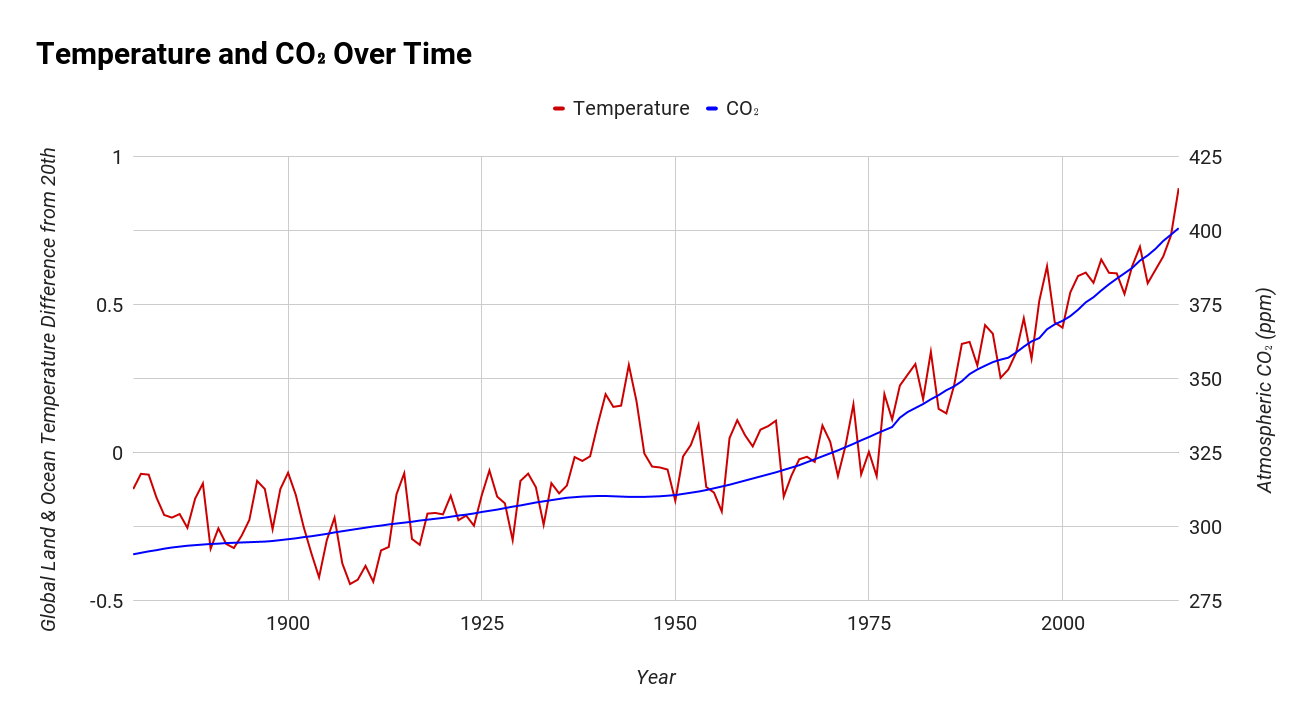
And over 800 thousand years:

We haven’t gone over 300 ppm in 800 THOUSAND years. Hence the rapid rise in temperatures.
If we really don’t yet understand why that’s a bad thing— for everyone — then fortunately there’s Google. -
Climate change denialAlarmists want you to believe that any temperature increase anywhere is bad. But there are many places in the world where a small temperature increase would be good. — Agree to Disagree
“Alarmists.” :lol: -
Climate change denialIf the earth was abnormally cold in the Little Ice Age (pre-industrial times) then the temperature recovering to normal (i.e. global warming) is probably a good thing. — Agree to Disagree
I’m glad to see the fully-fledged denier in you coming out. My senses still serve me well I see.
Even after all the politician-like statements about how you “of course” don’t deny climate change. The climate ALWAYS changes blah blah blah.
First nothing can be done because it’s cold in Russia.
Then scientists around the world are misleading people by focusing on anomalies and averages, rather than the “actual” temperatures that you alone have put nicely in a graph.
Then “what about the little ice age?”
Now: maybe a warming planet is a good thing?
So very predictable. Anyone who can’t see this is a complete imbecile. -
Climate change denialGlobal warming is slow and small compared to seasonal warming. — Agree to Disagree
Wow.
Yeah, you’re right— I guess you’re really on to something! Keep up the great work. -
Climate change denial
- global average temperature has increased rapidly
- global CO2 emissions has increased rapidly since the Industrial Revolution
As CO2 increases, temperature increases. Hence why the average goes up. An average means there will be some areas that are still cold, even very cold (like Russia, Greenland, Canada, the Antarctic, parts of Alaska, parts of Argentina, etc.). -
Climate change denialIf you don't know this then you don't know much about climate-change/global-warming. — Agree to Disagree
They’re all based on averages. Even anomalies, which you seem to barely understand, are based on averages. You cited an average yourself — for the month of January.
The global average temperature in the 20th century was 57 degrees F. There’s nothing “not actual” about that.
Also, having a huge collection of data points around the world is pointless. You take averages— long term and short term averages— to understand changes (whether positive or negative, which are deviations [“anomalies”] from a certain period’s average). Otherwise it’s simply pointless to look at a globe and say “hey, look at all the blue spots in January!”
Try learning something about climate change. Start by reading the link you cite. It doesn’t seem like you have. -
Climate change denialBest to laugh and walk away. — Banno
You’re more restrained than I am. This is a particularly important issue for me — which also makes it difficult to discuss with people who so arrogantly display their ignorance. -
Climate change denialYour response shows that you don't really know much about climate-change/global-warming. — Agree to Disagree
Yet, a few sentences later:
Climate scientists almost always only tell the public about temperature anomalies. — Agree to Disagree
Care to give any examples whatsoever?
Anyway, this is yet another denialist claim— i.e., the climate scientists aren’t being truthful with the public or giving the whole story. Usually it’s confined to the liberal media, not scientists themselves— but you take it a step further.
Anyway, you’re wrong. What you’re referring to is talk about average global temperatures. Anomalies are certainly seen on this level, yes. Which is why year after year breaks records (of measurements that began in the late 19th century).
You’re just confused about “anomalies”, apparently thinking scientists only report on the specific areas that are breaking heat records (which also explains your odd obsession with the “coldness” of Russia). This doesn’t even make sense, though, when you contrast it with “actual” temperatures: even high temperatures that break records (“anomalies”) are “actual”: they’re as real as any other temperature.
The real contrast to “actual” would be “speculative” in some sense, or perhaps somehow based on modeling (opposed to “real” thermometer readings).
So nothing you’re saying makes sense.
Here are the facts:
- global average temperature has increased rapidly
- global CO2 emissions has increased rapidly since the Industrial Revolution
As CO2 increases, temperature increases. Hence why the average goes up. An average means there will be some areas that are still cold, even very cold (like Russia, Greenland, Canada, the Antarctic, parts of Alaska, parts of Argentina, etc.).
But they have chosen to "hide" the actual temperatures from the public. — Agree to Disagree
Again— this is a climate denial argument. Somehow climate change isn’t “scary” (and perhaps not even real) because scientists are withholding information or are deliberately scaring the public.
What examples do you have? What could you possibly mean by “actual” temperatures? The temperature today in New Hampshire was a high of 79 and a low of 54. Which one is “actual”? If the average temperature today was 65, is that not real?
Look at all of the purple and blue color in the Northern Hemisphere. Purple represents actual temperatures less than zero degrees Celsius. Literally freezing cold. — Agree to Disagree
Yes…and?? What is your point? And are these averages for January? Are averages “actual” temperatures? If so, then that’s exactly what climate scientists talk about — which you claimed they don’t. They report on average global temperatures for each year — which is what you hear about in the news.
Yes, it's cold in winter. :roll: — Banno
I’m glad I’m not the only one who recognizes how ridiculous this is. -
Climate change denialFor example, Russia with +7.5 degrees Celsius of global warming will still have an average high temperature of the hottest month lower than America's with no global warming. — Agree to Disagree
So you’ve gathered data and put it into a graph — which thousands of climate scientists have also done — and then conclude with, once again, talking about how Russia is cold.
And this is supposed to disprove my quote statements above— which I stand by wholeheartedly. Hilarious.
It’s cold some places, it’s hotter other places. No kidding. Do you have a point to make or are you now just talking into the ether? -
Climate change denialI believe that these roadblocks won't be overcome. — Agree to Disagree
Right, you’re here to say “it can’t happen.” Just like those who said we’d never solve the ozone hole problem. Just a wave of the hand. Don’t have to learn anything or know anything, just point and say “way too hard— won’t happen.” Yeah, I suppose if everyone had attitudes like yours, it’d be a guarantee that nothing will happen.
Fortunately, even those who are pessimistic stress the importance of action. I value their onions; I don’t value yours. And for a simple reason: you haven’t shown even an 8th grade understanding of climate science.
Anyway— yes, time will tell. -
Climate change denialWhy should the Russians cooperate with you? — Agree to Disagree
So the Russians won’t cooperate because it’s cold in Russia. Which is like arguing that the Cook Island don’t care about nuclear proliferation, since they have may survive a nuclear war.
What a low opinion you have of Russian people. In fact, polling shows majorities consider climate change a threat and want to do something about it— despite massive propaganda from this Petrol State.
The Russian government also signed the Paris Accords. The elite pay lip service to climate change but have so far done very little— not a surprise, given their economy.
These counties might say that they will cooperate, but how hard will they really try? — Agree to Disagree
Many are trying much harder than us, in fact. With the exception of Canada, I think, all of them have lower per capita emissions than we do. So they’re trying harder and contributing less at the same time.
The issue, as I said at the beginning, is political will. Other countries have much stronger action plans on climate change. The dopey US, with one major party full of climate deniers, has only tepidly entered the fight with the Inflation Reduction Act of 2022, which incentivizes EVs, heat pumps, induction stoves, solar panels, etc. — all of which are important technologies. It seems a decent signal to the rest of the world.
There are real roadblocks. Nothing you mentioned, of course, because you don’t know what you’re talking about — but problems like building transmission lines, dealing with permitting and NIMBYism, plugging old oil wells, sealing the leakage of methane from natural gas wells, countering misperceptions about nuclear power, etc., are all real problems. But they’re not impossible. As the climate keeps beating down on more and more people, you’ll start seeing more changes. It’s whether or not there’s enough time— that’s the only question.
To come here with one argument: “throw a solution at me and I’ll make up a reason why it won’t happen,” is really strange. Guess you figured it would make you look interesting in some way. The reality is quite the opposite. -
Climate change denialYou call me a denier whenever you disagree with me. You say that my ideas are nonsense whenever you don't want to discuss them. I have refrained from labelling you because I want to have a genuine discussion about climate-change/global-warming. It is you who is stopping us having a good faith discussion. — Agree to Disagree
No, it's you. I gave you a long, detailed post explaining what climate change is. You respond with irrelevancies like "It's cold in Moscow."
If that's truly where your head is at -- to the point where you can't even see how stupid and irrelevant that statement was -- I'm not interested. You're not directing where the conversation goes, and I won't be dragged into a discourse on nonsense.
If you have something to say about climate change, or anything substantive about my post, by all means go for it. If there's some semblance of a point to be made by stating that one region of the world is cold, make it. Otherwise you're wasting my time and everyone else's.
(To those following along, notice how we've already strayed from anything to do with science, where some work actually needs to be done to follow along, into the subjective, flimsy world of "you're mean to me; I'm misunderstood; you call me names; you're not addressing my red herrings") -
The Scientific MethodIt seems that if 2) and 3) are true, then you are sure of at least some of the limits of science. — PhilosophyRunner
We can be unsure about what’s true and not true, yes? It doesn’t mean there’s no such thing as truth. -
The Scientific MethodAnd the same question for the other things you called pseudoscience. There is some reason you call these pseudoscience, something that distinguishes them as not science. What is it? — PhilosophyRunner
Well, we can start with the fact that there’s no credible evidence whatsoever for their claims or their beliefs. There’s very little evidence that manipulating vertebrae has any significant health benefits (beyond placebo), for instance. There’s no evidence that the positions of the planets have any demonstrable effect on human beings. And so forth.
But there are psychological reasons too. It’s usually easy to identify when a person wants to believe something— for understandable reasons. Whether because it’s comforting or there’s financial incentive or whatever. So motivation is a factor. Motivated reasoning.
But there’s also all kinds of biases and pitfalls that lead people astray— and you don’t even have to examine the evidence to know it’s complete nonsense. Claims about 9/11 and the moon landing are some obvious ones. Take a lot of people in, because they’re presented very smartly, by design. But upon inspection — assuming we need to bother to get that far — they reveal themselves as the half-truths and cherry-picked conglomerate of bullshit that they are. -
The Scientific MethodThis unverified-but-not-unverifiable direction of research begs for abuse by pseudo-scientific interests. — Pantagruel
Exactly, which is why there’s so much woo-woo that uses quantum mechanics as an example to justify it. Another one: “energy.” More New Age-y stuff. They really have no understanding of any of it, they simply use it to create fictions — like science fiction writers. Crichton did something similar with Jurassic Park … a lot of fun, but complete nonsense. -
Is Philosophy still Relevant?But isn't this what keeps philosophy alive as an independent discipline? Without that, doesn't it become just a theme? — Pantagruel
Yes it is what helps it remain a discipline — a specific profession and subject of study in schools, and so on. So be it. It’s a convenience.
But was Aristotle a philosopher? Sure. Also a political scientist, botanist, zoologist, etc. I think the professionalization of academia and the economic changes of specialized “jobs” has been internalized by nearly everyone, to the point where general inquiry and thoughtfulness is compartmentalized unnecessarily. It becomes part of an identity, as well. “I’m a philosopher…I’m a biologist…” In university websites, you see publications and “research interests.”
The most interesting people I’ve encountered pretty much ignore all of that— they’re interested in everything and want to learn. Chomsky, a personal favorite, is usually hard to peg: historian? Certainly — with no degree in history. Linguist…philosopher…political theorist…social critic. Yes. What about Kant? Scientist? Sure.
The point being: the names are fine for ordinary life and convenience. But we shouldn’t take them too seriously. Nearly everyone has the potential to “do” philosophy. It’s just a particular kind of thinking, in my view. Always relevant. -
The Scientific MethodThis may serve as a good starting point to understand the demarcation of science - what makes one theory science and another pseudo-science? Is it in the method used? — PhilosophyRunner
I don’t think sweeping, abstract claims can be made. You have to look at specific, real world examples. So, are horoscopes pseudoscience? Yes. Is chiropractic a pseudoscience? It depends - but mostly, yes. Is creation “Science” pseudoscience? Yes. And so on. You can demonstrate each fairly easily. -
Climate change denialDo you care that the people who live in Russia are too cold? — Agree to Disagree
So much for a good faith discussion about climate change.
As with most climate deniers, the conversation has to devolve into nonsense.
The science is never settled. — Agree to Disagree
It is settled. In any meaningful sense whatsoever, it’s settled. It’s as settled as the earth being spherical.
Notice how the “science is never settled” trope gets used selectively. Especially when one knows next to nothing about the topic. Quantum mechanics? Science isn’t settled. Electromagnetism? Science isn’t settled. “Science is never settled!” They become armchair philosophers of science.
Easy, tired slogans.
I’ll simplify it further:
1. CO2 is a greenhouse gas.
2. Burning fossil fuels increases CO2.
3. With increased CO2 comes an increase in global temperatures— as seen in the graphs from my post above.
That’s settled.
I am not sure whether CO2 is responsible for 100% of the temperature increase. — Agree to Disagree
No one has ever claimed — certainly not climate scientists — that CO2 is “100% responsible”. This is a ludicrous statement. -
Climate change denial
Right…that’s where this is going: it’s something other than CO2. But they can’t say it outright. -
Climate change denialYou seem to care about Foote's experiment because you used it to show that the glass container with more CO2 heated up the fastest. — Agree to Disagree
I pointed it out as a historical fact, which anyone can reproduce. You can do it yourself. You can control for anything you want — put more or less water vapor, throw in methane, anything. The particular experiment from the 1800s isn’t important beyond that. Who cares?
To save you from wasting more of your time, and my time, I will tell you what I believe. I believe:
- that CO2 is a greenhouse gas
- that humans are responsible for most of the increase in CO2 level above about 280 ppm
- that a lot of the increase in CO2 levels is due to the use of fossil fuels
- that the average temperature of the Earth has warmed by around 1.0 to 1.5 degrees Celsius since pre-industrial times
Does that make me a "denier" ? — Agree to Disagree
Not in the Bjorn Lomborg sense, I suppose.
So you say all this and yet bring up things like Moscow and how cows are a major industry and thus we won’t solve the issue. Why?
Mikie

Start FollowingSend a Message
- Other sites we like
- Social media
- Terms of Service
- Sign In
- Created with PlushForums
- © 2026 The Philosophy Forum