
Comments
-
Nothing to do with Dennett's "Quining Qualia"Right. I've seen that mentioned several times, but googling right now I find this BBC article (below) which says about 1 million from combinations of 100 basic colors. It also mentions some interesting stuff about ultraviolet and infrared detection by humans under certain connditions. And it claims that tetrochromats can see 100 million.
A healthy human eye has three types of cone cells, each of which can register about 100 different colour shades, therefore most researchers ballpark the number of colours we can distinguish at around a million. Still, perception of colour is a highly subjective ability that varies from person to person, thus making any hard-and-fast figure difficult to pinpoint.
The average number of colours we can distinguish is around a million
"You'd be hard-pressed to put a number on it," says Kimberly Jameson, an associate project scientist at the University of California, Irvine. "What might be possible with one person is only a fraction of the colours that another person sees.
https://www.bbc.com/future/article/20150727-what-are-the-limits-of-human-vision -
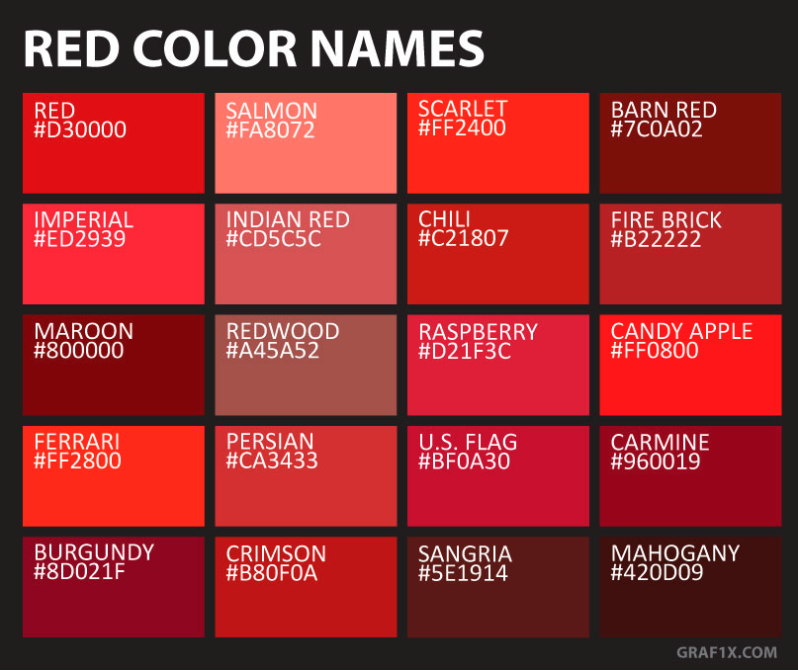
Nothing to do with Dennett's "Quining Qualia"Our eyes can make out ten million shades of color. I wonder how many shades have names? Here's a site with a bunch of shade names grouped by color:
https://graf1x.com/list-of-colors-with-color-names/
The red ones:
-
Nothing to do with Dennett's "Quining Qualia"That's because you ignore the naive realist assumption in ordinary language that apples look red because they are red, because the world is at it looks to us, end of story. But it's not. It's just the beginning of the story.
-
Nothing to do with Dennett's "Quining Qualia"What difference does that make here? In both cases, the apple is red due to how it interacts with light. — creativesoul
But it's only red because that's the color we see. We see that color because of the way or visual system works. If our visual system was different, we might not have an rgb vocabulary. The rest of the EM spectrum does not have color labels, because we don't see the rest of the electromagnetic radiation interacting with the environment.
That's something which is getting lost here. The apple just doesn't reflect light of certain wavelength. It also has other light reflecting off and going through it and what not. Insects and birds can see colors we can't. The full EM spectrum is all around us, but we only see a small fraction of it. -
Nothing to do with Dennett's "Quining Qualia"The word "red" picks out a physical aspect of the apple, not how it appears (which is a qualifier meaning "seem; give the impression of being", not a reference to a mental entity or mental experience). — Andrew M
The apple appearing red came long before optics. You have the cart before the horse. It's like arguing that sunrise means the Earth revolves around the sun, or solid means objects are filled with mostly empty space, held together by tight EM bonds. There would be no "sunrise" if if the sun didn't appear to move through the sky, similarly we wouldn't have quite the same word for "solid" if we utilized X-Ray vision instead. Nor would apples look red. -
Joe Biden: Accelerated Liberal ImperialismI think aliens would say, "Those creatures kill each other pretty much continuously, and not very efficiently. They bumble around exhausting enormous resources to do it.
"Meanwhile their climate is changing rapidly and they're just sitting there." — frank
Maybe the aliens can get off their butts and beam us plans for an economical fusion reactor along with the wormhole machine, instead of just judging us from afar. *Borat voice* Assholes aliens. -
How does a naive realist theory of colour explain darkness?1.3k
Why wouldn't a "naive realist" (a phrase which strikes me as an oxymoron) sim — Ciceronianus the White
Naive realist means an unreflective assumption that the world is pretty much as it appears to us humans. A direct realist would be aware of the various critiques of naive realism, armed with counter arguments in favor of the world looking at least somewhat as it appears to us, without there being some sort of mental intermediary. -
How does a naive realist theory of colour explain darkness?Maybe like this: the apple is red but I just can't see it. — jamalrob
What does it mean for the apple to be red when there is no visible light reflecting off it? For that matter. What does it mean for the apple to be red when nobody is looking at it? -
Nothing to do with Dennett's "Quining Qualia"Relational realism would mean colors are real for certain perceptual systems when perceiving under normal lighting conditions? I can dig that.
-
Nothing to do with Dennett's "Quining Qualia"Also sounds like an ontological commitment to color realism on Andrew’s part.
-
Nothing to do with Dennett's "Quining Qualia"The belief that a dictionary contains the meaning of a word. Naive. Indeed, silly. We don't need more holy books — Banno
So how is it so can look up a word I don’t know in the dictionary, read it’s definition, then use it meaningfully in conversation?
Seems like a rather holy experience to me. Especially when it’s Urban Dictionary. -
Joe Biden: Accelerated Liberal ImperialismOr to put it a different way - the US took the lead in winning the Cold War. Something which the whole world should be thankful for. If you have any complaints about how the US acted during the Cold War you should take it up with Mr Marx. — Paul Edwards
The US and the USSR put the entire planet at risk with their nuclear arms race. Luckily, none of the close calls triggered an actual launch. One could argue that nukes have prevented a third world war, because it's too terrible a price for the major powers to pay. But even so, it's a big gamble, and one we still live with, because who knows what could escalate matters in the future. -
Nothing to do with Dennett's "Quining Qualia"I'll just leave this hear since it will be covering some of the topics in this thread.
Minds and Machines
An introduction to philosophy of mind, exploring consciousness, reality, AI, and more. The most in-depth philosophy course available online.
Topics include:
The Chinese Room
The Turing Test
Mind-Body Dualism
The Identity Theory
Functionalism
Knowledge
Belief
Color
Perception
Consciousness
'What it's like' to be a bat
The Knowledge Argument
David Chalmers on dualism — https://www.edx.org/course/minds-and-machines -
Joe Biden: Accelerated Liberal ImperialismOne where it goes beyond preventing an individual in the street from being raped, because you might have to bomb a neighborhood, among other things.
-
Joe Biden: Accelerated Liberal ImperialismLet's take the paradigmatic cases of WW2. Most people think the Nazis (and their allies) were worth fighting, and if any war was just, it was that one. But there was a terrible price in doing so. An estimated 40-50 million civilians died, and this culminated in two nukes being dropped on cities. This after fire and carpet bombing cities, all done by the good guys.
Maybe it had to be done, but it's not so easy if you start out knowing that will be the cost. At the very least, the potential cost should be seriously taken into consideration before committing to such action. -
Joe Biden: Accelerated Liberal ImperialismIntervening in other countries is not analogous to helping an individual here. That paves over a lot of complexity.
-
Joe Biden: Accelerated Liberal ImperialismI don't think it was worth it, outside of targeting Al-Queda, which would have been special forces/limited military action.
-
Joe Biden: Accelerated Liberal ImperialismWould you want to generalize this to say that US involvement always makes things worse? Or would you say that it's fine under certain conditions? What would those be? — jamalrob
I don't know. I tend to support pacifism and non-intervention. But reality is messy. -
Joe Biden: Accelerated Liberal ImperialismBut this is difficult to swallow. For both of you, apparently, silent genocide victims ought to be ignored even by countries in a position to help. Aside from the sometime legality of humanitarian intervention under the aegis of the United Nations and international law, moral intuition tells us that innocent victims ought to be helped even if they don't ask for help. A strong man ought to help a frail old lady who is being beaten by someone younger and stronger than she is, even if she is not asking for help. The situation with humanitarian intervention is significantly different from that analogy, but exactly how is it different, and what are the consequences of that difference for the moral rightness or wrongness of intervening? — jamalrob
Shouldn't the cost of intervening be factored in? A country like the US is often in a position to interfere, but then what are the consequences? You get embroiled in someone else's civil war? Then it turns into another nation building exercise with troops still stationed there a decade later? And what if this involves complications with other nations? This also raises issues of why countries like the US or the EU get to intervene. Does that mean China and Russia do as well?
It's easy to say someone should stop and stop a Rwandan genocide. It's harder to think thought all the implications. What if the answer is yes for Rwanda because nobody else will oppose it, and no for Syria, because Russia, and no for North Korea because they could level cities? -
Nothing to do with Dennett's "Quining Qualia"Yep. That's right, I'm not sure what bearing you think that has on the issue. It's a fairly simple matter of demonstrating pretty conclusively that the use of the word 'red' does not reference a conscious experience. It can't do because the decision to use the word has already been made prior to any occipital originating signals in areas of the brain associated with conscious awareness. — Isaac
Assuming what you're saying is actually true. I've heard of this sort of study in reference to decision making (when its immediate, not following deliberation), but not reports of conscious experience. I've also seen criticism of conclusions reached regarding this sort of study, as many neurological studies engendering bold claims are often criticized for unwarranted conclusions.
But regardless, I can sit here and stare at a red object for five seconds before commenting on it, which means I've had time to be consciously aware before deciding to speak. And during that time, I may notice detail that wasn't immediately obvious and report that
We can go into that too if you like (spoiler - it's not by association with conscious awareness of 'redness' either), b — Isaac
I disagree. How could we talk of being in pain or having dreams without there being such experiences?
What we have no use for at all is armchair speculation about what the constituents of our perception-response system might be without any cause or evidence for such an arrangement. — Isaac
It's armchair speculation to suppose it's some form of self-reporting illusion. You have also equivocated between sensations being identical to certain neuronal activity and them being illusions. Which is also armchair speculation.
'm calling them stories in a technical sense. We treat these stories as reality whether we like it or not, even whilst we're trying to investigate them scientifically ( — Isaac
Conscious experience isn't a story we tell ourselves. It just is how we experience the world and our own bodies. -
Nothing to do with Dennett's "Quining Qualia"This just shows scientists are human too, and use ordinary language like the rest of us. The debate is going around in pointless circles at this juncture.
-
Nothing to do with Dennett's "Quining Qualia"Especially when one goes about picking which parts of ordinary language to rely on in ad hoc manners. In ordinary language, intentions are not illusory, for one example. We all speak as though sentient beings are endowed with agency (granted, and sometime speak of insentient things, like computers, as though they are endowed with agency; such as in, “it's thinking,” when a computer program doesn’t process information fast enough). — javra
Yep. I edited my post to remove that part as unnecessarily argumentative, but yeah, I have issues with ordinary language philosophy. Another part of or ordinary language is universals. But ordinary language philosophy is not very keen on Platonism. So colors are real, but not categories. -
Nothing to do with Dennett's "Quining Qualia"But on ordinary usage, as in scientific practice, there are red apples. In my view, ordinary language is straightforward, coherent and useful. And isn't susceptible to the kinds of philosophical problems that arise for subject/object dualism. — Andrew M
Ordinary language has naive realist assumptions. I really don't understand the obsession with ordinary language philosophy. Ordinary language has all sorts of assumptions baked into it. Why take those at face value?
Also, science doesn't say the apple is red, it says the apple reflects light of certain wavelength that we see as red. Important distinction. -
Nothing to do with Dennett's "Quining Qualia"We’re just going back over the same ground at this point.
-
Nothing to do with Dennett's "Quining Qualia""Red" doesn't refer to an experience, it refers to the color of the apple. — Andrew M
Apples aren't red. They reflect light in a wavelength range we see as red. Red is part of the visual experience. -
Nothing to do with Dennett's "Quining Qualia"If the apple looks different to you than to me, then our experiences are different. That's a difference that is, in principle, discoverable. — Andrew M
But not for creatures with sensory modalities different enough from us.
Not on the ordinary definition of experience (one's practical contact with the world). On that definition we can, and do, describe our experiences. — Andrew M
Experiences aren't limited to perception, and there is a limit to my ability to communicate what it's like to be me to you. We never fully know what other people experience. Their full feelings, dreams, thoughts, and being in their own skin is only something they experience.
Even with perception, if the difference is great enough, we can't always know. Some have suggested there are tetrachromatic females who have more vivid color perceptual abilities. Their ability to communicate what that's like to us would be limited by our 3 primary color combinations, if this is indeed so. I believe the evidence is still inconclusive, though. -
Nothing to do with Dennett's "Quining Qualia"No. I could imagine something which is red, I don't think I can imagine 'red' I don't believe there is such a thing. — Isaac
What about "seeing red" when someone is angry? The image being your entire visual field turns red in a fit of rage. That doesn't happen to me, but I can imagine it, and maybe it happens for some people.
No we haven't. Activation of Brodmann's area precedes signals being sent to the working memory. You literally start forming the word 'red' in response to firing from the V2 area prior to being aware of the fact that what you're seeing is red. — Isaac
That can only work on immediate responses prior to being conscious and not when taking your time to reflect on the red cup before you. Also, this is a learned response, not something infants do. They don't utter "red" the first time they see a red object. You're talking about a learned reflex. -
Nothing to do with Dennett's "Quining Qualia"Or we could just ask a mathematician whether a color is a number, but they'd probably think we were trolling.
Numbers are abstract quantities that you can perform mathematical operations on. Sure, you could assign 0 to purple and 1 to green, or use the standard digital hex value or HSLA. But numbers can be assigned to represent anything, from unicorns to philosophers.
Colors are not abstract quantities. You don't say there's "green squares" to represent a number of squares. -
Nothing to do with Dennett's "Quining Qualia"Problem is that when it comes to myself, I'm not positing anything theoretical when I taste spicy food. It just tastes spicy, red cups look red, and nutty coffee does taste a bit bitter to me. And that's prior to any philosophizing about internal states and "what it's like". Our sensations are not linguistic constructs or self-reports to make sense of behavior. They're just part of experience.
But anyway, good of you to bring up Dennett's intentional stance. And I prefer to add "2+2" in a Python environment. -
Nothing to do with Dennett's "Quining Qualia"So you deny basic logic? Numbers and neurons aren’t colors. This is a matter of identity. You expect me to reconsider?
-
Nothing to do with Dennett's "Quining Qualia"Intuition pump #16
Chase and Sanborn are sophisticated programs inside an elaborate computer simulation. They perform all the same functions when tasting coffee as humans do, and make the same reports in the simulation. Some say that means they must be conscious agents.
So computer scientists examine the running code and hardware. But nowhere do they find a sensation of coffee, nor any colors or feels. Only self-reports. Some others say they are not conscious, but rather digital p-zombies.
The problem remains hard. -
Nothing to do with Dennett's "Quining Qualia"I have never like the term 'what is it like', though. 'What is it like to be a bat'? Apart from the fact that it depends on the particular bat and the time, I would say that there is nothing it is like to be a bat. in the sense that being a bat is not like anything being anything else. Perhaps 'what it is to be a bat' or 'what it is to drink tea' and so on would be less misleading. — Janus
Good point. "What it is like" implies a comparison. Which can work for bitter and nutty coffee, because we know what bitter and nutty tastes like. But we don't know what a sonar modality would be like. We have nothing to compare it to, unless it's like vision or hearing, although bats also have ears and eyes, as do dolphins. So sonar sensations might be something entirely different that we can't compare to. -
Nothing to do with Dennett's "Quining Qualia"...which is begging the question already. As I said earlier, the debate is about these assumptions, discussion is pointless if you're going to start from the premise that they're obviously the case. — Isaac
It is a category error. 1s and 0s aren't colors. They're numbers. And neurons aren't colors either. And guess what, neither are photons! -
The Late Christopher Hitchens On MiraclesAll the Christians I've known thought there was good evidence (and arguments) for the beliefs. Faith was more of putting your trust in God kind of thing rather than some Kierkegaard leap of reason.
The only exceptions I can think of were very "liberal" believers who didn't like to define God and made sure their beliefs were consistent with science, but still thought there was some sort of spirit to the universe along with maybe an afterlife. Jesus was a good moral teacher who had some non-literal spiritual insights and all that jazz. The resurrection was some kind of metaphor for personal enlightenment.
I'm an atheist, so I think they're both wrong, but the first category has their own evidence based on a worldview that is somewhat at odds with our full modern understanding. -
Nothing to do with Dennett's "Quining Qualia"@Banno@creativesoulThis turns on the crux of the debate. Is Dennett and his defenders in this thread denying the experiences of color, coffee taste, etc? Or are they just saying there's nothing to those sensations that leads to a hard problem?
Banno has clarified that he doesn't deny sensation. There is a taste of coffee, and it can vary from bitter for you and nutty to him, but it's not inexpressible or (fundamentally) private.
However, we do have this from Dennett, which I quoted earlier:
The properties of the "thing experienced" are not to be confused with the properties of the event that realizes the experiencing. To put the matter vividly, the physical difference between someone's imagining a purple cow and imagining a green cow might be nothing more than the presence or absence of a particular zero or one in one of the brain's "registers". Such a brute physical presence is all that it would take to anchor the sorts of dispositional differences between imagining a purple cow and imagining a green cow that could then flow, causally, from that "intrinsic" fact. (I doubt that this is what the friends of qualia have had in mind when they have insisted that qualia are intrinsic properties.) — Quining Qualia
So what is Dennett saying here? It's a category error to say that the difference between purple and green is the neural equivalent of 0 and 1, because numbers aren't colors, and neither are spiking neurons. So the issue arises when attempting to explain our conscious sensations by reducing them to dispositional, relational or functional talk. Reason being that it seems to dismiss the experience of sensation, by replacing it with talk of something else (the purported underlying mechanism or behavior).
The biological explanation for coffee taste isn't the nutty or bitter taste itself. That's why we say there is a "what it's like", a "seeming", an "appearance of something". To be conscious is not to be conscious of some perceptual process or 1s and 0s in the brains "registers", it's to be aware of how things seem, whether nutty or purple.
We could have visible light detector hooked up to a voice dictation that reads out a color that matches our visual system, but there's no reason to think this system would have a color sensation just because it can discriminate and report accurately. We could easily modify the dictation to invert the colors or map taste words or Trumpisms instead (sorry, election is still "on" my mind).
And we could modify the detector for some EM range we can't see and feed that the color dictation. Would that mean it's now having the same color sensations for light we can't see? The p-zombie argument came about because we can't "see" how any physical system results in conscious sensations, even though we know there are physical correlations in the human case. -
Nothing to do with Dennett's "Quining Qualia"The condescending thing is claiming that people who disagree with you over a practically irrelevant philosophical dispute — fdrake
One which has inspired multiple books and numerous papers? That dispute which we're having the thousandth thread about in the history of this forum? The one that Dennett has probably had more to say about than any other dispute? -
Nothing to do with Dennett's "Quining Qualia"ncidentally, the quotes given above and the text around them in the article should be sufficient to put an end to the risible objection that Dennett denies the reality of conscious experience. Those who have made that assertion in this thread are guilty of not having understood what is being said; they ought go back and read at least the introduction of the article. — Banno
We're aware of what Dennett claims. It's also been pointed out that he likes to equivocate on terms like consciousness and free will. So he'll say that of course we're conscious and taste coffee and see colors, but then he goes on to argue in a way that denies the first person experience. So the conclusion to draw is that he doesn't really mean it the same way. By consciousness, Dennett means a third-person description amenable to science.
By tasting coffee and seeing colors, Dennett means something other than the sensations of taste and color. He means the behavioral aspect of discrimination, and its biological functions, which includes giving mistaken reports about coffee tastes and red cups, when it entails there being some first person experience to it.
Thus the claim that a wine tasting machine would have the same conscious gustary experience.
Marchesk

Start FollowingSend a Message
- Other sites we like
- Social media
- Terms of Service
- Sign In
- Created with PlushForums
- © 2026 The Philosophy Forum