
Comments
-
Nothing to do with Dennett's "Quining Qualia"A human being has a perspective of the world. The distinctions we make and our representations of the world presuppose that human perspective. But that perspective doesn't itself have properties (qualia) or a substantial existence (res cogitans), contra dualism. — Andrew M
However, if that perspective is is coloring in the world, adding sound, taste, smell and various feels, then we're still left with something that needs to be explained, because the rest of the world isn't colored in, doesn't have feels and tastes and what not. It's only that way to a perceiver. So somehow the perceiver adds those sensations to their interaction with the world. The hard problem remains in some form until there is some way to account for these sensations.
Maybe the concept of qualia is problematic, but the term itself was derived from an inability to account for consciousness, which is made up of those sensations, plus proprioception, feelings and any other internal sensations. All Dennett has done in Quininq Qulia is highlight some issues with the traditional definition of qualia, while leaving the core of the hard problem.
And yes, perceivers are part of the same world, not walled off from it, but still the question needs to be answered: from whence comes the colors, sounds, etc? -
How does a naive realist theory of colour explain darkness?We could ask where the colors live instead.
-
How does a naive realist theory of colour explain darkness?Perception doesn’t occur on the forum. And we don’t have to rely on individual definitions as this isn’t a new topic.
-
How does a naive realist theory of colour explain darkness?Brains analyse the data and resolve it into a meaningful landscape. — unenlightened
I'm gong to second Olivier5 here and say this is where the dispute takes place. That meaningful landsacpe the brain resolves, what does it mean for it to be direct? -
How does a naive realist theory of colour explain darkness?I can't make sense of the question. — jamalrob
Where is the perception formed? On the forum, at your eyeballs, or in the brain? -
How does a naive realist theory of colour explain darkness?Did you meet him on this forum, or in your mind? — jamalrob
Did the perception of meeting him in this forum occur in the mind, or on this forum? -
How does a naive realist theory of colour explain darkness?If there are reasons, you haven't made them understandable to me — unenlightened
The eight main arguments against Direct Realism are the Causal Argument, the TimeLag Argument, the Partial Character of Perception Argument, the Perceptual Relativity
Argument, the Argument from Perceptual Illusion, the Argument from Hallucination, the
Dubitability Argument, and the Objective Feature Argument. In what follows below,
each argument will first be exposited and then subjected to a Direct Realist rebuttal.
https://owd.tcnj.edu/~lemorvan/DR_web.pdf — Pierre Le Morvan
You can read the details of each argument in that paper, but I'm confident you're already acquainted with most of them. Instead you want to caricature indirect realism with statements like "perceptions being perceived", which is not what is being claimed. The claim is about the nature of the perception, and why there are reasons to doubt it is direct. It's not a linguistic confusion. -
CoronavirusThat's what I was trying to get at. Earlier lockdowns in other European countries did not prevent the need to lockdown yet again, so I'm not sure Sweden's strategy was worse just because now they decided to it was time to lockdown.
-
How does a naive realist theory of colour explain darkness?There is no possibility of "I watch my brain receiving sense data and comparing it to representation in the brain."
There is no possibility of perceptions being perceived.
And this is what the indirect realist is continually pretending to do. like this — unenlightened
What makes you so certain? This is an ongoing philosophical debate, not a settled one. And even one where some neuroscientists and psychologists come down on the side of indirect perception. Why are you being dogmatic? Maybe direct perception ends up being right, but what makes you so sure it is? It's not like there aren't reasons motivating the indirect side of the debate. I just read a paper defending direct realism that lists eight challenges presented by indirect realists. The author defends direct realism against all eight, but has to make a few concessions to do so. I'm not so sure the concessions amount to direct perception. -
CoronavirusIs Sweden any worse off than some of the notable European countries like Italy or France who did lock down? Sweden is 25th in European countries per million for cases, and 11th in deaths. Then again, Norway and Finland are much better.
-
How does a naive realist theory of colour explain darkness?It's like the perception of red. — unenlightened
What about when the color perceived is the result of the brain adjusting for lighting conditions, which differs from the color normally perceived from the wavelength being reflected? Is this not evidence the brain is coloring in the resulting image? -
How does a naive realist theory of colour explain darkness?I literally live in the world — unenlightened
What’s that like? -
How does a naive realist theory of colour explain darkness?Speaking for myself, I experience looking out at the world from my eyes. But I know that's not how it works. I also know the colors I see are just a small part of the EM spectrum, and if I could see the entirety of it in colors, the world would like quite different. The apple would not be quite so red and solid looking.
Moral of the story is just because the world is experienced a certain way, doesn't mean it is that way. -
How does a naive realist theory of colour explain darkness?If all else us the same, the apple, the light, etc, then why are there color blind people? — Harry Hindu
It's not all the same. Color blind people either have a defect in their eyes or in their brains.
The "difficult thing" is resolved by thinking of everything as information, not "physical" objects. — Harry Hindu
I'm not sure how this works for consciousness.
The apple isn't red. It is ripe. The light isn't red. Its an EM wave that has a 650nm wavelength. — Harry Hindu
Agreed. So where does the red come in to play? I agree that information comes into the brain from the senses interacting with the world. But then what? -
How does a naive realist theory of colour explain darkness?Some of us are trying to grasp how we tell a red apple from a green apple, and think the difference is somehow in the brain. — unenlightened
The colors we see are in the brain, because that's where the perception is formed. The cause comes from outside, but the cause is different from the colors seen. That different wavelengths activate different cones in our eyes, sending the resulting signals to the visual cortex, allowing us to discriminate red and green apples (as we call the color difference). But that gets turned into a color experience.
How do we know your red and my red are the same? We don't. We just know we can discriminate the same. -
How does a naive realist theory of colour explain darkness?Dude, you know it's the wavelength of the photons. I don't know what telepathy has to do with anything. The difficult thing to account for is the redness, not the causal chain.
-
How does a naive realist theory of colour explain darkness?By telepathy? or by some feature of the apples? — unenlightened
Electrical signals from the cones in their eyes. -
How does a naive realist theory of colour explain darkness?Explain how everyone knows to add red to the same apples. — unenlightened
Their brains are stimulated to see red. -
How does a naive realist theory of colour explain darkness?Does this image of direct perception work for you?
My problem with it is the implicit assumption that the apple is red the way it looks red to the perceiver. In my view, the awareness of red is added by the perceiver. -
How does a naive realist theory of colour explain darkness?An inference from what? Experiences in your head lead you to infer that the things you experience as outside your head are experiences in your head? — unenlightened
Where else would the experiences be? They're not out there in the objects. They're not on our eyeballs, ears or skin. We have good empirical reasons to think the brain is responsible. That's why dreams, illusions and other experiences are possible. The flow of sensory information comes into the brain, not the other way around.
But yes, it does require an inference to a physical world responsible for our having a body that perceives the world. However, metaphysically speaking, there are alternatives. It's just the physical one fits science best. -
Nothing to do with Dennett's "Quining Qualia"That is, apples don't look red in the dark, yet they are red — Andrew M
That's two different meanings for the word "red". One is how it looks to us, the other is having the property of looking red to us under normal lighting conditions. That is to say, the chemical structure of the red apple's surface is such that it reflects visible light of a certain wavelength. -
How does a naive realist theory of colour explain darkness?Its an inference, and yes that opens the door to skepticism and idealism, but it is what it is.
-
Nothing to do with Dennett's "Quining Qualia"Indeed. Animals with color vision don’t need language to tell colors apart.
-
Nothing to do with Dennett's "Quining Qualia"What framework would that be? — Srap Tasmaner
Dennett’s -
Nothing to do with Dennett's "Quining Qualia"But there's a general, philosophical way of asking, is that red ball really red? — Srap Tasmaner
It's asking whether the red ball is red in the way it looks red to us. Which is different from whether red is the result of a pigmentation instead of reflective surfaces, which is interesting, but a separate matter.
If the answer is no, then we're looking at some sort of subjective account of redness, and the difficult question arises as to how to account for that. -
How does a naive realist theory of colour explain darkness?But it does show where red originates. It doesn't travel from the apple into the head, riding along photons and electrons.
-
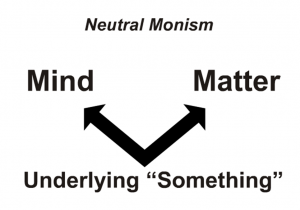
Is there more than matter and mind?Neutral Monism is the position that something which is neither mind nor matter gives rise to both. In my view, Tegmark's mathematical universe and Wheeler's It from Bit qualify. Math and information as the bedrock of reality doesn't seem like either mind or matter. But one could just as well say it's something beyond our comprehension. Maybe Kant's noumena.
I also think that quantum fields are pretty far removed the normal stuff materialism was based on.
-
Nothing to do with Dennett's "Quining Qualia"...eliminative materialism...
Folk suppose that if they can't sensibly talk about qualia then the eliminative materialists have won.
But that ain't so. — Banno
So we don’t eliminate red, but red is not a property of either the objects we see, or the properties used in explanations given for vision. So where does the red come from?
And by red, I mean the color we see, not the word, lest anyone be confused by talk of language. -
How does a naive realist theory of colour explain darkness?So what happens when your visual cortex is stimulated directly, and you have a red visual experience? It is, after all, dark in the brain as you noted.
-
How does a naive realist theory of colour explain darkness?Because there's no color quale intermediary/representation we're aware of instead?
-
Nothing to do with Dennett's "Quining Qualia"Depends on how nuanced we wish to get with language. We are seeing the cat via thermal imaging, but it's not what we normally see. Black cats don't usually look like glowing shades of red.
A question for you: Is the cat really black, or is it reddish? IOW, what makes our normal vision privileged? -
Nothing to do with Dennett's "Quining Qualia"does Odo know what it is like to be a bat? — Banno
Yes, that's it! Changelings would make the best philosophers. They could just morph into whatever and tell us.
I don't recall them ever exploring Odo using non-human senses. I know something he was a piece of furniture or a glass on Quark's tray. -
Nothing to do with Dennett's "Quining Qualia"Apparently, 7 of 9 retained her taste sensations, but they might be enhanced by the Borg nanoprobes.

-
Nothing to do with Dennett's "Quining Qualia"For instance, Locutus was introduced as an individual to give a face to the Borg in assimilating humanity; but why bother, if there already was an individual who could represent the Borg consciousness? — Banno
Uhhh, are we really going to do the thread like this? Okay.
That is a good point. I'm guessing the writers hadn't thought up the Queen yet. And what made humanity so special? Wouldn't they do that for all species? Have one Locutus individual for Romulans, Ferengi, etc?
A better question is, what would it be like for Odo? Do his sensations change as he modifies his form? And can changelings be assimilated? Who would win in a fight between Kirk and Picard?
-
Nothing to do with Dennett's "Quining Qualia"They sure do like to put "red" in front of their red shades.
-
Nothing to do with Dennett's "Quining Qualia"Ideal pink lemonade though ...
I love the Borg. One wonders what it's like to be the Queen (starting at 1:39):
-
Nothing to do with Dennett's "Quining Qualia"The lemonade shade produced mild synesthesia in me, as it trigged a slight lemonade taste/memory.

-
Nothing to do with Dennett's "Quining Qualia"Yes, just a few that stand out enough to be named for their use in paints and web design.

Marchesk

Start FollowingSend a Message
- Other sites we like
- Social media
- Terms of Service
- Sign In
- Created with PlushForums
- © 2026 The Philosophy Forum