
Comments
-
Nothing to do with Dennett's "Quining Qualia"There's not just the "practical contact" experience of light entering the eye, there's also the experience of seeing red. — Luke
Yes, and that experience happens inside the brain. -
Nothing to do with Dennett's "Quining Qualia"An analogy here might be with software that is designed to communicate with some other device on the network. The program could be enhanced to communicate with a virtual device that runs on the same computer as itself, or even as a module within the same program. — Andrew M
Software exists inside some computer system. It's not external to the computer or network. A simulation is a program running inside a computer. We don't interact with software, we interact with computers that run software.
Getting rid of internal/external distinctions doesn't work as long as there are things that have internal and external relationships. It's like saying we shouldn't talk about a movie playing inside a theater because the theater is part of the world!
Dreams are experienced inside brains and nowhere else, because you are asleep. -
Nothing to do with Dennett's "Quining Qualia"But the point of dreams and inner dialog is that it's happening inside your skull. A dream isn't of some event outside the head. An inner dialog is not hearing voices from other people.
-
Nothing to do with Dennett's "Quining Qualia"Hmmm... and if the mind is in part, physical? — creativesoul
Checkmate, Qualiasts? -
Nothing to do with Dennett's "Quining Qualia"Me at times reading this thread:

In deciding the status of emotions, it might help to look at primate studies and see whether a similar range of emotions is seen there. -
Nothing to do with Dennett's "Quining Qualia"Social bonding clearly is not innate, — creativesoul
Nonsense, bonding is found in all sorts of animal species. From parents to mates to social groups. -
Nothing to do with Dennett's "Quining Qualia"What do you think that "something else" could be? — Janus
Kantians would be talking about categories of the mind as they structure experience, and idealists would be talking about ideas. Physical for both is something mental.
It's also true that the physicalist thinks that physical reality (what we are modeling, but not our models though) is "mind-independent". Don't you? Don't you believe there were dinosaurs prior to humans? Or better, since dinosaurs presumably also were minded, don't you believe there were stars and nebulae prior to the dinosaurs? And that those stars and nebulae were physical? — Janus
Yes, but is a physical description exhaustive? We can say the world is physical, but what is meant by that? Does it mean it's only made of the stuff that physicists posit and nothing else? -
Physicalism is False Or CircularI don't think physicalism claims that the physical is abstract. — Janus
It doesn't. But our saying the world is physical is reifying the abstract models (largely mathematical) we have and saying the world is that structure in some sense. For example, Sean Caroll says the wavefunction is a true description of reality, therefore the Many Worlds Interpretation is true. As opposed to it being a useful model. -
Physicalism is False Or CircularOOO is a form of speculative realism where relations exist between all things, not just correlated to humans, and those relations always distort the objects being related. So the objects themselves are more than the relations.
You could fit that on top of physicalism, but it sounds like it's adding something more to things. Might be read as a form of essentialism. -
Physicalism is False Or CircularDoes it mean "spiritual" or "ghostly" or "transcendent"? — Janus
No, it means the natural world is more than the abstract stuff we model it with. Object Oriented Ontology would be another example. So would Aristotle's view of Platonism. -
Nothing to do with Dennett's "Quining Qualia"Something is physical if it, or its effects are detectable. We count something as physical if we can form a causal hypothesis as to its detectable effects. — Janus
That's empirical. A Kantian would agree, while not being a physicalist, for example. So would Berkeley, for that matter.
Physical means mind independent stuff supervening on the fundamental microstructure physicists posit, like particles, forces and fields in a spacetime topology. -
Nothing to do with Dennett's "Quining Qualia"What is property dualism, but merely an acknowledgement that we reify our linguistic concepts and think in dualistic categories. — Janus
You mean perceptual sensations?
If you want to say it's more than that, the next step seems to be metaphysical dualism. — Janus
Property dualism isn't substance dualism. It's just saying that are additional properties beyond the physical. Chalmers has defended a functional property dualism where integrated information has the extra properties of some conscious experience. Which I guess is a form of limited panpsychism. -
Physicalism is False Or CircularBut maybe neurons are more than physical. Physical being an abstract description of them.
-
Nothing to do with Dennett's "Quining Qualia"Metaphysical dualism is plagued by the so-called interaction problem. Physicalism eliminates that problem. — Janus
Yes, but it's not the only thing it eliminates. Also, property dualism and panpsychism don't have an interaction problem.
I'm more in favor of a neutral monism. Nature is something other than merely physical (or mathematical, informational, functional) which includes whatever consciousness is. Something which both (or our understanding/mapping of both) emerges from. -
Nothing to do with Dennett's "Quining Qualia"And there's nothing that says nature must be physical. That's an assumption.
-
Fermi Paradox & The Dark ForestWhy not both? NASA's budget in 2020 is $22.6 billion. The US Federal budget is $4.79 trillion. The European space budget is like $15.2 billion.
I'm not seeing a significant amount of funding going into space exploration. And it tends to pay off in technological advances and scientific discovery. Plus exploration is fundamental part of being human. -
Nothing to do with Dennett's "Quining Qualia"Do 'games' exist despite only having a family resemblance, or do we only commit to 'activities' with 'games' being a functional term, a speech act which achieves some task in context but doesn't refer? — Isaac
What about Dennett's quasi-realism with a focus on patterns underlying emotions or beliefs? -
Nothing to do with Dennett's "Quining Qualia"Assuming the physical exhausts the mental, which i don't believe anyone has successfully shown to be the case.
-
Physicalism is False Or CircularSo to believe in the soul is to be creationist? — Wayfarer
Are there Hindu creationists? -
Nothing to do with Dennett's "Quining Qualia"It is in that colloquial sense that I mean that the person who can't experience fear doesn't know what fear is, I don't mean to say they can't forumalte sentences with the word. — khaled
Or like how a sociopath learns to fake emotion and lie to manipulate people. A sociopath can say they love you and empathize with your situation, while at the same time plotting to empty your bank account.
Here's an intereting Radio Lab podcast on deception. One segment discusses a a pathological liar and how they conned a bunch of people who cared for them.
https://www.wnycstudios.org/podcasts/radiolab/episodes/91612-deception -
Nothing to do with Dennett's "Quining Qualia"How do you make the physical sciences immune from this doubt? — frank
Good question. I would as soon doubt the existence of neuroscience as I would anger. -
Nothing to do with Dennett's "Quining Qualia"if you were Dennett, how would you counter this? — frank
I don't know, maybe the illusion is useful? It was adaptive for creatures to evolve that belief that they were phenomenologically conscious in some real manner. He has used the computer desktop metaphor before in talks about evolution and consciousness. -
Nothing to do with Dennett's "Quining Qualia"When are the elements of a pattern real and not merely apparent? Answering this question will help us resolve the misconceptions that have led to the proliferation of "ontological positions" about beliefs, the different grades or kinds of realism. I shall concentrate on five salient exemplars arrayed in the space of possibilities: Fodor's industrial-strength Realism (he writes it with a capital 'R'); Davidson's regular strength realism; my mild realism; Richard Rorty's milder than-mild irrealism, according to which the pattern is only in the eyes of the beholders, and Paul Churchland's eliminative materialism, which denies the reality of beliefs altogether. — Real Patterns
That is interesting. Could make for it's own thread on forms of realism. But we could apply Dennett's five flavors of realism to qualia as well, and wonder why he's on the Churchland side when it comes to conscious sensations, whereas he's a mild realist about beliefs. -
Nothing to do with Dennett's "Quining Qualia"
ARE there really beliefs? Or are we learning (from neuroscience and psychology, presumably) that, strictly speaking, beliefs are figments of our imagination, items in a superseded ontology? Philosophers generally regard such ontological questions as admitting just two possible answers: either beliefs exist or they do not. There is no such state as quasi existence; there are no stable doctrines of semi realism. Beliefs must either be vindicated along with the viruses or banished along with the banshees. A bracing conviction prevails, then, to the effect that when it comes to beliefs (and other mental items) one must be either a realist or an eliminative materialist. — Real Patterns
I haven't read that paper before. Looks like Dennett will be defending quasi-realism about certian mental content like beliefs. I always wondered what a proper definition for quasi-realism is. -
The flaw in the Chinese Rooma computer possessed information about the state of it's body, and was programmed to engage in behaviors when that information appears in working memory, then how is that any different than what humans do? — Harry Hindu
Depends on whether the computer lacked a subjective experience of pain. -
Is Consciousness an Illusion?What is often used that way? It was a question. Read it again. — Harry Hindu
What you asked. I'm not terribly fond of using computers as a metaphor for brains and minds, as I think it's misleading. But there are some similarities like handling information.
S the brain a metaphor for the mind? — Harry Hindu
No. It's what's responsible for the mind when it's alive. -
Is Consciousness an Illusion?Is the computer a metaphor for how the brain works, or how the mind works? — Harry Hindu
It is often used that way.
What is the relationship between brain and mind? — Harry Hindu
One is three pounds of flesh, and the other has something to do with the resulting subjectivity, intelligence, intentionality and behavior of a person or animal. -
Is Consciousness an Illusion?The solution is to not divide the world into two separate parts - monism. — Harry Hindu
But then you're stuck with explaining everything from that monism. And some things don't fit quite so well. Take information before the evolution of life. What does it mean for a bunch of rocks to be information? Information to whom? -
Nothing to do with Dennett's "Quining Qualia"
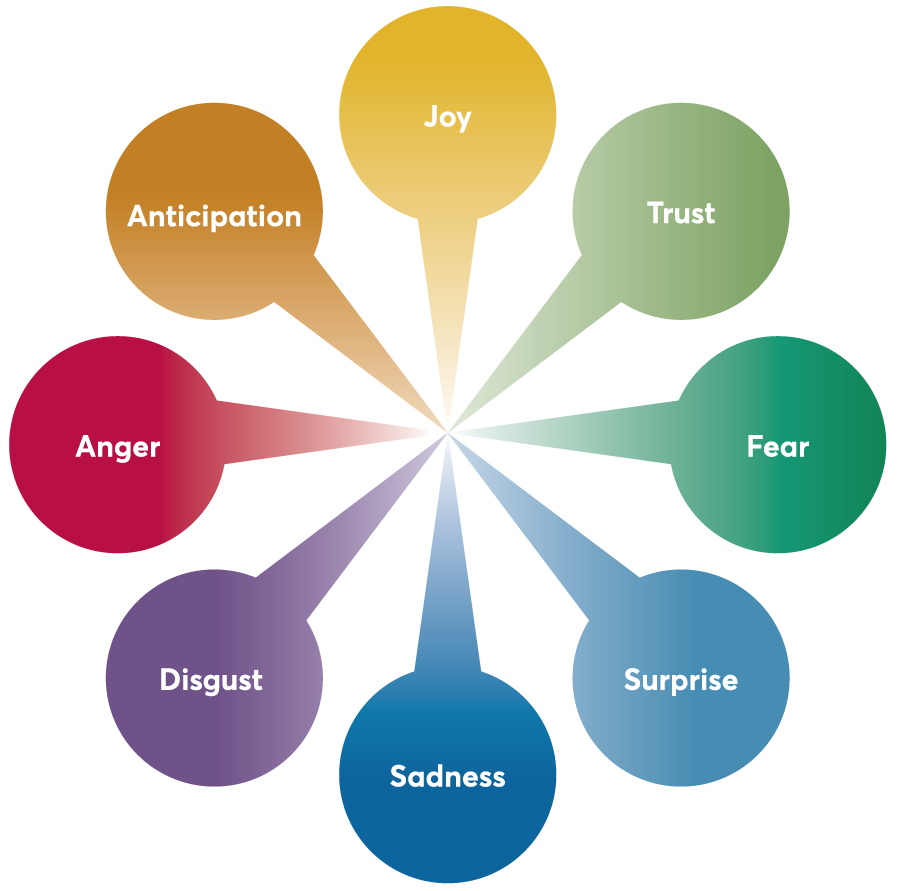
A nice colorful graphic of the eight emotions.
Similarly, in the 1980s, psychologist Robert Plutchik identified eight basic emotions which he grouped into pairs of opposites, including joy and sadness, anger and fear, trust and disgust, and surprise and anticipation. This classification is known as a wheel of emotions and can be compared to a color wheel in that certain emotions mixed together can create new complex emotions.
More recently, a new study from the Institute of Neuroscience and Psychology at the University of Glasgow in 2014 found that instead of six, there may only be four easily recognizable basic emotions. The study discovered that anger and disgust shared similar facial expressions, as did surprise and fear. This suggests that the differences between those emotions are sociologically-based and not biologically-based. Despite all the conflicting research and adaptations, most research acknowledge that there are a set of universal basic emotions with recognizable facial features.
https://online.uwa.edu/news/emotional-psychology/#:~:text=According%20to%20the%20American%20Psychological,situations%20they%20find%20personally%20significant. — The Science Of Emotion: Exploring The Basics Of Emotional Psychology
So there is some evidence for that anger and disgust form a basic emotion which is developed separately by social factors. -
Nothing to do with Dennett's "Quining Qualia"Although anger and aggression can have wide-ranging consequences for social interactions, there is sparse knowledge as to which brain activations underlie the feelings of anger and the regulation of related punishment behaviors. To address these issues, we studied brain activity while participants played an economic interaction paradigm called Inequality Game (IG). The current study confirms that the IG elicits anger through the competitive behavior of an unfair (versus fair) other and promotes punishment behavior. Critically, when participants see the face of the unfair other, self-reported anger is parametrically related to activations in temporal areas and amygdala – regions typically associated with mentalizing and emotion processing, respectively. During anger provocation, activations in the dorsolateral prefrontal cortex, an area important for regulating emotions, predicted the inhibition of later punishment behavior. When participants subsequently engaged in behavioral decisions for the unfair versus fair other, increased activations were observed in regions involved in behavioral adjustment and social cognition, comprising posterior cingulate cortex, temporal cortex, and precuneus. These data point to a distinction of brain activations related to angry feelings and the control of subsequent behavioral choices. Furthermore, they show a contribution of prefrontal control mechanisms during anger provocation to the inhibition of later punishment.
https://www.nature.com/articles/s41598-018-28863-3 — Distinct Brain Areas involved in Anger versus Punishment during Social Interactions
That study by Olga M. Klimecki, David Sander & Patrik Vuilleumier takes anger to be a real emotion with neural correlates and behaviors. -
Nothing to do with Dennett's "Quining Qualia"There's no anger, but there's still these unexplained "feelings" that people continue to call 'anger'? And since neuroscience can find no neural correlate for 'anger' then the feelings must be wrong? Jesus. — Luke
Indeed. What the hell? -
Nothing to do with Dennett's "Quining Qualia"I'm left with the impression that you and I both hold that fear is the only innate emotion. — creativesoul
What about love and social bonding??? -
Nothing to do with Dennett's "Quining Qualia"As I said to Khaled, if you're of the former persuasion, there's no point in us talking (there's no point in talking to anyone). If you're just going to assume that the way things seem to you to be is the way they actually are regardless of any evidence to the contrary, then there's no point in seeking other views is there? — Isaac
When it comes to denying emotions like anger, then yeah I'm going to have to strongly object. But thanks for answering my questions in detail. -
Nothing to do with Dennett's "Quining Qualia"No need to talk in terms of "qualia" or "quale". — creativesoul
I'm still worried about the coffee being bitter. One would think Banno could do better.
But then again, maybe Banno likes bitter tasting coffee. I like cauliflower. Dennett finds it repugnant.
I have a feeling that if we quined the relevant qualia, we could add cauliflower to the coffee, and nobody would object. -
Nothing to do with Dennett's "Quining Qualia"The content of the conscious experience is the content of the correlations... that includes both internal things and external things, however the correlation drawn between those things is neither for it consists of both. — creativesoul
That's not half bad. -
Nothing to do with Dennett's "Quining Qualia"I'd also add questions about non-perceptual experiences and how those avoid some sort of movie in the head. Dreams being the number one concern, but things like inner dialog sound like a stream of consciousness podcast is running in your skull. Or when a song gets "stuck in your mind".
-
Nothing to do with Dennett's "Quining Qualia"'ve already answered the question of what all conscious experience consists of. Meaningful correlations drawn between different things. — creativesoul
But those meaningful correlations might include the coffee being bitter when you drink it and the cat being black on a white mat when you see it over in the corner. -
Nothing to do with Dennett's "Quining Qualia"I mean draw correlations between different things. — creativesoul
So our conscious experience consists of relations we notice in the world between things like coffee drinking and cats on mats. The tastes and colors are relational properties, then. -
Nothing to do with Dennett's "Quining Qualia"hey are meaningful correlations drawn between different things. — creativesoul
And by attribute meaning, do you mean we project these correlations onto the world? We're conscious of correlations we draw among cats and mats? -
Is Consciousness an Illusion?If there is no internal world, why don’t you see what other people think? They don’t really think? You’re a solipsist? — leo
Reminds me of the aliens in Liu Cixin's Three Body Problem trilogy. Their thoughts are always visible to one another as patterns of lights which was the result of their neural activity. They communicate directly in that sense. Which means they can only engage in primitive forms of deception when separated by enough distance. When they figure out how deceptive humans can be, they become afraid of us.
Marchesk

Start FollowingSend a Message
- Other sites we like
- Social media
- Terms of Service
- Sign In
- Created with PlushForums
- © 2026 The Philosophy Forum